
Introducing Phonics Early Reading Segmenting Blending e m
Introducing Phonics & Early Reading
Segmenting & Blending e m e n Pho e m Fra
Sound Buttons • Press to hear the phoneme mat pop
Segmenting & Blending tap

Welcome to Year R Please complete the transition questionnaire on your seat. Thank you
Reading Ø Reading Books – Pictures to words - Understanding, language, questioning, predictions Ø Recording in Reading Record Book - Read as much as you want but we only need 5 times per week recorded, we will check for this on Friday, any books can be read (bedtime stories). Ø We won’t change the book until it has been read at least once and you have commented in the book.
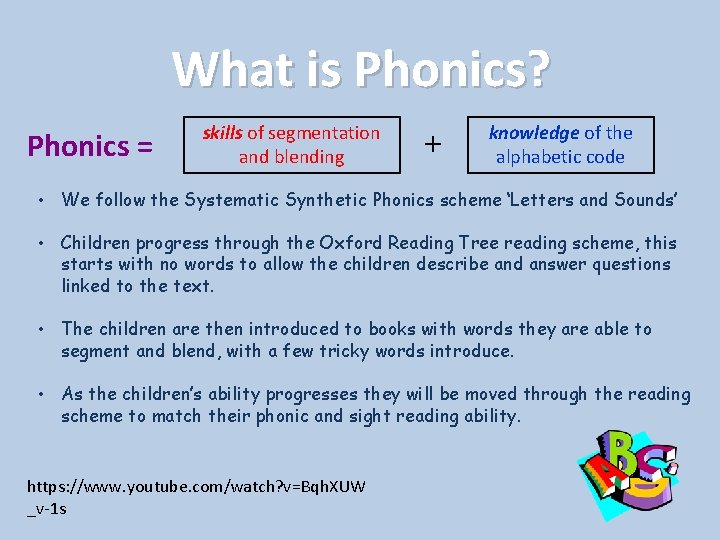
What is Phonics? Phonics = skills of segmentation and blending + knowledge of the alphabetic code • We follow the Systematic Synthetic Phonics scheme ‘Letters and Sounds’ • Children progress through the Oxford Reading Tree reading scheme, this starts with no words to allow the children describe and answer questions linked to the text. • The children are then introduced to books with words they are able to segment and blend, with a few tricky words introduce. • As the children’s ability progresses they will be moved through the reading scheme to match their phonic and sight reading ability. https: //www. youtube. com/watch? v=Bqh. XUW _v-1 s
6 Phases of Phonics • There are 6 phases to the teaching of phonics • These are expected to be covered by the end of Year 2, but these phases can continue throughout KS 2. • Phases 1 – 4 are expected be taught to the children in Foundation Stage • Phase 5 in Year 1 • Phase 6 in Year 2
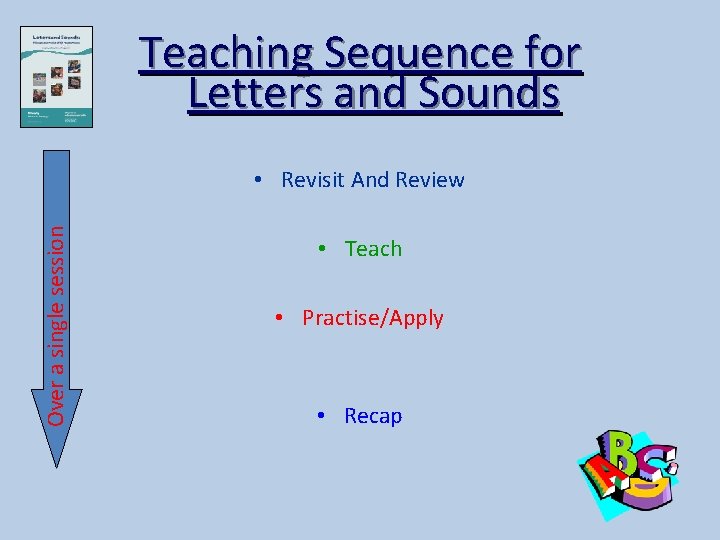
Teaching Sequence for Letters and Sounds Over a single session • Revisit And Review • Teach • Practise/Apply • Recap
Phase 1 • No correspondence between how a letter is written and the letter sound • Phase 1 doesn’t have a discrete end – it continues throughout the year groups • Mainly focuses on environmental and instrumental sound discrimination through games and songs. • Children are encouraged to orally segment and blend.
Phase 2 (usually 6 weeks) Aim is to: • Teach at least 19 letters in a set order, to enable making words as early as possible • Move on from oral segmenting and blending to blending and segmenting with letters. • Read some VC and CVC words and spell them
Aim is to: Phase 3 (usually up to 12 weeks) • Teach another 25 graphemes, most of them comprising of 2 letters e. g. oa • Continue to practise CVC blending and segmenting • Apply this knowledge to reading and spelling simple 2 syllable words and captions • Learn letter names • Read and spell some more tricky words e. g. I, she, me, we, be, was, you, my, they, her, all, are
Phase 4 Aim is to: (usually 4 -6 weeks) • Consolidate children’s knowledge of graphemes in reading and spelling words containing adjacent consonants (CVCC and CCVC words) and polysyllabic words. • Teach tricky words e. g. said, so, have, like, some, come, were, there, little, one, do, when, out, what
Phonics • Correct pronunciation – pure sounds no ‘er’ See - https: //www. youtube. com/watch? v=Iw. Jx 1 NSine. E • Correct vocabulary • We all need to use the same language at home and at school. • Little and often is the key. Does not have to be formal. • Link it to your child’s interests.
Phoneme • The smallest unit of sound in a word. • There are 44 phonemes that we teach.
Grapheme • Letters representing a phoneme e. g. ay ai a Children need to practise recognising the grapheme and saying the phoneme that it represents.
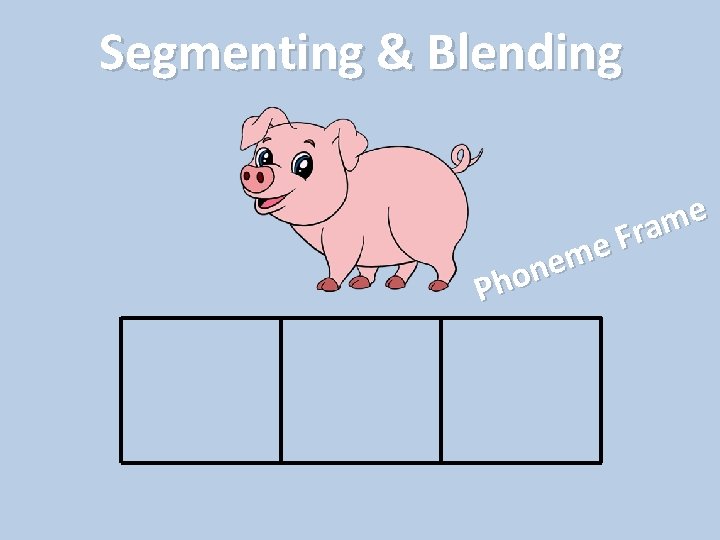
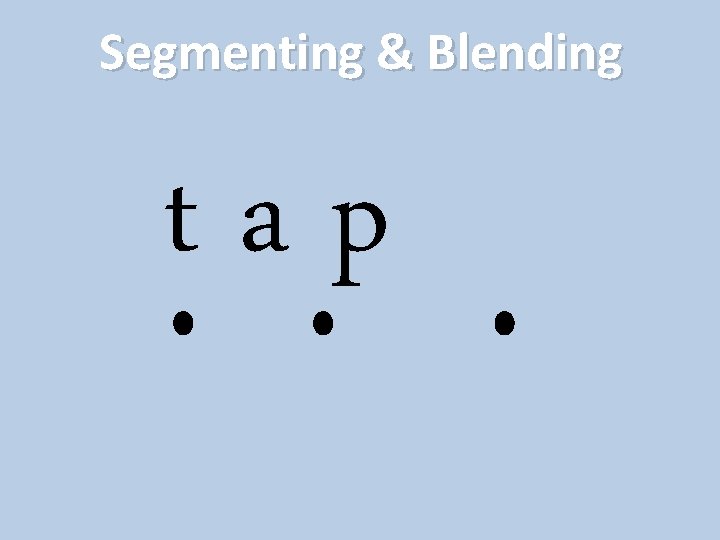
Segmenting & Blending • Recognising the letter sounds in a written word by chopping them up (Segmenting), for example c u p Merging or ‘blending’ them in the order in which they are written to pronounce the word ‘cup’. • Robot Arms
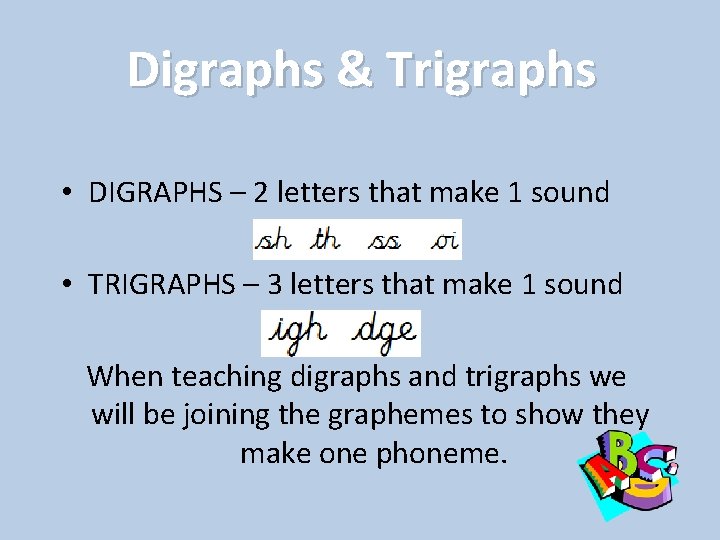
Digraphs & Trigraphs • DIGRAPHS – 2 letters that make 1 sound • TRIGRAPHS – 3 letters that make 1 sound When teaching digraphs and trigraphs we will be joining the graphemes to show they make one phoneme.
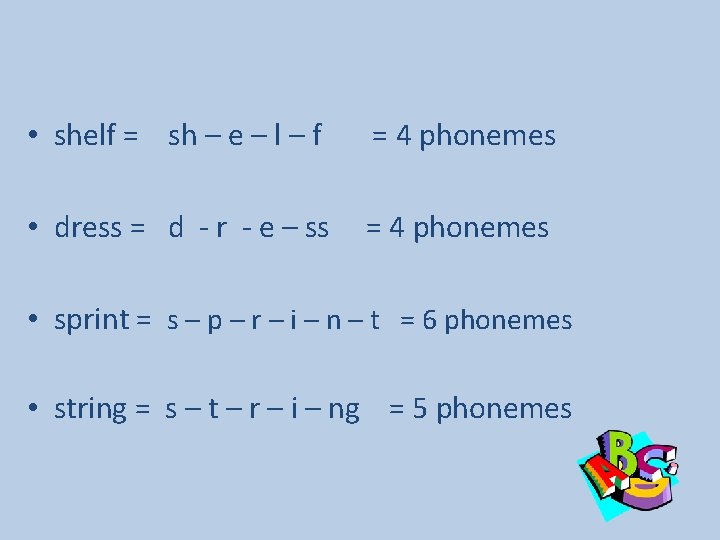
• shelf = sh – e – l – f = 4 phonemes • dress = d - r - e – ss = 4 phonemes • sprint = s – p – r – i – n – t = 6 phonemes • string = s – t – r – i – ng = 5 phonemes
Real & Alien Words • drep • blom • gris • drop
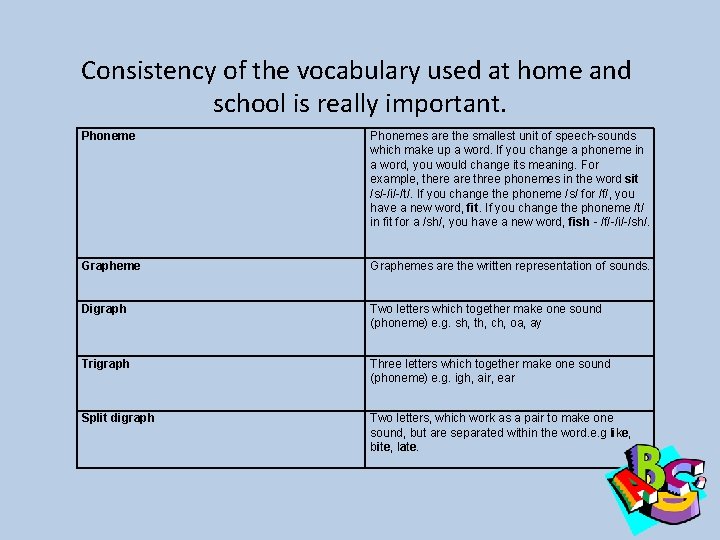
Consistency of the vocabulary used at home and school is really important. Phonemes are the smallest unit of speech-sounds which make up a word. If you change a phoneme in a word, you would change its meaning. For example, there are three phonemes in the word sit /s/-/i/-/t/. If you change the phoneme /s/ for /f/, you have a new word, fit. If you change the phoneme /t/ in fit for a /sh/, you have a new word, fish - /f/-/i/-/sh/. Graphemes are the written representation of sounds. Digraph Two letters which together make one sound (phoneme) e. g. sh, th, ch, oa, ay Trigraph Three letters which together make one sound (phoneme) e. g. igh, air, ear Split digraph Two letters, which work as a pair to make one sound, but are separated within the word. e. g like, bite, late.
Tricky Words • Words that are not phonically decodeable • e. g. was, the, I • Some are ‘tricky’ to start with but will become decodeable once we have learned the harder phonemes • e. g. out, there, mother
How can you help? • Segment words e. g. g-e-t d-r-e-ss-e-d • When writing, try not to correct your child’s spelling. In Reception we ask for the writing to be phonetically plausible. It is their attempt at writing. Spelling patterns will be taught in year one, plus the more they read the more they will recognise correct spellings. • Phonics games – ask them the tell you the first/last sound in objects around the house, make words using sound cards • Sounds Books
Useful websites • www. parentsintouch. co. uk • www. bbc. co. uk/schools/parents • www. jollylearning. co. uk/ • www. focusonphonics. co. uk/ • www. syntheticphonics. com
- Slides: 24