
Introducing Performance Measures 1 Learning Objectives What constitutes
Introducing Performance Measures 1
Learning Objectives • What constitutes a “good” measure • Understanding performance measurement requirement as defined by HAB 2

HAB Guidelines • Click here to access Policy Clarification Notice 15 -02; it details HAB’s expectations for a robust clinical quality management program
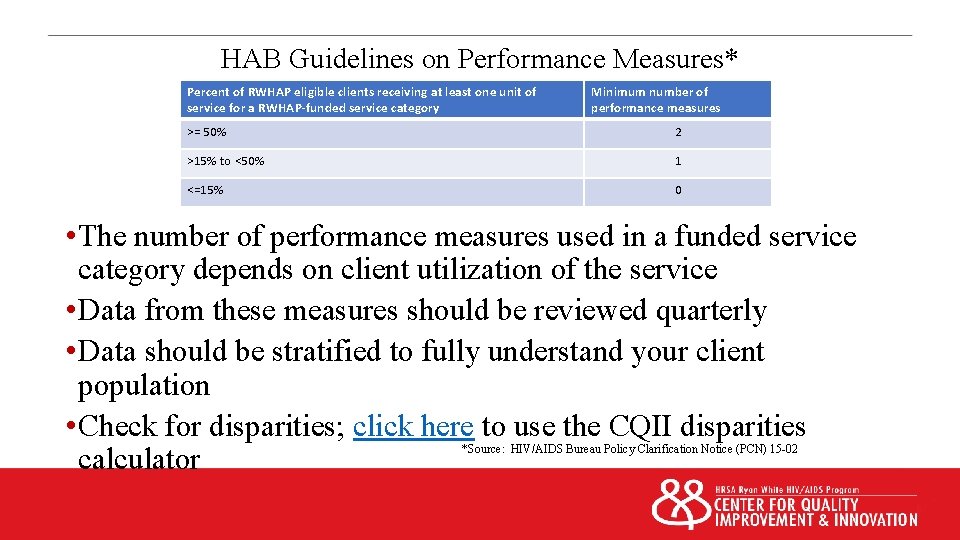
HAB Guidelines on Performance Measures* Percent of RWHAP eligible clients receiving at least one unit of service for a RWHAP-funded service category Minimum number of performance measures >= 50% 2 >15% to <50% 1 <=15% 0 • The number of performance measures used in a funded service category depends on client utilization of the service • Data from these measures should be reviewed quarterly • Data should be stratified to fully understand your client population • Check for disparities; click here to use the CQII disparities calculator *Source: HIV/AIDS Bureau Policy Clarification Notice (PCN) 15 -02
What Exactly Is a Measure? • A measure collects information such as: • Viral supression • Amount of time it takes to pay an invoice • A measure has many an alias • Key performance indicators • Indicator (also trailing or leading) • There are two basic types of measures • Process • Outcome 5
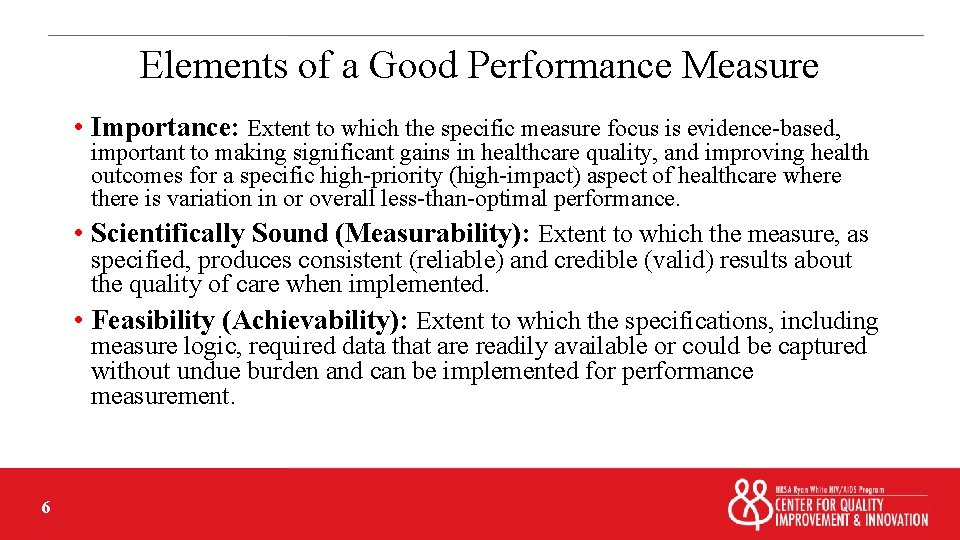
Elements of a Good Performance Measure • Importance: Extent to which the specific measure focus is evidence-based, important to making significant gains in healthcare quality, and improving health outcomes for a specific high-priority (high-impact) aspect of healthcare where there is variation in or overall less-than-optimal performance. • Scientifically Sound (Measurability): Extent to which the measure, as specified, produces consistent (reliable) and credible (valid) results about the quality of care when implemented. • Feasibility (Achievability): Extent to which the specifications, including measure logic, required data that are readily available or could be captured without undue burden and can be implemented for performance measurement. 6
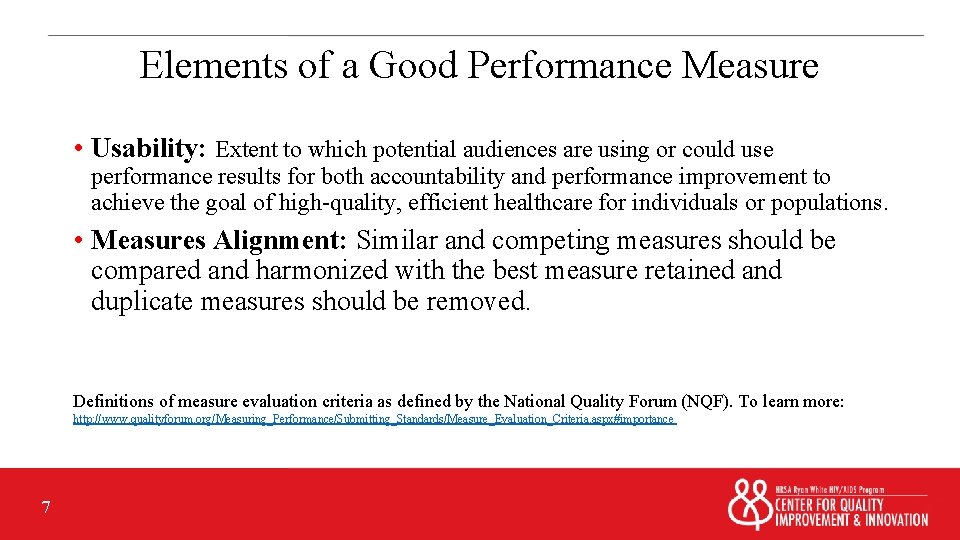
Elements of a Good Performance Measure • Usability: Extent to which potential audiences are using or could use performance results for both accountability and performance improvement to achieve the goal of high-quality, efficient healthcare for individuals or populations. • Measures Alignment: Similar and competing measures should be compared and harmonized with the best measure retained and duplicate measures should be removed. Definitions of measure evaluation criteria as defined by the National Quality Forum (NQF). To learn more: http: //www. qualityforum. org/Measuring_Performance/Submitting_Standards/Measure_Evaluation_Criteria. aspx#importance 7
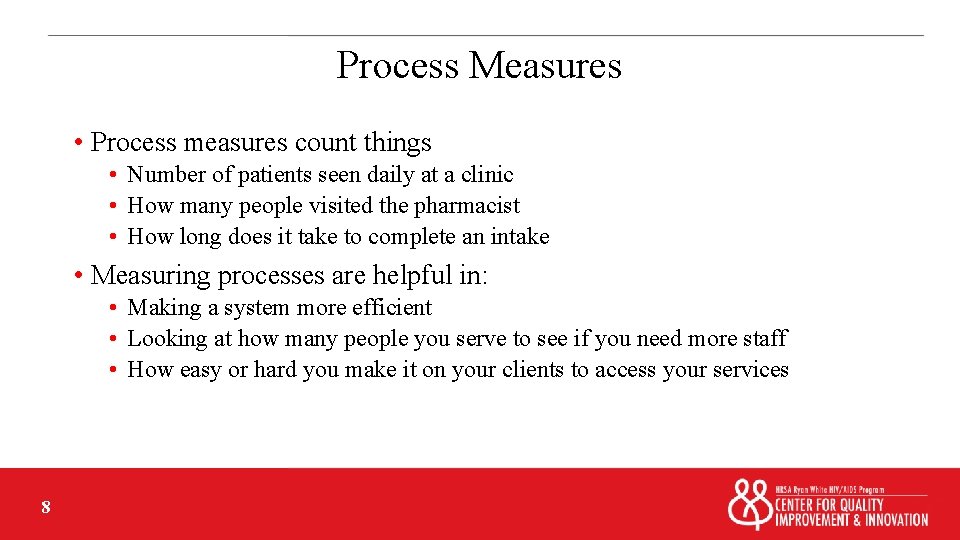
Process Measures • Process measures count things • Number of patients seen daily at a clinic • How many people visited the pharmacist • How long does it take to complete an intake • Measuring processes are helpful in: • Making a system more efficient • Looking at how many people you serve to see if you need more staff • How easy or hard you make it on your clients to access your services 8
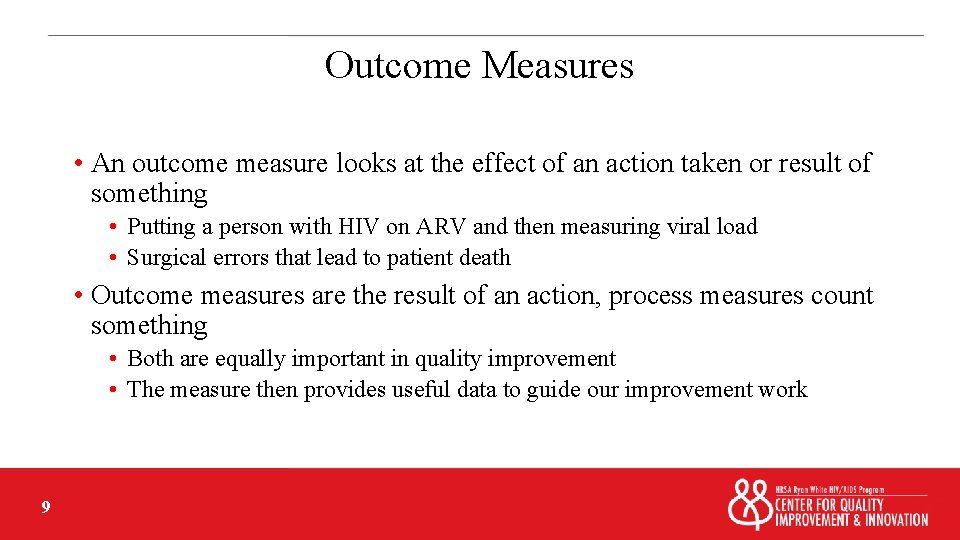
Outcome Measures • An outcome measure looks at the effect of an action taken or result of something • Putting a person with HIV on ARV and then measuring viral load • Surgical errors that lead to patient death • Outcome measures are the result of an action, process measures count something • Both are equally important in quality improvement • The measure then provides useful data to guide our improvement work 9
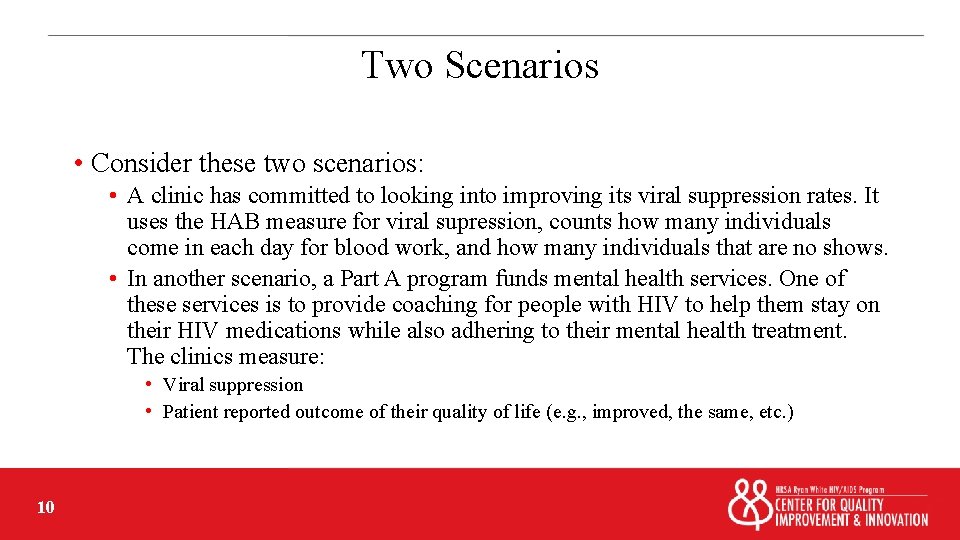
Two Scenarios • Consider these two scenarios: • A clinic has committed to looking into improving its viral suppression rates. It uses the HAB measure for viral supression, counts how many individuals come in each day for blood work, and how many individuals that are no shows. • In another scenario, a Part A program funds mental health services. One of these services is to provide coaching for people with HIV to help them stay on their HIV medications while also adhering to their mental health treatment. The clinics measure: • Viral suppression • Patient reported outcome of their quality of life (e. g. , improved, the same, etc. ) 10
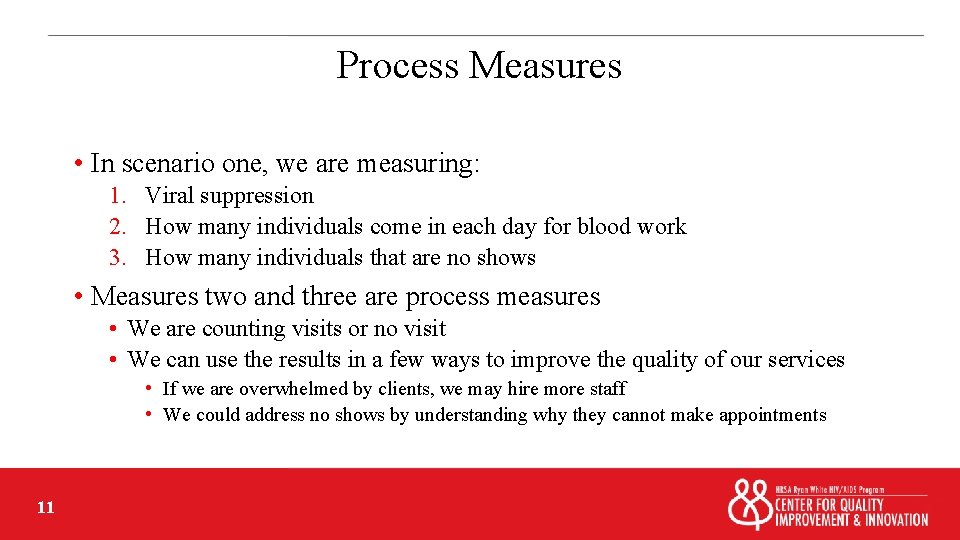
Process Measures • In scenario one, we are measuring: 1. Viral suppression 2. How many individuals come in each day for blood work 3. How many individuals that are no shows • Measures two and three are process measures • We are counting visits or no visit • We can use the results in a few ways to improve the quality of our services • If we are overwhelmed by clients, we may hire more staff • We could address no shows by understanding why they cannot make appointments 11
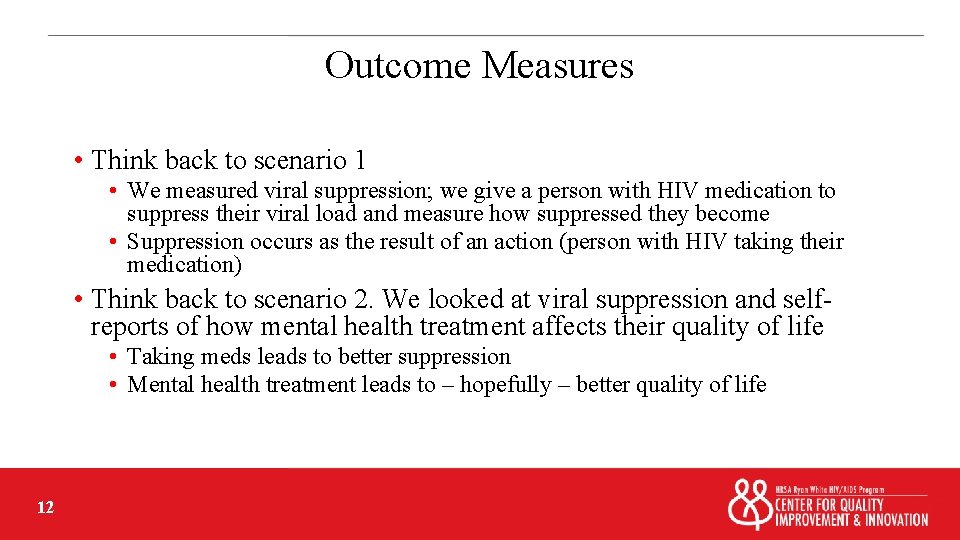
Outcome Measures • Think back to scenario 1 • We measured viral suppression; we give a person with HIV medication to suppress their viral load and measure how suppressed they become • Suppression occurs as the result of an action (person with HIV taking their medication) • Think back to scenario 2. We looked at viral suppression and selfreports of how mental health treatment affects their quality of life • Taking meds leads to better suppression • Mental health treatment leads to – hopefully – better quality of life 12
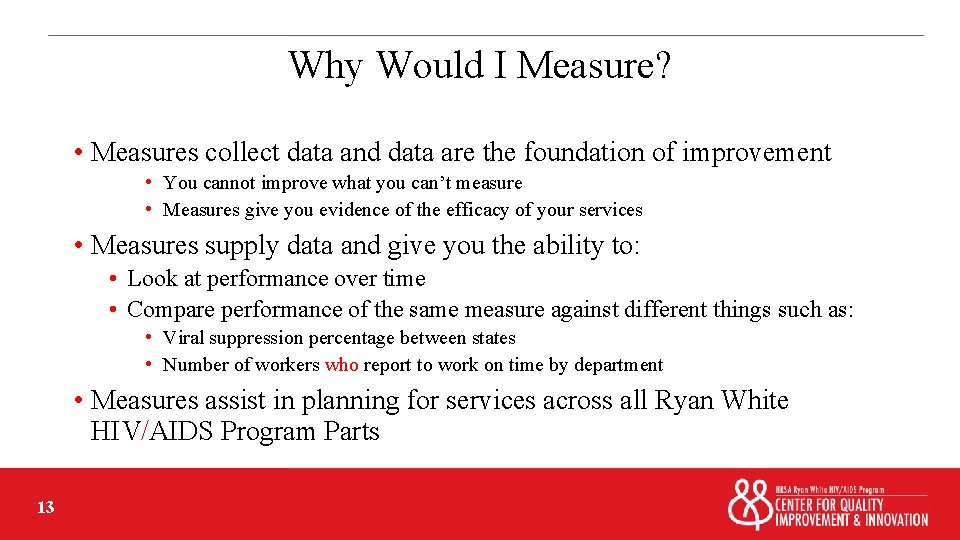
Why Would I Measure? • Measures collect data and data are the foundation of improvement • You cannot improve what you can’t measure • Measures give you evidence of the efficacy of your services • Measures supply data and give you the ability to: • Look at performance over time • Compare performance of the same measure against different things such as: • Viral suppression percentage between states • Number of workers who report to work on time by department • Measures assist in planning for services across all Ryan White HIV/AIDS Program Parts 13
Do I Build a Measure or Use Existing Ones? • HAB suggests that you use the HAB measures and/or nationally endorsed measures • The National Quality Forum (Qualityforum. org) considered the gold standard for health care measures • National Committee for Quality Assurance (NCQA. org) has a set of core measures including ones for HIV and Hepatitis • HAB also suggests that the HAB measures can be modified to meet local needs 14
Do I Build a Measure or Use Existing Ones? • If you need to build a measure, refer back to the Elements of a Good Measure slides • Always define the population you want to measure, such as: • Men who have sex with men who are between 35 and 50 • Youth, 13 -24, who self identify as male or female, who engage in unprotected sex • Consider having a time frame if applicable, such as: • Individuals who have had an office visit in the first six months of the year • People with HIV who have had their blood tested in January, June, and October 15 • If you are building a measure, consider any evidence in the literature to support your measure
Do I Build a Measure or Use Existing Ones? The end game of measurement is to collect the data necessary to ensure that the care you provide has optimal outcomes for people with HIV 16
What Tools Can I Use with Data? • Literally dozens of tools are available • Go to ASQ. org • Purchase The Memory Jogger • Tools should be chosen based on the data you’re collecting and what you want to learn • Do you want to examine performance over time? • Is there a perceived problem with a process? • Don’t overcomplicate; select the tool that best shows your message • Run charts show viral suppression rates over time • Pie charts show different pieces make a whole • Flowcharts map out how a process flows and produces a result 17
Properties On passing, 'Finish' button: Goes to next slide On failing, 'Finish' button: Goes to next slide Allow user to leave quiz: After user has completed quiz User may view slides after quiz: Any time Show quiz in menu as: Edit in Quizmaker Multiple Items Edit Properties
Resources for Measures • HAB Performance Measure Portfolio https: //hab. hrsa. gov/clinical-quality-management/performance-measure-portfolio • National Quality Forum http: //www. qualityforum. org/Home. aspx 19
- Slides: 19