
Introducing new language structures vocabulary and grammar Methods

Introducing new language structures (vocabulary and grammar) Methods of English Language Teaching II/4 English majors Ferenc Rákóczi II Transcarpathian Hungarian College of Higher Education Tutor: Ilona Huszti, Ph. D
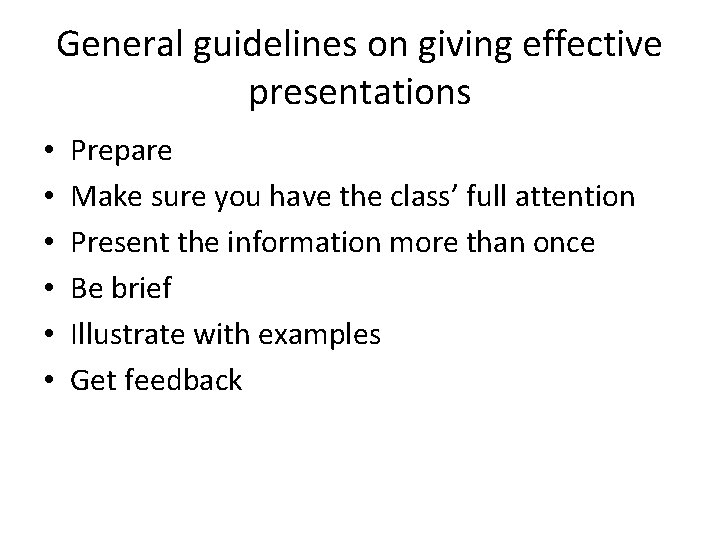
General guidelines on giving effective presentations • • • Prepare Make sure you have the class’ full attention Present the information more than once Be brief Illustrate with examples Get feedback
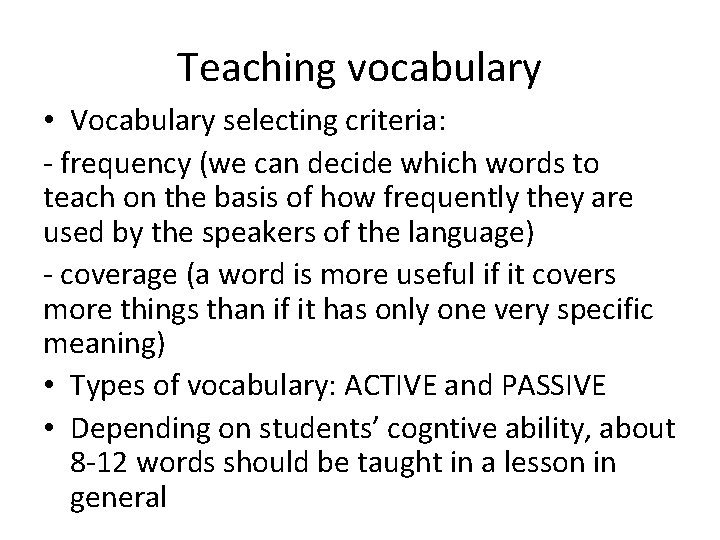
Teaching vocabulary • Vocabulary selecting criteria: - frequency (we can decide which words to teach on the basis of how frequently they are used by the speakers of the language) - coverage (a word is more useful if it covers more things than if it has only one very specific meaning) • Types of vocabulary: ACTIVE and PASSIVE • Depending on students’ cogntive ability, about 8 -12 words should be taught in a lesson in general
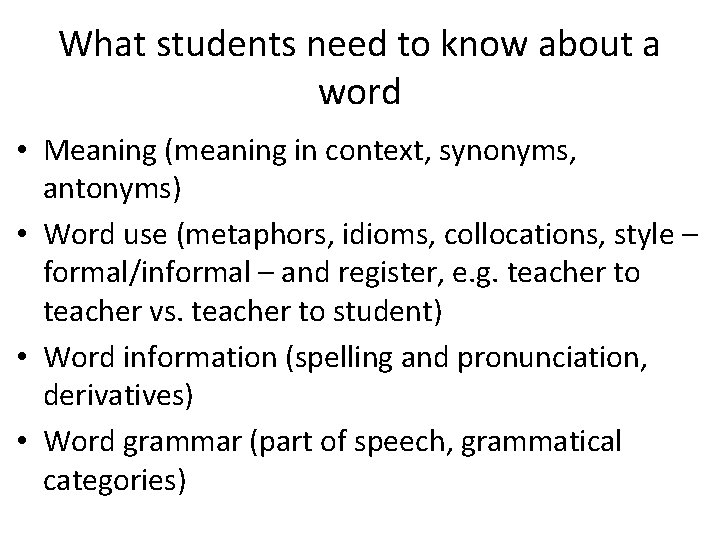
What students need to know about a word • Meaning (meaning in context, synonyms, antonyms) • Word use (metaphors, idioms, collocations, style – formal/informal – and register, e. g. teacher to teacher vs. teacher to student) • Word information (spelling and pronunciation, derivatives) • Word grammar (part of speech, grammatical categories)
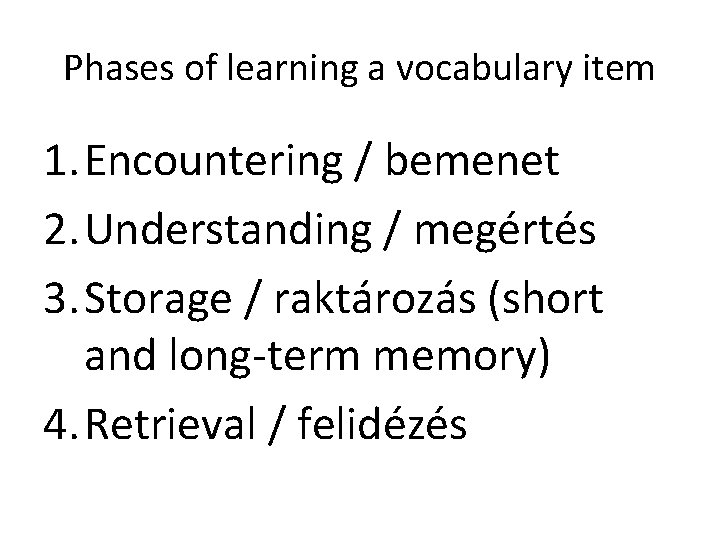
Phases of learning a vocabulary item 1. Encountering / bemenet 2. Understanding / megértés 3. Storage / raktározás (short and long-term memory) 4. Retrieval / felidézés
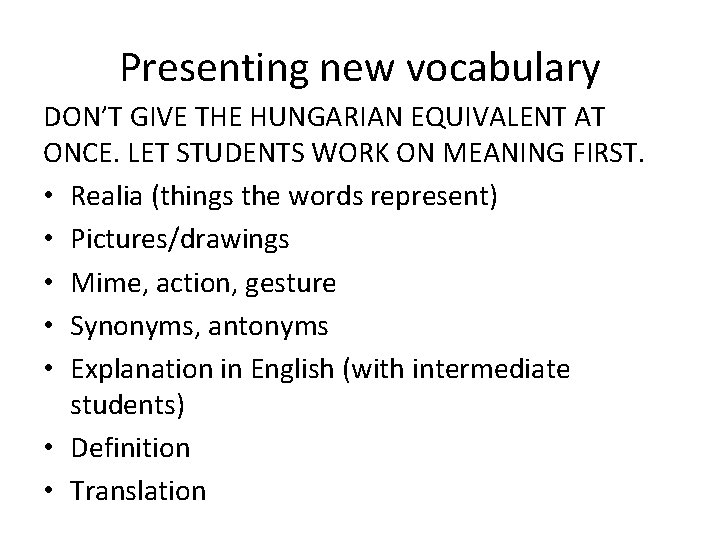
Presenting new vocabulary DON’T GIVE THE HUNGARIAN EQUIVALENT AT ONCE. LET STUDENTS WORK ON MEANING FIRST. • Realia (things the words represent) • Pictures/drawings • Mime, action, gesture • Synonyms, antonyms • Explanation in English (with intermediate students) • Definition • Translation
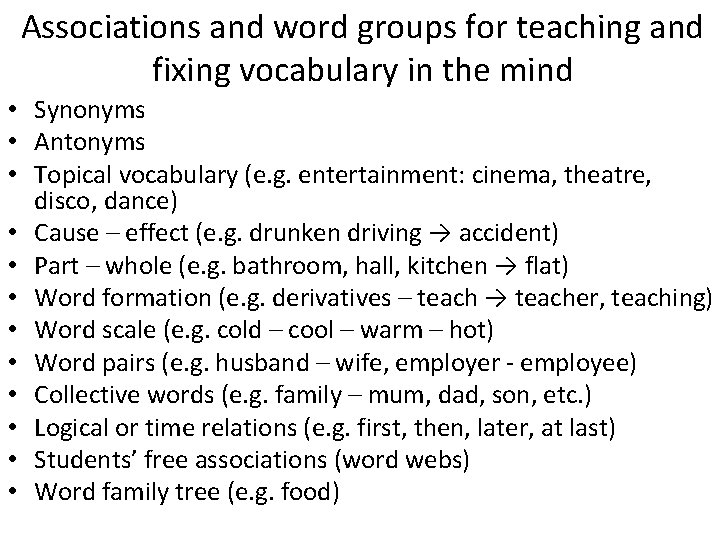
Associations and word groups for teaching and fixing vocabulary in the mind • Synonyms • Antonyms • Topical vocabulary (e. g. entertainment: cinema, theatre, disco, dance) • Cause – effect (e. g. drunken driving → accident) • Part – whole (e. g. bathroom, hall, kitchen → flat) • Word formation (e. g. derivatives – teach → teacher, teaching) • Word scale (e. g. cold – cool – warm – hot) • Word pairs (e. g. husband – wife, employer - employee) • Collective words (e. g. family – mum, dad, son, etc. ) • Logical or time relations (e. g. first, then, later, at last) • Students’ free associations (word webs) • Word family tree (e. g. food)

NOTA BENE! WORDS AND PHRASES WILL BE FIXED IN MIND ONLY BY FREQUENT PRACTICE AND USAGE. ONE EXPLANATION IS NOT ENOUGH BECAUSE UNUSED WORDS WILL BE SOON FORGOTTEN.
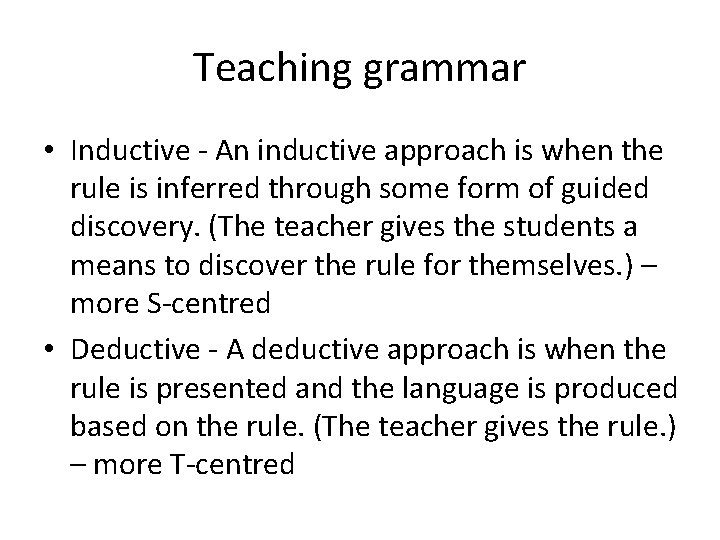
Teaching grammar • Inductive - An inductive approach is when the rule is inferred through some form of guided discovery. (The teacher gives the students a means to discover the rule for themselves. ) – more S-centred • Deductive - A deductive approach is when the rule is presented and the language is produced based on the rule. (The teacher gives the rule. ) – more T-centred
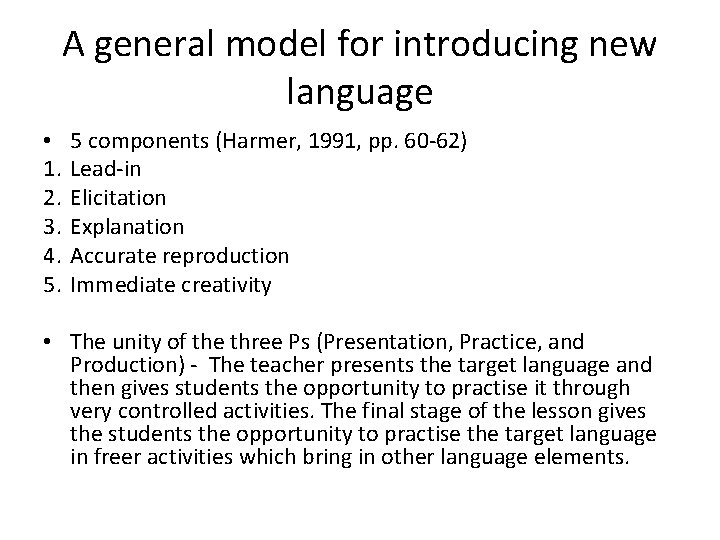
A general model for introducing new language • 1. 2. 3. 4. 5. 5 components (Harmer, 1991, pp. 60 -62) Lead-in Elicitation Explanation Accurate reproduction Immediate creativity • The unity of the three Ps (Presentation, Practice, and Production) - The teacher presents the target language and then gives students the opportunity to practise it through very controlled activities. The final stage of the lesson gives the students the opportunity to practise the target language in freer activities which bring in other language elements.
Three popular grammar practice activities • Change places if … • Find someone who … • Noughts and crosses https: //www. teachingenglish. org. uk/sites/teach eng/files/B 127 c%20 A 1%20 TE%20 Staff%20 Roo m%20 Posters%201. pdf
- Slides: 11