
Introducing i CM Leveraging Tableau for Curriculum Mapping

Introducing i. CM: Leveraging Tableau for Curriculum Mapping By: Pasha Hammond and Huda Sarraj from the University of Houston College of Technology
What is Curriculum Mapping ■ Defined as creating connections between learning outcomes and courses in an academic program. ■ Traditionally aimed at accreditation standards ■ When used well can foster a better understanding of the topics and skills covered throughout a program
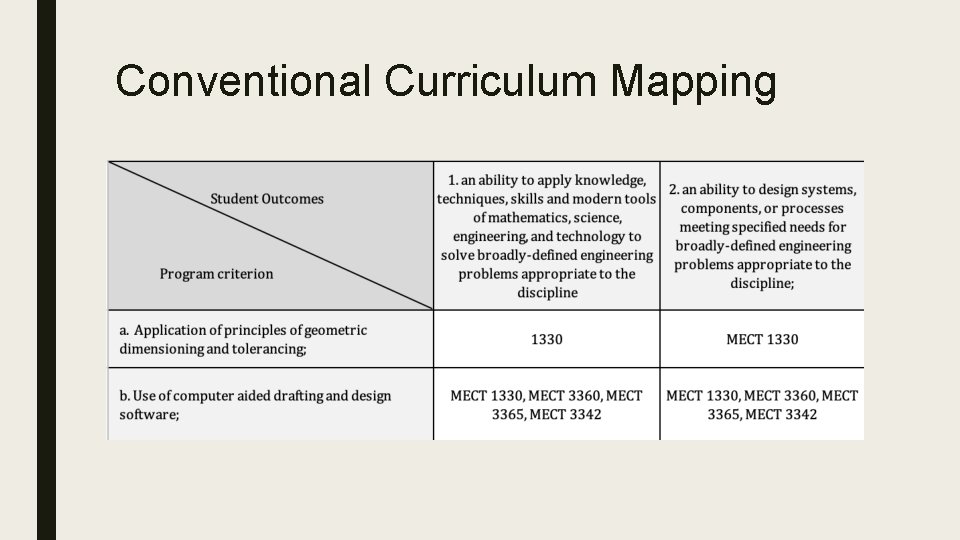
Conventional Curriculum Mapping ■ Usually made as tables ■ Have a number of issues however ■ Struggle to show all relevant information in a clear manner ■ Limited on the amount of basic, additional information that can be communicated e. g. course description, name, and prerequisites

Conventional Curriculum Mapping
Conventional Curriculum Mapping
Conventional Curriculum Mapping ■ Primary issue is that formats tend to obfuscate a lot of relevant information. ■ Difficult to read at first glance ■ Static visualizations make it difficult to extract the underling information if it is needed.

Improving how we store the data ■ Most important step is understanding that the important data points are not classes that fulfill an outcome OR outcomes a class develops. ■ The intersection of each class and outcome is the simplest form of the data. ■ What does this look like.
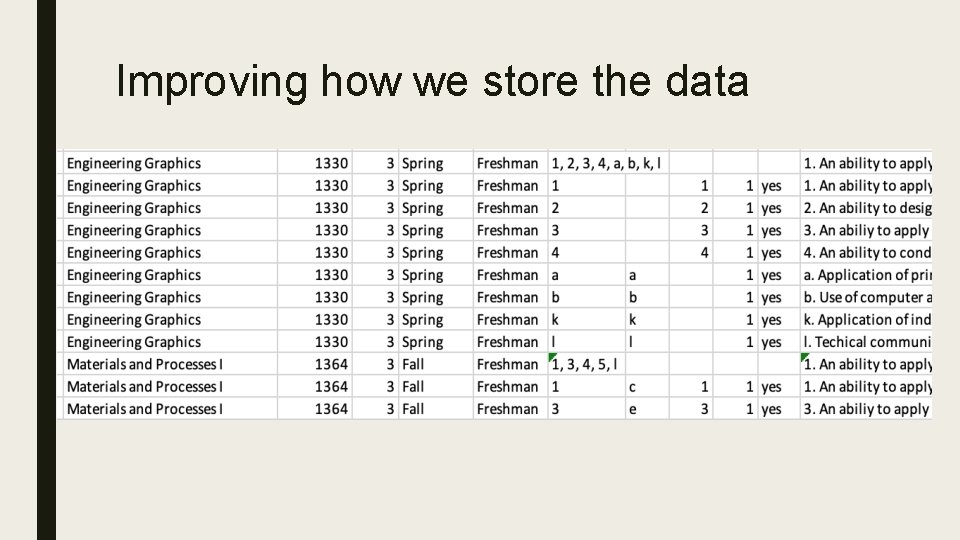
Improving how we store the data
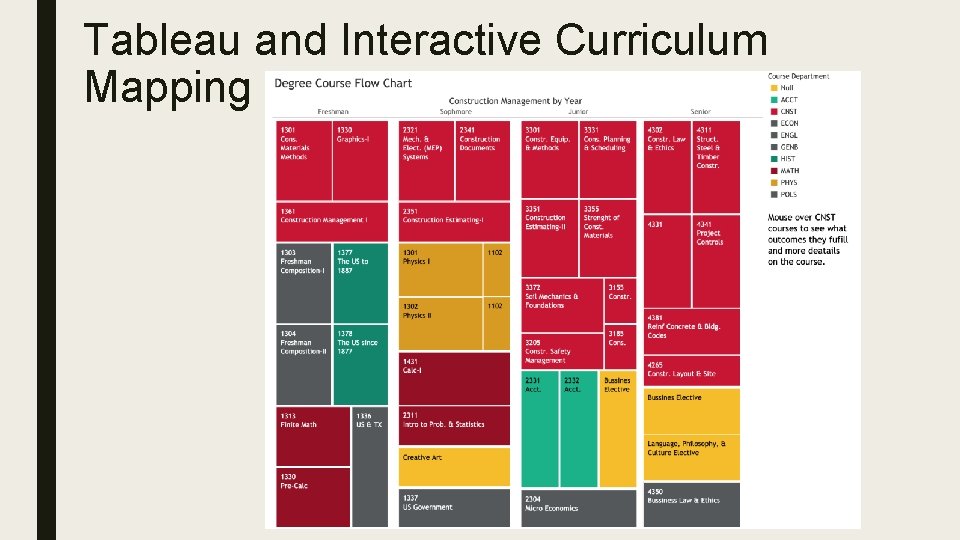
Tableau and Interactive Curriculum Mapping
Tableau and Interactive Curriculum Mapping
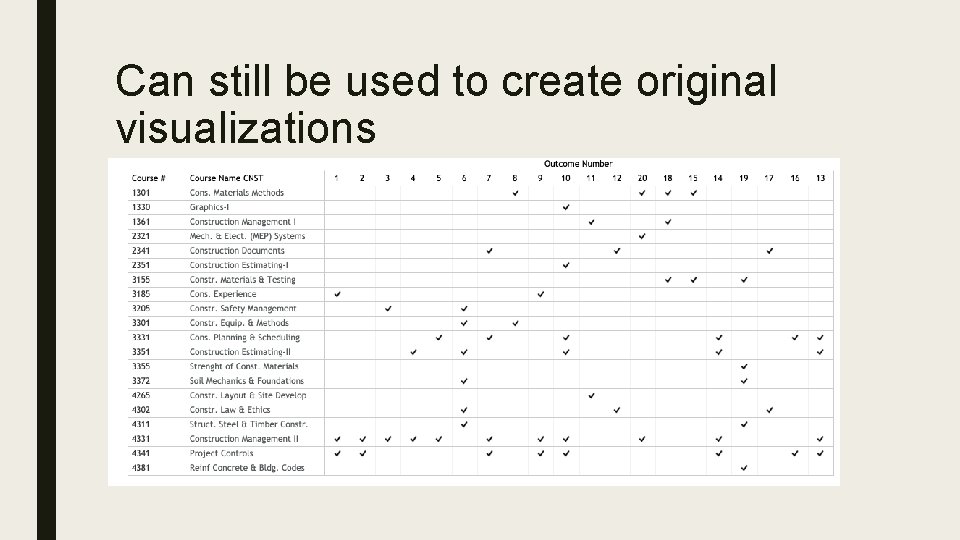
Can still be used to create original visualizations
Benefits and Future Opportunities ■ Updating the mapping and the data set that supports it is easy ■ Works as a one stop visualization instead of managing multiple documents or windows ■ Can be used to improve upon classic degree flow charts. ■ Workbooks can be designed with internal logic to be used by advisors or individual students to

Thank You For Your Time
- Slides: 13