
Introducing Content What is Scopus content Scopus author







- Slides: 34
Introducing
Content What is Scopus content Scopus author profiles Appendix: research metrics Further resources 05. 09. 2021
What is Scopus
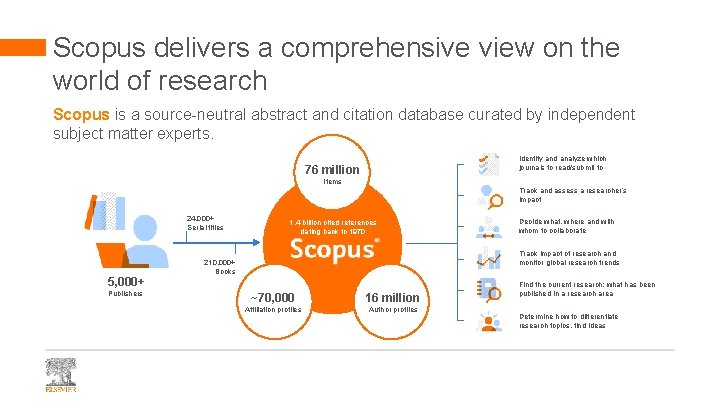
Scopus delivers a comprehensive view on the world of research Scopus is a source-neutral abstract and citation database curated by independent subject matter experts. Identify and analyze which journals to read/submit to 76 million Items Track and assess a researcher’s impact 24, 000+ Serial titles 5, 000+ Publishers 1. 4 billion cited references dating back to 1970 Decide what, where and with whom to collaborate Track impact of research and monitor global research trends 210, 000+ Books ~70, 000 16 million Affiliation profiles Author profiles Find the current research; what has been published in a research area Determine how to differentiate research topics, find ideas
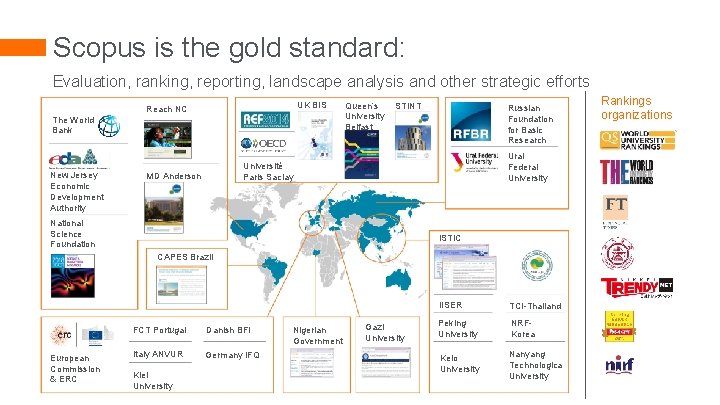
Scopus is the gold standard: Evaluation, ranking, reporting, landscape analysis and other strategic efforts v UK BIS Reach NC The World Bank New Jersey Economic Development Authority Queen’s University Belfast STINT Russian Foundation for Basic Research Ural Federal University Université Paris Saclay MD Anderson National Science Foundation ISTIC CAPES Brazil European Commission & ERC FCT Portugal Danish BFI Italy ANVUR Germany IFQ Kiel University Nigerian Government Gazi University IISER TCI-Thailand Peking University NRFKorea Keio University Nanyang Technologica University Rankings organizations
Scopus content
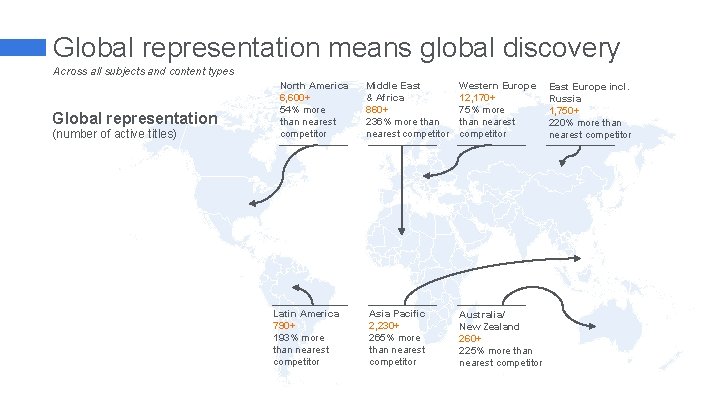
Global representation means global discovery Across all subjects and content types Global representation (number of active titles) North America 6, 600+ 54% more than nearest competitor Latin America 790+ 193% more than nearest competitor Middle East & Africa 860+ 236% more than nearest competitor Asia Pacific 2, 230+ 265% more than nearest competitor Western Europe 12, 170+ 75% more than nearest competitor Australia/ New Zealand 260+ 225% more than nearest competitor East Europe incl. Russia 1, 750+ 220% more than nearest competitor
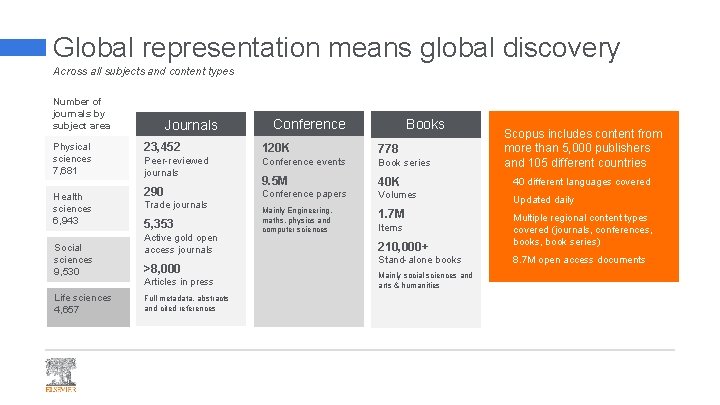
Global representation means global discovery Across all subjects and content types Number of journals by subject area Physical sciences 7, 681 Health sciences 6, 943 Social sciences 9, 530 Life sciences 4, 657 Journals 23, 452 120 K Peer-reviewed journals Conference events 290 Conference papers Trade journals 5, 353 Active gold open access journals >8, 000 Articles in press Full metadata, abstracts and cited references Books Conference 9. 5 M Mainly Engineering, maths, physics and computer sciences Book series Scopus includes content from more than 5, 000 publishers and 105 different countries 40 K • 40 different languages covered Volumes • Updated daily 1. 7 M • Multiple regional content types covered (journals, conferences, book series) 778 Items 210, 000+ Stand-alone books Mainly social sciences and arts & humanities • 8. 7 M open access documents
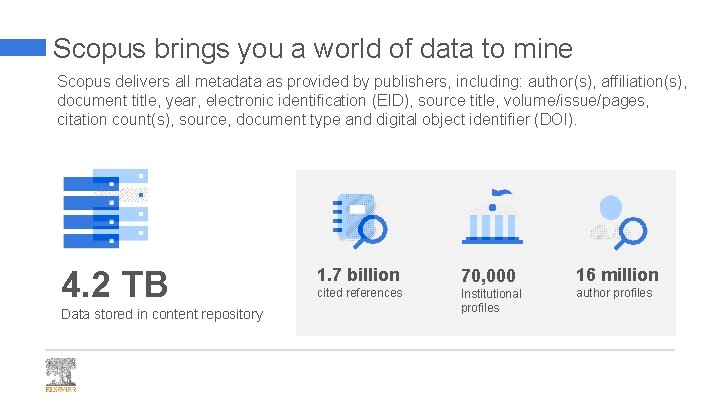
Scopus brings you a world of data to mine Scopus delivers all metadata as provided by publishers, including: author(s), affiliation(s), document title, year, electronic identification (EID), source title, volume/issue/pages, citation count(s), source, document type and digital object identifier (DOI). 4. 2 TB Data stored in content repository 1. 7 billion 70, 000 16 million cited references Institutional profiles author profiles
Built to meet your needs
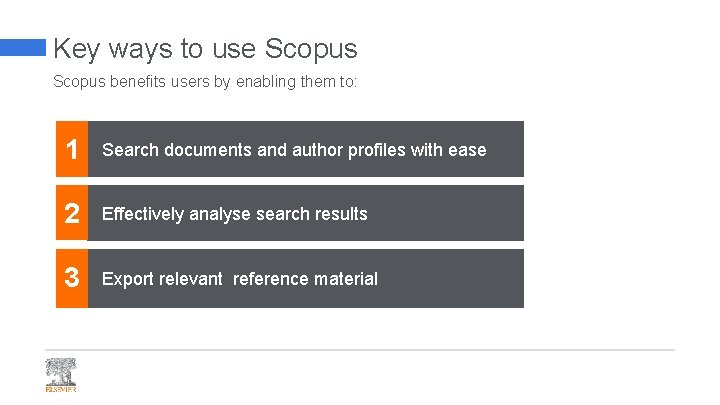
Key ways to use Scopus benefits users by enabling them to: 1 Search documents and author profiles with ease 2 Effectively analyse search results 3 Export relevant reference material
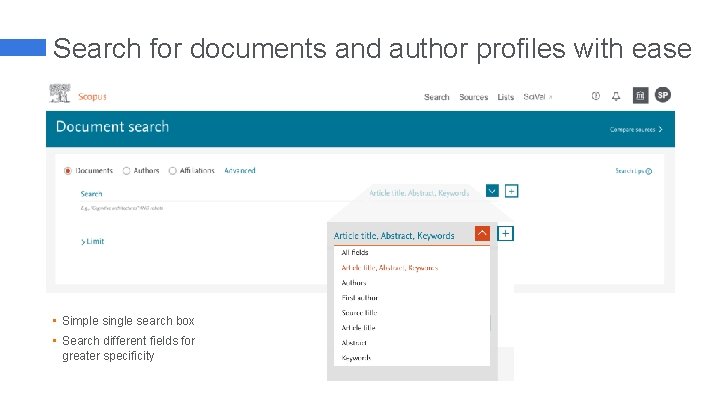
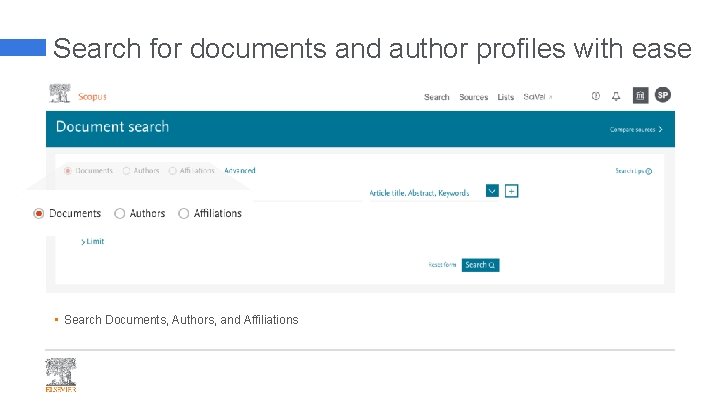
Search for documents and author profiles with ease • Simple single search box • Search different fields for greater specificity
Search for documents and author profiles with ease • Search Documents, Authors, and Affiliations
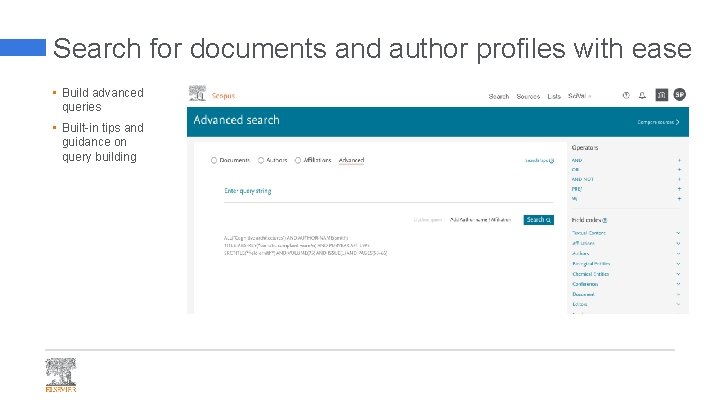
Search for documents and author profiles with ease • Build advanced queries • Built-in tips and guidance on query building
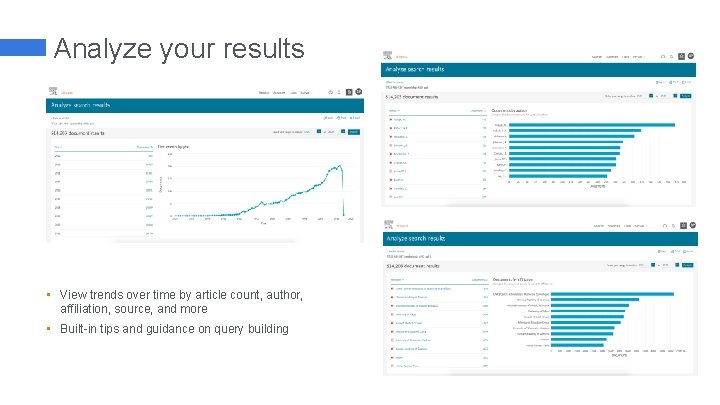
Analyze your results • View trends over time by article count, author, affiliation, source, and more • Built-in tips and guidance on query building
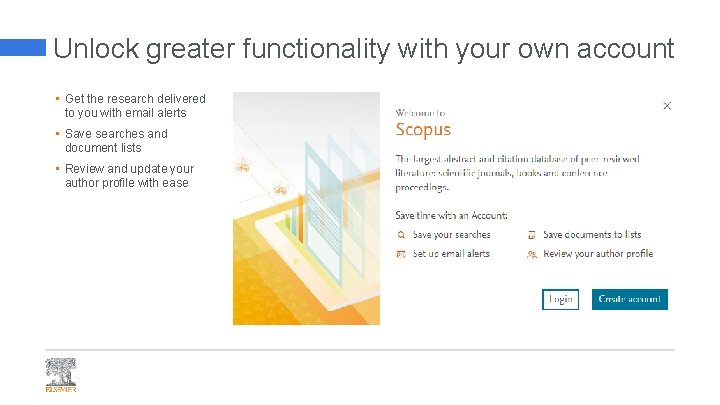
Unlock greater functionality with your own account • Get the research delivered to you with email alerts • Save searches and document lists • Review and update your author profile with ease
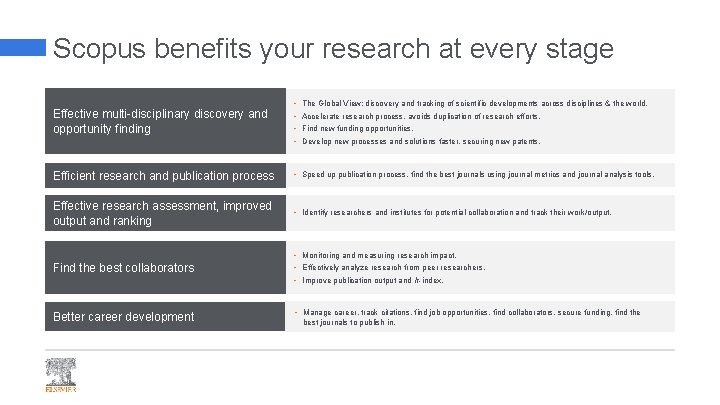
Scopus benefits your research at every stage Effective multi-disciplinary discovery and opportunity finding • • The Global View: discovery and tracking of scientific developments across disciplines & the world. Accelerate research process, avoids duplication of research efforts. Find new funding opportunities. Develop new processes and solutions faster, securing new patents. Efficient research and publication process • Speed up publication process, find the best journals using journal metrics and journal analysis tools. Effective research assessment, improved output and ranking • Identify researchers and institutes for potential collaboration and track their work/output. Find the best collaborators • Monitoring and measuring research impact. • Effectively analyze research from peer researchers. • Improve publication output and h-index. Better career development • Manage career, track citations, find job opportunities, find collaborators, secure funding, find the best journals to publish in.
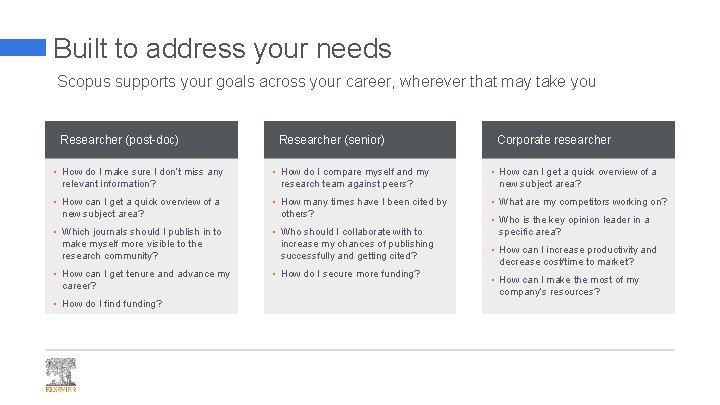
Built to address your needs Scopus supports your goals across your career, wherever that may take you Researcher (post-doc) Researcher (senior) Corporate researcher • How do I make sure I don’t miss any relevant information? • How do I compare myself and my research team against peers? • How can I get a quick overview of a new subject area? • How many times have I been cited by others? • What are my competitors working on? • Which journals should I publish in to make myself more visible to the research community? • Who should I collaborate with to increase my chances of publishing successfully and getting cited? • How can I get tenure and advance my career? • How do I secure more funding? • How do I find funding? • Who is the key opinion leader in a specific area? • How can I increase productivity and decrease cost/time to market? • How can I make the most of my company’s resources?
Scopus author profiles
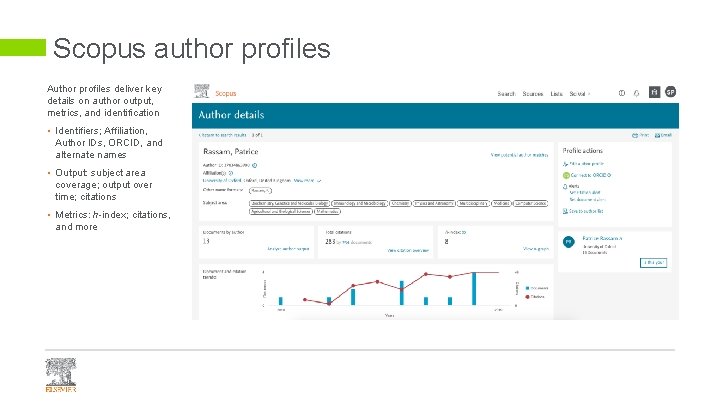
Scopus author profiles Author profiles deliver key details on author output, metrics, and identification • Identifiers; Affiliation, Author IDs, ORCID, and alternate names • Output: subject area coverage; output over time; citations • Metrics: h-index; citations, and more
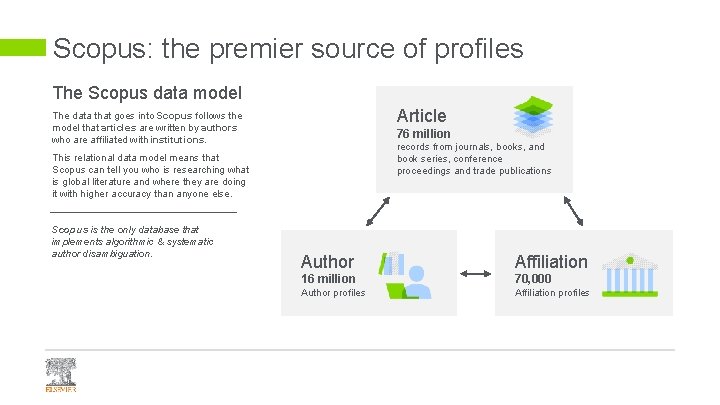
Scopus: the premier source of profiles The Scopus data model Article The data that goes into Scopus follows the model that articles are written by authors who are affiliated with institutions. 76 million records from journals, books, and book series, conference proceedings and trade publications This relational data model means that Scopus can tell you who is researching what is global literature and where they are doing it with higher accuracy than anyone else. Scopus is the only database that implements algorithmic & systematic author disambiguation. Author Affiliation 16 million 70, 000 Author profiles Affiliation profiles
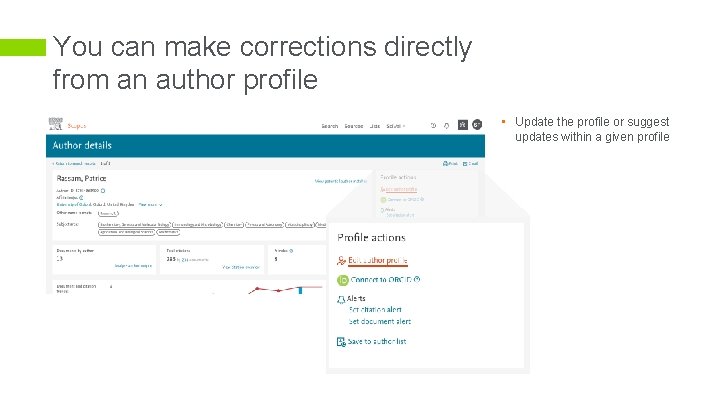
You can make corrections directly from an author profile • Update the profile or suggest updates within a given profile
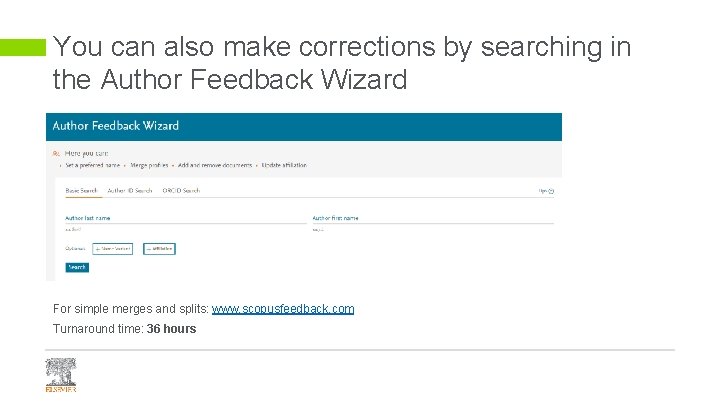
You can also make corrections by searching in the Author Feedback Wizard For simple merges and splits: www. scopusfeedback. com Turnaround time: 36 hours
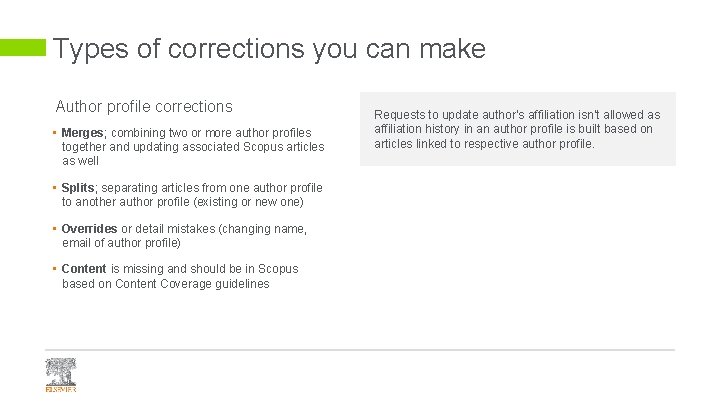
Types of corrections you can make Author profile corrections • Merges; combining two or more author profiles together and updating associated Scopus articles as well • Splits; separating articles from one author profile to another author profile (existing or new one) • Overrides or detail mistakes (changing name, email of author profile) • Content is missing and should be in Scopus based on Content Coverage guidelines Requests to update author’s affiliation isn’t allowed as affiliation history in an author profile is built based on articles linked to respective author profile.
Appendix: research metrics in Scopus
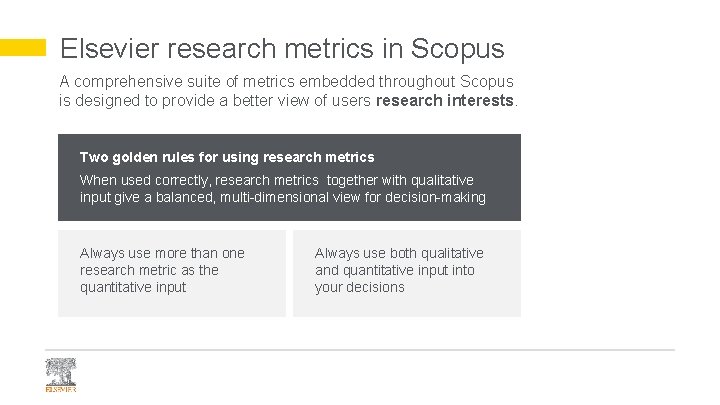
Elsevier research metrics in Scopus A comprehensive suite of metrics embedded throughout Scopus is designed to provide a better view of users research interests. Two golden rules for using research metrics When used correctly, research metrics together with qualitative input give a balanced, multi-dimensional view for decision-making Always use more than one research metric as the quantitative input Always use both qualitative and quantitative input into your decisions
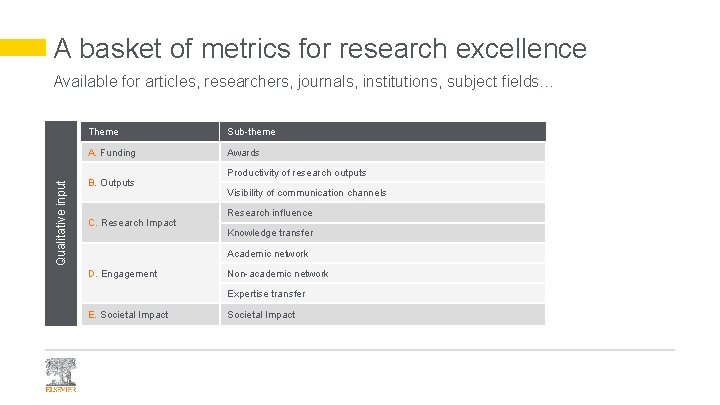
A basket of metrics for research excellence Qualitative input Available for articles, researchers, journals, institutions, subject fields… Theme Sub-theme A. Funding Awards B. Outputs C. Research Impact Productivity of research outputs Visibility of communication channels Research influence Knowledge transfer Academic network D. Engagement Non-academic network Expertise transfer E. Societal Impact
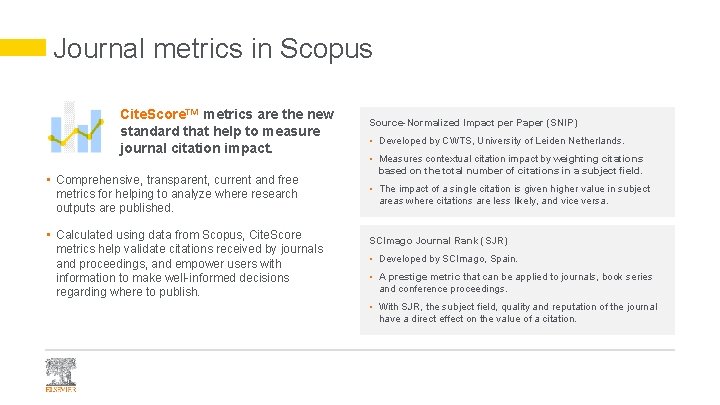
Journal metrics in Scopus Cite. Score™ metrics are the new standard that help to measure journal citation impact. • Comprehensive, transparent, current and free metrics for helping to analyze where research outputs are published. • Calculated using data from Scopus, Cite. Score metrics help validate citations received by journals and proceedings, and empower users with information to make well-informed decisions regarding where to publish. Source-Normalized Impact per Paper (SNIP) • Developed by CWTS, University of Leiden Netherlands. • Measures contextual citation impact by weighting citations based on the total number of citations in a subject field. • The impact of a single citation is given higher value in subject areas where citations are less likely, and vice versa. SCImago Journal Rank (SJR) • Developed by SCImago, Spain. • A prestige metric that can be applied to journals, book series and conference proceedings. • With SJR, the subject field, quality and reputation of the journal have a direct effect on the value of a citation.
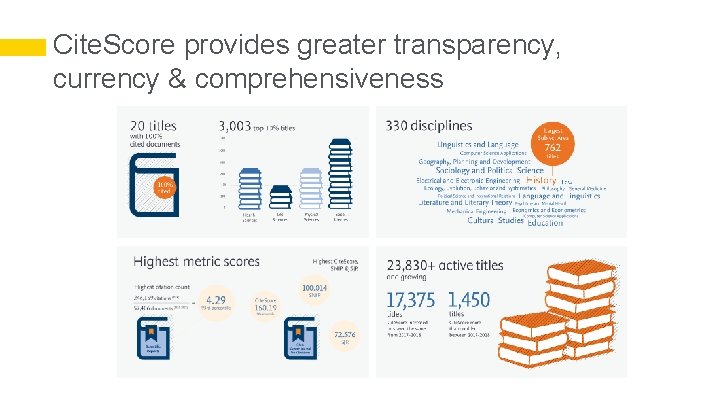
Cite. Score provides greater transparency, currency & comprehensiveness
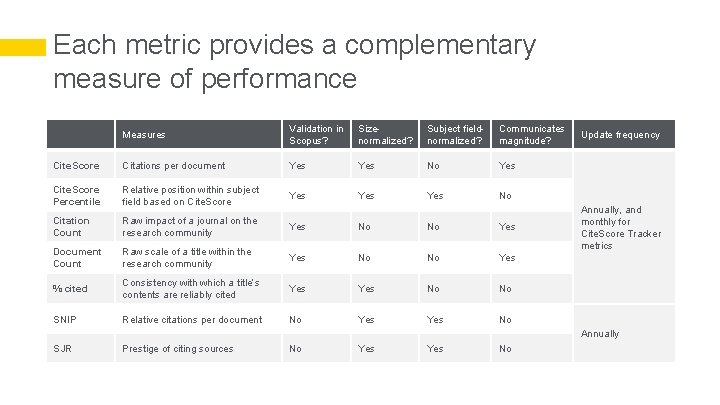
Each metric provides a complementary measure of performance Measures Validation in Scopus? Sizenormalized? Subject fieldnormalized? Communicates magnitude? Cite. Score Citations per document Yes No Yes Cite. Score Percentile Relative position within subject field based on Cite. Score Yes Yes No Citation Count Raw impact of a journal on the research community Yes No No Yes Document Count Raw scale of a title within the research community Yes No No Yes % cited Consistency with which a title’s contents are reliably cited Yes No No SNIP Relative citations per document No Yes No SJR Prestige of citing sources No Yes No Update frequency Annually, and monthly for Cite. Score Tracker metrics Annually
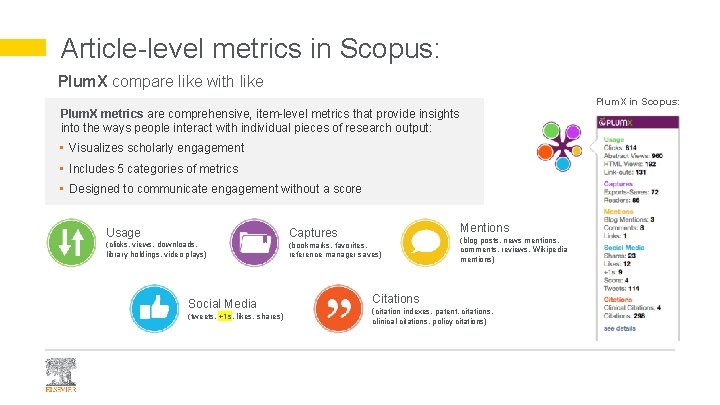
Article-level metrics in Scopus: Plum. X compare like with like Plum. X in Scopus: Plum. X metrics are comprehensive, item-level metrics that provide insights into the ways people interact with individual pieces of research output: • Visualizes scholarly engagement • Includes 5 categories of metrics • Designed to communicate engagement without a score Mentions Usage Captures (clicks, views, downloads, library holdings, video plays) (bookmarks, favorites, reference manager saves) Social Media (tweets, +1 s, likes, shares) (blog posts, news mentions, comments, reviews, Wikipedia mentions) Citations (citation indexes, patent, citations, clinical citations, policy citations)
Further resources
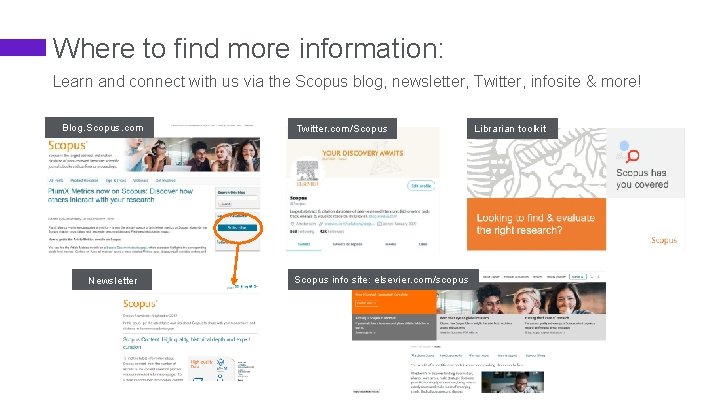
Where to find more information: Learn and connect with us via the Scopus blog, newsletter, Twitter, infosite & more! Blog. Scopus. com Newsletter Twitter. com/Scopus info site: elsevier. com/scopus Librarian toolkit
Thank you