
Introducing Chinese Culture in English Unit 1 The
![Resources: Words to note 1. reverence n. [U] The act of giving great respect](https://slidetodoc.com/presentation_image/7d517691028d09665c3291bc9c023f48/image-31.jpg "Resources: Words to note 1. reverence n. [U] The act of giving great respect")
![Resources: Words to note 2. appreciation (A) n. [C, U] The understanding of the](https://slidetodoc.com/presentation_image/7d517691028d09665c3291bc9c023f48/image-32.jpg "Resources: Words to note 2. appreciation (A) n. [C, U] The understanding of the")
![Resources: Words to note 5. ritual n. [U C] ritual & rite: The ceremony](https://slidetodoc.com/presentation_image/7d517691028d09665c3291bc9c023f48/image-35.jpg "Resources: Words to note 5. ritual n. [U C] ritual & rite: The ceremony")
- Slides: 54
Introducing Chinese Culture in English 英语畅谈中国文化
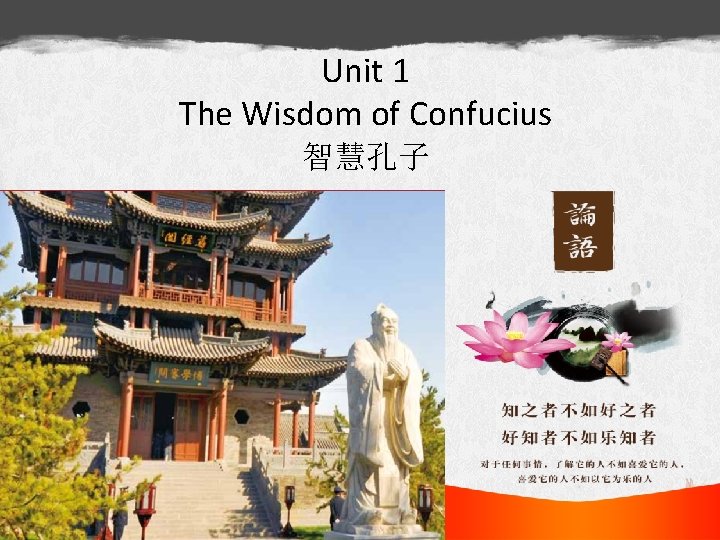
Unit 1 The Wisdom of Confucius 智慧孔子 Embarkation Exploration
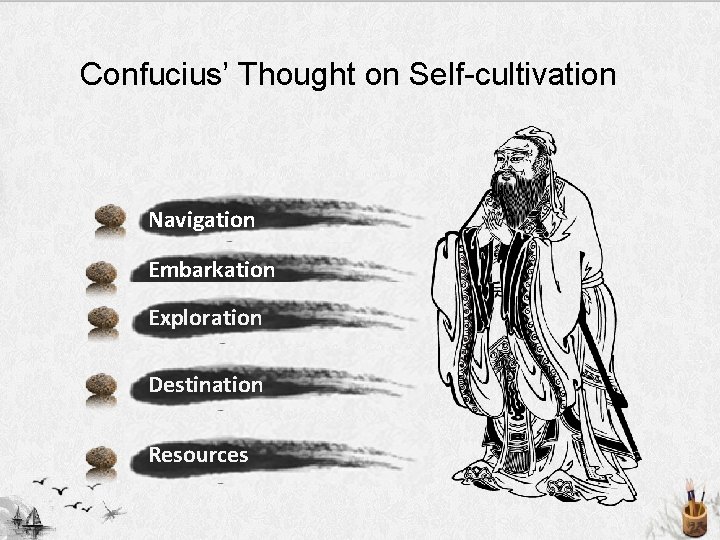
Confucius’ Thought on Self-cultivation Navigation Embarkation Exploration Destination Resources
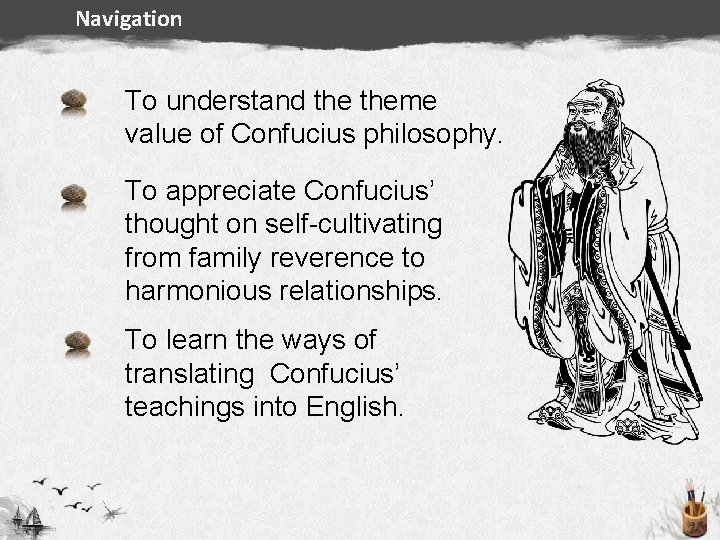
Navigation To understand theme value of Confucius philosophy. Lead - in To appreciate Confucius’ thought on self-cultivating from family reverence to mapping harmonious relationships. To preparing learn the ways of translating Confucius’ teachings into English. Destination
Embarkation Lead - in preparing
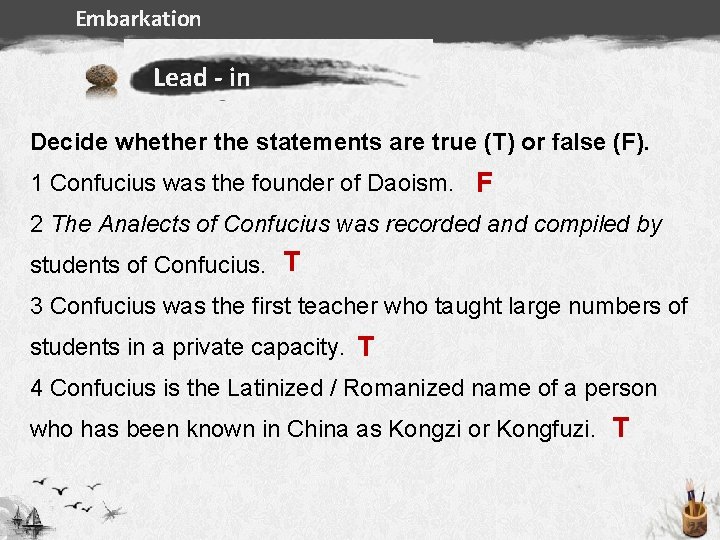
Embarkation Lead - in Decide whether the statements are true (T) or false (F). 1 Confucius was the founder of Daoism. F 2 The Analects of Confucius was recorded and compiled by students of Confucius. T 3 Confucius was the first teacher who taught large numbers of students in apreparing private capacity. T 4 Confucius is the Latinized / Romanized name of a person Destination who has been known in China as Kongzi or Kongfuzi. T Resources
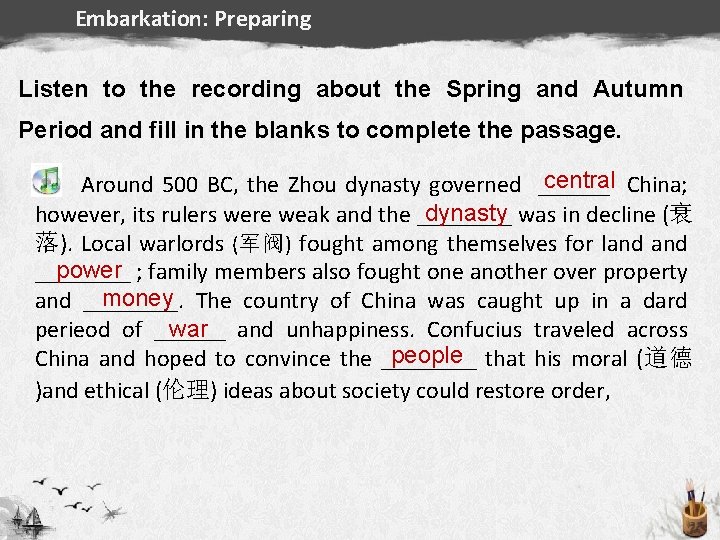
Embarkation: Preparing Listen to the recording about the Spring and Autumn Period and fill in the blanks to complete the passage. central China; Around 500 BC, the Zhou dynasty governed ______ dynasty was in decline (衰 however, its rulers were weak and the ____ 落). Local warlords (军阀) fought among themselves for land power ; family members also fought one another over property ____ money The country of China was caught up in a dard and ____. war and unhappiness. Confucius traveled across perieod of ______ preparing people that his moral (道德 China and hoped to convince the ____ )and ethical (伦理) ideas about society could restore order, Destination Resources
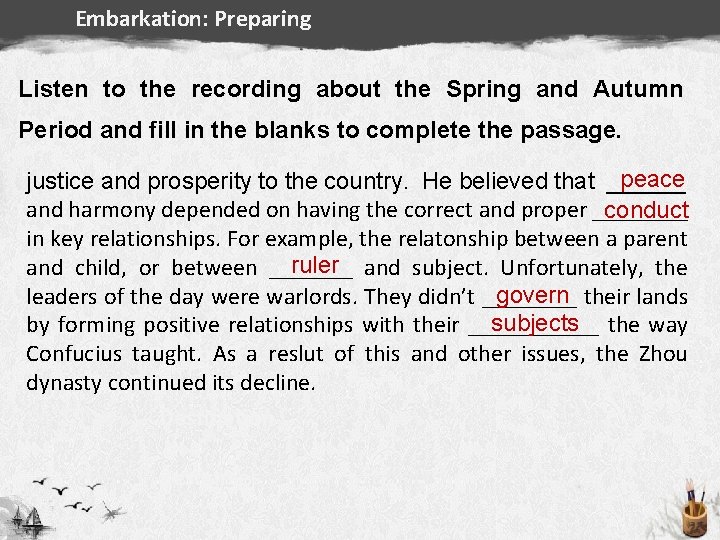
Embarkation: Preparing Listen to the recording about the Spring and Autumn Period and fill in the blanks to complete the passage. peace justice and prosperity to the country. He believed that ______ and harmony depended on having the correct and proper ____ conduct in key relationships. For example, the relatonship between a parent ruler and subject. Unfortunately, the and child, or between _______ govern their lands leaders of the day were warlords. They didn’t ____ subjects the way by forming positive relationships with their ______ preparing Confucius taught. As a reslut of this and other issues, the Zhou dynasty continued its decline. Destination Resources
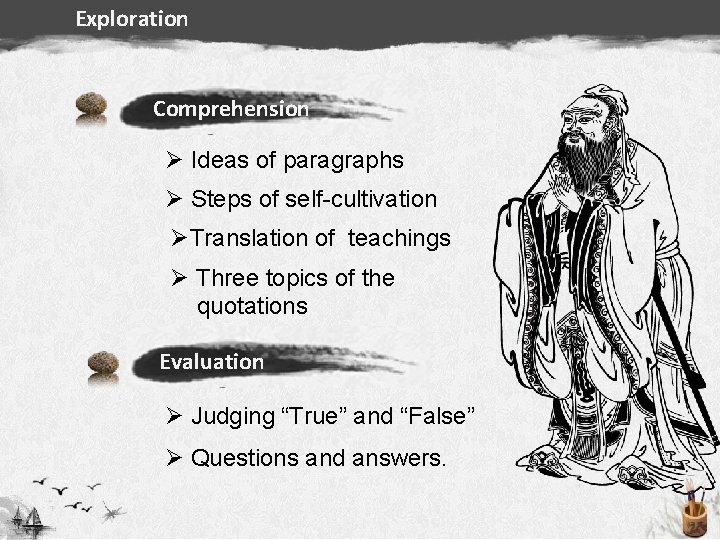
Exploration Comprehension Ø Ideas of paragraphs Ø Steps of self-cultivation ØTranslation of teachings Ø Three topics of the quotations preparing Evaluation Ø Judging “True” and “False” Destination Ø Questions and answers. Resources
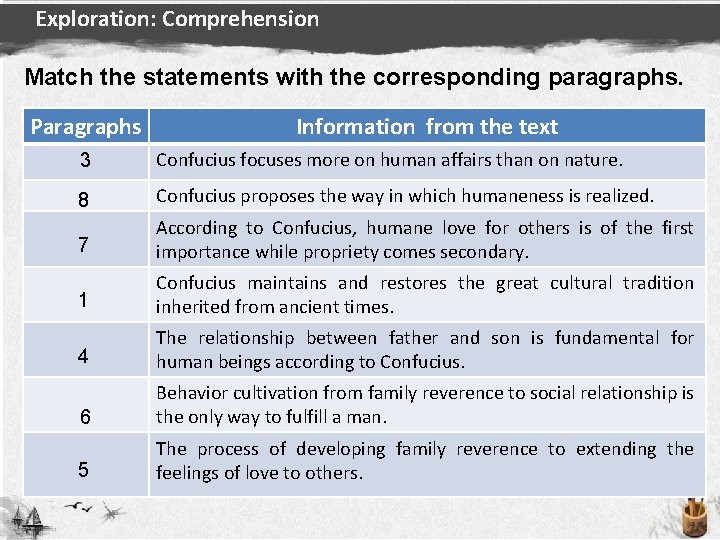
Exploration: Comprehension Match the statements with the corresponding paragraphs. Paragraphs Information from the text 3 Confucius focuses more on human affairs than on nature. 8 Confucius proposes the way in which humaneness is realized. 7 According to Confucius, humane love for others is of the first importance while propriety comes secondary. 1 Confucius maintains and restores the great cultural tradition inherited from ancient times. 4 Evaluation The relationship between father and son is fundamental for preparing human beings according to Confucius. 6 Behavior cultivation from family reverence to social relationship is the only way to fulfill a man. Destination 5 The process of developing family reverence to extending the feelings of love to others. Resources
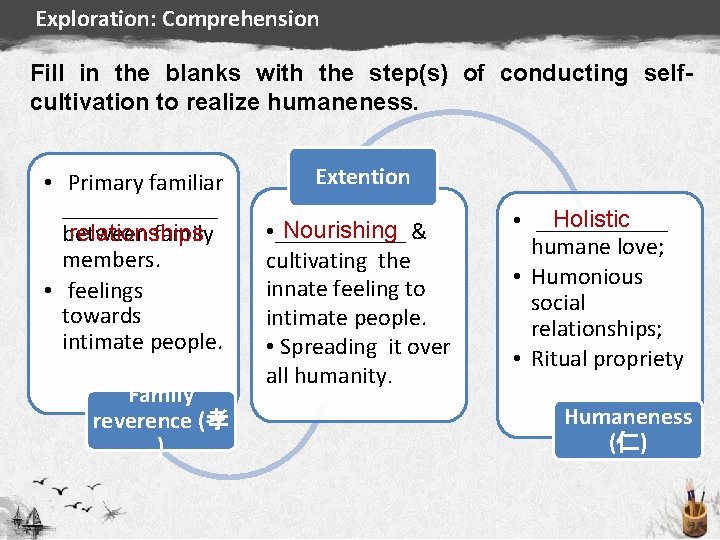
Exploration: Comprehension Fill in the blanks with the step(s) of conducting selfcultivation to realize humaneness. Extention • Primary familiar _______ Nourishing & • ______ relationships between family members. cultivating the innate feeling to • feelings towards Evaluation intimate people. preparing • Spreading it over all humanity. Family Destination reverence (孝 ) Resources Holistic • ______ humane love; • Humonious social relationships; • Ritual propriety Humaneness (仁)
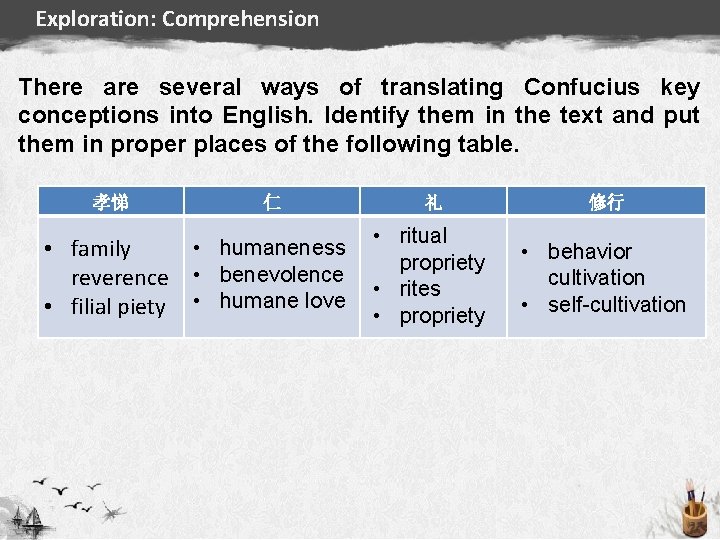
Exploration: Comprehension There are several ways of translating Confucius key conceptions into English. Identify them in the text and put them in proper places of the following table. 孝悌 仁 • family reverence • filial piety. Evaluation • humaneness • benevolence • humane love preparing Resources 礼 修行 • ritual propriety • rites • propriety • behavior cultivation • self-cultivation
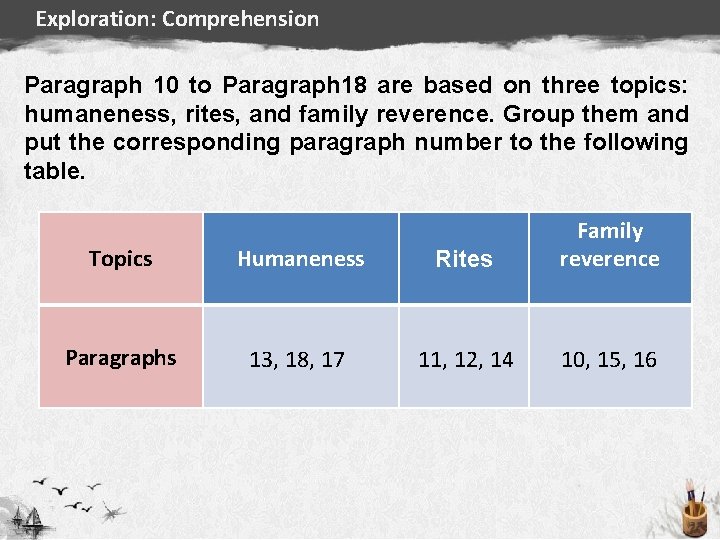
Exploration: Comprehension Paragraph 10 to Paragraph 18 are based on three topics: humaneness, rites, and family reverence. Group them and put the corresponding paragraph number to the following table. Topics Humaneness Evaluation preparing Paragraphs 13, 18, 17 Destination Resources Rites Family reverence 11, 12, 14 10, 15, 16
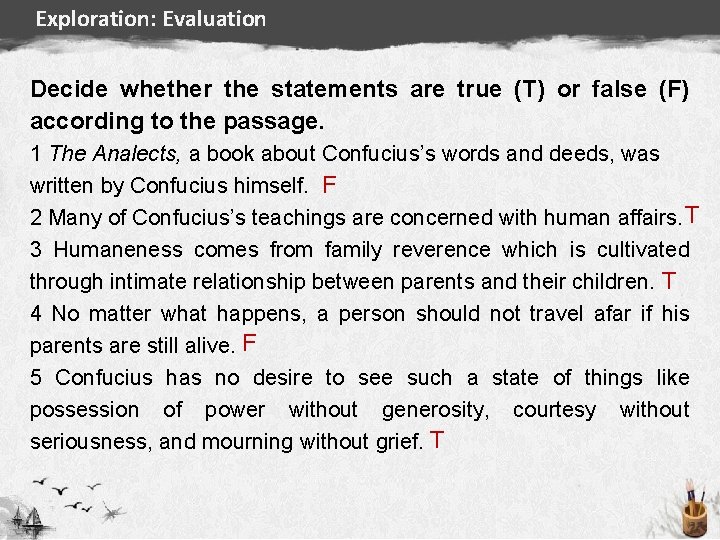
Exploration: Evaluation Decide whether the statements are true (T) or false (F) according to the passage. 1 The Analects, a book about Confucius’s words and deeds, was written by Confucius himself. F 2 Many of Confucius’s teachings are concerned with human affairs. T 3 Humaneness comes from family reverence which is cultivated through intimate relationship between parents and their children. T 4 No matter Evaluation what happens, a person should not travel afar if his preparing parents are still alive. F 5 Confucius has no desire to see such a state of things like possession Destination of power without generosity, courtesy without seriousness, and mourning without grief. T Resources
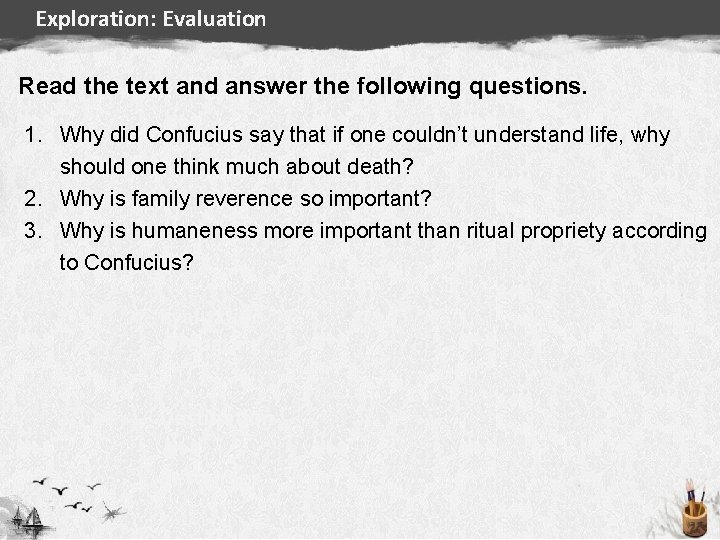
Exploration: Evaluation Read the text and answer the following questions. 1. Why did Confucius say that if one couldn’t understand life, why should one think much about death? 2. Why is family reverence so important? 3. Why is humaneness more important than ritual propriety according to Confucius? Evaluation preparing Destination Resources
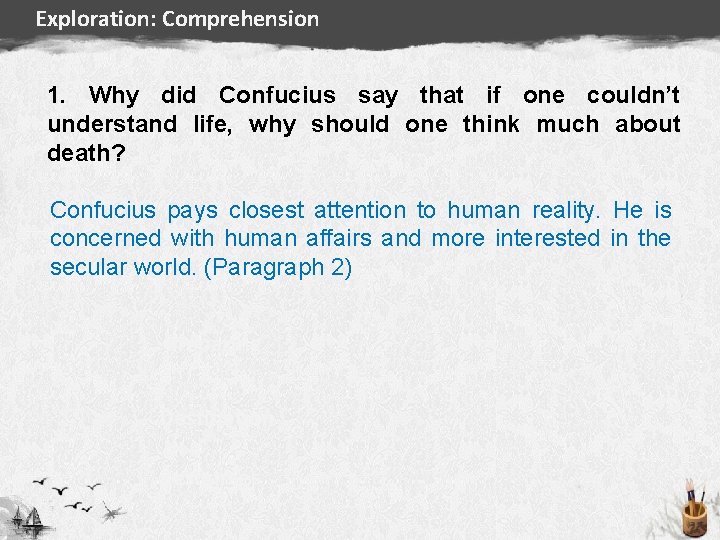
Exploration: Comprehension 1. Why did Confucius say that if one couldn’t understand life, why should one think much about death? Confucius pays closest attention to human reality. He is concerned with human affairs and more interested in the secular world. (Paragraph 2) preparing Destination Resources
Exploration: Comprehension 2. Why is family reverence so important? Family reverence is taken as the root of human feelings by Confucius. It is the root of humaneness (ren). Humane love starts from close intimate feelings and extends to other people as one begins to love. A human being can only fulfill himself by beginning with family reverence, the starting point of all relationships. We must be aware of this innate feeling so Evaluation we can nourish and cultivate it, and extend it to other socialpreparing relationships. (paragraphs 4 & 5) Destination Resources
Exploration: Comprehension 3. Why is humaneness more important than ritual propriety according to Confucius? In human communication, the most important factor is one’s feelings toward others, while the form as ritual propriety of this sentiment comes secondary. Evaluation preparing Destination Resources
Destination Summary Development Resources
Destination: Summary The passage discusses Confucius’ theory of cultivating one’s society It begins with the behavior toward family and ____. introduction of historical background of his time – the Spring and Autumn Period. It experienced a dramatic change of social system and prolonged chaos _____ and fighting. As a result, the cultural tradition _______ inherited from ancient times was corrupted. Confucius wanted to restore the great tradition abandoned (抛弃 ) by people harmonious social relationships among people. and established ______ Evaluation To realize this, preparing Confucius proposed self-cultivation with the starting nourished and point from feelings to parents. The feelings are ______ cultivated into family reverence. The love for parents extends to Destination other people as one begins to Resources
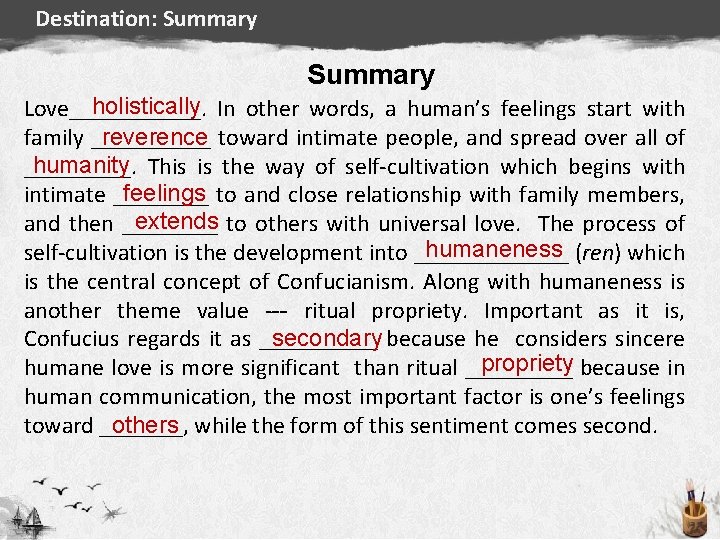
Destination: Summary holistically In other words, a human’s feelings start with Love______. family _____ reverence toward intimate people, and spread over all of humanity This is the way of self-cultivation which begins with _____. feelings to and close relationship with family members, intimate ____ extends to others with universal love. The process of and then ____ humaneness (ren) which self-cultivation is the development into _______ is the central concept of Confucianism. Along with humaneness is another theme value --- ritual propriety. Important as it is, Evaluation secondary because he considers sincere Confucius regards it as _____ preparing propriety because in humane love is more significant than ritual _____ human communication, the most important factor is one’s feelings Destination toward _______, while the form of this sentiment comes second. others Resources
Development Discuss the following questions with your partner. 1. What are the implications of humaneness to China today? 2. After reading the passage, have you got any insights into the socalled “Chinese-style” interpersonal relationship? Evaluation preparing Destination Resources
Resources Difficult sentences Words to note Information related Preview
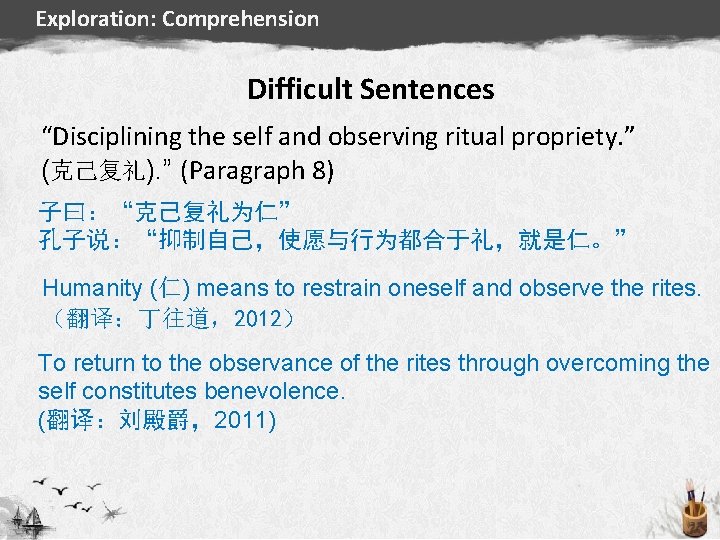
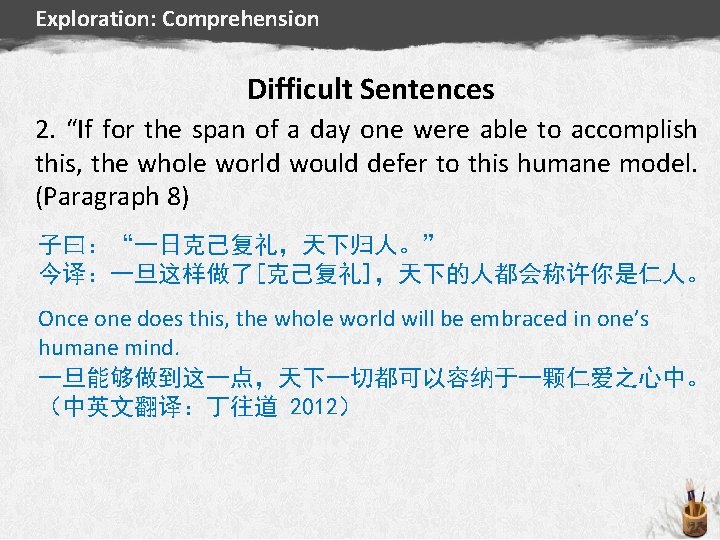
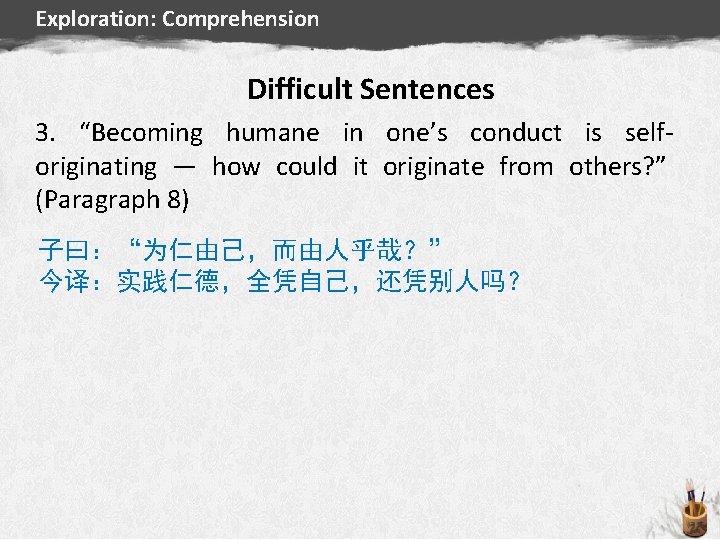
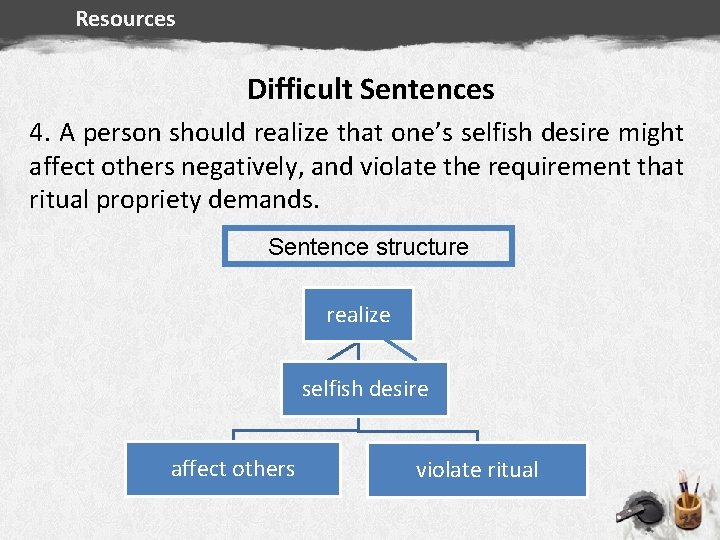
Resources Difficult Sentences 1. “Disciplining the self and observing ritual propriety. ” Summary 2. “If for the span of a day one were able to accomplish this, the whole world would defer to this humane model”. 3. “Becoming humane in one’s conduct is self-originating --- how could it originate from others? ” 4. “A person should realize that one’s selfish desire might affect others negatively, and violate the requirement that ritual propriety demands. ” Destination Resources
Exploration: Comprehension Difficult Sentences “Disciplining the self and observing ritual propriety. ” (克己复礼). ” (Paragraph 8) 子曰:“克己复礼为仁” 孔子说:“抑制自己,使愿与行为都合于礼,就是仁。” Humanity (仁) means to restrain oneself and observe the rites. (翻译:丁往道,2012) preparing To return to the observance of the rites through overcoming the self constitutes benevolence. Destination (翻译:刘殿爵,2011) Resources
Exploration: Comprehension Difficult Sentences 2. “If for the span of a day one were able to accomplish this, the whole world would defer to this humane model. (Paragraph 8) 子曰:“一日克己复礼,天下归人。” 今译:一旦这样做了[克己复礼],天下的人都会称许你是仁人。 Evaluation Once one does this, the whole world will be embraced in one’s preparing humane mind. 一旦能够做到这一点,天下一切都可以容纳于一颗仁爱之心中。 (中英文翻译:丁往道 Destination 2012) Resources
Exploration: Comprehension Difficult Sentences 3. “Becoming humane in one’s conduct is selforiginating — how could it originate from others? ” (Paragraph 8) 子曰:“为仁由己,而由人乎哉?” 今译:实践仁德,全凭自己,还凭别人吗? Evaluation preparing Resources
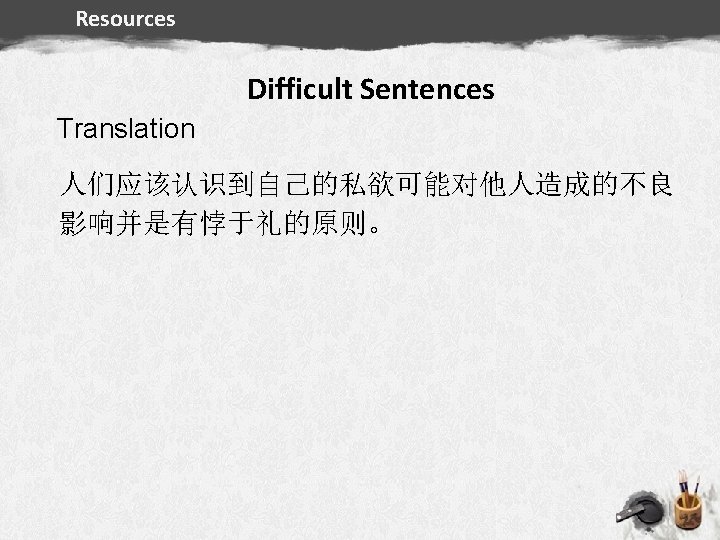
Resources Difficult Sentences 4. A person should realize that one’s selfish desire might Summary affect others negatively, and violate the requirement that ritual propriety demands. Sentence structure realize Destination affect others Resources selfish desire violate ritual
Resources Difficult Sentences Translation Summary 人们应该认识到自己的私欲可能对他人造成的不良 影响并是有悖于礼的原则。 Destination Resources
Resources Words to note New Words 1. 2. 3. 4. 5. 6. Expressions reverence 1. in the strict sense appreciation humane 2. fulfill himself cultivate ritual obedient 3. defer to 4. comply with
Resources: Words to note 1. reverence n. [U] The act of giving great respect and admiration to sb. or sth. 崇敬, 尊崇 Translate the following sentences. 1. He showed great reverence for / towards the pictures of the God. T 他对神像十分崇敬。 Evaluation 2. Family preparing reverence, also translated as filial piety, means to acquire the habits of love and respect at home and then extend the love and respect to others. Destination T 孝悌,又叫filial piety, 是指在家养成爱和尊重的习惯,然 后推己及人,把这份爱延伸到别人身上。
Resources: Words to note 2. appreciation (A) n. [C, U] The understanding of the importance and meaning of something. 理解、认识到 (B) n. [U] The understanding of good quality or worth of something 赞赏、欣赏 (C) a feeling of being grateful for something or somebody. 感激 Decide the meaning of the following sentences. Evaluation Their appreciation of the performance was expressed in loud cheers. B preparing He was presented with a golden pen in appreciation of his long service. Destination and hard work. C We are impressed by his realistic appreciation of the current situation. A Resources
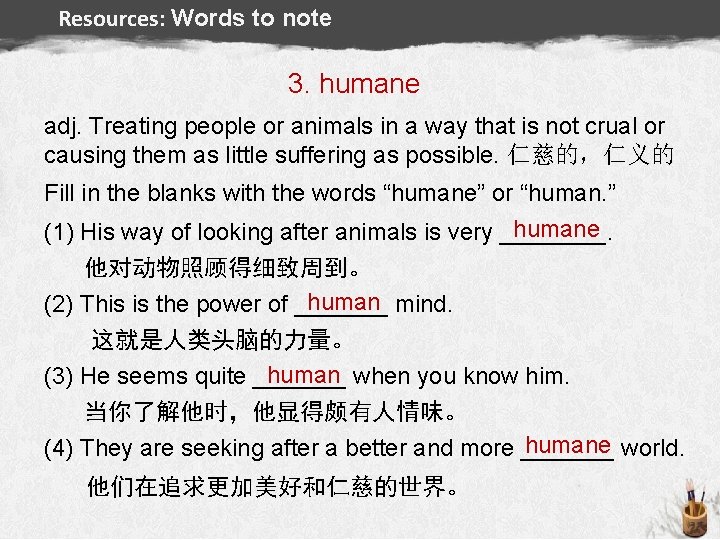
Resources: Words to note 3. humane adj. Treating people or animals in a way that is not crual or causing them as little suffering as possible. 仁慈的,仁义的 Fill in the blanks with the words “humane” or “human. ” humane (1) His way of looking after animals is very ____. 他对动物照顾得细致周到。 human mind. (2) This is the power of _______ Evaluation 这就是人类头脑的力量。 preparing human when you know him. (3) He seems quite _______ 当你了解他时,他显得颇有人情味。 Destination humane world. (4) They are seeking after a better and more _______ Resources 他们在追求更加美好和仁慈的世界。
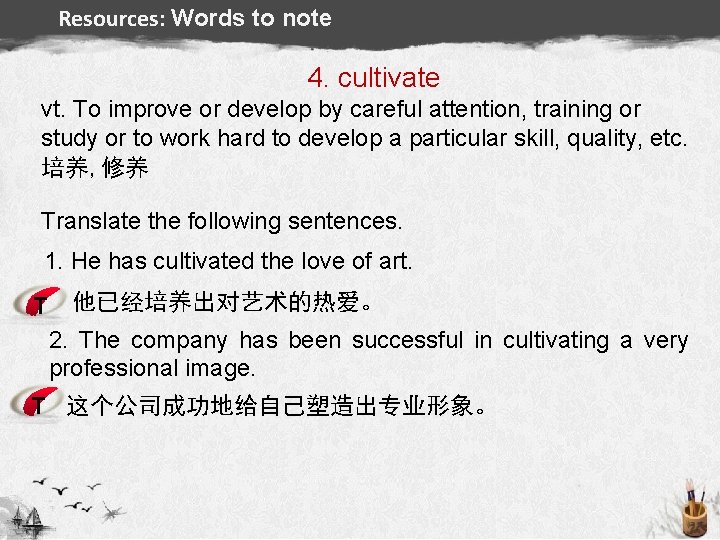
Resources: Words to note 4. cultivate vt. To improve or develop by careful attention, training or study or to work hard to develop a particular skill, quality, etc. 培养, 修养 Translate the following sentences. 1. He has cultivated the love of art. T 他已经培养出对艺术的热爱。 2. The company has been successful in cultivating a very preparing professional image. T 这个公司成功地给自己塑造出专业形象。 Destination Resources
Resources: Words to note 5. ritual n. [U C] ritual & rite: The ceremony that is always performed the same way in order to mark an important religious or social occasion. 礼仪, 仪式 n. [U] propriety: behavior that is social and moral correct 规范 ritual propriety rite Evaluation Fill in the blanks with the words in the table. ritual 1. The priestpreparing stressed the importance of religion and _______ in our lives. rite 2. The performed the funeral _______ Destination propriety. 3. They conduct themselves with _____. propriety of treating the ill children 4. They discussed the _____ Resources against wishes of their parents.
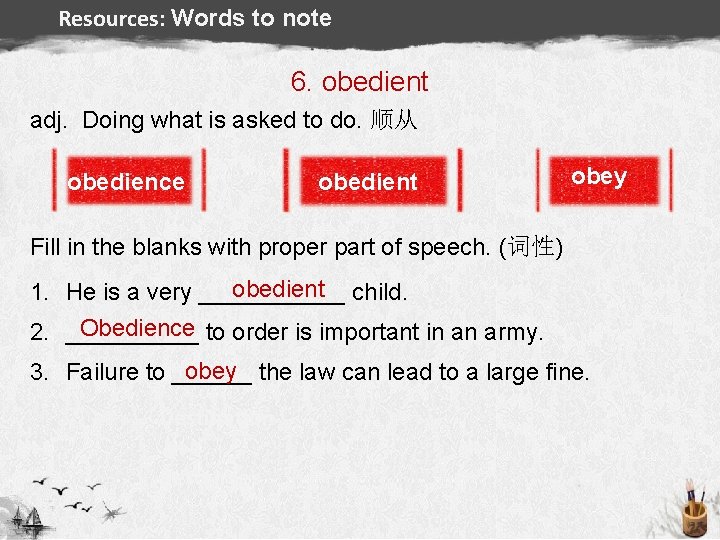
Resources: Words to note 6. obedient adj. Doing what is asked to do. 顺从 obedience obedient obey Fill in the blanks with proper part of speech. (词性) obedient child. 1. He is a very ______ Evaluation Obedience to order is important in an army. 2. _____ preparing obey the law can lead to a large fine. 3. Failure to ______ Destination Resources
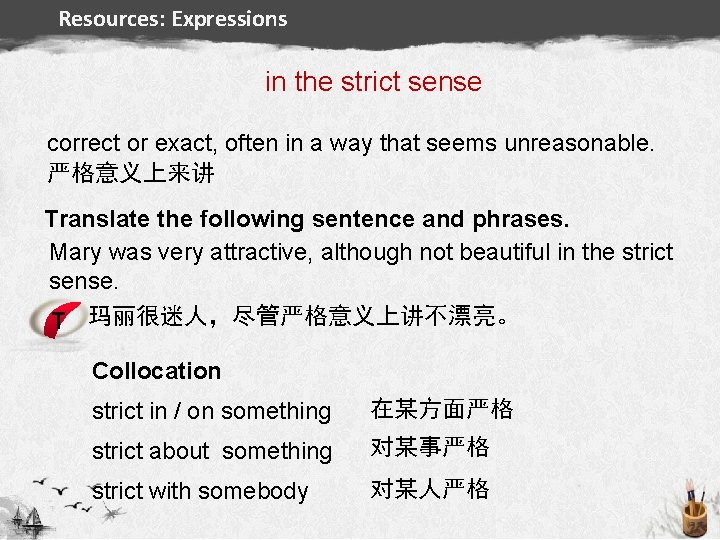
Resources: Expressions in the strict sense correct or exact, often in a way that seems unreasonable. 严格意义上来讲 Translate the following sentence and phrases. Mary was very attractive, although not beautiful in the strict sense. Evaluation T 玛丽很迷人,尽管严格意义上讲不漂亮。 preparing Collocation strict in. Destination / on something 在某方面严格 strict about something Resources strict with somebody 对某事严格 对某人严格
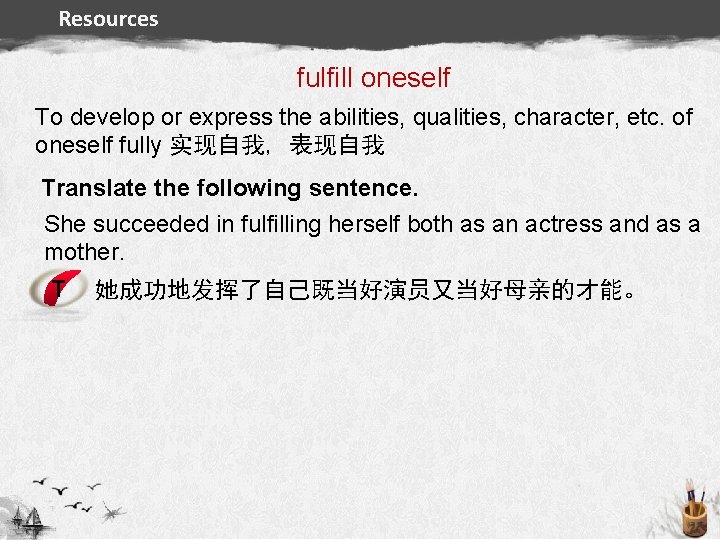
Resources fulfill oneself To develop or express the abilities, qualities, character, etc. of oneself fully 实现自我, 表现自我 Translate the following sentence. She succeeded in fulfilling herself both as an actress and as a mother. T 她成功地发挥了自己既当好演员又当好母亲的才能。 Evaluation preparing Destination Resources
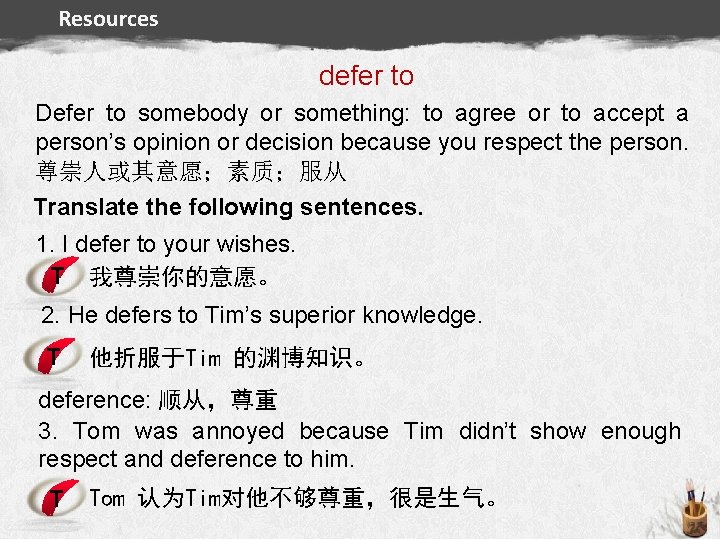
Resources defer to Defer to somebody or something: to agree or to accept a person’s opinion or decision because you respect the person. 尊崇人或其意愿;素质;服从 Translate the following sentences. 1. I defer to your wishes. T 我尊崇你的意愿。 2. He defers to Tim’s superior knowledge. Evaluation preparing T 他折服于Tim 的渊博知识。 deference: 顺从,尊重 Destination 3. Tom was annoyed because Tim didn’t show enough respect and deference to him. Resources T Tom 认为Tim对他不够尊重,很是生气。
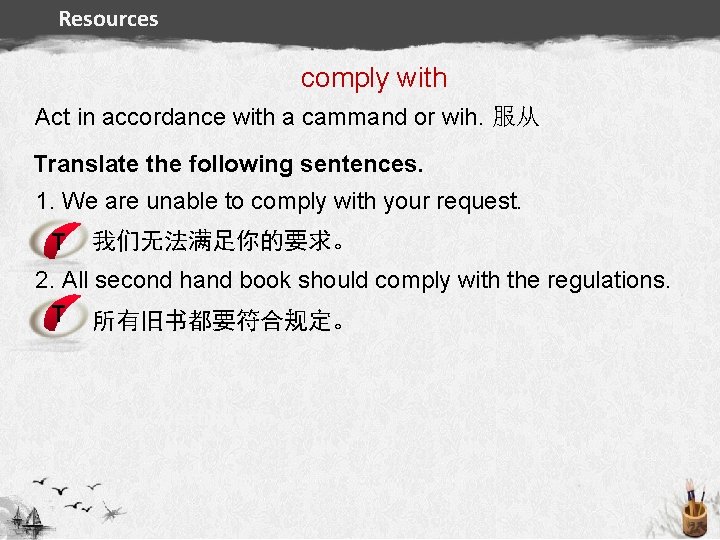
Resources comply with Act in accordance with a cammand or wih. 服从 Translate the following sentences. 1. We are unable to comply with your request. T 我们无法满足你的要求。 2. All second hand book should comply with the regulations. T 所有旧书都要符合规定。 Evaluation preparing Destination Resources
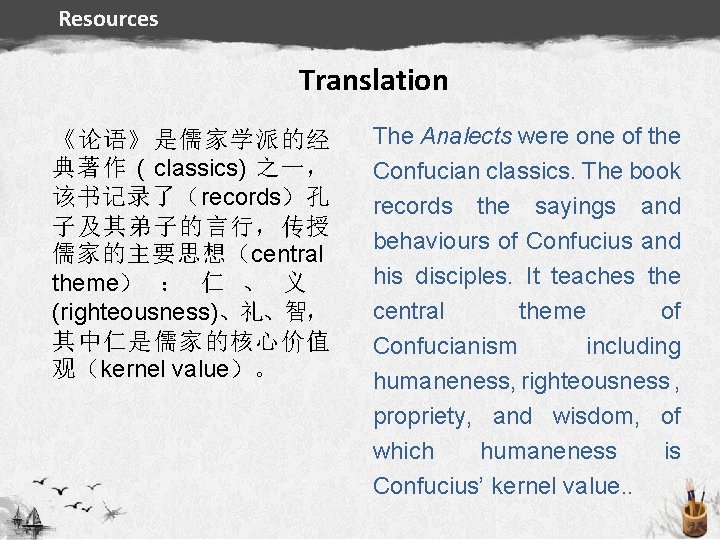
Resources Translation 《论语》是儒家学派的经 典著作 ( classics) 之一, 该书记录了(records)孔 子及其弟子的言行,传授 儒家的主要思想(central theme) : 仁 、 义 (righteousness)、礼、智, Evaluation 其中仁是儒家的核心价值 preparing 观(kernel value)。 Resources The Analects were one of the Confucian classics. The book records the sayings and behaviours of Confucius and his disciples. It teaches the central theme of Confucianism including humaneness, righteousness , propriety, and wisdom, of which humaneness is Confucius’ kernel value. .
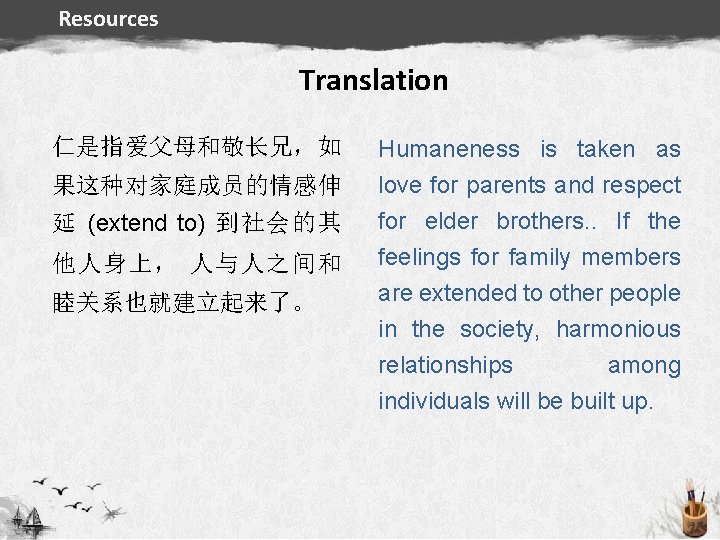
Resources Translation 仁是指爱父母和敬长兄,如 果这种对家庭成员的情感伸 延 (extend to) 到社会的其 他人身上, 人与人之间和 睦关系也就建立起来了。 Evaluation preparing Humaneness is taken as love for parents and respect for elder brothers. . If the feelings for family members are extended to other people in the society, harmonious relationships among individuals will be built up.
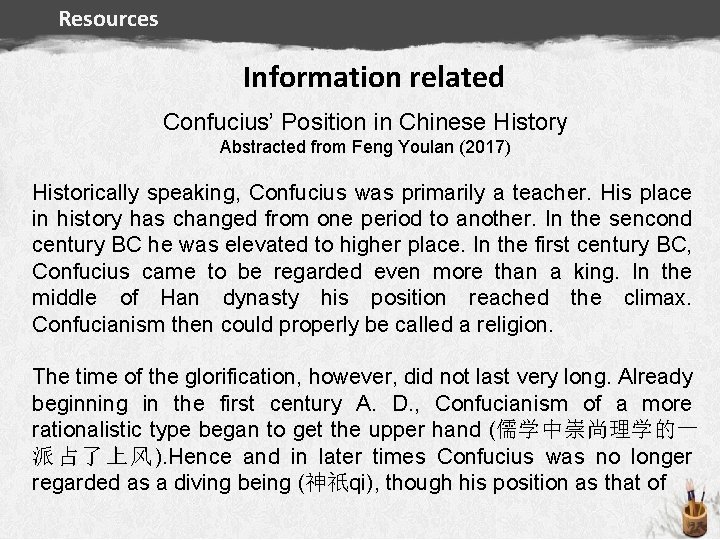
Resources Information related Confucius’ Position in Chinese History Abstracted from Feng Youlan (2017) Historically speaking, Confucius was primarily a teacher. His place in history has changed from one period to another. In the sencond century BC he was elevated to higher place. In the first century BC, Confucius came to be regarded even more than a king. In the middle of Han dynasty his position reached the climax. Confucianism. Evaluation then could properly be called a religion. preparing The time of the glorification, however, did not last very long. Already beginning in the first century A. D. , Confucianism of a more Destination rationalistic type began to get the upper hand (儒学中崇尚理学的一 派 占 了 上 风 ). Hence and in later times Confucius was no longer regarded as a. Resources diving being (神祇qi), though his position as that of
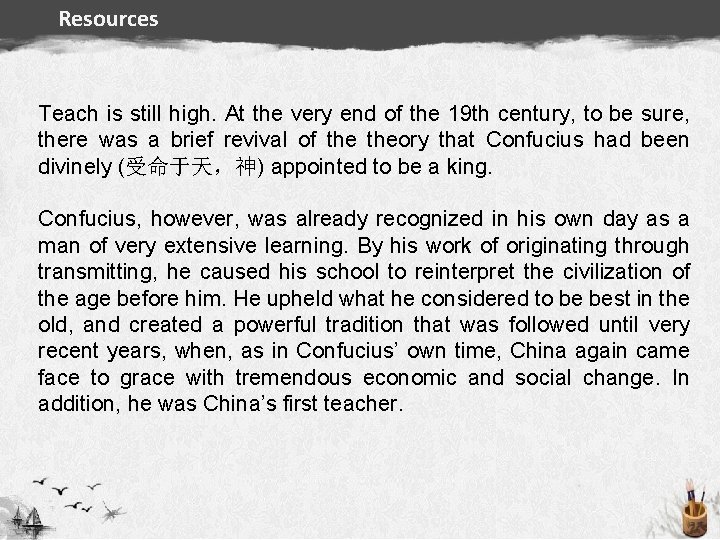
Resources Teach is still high. At the very end of the 19 th century, to be sure, there was a brief revival of theory that Confucius had been divinely (受命于天,神) appointed to be a king. Confucius, however, was already recognized in his own day as a man of very extensive learning. By his work of originating through transmitting, he caused his school to reinterpret the civilization of the age before him. He upheld what he considered to be best in the Evaluation old, and created a powerful tradition that was followed until very recent years, preparing when, as in Confucius’ own time, China again came face to grace with tremendous economic and social change. In addition, he was China’s first teacher. Destination Resources
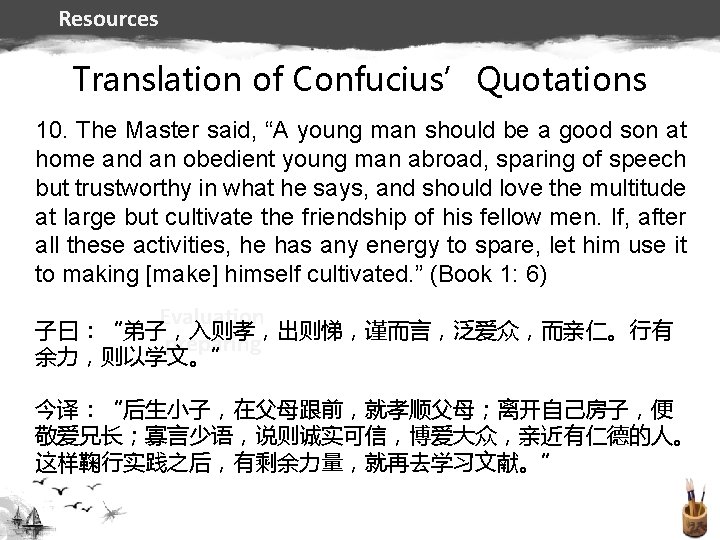
Resources Translation of Confucius’Quotations 10. The Master said, “A young man should be a good son at home and an obedient young man abroad, sparing of speech but trustworthy in what he says, and should love the multitude at large but cultivate the friendship of his fellow men. If, after all these activities, he has any energy to spare, let him use it to making [make] himself cultivated. ” (Book 1: 6) Evaluation 子曰:“弟子,入则孝,出则悌,谨而言,泛爱众,而亲仁。行有 preparing 余力,则以学文。” 今译:“后生小子,在父母跟前,就孝顺父母;离开自己房子,便 敬爱兄长;寡言少语,说则诚实可信,博爱大众,亲近有仁德的人。 这样鞠行实践之后,有剩余力量,就再去学习文献。”
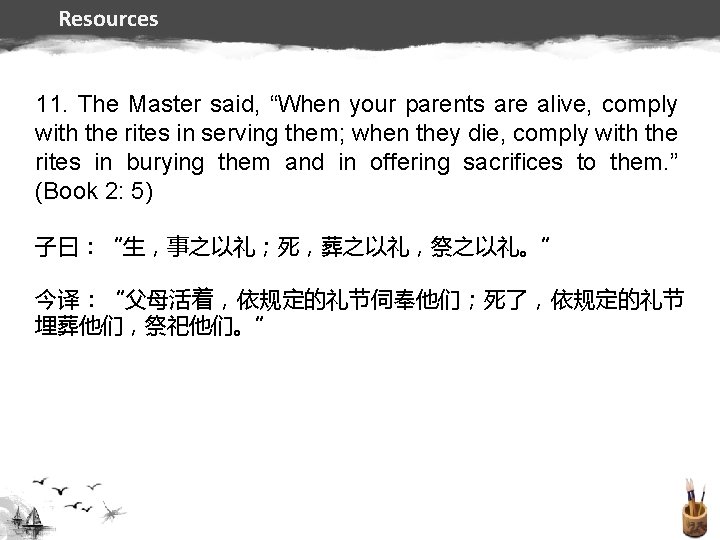
Resources 11. The Master said, “When your parents are alive, comply with the rites in serving them; when they die, comply with the rites in burying them and in offering sacrifices to them. ” (Book 2: 5) 子曰:“生,事之以礼;死,葬之以礼,祭之以礼。” 今译:“父母活着,依规定的礼节伺奉他们;死了,依规定的礼节 埋葬他们,祭祀他们。”
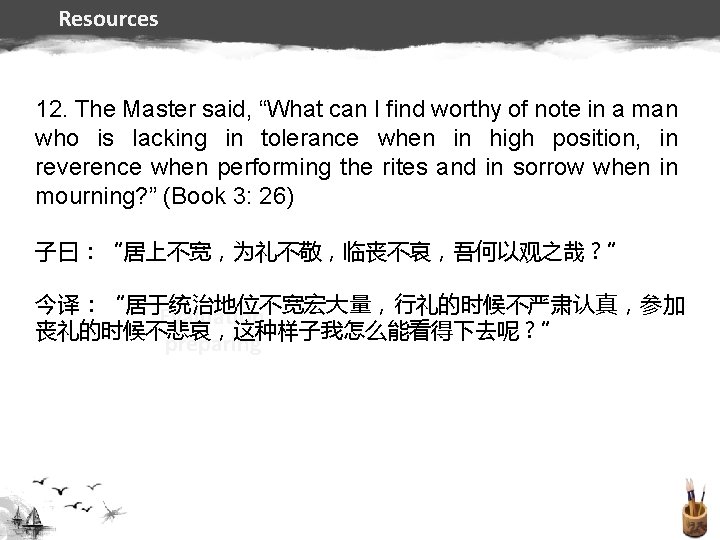
Resources 12. The Master said, “What can I find worthy of note in a man who is lacking in tolerance when in high position, in reverence when performing the rites and in sorrow when in mourning? ” (Book 3: 26) 子曰:“居上不宽,为礼不敬,临丧不哀,吾何以观之哉?” 今译:“居于统治地位不宽宏大量,行礼的时候不严肃认真,参加 Evaluation 丧礼的时候不悲哀,这种样子我怎么能看得下去呢?” preparing
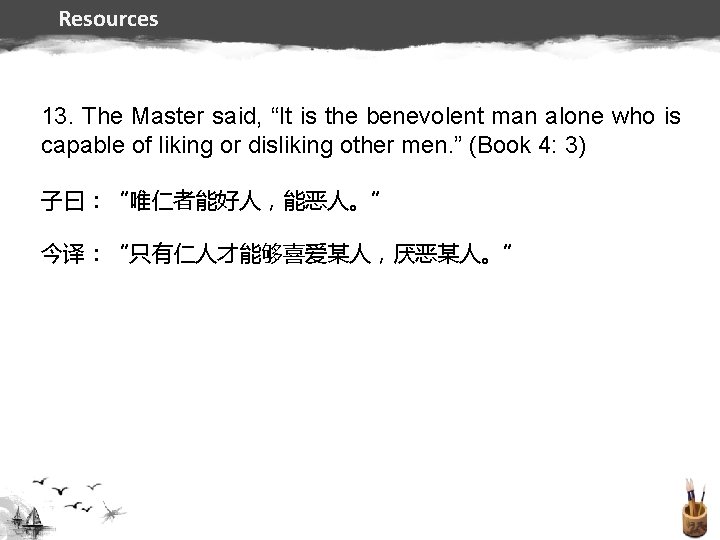
Resources 13. The Master said, “It is the benevolent man alone who is capable of liking or disliking other men. ” (Book 4: 3) 子曰:“唯仁者能好人,能恶人。” 今译:“只有仁人才能够喜爱某人,厌恶某人。”
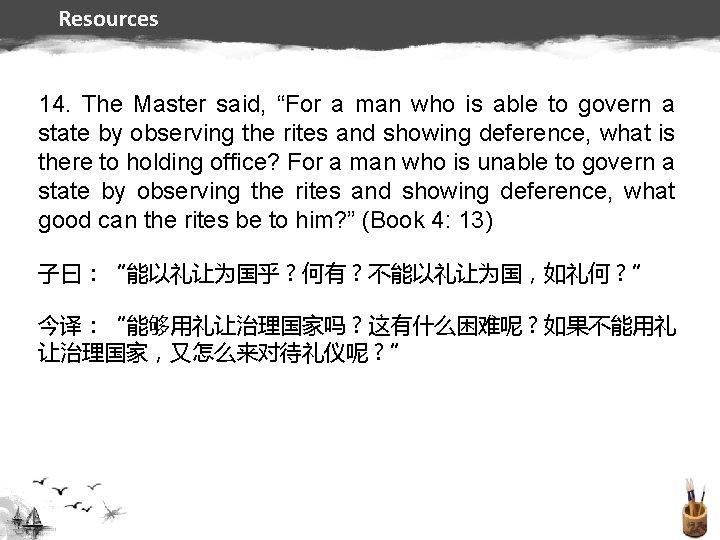
Resources 14. The Master said, “For a man who is able to govern a state by observing the rites and showing deference, what is there to holding office? For a man who is unable to govern a state by observing the rites and showing deference, what good can the rites be to him? ” (Book 4: 13) 子曰:“能以礼让为国乎?何有?不能以礼让为国,如礼何?” 今译:“能够用礼让治理国家吗?这有什么困难呢?如果不能用礼 让治理国家,又怎么来对待礼仪呢?”
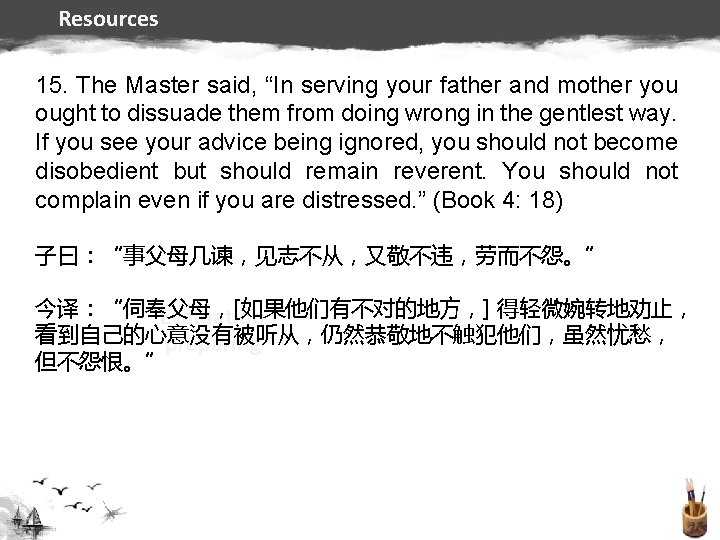
Resources 15. The Master said, “In serving your father and mother you ought to dissuade them from doing wrong in the gentlest way. If you see your advice being ignored, you should not become disobedient but should remain reverent. You should not complain even if you are distressed. ” (Book 4: 18) 子曰:“事父母几谏,见志不从,又敬不违,劳而不怨。” 今译:“伺奉父母,[如果他们有不对的地方,] 得轻微婉转地劝止, Evaluation 看到自己的心意没有被听从,仍然恭敬地不触犯他们,虽然忧愁, preparing 但不怨恨。”
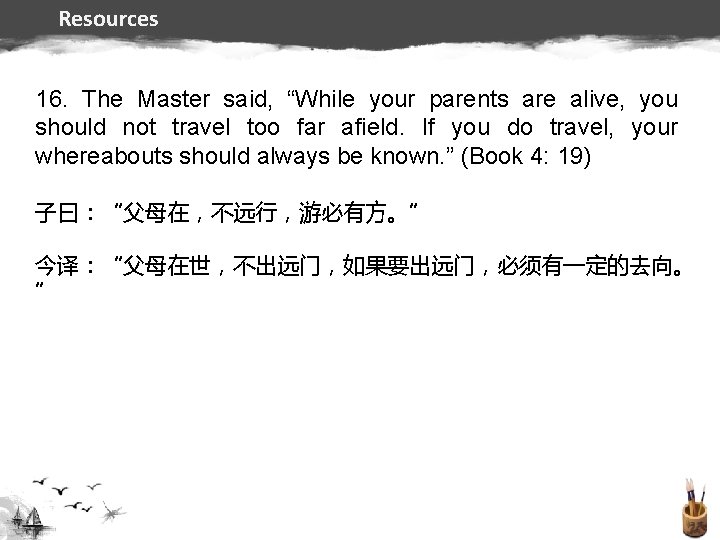
Resources 16. The Master said, “While your parents are alive, you should not travel too far afield. If you do travel, your whereabouts should always be known. ” (Book 4: 19) 子曰:“父母在,不远行,游必有方。” 今译:“父母在世,不出远门,如果要出远门,必须有一定的去向。 ”
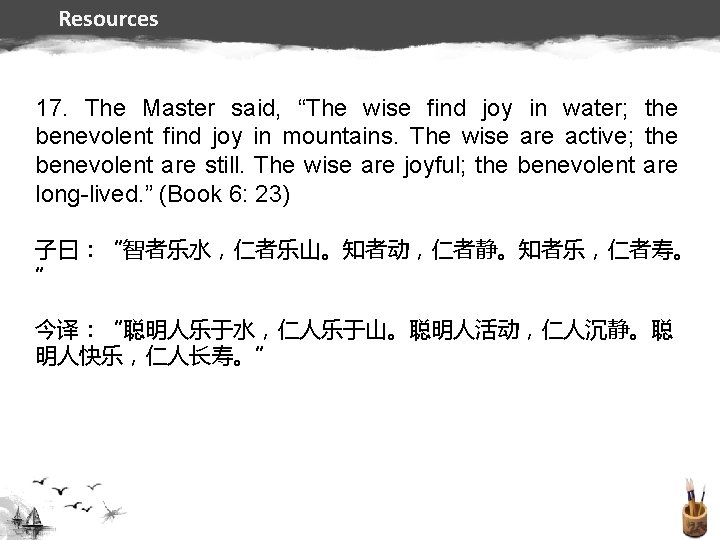
Resources 17. The Master said, “The wise find joy in water; the benevolent find joy in mountains. The wise are active; the benevolent are still. The wise are joyful; the benevolent are long-lived. ” (Book 6: 23) 子曰:“智者乐水,仁者乐山。知者动,仁者静。知者乐,仁者寿。 ” 今译:“聪明人乐于水,仁人乐于山。聪明人活动,仁人沉静。聪 明人快乐,仁人长寿。”
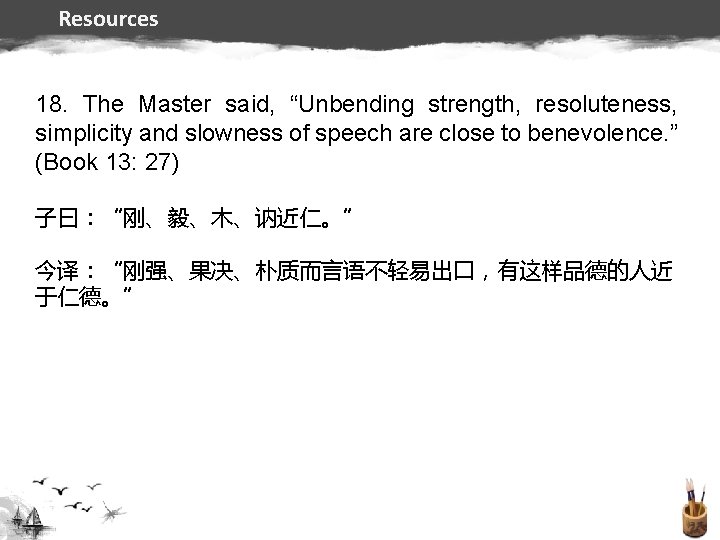
Resources 18. The Master said, “Unbending strength, resoluteness, simplicity and slowness of speech are close to benevolence. ” (Book 13: 27) 子曰:“刚、毅、木、讷近仁。” 今译:“刚强、果决、朴质而言语不轻易出口,有这样品德的人近 于仁德。”
Resources Thank you! Evaluation preparing Destination