
Introducing BIOMATERIALS Teachers in Residence Programme Iseult Mangan
Introducing BIOMATERIALS

Teachers in Residence Programme Iseult Mangan and Tom Flanagan
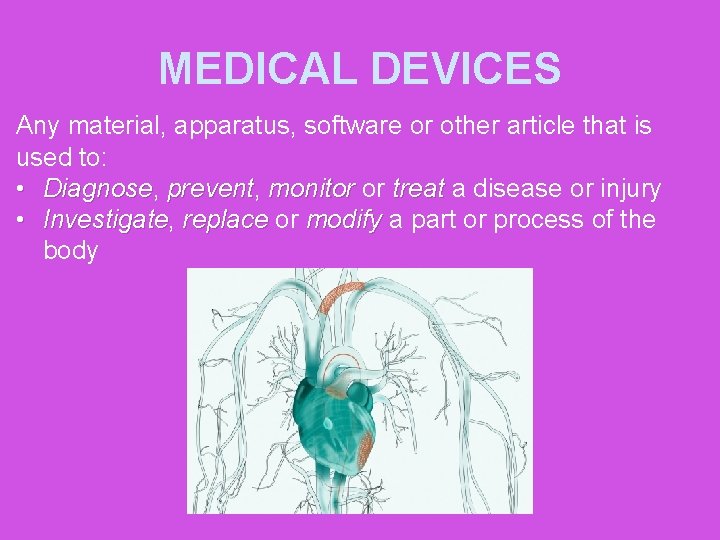
MEDICAL DEVICES Any material, apparatus, software or other article that is used to: • Diagnose, Diagnose prevent, prevent monitor or treat a disease or injury • Investigate, Investigate replace or modify a part or process of the body
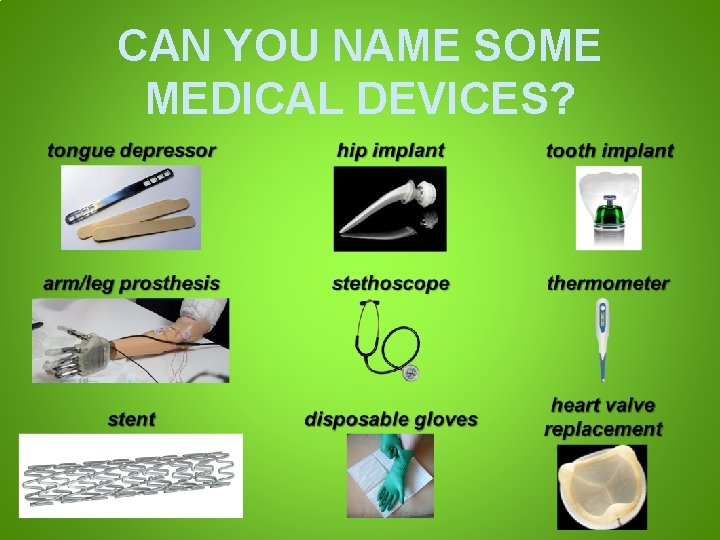
CAN YOU NAME SOME MEDICAL DEVICES?
Biomaterials are used to make medical devices What are BIOMATERIALS?
Biomaterials
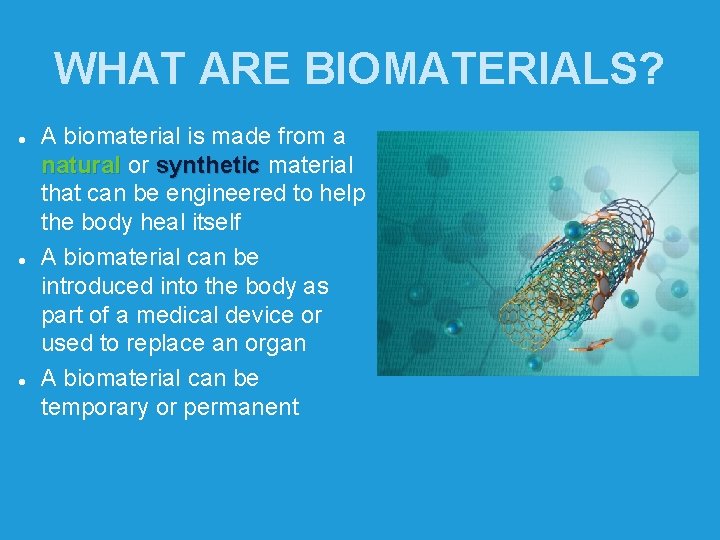
WHAT ARE BIOMATERIALS? A biomaterial is made from a natural or synthetic material that can be engineered to help the body heal itself A biomaterial can be introduced into the body as part of a medical device or used to replace an organ A biomaterial can be temporary or permanent
Must have appropriate physical properties for the area of the Can easily be body they are made being used Mustinto be a shape of noncarcinogenic Must be choice Biomaterials biocompatible Must be nontoxic
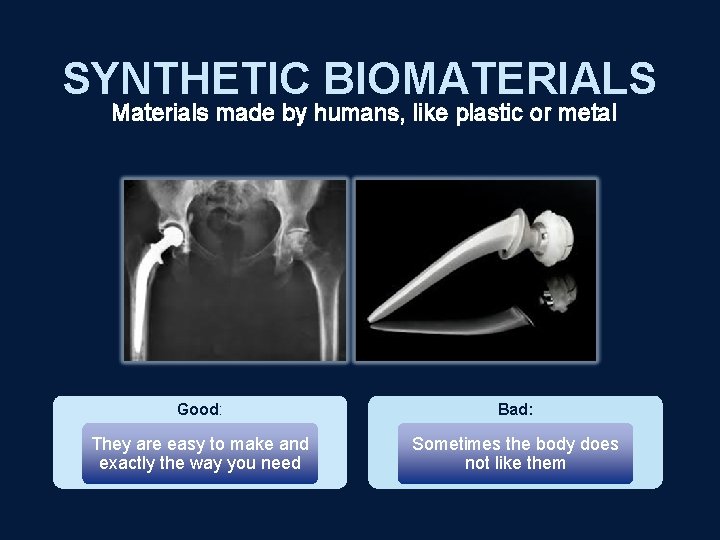
SYNTHETIC BIOMATERIALS Materials made by humans, like plastic or metal Good: Bad: They are easy to make and exactly the way you need Sometimes the body does not like them
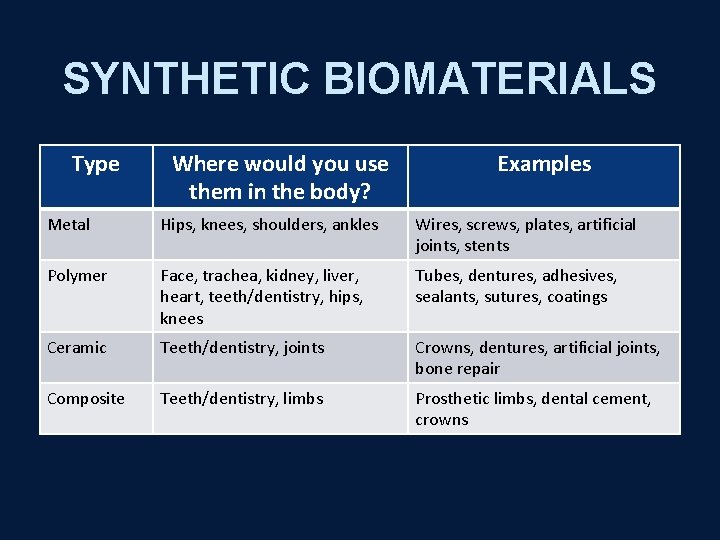
SYNTHETIC BIOMATERIALS Type Where would you use them in the body? Examples Metal Hips, knees, shoulders, ankles Wires, screws, plates, artificial joints, stents Polymer Face, trachea, kidney, liver, heart, teeth/dentistry, hips, knees Tubes, dentures, adhesives, sealants, sutures, coatings Ceramic Teeth/dentistry, joints Crowns, dentures, artificial joints, bone repair Composite Teeth/dentistry, limbs Prosthetic limbs, dental cement, crowns
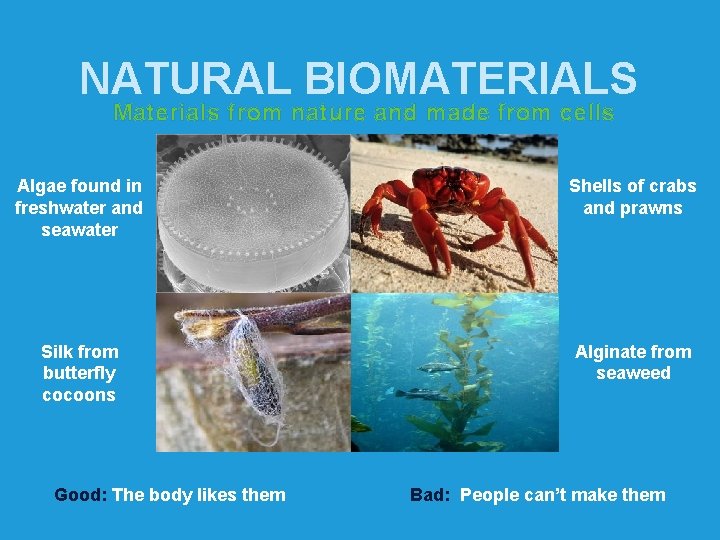
NATURAL BIOMATERIALS Materials from nature and made from cells Algae found in freshwater and seawater Shells of crabs and prawns Silk from butterfly cocoons Alginate from seaweed Good: The body likes them Bad: People can’t make them
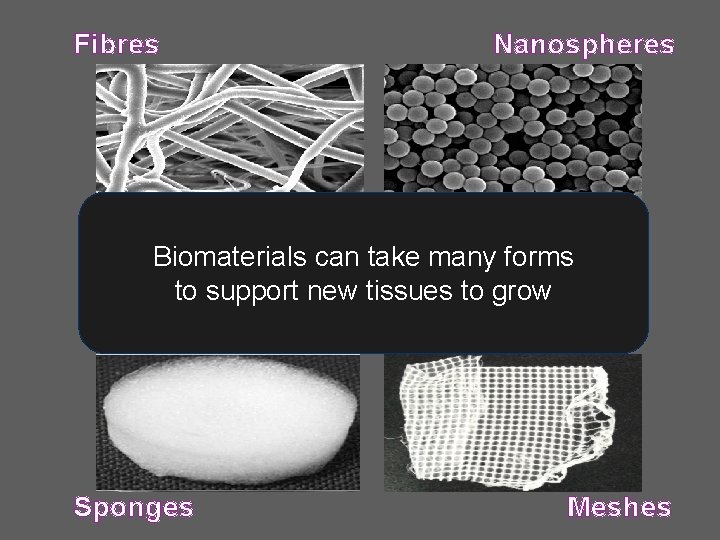
Fibres Nanospheres Biomaterials can take many forms to support new tissues to grow Sponges Meshes
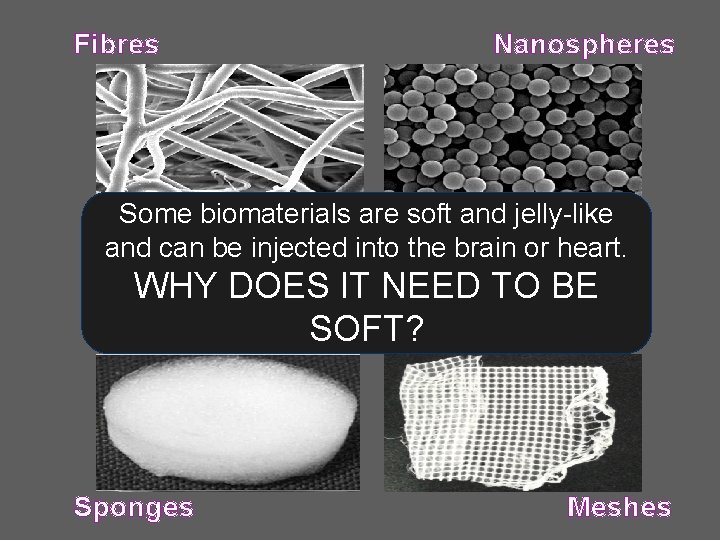
Fibres Nanospheres Some biomaterials are soft and jelly-like and can be injected into the brain or heart. WHY DOES IT NEED TO BE SOFT? Sponges Meshes
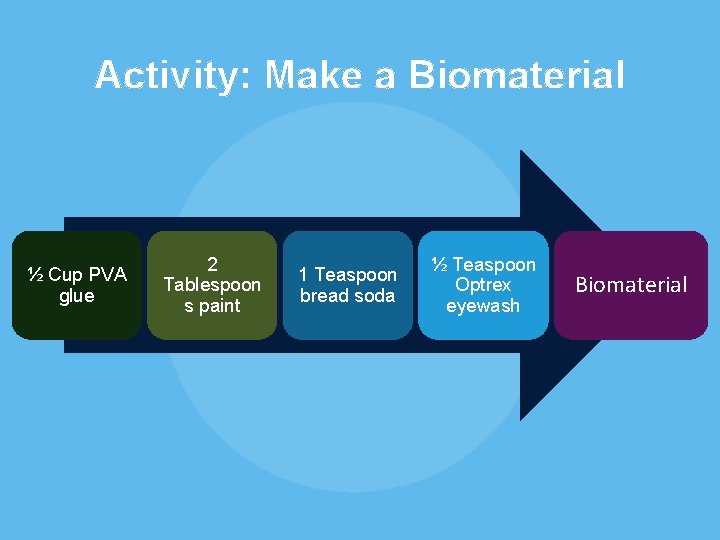
Activity: Make a Biomaterial ½ Cup PVA glue 2 Tablespoon s paint 1 Teaspoon bread soda ½ Teaspoon Optrex eyewash Biomaterial
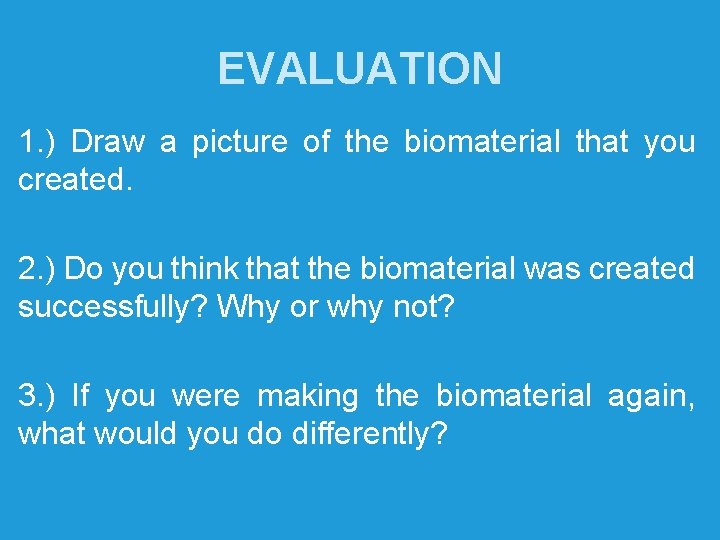
EVALUATION 1. ) Draw a picture of the biomaterial that you created. 2. ) Do you think that the biomaterial was created successfully? Why or why not? 3. ) If you were making the biomaterial again, what would you do differently?
Biomaterials

References: 1. Handbook of Materials for Medical Devices, 2003 ASM International 2. “Milestones in Medical Technology, ” New York Times, Published October 10, 2012 3. www. celldataservices. co. uk/biomaterials 4. commons. wikimedia. org 5. www. flickr. com 6. www. pixabay. com 7. vimeo. com 8. www. gojiberryblog. com/2011/09/11/how-to-revive-your-plants/ 9. gpwalsh. com/the-shift/ 10. animals. nationalgeographic. com/animals/invertebrates/red-crab/ Sincere thanks to all of the researchers who gave lectures and generously gave their time throughout the course. Thanks also to all the participating teachers who very kindly shared ideas and resources.

This publication has emanated from research conducted with the financial support of Science Foundation Ireland (SFI) and is co-funded under the European Regional Development Fund under Grant Number 13/RC/2073. This project has been funded by the European Union Seventh Framework Programme under Marie Curie Initial Training Networks (FP 7 -PEOPLE 2012 -ITN) and Grant Agreement Number 317304 (Angio. Mat. Train). This project has also been funded by the European Union Horizon 2020 Programme (H 2020 -MSCA-ITN-2015) under the Marie Skłodowska-Curie Innovative Training Networks and Grant Agreement Numbers 676408 (Brain. Mat. Train) and 676338 (Tendon Therapy Train).
- Slides: 19