
Introducing AP and IB Biology I hear and
Introducing AP and IB Biology I hear and I forget. I see and I remember. I do and I understand. Confucius
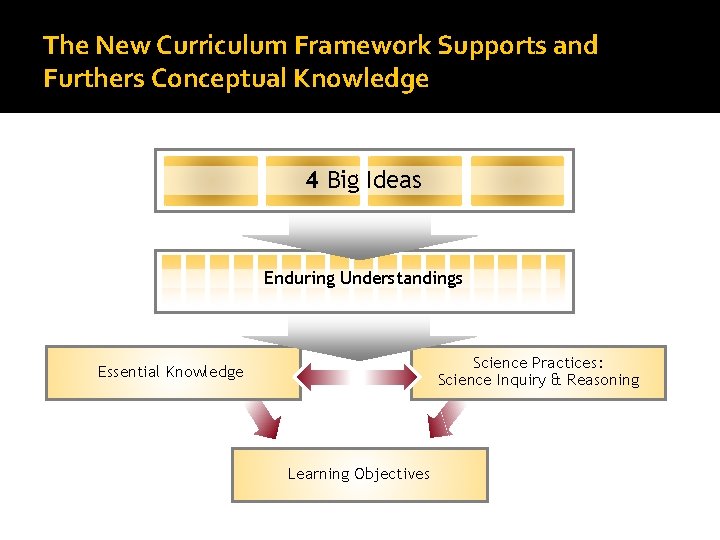
The New Curriculum Framework Supports and Furthers Conceptual Knowledge 4 Big Ideas Enduring Understandings Science Practices: Science Inquiry & Reasoning Essential Knowledge Learning Objectives
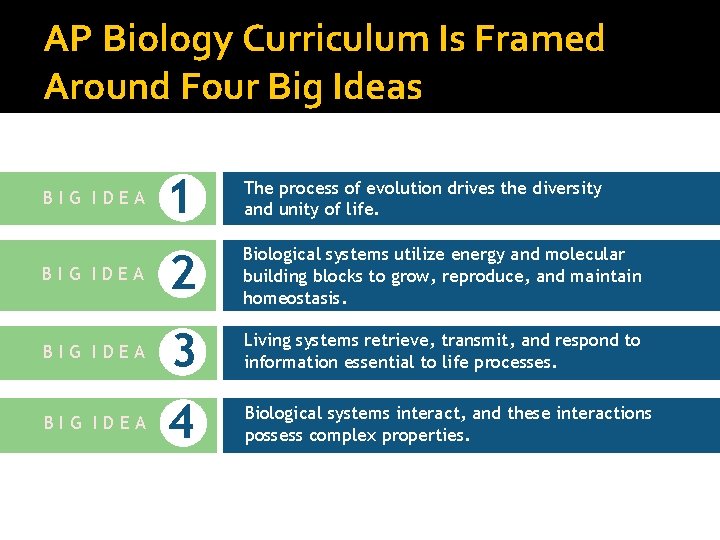
AP Biology Curriculum Is Framed Around Four Big Ideas BIG IDEA 1 The process of evolution drives the diversity and unity of life. 2 Biological systems utilize energy and molecular building blocks to grow, reproduce, and maintain homeostasis. 3 4 Living systems retrieve, transmit, and respond to information essential to life processes. Biological systems interact, and these interactions possess complex properties.
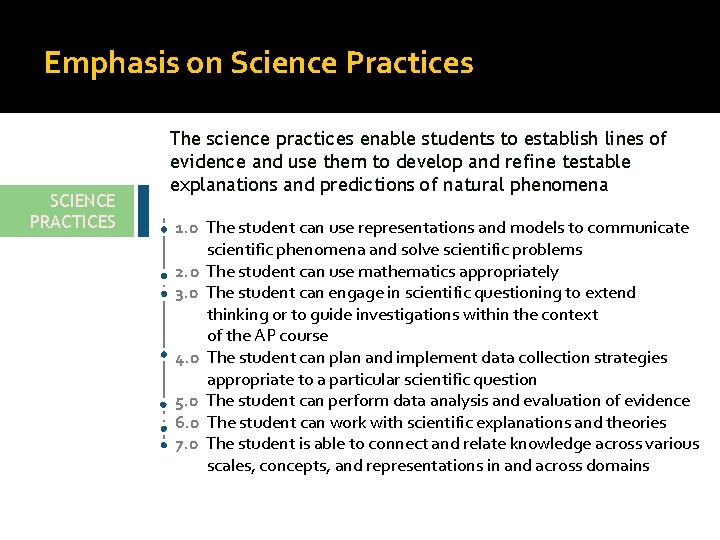
Emphasis on Science Practices SCIENCE PRACTICES The science practices enable students to establish lines of evidence and use them to develop and refine testable explanations and predictions of natural phenomena 1. 0 The student can use representations and models to communicate scientific phenomena and solve scientific problems 2. 0 The student can use mathematics appropriately 3. 0 The student can engage in scientific questioning to extend thinking or to guide investigations within the context of the AP course 4. 0 The student can plan and implement data collection strategies appropriate to a particular scientific question 5. 0 The student can perform data analysis and evaluation of evidence 6. 0 The student can work with scientific explanations and theories 7. 0 The student is able to connect and relate knowledge across various scales, concepts, and representations in and across domains

AP Biology Test Exam Design Section Information: Item Types & Weight Multiple Choice + Grid-ins (50% of exam weight) Question Types and Distribution 63 multiple choice 6 grid-in questions (New type: mathematical manipulation/calculation. Students will write and bubble in numerated answer) Timing 90 m Ten Minutes Required Reading Time in Advance of the Free Response Section Free Response (50% of exam weight) 2 long free response questions, 1 of which connects to the lab experience 6 short free response questions 80 minutes + 10 minute reading period
IB Mission Statement � The International Baccalaureate aims to develop inquiring, knowledgeable and caring young people who help to create a better and more peaceful world through intercultural understanding and respect. � To this end the organization works with schools, governments and international organizations to develop challenging programmes of international education and rigorous assessment. � These programmes encourage students across the world to become active, compassionate and lifelong learners who understand that other people, with their differences, can also be right.
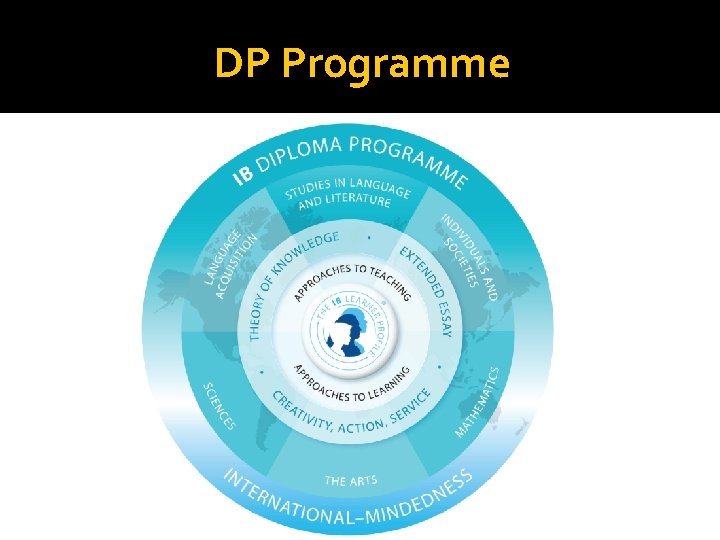
DP Programme
IB Learners Strive to Be � Inquirers- They develop their natural curiosity. They acquire the skills necessary to conduct inquiry and research and show independence in learning. They actively enjoy learning and this love of learning will be sustained throughout their lives. � Knowledgeable- They explore concepts, ideas and issues that have local and global significance. In so doing, they acquire in-depth knowledge and develop understanding across a broad and balanced range of disciplines. � Thinkers- They exercise initiative in applying thinking skills critically and creatively to recognize and approach complex problems, and make reasoned, ethical decisions. � Communicators- They understand express ideas and information confidently and creatively in more than one language and in a variety of modes of communication. They work effectively and willingly in collaboration with others � Principled- They act with integrity and honesty, with a strong sense of fairness, justice and respect for the dignity of the individual, groups and communities. They take responsibility for their own actions and the consequences that accompany them.
IB Learners Strive to Be � Open-minded- They understand appreciate their own cultures and personal histories, and are open to the perspectives, values and traditions of other individuals and communities. They are accustomed to seeking and evaluating a range of points of view, and are willing to grow from the experience. � Caring- They show empathy, compassion and respect towards the needs and feelings of others. They have a personal commitment to service, and act to make a positive difference to the lives of others and to the environment. � Risk-takers- They approach unfamiliar situations and uncertainty with courage and forethought, and have the independence of spirit to explore new roles, ideas and strategies. They are brave and articulate in defending their beliefs. � Balanced- They understand the importance of intellectual, physical and emotional balance to achieve personal well-being for themselves and others. � Reflective- They give thoughtful consideration to their own learning and experience. They are able to assess and understand their strengths and limitations in order to support their learning and personal development
Group 4 Subjects � The DP is a pre-university course of study leading to examinations; it is designed as a comprehensive two-year curriculum that allows its graduates to fulfill the requirements of university entrance to universities worldwide. � Through studying any of the group 4 subjects, students should become aware of how scientists work and communicate with each other. While the “scientific method” may take on a wide variety of forms, it is the emphasis on a practical approach through experimental work that distinguishes the group 4 subjects from other disciplines and characterizes each of the subjects within group 4.
DP Assessment �In group 4, the subjects physics, chemistry and biology have common aims and there is a single model of assessment for all three. This consists of practical work weighted at 24%, undertaken throughout the course, and written examinations weighted at 76%, taken at the end of the course
Internal Assessment � For internal assessment there are three assessment criteria to assess practical investigations: ▪ Design ▪ Data Collection and Processing ▪ Conclusion and Evaluation. � Two pieces of work are assessed for each criterion. The criterion “manipulative skills” is used summatively to assess a student’s hands-on practical skills during the course and the criterion “personal skills” is used to assess a student’s participation in the group 4 project
Summative Assessment �The summative assessment that takes place at the end of the course is in the form of three written examination papers: Paper 1—a multiple-choice question paper Paper 2—a mixture of short-answer questions and extended-response questions Paper 3—examining performance in the chosen topic options
AP Lab Final/Group 4 Project �The AP Lab Final/ Group 4 Project is an interdisciplinary activity in which all AP Biology/Diploma Programme science students must participate. � It mirrors the work of real scientists by encouraging collaboration between schools across the regions. �The emphasis is on the processes involved in scientific investigation rather than the products of such investigation.
AP Lab Final/Group 4 Project �The Project will be one scientific investigation taking about 10 hours � The write-up should be about 6 to 12 pages long. �It should require a purposeful research question and the scientific rationale for it.
AP Lab Final/Group 4 Project �Some of the possible tasks include: • a hands-on laboratory investigation • using a spreadsheet for analysis and modelling • extracting data from a database and analysing it graphically • producing a hybrid of spreadsheet/database work with a traditional hands-on investigation • using a simulation provided it is interactive and openended. �Some tasks may consist of relevant and appropriate qualitative work combined with quantitative work.
- Slides: 16