
Intro to World Geography Ready Video Clip Importance
- Slides: 6
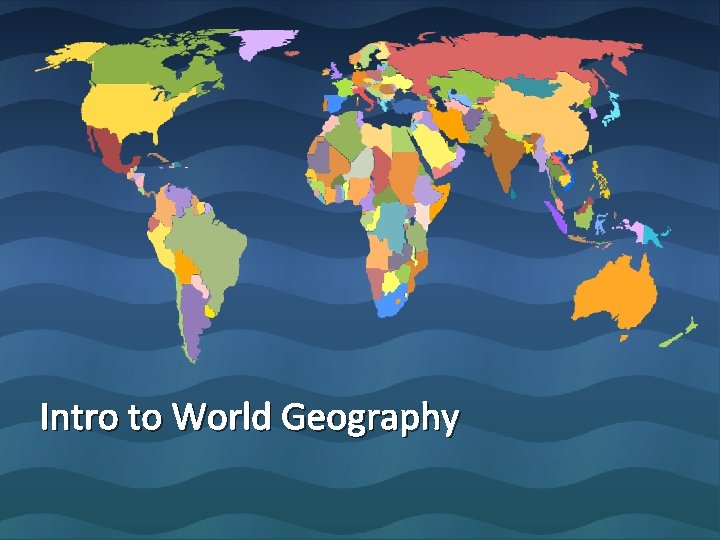
Intro to World Geography
Ready • Video Clip– Importance of Geography and knowledge of history • What do you know about geography?
Set– Basic Geography Terms absolute location-- The location of a point on the Earth's surface that can be expressed by a grid reference such as latitude and longitude. Altitude--Height of an object in the atmosphere above sea level. Atlas--A bound collection of maps. Boundary--A line indicating the limit of a country, state, or other political jurisdiction. Cartographer--A person who draws or makes maps or charts. Continent--One of the large, continuous areas of the Earth into which the land surface is divided.
Elevation--The height of a point on the Earth's surface above sea level. Equator--An imaginary circle around the Earth halfway between the North Pole and the South Pole; the largest circumference of the Earth. Grid--A pattern of lines on a chart or map, such as those representing latitude and longitude, which helps determine absolute location. Hemisphere--Half of the Earth, usually conceived as resulting from the division of the globe into two equal parts 'north and south or east and west. international date line-- A line of longitude generally 180 degrees east and west of the prime meridian. The date is one day earlier to the east of the line.
Latitude-- Imaginary lines that cross the surface of the Earth parallel to the Equator, measuring how far north or south of the Equator a place is located. Legend-- A key to what the symbols or pictures in a map mean. Longitude--Imaginary lines that cross the surface of the Earth, running from north to south, measuring how far east or west of the prime meridian a place is located. Map-- A picture of a place that is usually drawn to scale on a flat surface. prime meridian--An imaginary line running from north to south through Greenwich, England, used as the reference point for longitude. Scale--The proportional relationship between a linear measurement on a map and the distance it represents on the Earth's surface. sea level--The ocean surface. Topography --The physical features of a place; or the study and depiction of physical features, including terrain relief.
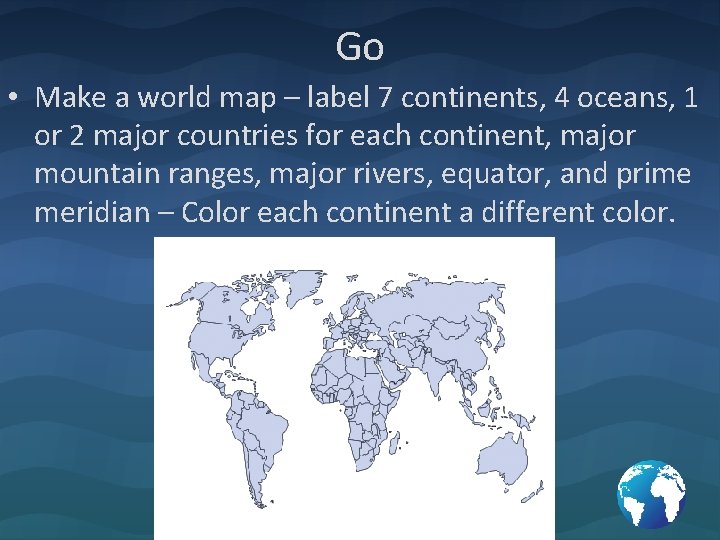
Go • Make a world map – label 7 continents, 4 oceans, 1 or 2 major countries for each continent, major mountain ranges, major rivers, equator, and prime meridian – Color each continent a different color.