
Intro to Verbs and Present Active Indicative Introduction

Intro to Verbs and Present Active Indicative Introduction to Verbs By Stephen Curto For Intro to Greek Oct 2, 2016

Outline I. Review II. Intro to Verbs III. Present Active Indicative
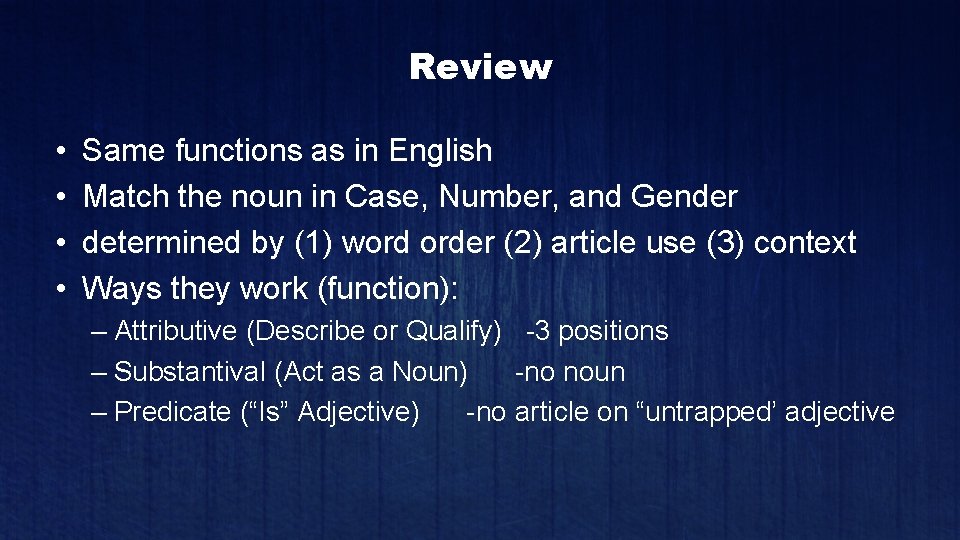
Review • • Same functions as in English Match the noun in Case, Number, and Gender determined by (1) word order (2) article use (3) context Ways they work (function): – Attributive (Describe or Qualify) -3 positions – Substantival (Act as a Noun) -no noun – Predicate (“Is” Adjective) -no article on “untrapped’ adjective
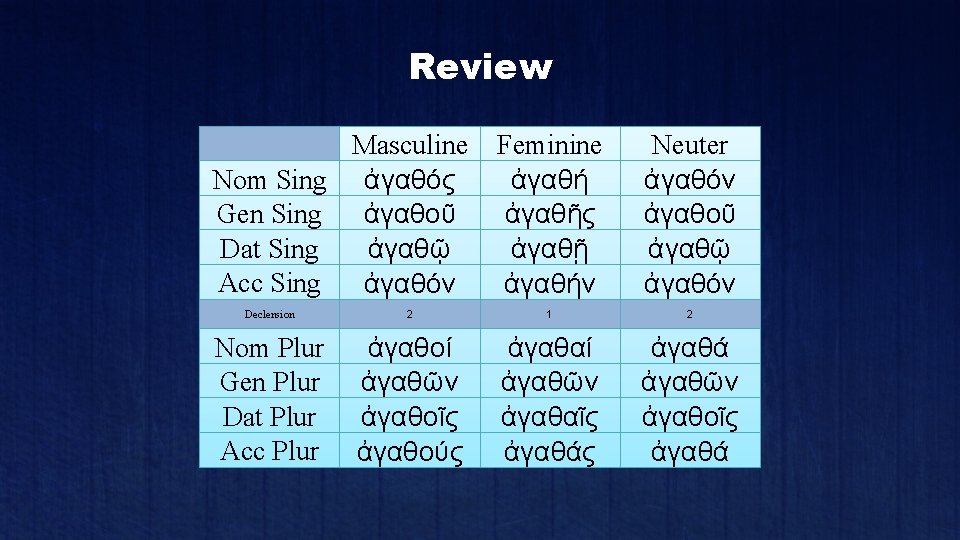

Review Homework - Exercise 9
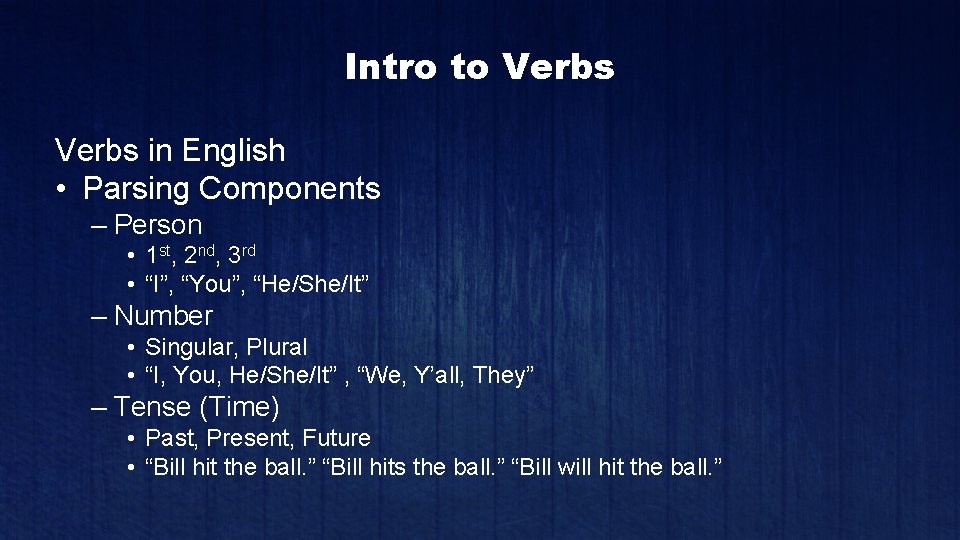
Intro to Verbs in English • Parsing Components – Person • 1 st, 2 nd, 3 rd • “I”, “You”, “He/She/It” – Number • Singular, Plural • “I, You, He/She/It” , “We, Y’all, They” – Tense (Time) • Past, Present, Future • “Bill hit the ball. ” “Bill hits the ball. ” “Bill will hit the ball. ”
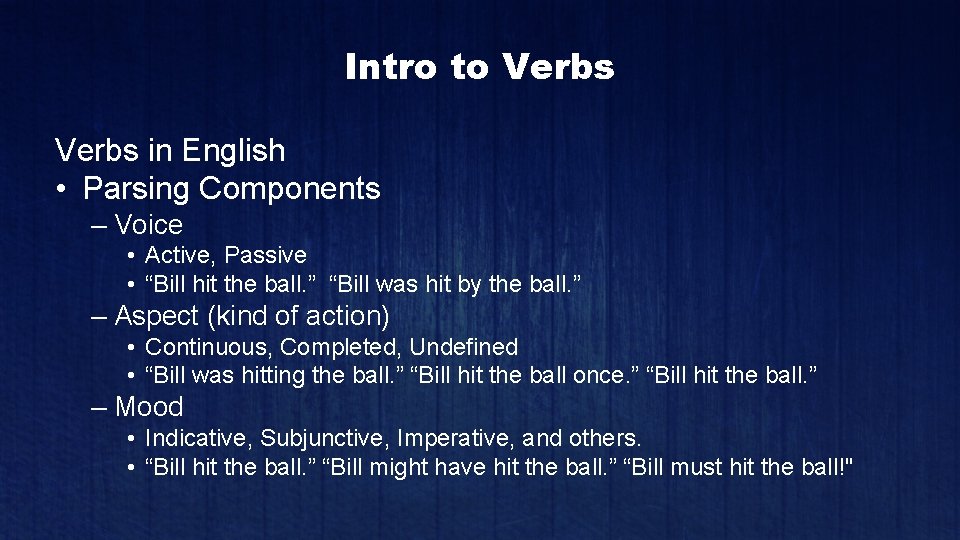
Intro to Verbs in English • Parsing Components – Voice • Active, Passive • “Bill hit the ball. ” “Bill was hit by the ball. ” – Aspect (kind of action) • Continuous, Completed, Undefined • “Bill was hitting the ball. ” “Bill hit the ball once. ” “Bill hit the ball. ” – Mood • Indicative, Subjunctive, Imperative, and others. • “Bill hit the ball. ” “Bill might have hit the ball. ” “Bill must hit the ball!"
Intro to Verbs in Greek • Parsing Components – Person • 1 st, 2 nd, 3 rd – Number • Singular, Plural – Voice • Active, Middle, Passive – Mood • Indicative, Subjunctive, Imperative, Optative, (Participle), (Infinitive)
Intro to Verbs in Greek • Parsing Components – Tense (Time AND Aspect [or “Kind of Action”]) • Present, Imperfect, Perfect, Aorist, Future, Pluperfect e. g. Present – Present time and either continuous or undefined aspect. Imperfect – Past time and continuous aspect. Aorist – Past time and undefined aspect. Perfect – Past time and completed aspect.
Present Active Indicative • Present Tense – Present time and continuous or undefined aspect • Active Voice – The subject is the actor of the verb • Indicative Mood – It states a fact. The “How it is” mood. (We won’t see any other moods. )
Present Active Indicative REMEMBER – Parts of a Greek Word Stem. Case Ending. Connecting vowel?
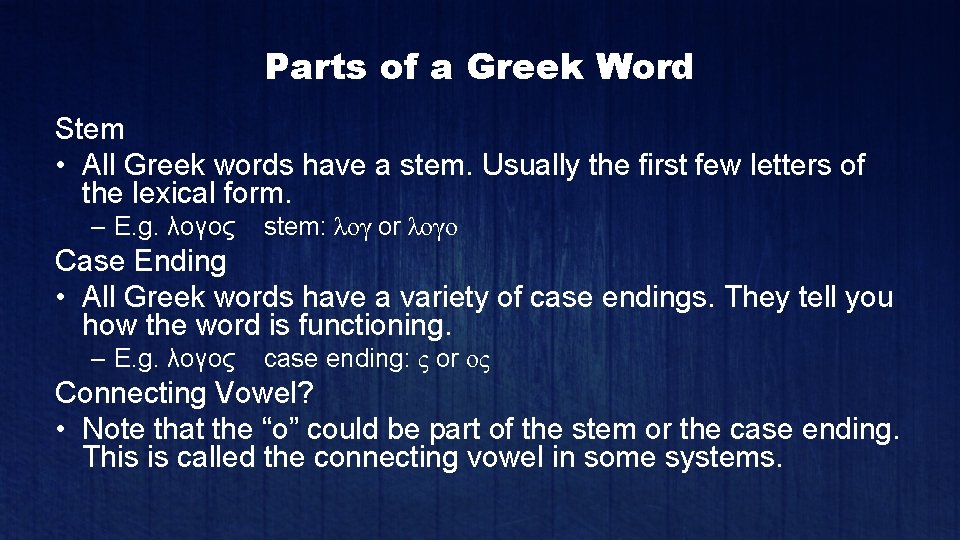
Parts of a Greek Word Stem • All Greek words have a stem. Usually the first few letters of the lexical form. – E. g. λογος stem: λογ or λογο Case Ending • All Greek words have a variety of case endings. They tell you how the word is functioning. – E. g. λογος case ending: ς or ος Connecting Vowel? • Note that the “o” could be part of the stem or the case ending. This is called the connecting vowel in some systems.
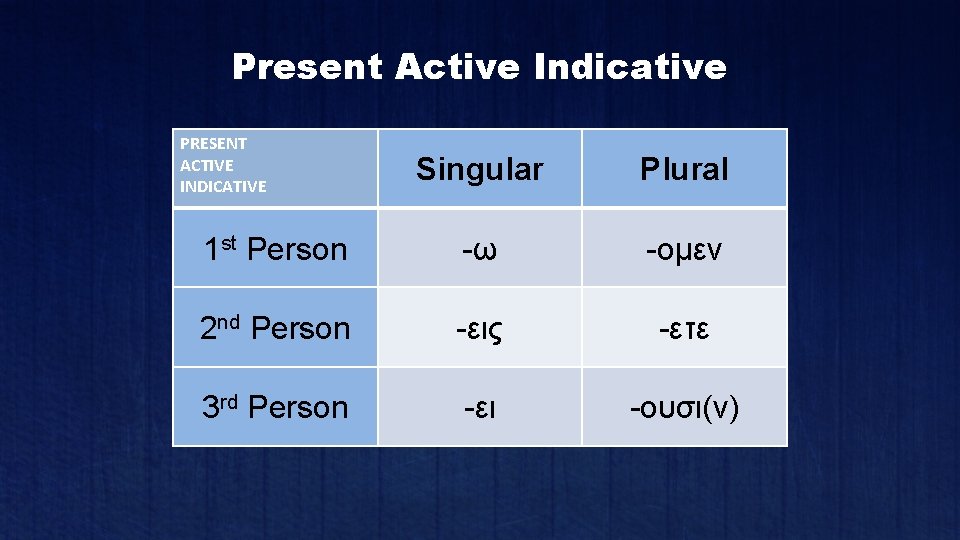
Present Active Indicative PRESENT ACTIVE INDICATIVE Singular Plural 1 st Person -ω -ομεν 2 nd Person -εις -ετε 3 rd Person -ει -ουσι(ν)
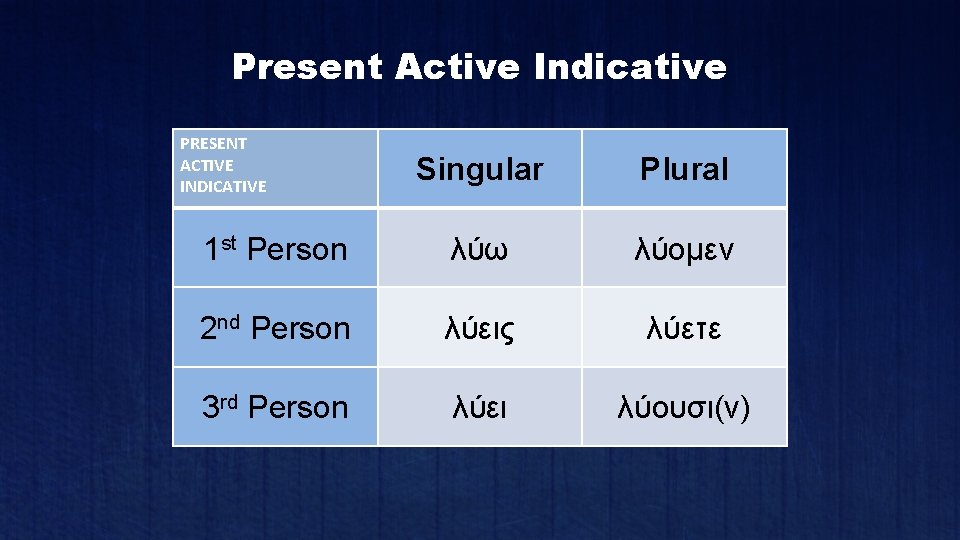
Present Active Indicative PRESENT ACTIVE INDICATIVE Singular Plural 1 st Person λύω λύομεν 2 nd Person λύεις λύετε 3 rd Person λύει λύουσι(ν)
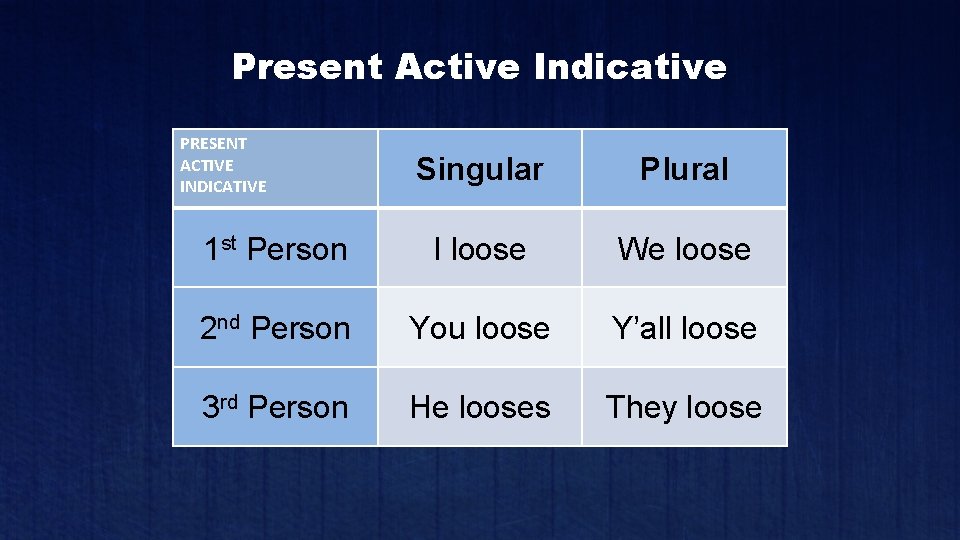
Present Active Indicative PRESENT ACTIVE INDICATIVE Singular Plural 1 st Person I loose We loose 2 nd Person You loose Y’all loose 3 rd Person He looses They loose
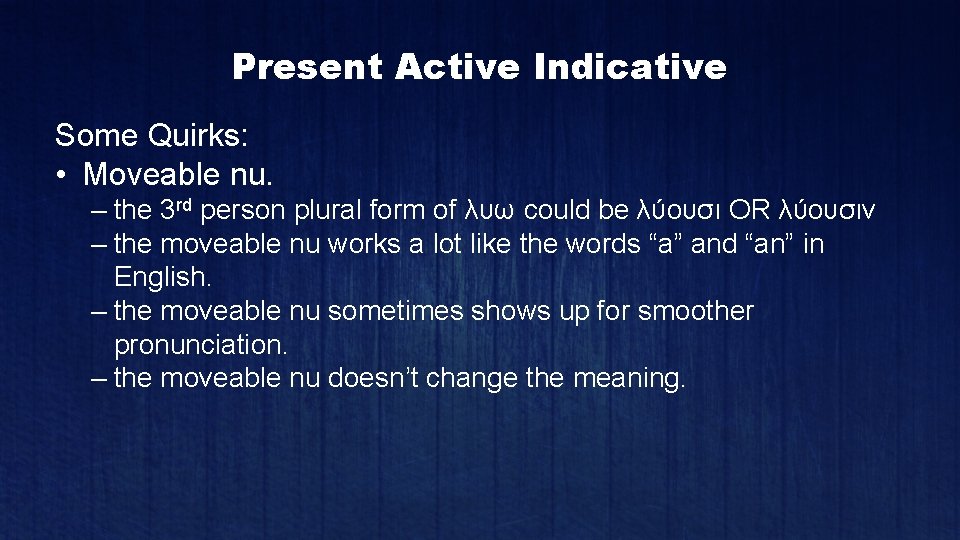
Present Active Indicative Some Quirks: • Moveable nu. – the 3 rd person plural form of λυω could be λύουσι OR λύουσιν – the moveable nu works a lot like the words “a” and “an” in English. – the moveable nu sometimes shows up for smoother pronunciation. – the moveable nu doesn’t change the meaning.
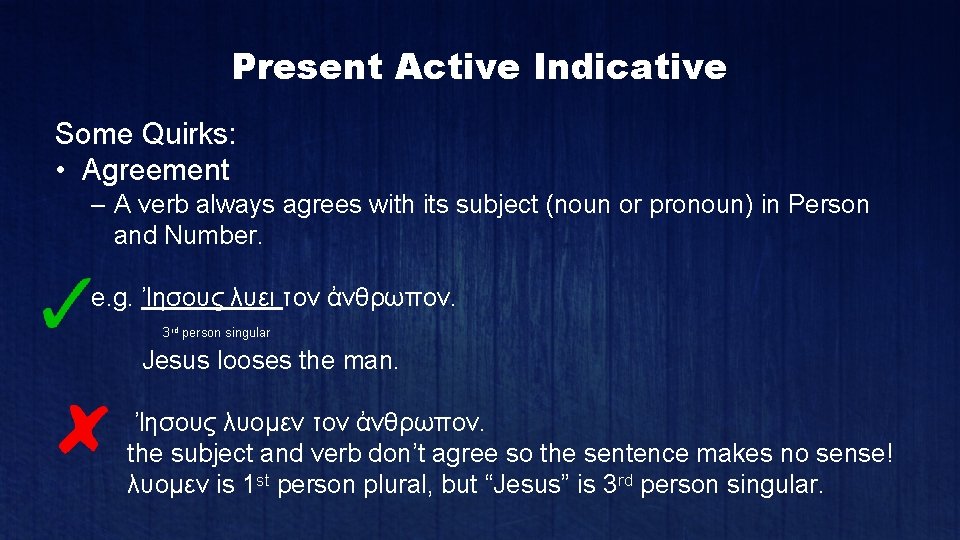
Present Active Indicative Some Quirks: • Agreement – A verb always agrees with its subject (noun or pronoun) in Person and Number. e. g. Ἰησους λυει τον ἀνθρωπον. 3 rd person singular Jesus looses the man. Ἰησους λυομεν τον ἀνθρωπον. the subject and verb don’t agree so the sentence makes no sense! λυομεν is 1 st person plural, but “Jesus” is 3 rd person singular.

- Slides: 18