
Intro to Tiling Assembly From PPT by HoLin
Intro to Tiling Assembly From PPT by Ho-Lin Chen, Ashish Goel, Tianqi Song
Self-Assembly n Self-Assembly is the process by which simple objects autonomously assemble into complexes. n n Geometry, dynamics, combinatorics are all important Inorganic: Crystals, supramolecules Organic: Proteins, DNA, cells, organisms Goals: Understand self-assembly, design self-assembling systems n A key problem in nano-technology, molecular robotics, molecular computation

What is Molecular Selfassembly? • Self-assembly is the spontaneous formation of a complex by small (molecular) components under simple combination rules • Geometry, dynamics, combinatorics are all important • Inorganic: Crystals, supramolecules • Organic: Proteins, DNA • Goals: Understand self-assembly, design selfassembling systems • A key problem in nano-technology, molecular robotics, molecular computation
A Matter of Scale • Question: Why a mathematical study “molecular” self-assembly specifically? • Answer: The scale changes everything of • Consider assembling micro-level (or larger) structures such as robotic swarms. We can attach rudimentary computers, motors, and radios to these structures. • Can now implement an intelligent distributed algorithm. • In molecular self-assembly, we have nano-scale components. No computers. No radios. No antennas. We need self-assembly to make computers, radios, antennas, motors. • Local rules such as “attach to another component if it has a complementary DNA strand” • Self-assembly at larger scales is interesting, but is more a sub-discipline of distributed algorithms, artificial intelligence etc.
Applications of Self-Assembly n Building blocks of nano-machines. n DNA computing. n n Small electrical devices such as FLASH memory. [Black et. Al. ’ 03] Nanostructures which “steer” light in the same way computer chips steer electrons. [Percec et. Al. ’ 03]
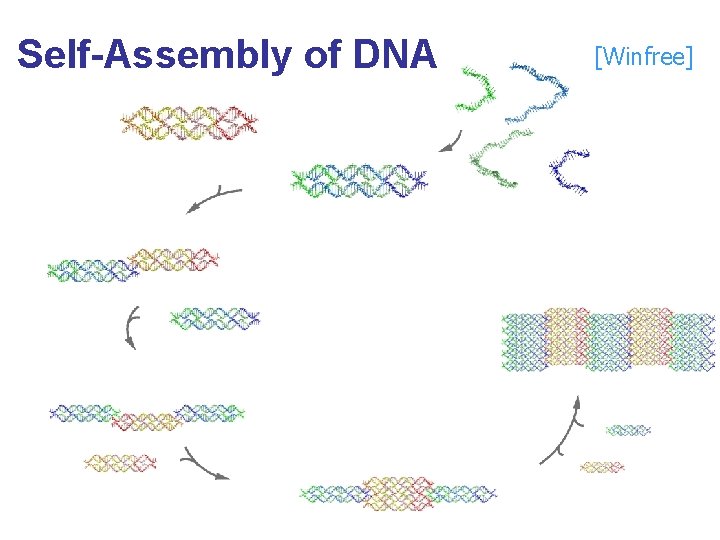
Self-Assembly of DNA [Winfree] 6
Wang Tiling n n Proposed by Hao Wang in 1961. Given a finite set of square tiles with a glue on each side. Question: whether they can tile the plane with same abutting glue. Note that tiles cannot be rotated or reflected and you can use infinite number of copies of each tile.
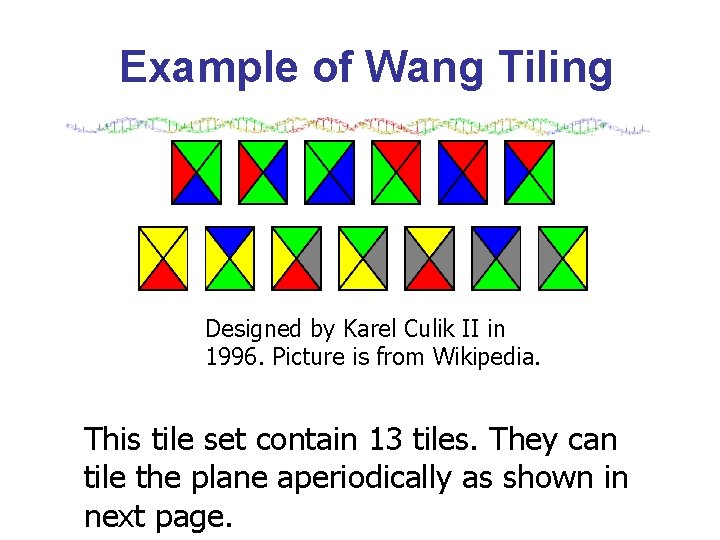
Example of Wang Tiling Designed by Karel Culik II in 1996. Picture is from Wikipedia. This tile set contain 13 tiles. They can tile the plane aperiodically as shown in next page.

Example of Wang Tiling This picture is from Wikipedia.

Undecidability of tiling problem Robinson, 1971 : Undecidability and Nonperiodicity for Tilings of the Plane: It is possible to translate any Turing machine into a set of Wang tiles, such that the Wang tiles can tile the plane if and only if the Turing machine will never halt Due to the reduction of Turing machines to tilings systems: a self-tiling system could compute a function!
Is Self-Assembly Just Crystallization? n No. Crystals do not grow into unique terminal structures! n n Crystals are typically made up of a small number of different types of components n n Two types of proteins; a single Carbon molecule Crystals have regular patterns n n A sugar crystal does not grow to precisely 20 nm Computer circuits, which we would like to self-assemble, don’t Self-assembly = combinatorics + crystallization n n Can count, make interesting patterns Nature doesn’t count too well, so molecular self-assembly is a genuinely new engineering paradigm. Think engines. Think semiconductors.

Abstract System Model(ATAM)

DNA Tiles G 4 G 3 = G 1 G 2 [Fu and Seeman, 93] [Winfree and Seeman] Glues = sticky ends Tiles = molecules

DNA Self-Assembly n We will tacitly assume that the tiles are made of DNA strands woven together, and that the glues are really free DNA strands n DNA is combinatorial, i. e. , the functionality of DNA is determined largely by the sequence of ACTG bases. Can ignore geometry to a first order. n n Trying to “count” using proteins would be hell – proteins have a complicated geometry and it is hard to predict what shape a single protein will take, let alone an entire assembly Proof-of-concept from nature: DNA strands can attach to combinatorially matching sequences DNA tiles have been constructed in the lab, and DNA computation has been demonstrated Can simulate arbitrary tile systems, so we do not lose any theoretical generality, but we get a concrete grounding in the real world
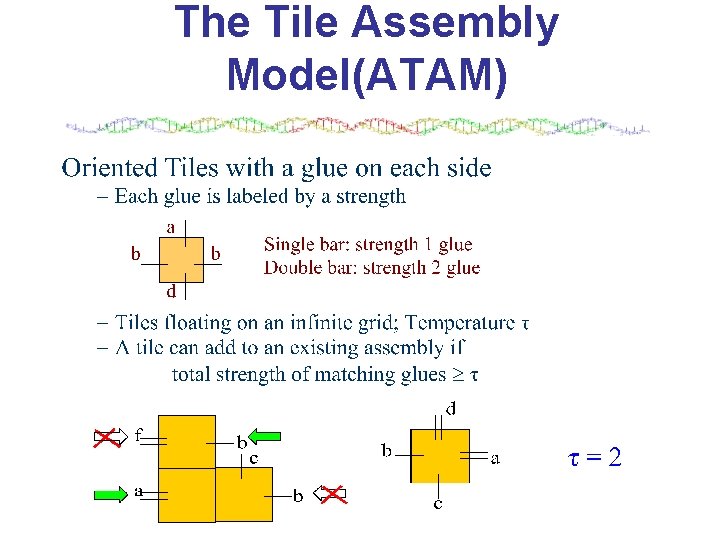
The Tile Assembly Model(ATAM)
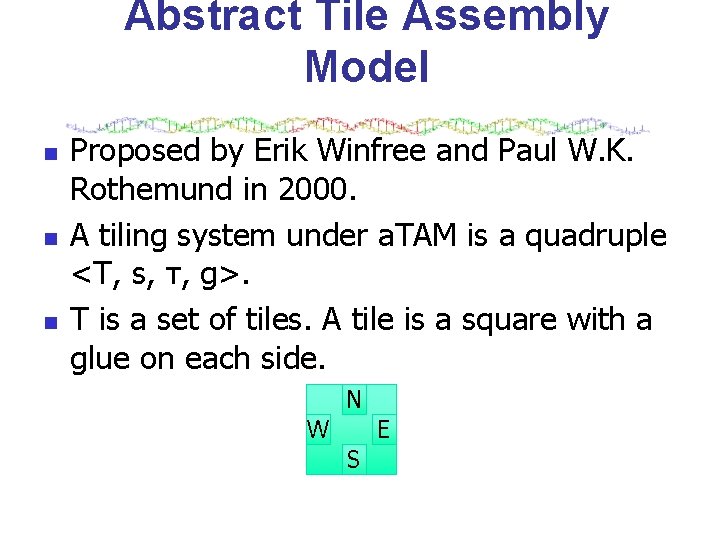
Abstract Tile Assembly Model n n n Proposed by Erik Winfree and Paul W. K. Rothemund in 2000. A tiling system under a. TAM is a quadruple <T, s, τ, g>. T is a set of tiles. A tile is a square with a glue on each side. N W E S
Abstract Tile Assembly Model n n s is seed tile. The initial configuration has only seed tile. τ is temperature: the minimum accumulative strength that can fix a tile in a configuration. g is glue strength function: G×G->N+, where G is glue set. For any x, y in G, g(x, y)=g(y, x). A configuration is a function: Z×Z->T U {empty}, where Z is the set of integers.
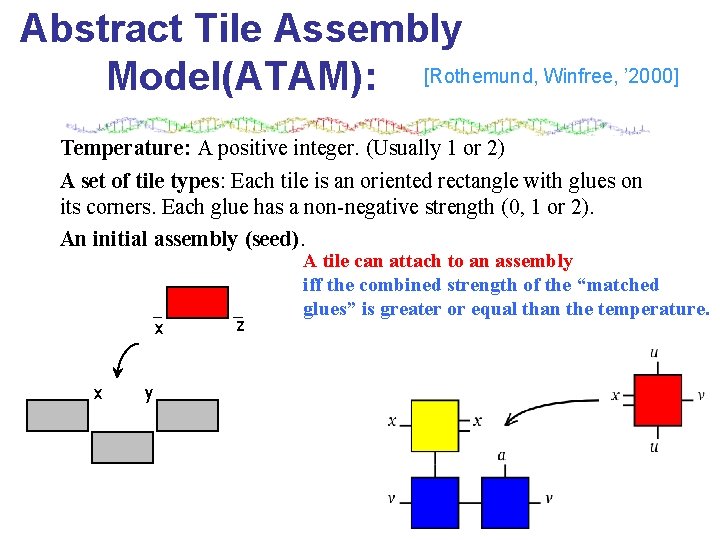
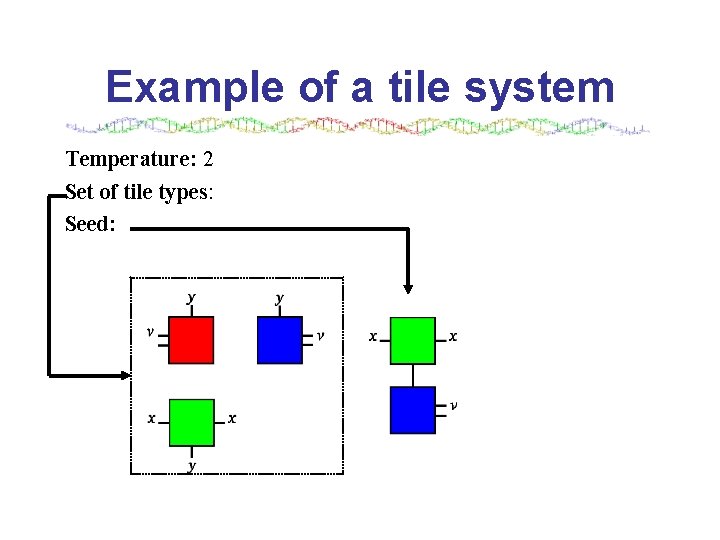
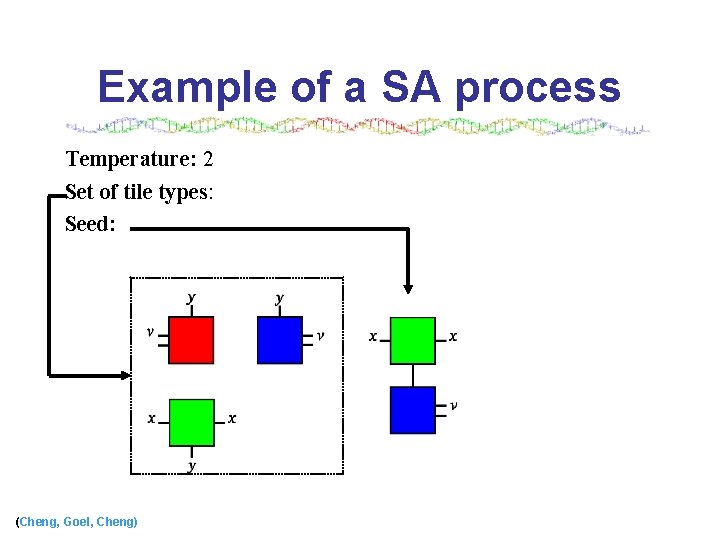
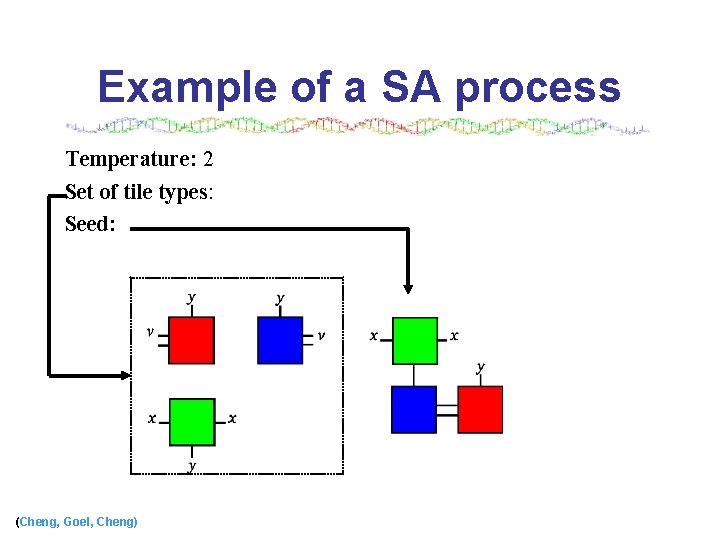
Abstract Tile Assembly Model(ATAM): [Rothemund, Winfree, ’ 2000] Temperature: A positive integer. (Usually 1 or 2) A set of tile types: Each tile is an oriented rectangle with glues on its corners. Each glue has a non-negative strength (0, 1 or 2). An initial assembly (seed). x x y z A tile can attach to an assembly iff the combined strength of the “matched glues” is greater or equal than the temperature.
Abstract Tile Systems
Example of a tile system Temperature: 2 Set of tile types: Seed:
Example of a SA process Temperature: 2 Set of tile types: Seed: (Cheng, Goel, Cheng)
Example of a SA process Temperature: 2 Set of tile types: Seed: (Cheng, Goel, Cheng)
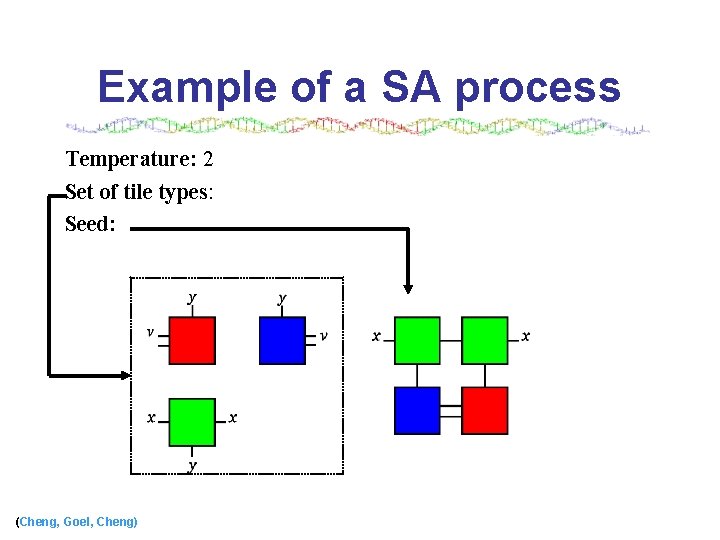
Example of a SA process Temperature: 2 Set of tile types: Seed: (Cheng, Goel, Cheng)
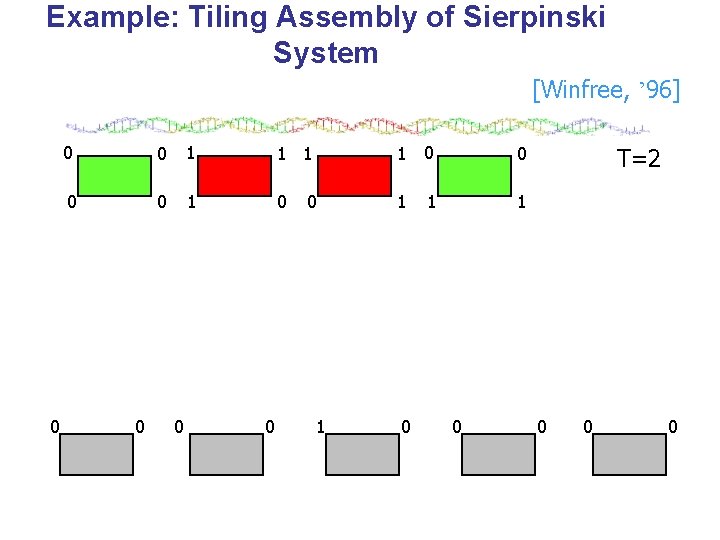
Example: Tiling Assembly of Sierpinski System [Winfree, ’ 96] 0 0 0 1 1 0 0 1 0 T=2 0 0 0
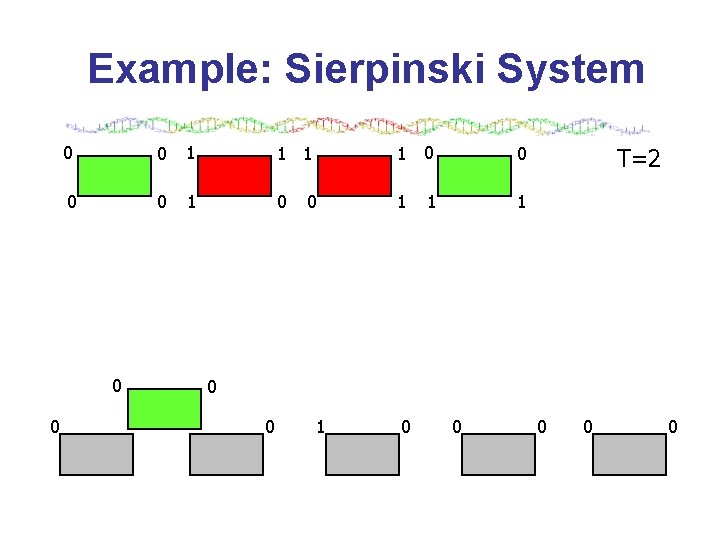
Example: Sierpinski System 0 0 1 1 0 0 1 0 1 1 0 0 0 1 T=2 0 0 1 0 0 0
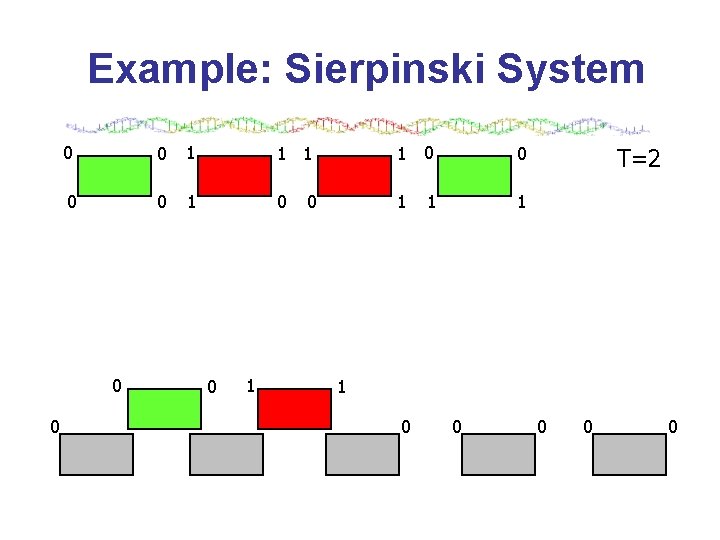
Example: Sierpinski System 0 0 1 1 0 0 1 0 1 1 0 0 0 1 T=2 1 0 0 0
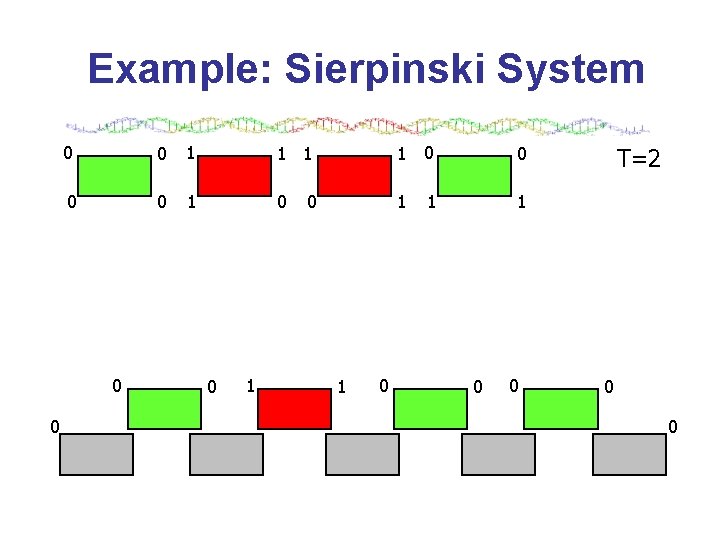
Example: Sierpinski System 0 0 1 1 0 0 1 0 1 1 0 0 0 1 0 1 0 0 T=2 0 0
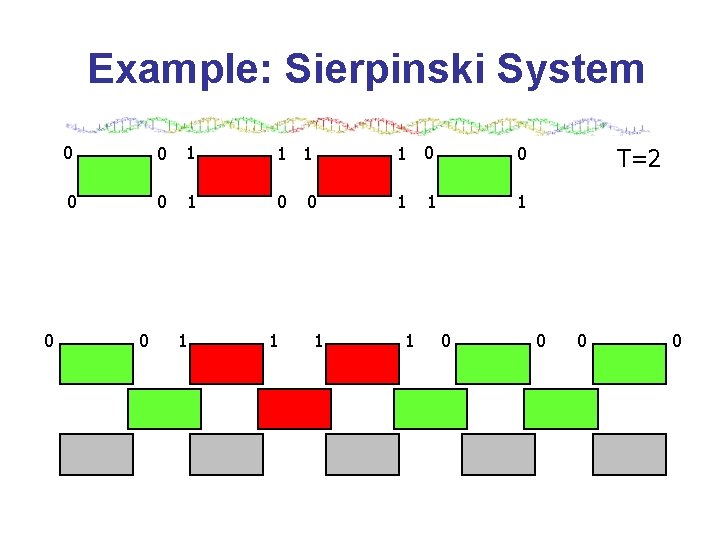
Example: Sierpinski System 0 0 0 1 1 0 0 1 0 1 1 1 0 T=2 0 0 0
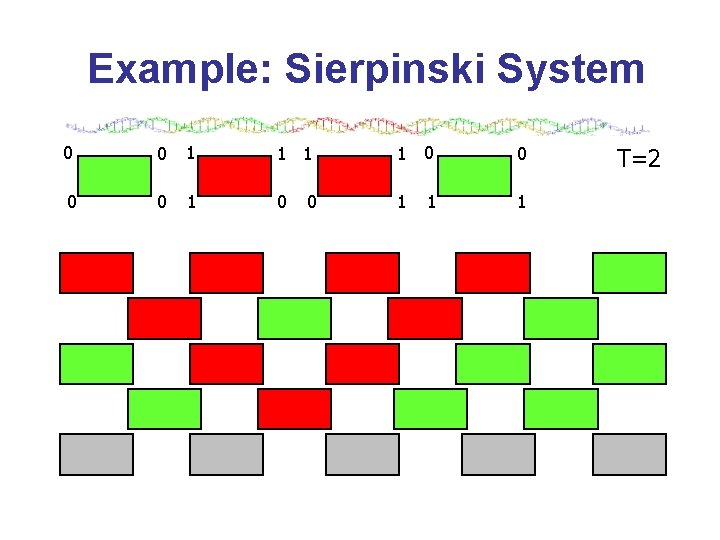
Example: Sierpinski System 0 0 1 1 0 0 1 0 1 T=2
Self-Assembled Circuit Patterns from DNA 9 Conference paper by Cook, Rothmund, Winfree
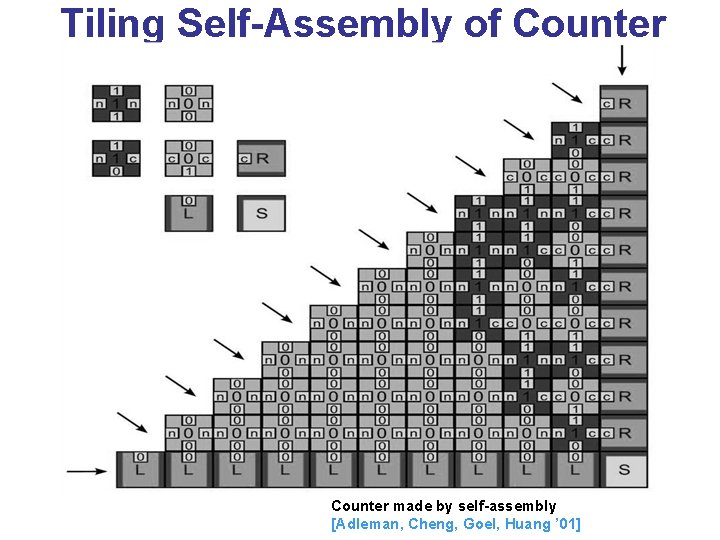
Tiling Self-Assembly of Counter made by self-assembly [Adleman, Cheng, Goel, Huang ’ 01]
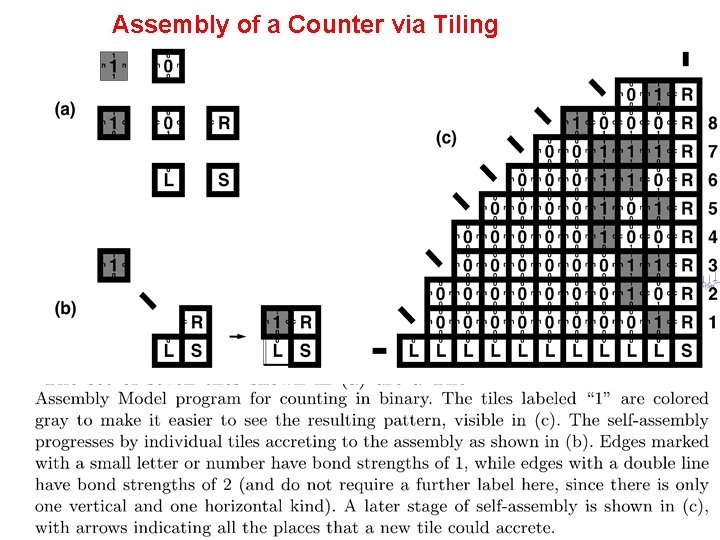
Assembly of a Counter via Tiling
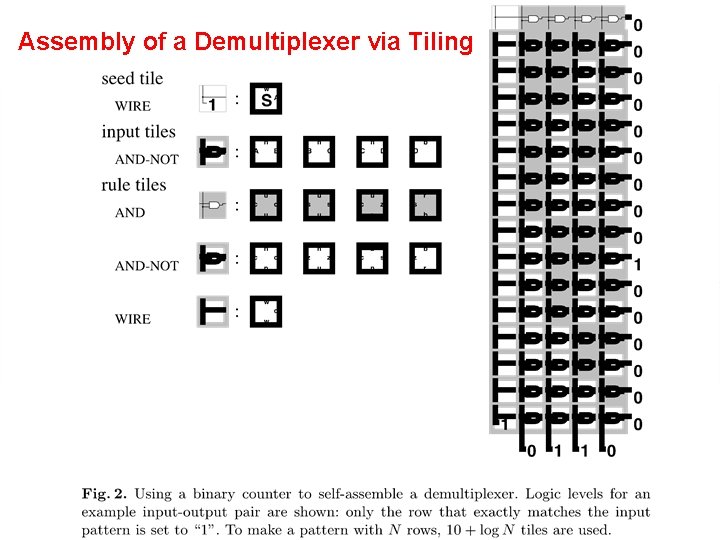
Assembly of a Demultiplexer via Tiling
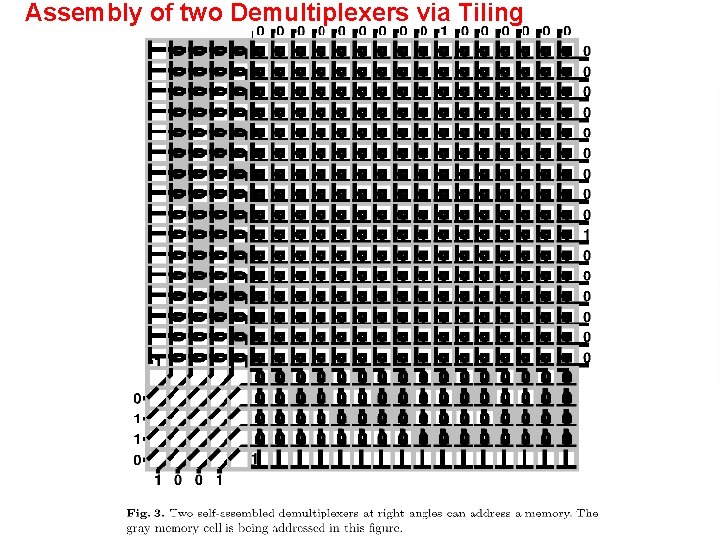
Assembly of two Demultiplexers via Tiling
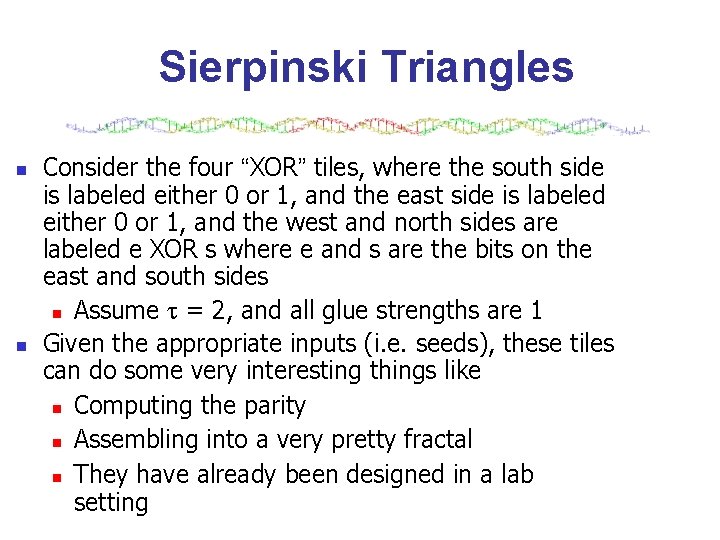
Sierpinski Triangles n n Consider the four “XOR” tiles, where the south side is labeled either 0 or 1, and the east side is labeled either 0 or 1, and the west and north sides are labeled e XOR s where e and s are the bits on the east and south sides n Assume t = 2, and all glue strengths are 1 Given the appropriate inputs (i. e. seeds), these tiles can do some very interesting things like n Computing the parity n Assembling into a very pretty fractal n They have already been designed in a lab setting
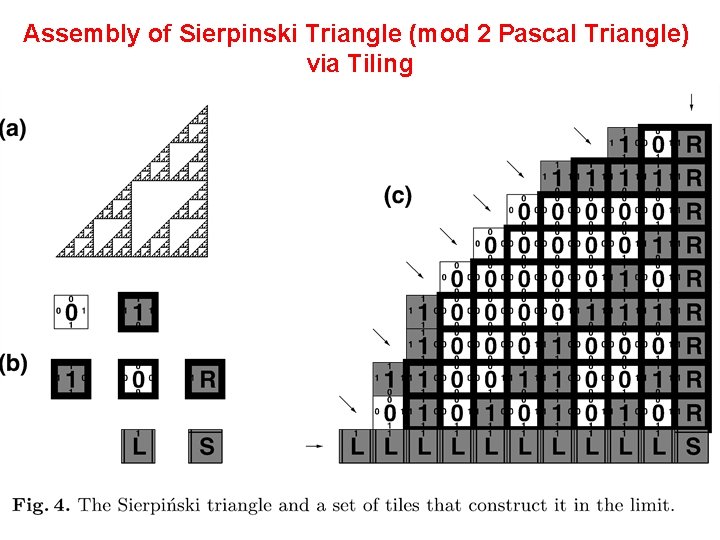
Assembly of Sierpinski Triangle (mod 2 Pascal Triangle) via Tiling
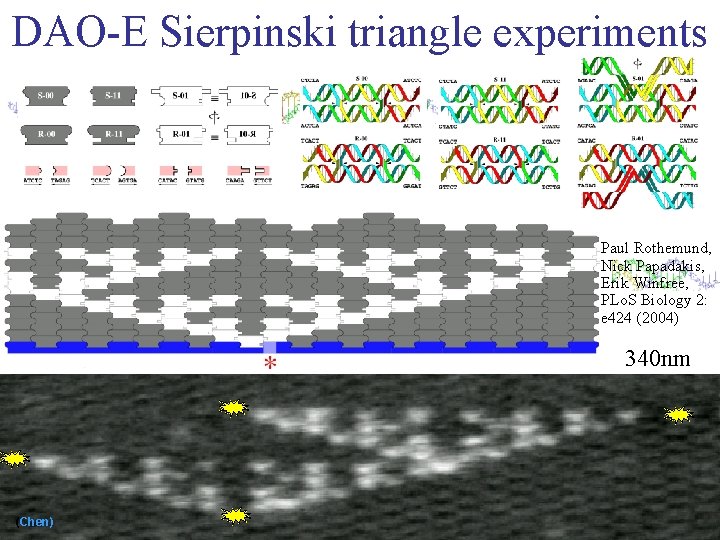
DAO-E Sierpinski triangle experiments Paul Rothemund, Nick Papadakis, Erik Winfree, PLo. S Biology 2: e 424 (2004) 340 nm (Chen)
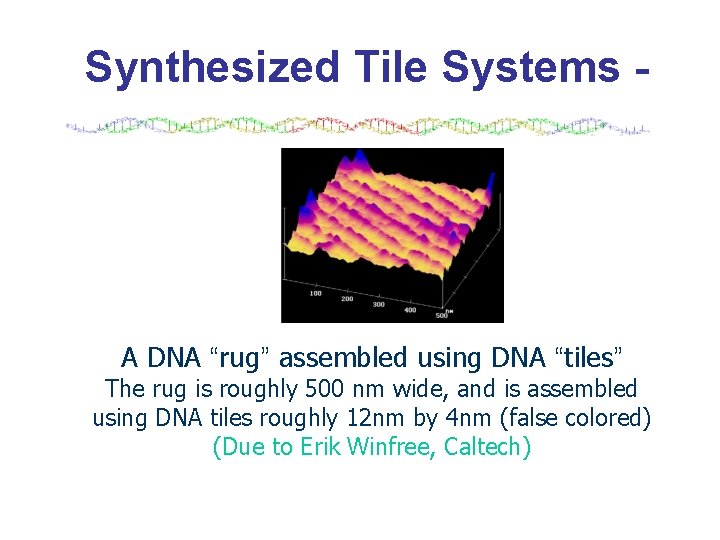
Synthesized Tile Systems - A DNA “rug” assembled using DNA “tiles” The rug is roughly 500 nm wide, and is assembled using DNA tiles roughly 12 nm by 4 nm (false colored) (Due to Erik Winfree, Caltech)
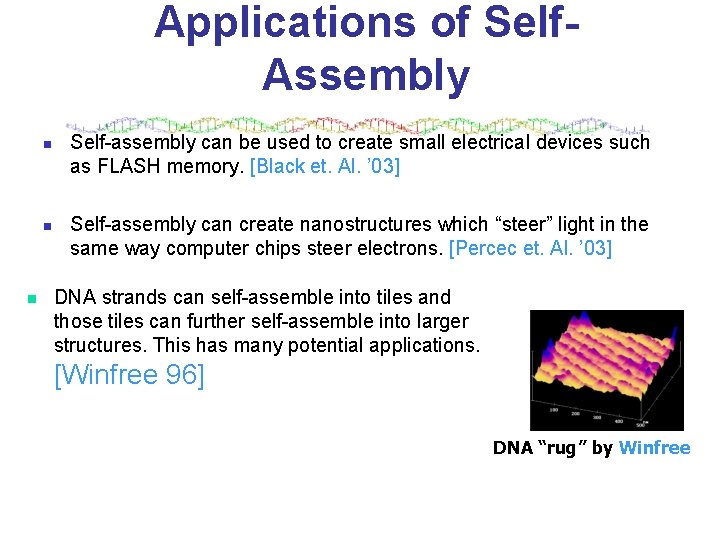
Applications of Self. Assembly n n n Self-assembly can be used to create small electrical devices such as FLASH memory. [Black et. Al. ’ 03] Self-assembly can create nanostructures which “steer” light in the same way computer chips steer electrons. [Percec et. Al. ’ 03] DNA strands can self-assemble into tiles and those tiles can further self-assemble into larger structures. This has many potential applications. [Winfree 96] DNA “rug” by Winfree
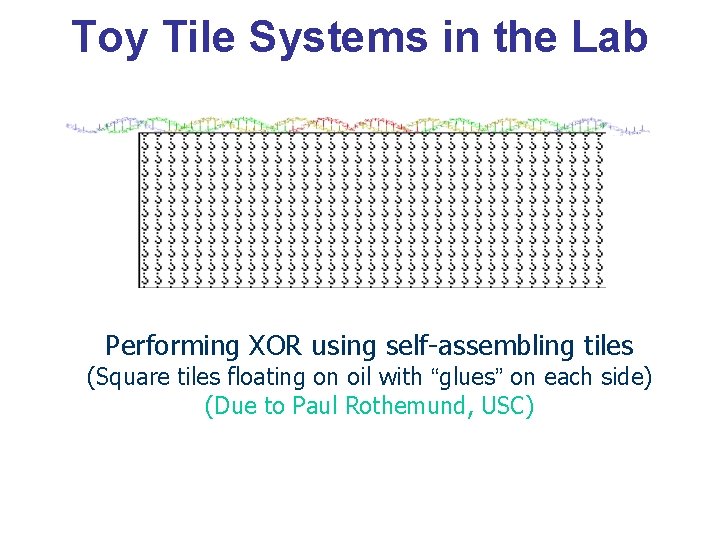
Toy Tile Systems in the Lab Performing XOR using self-assembling tiles (Square tiles floating on oil with “glues” on each side) (Due to Paul Rothemund, USC)
1 -D, 2 -D, and 3 -D n n Linear self-assemblies are very different from 2 -D self-assemblies 2 -D and 3 -D are essentially identical in terms of theory
Tile Complexity n n Tile complexity or program-size complexity: the minimum number of tile types required to assemble a shape. [Erik Winfree and Paul W. K. Rothemund STOC 2000] A special case: in the linear version proposed by Chandran et al, the tile set is MULTISET.
Theoretical and Algorithmic Issues n Efficiently assembling basic shapes with precisely controlled size and pattern n Constructing N X N squares with Ω(log n/log n) tiles [Adleman, Cheng, Goel, Huang, ’ 01] n Perform universal computation by simulating BCA [Winfree ’ 99] n n Library of primitives to use in designing nanoscale structures [Adleman, Cheng, Goel, Huang, ’ 01] Automate the design process [Adleman, Cheng, Goel, Huang, Kempe, Moisset de espanes, Rothemund ’ 01] n Robustness
Design Complexity of a Tile System n Suppose the tile system has k different tiles n n n Assume that we have q(k) different glues Assume for simplicity that all glues are represented by DNA strands of the same length, L How many different glues can we have? n n Each position can be one of the bases A, C, T, or G. An A pairs with T on the complementary strand, and a C pairs with G. So we can think of each position as corresponding to an AC base pair or a CG base pair. Two choices ) Binary encoding Number of glues · 2 L Total length of all the DNA strands in all the distinct tiles = q(k log k). We will refer to k log k as the design complexity n Does not depend on the size of the final structure. This is how much time and expertise and resources you would have to invest into designing the components (like program complexity)
Notes 1. 1. We will sometimes informally use the quantity k to refer to the design complexity. The rules of assembly are easy to code up in a simulator. Thus if a tile system of k tiles can assemble into a certain shape, then there is a computer program of size q(k log k) which generates that shape. Design complexity is only interesting for assembling larger and larger shapes of a particular type, eg. squares, lines, spirals. Design complexity of an infinite line, infinite square etc. is just 1.
Three Exercises 1. 2. 3. Suppose we did not assume that the number of glues is q(k). Can you still prove that the total length of all the strands in all the tiles is q(k log k)? We assumed that our tiles are oriented, i. e. , east is always east and north is always north, and the tiles are not allowed to rotate. Show an oriented tile system can be simulated using a system where tiles can rotate by +/- 90 degrees. Now use the fact that the glues are really DNA strands to show an oriented tile system can be simulated using a system where tiles can rotate by +/- 90 as well as 180 degrees.
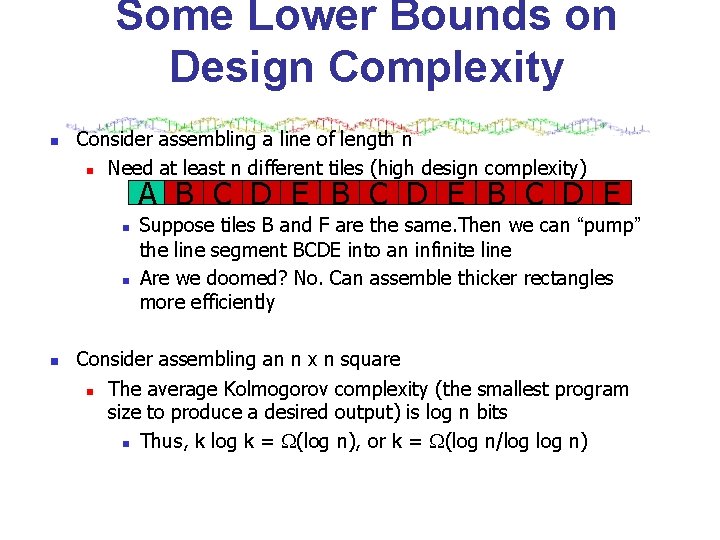
Some Lower Bounds on Design Complexity n Consider assembling a line of length n n Need at least n different tiles (high design complexity) A B C D E B F C G D H EI B C D E n n n Suppose tiles B and F are the same. Then we can “pump” the line segment BCDE into an infinite line Are we doomed? No. Can assemble thicker rectangles more efficiently Consider assembling an n x n square n The average Kolmogorov complexity (the smallest program size to produce a desired output) is log n bits n Thus, k log k = W(log n), or k = W(log n/log n)
Theoretical Results n Efficiently assembling basic shapes with precisely controlled size and pattern. n n n Constructing N X N squares with O(log n/log n) tiles. [Adleman, Cheng, Goel, Huang, ’ 01] Perform universal computation by simulating BCA. [Winfree ’ 99] Assemble arbitrary shape by O( Kolmogorov complexity) tiles with scaling. [Soloveichik, Winfree ’ 04]
Tile System Design n Library of primitives to use in designing nano-scale structures [Adleman, Cheng, Goel, Huang, ’ 01] n Automate the design process [Adleman, Cheng, Goel, Huang, Kempe, Moisset de espanes, Rothemund ’ 01]
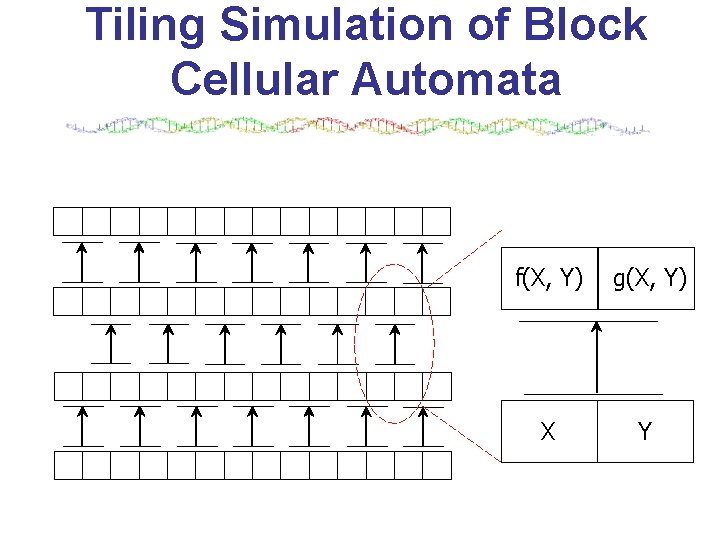
Tiling Simulation of Block Cellular Automata f(X, Y) g(X, Y) X Y
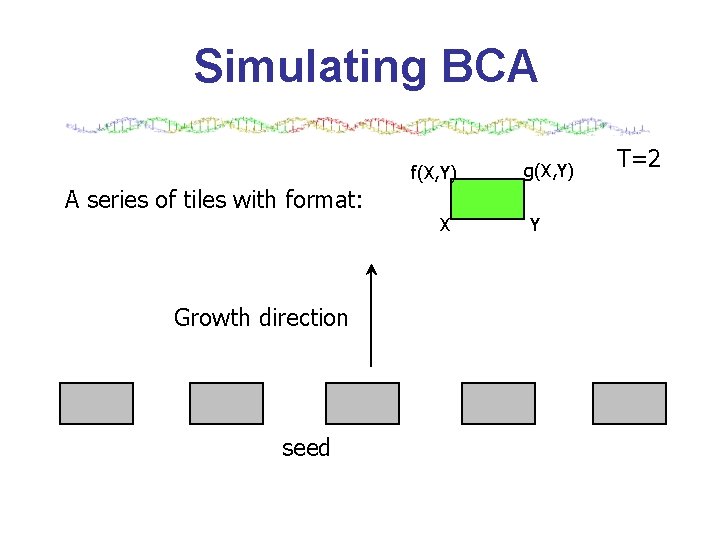
Simulating BCA f(X, Y) g(X, Y) A series of tiles with format: X Growth direction seed Y T=2
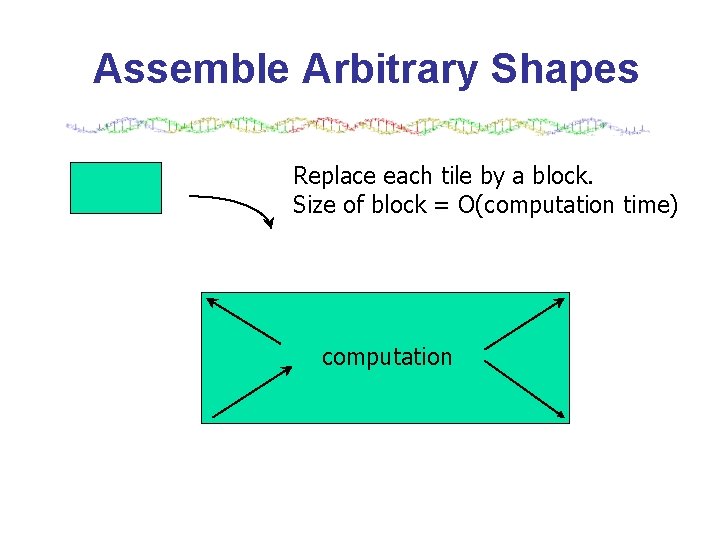
Assemble Arbitrary Shapes Replace each tile by a block. Size of block = O(computation time) computation
Kinetic Tiling System Model (KTAM)
Kinetic Tile Assembly (KTAM) Model n n Proposed by Erik Winfree in 1988. Four assumptions: (1) All monomers hold the same constant concentration. (2)There are not interactions among aggregates.
Kinetic Tile Assembly (KTAM) Model Four assumptions(continue): (3) All monomers have the same forward rate constant. (4) The reverse rate depends exponentially on the number of pairs need to be broken. n
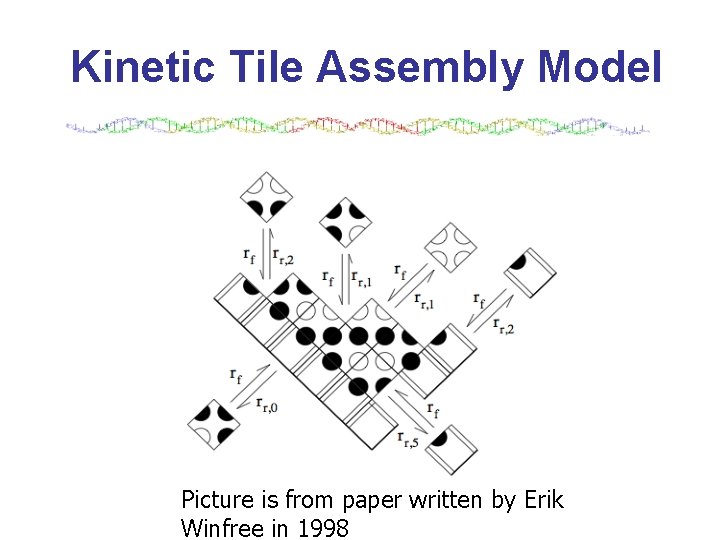
Kinetic Tile Assembly Model Picture is from paper written by Erik Winfree in 1998
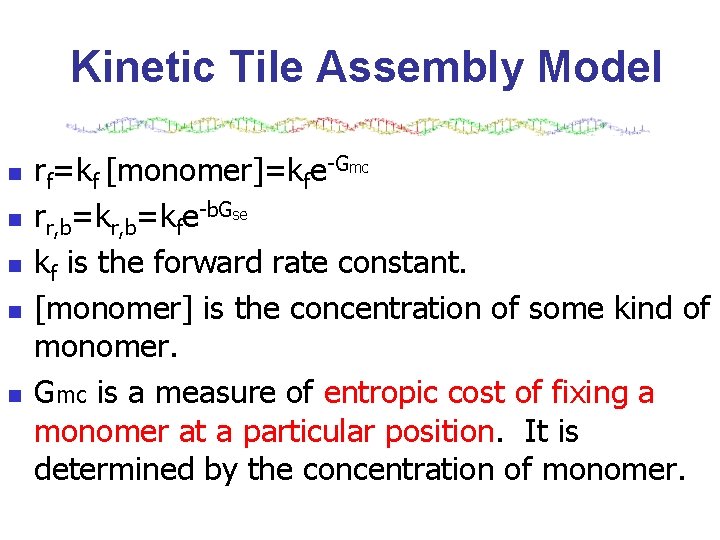
Kinetic Tile Assembly Model n n n rf=kf [monomer]=kfe-Gmc rr, b=kfe-b. Gse kf is the forward rate constant. [monomer] is the concentration of some kind of monomer. Gmc is a measure of entropic cost of fixing a monomer at a particular position. It is determined by the concentration of monomer.
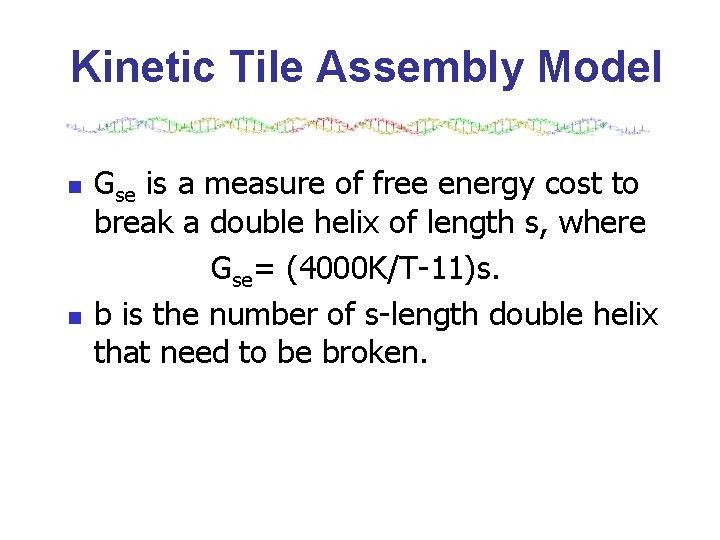
Kinetic Tile Assembly Model n n Gse is a measure of free energy cost to break a double helix of length s, where Gse= (4000 K/T-11)s. b is the number of s-length double helix that need to be broken.
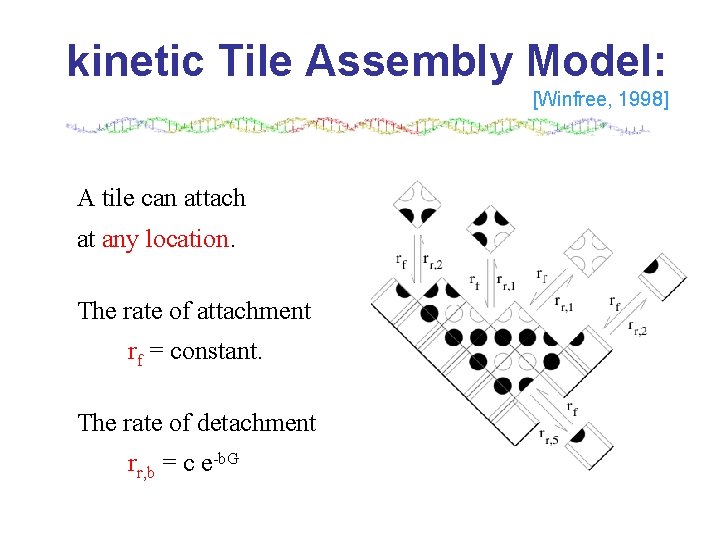
kinetic Tile Assembly Model: [Winfree, 1998] A tile can attach at any location. The rate of attachment rf = constant. The rate of detachment rr, b = c e-b. G
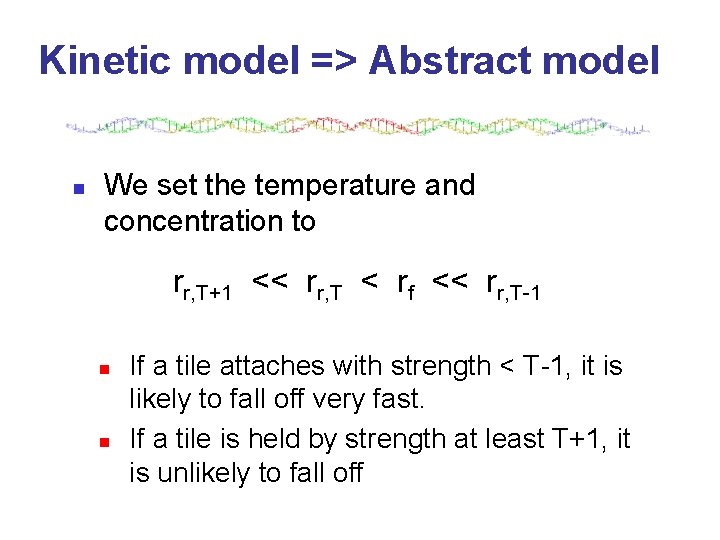
Kinetic model => Abstract model n We set the temperature and concentration to rr, T+1 << rr, T < rf << rr, T-1 n n If a tile attaches with strength < T-1, it is likely to fall off very fast. If a tile is held by strength at least T+1, it is unlikely to fall off
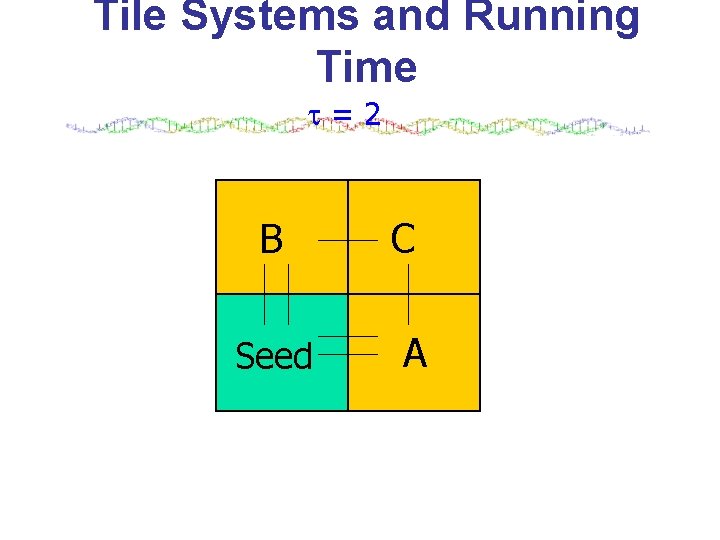
Tile Systems and Running Time t=2 B Seed C A
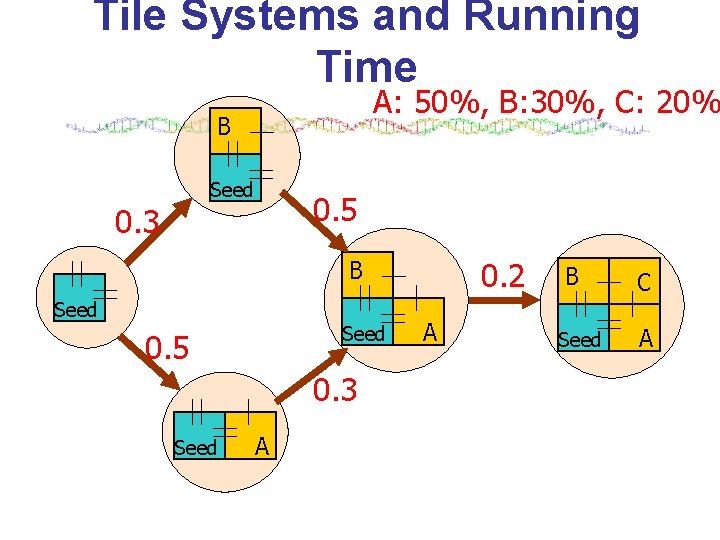
Tile Systems and Running Time A: 50%, B: 30%, C: 20% B Seed 0. 3 0. 5 0. 2 B Seed 0. 5 0. 3 Seed A A B C Seed A
Time Complexity n n n States: possible configurations. Rate between state S 1 and S 2: if S 2 is got by attaching a tile x to S 1. The rate is the concentration of tile x. Otherwise, no edge between S 1 and S 2. The time from initial configuration to the terminal configuration is a random variable. Time complexity is the expected value of the random variable
Reversible Tile Assembly Model n n Proposed by Leonard M. Adleman in 1999 to study linear assembly. Define two functions: n n (1) σ: G×G->[0, 1] (2) v: G×G->[0, 1] where G is the glue set. σ(g 1, g 2) is the probability of sticking between glue g 1 and g 2. v(g 1, g 2) is the probability of unsticking between glue g 1 and g 2.
Tile Systems and Running Time n n Define a continuous time Markov chain M n State space S: set of all structures that a tile system can assemble into n Tiles of type Ti have concentration ci n Σi ci = 1 n Unique terminal structure => unique sink in M n Seed tile is the unique source state Assembly time: the hitting time for the sink state from the source state in the Markov Chain
Old Example: Assembling Lines n Very simple Markov Chain. Average time for the ith tile to attach is 1/ci n n Assembly time = åi 1/ci For fastest assembly, all tiles must have the same concentration of 1/(n-1) n n Expected assembly time is ¼ n 2 Can assemble thicker rectangles much faster and with much fewer different tiles
Multiple Temperature Model n n Proposed by [Aggarwal et al. 2004]. Replace temperature t in tiling kmodel by sequence of temperatures {τi}i=1. A system that has k temperatures is a k -temperature system. Assembly mechanism: the assembly process of a k-temperature system has k phases.
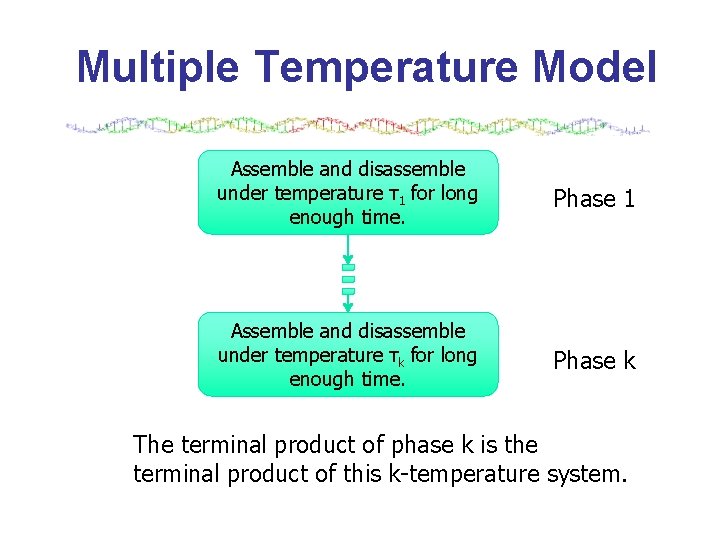
Multiple Temperature Model Assemble and disassemble under temperature τ1 for long enough time. Phase 1 Assemble and disassemble under temperature τk for long enough time. Phase k The terminal product of phase k is the terminal product of this k-temperature system.
Flexible Glue Model n n n Proposed by by Aggarwal et al. in 2004. In standard model: g(x, y)= 0 if x≠y. In flexible glue model: g(x, y) may not be 0 when x≠y.
q-Tile Model n n Proposed by by Aggarwal et al. in 2004. In standard model: only single tile can attach to the growing supertile containing seed. In q-tile model: supertiles of size not larger than q can form and attach to the seed supertile if the accumulative glue strength between two supertiles is not less than temperature. Standard model is exactly 1 -tile model.
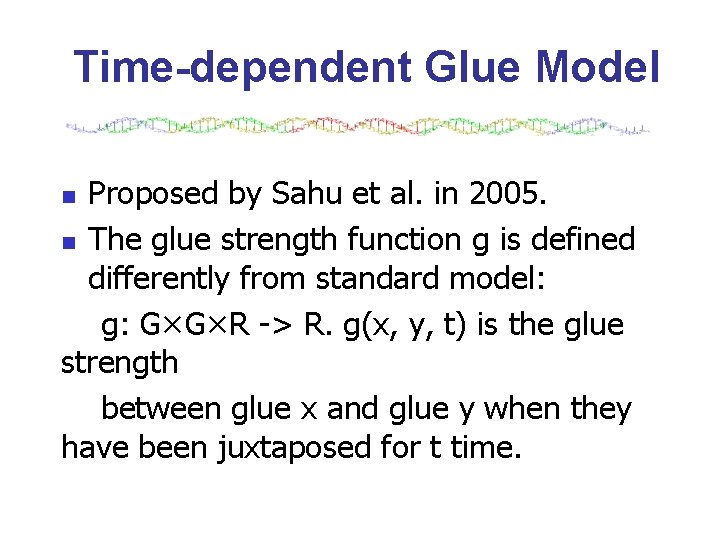
Time-dependent Glue Model Proposed by Sahu et al. in 2005. n The glue strength function g is defined differently from standard model: g: G×G×R -> R. g(x, y, t) is the glue strength between glue x and glue y when they have been juxtaposed for t time. n
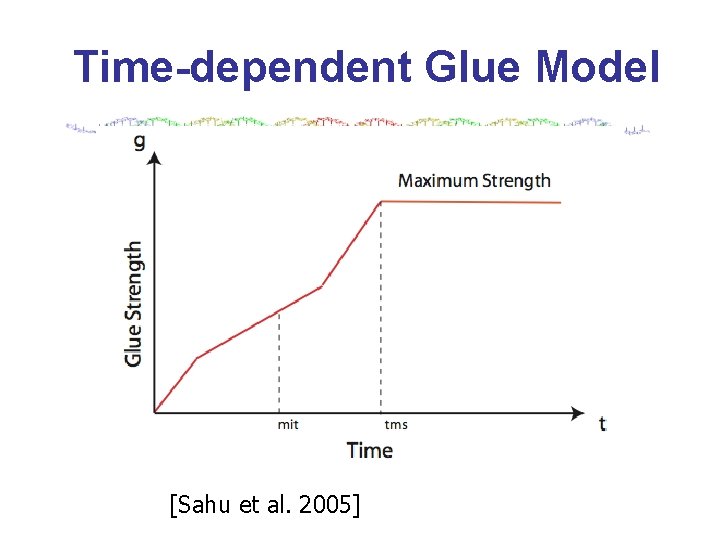
Time-dependent Glue Model [Sahu et al. 2005]
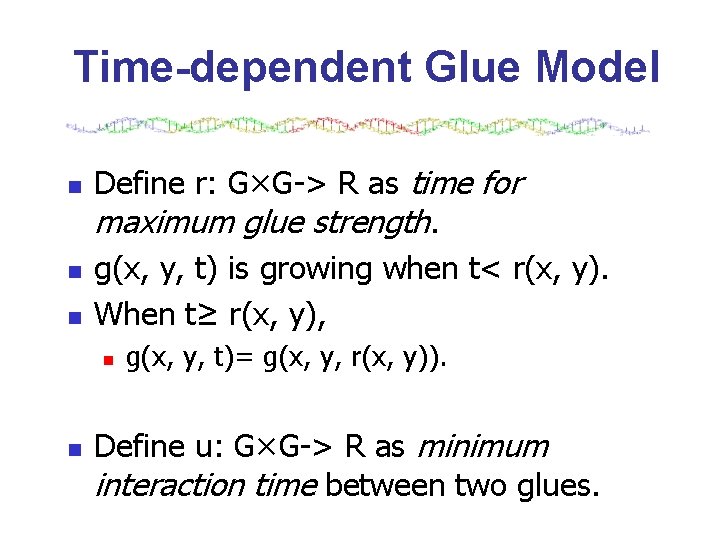
Time-dependent Glue Model n n n Define r: G×G-> R as time for maximum glue strength. g(x, y, t) is growing when t< r(x, y). When t≥ r(x, y), n n g(x, y, t)= g(x, y, r(x, y)). Define u: G×G-> R as minimum interaction time between two glues.
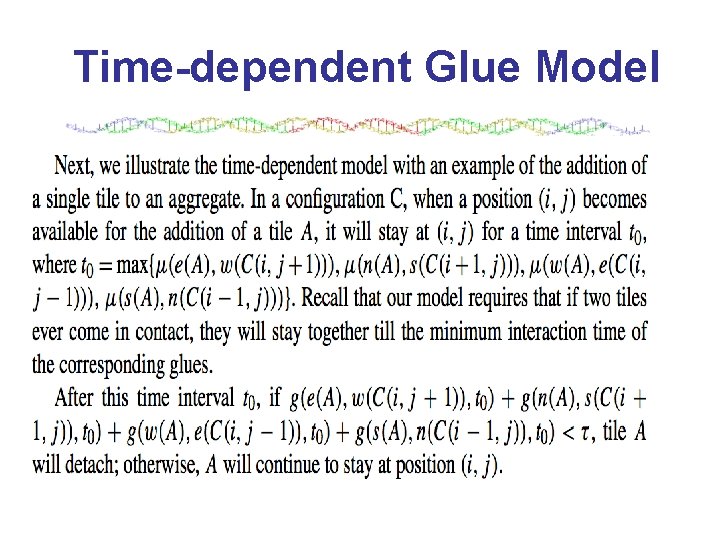
Time-dependent Glue Model n An example from Sahu’s paper:
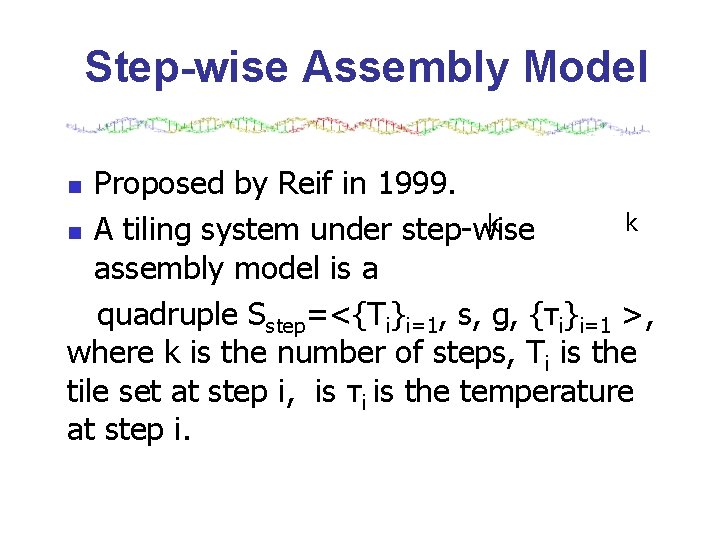
Step-wise Assembly Model Proposed by Reif in 1999. k k n A tiling system under step-wise assembly model is a quadruple Sstep=<{Ti}i=1, s, g, {τi}i=1 >, where k is the number of steps, Ti is the tile set at step i, is τi is the temperature at step i. n
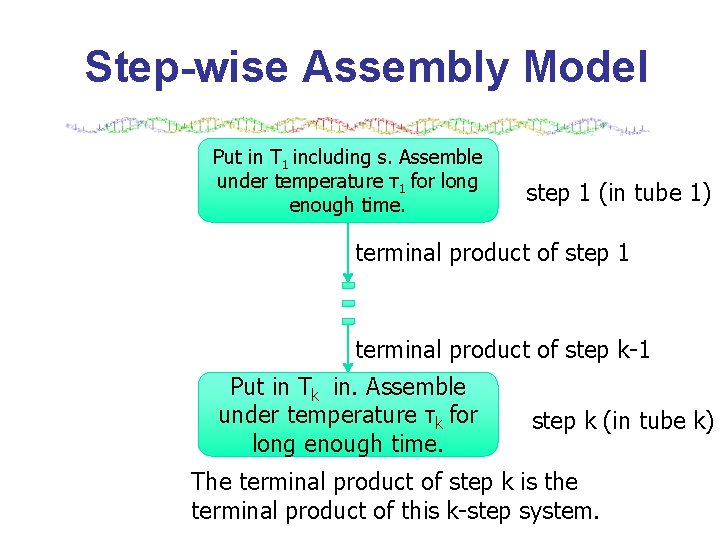
Step-wise Assembly Model Put in T 1 including s. Assemble under temperature τ1 for long enough time. step 1 (in tube 1) terminal product of step 1 terminal product of step k-1 Put in Tk in. Assemble under temperature τk for long enough time. step k (in tube k) The terminal product of step k is the terminal product of this k-step system.
Staged Assembly Model n n n Proposed by Demaine et al. in 2007. It is a generalized version of step-wise assembly model. The assembly process under staged assembly model is shown in the Figure(next page).
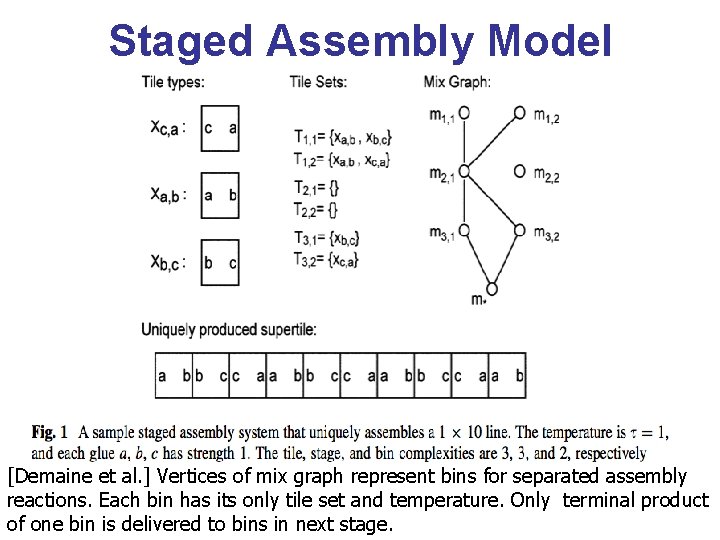
Staged Assembly Model [Demaine et al. ] Vertices of mix graph represent bins for separated assembly reactions. Each bin has its only tile set and temperature. Only terminal product of one bin is delivered to bins in next stage.
- Slides: 78