
Intro to Self Reports Reports including surveys questionnaires
- Slides: 29
Intro to Self. Reports, Reports including surveys, questionnaires and Interviews
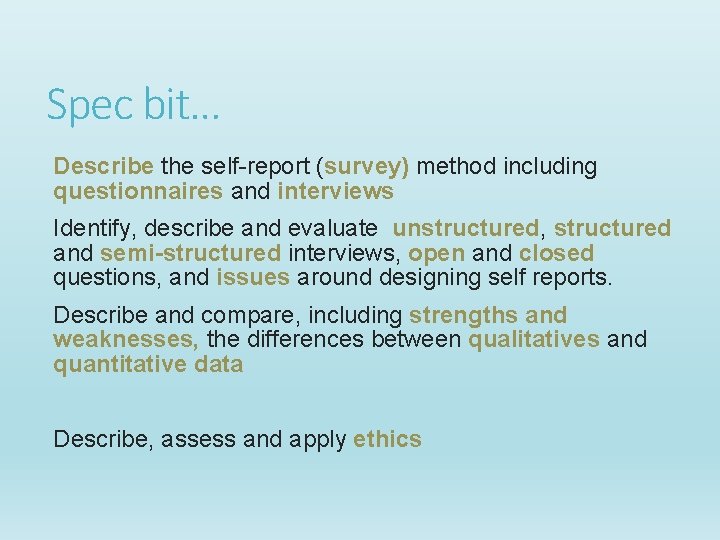
Spec bit… Describe the self-report (survey) method including questionnaires and interviews Identify, describe and evaluate unstructured, structured and semi-structured interviews, open and closed questions, and issues around designing self reports. Describe and compare, including strengths and weaknesses, the differences between qualitatives and quantitative data Describe, assess and apply ethics
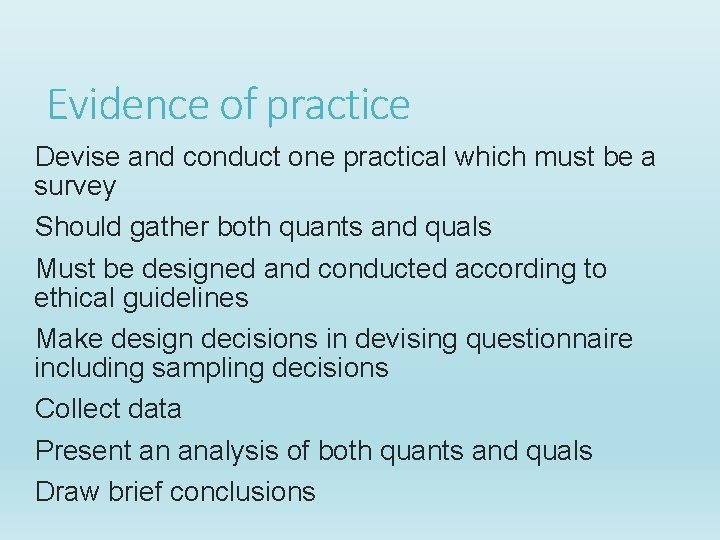
Evidence of practice Devise and conduct one practical which must be a survey Should gather both quants and quals Must be designed and conducted according to ethical guidelines Make design decisions in devising questionnaire including sampling decisions Collect data Present an analysis of both quants and quals Draw brief conclusions
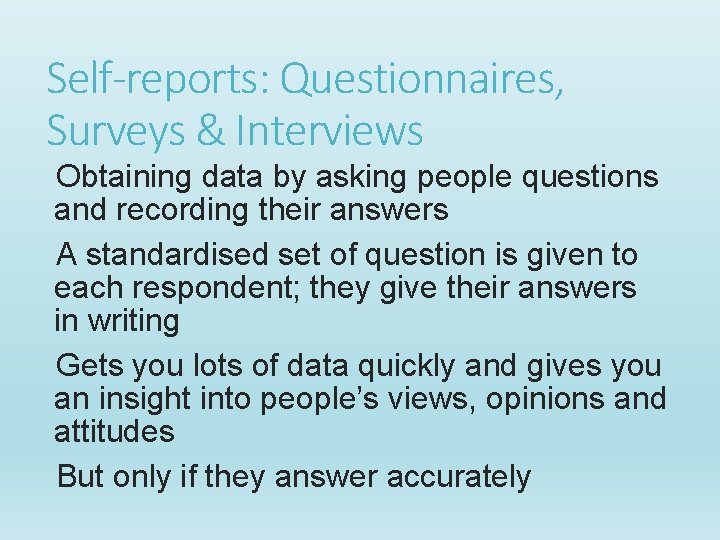
Self-reports: Questionnaires, Surveys & Interviews Obtaining data by asking people questions and recording their answers A standardised set of question is given to each respondent; they give their answers in writing Gets you lots of data quickly and gives you an insight into people’s views, opinions and attitudes But only if they answer accurately
Types of Interview • Unstructured • Semi-structured
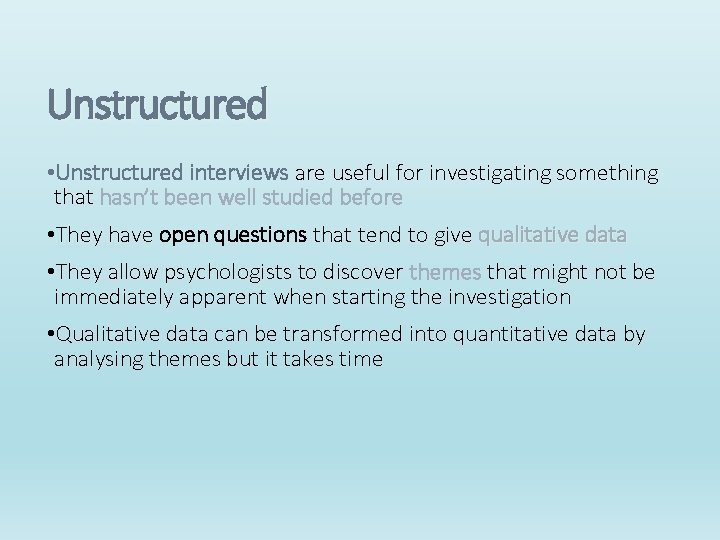
Unstructured • Unstructured interviews are useful for investigating something that hasn’t been well studied before • They have open questions that tend to give qualitative data • They allow psychologists to discover themes that might not be immediately apparent when starting the investigation • Qualitative data can be transformed into quantitative data by analysing themes but it takes time
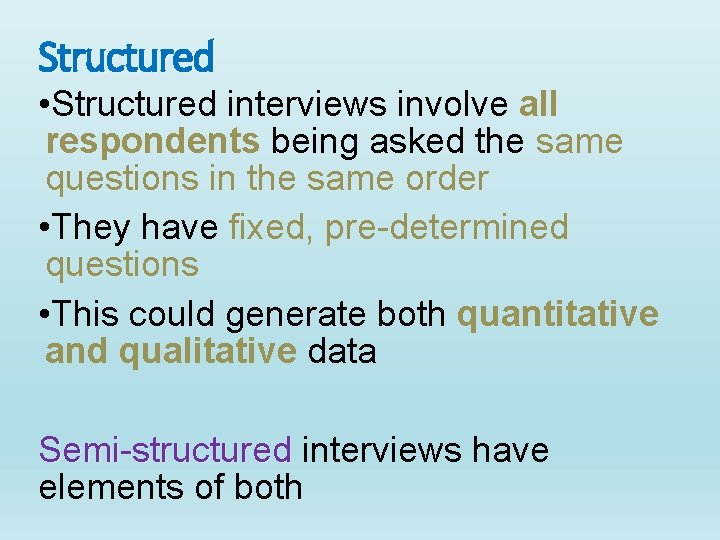
Structured • Structured interviews involve all respondents being asked the same questions in the same order • They have fixed, pre-determined questions • This could generate both quantitative and qualitative data Semi-structured interviews have elements of both
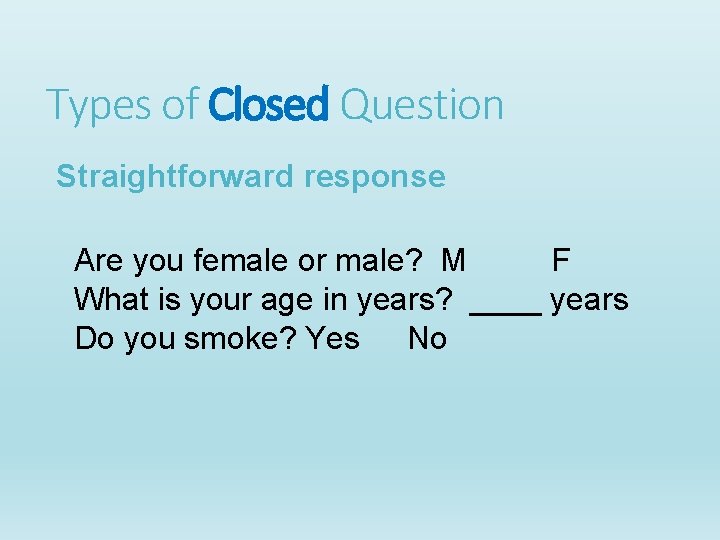
Types of Closed Question Straightforward response Are you female or male? M F What is your age in years? ____ years Do you smoke? Yes No
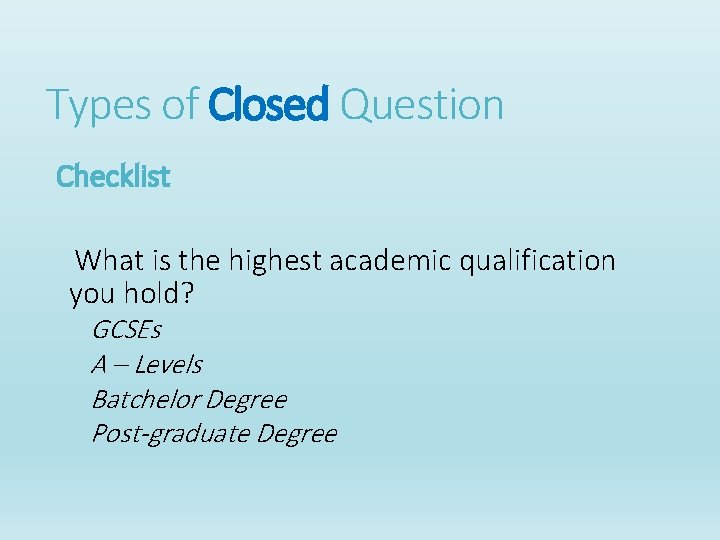
Types of Closed Question Checklist What is the highest academic qualification you hold? GCSEs A – Levels Batchelor Degree Post-graduate Degree
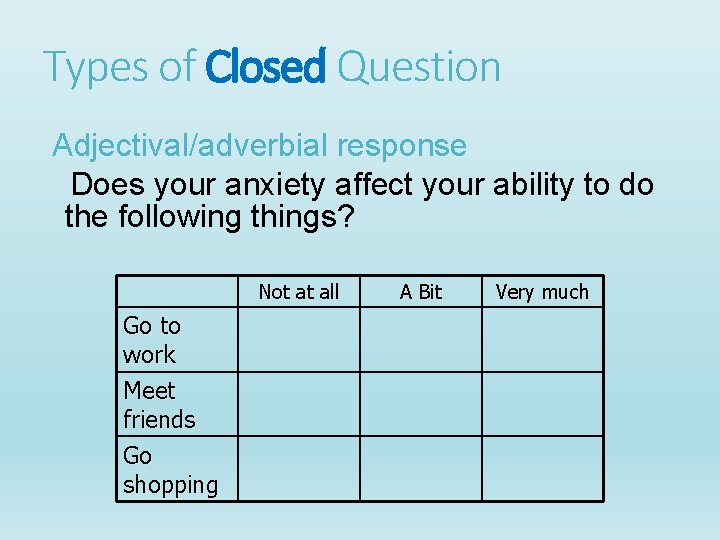
Types of Closed Question Adjectival/adverbial response Does your anxiety affect your ability to do the following things? Not at all Go to work Meet friends Go shopping A Bit Very much
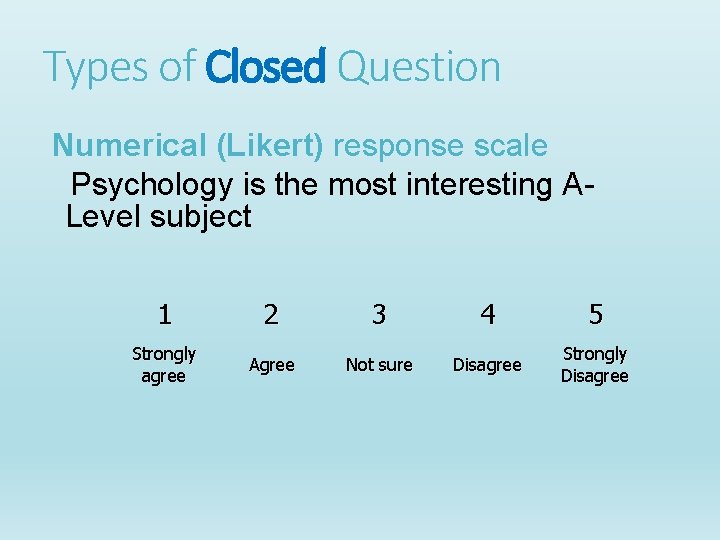
Types of Closed Question Numerical (Likert) response scale Psychology is the most interesting ALevel subject 1 2 3 4 5 Strongly agree Agree Not sure Disagree Strongly Disagree
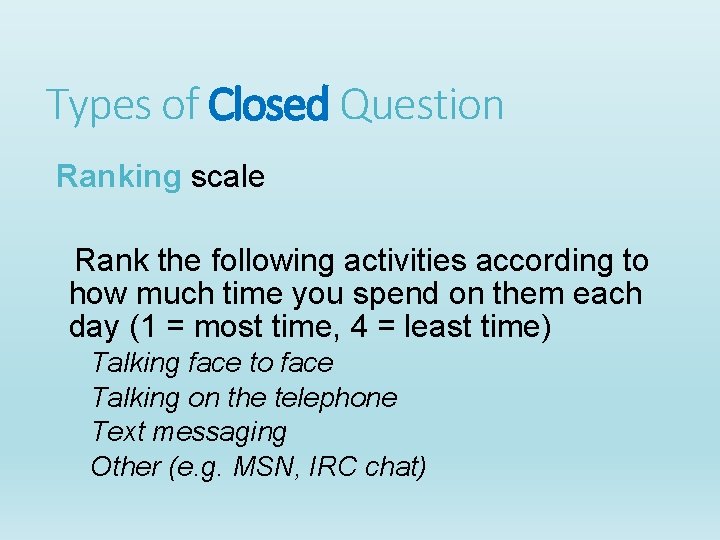
Types of Closed Question Ranking scale Rank the following activities according to how much time you spend on them each day (1 = most time, 4 = least time) Talking face to face Talking on the telephone Text messaging Other (e. g. MSN, IRC chat)
Problems… Social desirability bias – people give answers that make them ‘sound good’ rather than what they actually think Honesty – people lie! It’s impossible to control for personal interpretations of the questions
Open ended questions “What is your opinion of……” “Describe………. ” “What do you think about……. ” These type of questions result in a narrative form of response
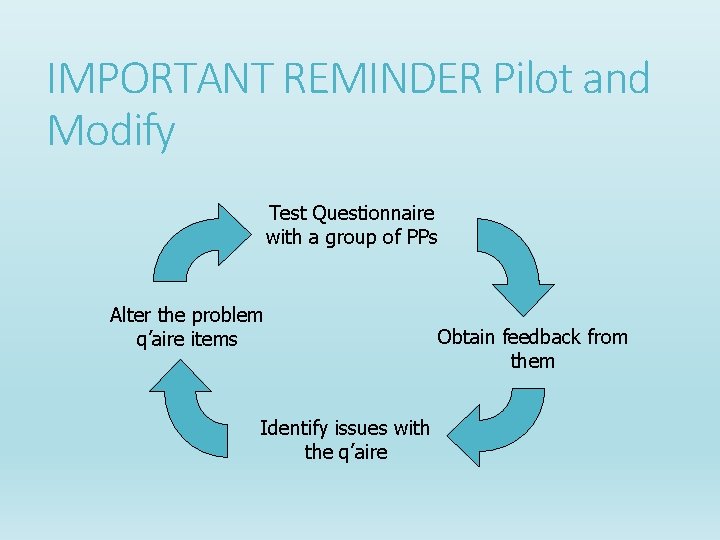
Designing a survey 1. Decide which attitudes, behaviours or traits you want to measure 2. Decide whether you want qualitative or quantitative data 3. Decide which sorts of questions you will ask 4. Pilot and modify the questionnaire 5. Collect data
Questionnaires vs Interviews • Questionnaires can be both structured and unstructured but tend to lend themselves to being highly structured • We tend to use questionnaire when we want quantitative data & • Interview when we want qualitative data • You can however, gather both qualitative & quantitative data by both methods
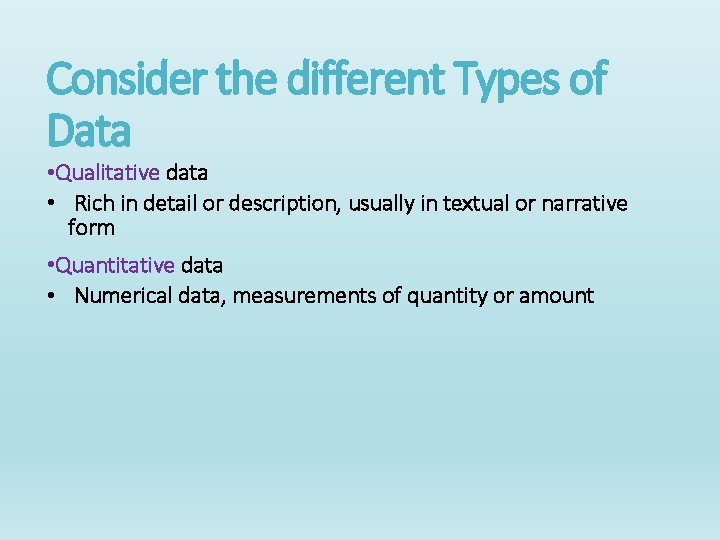
Consider the different Types of Data • Qualitative data • Rich in detail or description, usually in textual or narrative form • Quantitative data • Numerical data, measurements of quantity or amount
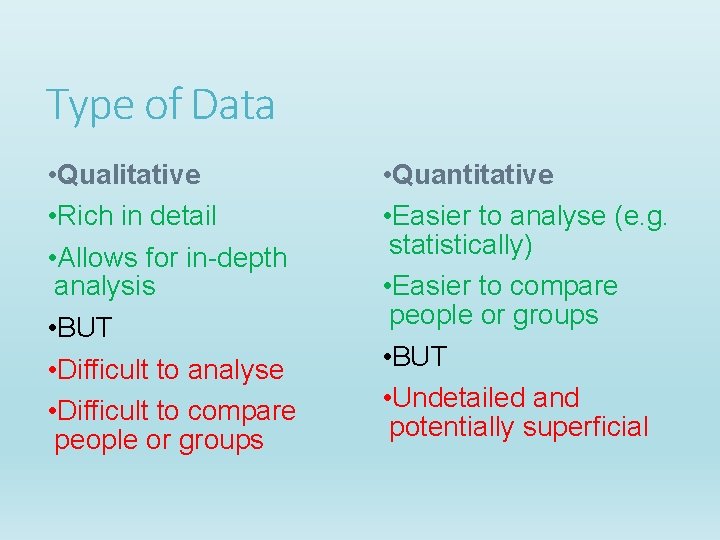
Type of Data • Qualitative • Rich in detail • Allows for in-depth analysis • BUT • Difficult to analyse • Difficult to compare people or groups • Quantitative • Easier to analyse (e. g. statistically) • Easier to compare people or groups • BUT • Undetailed and potentially superficial
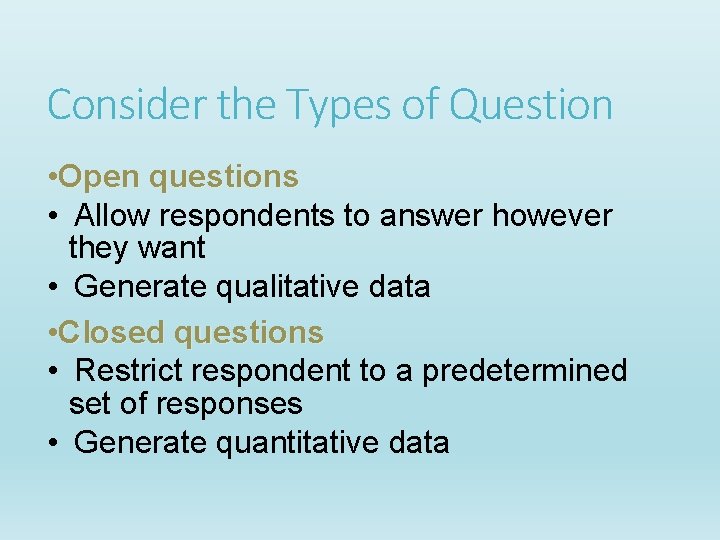
Consider the Types of Question • Open questions • Allow respondents to answer however they want • Generate qualitative data • Closed questions • Restrict respondent to a predetermined set of responses • Generate quantitative data
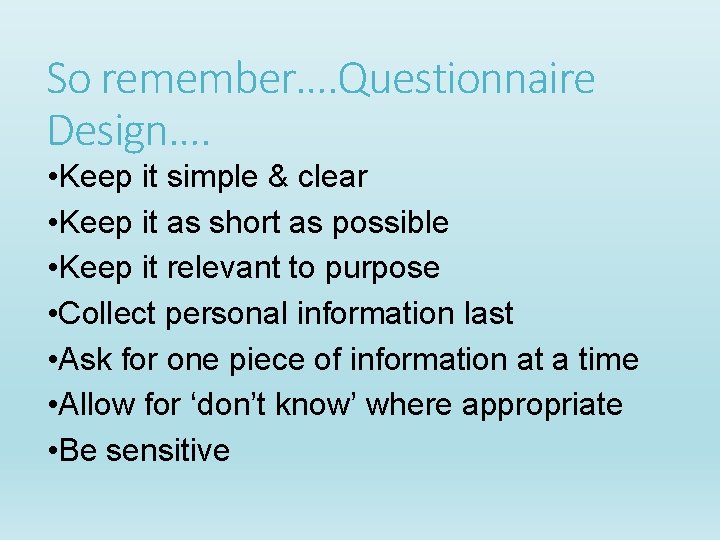
So remember…. Questionnaire Design…. • Keep it simple & clear • Keep it as short as possible • Keep it relevant to purpose • Collect personal information last • Ask for one piece of information at a time • Allow for ‘don’t know’ where appropriate • Be sensitive
IMPORTANT REMINDER Pilot and Modify Test Questionnaire with a group of PPs Alter the problem q’aire items Identify issues with the q’aire Obtain feedback from them
What have I learnt? 1. What is social desirability bias?
What have I learnt? 2. What is qualitative data?
What have I learnt? 3. What sort of questions does a structured interview have?
What I learnt? 4. What sort of data do you get from unstructured interview?
What have I learnt 5. Give an example of a Likert scale You need to write a question and provide a scale
What have I learnt Give an example of a fixed choice (closed)question
What have I learnt Give an example of an open ended question
What are the advantages and disadvantages of both types of question? You have a work sheet to complete for prep