
Intro to Renewable Energy Solar Wind Hydro Biomass
Intro to Renewable Energy • Solar • Wind • Hydro • Biomass / Biofuels • Ocean Power (Tidal and Wave Power)
Short Video- Renewable Energy 101
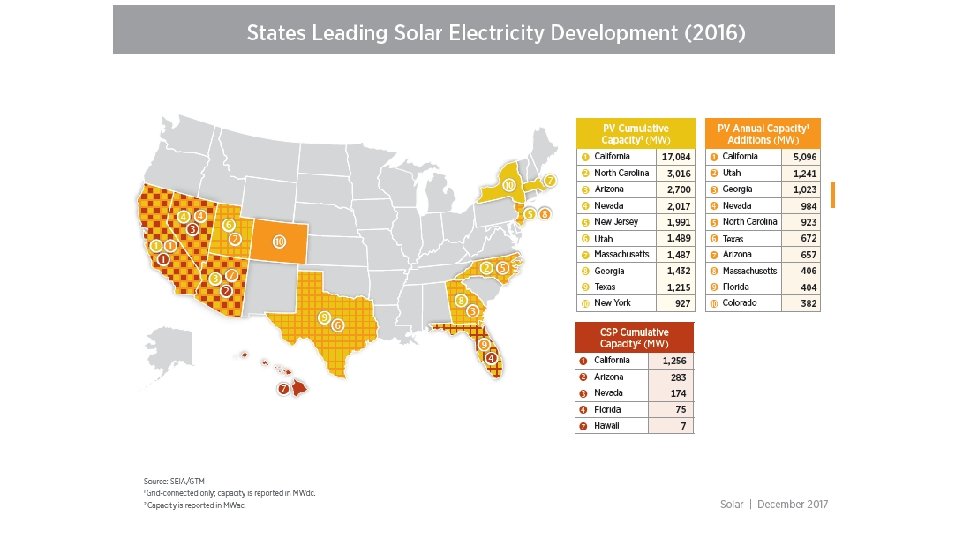
Solar Energy
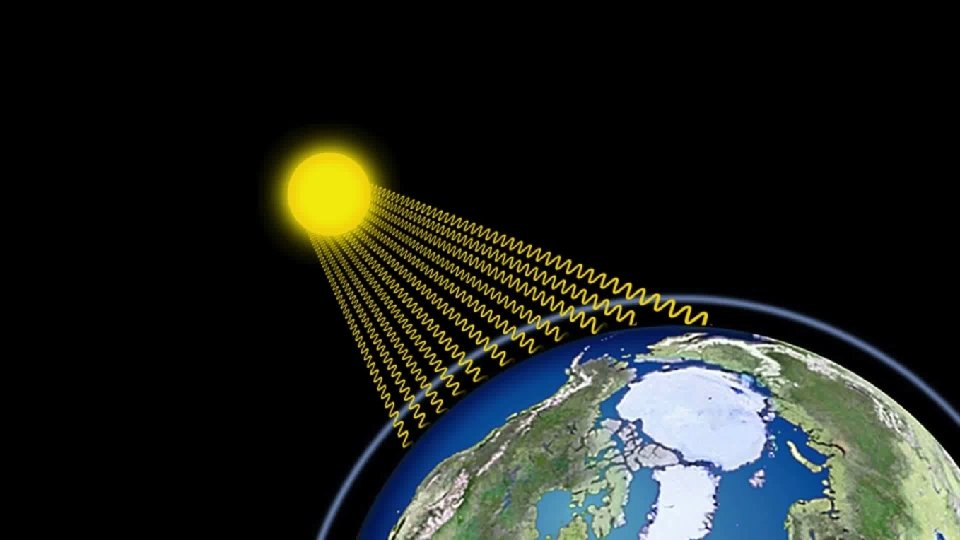
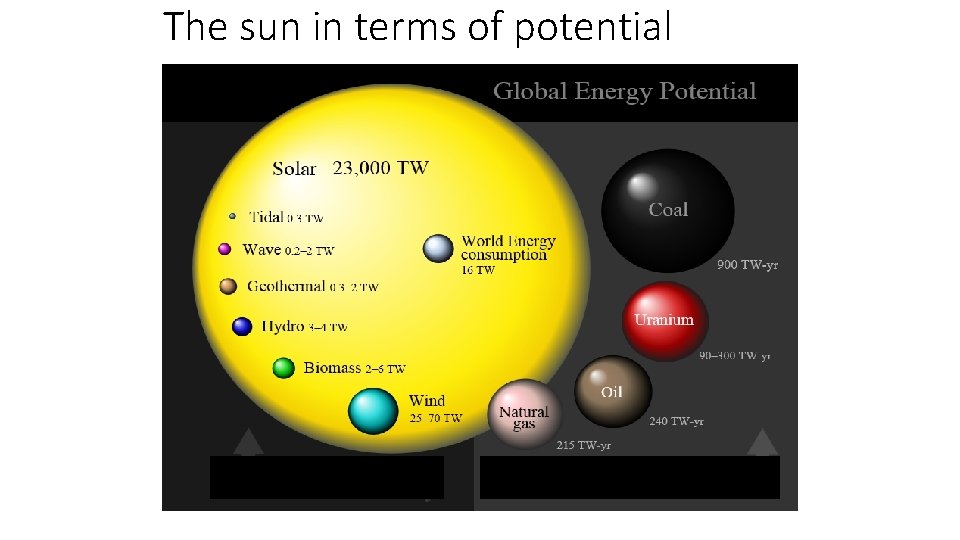
The sun in terms of potential
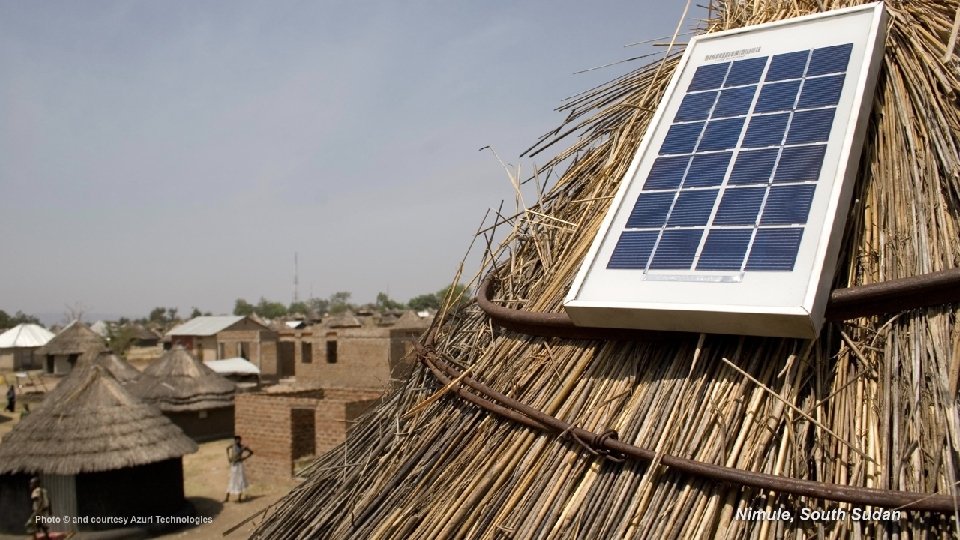
How does the sun create Energy • In simple terms: • Converts light to Energy (DC) • Different types of modules have different efficiencies in converting light to energy • DC needs to be converted to AC in most cases via inverter • There are losses in the conversion • The BEST commercially available crystalline solar modules are only 25% efficient
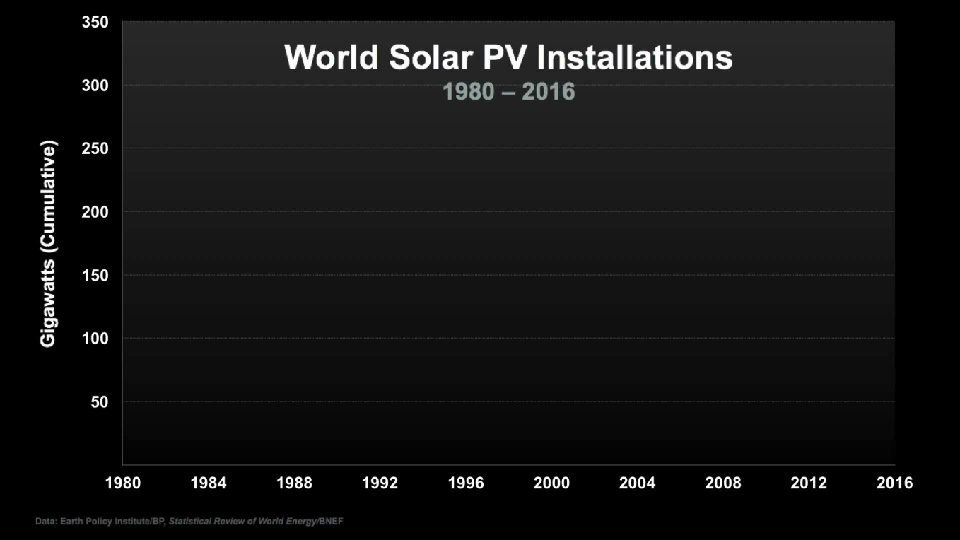
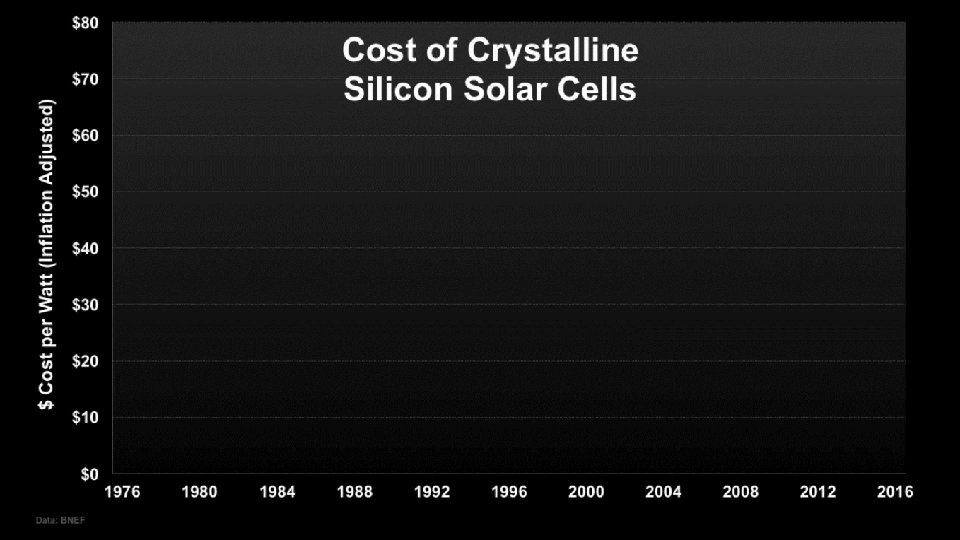
Short Videos: Solar PV 101 Solar Thermal/ CSP 101
Wind Energy
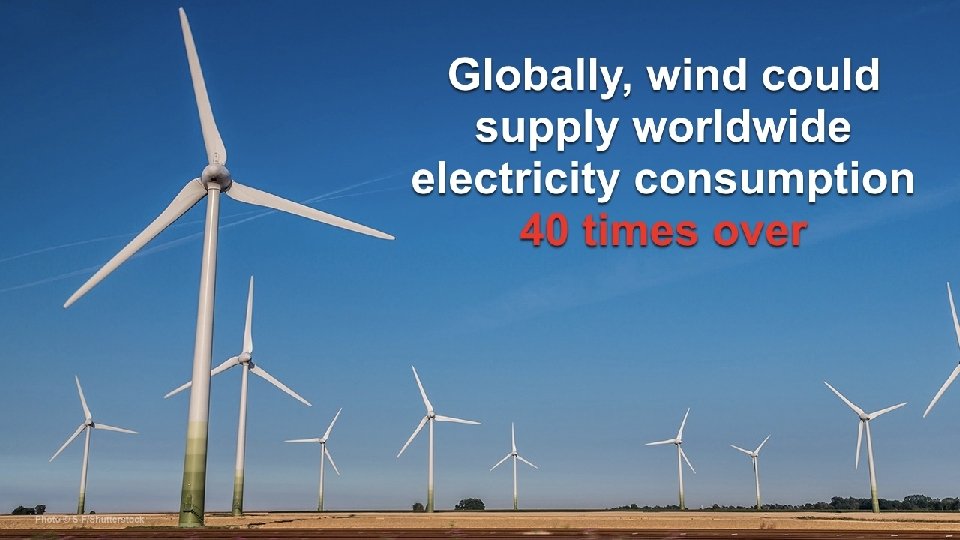
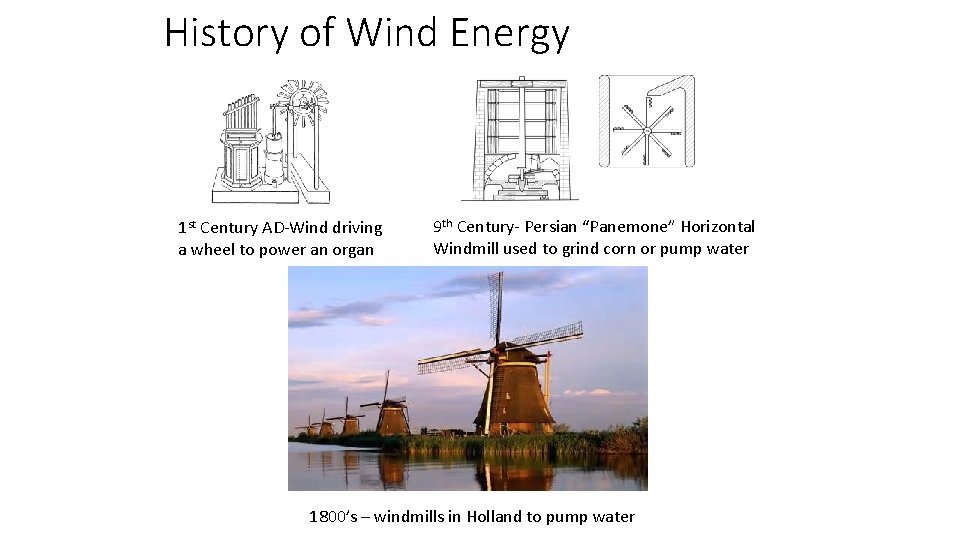
History of Wind Energy 1 st Century AD-Wind driving a wheel to power an organ 9 th Century- Persian “Panemone” Horizontal Windmill used to grind corn or pump water 1800’s – windmills in Holland to pump water
How does Wind Energy work? • The blades of the turbine are attached to a hub that is mounted on a turning shaft. • The shaft goes through a gear transmission box where the turning speed is increased. • The transmission is attached to a high speed shaft which turns a generator that makes electricity • A series of gears increase the rotation of the rotor from about 18 revolutions a minute to roughly 1, 800 revolutions per minute -- a speed that allows the turbine’s generator to produce AC electricity. • The height of the turbine (wind resources) and the length of the blade (centrifugal) have an impact on the energy created. • How a wind turbine works • https: //www. youtube. com/watch? v=ts. ZITSe. QFR 0
Improvements in Wind Efficiency • Technology and research have increased efficiencies from 22 percent for wind turbines installed before 1998 to more than 32 percent for turbines installed between 2006 and 2012 • Wind energy costs have been reduced from more than 55 cents per kilowatt-hour (k. Wh) in 1980 to under 6 cents/k. Wh today in areas with good wind resources.
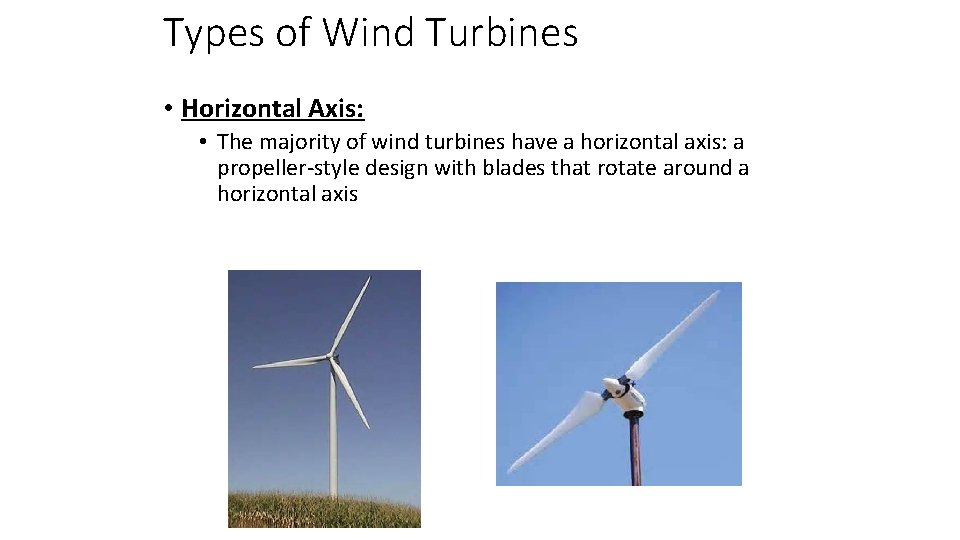
Types of Wind Turbines • Horizontal Axis: • The majority of wind turbines have a horizontal axis: a propeller-style design with blades that rotate around a horizontal axis
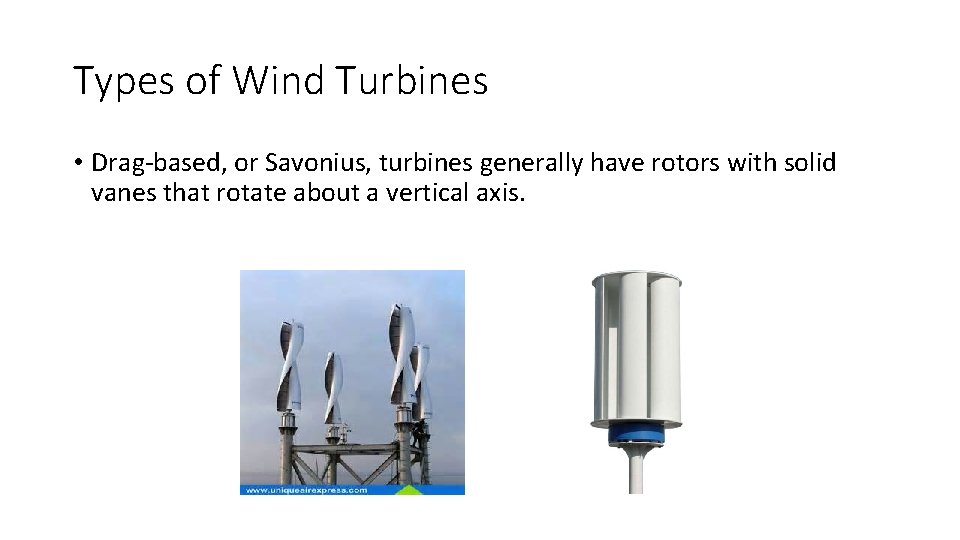
Types of Wind Turbines • Drag-based, or Savonius, turbines generally have rotors with solid vanes that rotate about a vertical axis.
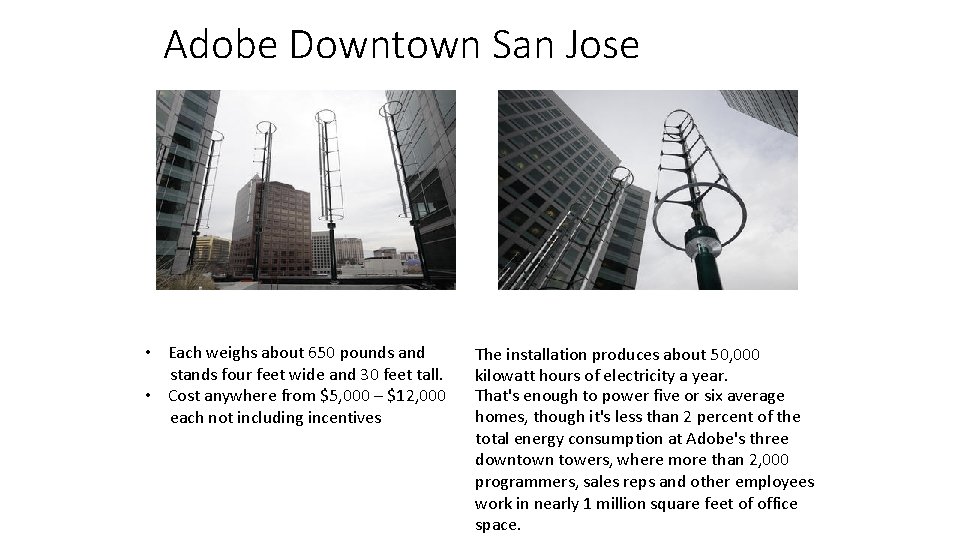
Adobe Downtown San Jose • Each weighs about 650 pounds and stands four feet wide and 30 feet tall. • Cost anywhere from $5, 000 – $12, 000 each not including incentives The installation produces about 50, 000 kilowatt hours of electricity a year. That's enough to power five or six average homes, though it's less than 2 percent of the total energy consumption at Adobe's three downtown towers, where more than 2, 000 programmers, sales reps and other employees work in nearly 1 million square feet of office space.
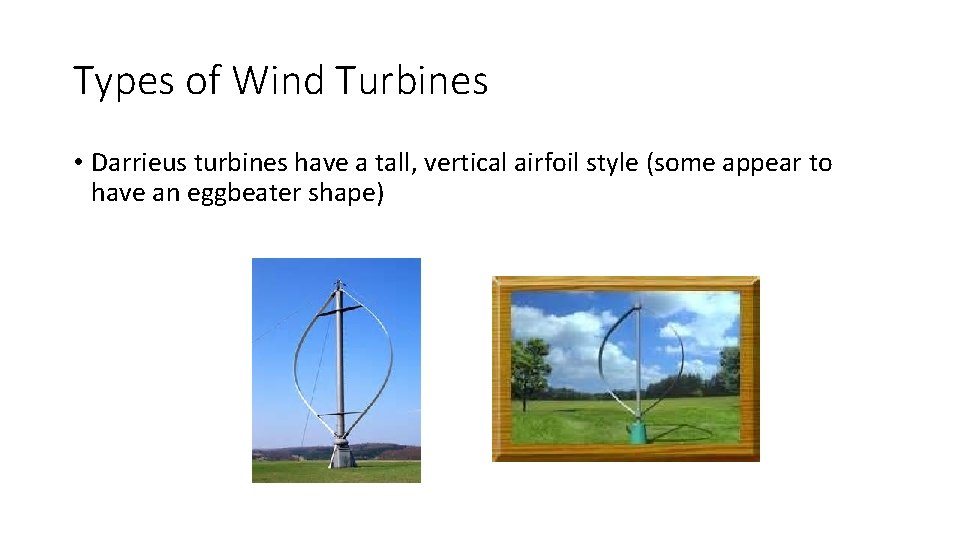
Types of Wind Turbines • Darrieus turbines have a tall, vertical airfoil style (some appear to have an eggbeater shape)
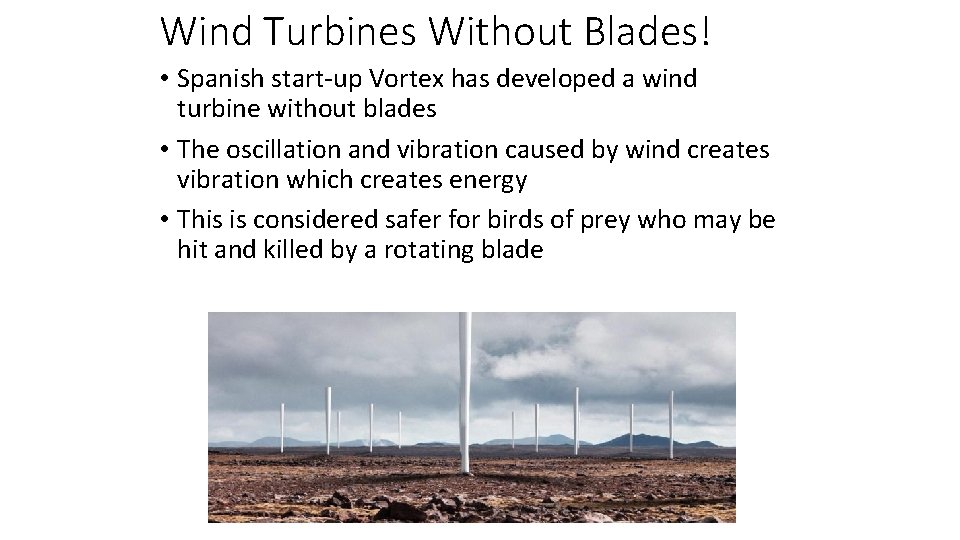
Wind Turbines Without Blades! • Spanish start-up Vortex has developed a wind turbine without blades • The oscillation and vibration caused by wind creates vibration which creates energy • This is considered safer for birds of prey who may be hit and killed by a rotating blade
Advantages of Wind Energy 1. It's a clean fuel source Compared to the environmental impact of traditional energy sources, the environmental impact of wind power is relatively minor. Wind power consumes no fuel, and emits no air pollution.
Advantages of Wind Energy • Wind energy is a domestic source of energy. The nation's wind supply is abundant: over the past 10 years, cumulative wind power capacity in the United States increased an average of 30% per year, outpacing the 28% growth rate in worldwide capacity.
Advantages of Wind Energy • It's sustainable. Wind is actually a form of solar energy; winds are caused by the heating of the atmosphere by the sun, the rotation of the earth, and the earth's surface irregularities. For as long as the sun shines and the wind blows, the energy produced can be harnessed to send power across the grid.
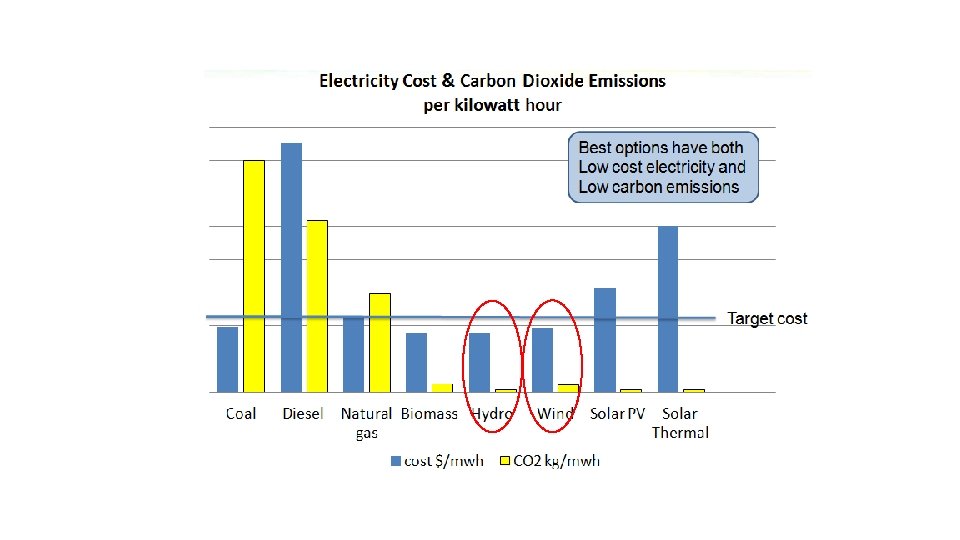
Advantages of Wind Energy • Wind power is cost effective. It is one of the lowest-priced renewable energy technologies available today, costing between four and six cents per kilowatt-hour, depending upon the wind resource and project financing of the particular project.
Advantages of Wind Energy • Wind turbines can be built on existing farms or ranches. This greatly benefits the economy in rural areas, where most of the best wind sites are found. • Farmers and ranchers can continue to work the land because the wind turbines use only a fraction of the land. • Wind power plant owners make rent payments to the farmer or rancher for the use of the land providing landowners with additional income.
Challenges of Wind Energy • Wind power must still compete with conventional generation sources on a cost basis. Depending on how energetic a wind site is, the wind farm may or may not be cost competitive. • Even though the cost of wind power has decreased dramatically in the past 10 years, the technology requires a higher initial investment than fossil-fueled generators.
Challenges of Wind Energy • Good wind sites are often located in remote locations, far from cities where the electricity is needed. Transmission lines must be built to bring the electricity from the wind farm to the city. • Reliability of wind. You cannot expect the "same amount" of wind power to be generated by your wind turbine
Challenges of Wind Energy • Wind resource development may not be the most profitable use of the land. • Land suitable for wind turbine installation must compete with alternative uses for the land, which may be more highly valued than electricity generation.
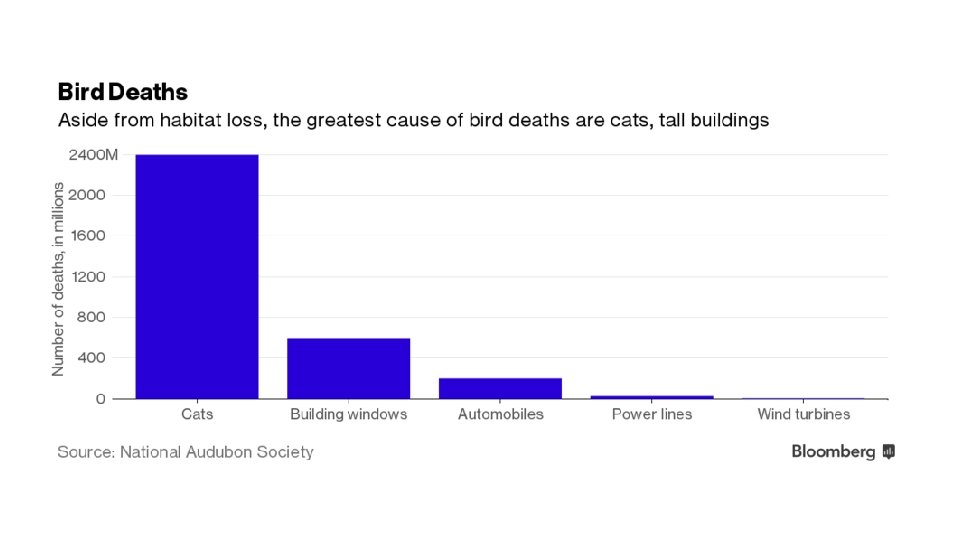
Challenges of Wind Energy • The turbine blades may damage local wildlife. • Sometimes birds have been killed by flying into the rotors. • Turbine blades and towers can pose a threat to flying wildlife like birds (for example, the sage-grouse) and bats. • Over the past two decades, the impact of wind development on birds has been greatly reduced by improvements in turbine design and particularly through improved project and turbine siting.
Challenges of Wind Energy • Possible Noise Pollution -There is a low 'swoshing' sound from some home wind turbines. However, the noise from commercial wind turbines or from 'wind farms' is similar to the sound of a small jet engine. • https: //www. youtube. com/watch? v=Mk 5 z. Mx. YVca 0#t=30

Short Video: Wind 101
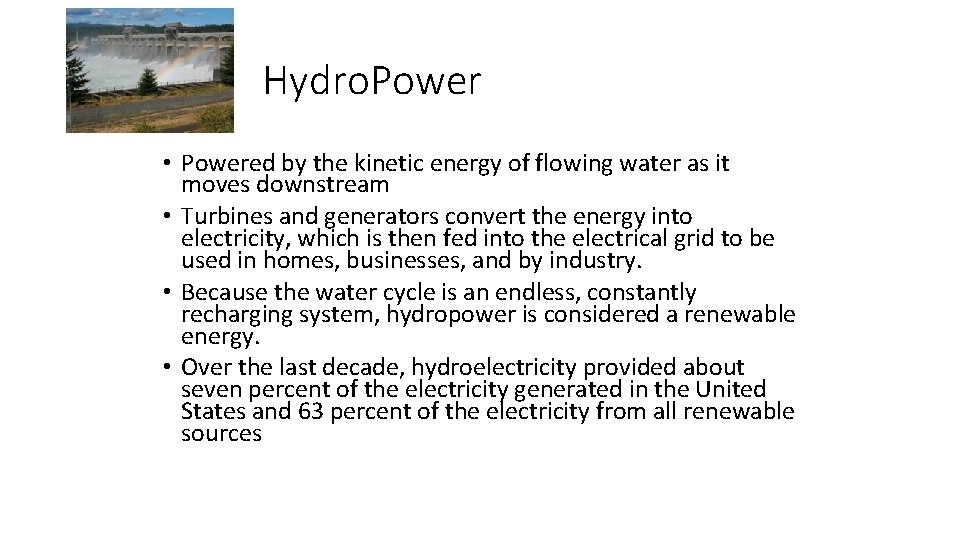
Hydro. Power • Powered by the kinetic energy of flowing water as it moves downstream • Turbines and generators convert the energy into electricity, which is then fed into the electrical grid to be used in homes, businesses, and by industry. • Because the water cycle is an endless, constantly recharging system, hydropower is considered a renewable energy. • Over the last decade, hydroelectricity provided about seven percent of the electricity generated in the United States and 63 percent of the electricity from all renewable sources
The history of hydropower • B. C. -Hydropower used by the Greeks to turn water wheels for grinding wheat into flour, more than 2, 000 years ago. • Mid-1770 s French hydraulic and military engineer Bernard Forest de Bélidor wrote Architecture Hydraulique, a four-volume work describing vertical- and horizontalaxis machines. • 1881 Niagara Falls city street lamps powered by hydropower. • 1882 World's first hydroelectric power plant began operation on the Fox River in Appleton, Wisconsin. • 1889 Two hundred electric plants in the U. S. use waterpower for some or all generation. • 1901 First Federal Water Power Act. • 1907 Hydropower provided 15% of U. S. electrical generation. • 1920 Hydropower provided 25% of U. S. electrical generation. Federal Power Act establishes Federal Power Commission authority to issue licenses for hydro development on public lands. • 1940 Hydropower provided 40% of electrical generation. Conventional capacity tripled in United States since 1920. • 1980 Conventional capacity nearly tripled in United States since 1940. • Today- About 6– 8% of U. S. electricity comes from hydropower.
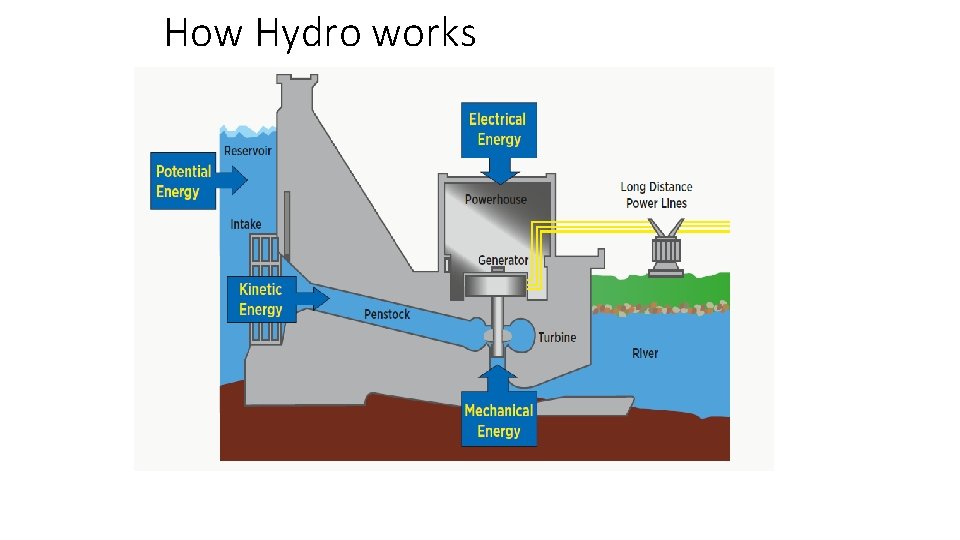
How Hydro works
Benefits of Hydropower • A clean fuel source, meaning it won't pollute the air like power plants that burn fossil fuels, such as coal or natural gas. • Hydroelectric power is a domestic source of energy, allowing each state to produce their own energy without being reliant on international fuel sources. • Most water power installations are required to provide some public access to the reservoir to allow the public to take advantage of recreational opportunities. • Some hydropower facilities can quickly go from zero power to maximum output. Because hydropower plants can generate power to the grid immediately, they provide essential back-up power during major electricity outages or disruptions. • In addition to a sustainable fuel source, hydropower efforts produce a number of benefits, such as flood control, irrigation, and water supply.
Advantages of Hydropower 1. Once a dam is constructed, electricity can be produced at a constant rate. 2. If electricity is not needed, the gates can be shut, stopping electricity generation. The water can be saved for use another time when electricity demand is high. 3. Dams are designed to last many decades and so can contribute to the generation of electricity for many years / decades. 4. The lake that forms behind the dam can be used for water sports and leisure / pleasure activities. Often large dams become tourist attractions in their own right. 5. The lake's water can be used for irrigation purposes. 6. The build up of water in the lake means that energy can be stored until needed, when the water is released to produce electricity. 7. When in use, electricity produced by dam systems do not produce green house gases. They do not pollute the atmosphere.
Disadvantages of Hydropower 1. Dams are extremely expensive to build and must be built to a very high standard. 2. The high cost of dam construction means that they must operate for many decades to become profitable. 3. The flooding of large areas of land means that the natural environment is destroyed. 4. People living in villages and towns that are in the valley to be flooded, must move out. This means that they lose their farms and businesses. In some countries, people are forcibly removed so that hydro-power schemes can go ahead. 5. The building of large dams can cause serious geological damage. For example, the building of the Hoover Dam triggered a number of earth quakes and has depressed the earth’s surface at its location.
Disadvantages cont. 6. Although modern planning and design of dams is good, in the past old dams have been known to be breached (the dam gives under the weight of water in the lake). This has led to deaths and flooding. 7. Dams built blocking the progress of a river in one country (or state) usually means that the water supply from the same river in the following country is out of their control. This can lead to serious problems between neighboring states and counties.

Short Video- Hydro 101
Biomass, Tidal and Wave Power
Biomass
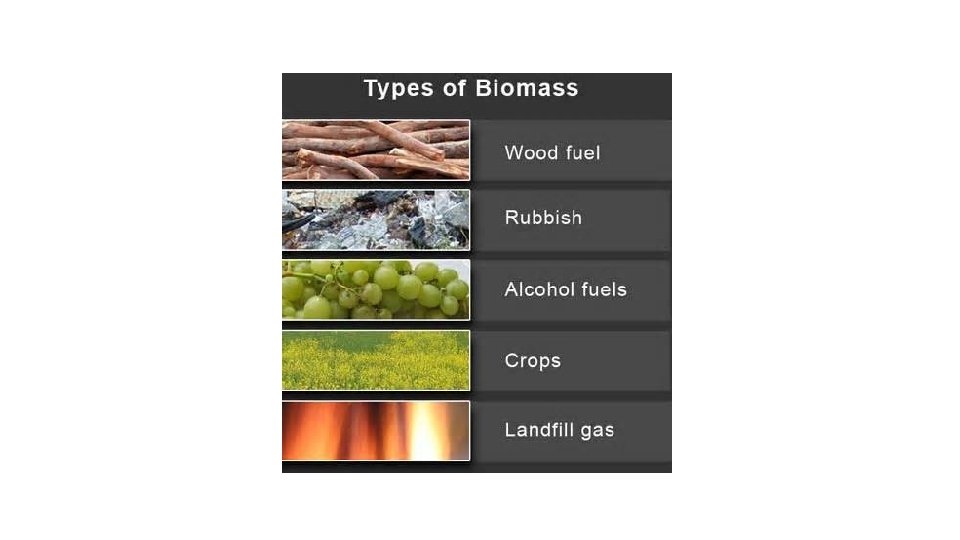
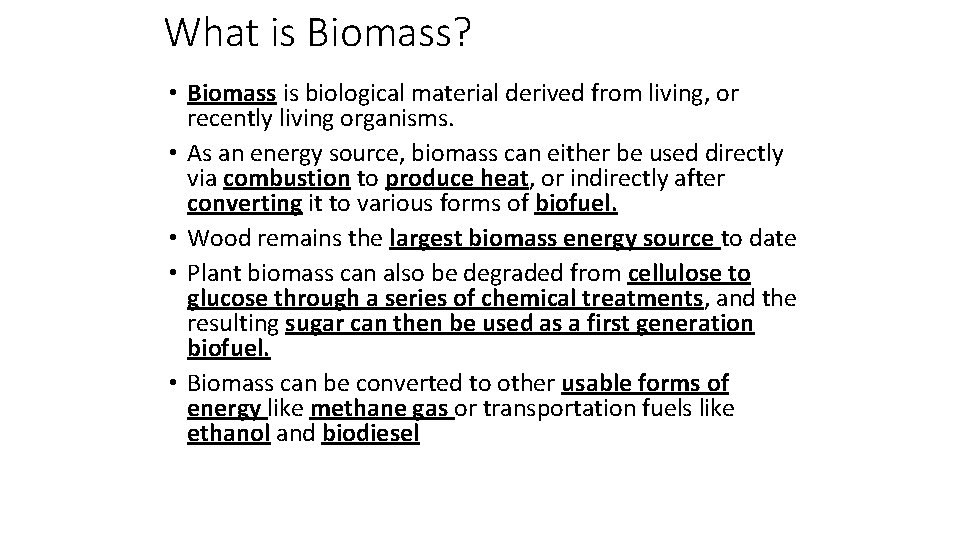
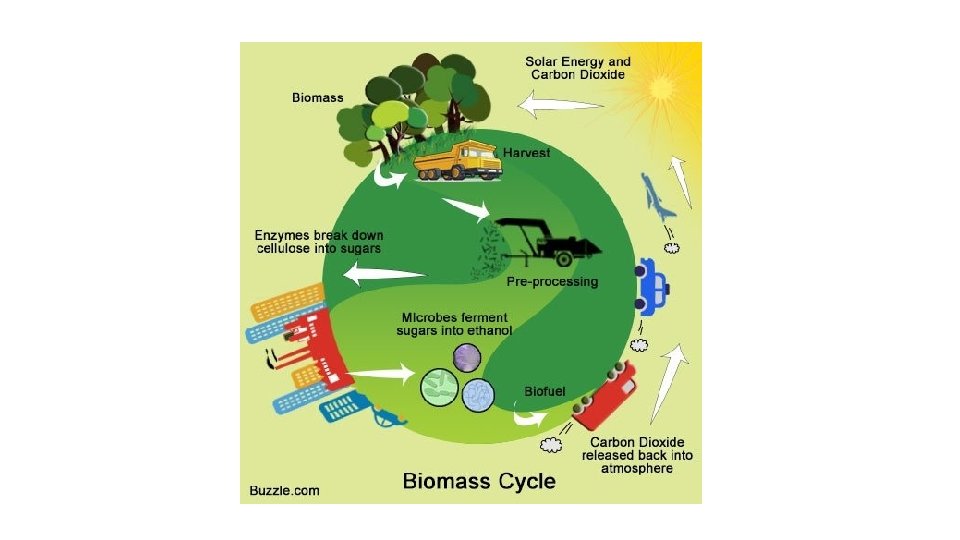
What is Biomass? • Biomass is biological material derived from living, or recently living organisms. • As an energy source, biomass can either be used directly via combustion to produce heat, or indirectly after converting it to various forms of biofuel. • Wood remains the largest biomass energy source to date • Plant biomass can also be degraded from cellulose to glucose through a series of chemical treatments, and the resulting sugar can then be used as a first generation biofuel. • Biomass can be converted to other usable forms of energy like methane gas or transportation fuels like ethanol and biodiesel
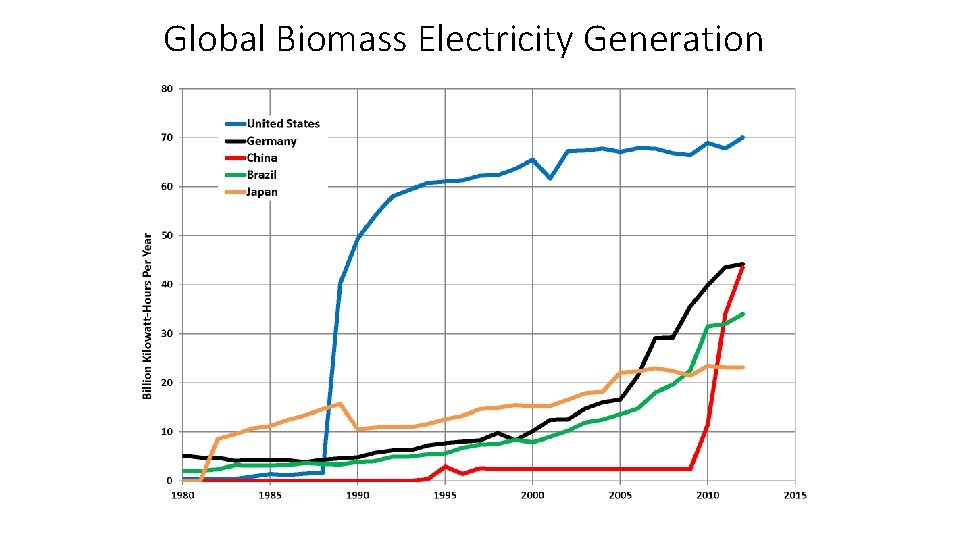
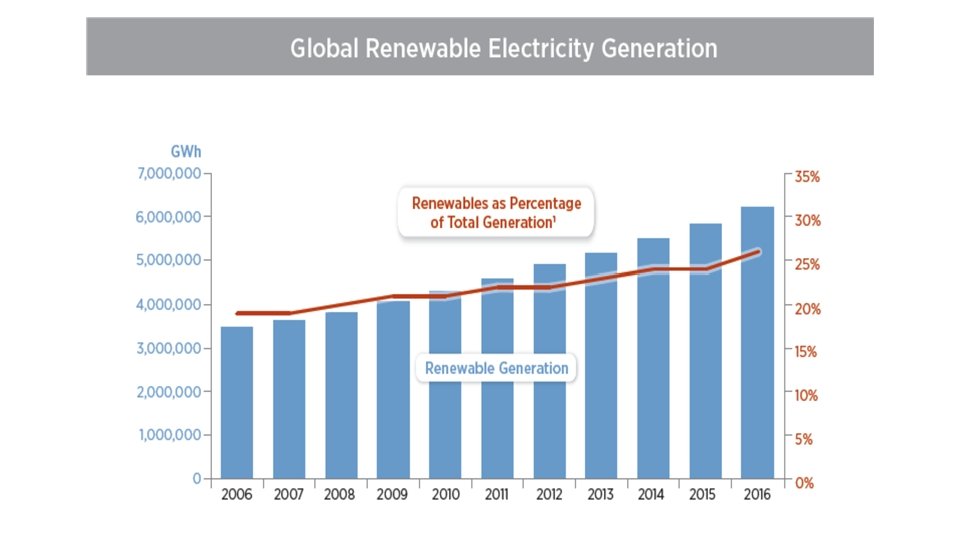
Global Biomass Electricity Generation
Biomass productivity • The biomass power generating industry in the United States, which consists of approximately 11, 000 MW of summer operating capacity actively supplying power to the grid, produces about 1. 4 percent of the U. S. electricity supply • The New Hope Power Partnership is the largest biomass power plant in North America. • The 140 MW facility uses sugar cane fiber and recycled urban wood as fuel to generate enough power for its large milling and refining operations as well as to supply electricity for nearly 60, 000 homes
Environmental Impact • Using biomass as a fuel produces air pollution in the form of carbon monoxide, NOx (nitrogen oxides), VOCs (volatile organic compounds), particulates and other pollutants at levels above those from traditional fuel sources such as coal or natural gas in some cases. • Forest-based biomass has recently come under fire from a number of environmental organizations, including Greenpeace and the Natural Resources Defense Council, for the harmful impacts it can have on forests and the climate
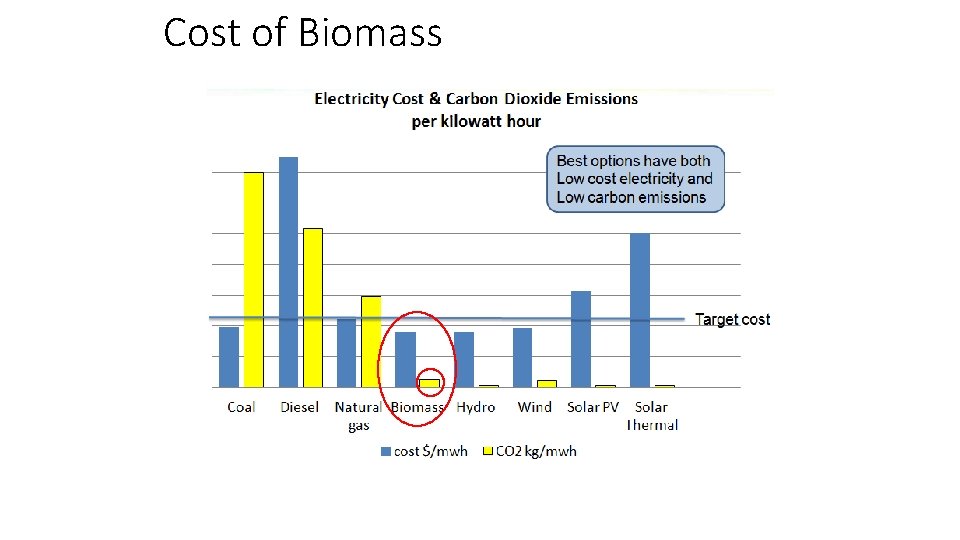
Cost of Biomass
Biomass advantages 1. Abundant and Renewable 2. Reduce Dependency on Fossil Fuels 3. Reduce Landfills
Biomass Disadvantages 1. Expensive 2. Inefficient compared to Fossil Fuels 3. Harmful to Environment 4. Consume More Fuel 5. Require More Land
Short Videos. Biomass 101 Biofuels 101
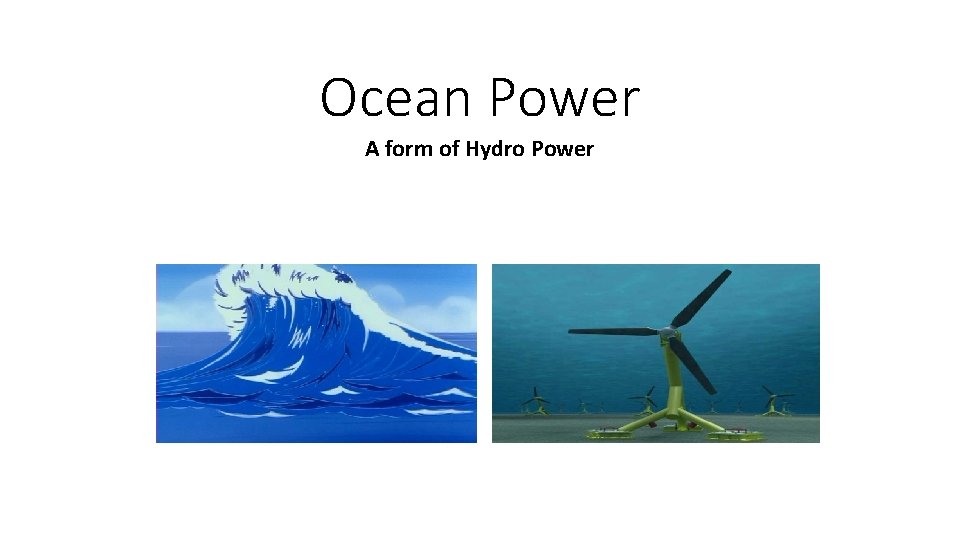
Ocean Power A form of Hydro Power
Ocean Energy as a whole……. • Ocean Energy is a Renewable Energy Source that is still at infant status when compared to other renewable energy sources. • But it has a great potential since 70% of the surface of the earth is covered by the ocean • The theoretical potential of Ocean Energy is estimated to be around 1. 8 TW with current knowledge and technologies.

What does it include? • Generating technologies for deriving electrical power from the ocean include tidal power, wave power, ocean thermal energy conversion, ocean currents, ocean winds and salinity gradients • Today we will cover: • Tidal Power • Wave Power
Tidal Power • Converts the energy of tides into useful forms of power, mainly electricity. • Tides are more predictable than wind energy and solar power- Does anyone here fish? • Tidal power has traditionally suffered from relatively high cost and limited availability of sites with sufficiently high tidal ranges or flow velocities
Where is Tidal Energy Prevalent? • “Tide Mills” have been used both in Europe and on the Atlantic coast of North America. • The world's first large-scale tidal power plant is the Rance Tidal Power Station in France, which became operational in 1966 - Today 250 MW) • 300 tide mills in North America, 200 in the British Isles, and 100 in France
How does it work? • Tidal power is taken from the Earth's oceanic tides; tidal forces are periodic variations in gravitational attraction exerted by celestial bodies • Due to the strong attraction to the oceans, a bulge in the water level is created, causing a temporary increase in sea level. • When the sea level is raised, water from the middle of the ocean is forced to move toward the shorelines, creating a tide. • This occurrence takes place in an unfailing manner, due to the consistent pattern of the moon’s orbit around the earth
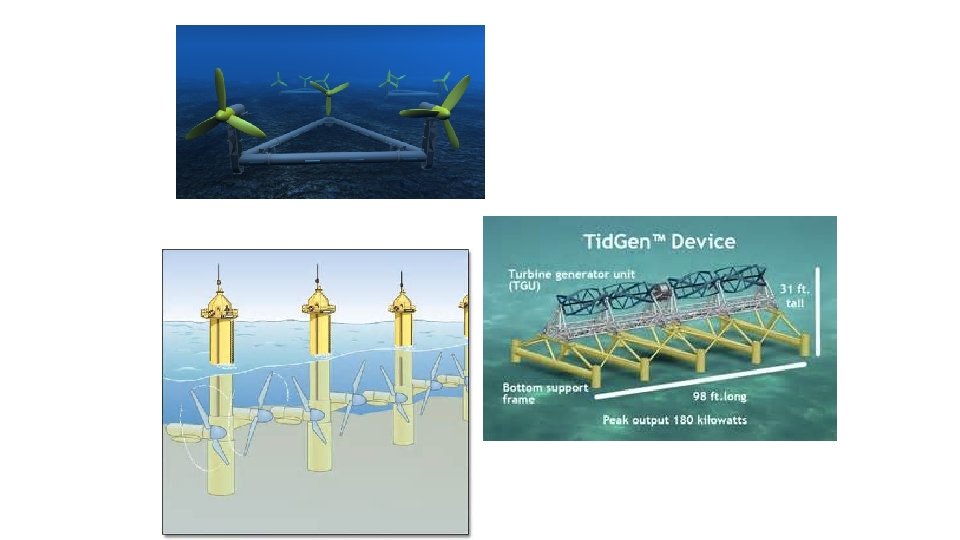
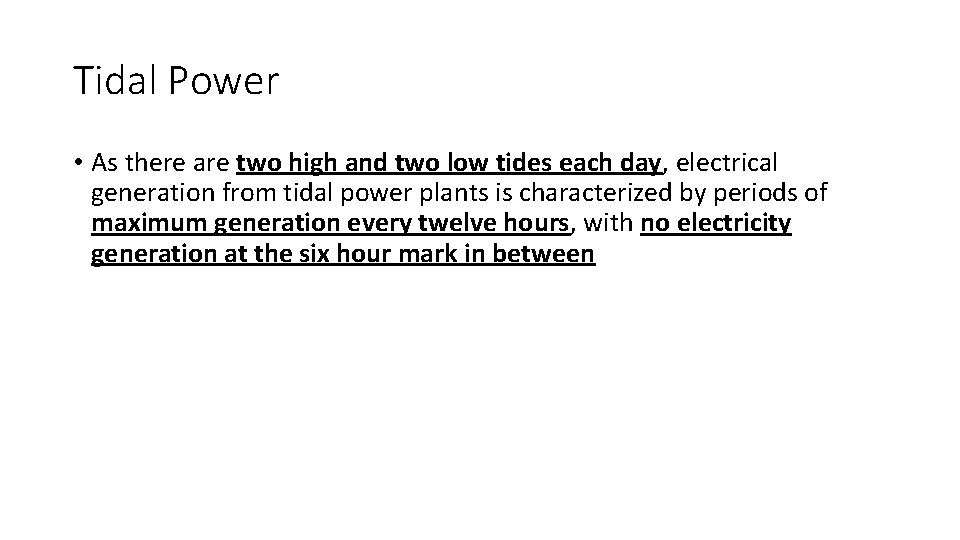
Tidal Power • As there are two high and two low tides each day, electrical generation from tidal power plants is characterized by periods of maximum generation every twelve hours, with no electricity generation at the six hour mark in between
Tidal Power • Advantages: • Reliable and predictable producer of energy • No Greenhouse gases emitted • Disadvantages: • There is a high capital cost for a tidal energy project, with possibly a 10 -year construction period (ROI? ). • Changing tidal flows by damming a bay or estuary could result in negative impacts on aquatic and shoreline ecosystems, as well as navigation and recreation.
Wave Power • Wave energy is produced when electricity generators are placed on the surface of the ocean. • Blowing wind and pressure fluctuations below the surface are the main reasons for causing waves • Energy output is determined by wave height, wave speed, wavelength, and water density. • But consistency of waves differs from one area of ocean to another. Some regions of oceans receive waves with enough uniformity and force to create consistent energy.
Advantages of Wave Power • Capable of high efficiency (60 -80%) in ideal conditions. • Renewable energy source obtained by wind via the Sun’s heating of our atmosphere. • Minimal environmental impact when properly placed. • Low operation and maintenance costs after construction. • Relatively low upfront construction costs. • No emissions during operation.
Disadvantages of Wave Power • Improperly placed wave power plants can damage the marine ecosystem. • Limited locations where waves are strong enough to produce electricity without damaging equipment. • Power only produced near oceans making transmission to inland customers difficult. • Winds (and thus waves) can be unpredictable and far from reliable. • Might not produce electricity at all times.
How Tidal and Wave Power Works PLUS: The future of renewables • www. youtube. com/watch? v=t. SBACz. RE 3 Gwo/2008/sep/24/wave. po wer. station
Short Video- Tidal Power 101
- Slides: 72