
Intro to PreElectrical Engineering The fundamentals of electricity
- Slides: 15
Intro to Pre-Electrical Engineering The fundamentals of electricity and electrical science 1
Discussion • What is electrical engineering technology? • History of electrical engineering • What occupations are associated with electrical engineering technology? • Electrical engineering: past, present and future • Sustainable solutions in electrical engineering Lesson 4 Intro Eng 2
Important Electrical Foundations Principles of Electrical Engineering – Analog and Digital Fundamentals • The basic principles of voltage, current and resistance and to teach the difference between analog and digital signals. – Ohm’s Law, – Kirchoff’s Law – Basic Digital Electronics • Lab Assignments: 3
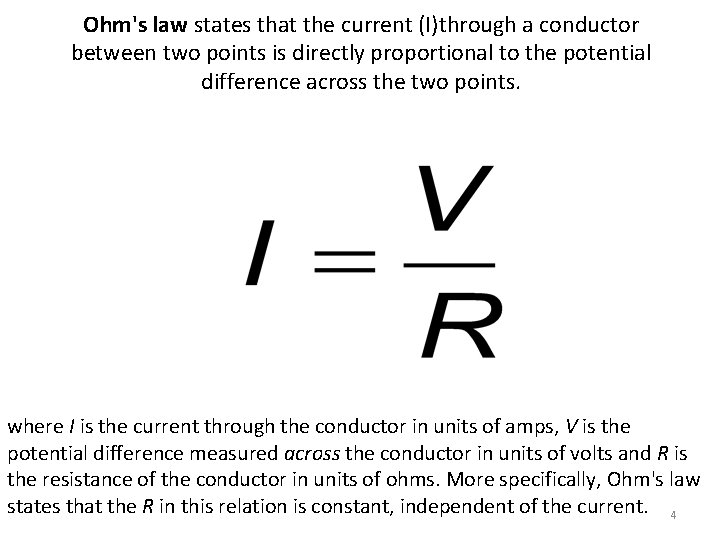
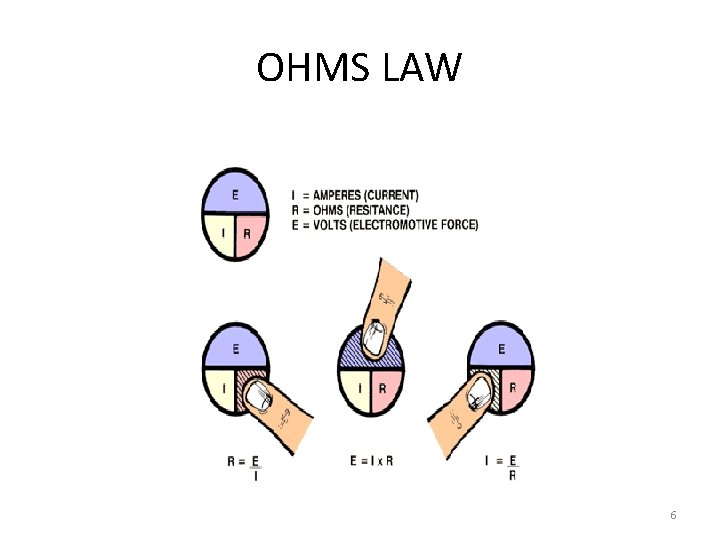
Ohm's law states that the current (I)through a conductor between two points is directly proportional to the potential difference across the two points. where I is the current through the conductor in units of amps, V is the potential difference measured across the conductor in units of volts and R is the resistance of the conductor in units of ohms. More specifically, Ohm's law states that the R in this relation is constant, independent of the current. 4
Ohms Law • The relationship among voltage, current and resistance • Voltmeters • Ammeters • Multimeters • Oscilloscopes • Calculate and support Ohm’s Law • Ohm's law states that the current through a conductor between two points is directly proportional to the potential difference across the two points. Introducing the constant of proportionality, the resistance, one arrives at the usual mathematical equation that describes this relationship. • • 5
OHMS LAW 6
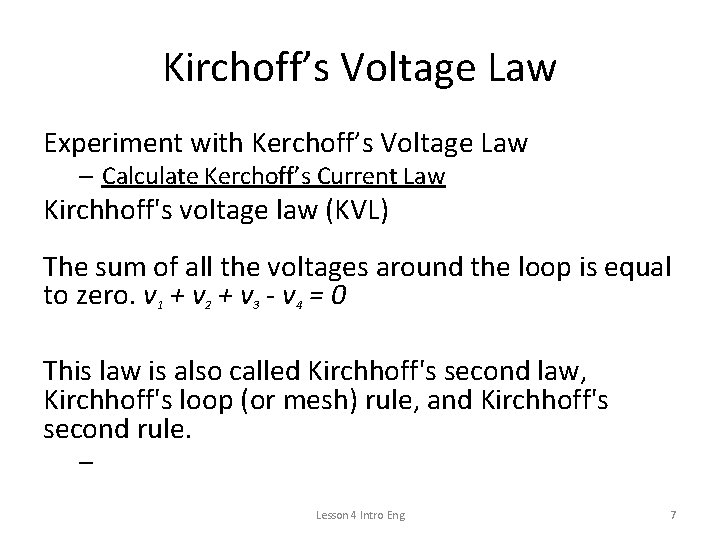
Kirchoff’s Voltage Law Experiment with Kerchoff’s Voltage Law – Calculate Kerchoff’s Current Law Kirchhoff's voltage law (KVL) The sum of all the voltages around the loop is equal to zero. v 1 + v 2 + v 3 - v 4 = 0 This law is also called Kirchhoff's second law, Kirchhoff's loop (or mesh) rule, and Kirchhoff's second rule. – Lesson 4 Intro Eng 7
Resistance • Consumes real power in the form of heat, light, work… • Physical property of a wire that results in power loss (I 2 R) • Property of a portion of a load that performs real work Lesson 4 Intro Eng 8
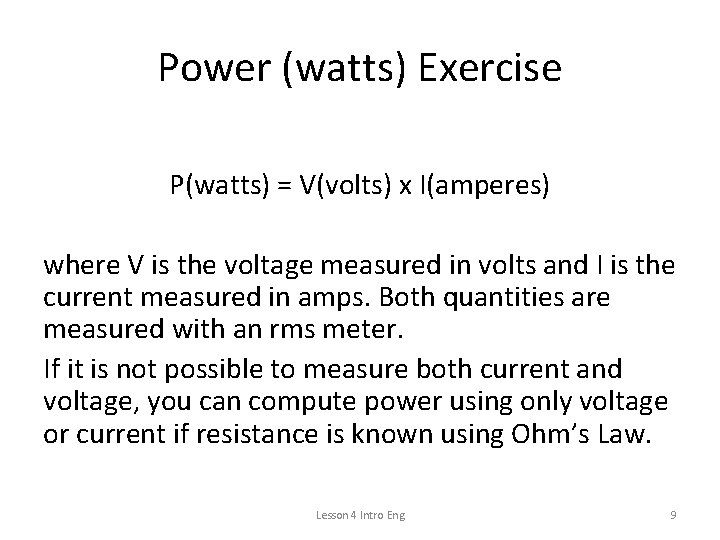
Power (watts) Exercise P(watts) = V(volts) x I(amperes) where V is the voltage measured in volts and I is the current measured in amps. Both quantities are measured with an rms meter. If it is not possible to measure both current and voltage, you can compute power using only voltage or current if resistance is known using Ohm’s Law. Lesson 4 Intro Eng 9
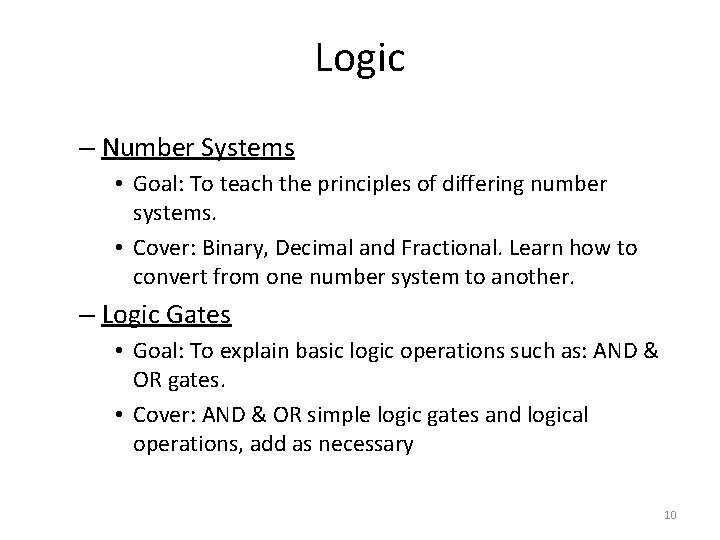
Logic – Number Systems • Goal: To teach the principles of differing number systems. • Cover: Binary, Decimal and Fractional. Learn how to convert from one number system to another. – Logic Gates • Goal: To explain basic logic operations such as: AND & OR gates. • Cover: AND & OR simple logic gates and logical operations, add as necessary 10
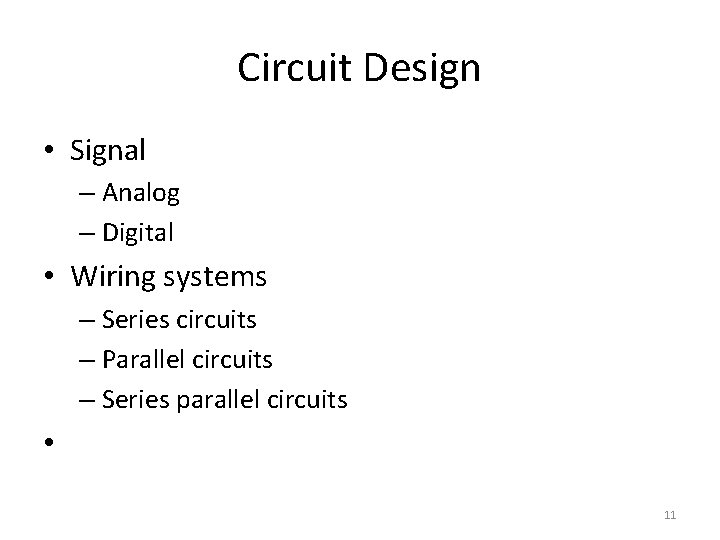
Circuit Design • Signal – Analog – Digital • Wiring systems – Series circuits – Parallel circuits – Series parallel circuits • 11
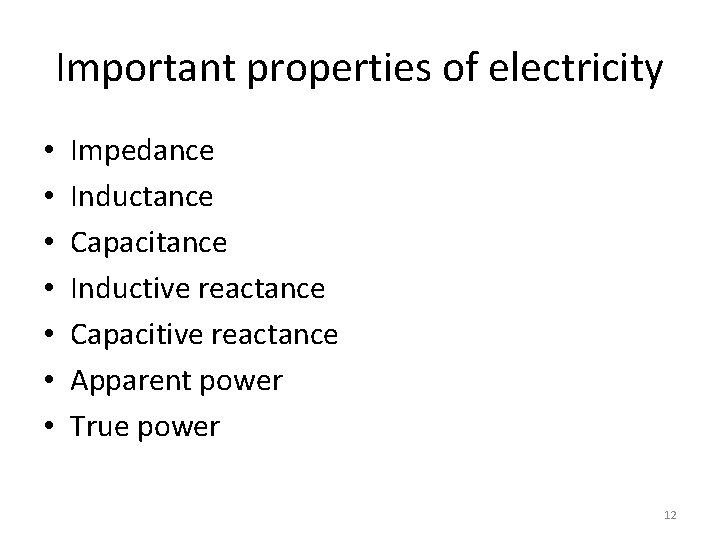
Important properties of electricity • • Impedance Inductance Capacitance Inductive reactance Capacitive reactance Apparent power True power 12
Power Factor Correction • • Large commercial and industrial energy users with fluorescent lighting and heavy machinery Maintain the smallest phase angle between current and voltage The cosine of the phase angle between the current and the voltage is the power factor that is a multiplier that determines whether the electric energy is used at its maximum to deliver lighting or mechanical work or is wasted as heat. Power factor (P) is defined as the product of voltage (V) and current (I) times the cosine of the phase angle, or P = V x I x cosine angle Motors, transformers, lighting ballasts with wound copper coils are inductive (magnetic) elements. Inductive loads have a tendency to shift the current and voltage phase angles that result in a power factor of less than 1, reducing power efficiency, wasting real electricity and costing real money. A rule of thumb is to attain a power factor above. 93. When PF is below. 87, PF can be improved by adding capacitors (capacitor reactance). See capacitor manufacturer sheet to specify capacitors for a specific building’s inductive load. 13
Two other important electrical topics • Three phase power • Variable Frequency Drives 14
Applications to Computers – Flow Chart Concepts • Goal: To explain the concepts, design basics, and uses of flow-charting • Cover: Fundamental principles of flow charts such as decisions, processes, inputs and outputs using MS VISIO or similar. – Introduction to Programming Language/Sequencing • Goal: To be able to understand the basic concepts of programming and different types of programming languages, as related to sequencing electromechnical systems • Cover: In/out algorithm concepts i. e. input/output “black box” concept • Cover: Program structure, simple programming sequences, graphic and numeric languages such as that used by Johnson Controls et al. – HTML/Website design • Goal: To be able to understand implement the hypertext markup language. • Will Cover: HTML tags and explanations, web page structure and design. • Lab Assignments: – “Our Sustainability Website Concept” » Purpose: Students may work as a team in building a team sustainability website concept. Note: The concept of teamwork is important in the fields of energy and engineering in general. Even though some students like working alone, encouraging the students to work in a team environment is strongly advised. 15