
Intro to NONFICTION Please take notes on your
- Slides: 20
Intro to NONFICTION Please take notes on your handout as you view the information in this Power Point!
NONFICTION: • factual, prose writing that deals with real people and experiences • Nonfiction books and articles are excellent resources for reading, writing, and learning.
Traits of Nonfiction • Purpose—to inform, persuade, or entertain • Usually focuses on one topic or main idea • Information is factual, but may contain opinions • Facts may be supported by detailed descriptions, examples, definitions, or quotations.
• Autobiography/Bio graphy • Essay • Editorial • Speech • Newspaper/ Magazine Articles
• TRAITS – written about a person’s life or one main event-has a plot-can be read in one sitting or have many chapters • PURPOSE – To entertain – To inform
• TRAITS – can be based on research or personal experience – -can be read in one sitting – -written in paragraph form/usually five or more • PURPOSE – To inform – To persuade – To entertain
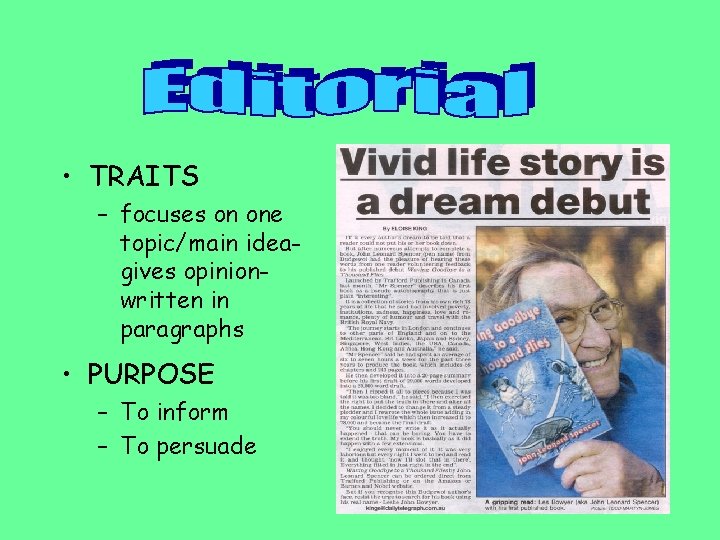
• TRAITS – focuses on one topic/main ideagives opinionwritten in paragraphs • PURPOSE – To inform – To persuade
• TRAITS – focuses on one topic/main idea – oral presentation – can be researched or personal experience – written in paragraphs • PURPOSE – To inform – To persuade – To entertain
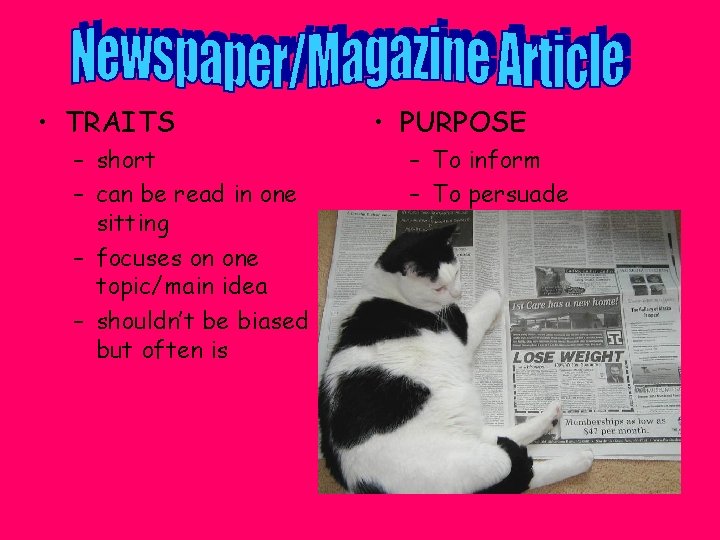
• TRAITS – short – can be read in one sitting – focuses on one topic/main idea – shouldn’t be biased but often is • PURPOSE – To inform – To persuade
Author’s Purpose • The intention of the writer: – – – to entertain to inform to persuade to explain to describe *can be a combination of two or more of these purposes
ARGUMENT A course of reasoning aimed at demonstrating the truth or falsehood of a specific point
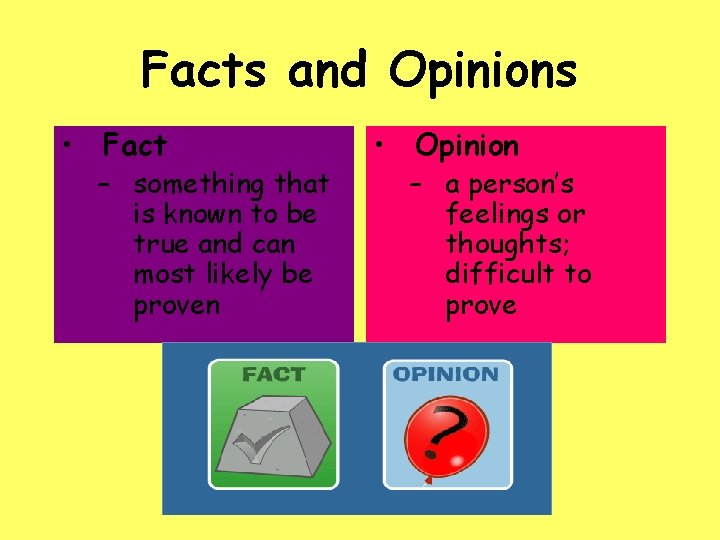
Facts and Opinions • Fact – something that is known to be true and can most likely be proven • Opinion – a person’s feelings or thoughts; difficult to prove
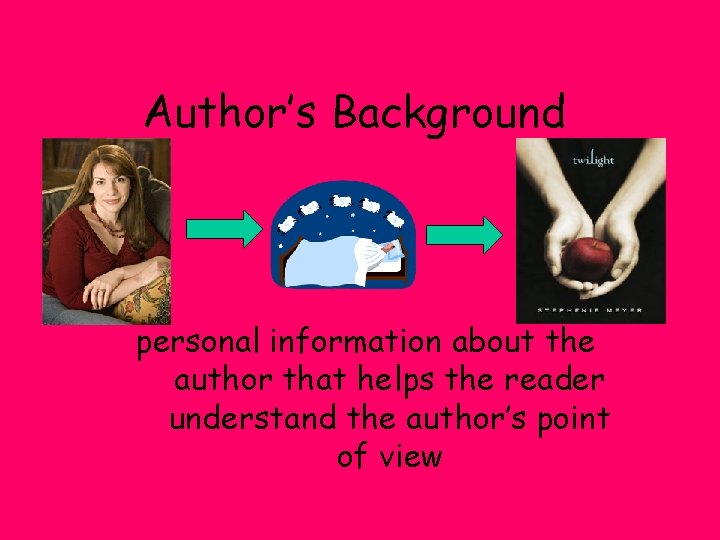
Author’s Background personal information about the author that helps the reader understand the author’s point of view
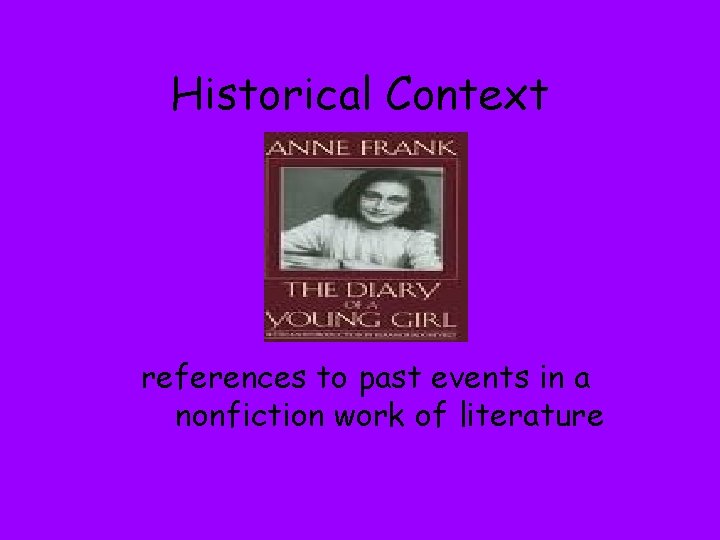
Historical Context references to past events in a nonfiction work of literature
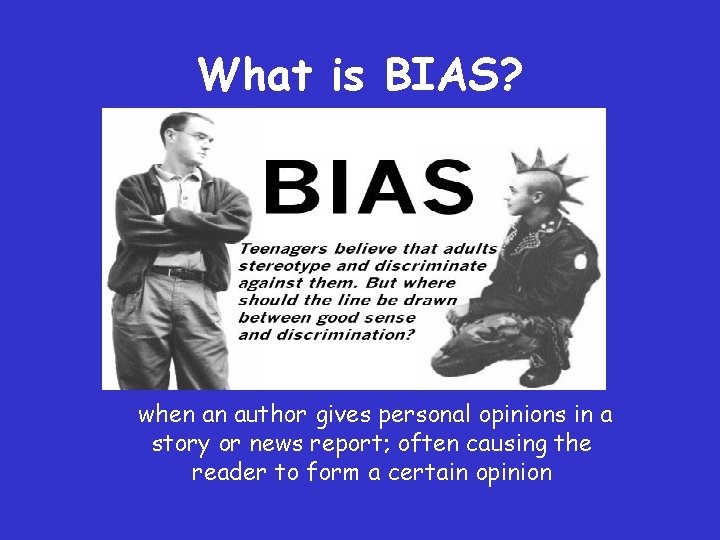
What is BIAS? when an author gives personal opinions in a story or news report; often causing the reader to form a certain opinion
Emotional Language/Semantic Slanting Emotional Language *loaded words that impact the reader’s opinion/feelings Semantic Slanting *a technique that an author uses to influence the reader’s opinion
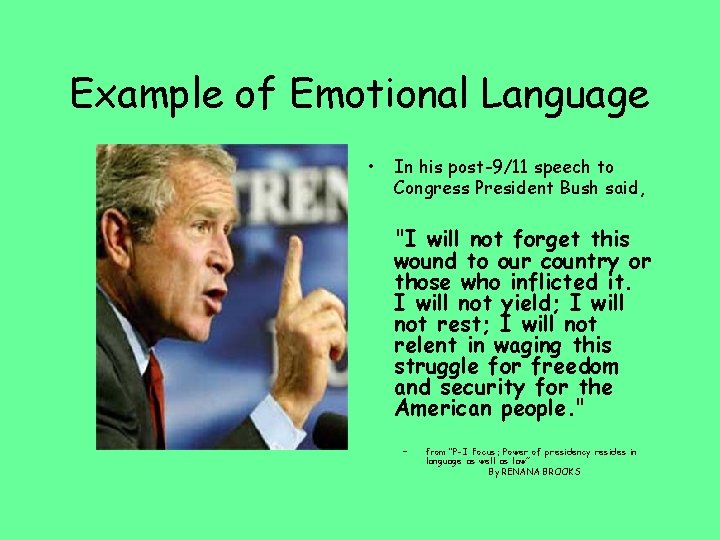
Example of Emotional Language • In his post-9/11 speech to Congress President Bush said, "I will not forget this wound to our country or those who inflicted it. I will not yield; I will not rest; I will not relent in waging this struggle for freedom and security for the American people. " – from “P-I Focus: Power of presidency resides in language as well as law” By RENANA BROOKS
Making Inferences • Inference: to read between the lines or make an educated guess • Purpose: to determine things that are not directly stated in the passage. INFERENCE= What the text says + What the author is saying + What you know
Drawing Conclusions • Means making judgments about what has happened or what you have learned in your reading • Strategy: List supporting facts that lead to a conclusion or judgment
That’s All Folks…