
Intro to Narrative Writing What is a narrative
- Slides: 30
Intro to Narrative Writing
What is a narrative? • A narrative is a story made up of real or imagined experiences. • A personal narrative is an account of events from your life. • A fictional narrative is a made up story.
Writing a Narrative Your narrative will need to include: • characters (a protagonist and antagonist) • a setting • a plot • a conflict (external or internal) • a point of view • a climax • a conclusion
The Narrative Elements • Character – a person depicted in a work of fiction. – Protagonist - the leading character or one of the major characters in a drama, movie, novel, or other fictional text – Antagonist - a person who actively opposes or is hostile to someone or something; an adversary
The Narrative Elements • Setting –the time and place a story is set. – When: What time does the story take place (hour of the day, day of the week, year, time period, season, etc. )? – Where: At what location does the story take place?
The Narrative Elements • Plot - the events take make up a storyline – Exposition – Inciting Incident – Rising Action – Climax – Falling Action – Conclusion
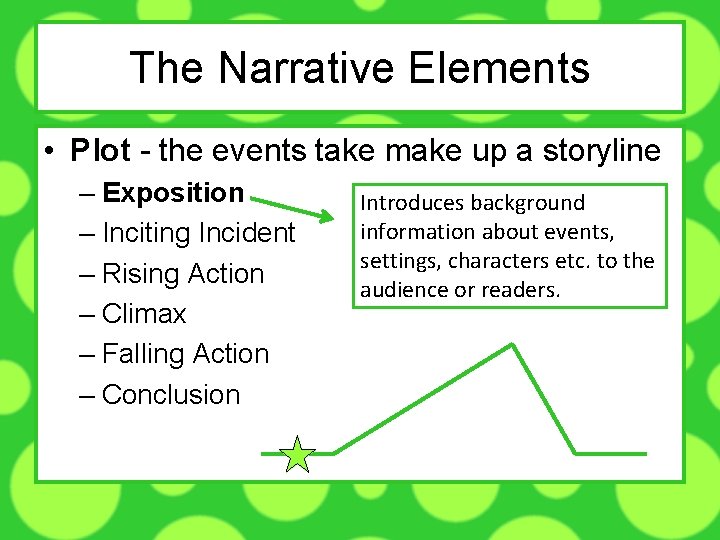
The Narrative Elements • Plot - the events take make up a storyline – Exposition – Inciting Incident – Rising Action – Climax – Falling Action – Conclusion Introduces background information about events, settings, characters etc. to the audience or readers.
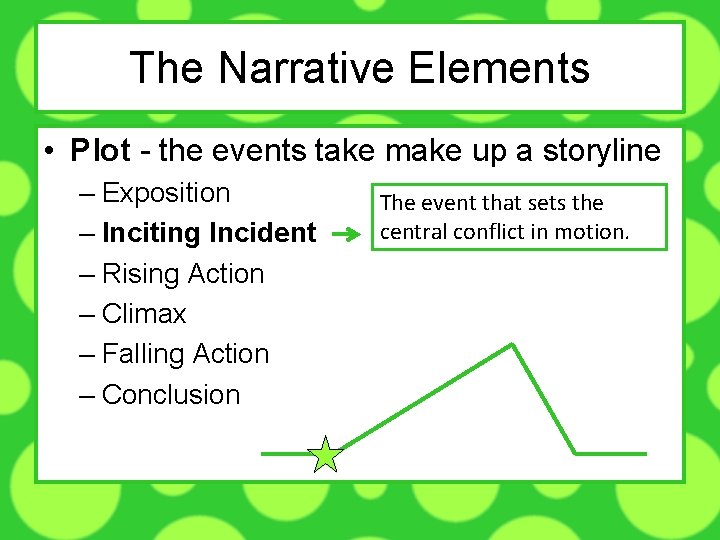
The Narrative Elements • Plot - the events take make up a storyline – Exposition – Inciting Incident – Rising Action – Climax – Falling Action – Conclusion The event that sets the central conflict in motion.
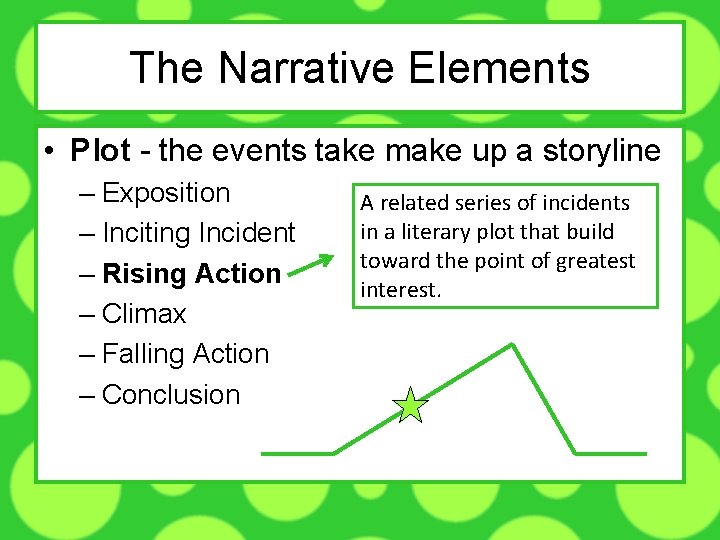
The Narrative Elements • Plot - the events take make up a storyline – Exposition – Inciting Incident – Rising Action – Climax – Falling Action – Conclusion A related series of incidents in a literary plot that build toward the point of greatest interest.
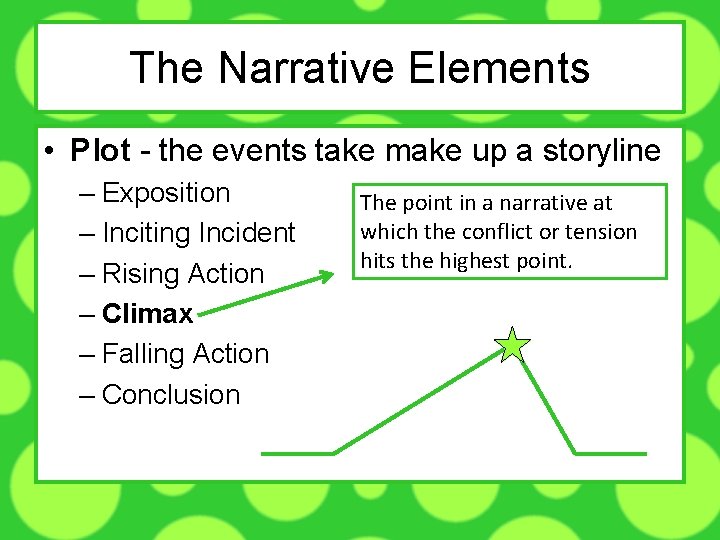
The Narrative Elements • Plot - the events take make up a storyline – Exposition – Inciting Incident – Rising Action – Climax – Falling Action – Conclusion The point in a narrative at which the conflict or tension hits the highest point.
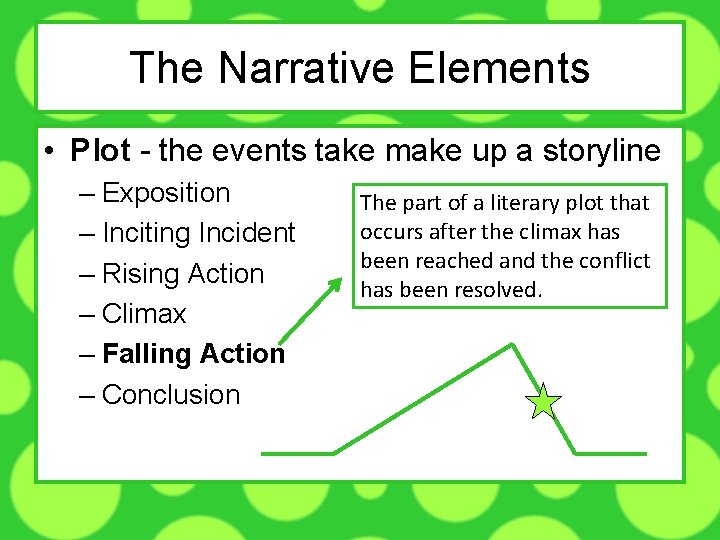
The Narrative Elements • Plot - the events take make up a storyline – Exposition – Inciting Incident – Rising Action – Climax – Falling Action – Conclusion The part of a literary plot that occurs after the climax has been reached and the conflict has been resolved.
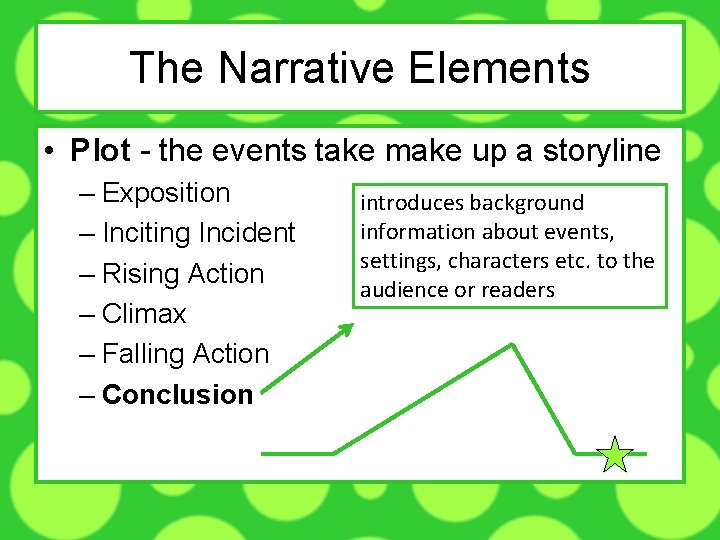
The Narrative Elements • Plot - the events take make up a storyline – Exposition – Inciting Incident – Rising Action – Climax – Falling Action – Conclusion introduces background information about events, settings, characters etc. to the audience or readers
The Narrative Elements • Conflict - a literary element that involves a struggle between two opposing forces usually a protagonist and an antagonist. – External: a struggle between a character and an outside force (another character or nature). – Internal: a struggle happening within a character’s mind.
The Narrative Elements • Point of View - the narrator's position in relation to the story being told. – 1 st person: The narrator is in the story • EX: I woke up that morning and wanted to buy some ice cream. – 3 rd person: The narrator is an outsider telling the story • EX: He woke up that morning and wanted to buy some ice cream.
The Writing Process Follow these steps to write a narrative • Prewriting • Drafting • Revising • Editing • Publishing
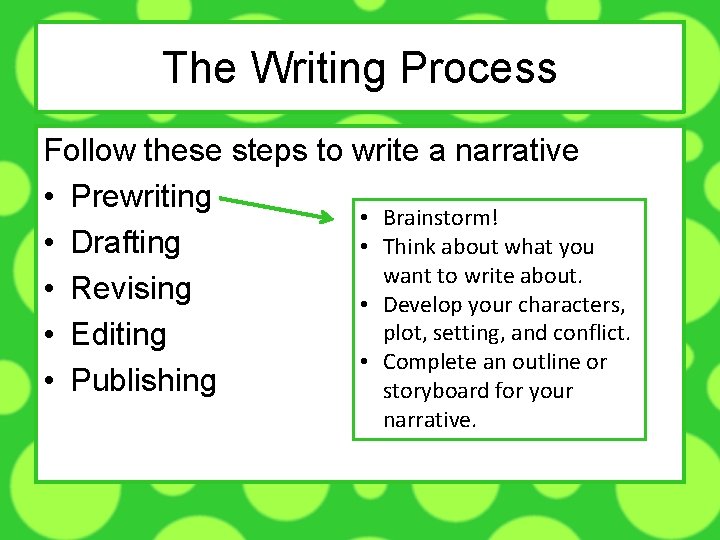
The Writing Process Follow these steps to write a narrative • Prewriting • Brainstorm! • Drafting • Think about what you want to write about. • Revising • Develop your characters, plot, setting, and conflict. • Editing • Complete an outline or • Publishing storyboard for your narrative.
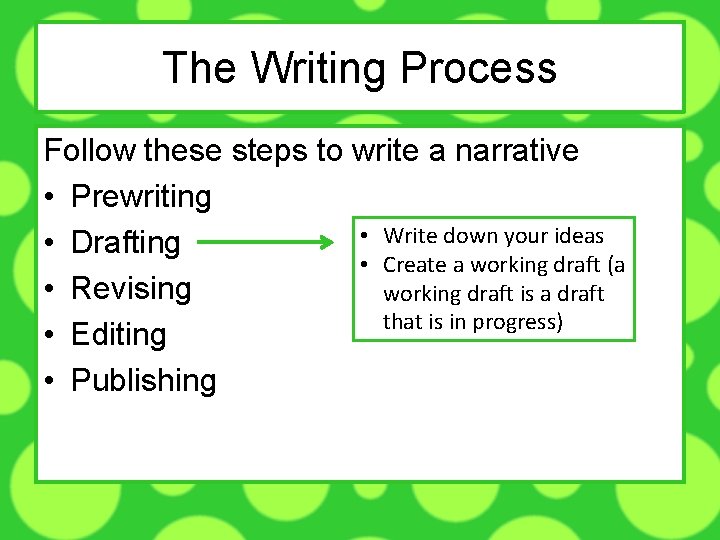
The Writing Process Follow these steps to write a narrative • Prewriting • Write down your ideas • Drafting • Create a working draft (a • Revising working draft is a draft that is in progress) • Editing • Publishing
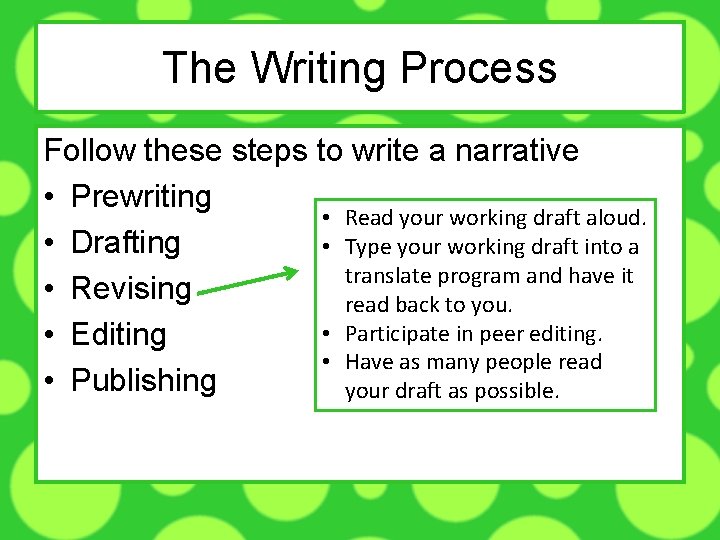
The Writing Process Follow these steps to write a narrative • Prewriting • Read your working draft aloud. • Drafting • Type your working draft into a translate program and have it • Revising read back to you. • Participate in peer editing. • Editing • Have as many people read • Publishing your draft as possible.
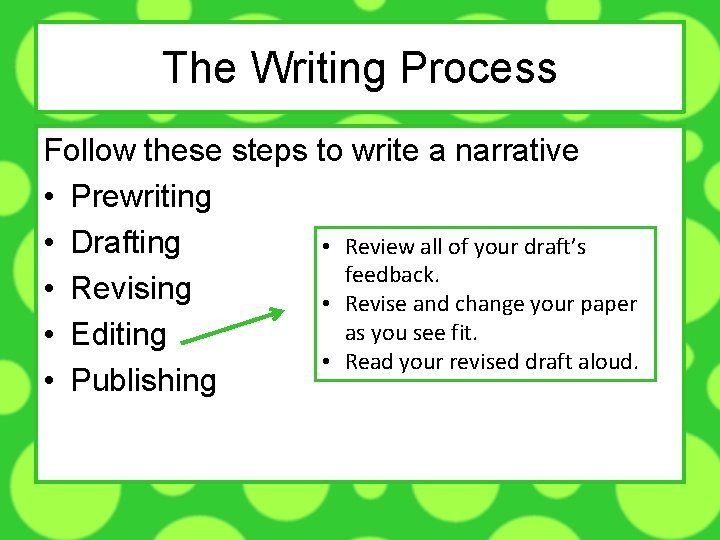
The Writing Process Follow these steps to write a narrative • Prewriting • Drafting • Review all of your draft’s feedback. • Revising • Revise and change your paper as you see fit. • Editing • Read your revised draft aloud. • Publishing
The Writing Process Follow these steps to write a narrative • Prewriting • Drafting • Type your final draft • Revising • Editing • Publishing
Brainstorming Let’s get started! • Think about the characters for your narrative. – Will the characters be you, a version of you, or completely made up? – How old will the characters be? – What will the characters look like? – How will the characters act?
Brainstorming Let’s get started! • Think about the setting of your narrative. – Where will your narrative take place? – When will your narrative take place? – What is the weather like? – What are the surroundings like?
Brainstorming Let’s get started! • Think about the conflict of your narrative. – What is the central conflict of your narrative? – Is it an external or an internal conflict? – Who are the opposing forces? – Why are these forces against each other?
Brainstorming Let’s get started! • Think about the point of view for your narrative. – What point of view will you write your narrative in? – Will the narrator be a character in the story? – Will the narrator be a spectator? – Will the narrator have limited access to the characters and their thoughts?
Brainstorming Let’s get started! • Think about the tone of your narrative. – What is the author’s attitude toward the characters? – What is the author’s attitude toward the setting? – What is the author’s attitude toward the conflict?
Brainstorming Let’s get started! • Think about the plot of your narrative. – What is going to happen in your narrative? – What event will start the central conflict? – How will the climax be resolved?
Drafting • Using all of the materials from the brainstorming process, get to work writing your first draft. • You can always go back and edit and revise your writing. • The key is to get your thoughts onto the paper.
Revising • Once you complete your rough draft, read it aloud. • You can type your rough draft into an Internet translator and have it read to you. • Participate in peed editing.
Editing • Review all of your notes and the peer review notes. • Revise your narrative to improve its quality and content.
Publishing • Prepare the final draft of your narrative. • Type your narrative.