
Intro to Lab Modeling a Microvascular Network on

Intro to Lab: Modeling a Microvascular Network on a Chip ECE 1810 October 3 2011 Erik Zavrel
Lab Objectives �To characterize simple model of microvascular system using microfluidic device �To introduce you to microfluidics Measure flow velocities within model network before and after a blockage (occlusion or clot of a blood vessel - stroke) ▪ particle velocimetry Show EE concepts transfer to the design and analysis of a microfluidic network Lab will be accompanied by an assignment ▪ theoretically calculate pressure and velocity in each channel before and after blockage ▪ compare calculated pressure and velocities with empirical velocities
What is Microfluidics: What’s in a name? � Infer: manipulation of minute quantities of fluids (L and G) … inside very small devices � Applies ultra-precise fab technology to conventionally “messy” fields like biology (dishes, plates) and chemistry (vats, reaction vessels) Emerged early 90 s: Andreas Manz, George Whitesides, but idea has been around much longer: ▪ Richard Feynman – “There’s Plenty of Room at the Bottom” – 1959 Why? ▪ Unique physics at microscale permits novel creations ▪ Permits more orderly, systematic approach to bio-related problems, reduces physical effort: ▪ drug discovery ▪ cytotoxicity assays ▪ protein crystallization
Background � Aims to do for chemistry and biology what Kilby’s and Noyce’s invention of the IC did for the field of electronics: dramatic reduction in size and cost increase in performance and portability lab on a chip: goal to have all stages of chemical analysis performed in integrated fashion: ▪ ▪ ▪ sample prep. rxns analyte sep. analyte purification detection analysis µTAS, POCT, decentralized � Benefits: integration of functionality, small consumption of expensive reagents, automation, high throughput, reproducibility of results, parallelization, disposable
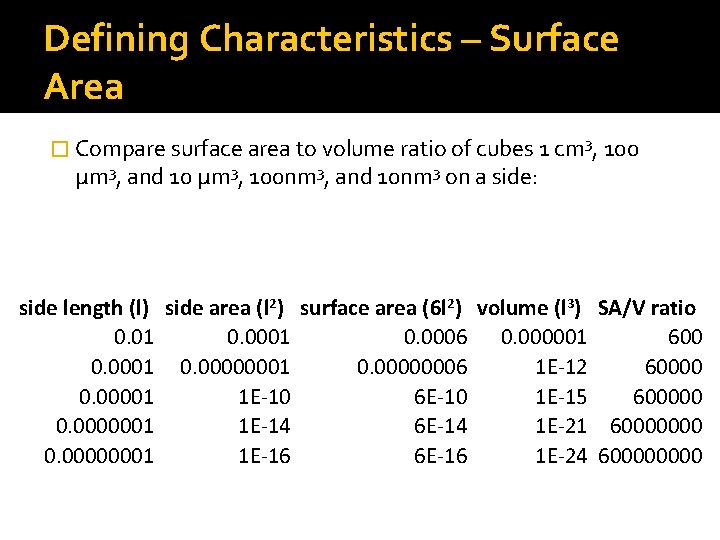
Defining Characteristics – Surface Area � Compare surface area to volume ratio of cubes 1 cm 3, 100 μm 3, and 10 μm 3, 100 nm 3, and 10 nm 3 on a side: side length (l) side area (l 2) surface area (6 l 2) volume (l 3) SA/V ratio 0. 01 0. 0006 0. 000001 600 0. 0001 0. 00000006 1 E-12 60000 0. 00001 1 E-10 6 E-10 1 E-15 600000 0. 0000001 1 E-14 6 E-14 1 E-21 60000000 0. 00000001 1 E-16 6 E-16 1 E-24 60000
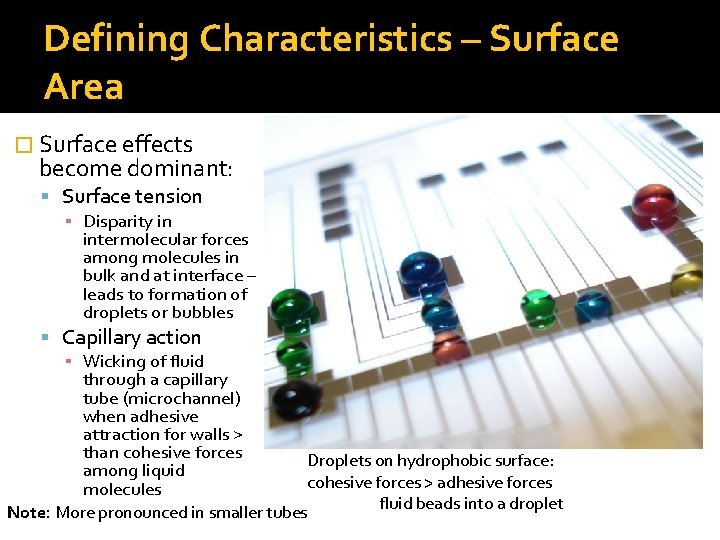
Defining Characteristics – Surface Area � Surface effects become dominant: Surface tension ▪ Disparity in intermolecular forces among molecules in bulk and at interface – leads to formation of droplets or bubbles Capillary action ▪ Wicking of fluid through a capillary tube (microchannel) when adhesive attraction for walls > than cohesive forces among liquid molecules Droplets on hydrophobic surface: cohesive forces > adhesive forces fluid beads into a droplet Note: More pronounced in smaller tubes
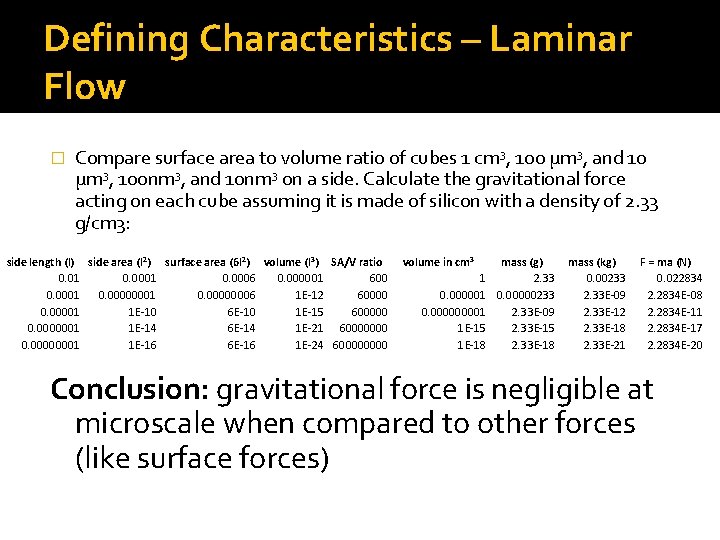
Defining Characteristics – Laminar Flow � Compare surface area to volume ratio of cubes 1 cm 3, 100 μm 3, and 10 μm 3, 100 nm 3, and 10 nm 3 on a side. Calculate the gravitational force acting on each cube assuming it is made of silicon with a density of 2. 33 g/cm 3: side length (l) side area (l 2) surface area (6 l 2) volume (l 3) SA/V ratio 0. 01 0. 0006 0. 000001 600 0. 0001 0. 00000006 1 E-12 60000 0. 00001 1 E-10 6 E-10 1 E-15 600000 0. 0000001 1 E-14 6 E-14 1 E-21 60000000 0. 00000001 1 E-16 6 E-16 1 E-24 60000 volume in cm 3 1 0. 000000001 1 E-15 1 E-18 mass (g) 2. 33 0. 00000233 2. 33 E-09 2. 33 E-15 2. 33 E-18 mass (kg) 0. 00233 2. 33 E-09 2. 33 E-12 2. 33 E-18 2. 33 E-21 F = ma (N) 0. 022834 2. 2834 E-08 2. 2834 E-11 2. 2834 E-17 2. 2834 E-20 Conclusion: gravitational force is negligible at microscale when compared to other forces (like surface forces)
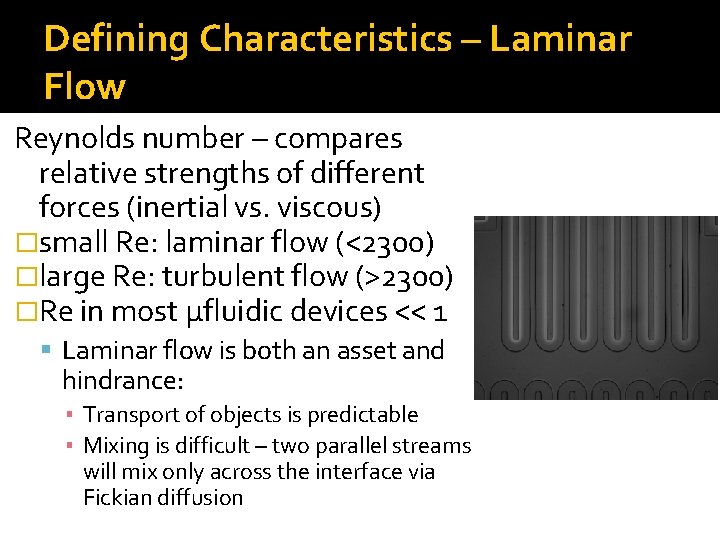
Defining Characteristics – Laminar Flow Reynolds number – compares relative strengths of different forces (inertial vs. viscous) �small Re: laminar flow (<2300) �large Re: turbulent flow (>2300) �Re in most μfluidic devices << 1 Laminar flow is both an asset and hindrance: ▪ Transport of objects is predictable ▪ Mixing is difficult – two parallel streams will mix only across the interface via Fickian diffusion
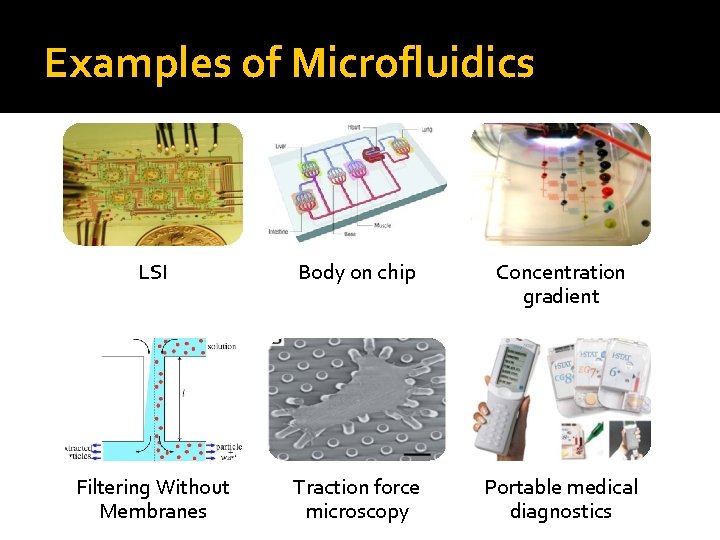
Examples of Microfluidics LSI Body on chip Concentration gradient Filtering Without Membranes Traction force microscopy Portable medical diagnostics
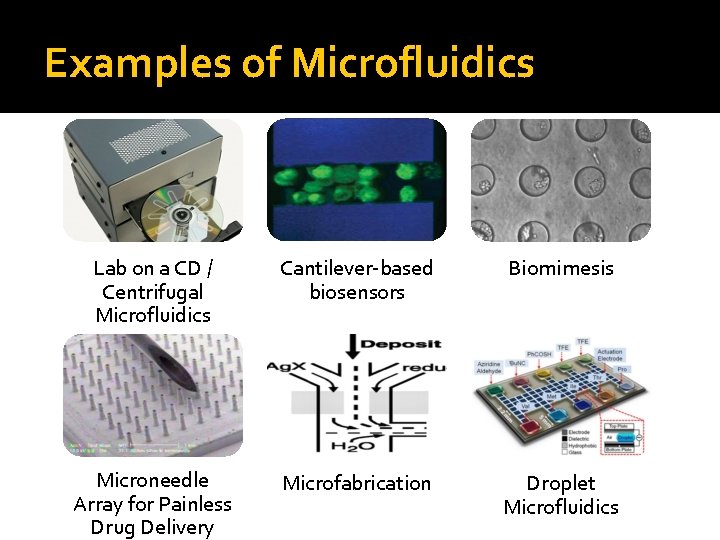
Examples of Microfluidics Lab on a CD / Centrifugal Microfluidics Cantilever-based biosensors Biomimesis Microneedle Array for Painless Drug Delivery Microfabrication Droplet Microfluidics

Field Overview �Very low tech to very complex �Single layer lithography to multiple layers requiring alignment �Minimalistic (paper-based) vs. sophisticated �Components vs. Systems (hierarchical) �Devices vs. Applications
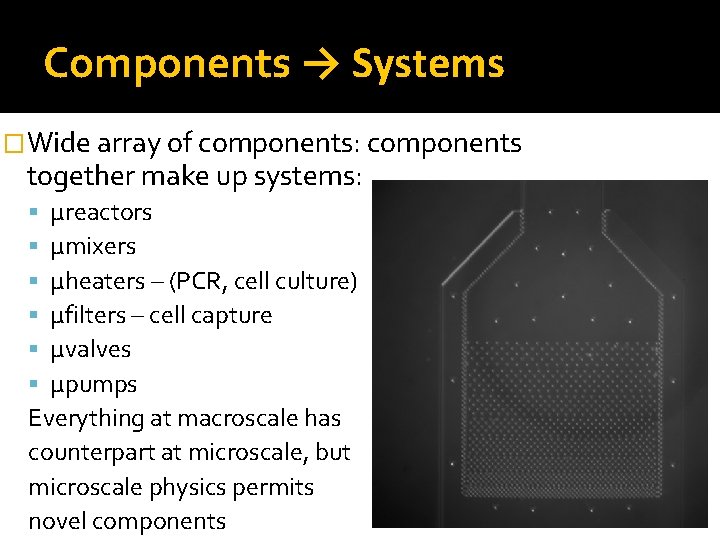
Components → Systems �Wide array of components: components together make up systems: μreactors μmixers μheaters – (PCR, cell culture) μfilters – cell capture μvalves μpumps Everything at macroscale has counterpart at microscale, but microscale physics permits novel components
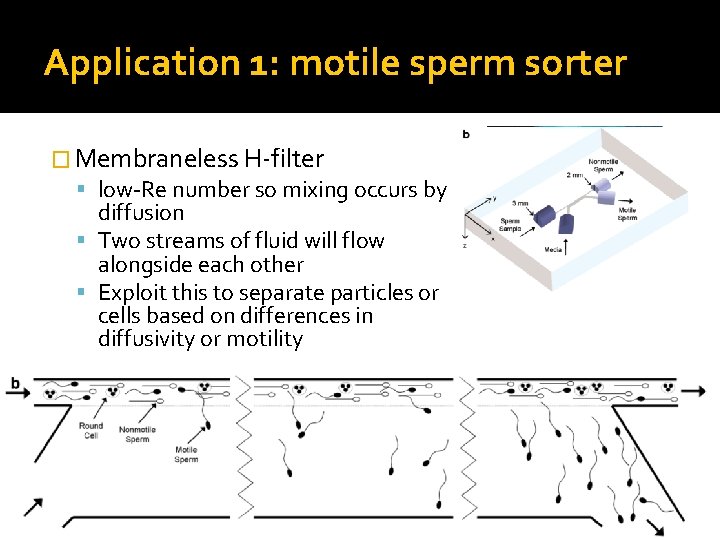
Application 1: motile sperm sorter � Membraneless H-filter low-Re number so mixing occurs by diffusion Two streams of fluid will flow alongside each other Exploit this to separate particles or cells based on differences in diffusivity or motility
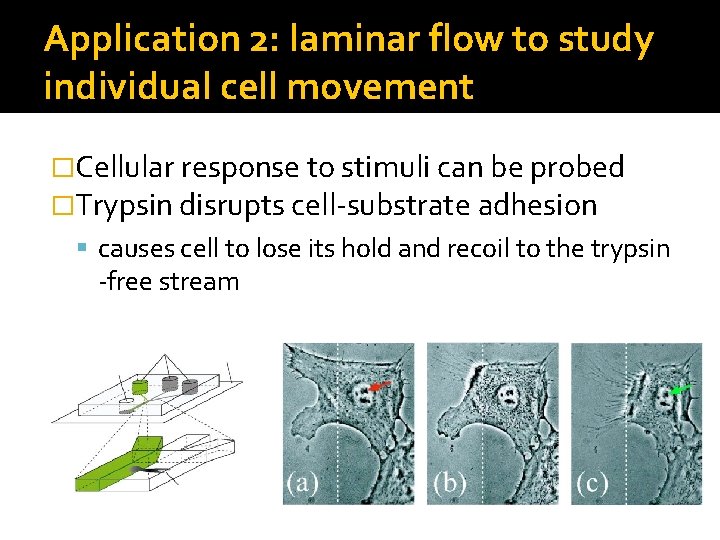
Application 2: laminar flow to study individual cell movement �Cellular response to stimuli can be probed �Trypsin disrupts cell-substrate adhesion causes cell to lose its hold and recoil to the trypsin -free stream
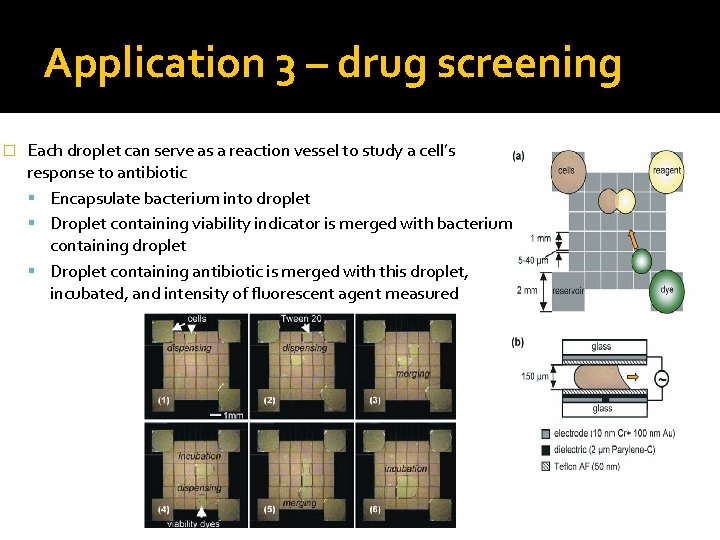
Application 3 – drug screening � Each droplet can serve as a reaction vessel to study a cell’s response to antibiotic Encapsulate bacterium into droplet Droplet containing viability indicator is merged with bacteriumcontaining droplet Droplet containing antibiotic is merged with this droplet, incubated, and intensity of fluorescent agent measured
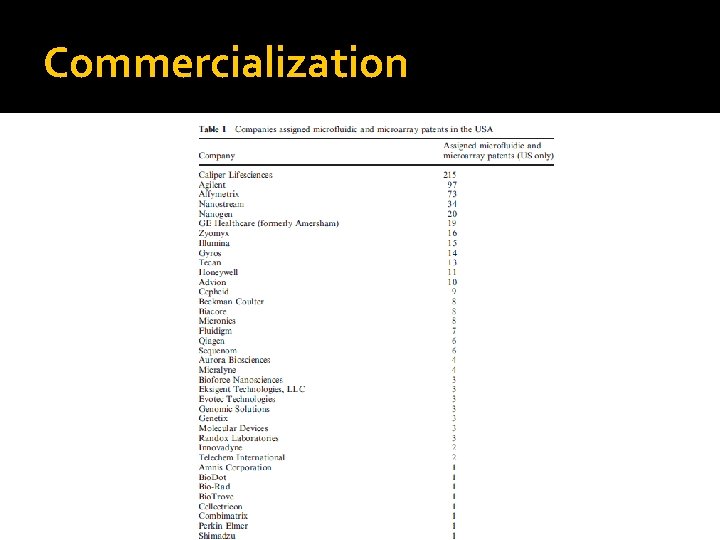
Commercialization �Despite being subject of ongoing research, microfluidics is being commercialized (startups, spinoffs, lucrative extensions to established) �Microfabrication-related industries (MEMS, inkjet heads, accelerometers, gyroscopes) much more mature and profitable No standards (DIP), competing paradigms, diff. materials �Research has spawned microfluidics companies high-throughput low-cost DNA sequencing portable diagnostic tools novel displays for E-readers
Commercialization
Connection to EE � Basic concepts have direct analogs to EE (voltage, current, resistance) � Design and analysis of devices uses same methods used to analyze circuits (KCL, KVL, Ohm’s Law) � Fabrication of devices uses tools and techniques borrowed from semiconductor industry � Entire electronic devices have counterparts in microfluidics: shift register voltage divider (drop pressure) current divider (split flow) � Control is effected in same way: multiplexing truth tables
Fabrication: How Are Microfluidic Devices Made? �Semiconductor fabrication methods �Pattern is defined on surface (2 D) and then transferred into vertical plane �Process flow – depicted as a cross-sectional view, each step showing execution of one step (addition of layer, exposure, removal of layer, etc. ) �Detailed process to create master, replicas created inexpensively
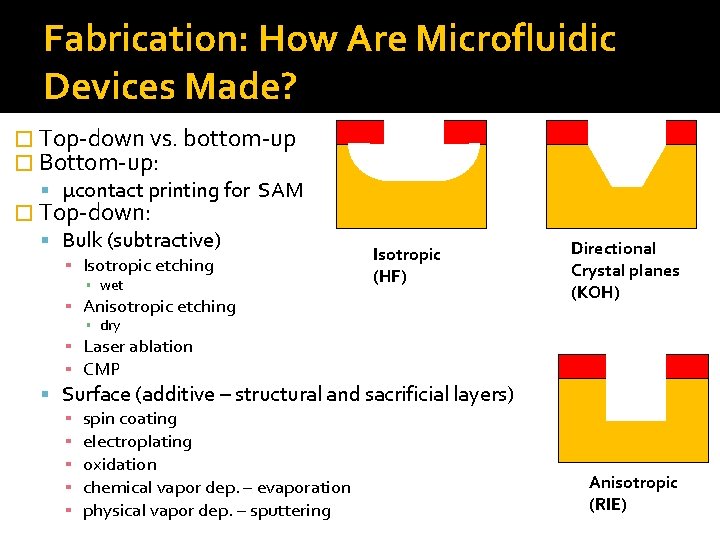
Fabrication: How Are Microfluidic Devices Made? � Top-down vs. bottom-up � Bottom-up: μcontact printing for SAM � Top-down: Bulk (subtractive) ▪ Isotropic etching ▪ wet Isotropic (HF) ▪ Anisotropic etching Directional Crystal planes (KOH) ▪ dry ▪ Laser ablation ▪ CMP Surface (additive – structural and sacrificial layers) ▪ spin coating ▪ electroplating ▪ oxidation ▪ chemical vapor dep. – evaporation ▪ physical vapor dep. – sputtering Anisotropic (RIE)
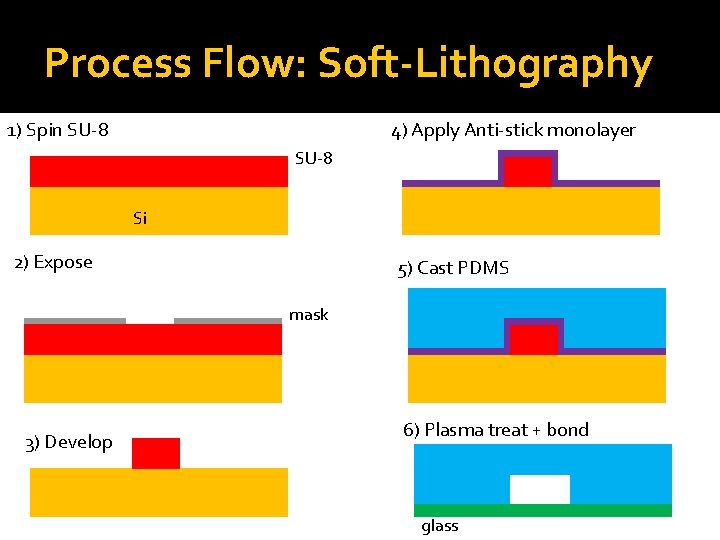
Process Flow: Soft-Lithography 1) Spin SU-8 4) Apply Anti-stick monolayer SU-8 Si 2) Expose 3) Develop 5) Cast PDMS Mask mask 6) Plasma treat + bond glass
Example: Serial Dilution Gradient Generator • • Works on laboratory practice of serial dilution: – Create a number of solutions, each with a unique concentration, by using a small amount of the more concentrated solution to create the next less concentrated solution: – More reliable – Log base 10 Example: • Stock solution consists of 1 m. L of solute in 9 m. L of solvent = 1 X • 1 m. L of this into 9 m. L solvent yields 0. 01 X In a microfluidic implementation, the concentration of each step is determined by the ratio of two merging flow rates at the junction of the buffer and the agent After the chemical to be diluted is merged with the buffer at the intersection, the combined solution is passed through the mixing region Some portion of the diluted solution is collected at the outlet and remainder is passed on to the next intersection
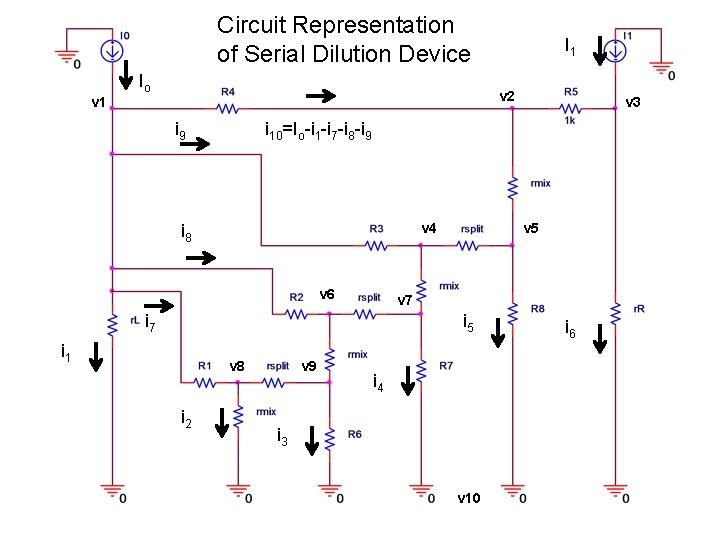
Circuit Representation of Serial Dilution Device Io I 1 v 2 v 1 i 9 i 10=Io-i 1 -i 7 -i 8 -i 9 v 4 i 8 v 6 v 5 v 7 i 5 i 1 v 8 i 2 v 3 v 9 i 4 i 3 v 10 i 6
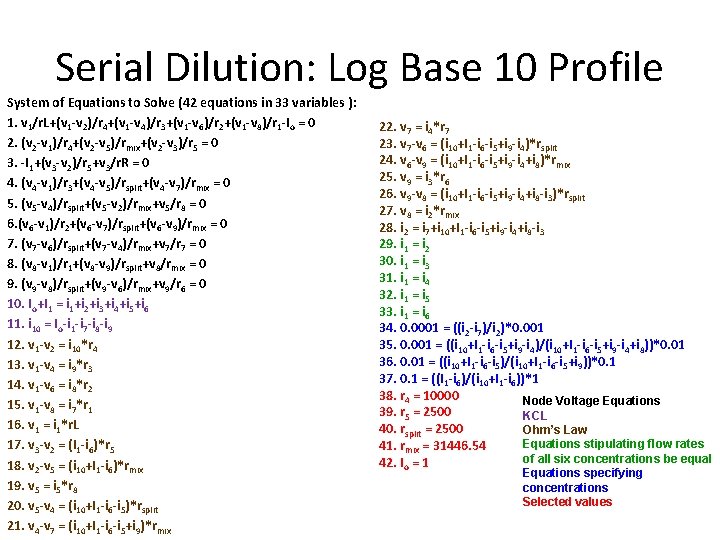
Serial Dilution: Log Base 10 Profile System of Equations to Solve (42 equations in 33 variables ): 1. v 1/r. L+(v 1 -v 2)/r 4+(v 1 -v 4)/r 3+(v 1 -v 6)/r 2+(v 1 -v 8)/r 1 -Io = 0 2. (v 2 -v 1)/r 4+(v 2 -v 5)/rmix+(v 2 -v 3)/r 5 = 0 3. -I 1+(v 3 -v 2)/r 5+v 3/r. R = 0 4. (v 4 -v 1)/r 3+(v 4 -v 5)/rsplit+(v 4 -v 7)/rmix = 0 5. (v 5 -v 4)/rsplit+(v 5 -v 2)/rmix+v 5/r 8 = 0 6. (v 6 -v 1)/r 2+(v 6 -v 7)/rsplit+(v 6 -v 9)/rmix = 0 7. (v 7 -v 6)/rsplit+(v 7 -v 4)/rmix+v 7/r 7 = 0 8. (v 8 -v 1)/r 1+(v 8 -v 9)/rsplit+v 8/rmix = 0 9. (v 9 -v 8)/rsplit+(v 9 -v 6)/rmix+v 9/r 6 = 0 10. Io+I 1 = i 1+i 2+i 3+i 4+i 5+i 6 11. i 10 = Io-i 1 -i 7 -i 8 -i 9 12. v 1 -v 2 = i 10*r 4 13. v 1 -v 4 = i 9*r 3 14. v 1 -v 6 = i 8*r 2 15. v 1 -v 8 = i 7*r 1 16. v 1 = i 1*r. L 17. v 3 -v 2 = (I 1 -i 6)*r 5 18. v 2 -v 5 = (i 10+I 1 -i 6)*rmix 19. v 5 = i 5*r 8 20. v 5 -v 4 = (i 10+I 1 -i 6 -i 5)*rsplit 21. v 4 -v 7 = (i 10+I 1 -i 6 -i 5+i 9)*rmix 22. v 7 = i 4*r 7 23. v 7 -v 6 = (i 10+I 1 -i 6 -i 5+i 9 -i 4)*rsplit 24. v 6 -v 9 = (i 10+I 1 -i 6 -i 5+i 9 -i 4+i 8)*rmix 25. v 9 = i 3*r 6 26. v 9 -v 8 = (i 10+I 1 -i 6 -i 5+i 9 -i 4+i 8 -i 3)*rsplit 27. v 8 = i 2*rmix 28. i 2 = i 7+i 10+I 1 -i 6 -i 5+i 9 -i 4+i 8 -i 3 29. i 1 = i 2 30. i 1 = i 3 31. i 1 = i 4 32. i 1 = i 5 33. i 1 = i 6 34. 0. 0001 = ((i 2 -i 7)/i 2)*0. 001 35. 0. 001 = ((i 10+I 1 -i 6 -i 5+i 9 -i 4)/(i 10+I 1 -i 6 -i 5+i 9 -i 4+i 8))*0. 01 36. 0. 01 = ((i 10+I 1 -i 6 -i 5)/(i 10+I 1 -i 6 -i 5+i 9))*0. 1 37. 0. 1 = ((I 1 -i 6)/(i 10+I 1 -i 6))*1 38. r 4 = 10000 Node Voltage Equations 39. r 5 = 2500 KCL 40. rsplit = 2500 Ohm’s Law Equations stipulating flow rates 41. rmix = 31446. 54 of all six concentrations be equal 42. Io = 1 Equations specifying concentrations Selected values
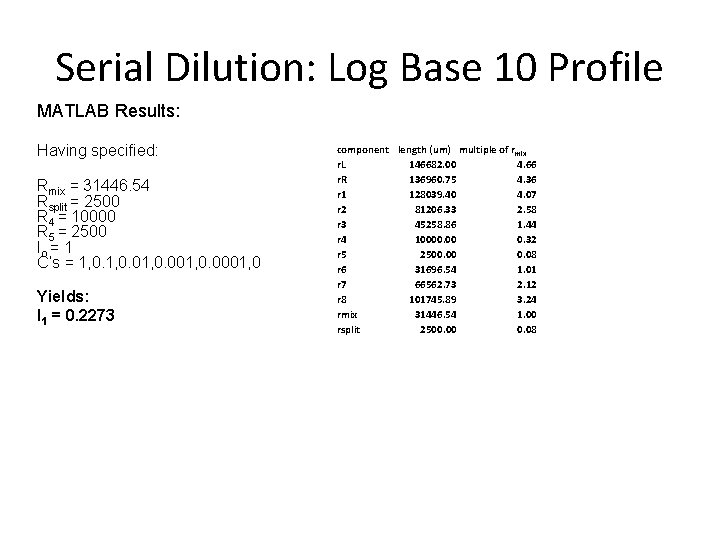
Serial Dilution: Log Base 10 Profile MATLAB Results: Having specified: Rmix = 31446. 54 Rsplit = 2500 R 4 = 10000 R 5 = 2500 Io = 1 C’s = 1, 0. 01, 0. 0001, 0 Yields: I 1 = 0. 2273 component length (um) multiple of rmix r. L 146682. 00 4. 66 r. R 136960. 75 4. 36 r 1 128039. 40 4. 07 r 2 81206. 33 2. 58 r 3 45258. 86 1. 44 r 4 10000. 00 0. 32 r 5 2500. 00 0. 08 r 6 31696. 54 1. 01 r 7 66562. 73 2. 12 r 8 101745. 89 3. 24 rmix 31446. 54 1. 00 rsplit 2500. 00 0. 08
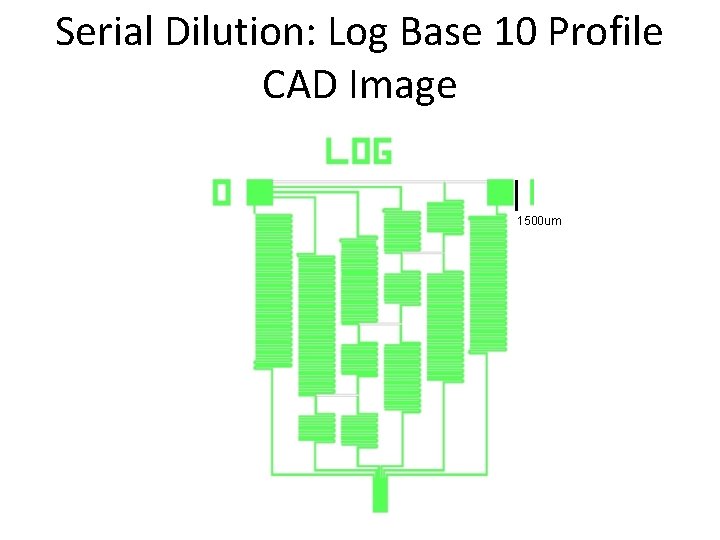
Serial Dilution: Log Base 10 Profile CAD Image 1500 um
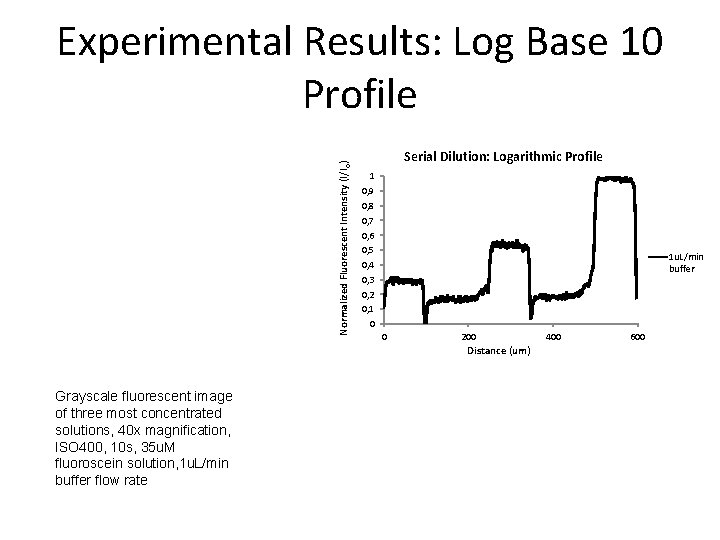
Normalized Fluorescent Intensity (I/Io) Experimental Results: Log Base 10 Profile Serial Dilution: Logarithmic Profile 1 0, 9 0, 8 0, 7 0, 6 0, 5 0, 4 0, 3 0, 2 0, 1 0 1 u. L/min buffer 0 200 Distance (um) Grayscale fluorescent image of three most concentrated solutions, 40 x magnification, ISO 400, 10 s, 35 u. M fluoroscein solution, 1 u. L/min buffer flow rate 400 600
Biological Relevance �Stroke � Interruption in blood supply to the brain caused by ischemia (insufficient blood flow) due to a blockage (blood clot, thrombus, embolism) �Atherosclerosis Narrowing of blood vessels due to build-up of fatty deposits Leads to hypertension, which in turn exacerbates atherosclerosis ▪ High blood pressure causes distension of vessels, which damages endothelium lining, which in turn attracts more fatty deposits
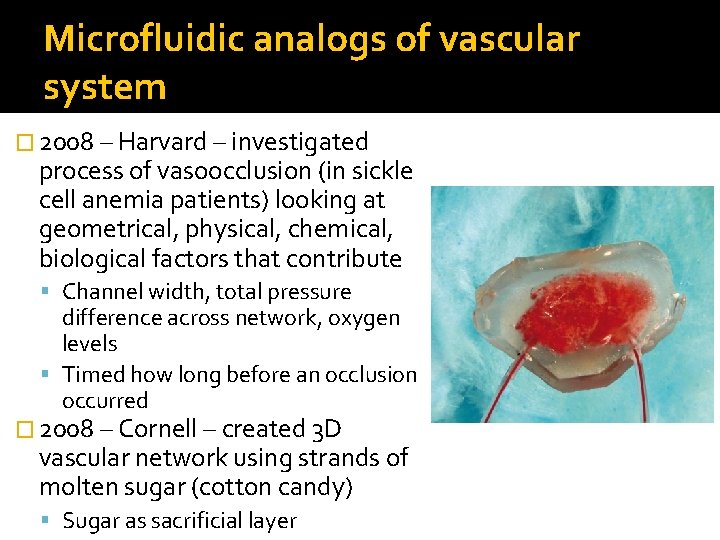
Microfluidic analogs of vascular system � 2008 – Harvard – investigated process of vasoocclusion (in sickle cell anemia patients) looking at geometrical, physical, chemical, biological factors that contribute Channel width, total pressure difference across network, oxygen levels Timed how long before an occlusion occurred � 2008 – Cornell – created 3 D vascular network using strands of molten sugar (cotton candy) Sugar as sacrificial layer
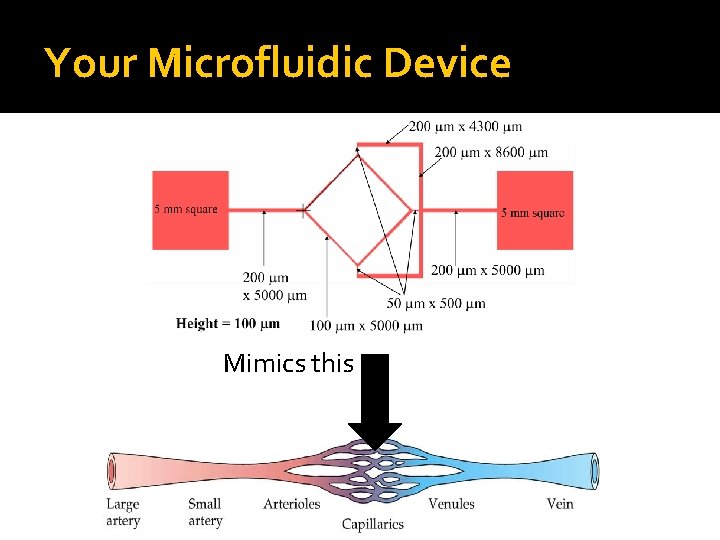
Your Microfluidic Device Mimics this

Particle Velocimetry �Technique to qualitatively visualize and quantitatively assess fluid flow Small tracer particles (beads) are added to fluid Velocity of beads assumed to be same as velocity of surrounding fluid Special buffer solution used to prevent beads from aggregating / adhering to channel surfaces
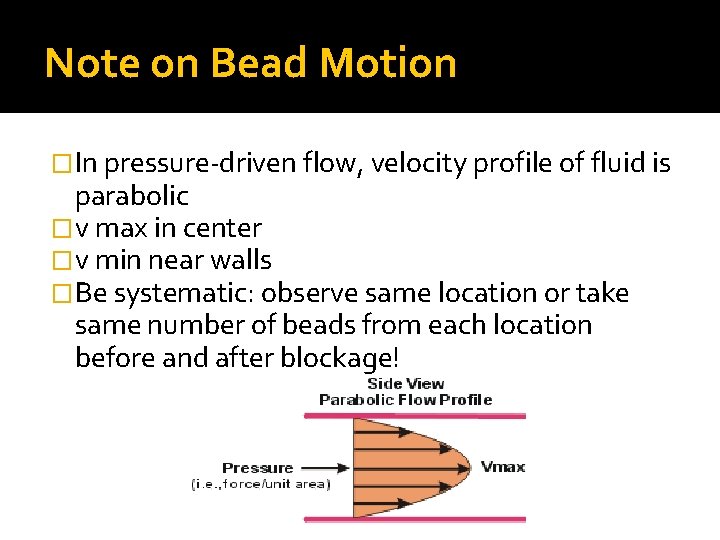
Note on Bead Motion �In pressure-driven flow, velocity profile of fluid is parabolic �v max in center �v min near walls �Be systematic: observe same location or take same number of beads from each location before and after blockage!
Procedure: Before Clot �PDMS devices made for you �Fill syringe with bead (10 um dia. ) solution �Connect needle to syringe �Connect tubing to needle �Place syringe in syringe pump �Flow @ 50 u. L/min to flush out bubbles �Reduce flow rate to 2 u. L/min �Capture series of images to track beads in each channel of device V = d/t
Procedure: Clot �Disconnect device from pump �Using empty syringe, introduce air to dry device �Punch hole in desired channel with punch �Remove plug of PDMS �Inject sealant to block channel �Cure @ 60 C for 10 min �Repeat process: track beads in each channel
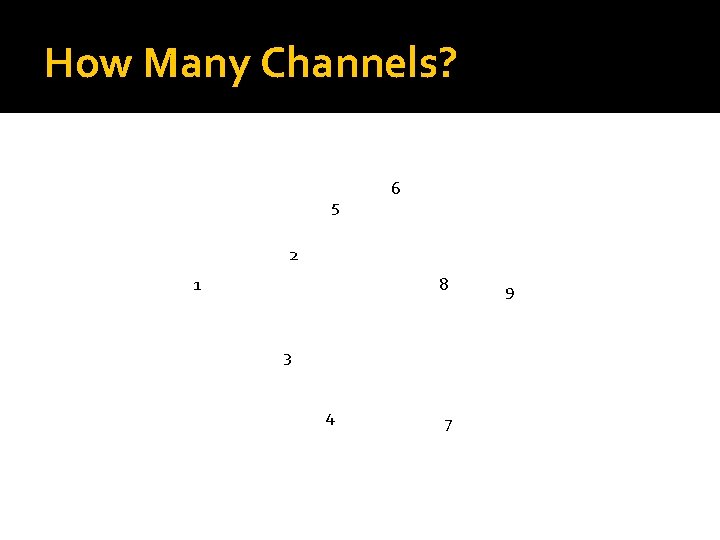
How Many Channels? 5 6 2 1 8 3 4 7 9
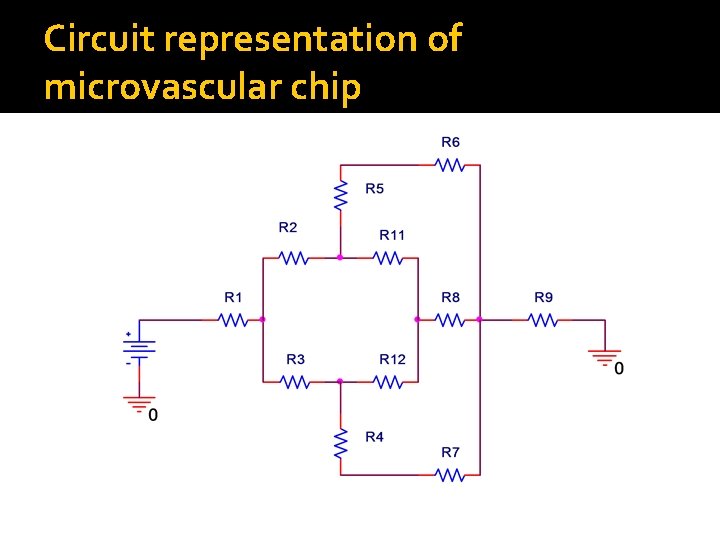
Circuit representation of microvascular chip
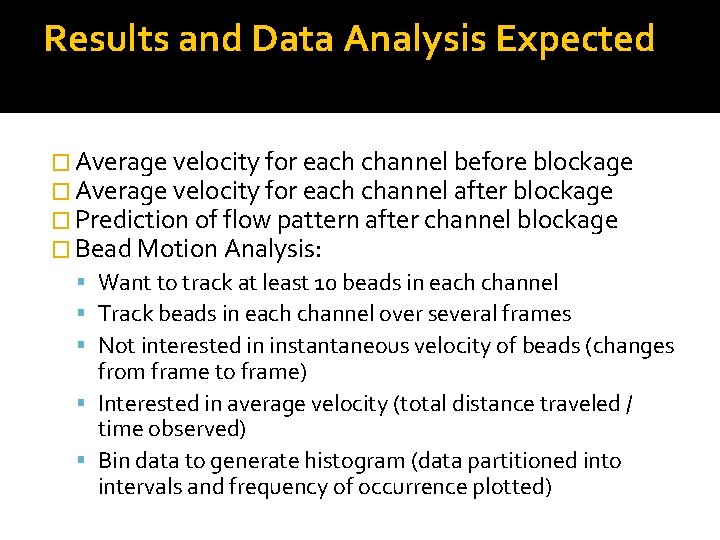
Results and Data Analysis Expected � Average velocity for each channel before blockage � Average velocity for each channel after blockage � Prediction of flow pattern after channel blockage � Bead Motion Analysis: Want to track at least 10 beads in each channel Track beads in each channel over several frames Not interested in instantaneous velocity of beads (changes from frame to frame) Interested in average velocity (total distance traveled / time observed) Bin data to generate histogram (data partitioned into intervals and frequency of occurrence plotted)
Report Guidelines – SHEN/BRUCE
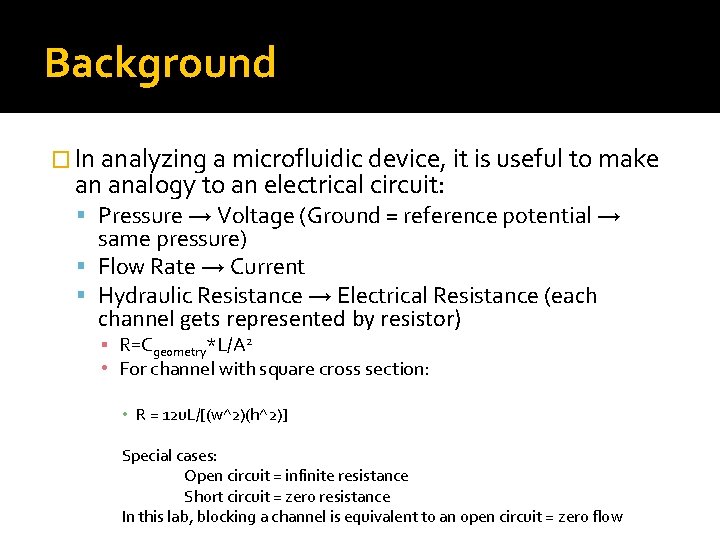
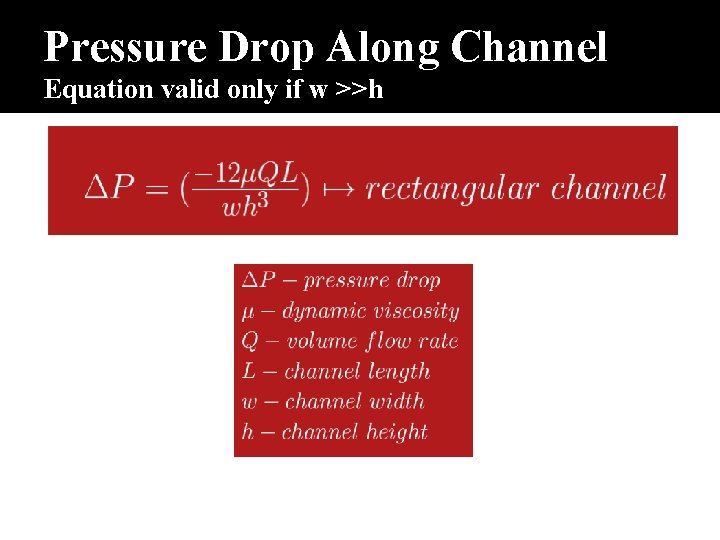
Background � In analyzing a microfluidic device, it is useful to make an analogy to an electrical circuit: Pressure → Voltage (Ground = reference potential → same pressure) Flow Rate → Current Hydraulic Resistance → Electrical Resistance (each channel gets represented by resistor) ▪ R=Cgeometry*L/A 2 • For channel with square cross section: • R = 12 u. L/[(w^2)(h^2)] Special cases: Open circuit = infinite resistance Short circuit = zero resistance In this lab, blocking a channel is equivalent to an open circuit = zero flow
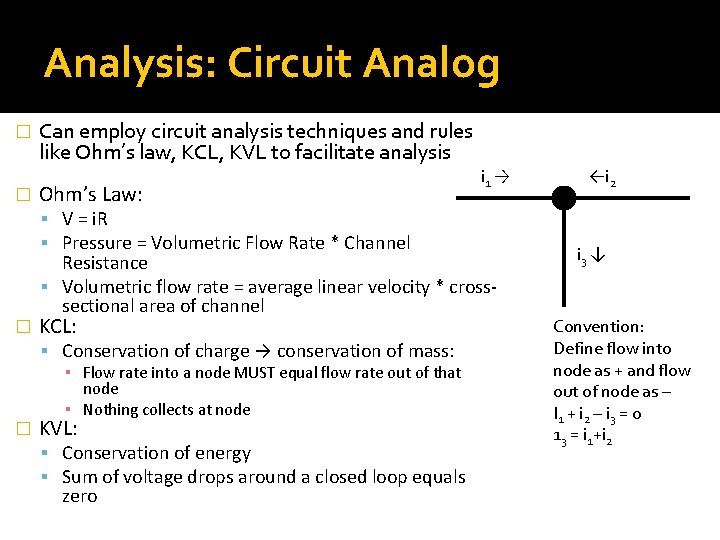
Analysis: Circuit Analog � � Can employ circuit analysis techniques and rules like Ohm’s law, KCL, KVL to facilitate analysis Ohm’s Law: V = i. R Pressure = Volumetric Flow Rate * Channel � Resistance Volumetric flow rate = average linear velocity * crosssectional area of channel KCL: Conservation of charge → conservation of mass: � i 1 → ▪ Flow rate into a node MUST equal flow rate out of that node ▪ Nothing collects at node KVL: Conservation of energy Sum of voltage drops around a closed loop equals zero ←i 2 i 3 ↓ Convention: Define flow into node as + and flow out of node as – I 1 + i 2 – i 3 = 0 13 = i 1+i 2
Pressure Drop Along Channel Equation valid only if w >>h
Circuit Analysis �Resistances are either in series or parallel, except for when they’re not
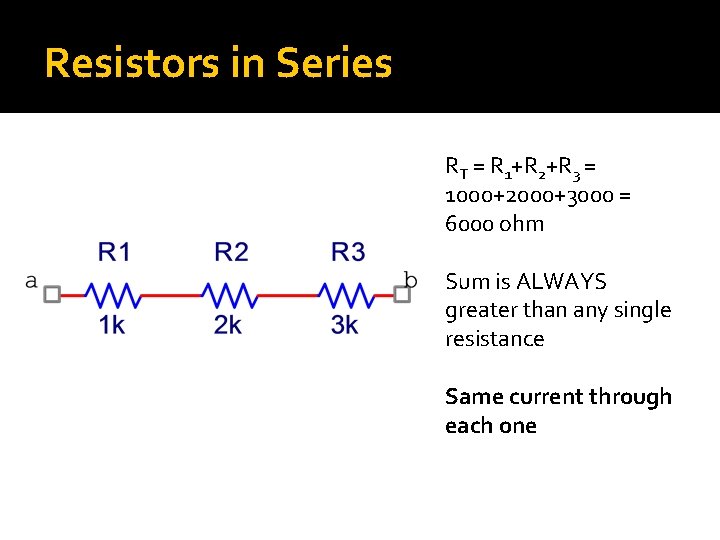
Resistors in Series RT = R 1+R 2+R 3 = 1000+2000+3000 = 6000 ohm Sum is ALWAYS greater than any single resistance Same current through each one
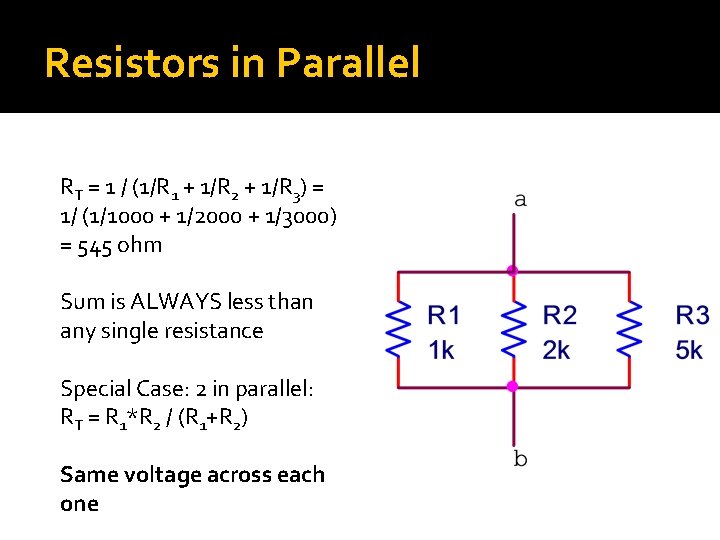
Resistors in Parallel RT = 1 / (1/R 1 + 1/R 2 + 1/R 3) = 1/ (1/1000 + 1/2000 + 1/3000) = 545 ohm Sum is ALWAYS less than any single resistance Special Case: 2 in parallel: RT = R 1*R 2 / (R 1+R 2) Same voltage across each one

Example: Resistance Network
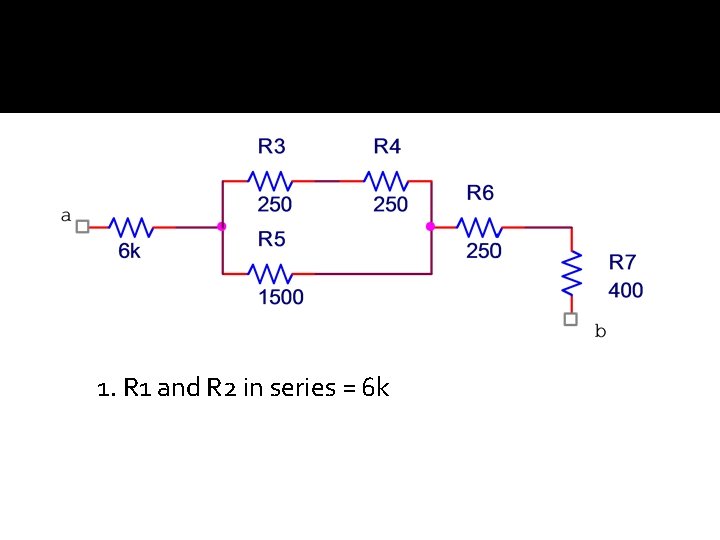
1. R 1 and R 2 in series = 6 k
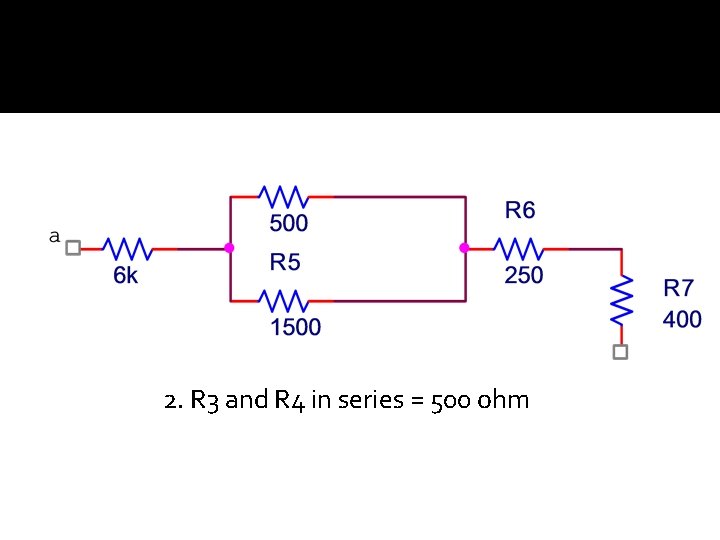
2. R 3 and R 4 in series = 500 ohm
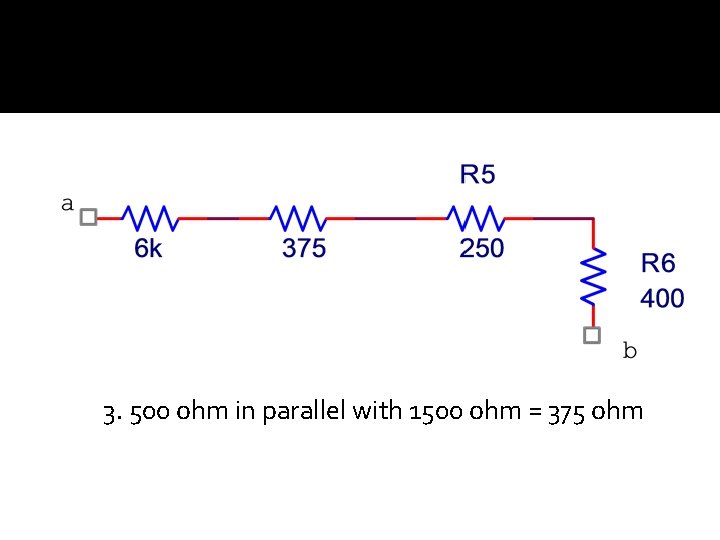
3. 500 ohm in parallel with 1500 ohm = 375 ohm
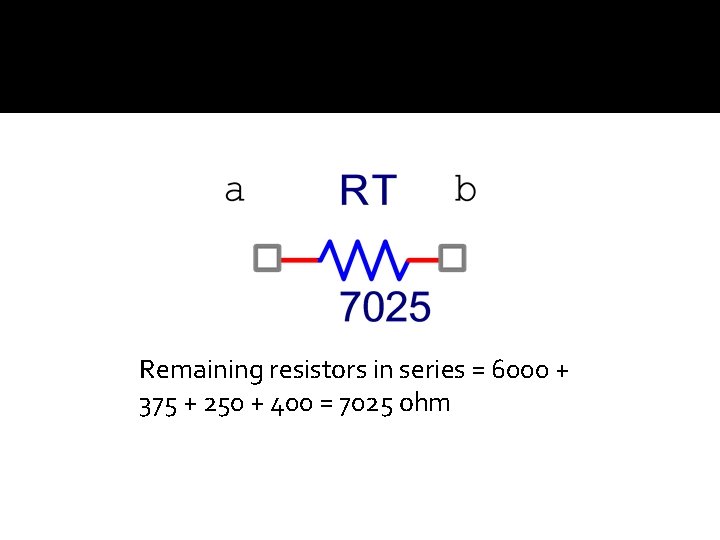
Remaining resistors in series = 6000 + 375 + 250 + 400 = 7025 ohm
Special Case: Delta-to-Wye (∆-to. Y) Transformation �Used when resistors are neither in series nor parallel �How to identify this case: Sometimes two resistors look like they are in parallel but they really aren’t Ask: do they share nodes at both terminals? ▪ If yes, they are in parallel ▪ If no, they aren’t
Delta-to-Wye (∆-to. Y) Transformation
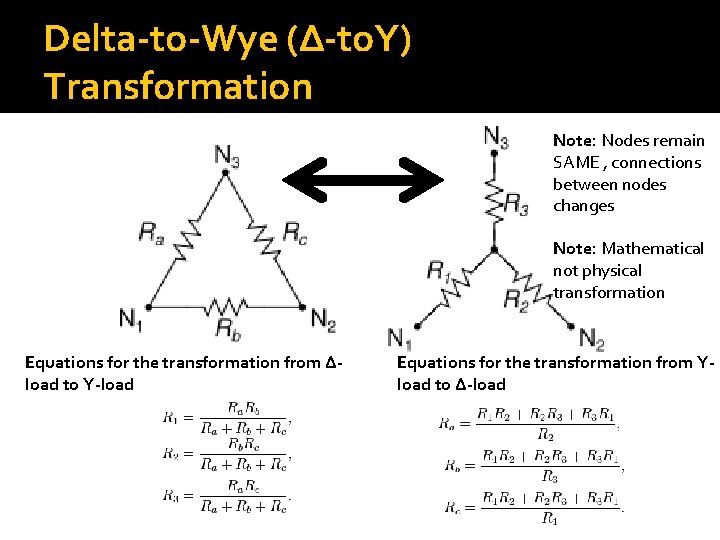
Delta-to-Wye (∆-to. Y) Transformation Note: Nodes remain SAME , connections between nodes changes Note: Mathematical not physical transformation Equations for the transformation from Δload to Y-load Equations for the transformation from Yload to Δ-load
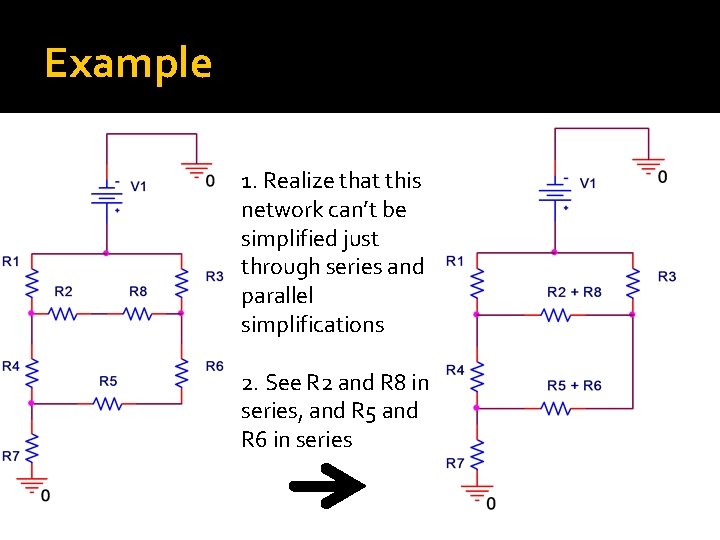
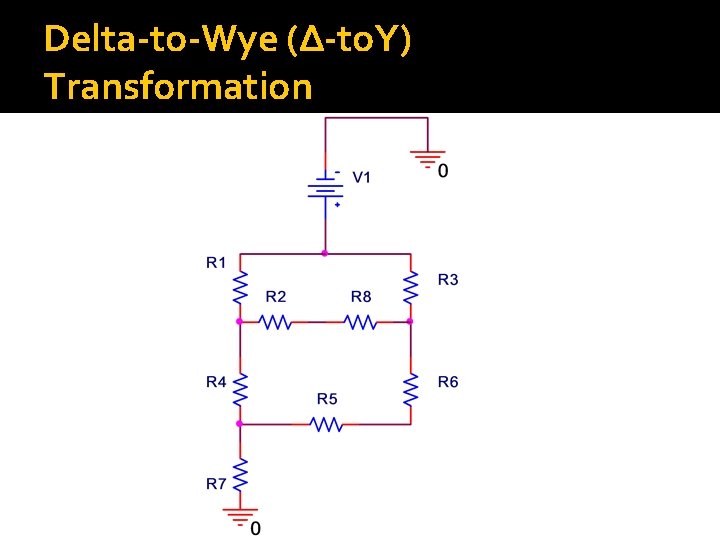
Example 1. Realize that this network can’t be simplified just through series and parallel simplifications 2. See R 2 and R 8 in series, and R 5 and R 6 in series
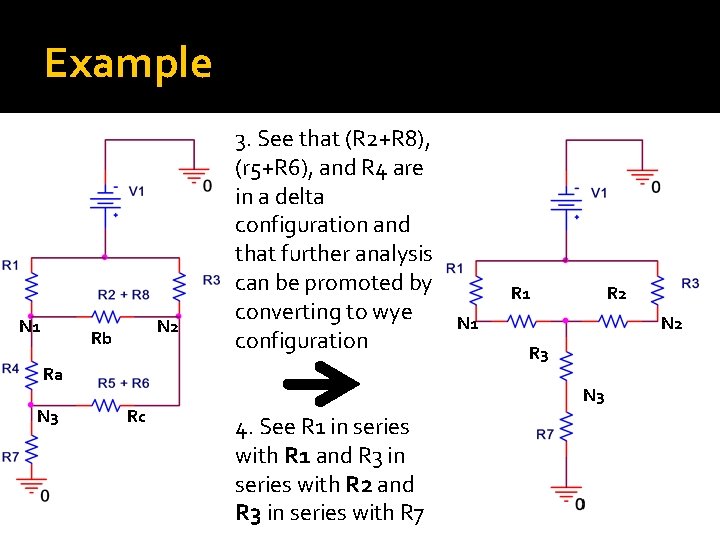
Example N 1 N 2 Rb 3. See that (R 2+R 8), (r 5+R 6), and R 4 are in a delta configuration and that further analysis can be promoted by converting to wye configuration Ra N 3 Rc R 1 R 2 N 1 N 2 R 3 N 3 4. See R 1 in series with R 1 and R 3 in series with R 2 and R 3 in series with R 7
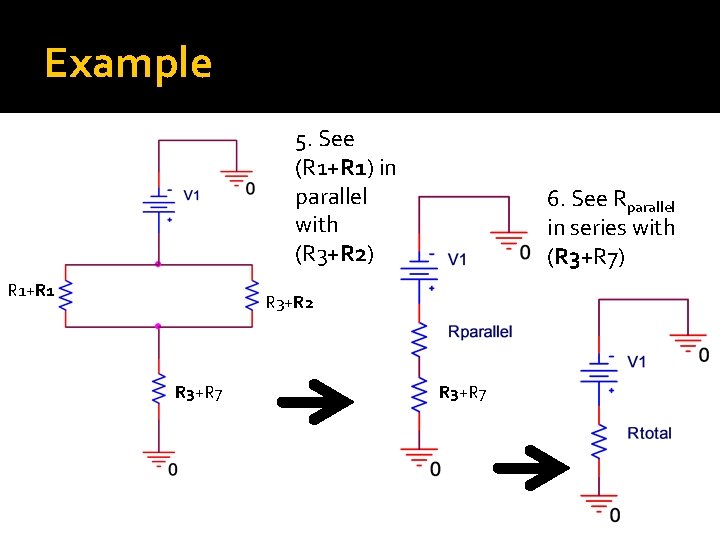
Example 5. See (R 1+R 1) in parallel with (R 3+R 2) R 1+R 1 6. See Rparallel in series with (R 3+R 7) R 3+R 2 R 3+R 7
Voltage Divider �Key Idea: The voltage that appears across a resistor – “dropped across it’ – is proportional to the resistance �Intuitive: If two resistors are in series, we expect that the one with more resistance will see the majority of the voltage Since resistors in series have the same current through them, we can expect the component with greater resistance will “consume” most of the voltage
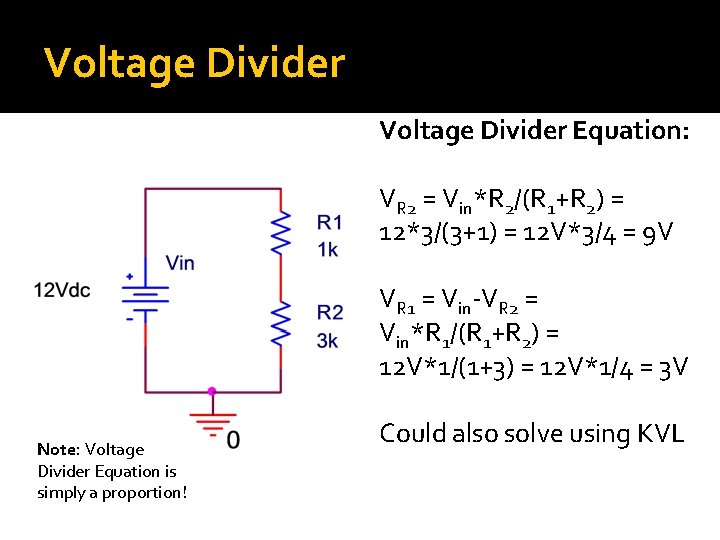
Voltage Divider Equation: VR 2 = Vin*R 2/(R 1+R 2) = 12*3/(3+1) = 12 V*3/4 = 9 V VR 1 = Vin-VR 2 = Vin*R 1/(R 1+R 2) = 12 V*1/(1+3) = 12 V*1/4 = 3 V Note: Voltage Divider Equation is simply a proportion! Could also solve using KVL
Voltage Divider = Pressure Divider �In a microfluidic network, same rule holds: Channels with high resistances (shallow, narrow, long) will have large pressure drop across them Channels with low resistances (tall, wide, short) will have small pressure drop across them
Current Divider �Key Idea: The current that flow through a resistor is inversely proportional to the resistance �Intuitive: If two resistors are in parallel, we expect that most of the current will pass through the one with less resistance – “follow the path of least resistance”
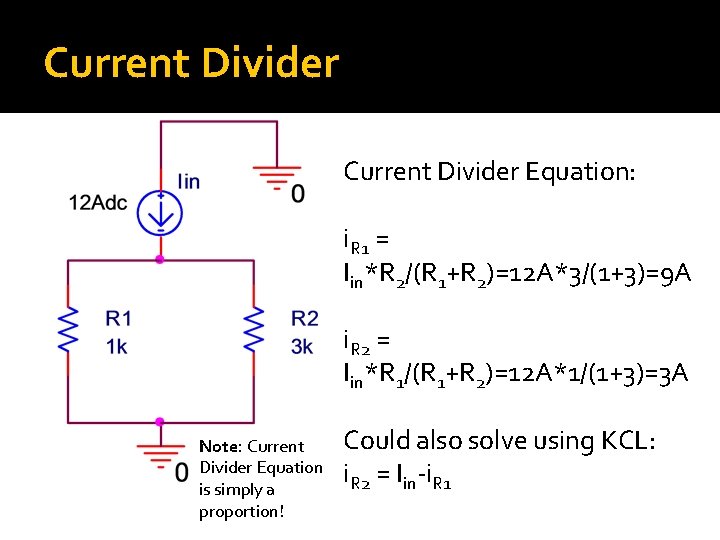
Current Divider Equation: i. R 1 = Iin*R 2/(R 1+R 2)=12 A*3/(1+3)=9 A i. R 2 = Iin*R 1/(R 1+R 2)=12 A*1/(1+3)=3 A Note: Current Divider Equation is simply a proportion! Could also solve using KCL: i. R 2 = Iin-i. R 1
Current Divider = Flow Divider �In a microfluidic network, the same rule holds: Channels with high resistances (shallow, narrow, long) will have small fluid flow through them Channels with low resistances (tall, wide, short) will have large fluid flow through them
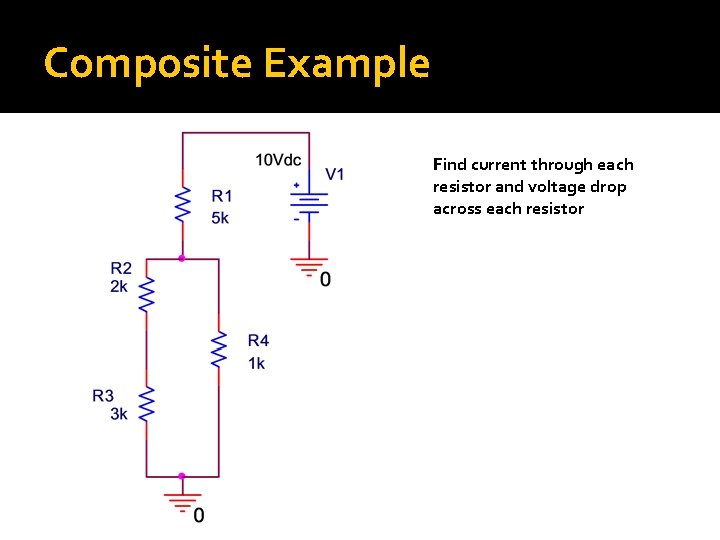
Composite Example Find current through each resistor and voltage drop across each resistor
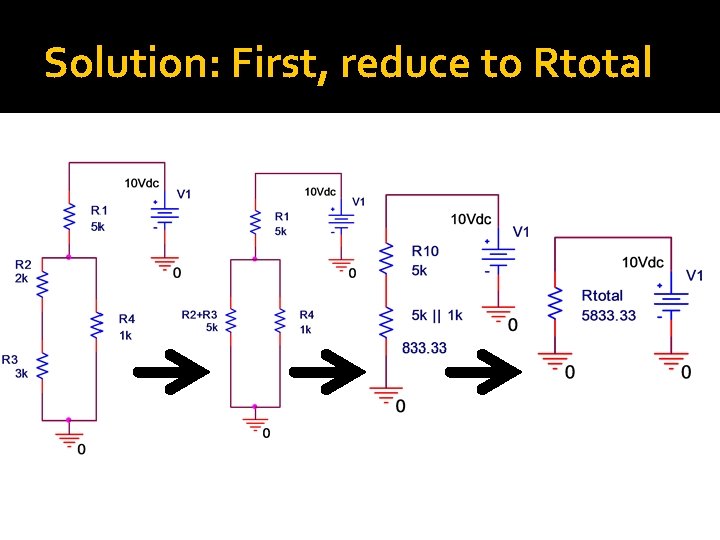
Solution: First, reduce to Rtotal
Assignment �Several questions related to your lab and to lecture content �Remember: linear velocity = volumetric flow rate / cross-sectional area of channel

Solution: Second, Find i. T �Ohm’s Law: �V=i. R �IT = V/RT = 10 V/5833. 33Ω = 0. 00171 A = 1. 71 m. A
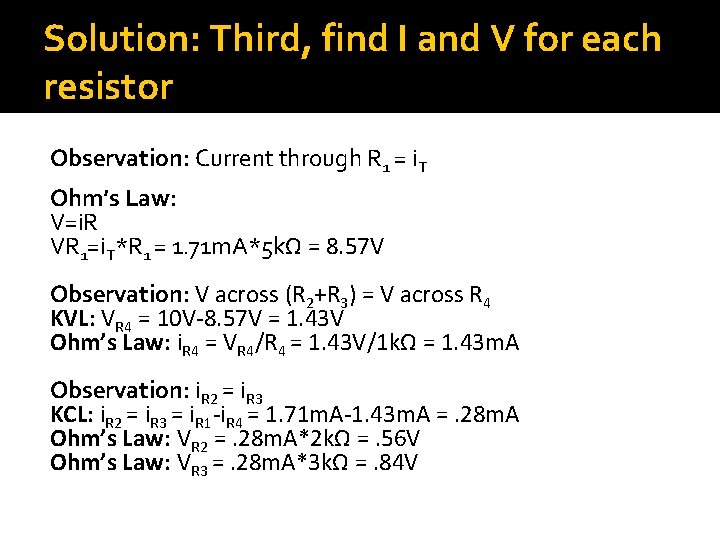
Solution: Third, find I and V for each resistor Observation: Current through R 1 = i. T Ohm’s Law: V=i. R VR 1=i. T*R 1 = 1. 71 m. A*5 kΩ = 8. 57 V Observation: V across (R 2+R 3) = V across R 4 KVL: VR 4 = 10 V-8. 57 V = 1. 43 V Ohm’s Law: i. R 4 = VR 4/R 4 = 1. 43 V/1 kΩ = 1. 43 m. A Observation: i. R 2 = i. R 3 KCL: i. R 2 = i. R 3 = i. R 1 -i. R 4 = 1. 71 m. A-1. 43 m. A =. 28 m. A Ohm’s Law: VR 2 =. 28 m. A*2 kΩ =. 56 V Ohm’s Law: VR 3 =. 28 m. A*3 kΩ =. 84 V
- Slides: 66