
Intro to Julius Caesar The history behind the

Intro to Julius Caesar The history behind the fiction
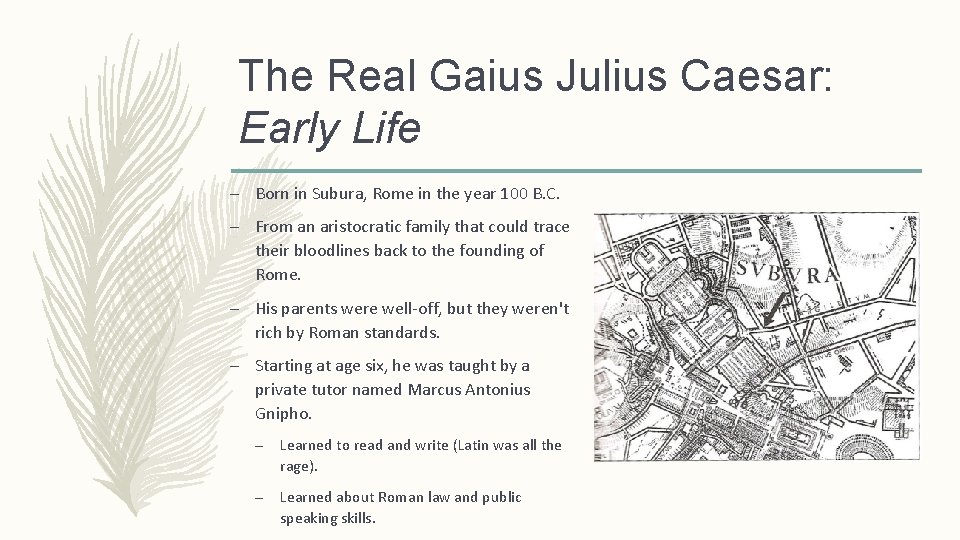
The Real Gaius Julius Caesar: Early Life – Born in Subura, Rome in the year 100 B. C. – From an aristocratic family that could trace their bloodlines back to the founding of Rome. – His parents were well-off, but they weren't rich by Roman standards. – Starting at age six, he was taught by a private tutor named Marcus Antonius Gnipho. – Learned to read and write (Latin was all the rage). – Learned about Roman law and public speaking skills.
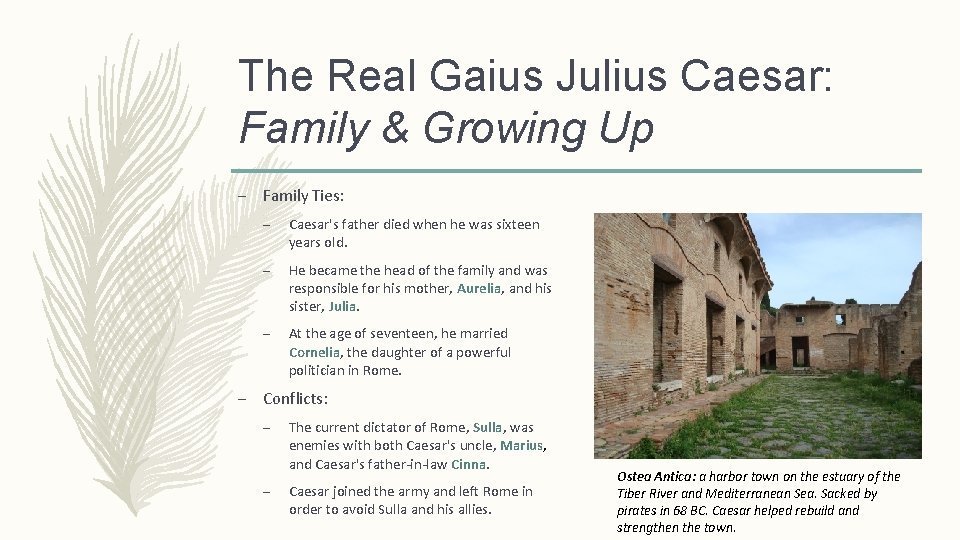
The Real Gaius Julius Caesar: Family & Growing Up – Family Ties: – Caesar's father died when he was sixteen years old. – He became the head of the family and was responsible for his mother, Aurelia, and his sister, Julia. – At the age of seventeen, he married Cornelia, the daughter of a powerful politician in Rome. – Conflicts: – – The current dictator of Rome, Sulla, was enemies with both Caesar's uncle, Marius, and Caesar's father-in-law Cinna. Caesar joined the army and left Rome in order to avoid Sulla and his allies. Ostea Antica: a harbor town on the estuary of the Tiber River and Mediterranean Sea. Sacked by pirates in 68 BC. Caesar helped rebuild and strengthen the town.
The Real Gaius Julius Caesar: The Beginning of Power – Caesar’s Return to Rome: – After being kidnapped by pirates in 75 B. C. , Caesar returned to Rome as a military hero, but also a widower as Cornelia had died while he was away. (The family enemy, Sulla, died in 78 B. C. ) – He made allies with powerful men such as the general Pompey the Great and the wealthy Crassus. Caesar was an excellent speaker and the people of Rome loved him. – He quickly rose up the ranks in the Roman government, first becoming aedile (think city level government: managing roads, water and grain supplies), two years later becoming tribune (the equivalent of a modern-day legislator), and three years after that becoming part of the First Triumvirate of Power. – Less than 15 years later: – At the age of 40 he was elected to consul. Think of this like a president, but there are two consuls and they only serve for one year.
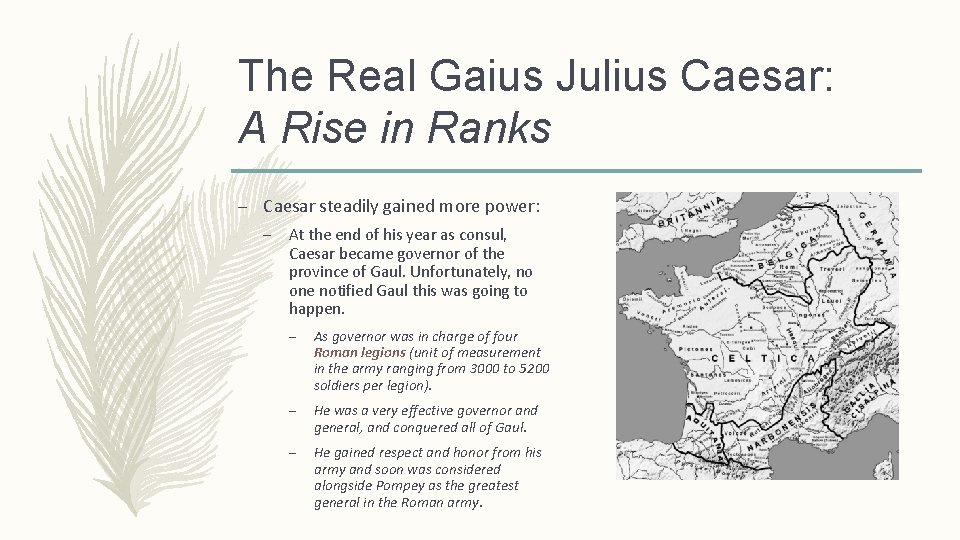
The Real Gaius Julius Caesar: A Rise in Ranks – Caesar steadily gained more power: – At the end of his year as consul, Caesar became governor of the province of Gaul. Unfortunately, no one notified Gaul this was going to happen. – As governor was in charge of four Roman legions (unit of measurement in the army ranging from 3000 to 5200 soldiers per legion). – He was a very effective governor and general, and conquered all of Gaul. – He gained respect and honor from his army and soon was considered alongside Pompey as the greatest general in the Roman army.
The Real Gaius Julius Caesar: The Road to Triumph – A Divide in the Triumvirate: – Politics in Rome became increasingly hostile while Caesar was in Gaul. – Many of the leaders were jealous of Caesar and his following. Even Pompey became jealous and soon Caesar and Pompey became rivals. – Caesar had the support of the people and Pompey had the support of the aristocrats. – The Conquer of Rome: – Caesar announced his intention to return to Rome and run for consul again. – The Senate labeled him a traitor for not giving up his army as they demanded, and Caesar began to march his army to Rome. – Caesar took control of Rome in 49 BC and spent the next 18 months fighting Pompey. He finally defeated Pompey, chasing him all the way to Egypt. – When he reached Egypt, the young Pharaoh, Ptolemy VIII, had Pompey killed and presented his head to Caesar as a gift.
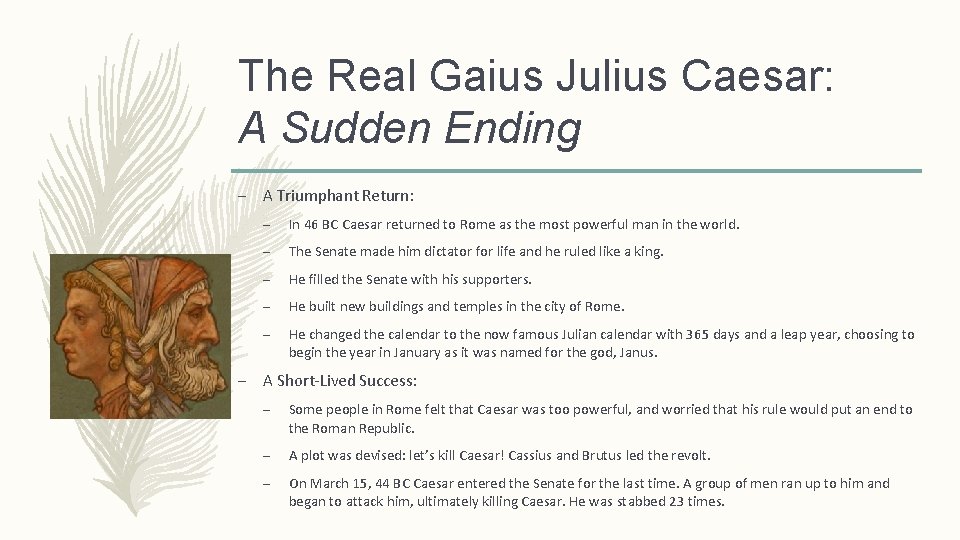
The Real Gaius Julius Caesar: A Sudden Ending – A Triumphant Return: – In 46 BC Caesar returned to Rome as the most powerful man in the world. – The Senate made him dictator for life and he ruled like a king. – He filled the Senate with his supporters. – He built new buildings and temples in the city of Rome. – He changed the calendar to the now famous Julian calendar with 365 days and a leap year, choosing to begin the year in January as it was named for the god, Janus. – A Short-Lived Success: – Some people in Rome felt that Caesar was too powerful, and worried that his rule would put an end to the Roman Republic. – A plot was devised: let’s kill Caesar! Cassius and Brutus led the revolt. – On March 15, 44 BC Caesar entered the Senate for the last time. A group of men ran up to him and began to attack him, ultimately killing Caesar. He was stabbed 23 times.
- Slides: 7