
Intro to Genetics Genetics Student Expectation B 6
Intro to Genetics
Genetics Student Expectation: B 6. F Predict possible outcomes of various genetic combinations such as monohybrid crosses, dihybrid crosses and non-Mendelian inheritance. Readiness Standard
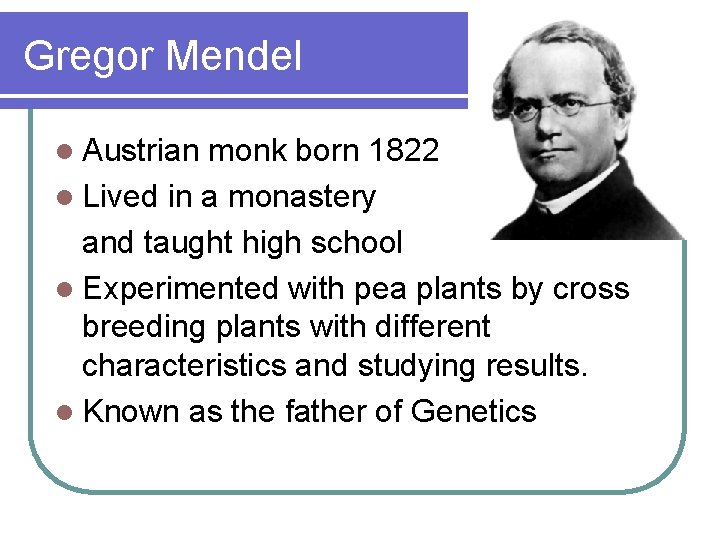
Gregor Mendel l Austrian monk born 1822 l Lived in a monastery and taught high school l Experimented with pea plants by cross breeding plants with different characteristics and studying results. l Known as the father of Genetics
Mendel’s Principles Law of Inheritance – Characteristics or traits are inherited by individual units known as “genes”.
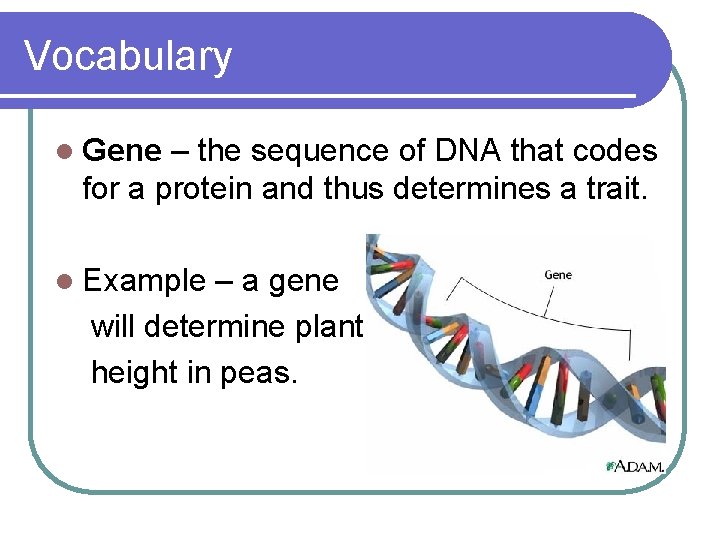
Vocabulary l Gene – the sequence of DNA that codes for a protein and thus determines a trait. l Example – a gene will determine plant height in peas.
Mendel’s Principles l Law of Segregation - states that during the formation of reproductive cells (gametes), pairs of hereditary factors (genes) for a specific trait separate so that offspring receive one factor from each parent.
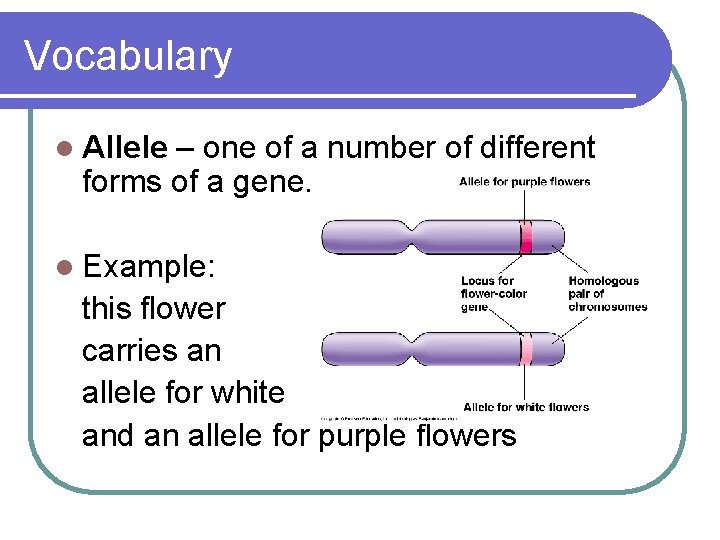
Vocabulary l Allele – one of a number of different forms of a gene. l Example: this flower carries an allele for white and an allele for purple flowers
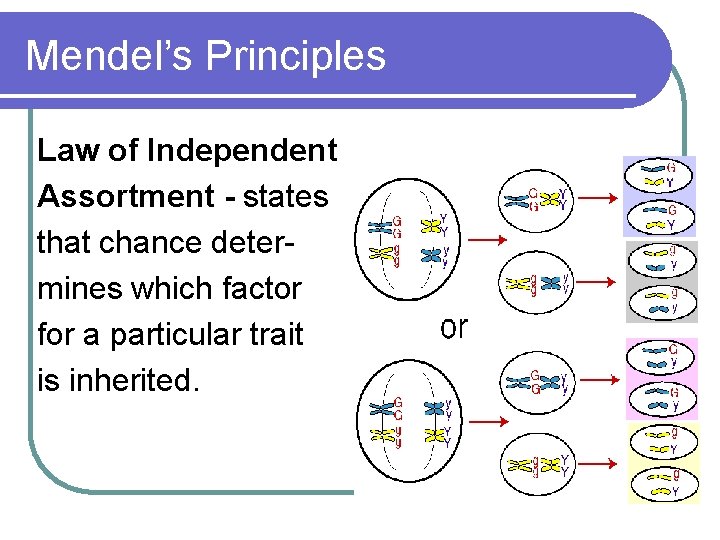
Mendel’s Principles Law of Independent Assortment - states that chance determines which factor for a particular trait is inherited.
Mendel’s Principles l Law of Dominance – states that when 2 or more forms of a gene exist (alleles), some forms are dominant and others are recessive
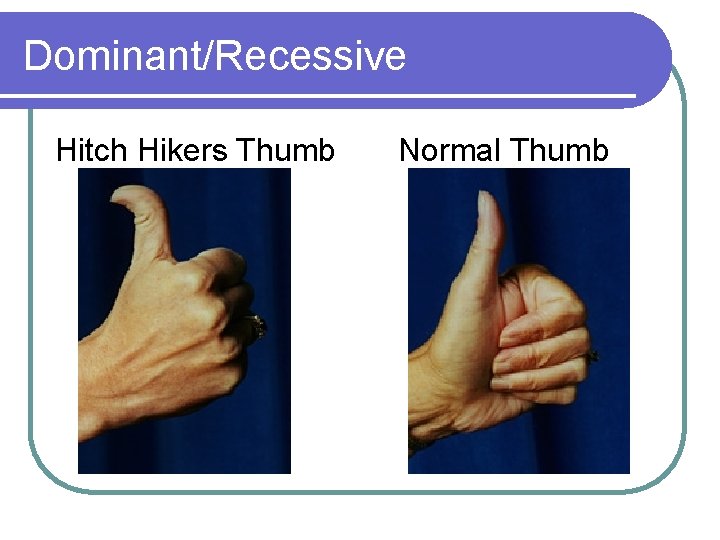
Dominant/Recessive Hitch Hikers Thumb Normal Thumb

Dominant/Recessive Free Earlobes Attached Earlobes
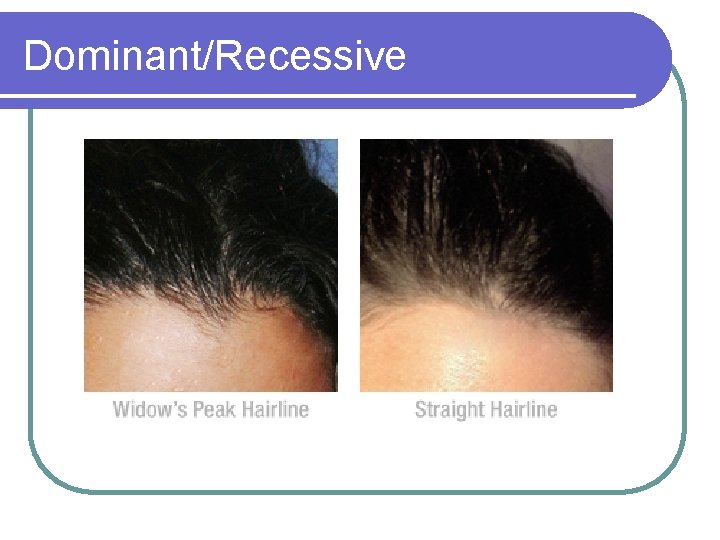
Dominant/Recessive

Polydactyly is Dominant!!
Dominant/Recessive Other examples of dominant traits: Dimples Tongue Rolling Freckles Curly hair (may be more than one gene)
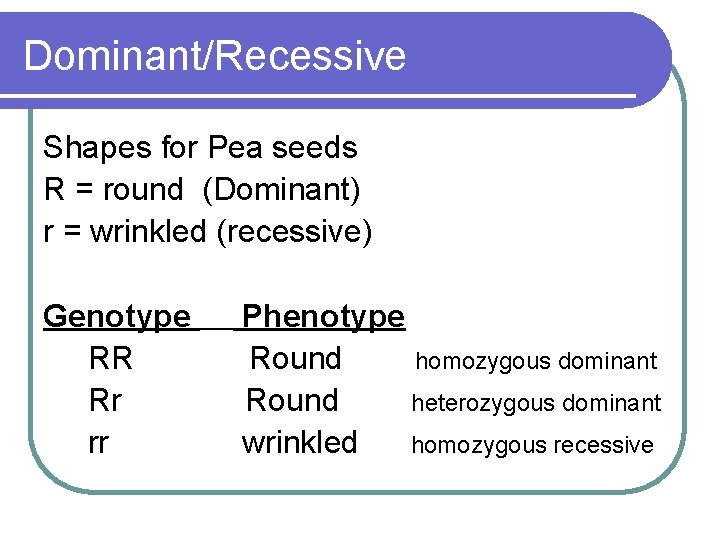
Dominant/Recessive Shapes for Pea seeds R = round (Dominant) r = wrinkled (recessive) Genotype RR Rr rr Phenotype Round homozygous dominant Round heterozygous dominant wrinkled homozygous recessive
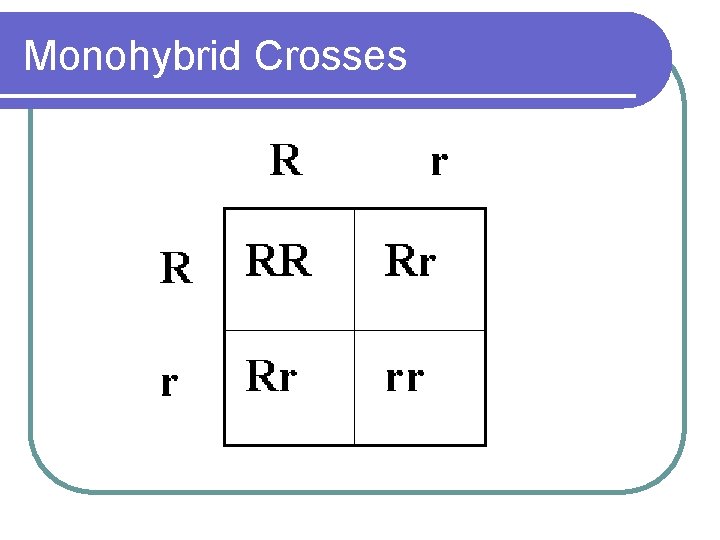
Monohybrid Crosses

Monohybrid Crosses
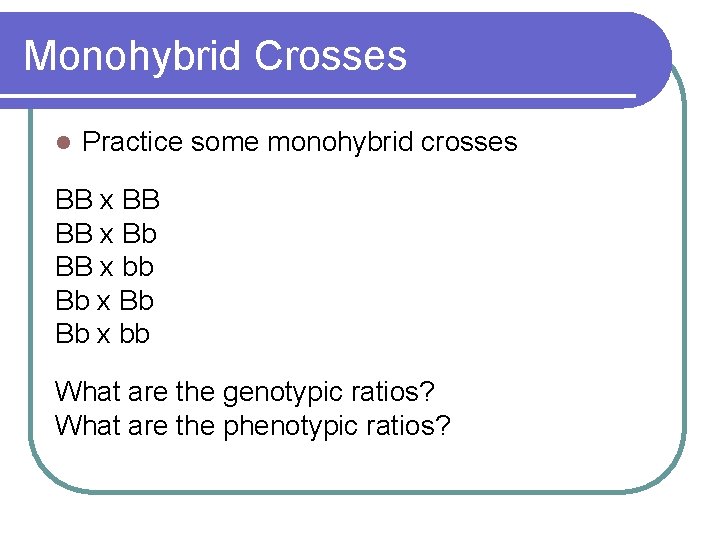
Monohybrid Crosses l Practice some monohybrid crosses BB x BB BB x Bb BB x bb Bb x Bb Bb x bb What are the genotypic ratios? What are the phenotypic ratios?
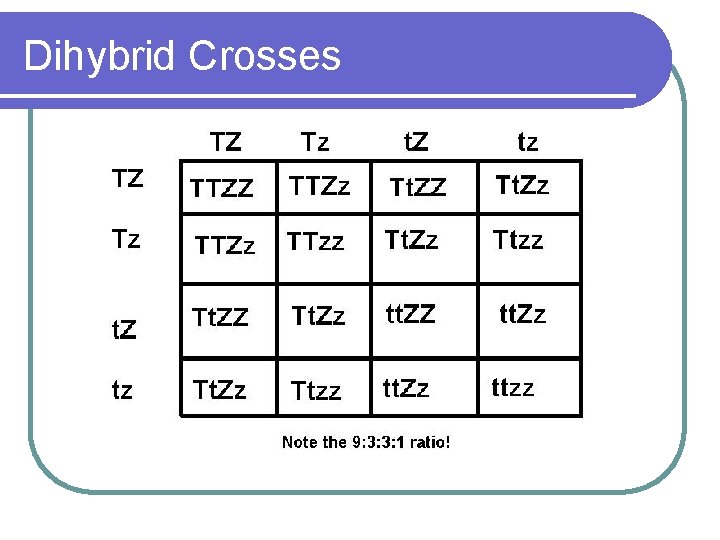
Dihybrid Crosses
Non Mendelian Genetics Exceptions to Mendel’s Principles: - Not all genes show simple patterns of dominant and recessive alleles - The majority of genes have more than two alleles. - Many traits are controlled by more than one gene.
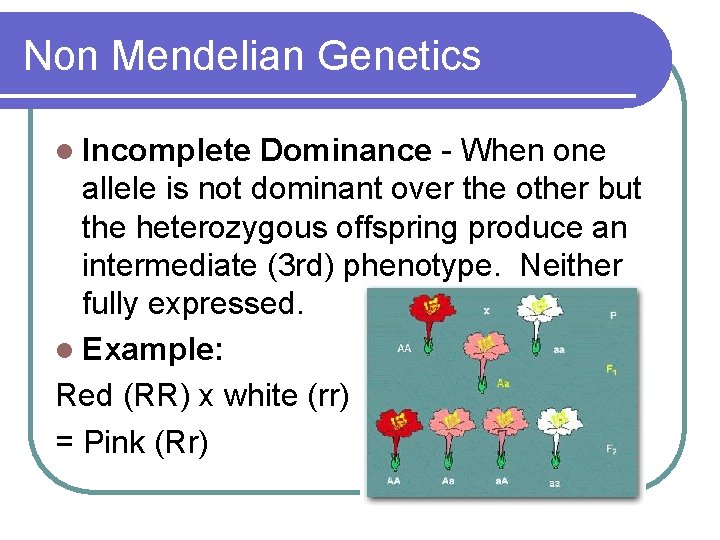
Non Mendelian Genetics l Incomplete Dominance - When one allele is not dominant over the other but the heterozygous offspring produce an intermediate (3 rd) phenotype. Neither fully expressed. l Example: Red (RR) x white (rr) = Pink (Rr)
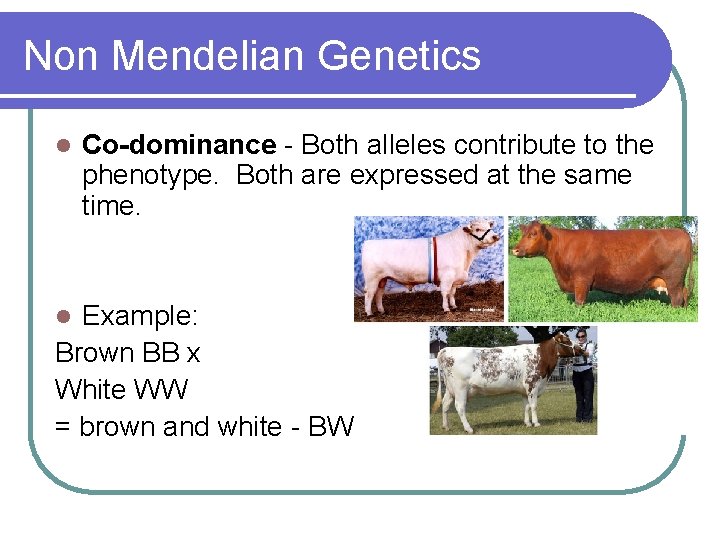
Non Mendelian Genetics l Co-dominance - Both alleles contribute to the phenotype. Both are expressed at the same time. Example: Brown BB x White WW = brown and white - BW l
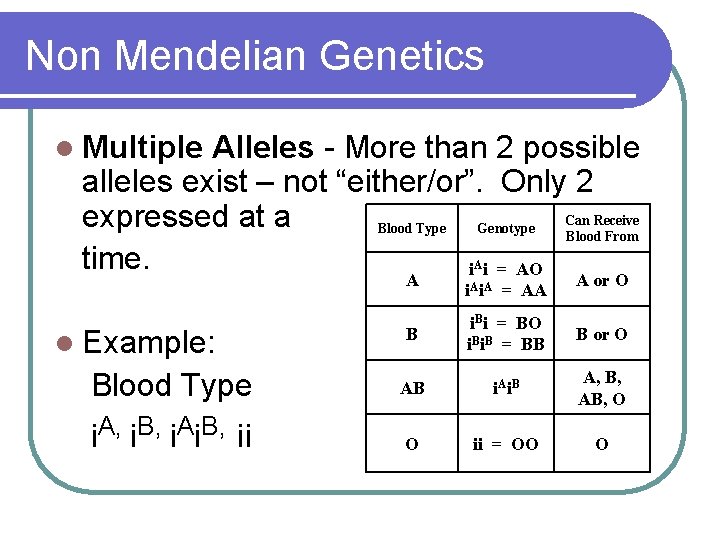
Non Mendelian Genetics l Multiple Alleles - More than 2 possible alleles exist – not “either/or”. Only 2 Can Receive expressed at a Blood Type Genotype Blood From time. i i = AO A A i. A = AA A or O B i. Bi = BO i. B = BB B or O Blood Type AB i. A i. B A, B, AB, O i. A, i. B, i. Ai. B, ii O ii = OO O l Example:

Multiple Alleles – Blood Types
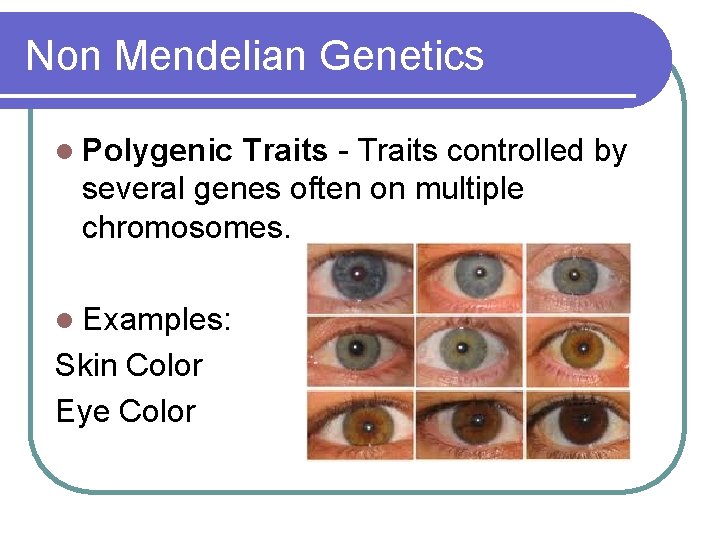
Non Mendelian Genetics l Polygenic Traits - Traits controlled by several genes often on multiple chromosomes. l Examples: Skin Color Eye Color
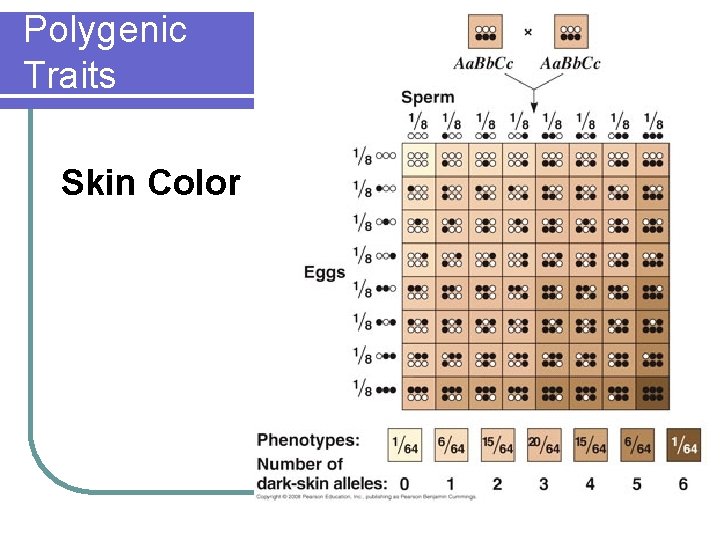
Polygenic Traits Skin Color
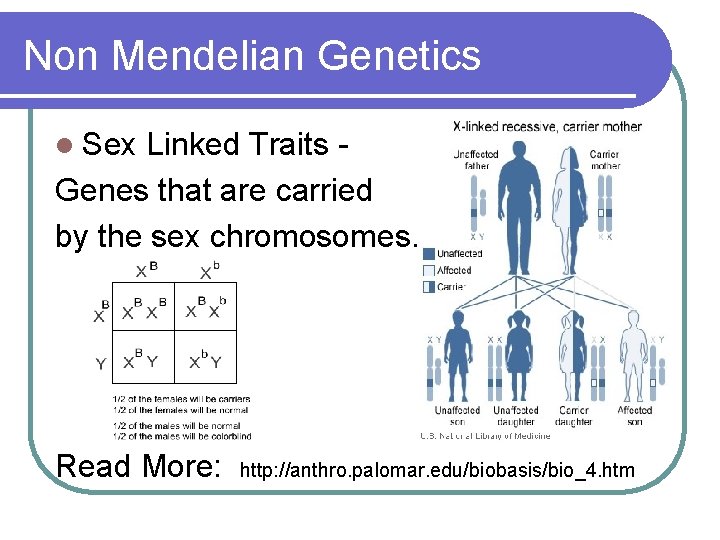
Non Mendelian Genetics l Sex Linked Traits Genes that are carried by the sex chromosomes. Read More: http: //anthro. palomar. edu/biobasis/bio_4. htm
Journal Work l In your journal you will work the following punnett squares. This will be a graded assignment. l You must re-write or abbreviate the questions and you must show your work and circle or hi-lite your answers.
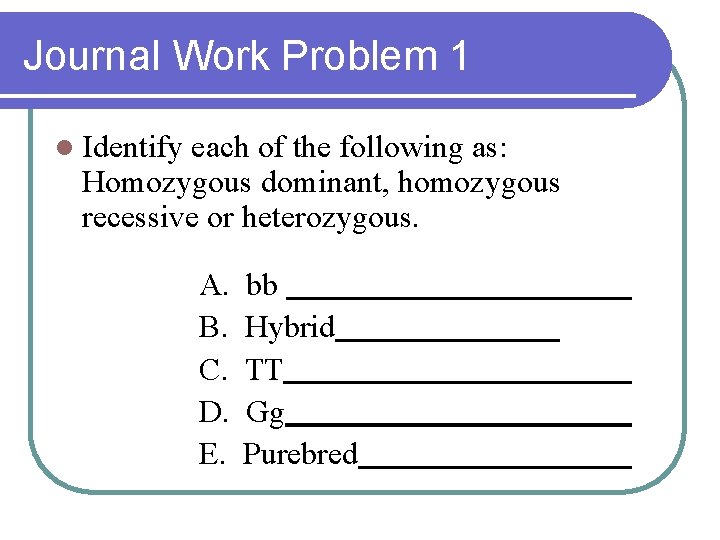
Journal Work Problem 1 l Identify each of the following as: Homozygous dominant, homozygous recessive or heterozygous. A. B. C. D. E. bb Hybrid TT Gg Purebred
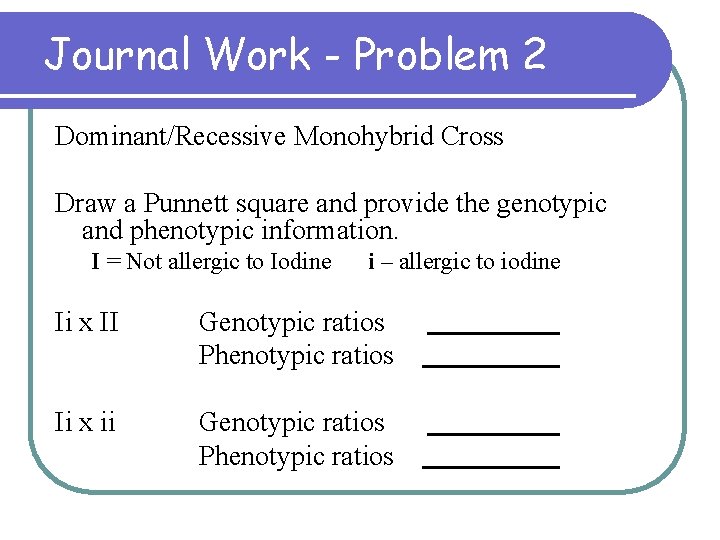
Journal Work - Problem 2 Dominant/Recessive Monohybrid Cross Draw a Punnett square and provide the genotypic and phenotypic information. I = Not allergic to Iodine i – allergic to iodine Ii x II Genotypic ratios Phenotypic ratios Ii x ii Genotypic ratios Phenotypic ratios
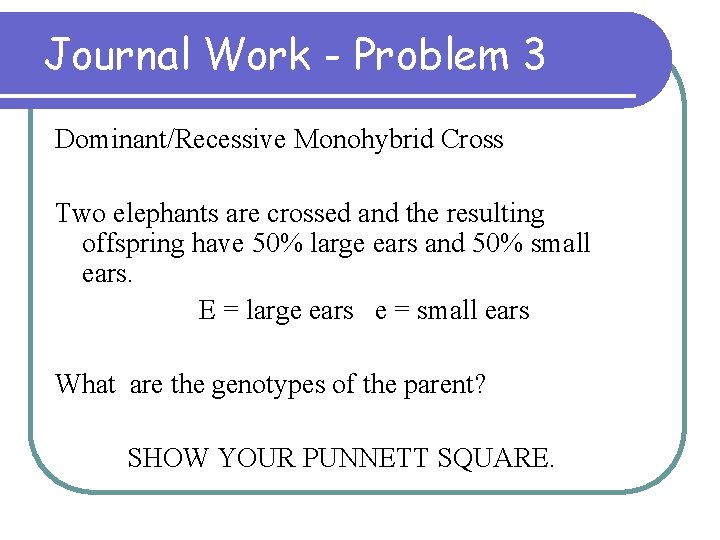
Journal Work - Problem 3 Dominant/Recessive Monohybrid Cross Two elephants are crossed and the resulting offspring have 50% large ears and 50% small ears. E = large ears e = small ears What are the genotypes of the parent? SHOW YOUR PUNNETT SQUARE.
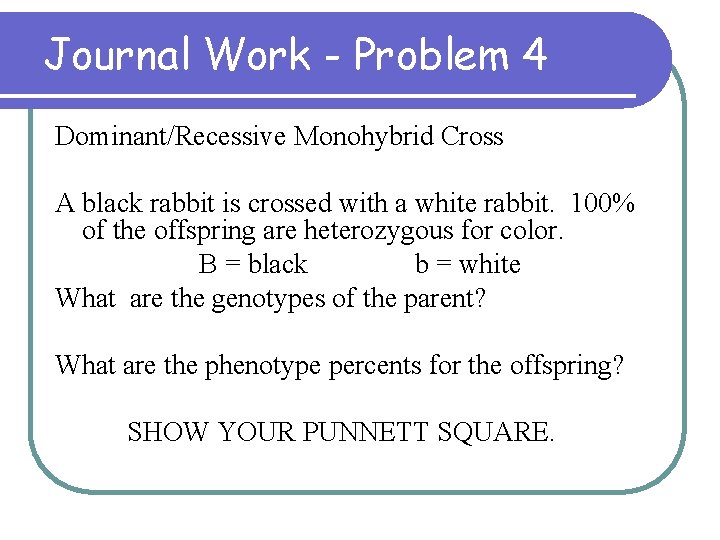
Journal Work - Problem 4 Dominant/Recessive Monohybrid Cross A black rabbit is crossed with a white rabbit. 100% of the offspring are heterozygous for color. B = black b = white What are the genotypes of the parent? What are the phenotype percents for the offspring? SHOW YOUR PUNNETT SQUARE.
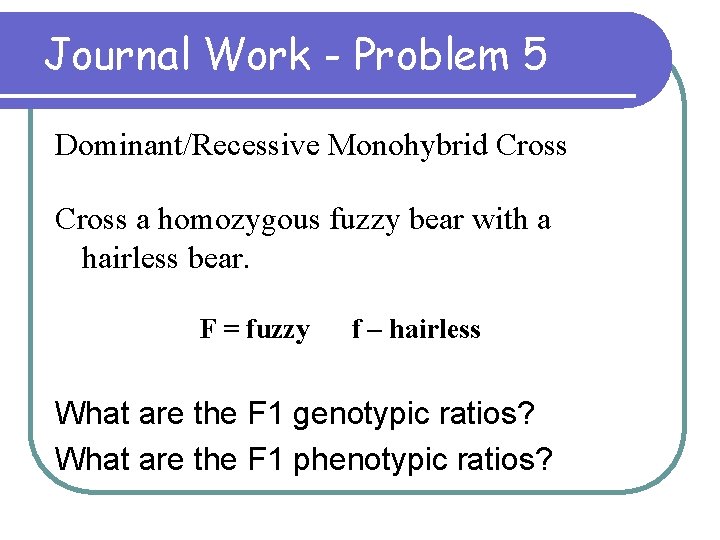
Journal Work - Problem 5 Dominant/Recessive Monohybrid Cross a homozygous fuzzy bear with a hairless bear. F = fuzzy f – hairless What are the F 1 genotypic ratios? What are the F 1 phenotypic ratios?
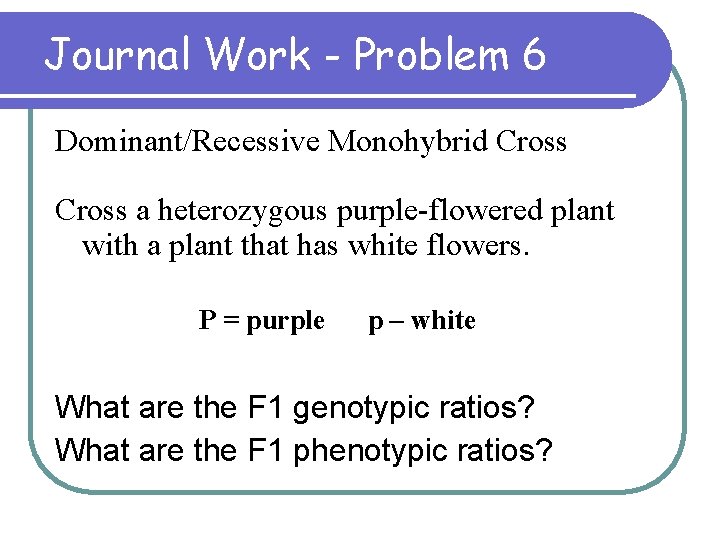
Journal Work - Problem 6 Dominant/Recessive Monohybrid Cross a heterozygous purple-flowered plant with a plant that has white flowers. P = purple p – white What are the F 1 genotypic ratios? What are the F 1 phenotypic ratios?
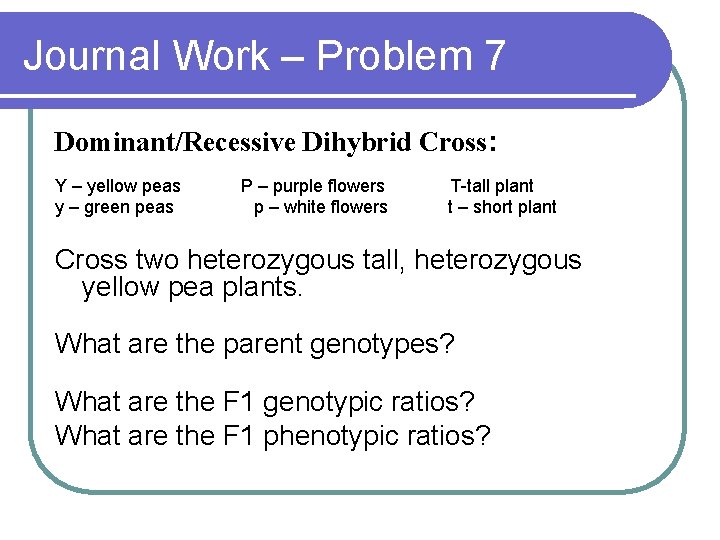
Journal Work – Problem 7 Dominant/Recessive Dihybrid Cross: Y – yellow peas y – green peas P – purple flowers p – white flowers T-tall plant t – short plant Cross two heterozygous tall, heterozygous yellow pea plants. What are the parent genotypes? What are the F 1 genotypic ratios? What are the F 1 phenotypic ratios?

Journal Work – Problem 8 Dominant/Recessive Dihybrid Cross: Y – yellow peas y – green peas P – purple flowers p – white flower T-tall plant t – short plant Cross a short, purple flower plant that is homozygous for color with a short, purple flower plant that is heterozygous for color. Whate are the parent genotypes? What are the F 1 genotypic ratios? What are the F 1 phenotypic ratios?
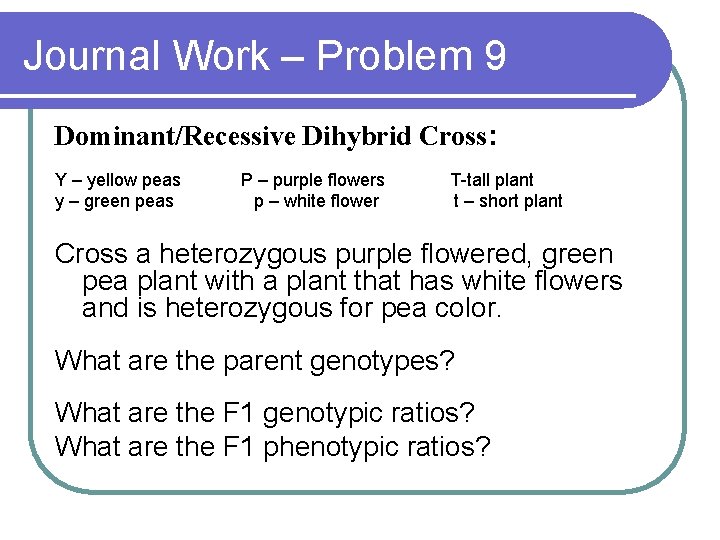
Journal Work – Problem 9 Dominant/Recessive Dihybrid Cross: Y – yellow peas y – green peas P – purple flowers p – white flower T-tall plant t – short plant Cross a heterozygous purple flowered, green pea plant with a plant that has white flowers and is heterozygous for pea color. What are the parent genotypes? What are the F 1 genotypic ratios? What are the F 1 phenotypic ratios?
Journal Work – Problem 10 Incomplete Dominance - Monohybrid Cross: In snapdragons, red and white are both dominant. When they cross, they produce a pink flower. R – red R’ – white Cross a homozygous red and a homozygous white snapdragon. What are the parent genotypes? What are the F 1 genotypic ratios? What are the F 1 phenotypic ratios?
Journal Work – Problem 11 Co - Dominance - Monohybrid Cross: In a certain type of chicken, black and white feather share dominance. When they cross they produce chickens with both black and white feathers. B - black B’ - white Cross a homozygous black and a homozygous white chicken. Whate are the parent genotypes? What are the F 1 genotypic ratios? What are the F 1 phenotypic ratios?
Journal Work – Problem 12 Incomplete and Co - Dominance - Dihybrid Cross: In Fuzzy Trolls, Blue and Purple hair are both dominant. A hybrid genotype produces blue and purple stripes. Yellow skin and Red skin are both dominant. A hybrid genotype produces orange skin. B – Blue hair B’ – Purple hair Y – yellow skin Y’ Red skin A troll with purple hair and red skin reproduces with a troll with blue hair and orange skin. What are the parent genotypes? What are the F 1 genotypic ratios? What are the F 1 phenotypic ratios?
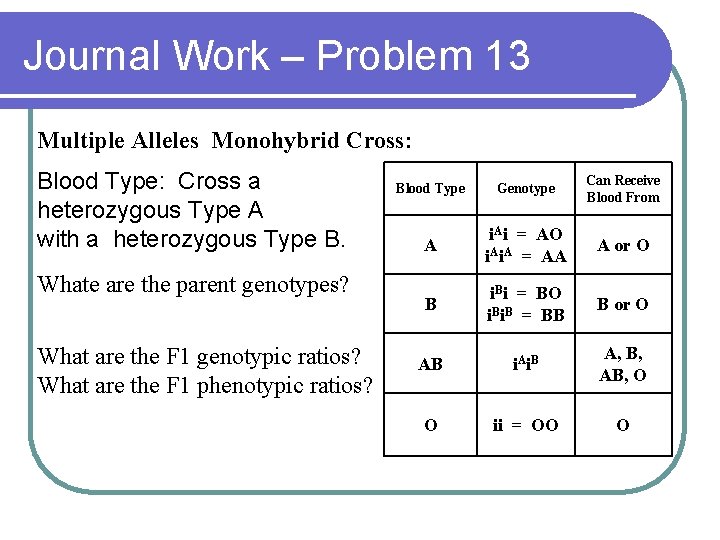
Journal Work – Problem 13 Multiple Alleles Monohybrid Cross: Blood Type: Cross a heterozygous Type A with a heterozygous Type B. Whate are the parent genotypes? What are the F 1 genotypic ratios? What are the F 1 phenotypic ratios? Blood Type Genotype Can Receive Blood From A i. Ai = AO i. A = AA A or O B i. Bi = BO i. B = BB B or O AB i. A i. B A, B, AB, O O ii = OO O
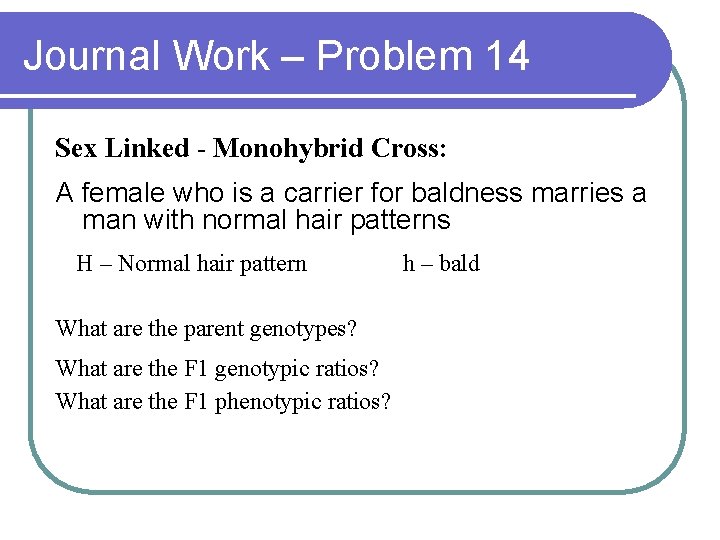
Journal Work – Problem 14 Sex Linked - Monohybrid Cross: A female who is a carrier for baldness marries a man with normal hair patterns H – Normal hair pattern What are the parent genotypes? What are the F 1 genotypic ratios? What are the F 1 phenotypic ratios? h – bald
- Slides: 42