
Intro to Genetic Terminology Vocabulary A flys phenotype

Intro to Genetic Terminology
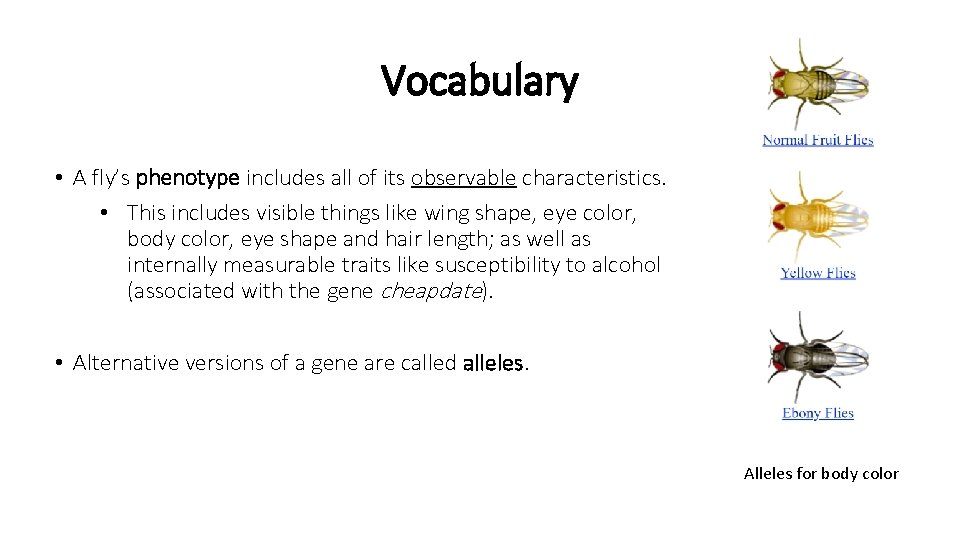
Vocabulary • A fly’s phenotype includes all of its observable characteristics. • This includes visible things like wing shape, eye color, body color, eye shape and hair length; as well as internally measurable traits like susceptibility to alcohol (associated with the gene cheapdate). • Alternative versions of a gene are called alleles. Alleles for body color
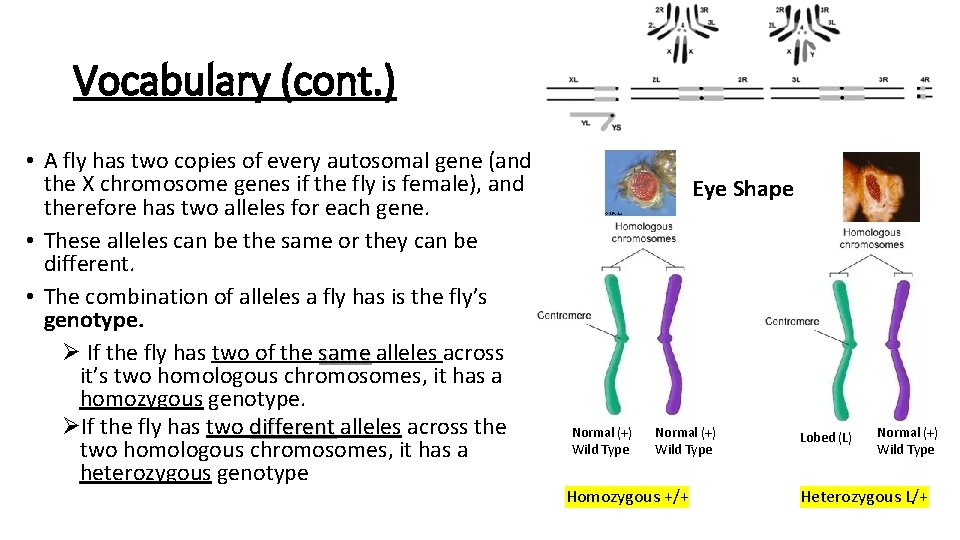
Vocabulary (cont. ) • A fly has two copies of every autosomal gene (and the X chromosome genes if the fly is female), and therefore has two alleles for each gene. • These alleles can be the same or they can be different. • The combination of alleles a fly has is the fly’s genotype. Ø If the fly has two of the same alleles across it’s two homologous chromosomes, it has a homozygous genotype. ØIf the fly has two different alleles across the two homologous chromosomes, it has a heterozygous genotype Eye Shape Normal (+) Wild Type Homozygous +/+ Lobed (L) Normal (+) Wild Type Heterozygous L/+
Genetic Naming and Writing Conventions

Naming Genes • Drosophila genes used to be named after their loss-of-function phenotype • Example for white gene. Ø The White protein (the protein encoded by the white gene) encodes a protein required to make red eye pigment. Ø However, a mutation rendering this gene non-functional results in failure to produce this red eye pigment. Ø Hence, the eye is white and the gene that makes red eye pigment is called white.

Writing Gene and Protein Names • Gene names are written in small caps italics. This rule applies even when the gene name is at the start of a sentence. • Proteins start with a capital letter. ØFor example: The gene white encodes the protein White. The gene ebony encodes the protein Ebony.

Gene Abbreviations • Genes are written into genotypes in their abbreviated form. Example: white is abbreviated w • Different alleles of a gene are abbreviated in different ways ØWild type (fully functional) versions of a gene are written with the gene abbreviation and a superscript (+). Sometimes they are just abbreviated as +. Sometimes wild type genes are not written into the genotype at all. ØMutated versions of a gene are written as either simply the gene abbreviation or as the abbreviation with a superscript (-) Example: Wild type white gene: w+ or absent (phenotype: red eye) Mutated white gene: w or w- (phenotype: white eye)
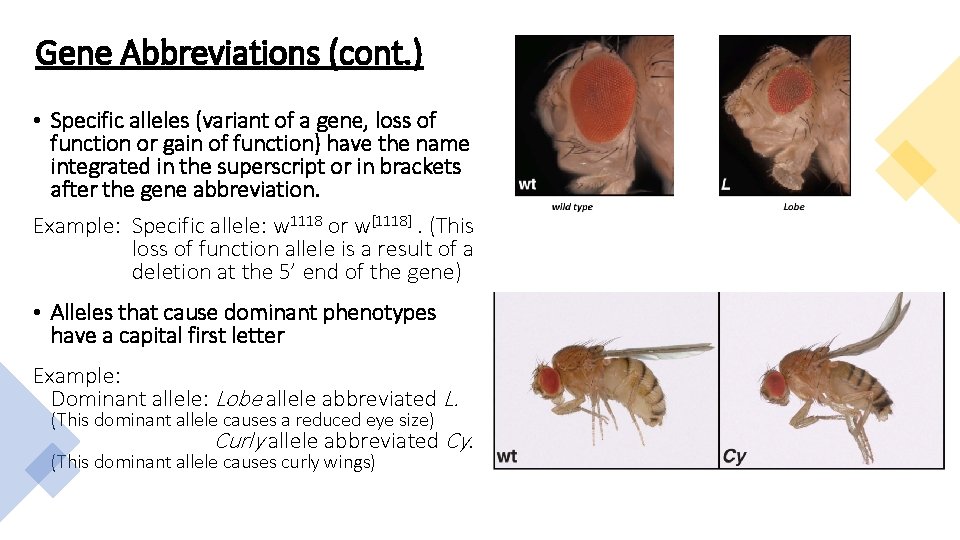
Gene Abbreviations (cont. ) • Specific alleles (variant of a gene, loss of function or gain of function) have the name integrated in the superscript or in brackets after the gene abbreviation. Example: Specific allele: w 1118 or w[1118]. (This loss of function allele is a result of a deletion at the 5’ end of the gene) • Alleles that cause dominant phenotypes have a capital first letter Example: Dominant allele: Lobe allele abbreviated L. (This dominant allele causes a reduced eye size) Curly allele abbreviated Cy. (This dominant allele causes curly wings)
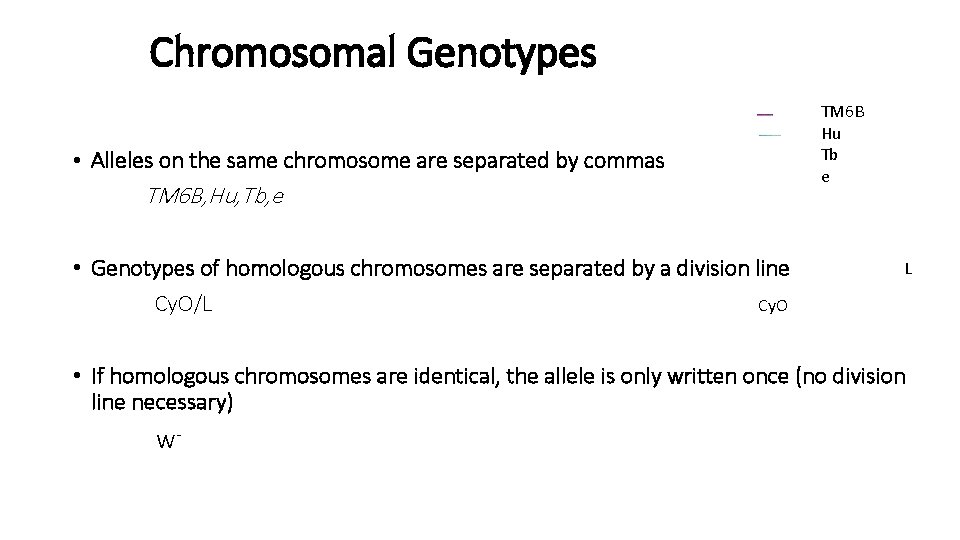
Chromosomal Genotypes • Alleles on the same chromosome are separated by commas TM 6 B, Hu, Tb, e • Genotypes of homologous chromosomes are separated by a division line Cy. O/L TM 6 B Hu Tb e L • If homologous chromosomes are identical, the allele is only written once (no division line necessary) w-
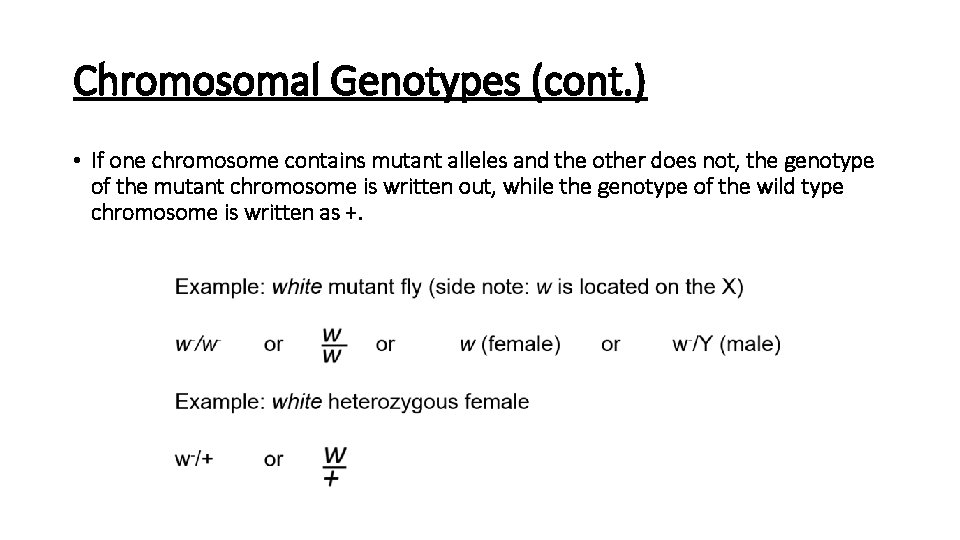
Chromosomal Genotypes (cont. ) • If one chromosome contains mutant alleles and the other does not, the genotype of the mutant chromosome is written out, while the genotype of the wild type chromosome is written as +.

Genotypes across multiple chromosomes • Chromosomal groups are written in order • Chromosomal groups are separated by semicolons X/Y ; 2 ; 3 ; 4 For example: f; cn, bw; TM 2/tra refer to X, 2, 3, respectively. • Chromosome 4 is usually ignored because it is very small and does not have that many genes on it. • If the pertinent mutations are on the X and 3 only then you would skip any designations for chromosome 2. • Anything that is not shown is presumed to be wild type

Monohybrid Cross
- Slides: 12