
Intro to Failure Mode Effect Analysis FMEA Definition


- Slides: 10
Intro to Failure Mode Effect Analysis (FMEA)
Definition • FMEA — failure mode and effects analysis — is a tool for identifying potential problems and their impact.
Basics • FMEA is a qualitative and systematic tool, usually created within a spreadsheet, to help practitioners anticipate what might go wrong with a product or process. • FMEA also helps find the possible causes of failures and the likelihood of failures being detected before occurrence. • Used across many industries, FMEA is one of the best ways of analysing potential reliability problems early in the development cycle, making it easier for manufacturers to take quick action and mitigate failure. • The ability to anticipate issues early allows practitioners to design out failures and design in reliable, safe and customer-pleasing features.
Finding Failures • One of the first steps to take when completing an FMEA is to determine the participants. • The right people with the right experience, such as process owners and designers, should be involved in order to catch potential failure modes. • Practitioners also should consider inviting customers and suppliers to gather alternative viewpoints. • Once the participants are together, the brainstorming can begin. • When completing an FMEA, it’s important to remember Murphy’s Law: “Anything that can go wrong, will go wrong. ” • Participants need to identify all the components, systems, processes and functions that could potentially fail to meet the required level of quality or reliability. The team should not only be able to describe the effects of the failure, but also the possible causes.
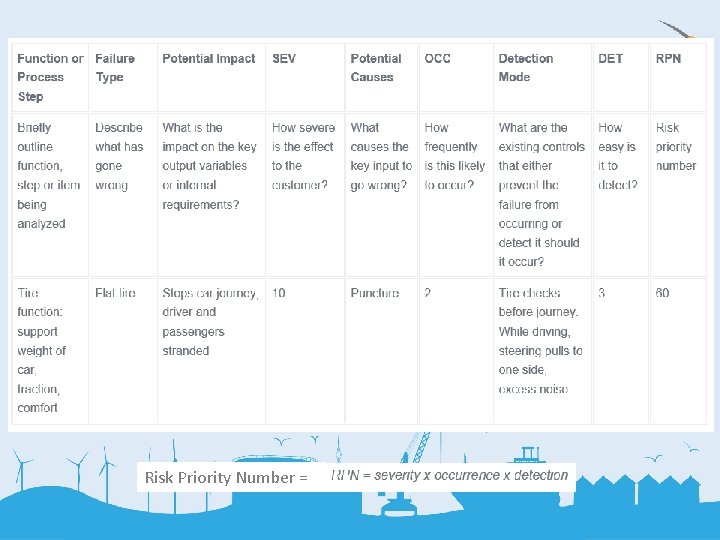
Risk Priority Number =
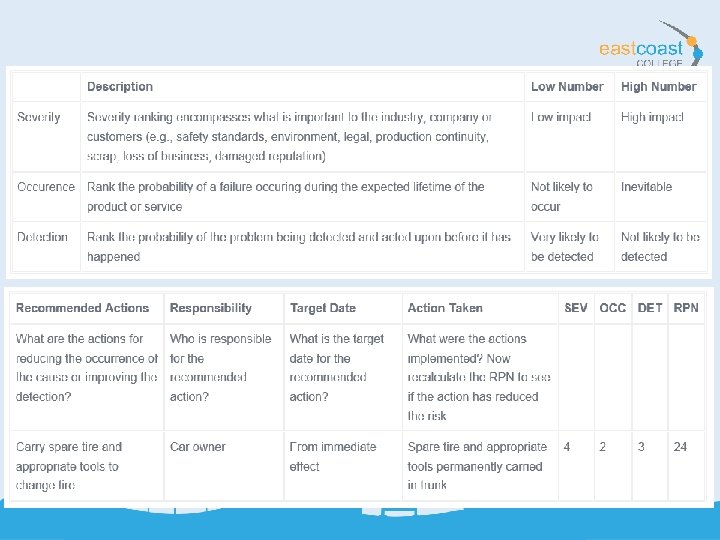
Criteria • An FMEA uses three criteria to assess a problem: 1) the severity of the effect on the customer, 2) how frequently the problem is likely to occur and 3) how easily the problem can be detected. • Participants must set and agree on a ranking between 1 and 10 (1 = low, 10 = high) for the severity, occurrence and detection level for each of the failure modes. • Although FMEA is a qualitative process, it is important to use data (if available) to qualify the decisions the team makes regarding these ratings.
Priorities • Once all the failure modes have been assessed, the team should adjust the FMEA to list failures in descending RPN order. • This highlights the areas where corrective actions can be focused. • If resources are limited, practitioners must set priorities on the biggest problems first. • There is no definitive RPN threshold to decide which areas should receive the most attention; this depends on many factors, including industry standards, legal or safety requirements, and quality control. • However, a starting point for prioritization is to apply the Pareto rule: typically, 80 percent of issues are caused by 20 percent of the potential problems. As a rule of thumb, teams can focus their attention initially on the failures with the top 20 percent of the highest RPN scores
Corrective Actions • Once priorities set action plan created to at the every least improving the detection. The FMEA leader should assign responsibility for these actions and set target completion dates. • Once corrective actions have been completed, the team should meet again to reassess and rescore. This will enable them to determine the effectiveness of the corrective actions taken. These assessments may be helpful in case the team decides that it needs to enact new corrective actions. • The FMEA is a valuable tool that can be used to realize a number of benefits, including improved reliability of products and services, prevention of costly late design changes, and increased customer satisfaction.
Questions?