
Intro to Evolution A Short History PreDarwinian View
- Slides: 14
Intro to Evolution A Short History
Pre-Darwinian View Aristotle Envisioned – scala naturae Fixed species occupied allotted rungs on an increasingly complex ladder of life Linnaeus – Devised a hierarchy for classification King Phillip Came Over For Grape Soda
Pre-Darwinian View Cuvier – Believed that catastrophic extinctions explained unique sets of fossil species between successive strata James Hutton & Charles Lyell Proposed that profound changes in the earth’s surface can result from slow, continuous actions
Pre-Darwinian View Jean Baptiste Lemark Inheritance of Acquired Characteristics Proposed theory of evolution where increasing complexity & more perfect adaptations result from inheritance of characteristics acquired by organisms interacting w/ the environment However, there is NO evidence for inheritance of acquired characteristics
Pre-Darwinian View Darwin Proposed the idea that new species originate from ancestral forms by the gradual accumulations of adaptations Alfred Wallace Independently arrived at theory of Natural Selection soon after Darwin
Dual Meaning of Darwinism Darwinian view of life has 2 parts: Descent with Modification Natural Selection
Natural Selection Survival of the Fittest The driving force of Evolution Based on differential success in reproduction Individuals best adapted to the local environment leave more offspring = thereby pass on their adaptive characteristics more frequently
5 Facts of Nature Fact 1: All species’ population size would increase exponentially if all individuals that are born reproduce successfully Fact 2 Most populations are normally stable in size, except for seasonal fluctuations Fact 3 Natural resources are limited
5 Facts of Nature Fact 4 Individuals of a population vary extensively in their characteristics; no 2 individuals are exactly alike Fact 5 Much of this variation is inherited
Darwin’s Conclusions Darwin’s 1 st Inference/Conclusion: Production of more individuals than the environment can support leads to a struggle for existence among individuals of a population, w/ only a fraction of offspring surviving each generation
2 nd Inference/Conclusion: Survival is a struggle that depends on the inherited characteristics of the individual. Surviving individuals will produce more offspring 3 rd Inference/Conclusion: Unequal ability to survive and reproduce will lead to gradual change in a population
Signs of Evolution Biogeography of species First suggested common descent – island species are more closely related than those on distant shores Chronological fossil record This supports and is compatible w/ other lines of evidence Taxonomic hierarchy reflects common descent
Signs of Evolution Cont. Homologous structures testify to an evolutionary remodeling process Embryonic Development Reveals homologies not apparent in adult species Closely related species show unmistakable similarities in their DNA and Proteins
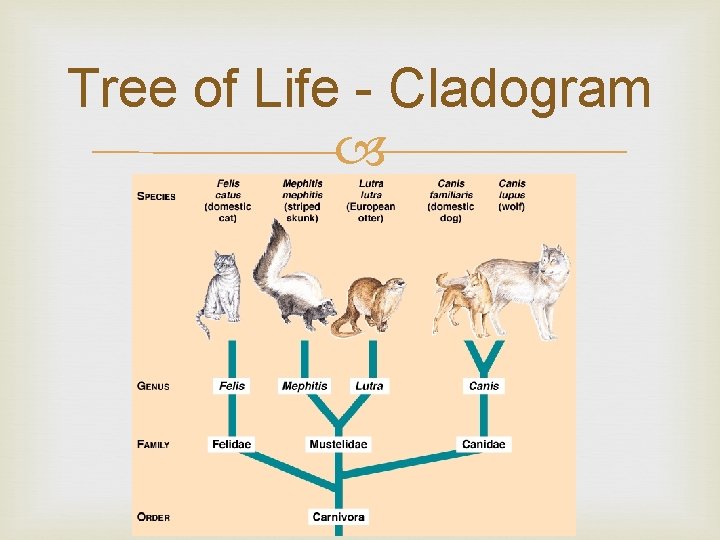
Tree of Life - Cladogram