
Intro to Environmental Science TYPES AND STRUCTURE OF






- Slides: 70
Intro to Environmental Science
TYPES AND STRUCTURE OF MATTER • Elements and Compounds – Matter exists in chemical forms as elements and compounds. • Elements (represented on the periodic table) are the distinctive building blocks of matter. • Compounds: two or more different elements held together in fixed proportions by chemical bonds.
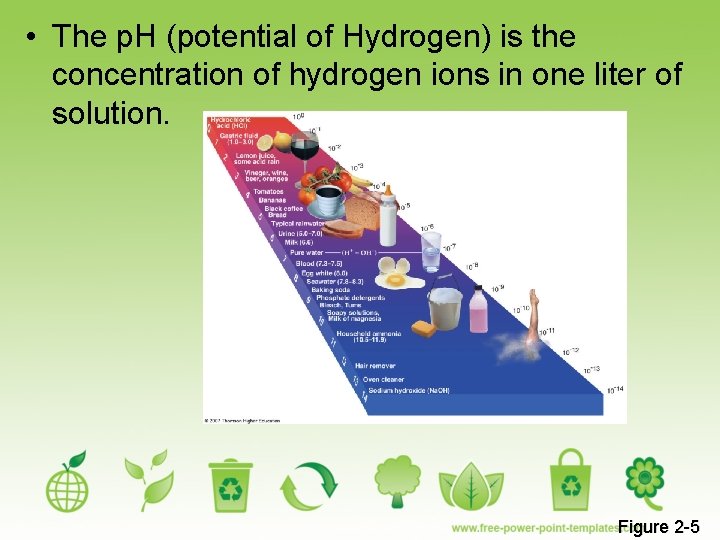
• The p. H (potential of Hydrogen) is the concentration of hydrogen ions in one liter of solution. Figure 2 -5
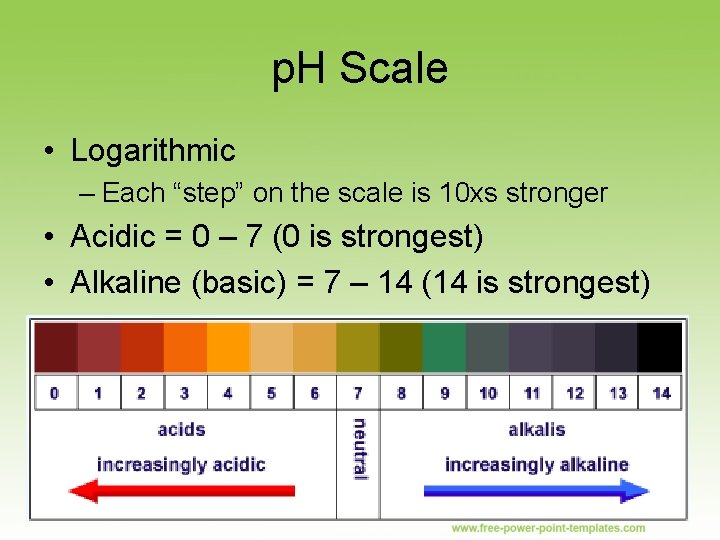
p. H Scale • Logarithmic – Each “step” on the scale is 10 xs stronger • Acidic = 0 – 7 (0 is strongest) • Alkaline (basic) = 7 – 14 (14 is strongest)
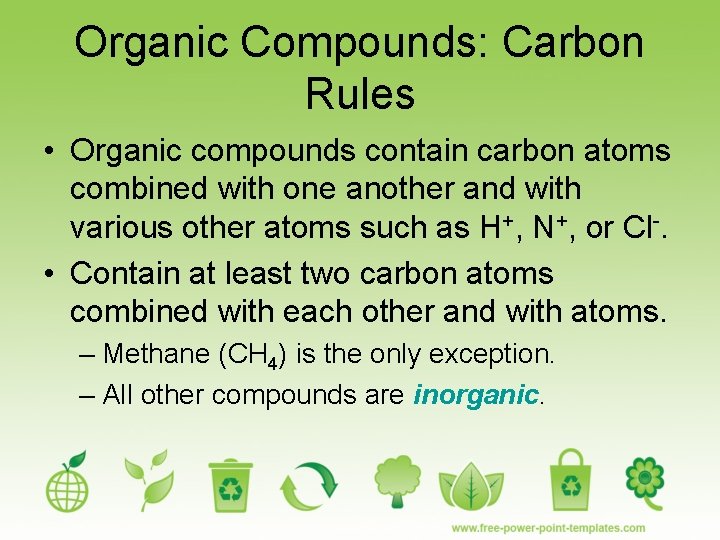
Organic Compounds: Carbon Rules • Organic compounds contain carbon atoms combined with one another and with various other atoms such as H+, N+, or Cl-. • Contain at least two carbon atoms combined with each other and with atoms. – Methane (CH 4) is the only exception. – All other compounds are inorganic.
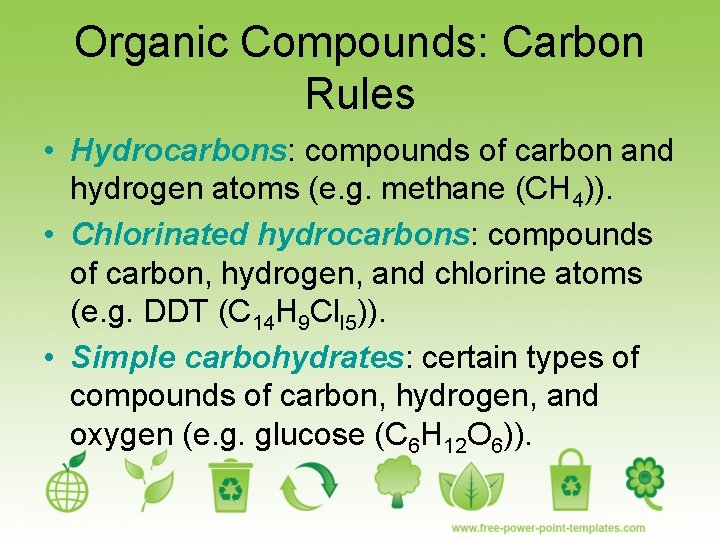
Organic Compounds: Carbon Rules • Hydrocarbons: compounds of carbon and hydrogen atoms (e. g. methane (CH 4)). • Chlorinated hydrocarbons: compounds of carbon, hydrogen, and chlorine atoms (e. g. DDT (C 14 H 9 Cll 5)). • Simple carbohydrates: certain types of compounds of carbon, hydrogen, and oxygen (e. g. glucose (C 6 H 12 O 6)).
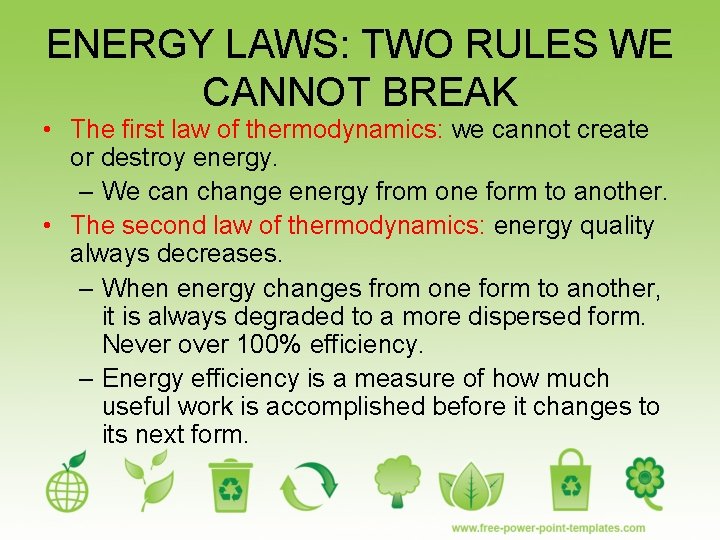
ENERGY LAWS: TWO RULES WE CANNOT BREAK • The first law of thermodynamics: we cannot create or destroy energy. – We can change energy from one form to another. • The second law of thermodynamics: energy quality always decreases. – When energy changes from one form to another, it is always degraded to a more dispersed form. Never over 100% efficiency. – Energy efficiency is a measure of how much useful work is accomplished before it changes to its next form.
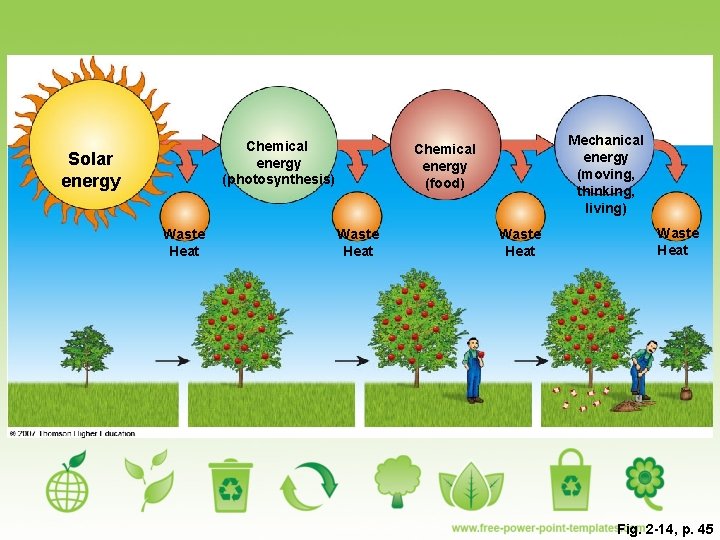
Chemical energy (photosynthesis) Solar energy Waste Heat Mechanical energy (moving, thinking, living) Chemical energy (food) Waste Heat Fig. 2 -14, p. 45
How to determine if it’s a good source… • Who wrote it? (Authority) • Who is responsible for the content of the source? Can you determine the name of the individual, the organization, or entity which produced it? Is there an address or e-mail given to provide communication or feedback? If NOT, then find a better source. You can’t trust a source when the authorship is hidden.
How to determine if it’s a good source… • Why was it written? (Objectivity) • Purpose of a source is very important to understand its bias. Every creator has a purpose or viewpoint behind what he/she makes. Look at the title, the address for clues, and read the material carefully for language which gives opinion, viewpoint, or perspective.
How to determine if it’s a good source… • When was it written? (Currency) • Timeliness is often an important factor in the usefulness of information. Look for copyright dates, updates, and sources used. You need to look for CURRENT (within the last 3 or 4 years) information. For some topics you will need information even more current than that.
How to determine if it’s a good source… • Where has the information been published previously? (Accuracy) • The more reliable a source the more likely it is that the information contained in it was checked and verified. If the information was published without such checks, you cannot tell if the information is true or not. (That’s how rumors get started!)
How to determine if it’s a good source… • Internet tips: –. edu and. gov are likely good sources –. org is often non-profit and can be either good or poor… be selective as they may have significant bias. –. com means commercial and means there is likely a substantial bias
Experimental Design • Hypothesis – Has to be testable (no opinions) – Should be a statement • If / then statements • Ex) If pesticide x is used on a field, crop yields will increase.
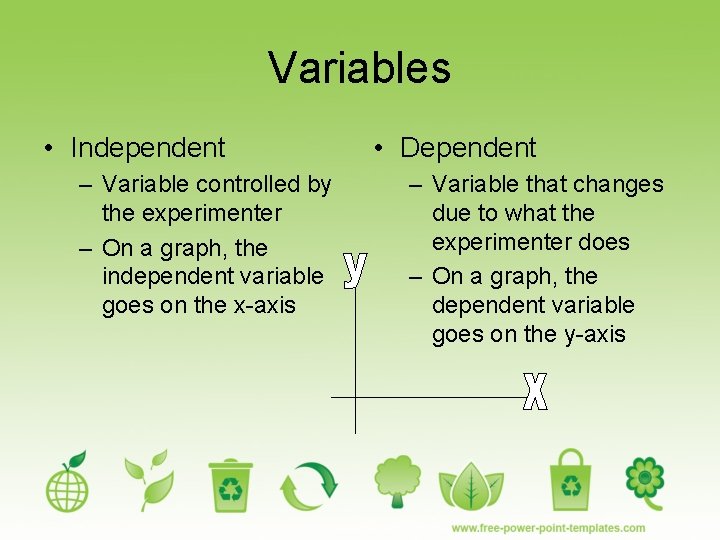
Variables • Independent – Variable controlled by the experimenter – On a graph, the independent variable goes on the x-axis • Dependent – Variable that changes due to what the experimenter does – On a graph, the dependent variable goes on the y-axis
Constants • Keeping extra factors equal. • The constants are not allowed to change during the experiment. Control • A standard by which the dependent variable is often compared. • Example: placebos
Repeated Trials • The greater the number of trials or the greater the sample size, the more valid the results will be. Time Scale • Make sure the time to perform the lab works with subject being tested • Ex) When testing effects on trees, a lab should run for several years.
Predicting Values • Extrapolate – Predicting a point beyond known data based on the trend of the known data • Interpolate – Predicting a value between two known data points based on the trend of the known data.
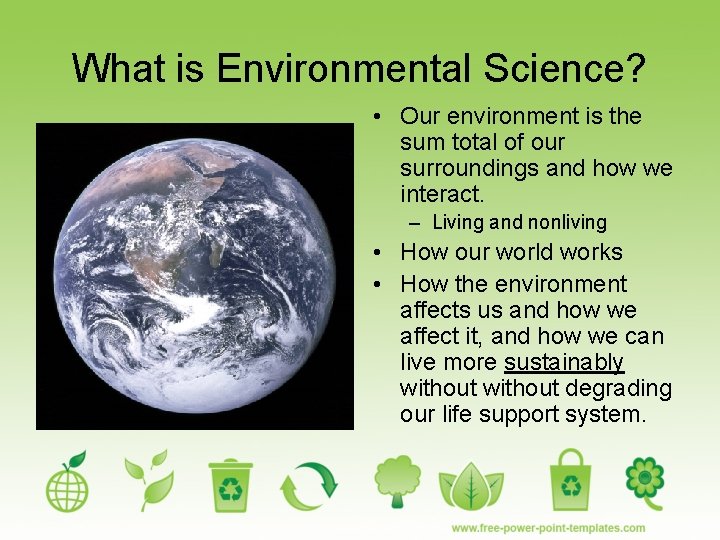
What is Environmental Science? • Our environment is the sum total of our surroundings and how we interact. – Living and nonliving • How our world works • How the environment affects us and how we affect it, and how we can live more sustainably without degrading our life support system.
Environmentalism vs. Environmental Science • Environmentalism – Social movement – Includes lobbying, activism, and education • Environmental Science – Includes chemistry, biology, earth science – Also includes economics, literature, and ethics
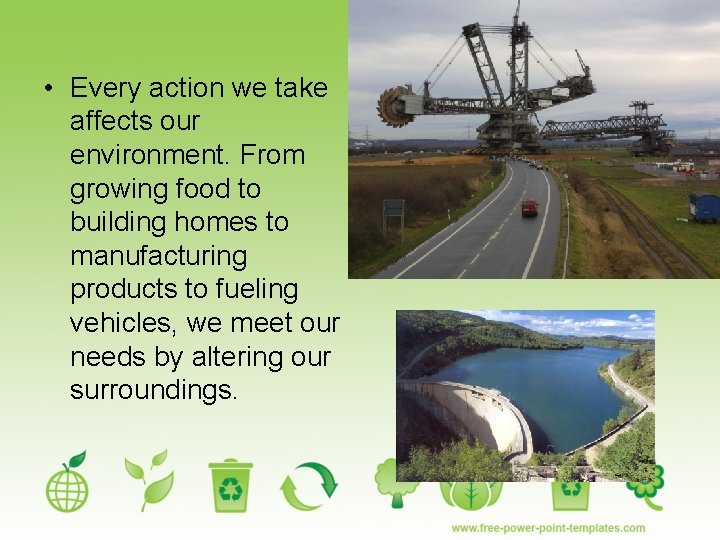
• Every action we take affects our environment. From growing food to building homes to manufacturing products to fueling vehicles, we meet our needs by altering our surroundings.
NATURAL RESOURCES – Materials or substances such as minerals, forests, water, and fertile land that occur in nature and can be used for economic gain. NATURAL SERVICES – Humankind benefits from a multitude of resources and processes that are supplied by natural ecosystems.
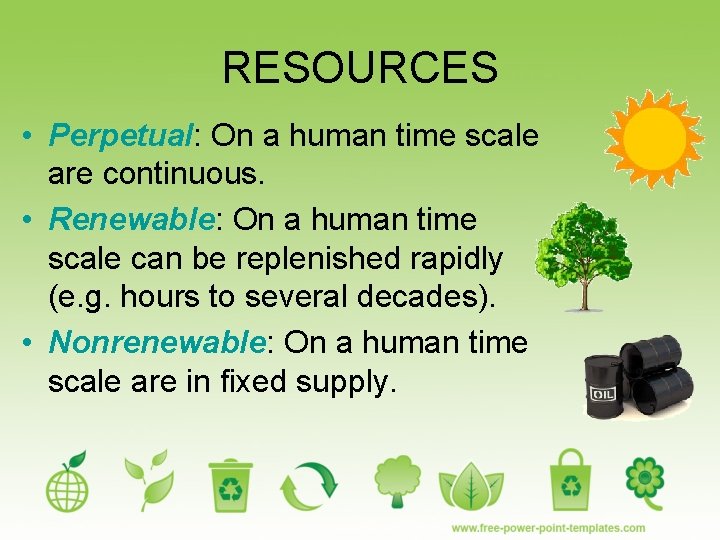
RESOURCES • Perpetual: On a human time scale are continuous. • Renewable: On a human time scale can be replenished rapidly (e. g. hours to several decades). • Nonrenewable: On a human time scale are in fixed supply.
Themes seen throughout ES. • Stewardship / Ethics – the ethical and moral framework that should inform our public and private actions. – Ethics that guide actions taken to benefit the natural world and other people. This is a branch of philosophy that involves the study of good and bad, right and wrong – Culture and worldview influence our perception of the environment • People trying to stop the destruction of the environment. Recycling, buying a hybrid car, supporting organizations, voting for candidates that carry the same ideals.
ENVIRONMENTAL WORLDVIEWS AND VALUES • Your environmental worldview encompasses: – How you think the world works. – What you believe your environmental role in the world should be. – What you believe is right and wrong environmental behavior.
HUMAN-CENTERED AND LIFECENTERED ENVIRONMENTAL WORLDVIEWS • The major difference among environmental worldviews is the emphasis they put on the role of humans dealing with environmental problems.
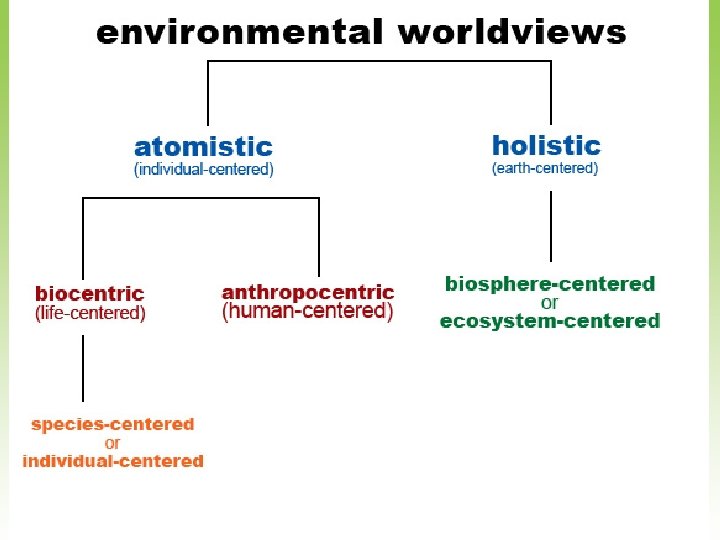
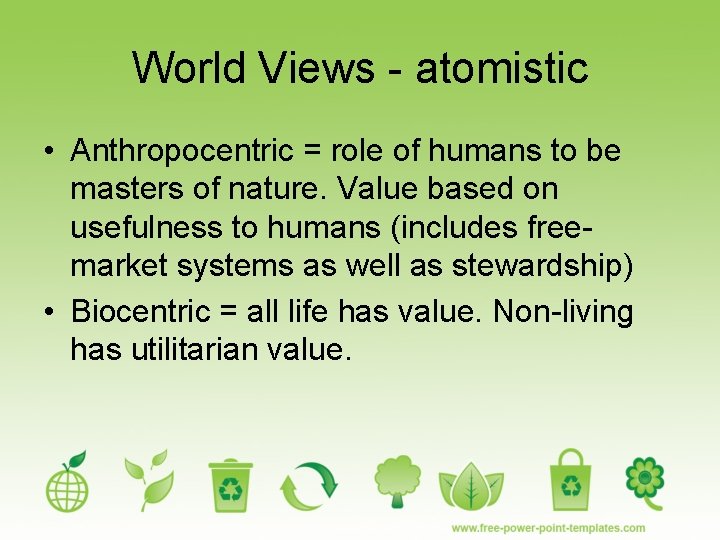
World Views - atomistic • Anthropocentric = role of humans to be masters of nature. Value based on usefulness to humans (includes freemarket systems as well as stewardship) • Biocentric = all life has value. Non-living has utilitarian value.
World Views - Holistic • Ecocentric = everything has value just because it exists. – Environmental wisdom – adapt our needs to the environment to provide a sustainable future – Deep ecology – humans have no right to interfere with environmental richness and diversity
Gaia Hypothesis • Conjectures that our planet functions as a single organism that maintains conditions (not unlike homeostasis in humans) necessary for its survival.
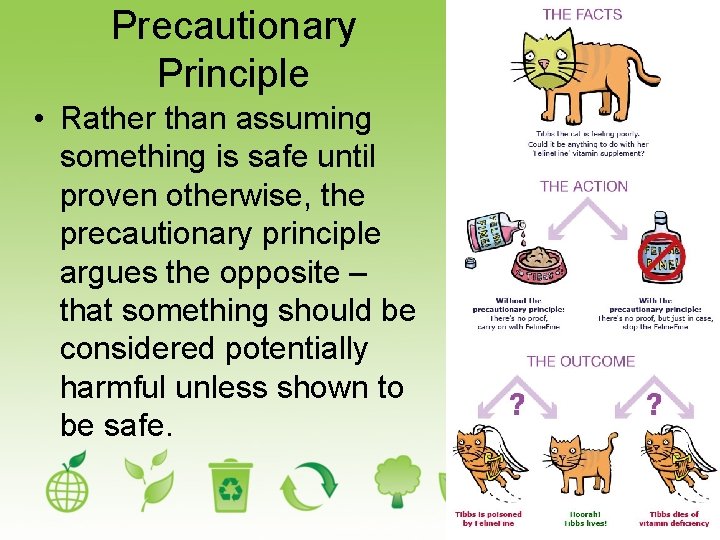
Precautionary Principle • If an action or policy has a suspected risk of causing harm to the public or to the environment, in the absence of scientific consensus that the action or policy is harmful, the burden of proof that it is not harmful falls on those taking the action.
Precautionary Principle • Rather than assuming something is safe until proven otherwise, the precautionary principle argues the opposite – that something should be considered potentially harmful unless shown to be safe.
Gandhi’s Philosophies • Voluntary simplicity- do and enjoy things more with less. • Principle of “Enoughness”- the earth provides enough, and we should use the minimal amounts of everything. • This is not the same as forced simplicity that plagues those that cannot afford to have possessions. • Law of progressive simplification- we must transfer energy from material to nonmaterial.
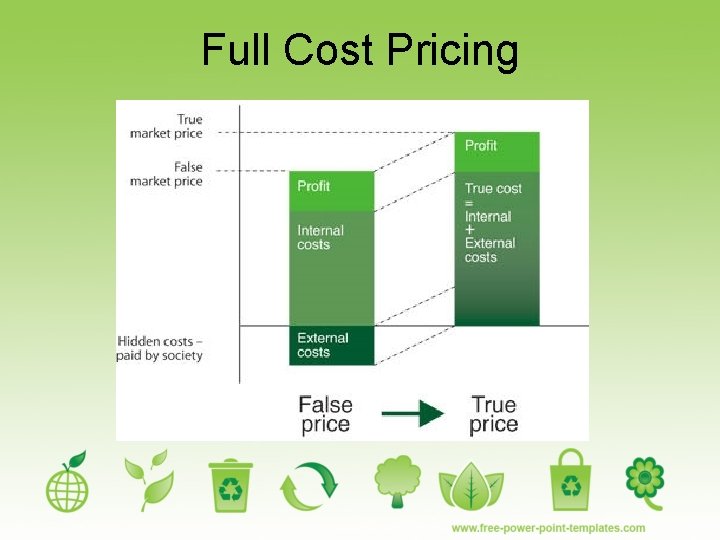
Full-cost pricing • Method of accounting for environmental, social, and economic costs and benefits of goods • Sometimes described as including direct and indirect costs.
Full Cost Pricing
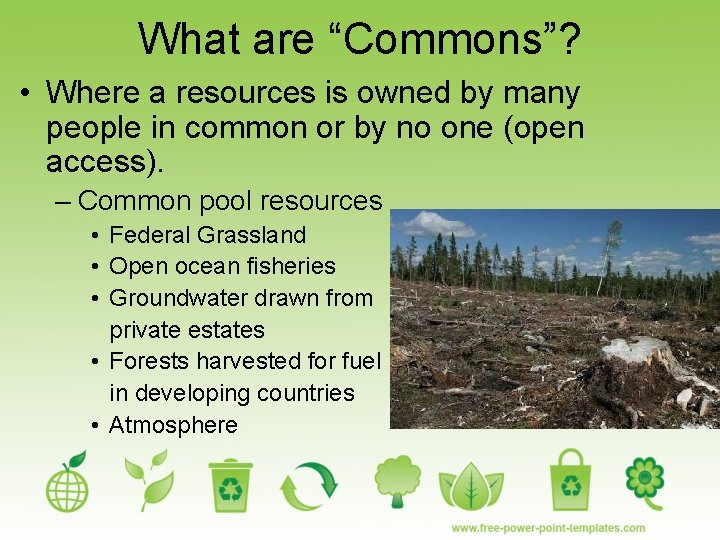
What are “Commons”? • Where a resources is owned by many people in common or by no one (open access). – Common pool resources • Federal Grassland • Open ocean fisheries • Groundwater drawn from private estates • Forests harvested for fuel in developing countries • Atmosphere
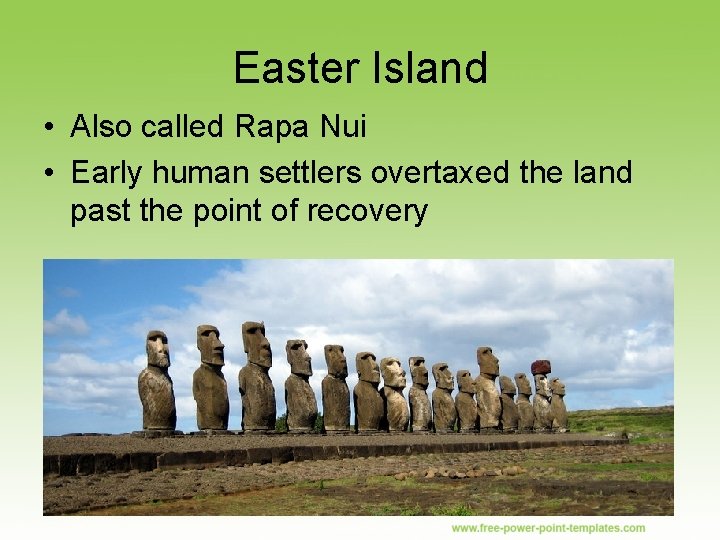
Easter Island • Also called Rapa Nui • Early human settlers overtaxed the land past the point of recovery
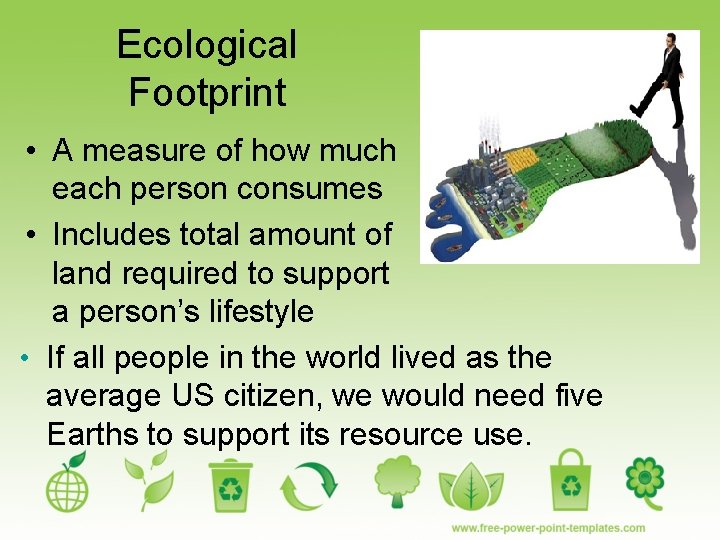
Ecological Footprint • A measure of how much each person consumes • Includes total amount of land required to support a person’s lifestyle • If all people in the world lived as the average US citizen, we would need five Earths to support its resource use.
Economics – By definition, an environmental problem is an economic problem than can intensify as population and per capita resources consumption increases. – Most conventional economist adhere to a world view that largely ignores the environment and this world view continues to drive most policy decisions. – Economic growth measures a society’s status. • GDP – Gross domestic product – the annual market value of all goods and services produced by all firms operating within a country.
Poverty • Poverty has been identified as one of the five major causes of environmental problems. – 1. 1 billion people struggle to survive on an income of less than $1 a day. – Poorest of the rural poor depend on the environment for 80% of their basic needs. – They live unsustainably
World Trade Organization • Formed under Marrakech Agreement in 1995 • Sustainable development and protection and preservation of the environment are fundamental goals of the WTO, but there is no specific agreement dealing with the environment • Not a smooth process. – Free trade issues – Human Rights – Environmental Resource concerns – Negotiation break downs – Mass Protests
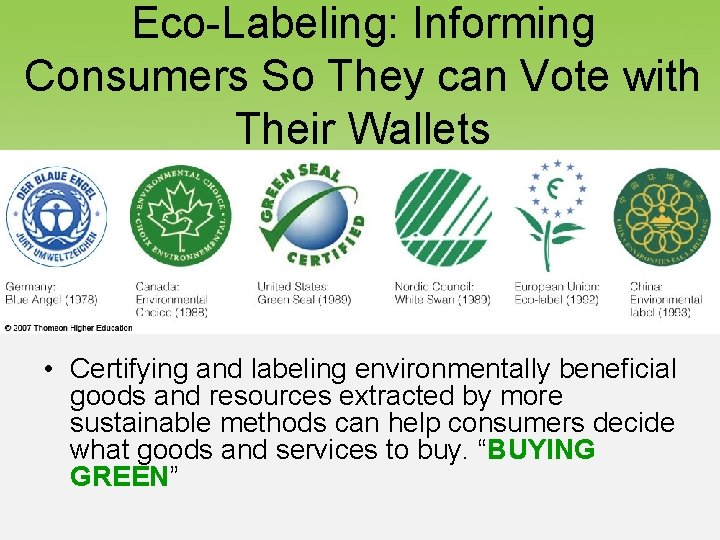
Eco-Labeling: Informing Consumers So They can Vote with Their Wallets • Certifying and labeling environmentally beneficial goods and resources extracted by more sustainable methods can help consumers decide what goods and services to buy. “BUYING GREEN”
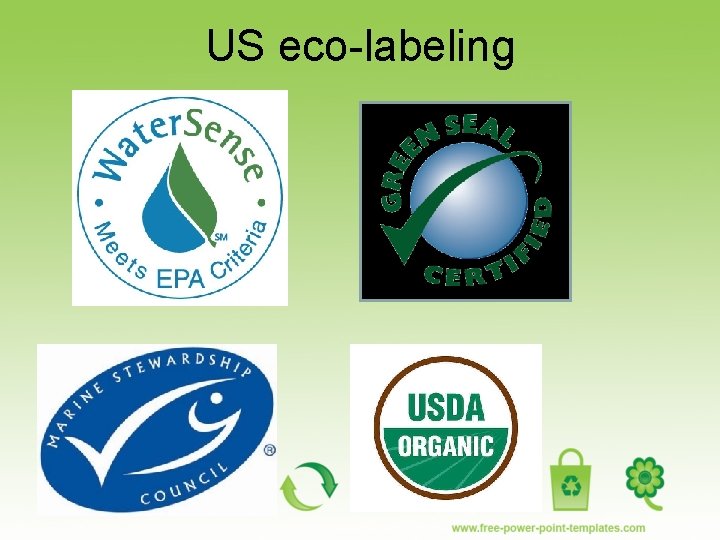
US eco-labeling
Green Taxes • taxes intended to promote ecologically sustainable activities via economic incentives. • attempts to make the private parties involved feel the social burden of their actions
Cost vs. Benefit • Cost Benefit analysis is an economic measure applied to environmental policy. • A tool of risk management – Needs vs. cost to environment – Needs vs. cost to people – Needs vs. cost to Biodiversity – Short term issue vs. long term issue
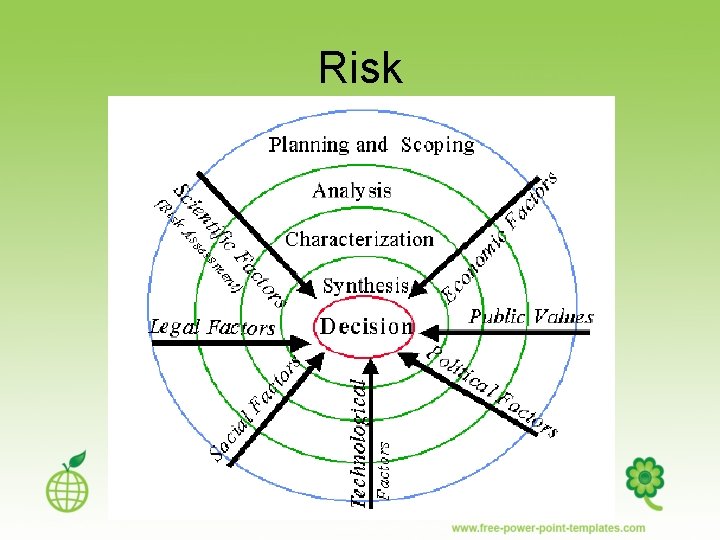
Risk
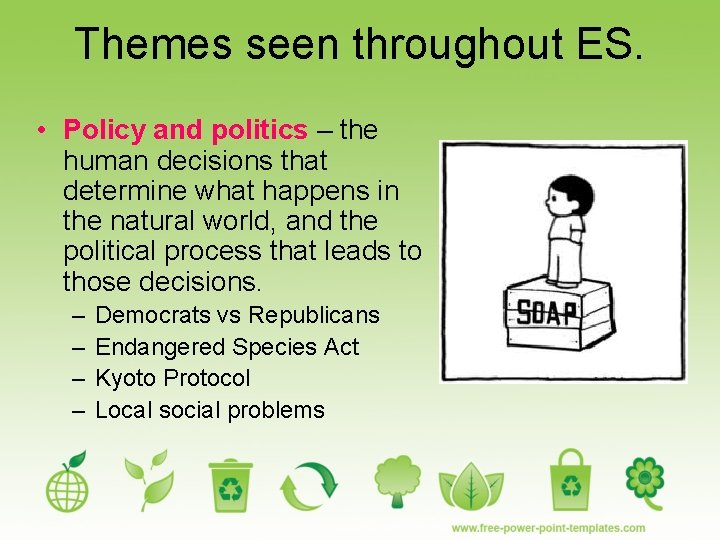
Themes seen throughout ES. • Policy and politics – the human decisions that determine what happens in the natural world, and the political process that leads to those decisions. – – Democrats vs Republicans Endangered Species Act Kyoto Protocol Local social problems
Policy and politics • Policy is what a government does to support its ideas. (laws. . tariffs. . wars. . ) • Politics decides which ideas the government believes. (free trade, isolationism)
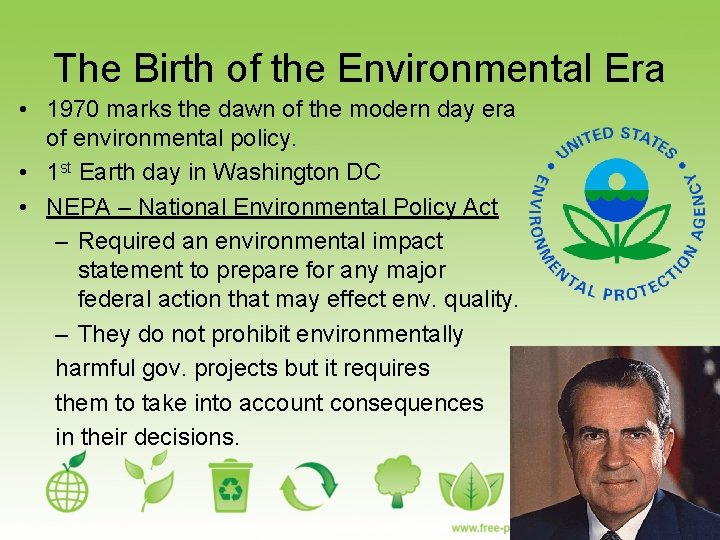
The Birth of the Environmental Era • 1970 marks the dawn of the modern day era of environmental policy. • 1 st Earth day in Washington DC • NEPA – National Environmental Policy Act – Required an environmental impact statement to prepare for any major federal action that may effect env. quality. – They do not prohibit environmentally harmful gov. projects but it requires them to take into account consequences in their decisions.
The Birth of the Environmental Era • EPA – Environmental Protection Agency – In charge of conducting and evaluating research, monitoring environmental quality, setting and enforcing standard for pollution levels, assisting states in meeting standards and goals, and educating the public.
What can the government do? • • • Tax it Subsidize it Provide a tax break Regulate it Tradable environmental permits • • • Ban it Phase it out Fines Inspections Prohibit trade Cap and trade The government can NOT set prices!
Environmental group and how they affect policy • Env groups monitor env activities, work to pass and strengthen laws, and work with corporations to find solutions. • There are more than 100, 000 Nonprofit groups often called Non-governmental Organizations(NGOs). – WWF, Sierra Club, National Wildlife Fund, Audubon Society, Greenpeace, Nature Conservancy, Ducks Unlimited
Environmental group and how they affect policy • Some industries and groups are working together to find solutions to env. issues. – Rainforest Alliance and Chiquita Banana – Environmental Defense Fund and Mc. Donalds
Themes seen throughout ES. • Sustainability – a system that can be continued indefinitely, without depleting any of the material or energy resources required to keep it running. – Ex. Trees, fish, and other biological species reproduce at rates faster than required to keep their populations stable. Thus it is possible to harvest a certain percentage every year without reducing the population below a certain baseline. – It becomes unsustainable when we harvest at a rate that exceeds the capacity for their present population to reproduce and grow.
Living More Lightly on the Earth: The Sustainable Dozen • Agriculture 1) Reduce you meat consumption. 2) Buy locally grown and produced food. 3) Buy more organic food and grow your own. 4) Don’t use pesticides.
Living More Lightly on the Earth: The Sustainable Dozen • Transportation 5) Drive an energy-efficient vehicle. 6) Walk, bike, carpool, or take mass transit. 7) Work at home or live near work. 8) Reduce your car use by 10%
Living More Lightly on the Earth: The Sustainable Dozen • Home Energy Use 9) Caulk leaks, add insulation, use energy efficient appliances. 10)Try to use solar, wind, flowing water, biomass for home energy.
Living More Lightly on the Earth: The Sustainable Dozen • Water 11)Use water-saving showers and toilets, use drip irrigation, landscape yard with natural plants that do not require excess water. • Resource Consumption 12)Reduce your consumption and waste of stuff by at least 10%: Refuse and Reuse.
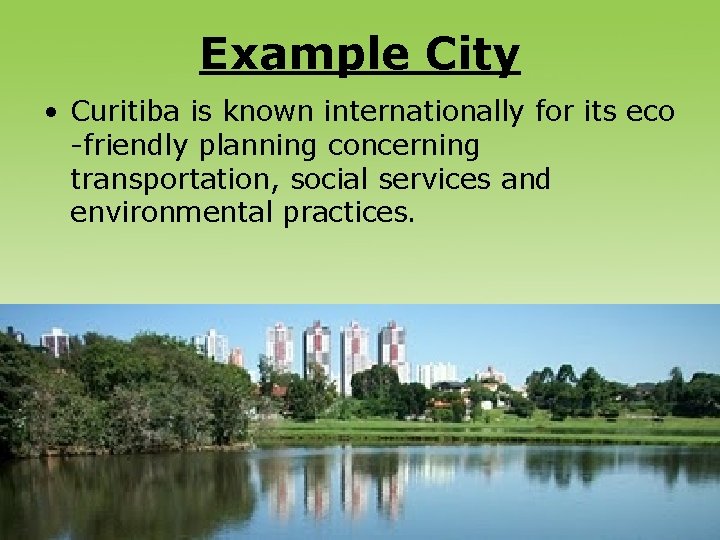
Example City • Curitiba is known internationally for its eco -friendly planning concerning transportation, social services and environmental practices.
Sustainable World: Curitiba, Brazil - public transportation • Watch the video below: • http: //www. youtube. com/watch? v=vvk. Si. TF XG 4 g
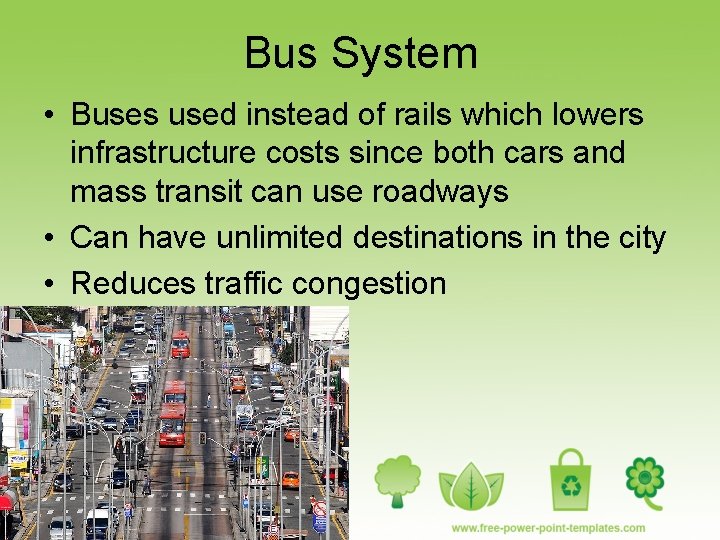
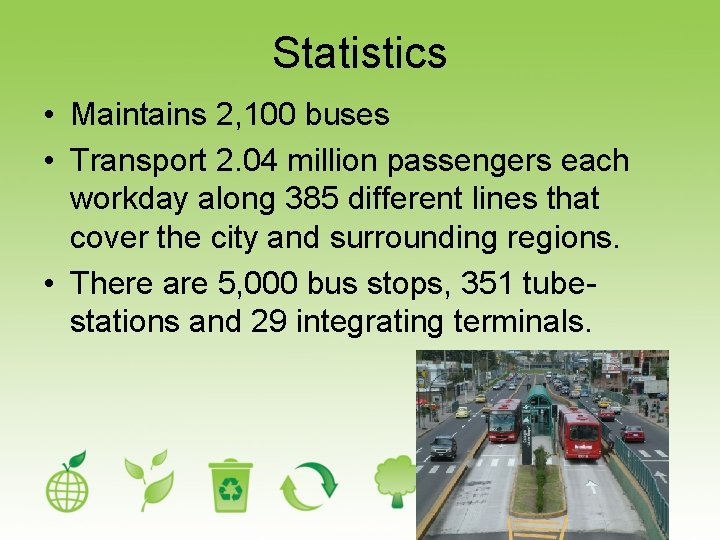
Bus System • Buses used instead of rails which lowers infrastructure costs since both cars and mass transit can use roadways • Can have unlimited destinations in the city • Reduces traffic congestion
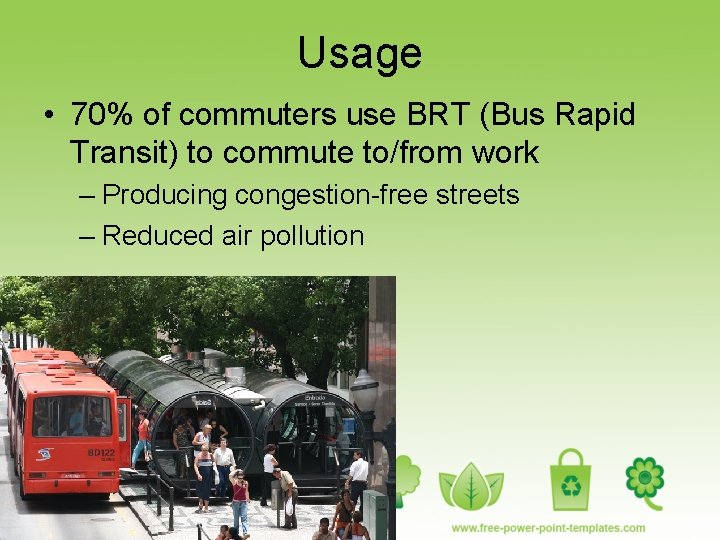
Usage • 70% of commuters use BRT (Bus Rapid Transit) to commute to/from work – Producing congestion-free streets – Reduced air pollution
Transportation and City Planning • Growth of the city was planned so that growth was not just outward from the center but along designated corridors allowing access for all those living in the city. • Mass transit would replace the car as the primary means of transport within the city, and the development along the corridors would produce a high volume of transit ridership.
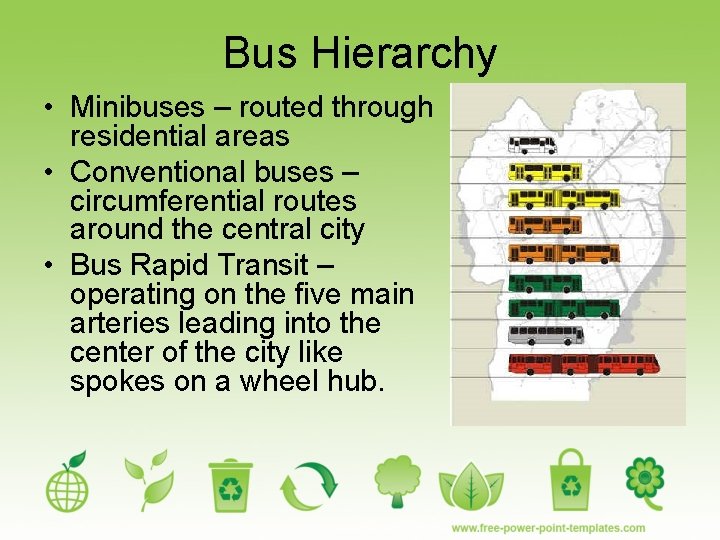
Bus Hierarchy • Minibuses – routed through residential areas • Conventional buses – circumferential routes around the central city • Bus Rapid Transit – operating on the five main arteries leading into the center of the city like spokes on a wheel hub.
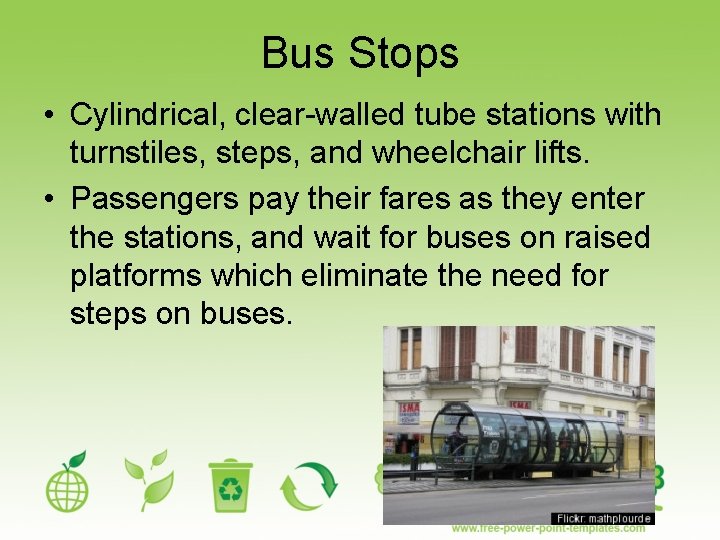
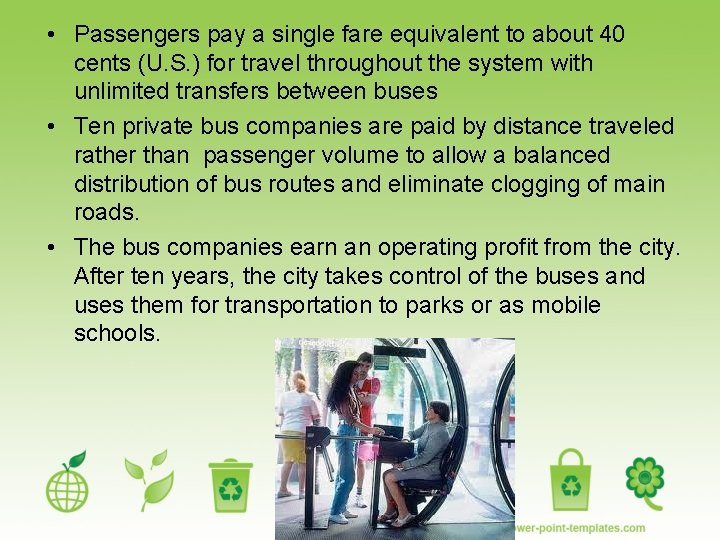
Bus Stops • Cylindrical, clear-walled tube stations with turnstiles, steps, and wheelchair lifts. • Passengers pay their fares as they enter the stations, and wait for buses on raised platforms which eliminate the need for steps on buses.
• Passengers pay a single fare equivalent to about 40 cents (U. S. ) for travel throughout the system with unlimited transfers between buses • Ten private bus companies are paid by distance traveled rather than passenger volume to allow a balanced distribution of bus routes and eliminate clogging of main roads. • The bus companies earn an operating profit from the city. After ten years, the city takes control of the buses and uses them for transportation to parks or as mobile schools.
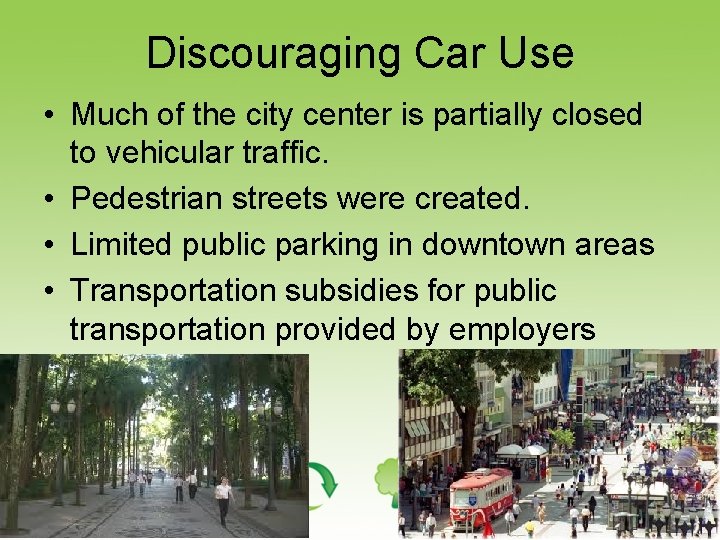
Discouraging Car Use • Much of the city center is partially closed to vehicular traffic. • Pedestrian streets were created. • Limited public parking in downtown areas • Transportation subsidies for public transportation provided by employers
Statistics • Maintains 2, 100 buses • Transport 2. 04 million passengers each workday along 385 different lines that cover the city and surrounding regions. • There are 5, 000 bus stops, 351 tubestations and 29 integrating terminals.
Local Sustainable Options • • • Recycling Live Green in Plano courses Bicycling / using mass transit Community gardening / composting From Farm to Fork – Slow Foods – Dallas