
Intro to Electricity Review of the Atom Subatomic
Intro to Electricity
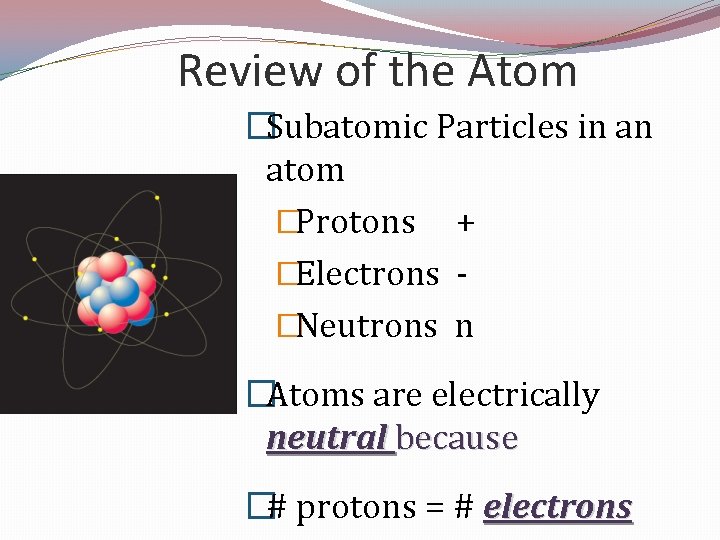
Review of the Atom �Subatomic Particles in an atom �Protons + �Electrons �Neutrons n �Atoms are electrically neutral because �# protons = # electrons
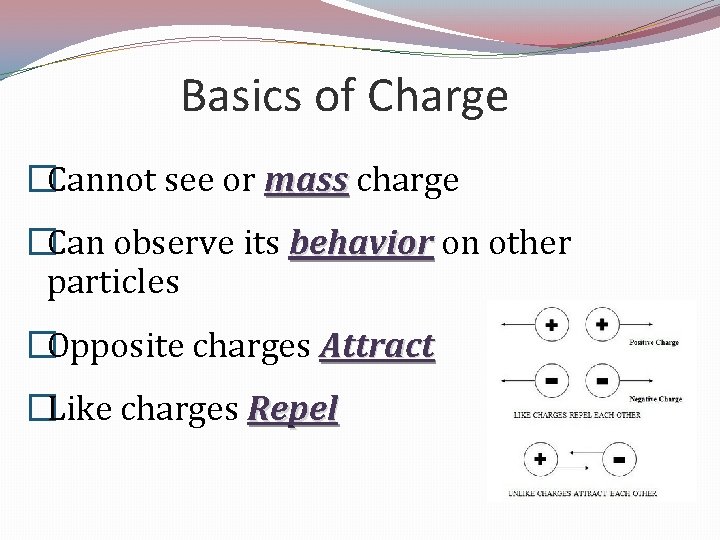
Basics of Charge �Cannot see or mass charge �Can observe its behavior on other particles �Opposite charges Attract �Like charges Repel

Charge Interaction
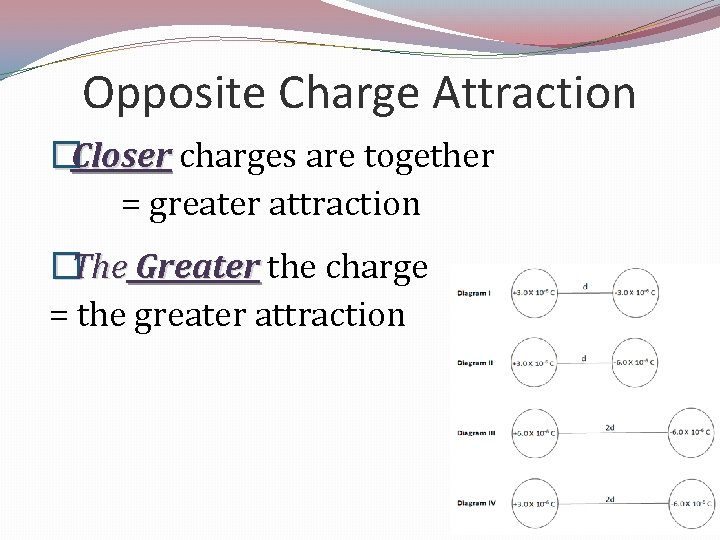
Opposite Charge Attraction �Closer charges are together = greater attraction �The Greater the charge = the greater attraction

Electric Field �An electric field extends outward through space from every charged particle �As the distance of the electric field, from the charged particle increases, the strength of the electric field decreases
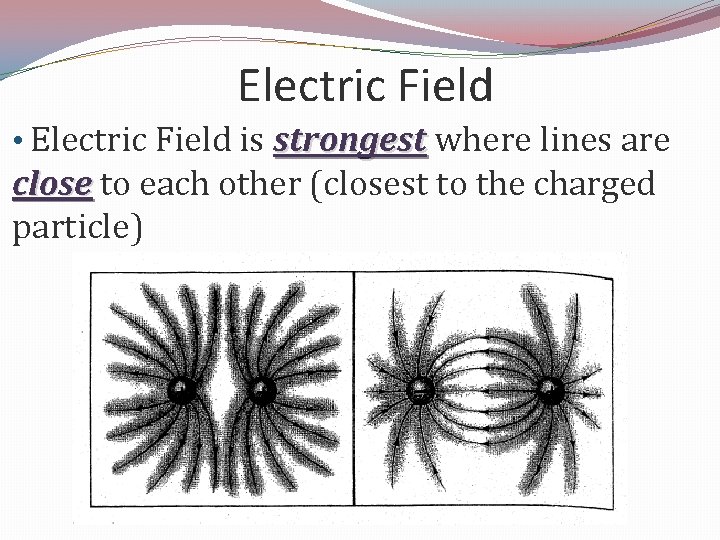
Electric Field • Electric Field is strongest where lines are close to each other (closest to the charged particle)
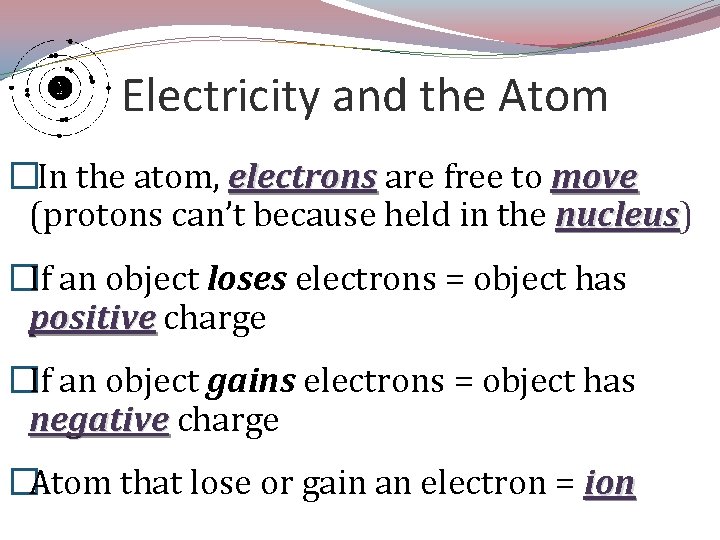
Electricity and the Atom �In the atom, electrons are free to move (protons can’t because held in the nucleus) nucleus �If an object loses electrons = object has positive charge �If an object gains electrons = object has negative charge �Atom that lose or gain an electron = ion
Law of Conservation of Charge cannot be created or destroyed. It can only be transferred from one object to another.
Conductors vs Insulators �Conductor–materials electrons are able to move through easily. Exa. metals �Insulator – materials electrons are not able to move through easily Exa. plastics, rubber, glass �Why is this important when it comes to electricity?
Static Electricity �The transfer of electrons from one object to another without further movement of objects is called static electricity. �Static means not moving or stationary �Static electricity is the build up of electric charges on an object. �Once built up, the charges remain at rest; rest they do not flow! flow
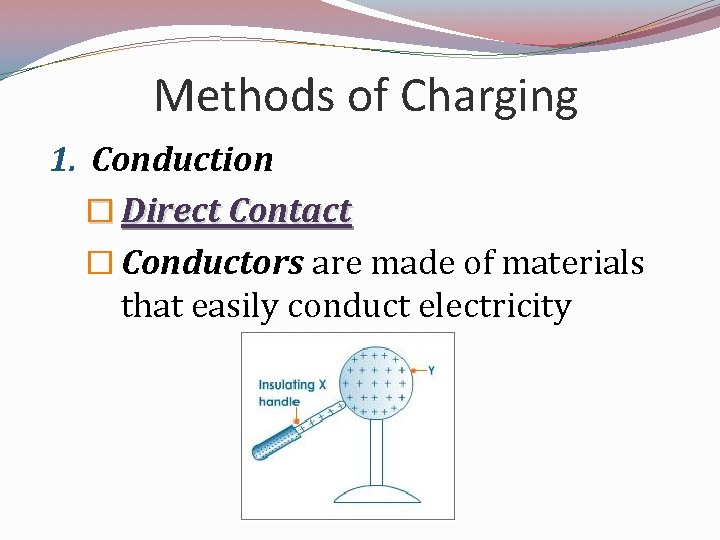
Methods of Charging 1. Conduction � Direct Contact � Conductors are made of materials that easily conduct electricity
Methods of Charging 2. Charging by induction • No contact necessary • Rearrangement of electric charges
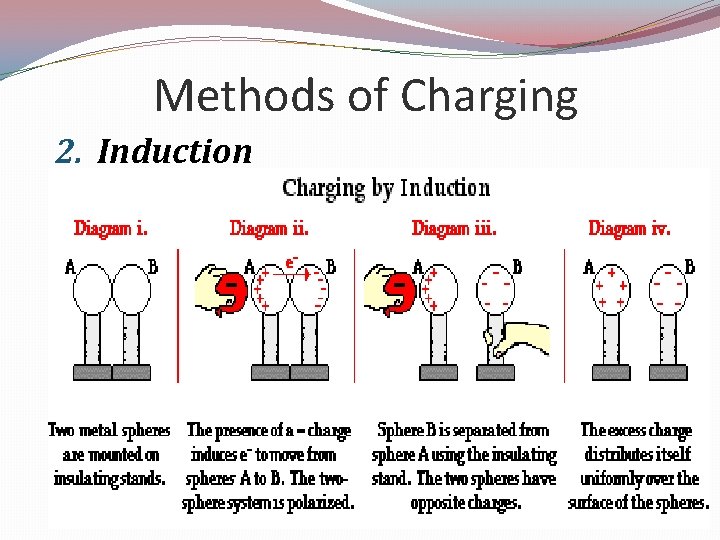
Methods of Charging 2. Induction
Methods of Charging 3. Charging by Friction � Rubbing 2 objects together � One loses electrons, one gains electrons � Both become oppisitly charged
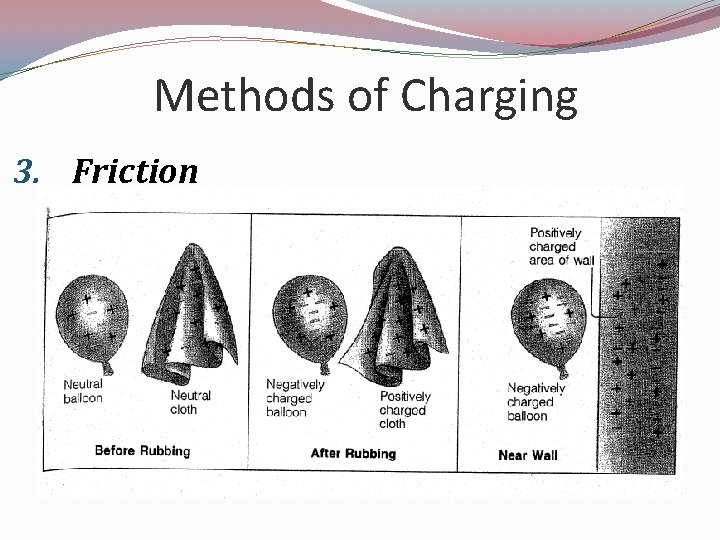
Methods of Charging 3. Friction
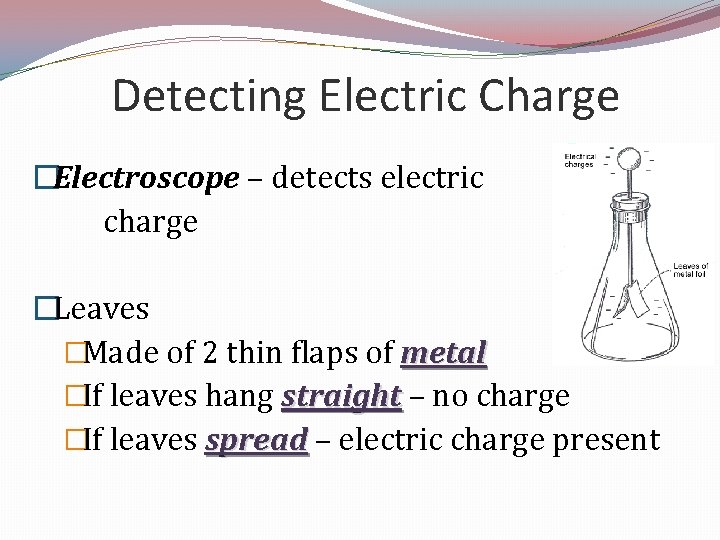
Detecting Electric Charge �Electroscope – detects electric charge �Leaves �Made of 2 thin flaps of metal �If leaves hang straight – no charge �If leaves spread – electric charge present
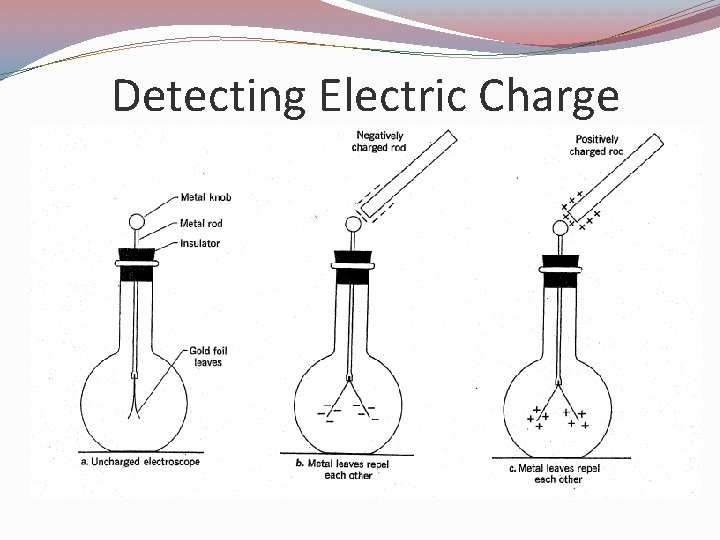
Detecting Electric Charge
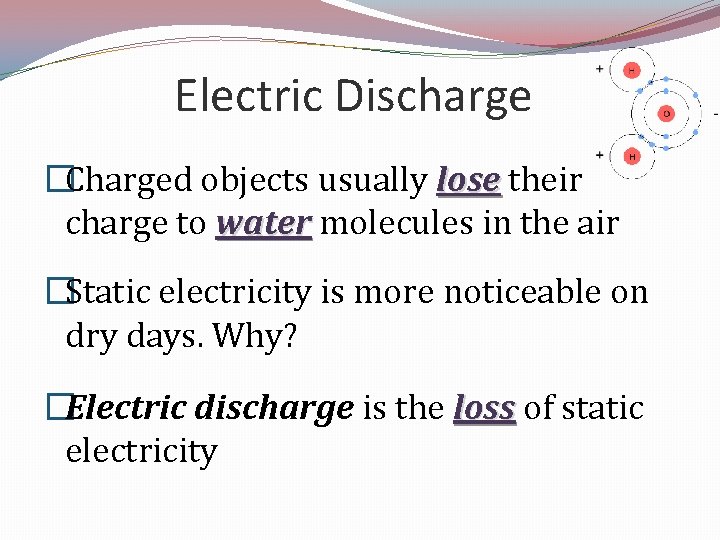
Electric Discharge �Charged objects usually lose their charge to water molecules in the air �Static electricity is more noticeable on dry days. Why? �Electric discharge is the loss of static electricity
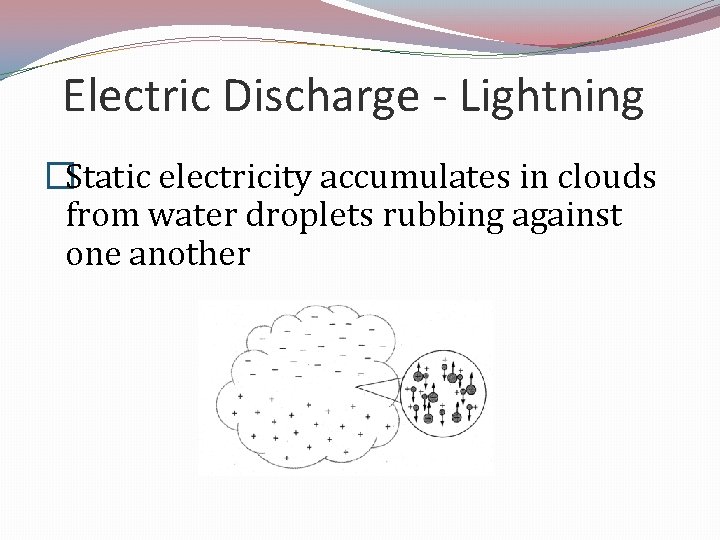
Electric Discharge - Lightning �Static electricity accumulates in clouds from water droplets rubbing against one another
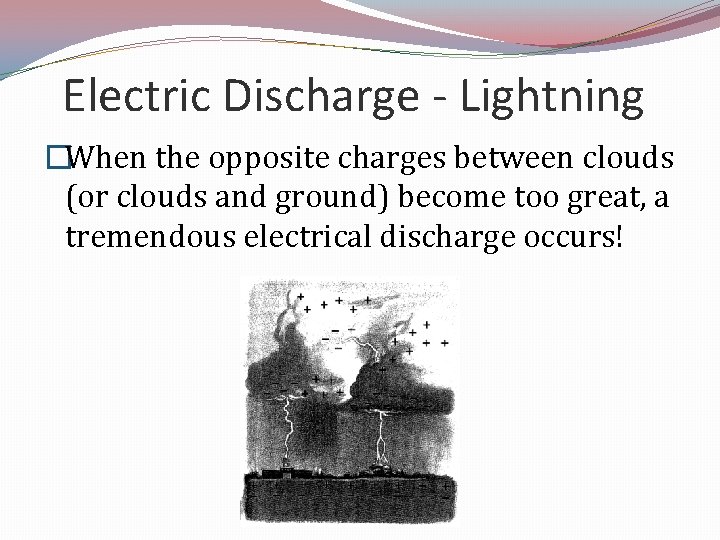
Electric Discharge - Lightning �When the opposite charges between clouds (or clouds and ground) become too great, a tremendous electrical discharge occurs!
Getting Electricity to Flow
Flowing Electricity �Work must be done to move a charged particle �The amount of work required to move a charge between two points (the work per unit charge) is called the electric potential difference �Measured in volts (V)
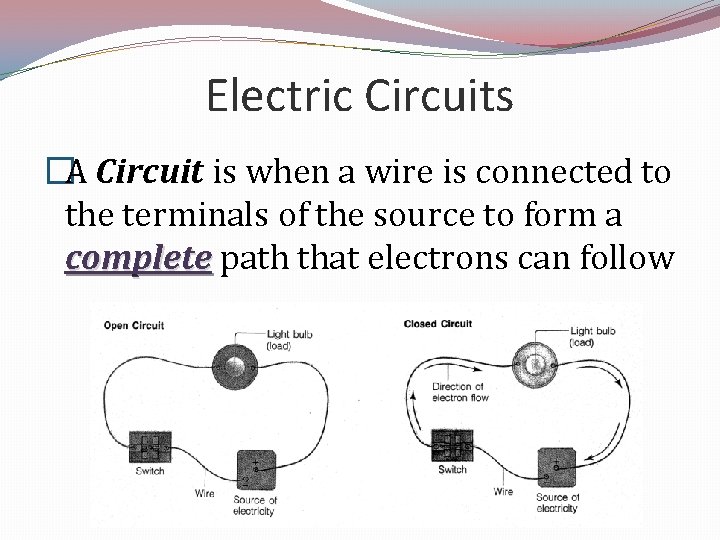
Electric Circuits �A Circuit is when a wire is connected to the terminals of the source to form a complete path that electrons can follow
Electric Current �A flow of charge (electrons) electrons is called an electric current �letter variable = I (electric current) �The amount of charge that passes a given point per second �The unit for current is the ampere (A) or amp for short
Resistance to Flow �Items in the circuit resist the flow of electrons �Load/appliance Load �Wires �The current is slowed by interactions with the load and atoms in the wire
Resistance to Flow �Resistance �Letter variable = R �Unit = ohms ( ) �Factors that affect resistance: �Resistance Increases with, longer wire �Resistance Increases with higher temperature �Resistance Decreases with a thicker wire
Ohm’s Law �Ohm’s Law states the relationship between voltage difference, current and resistance in a circuit. �Ohm’s Law states that the current in a wire (I) is equal to the voltage (V) divided by the resistance (R) �I=V/R
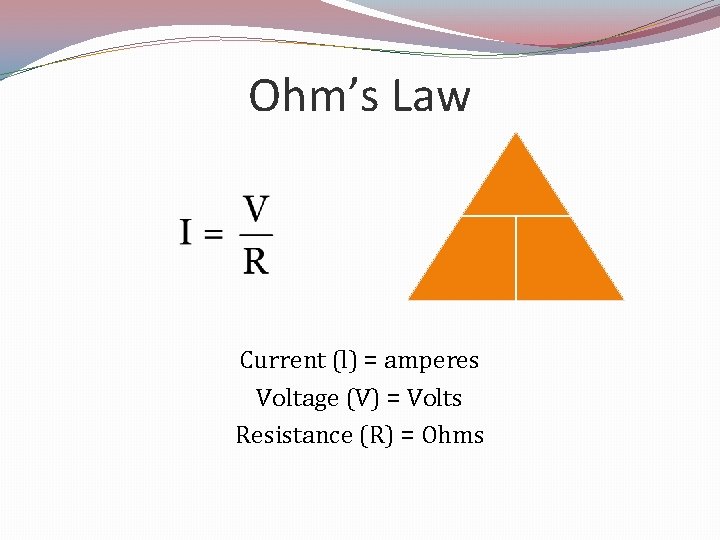
Ohm’s Law Current (l) = amperes Voltage (V) = Volts Resistance (R) = Ohms
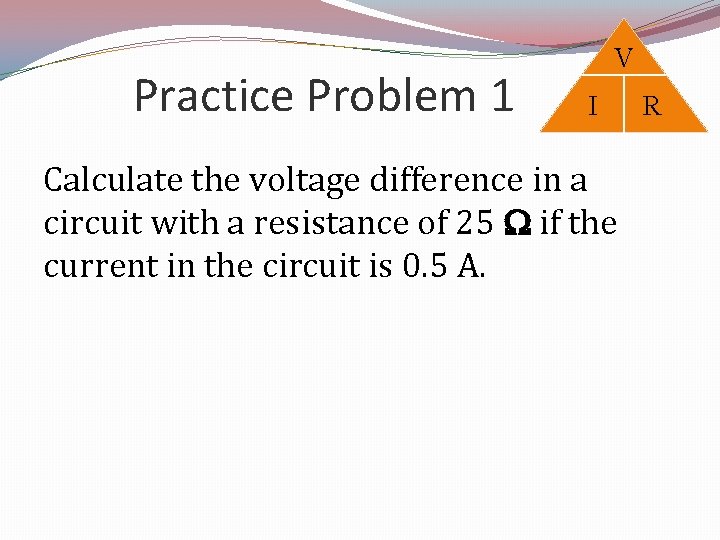
Practice Problem 1 V I Calculate the voltage difference in a circuit with a resistance of 25 if the current in the circuit is 0. 5 A. R
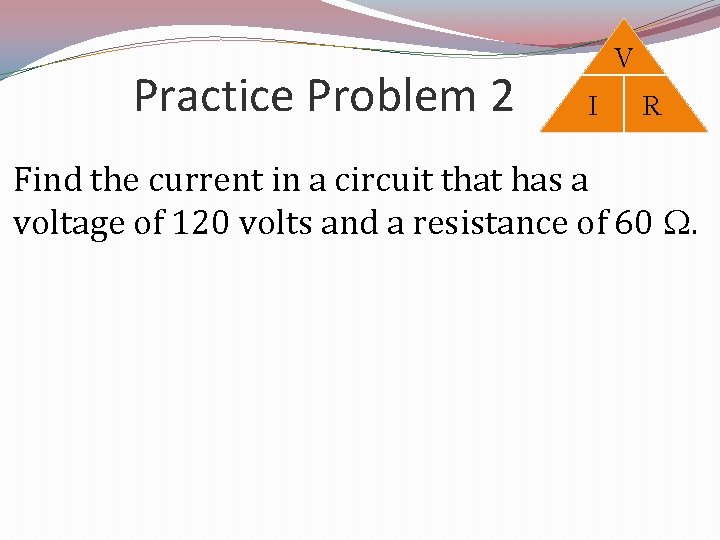
Practice Problem 2 V I R Find the current in a circuit that has a voltage of 120 volts and a resistance of 60 .
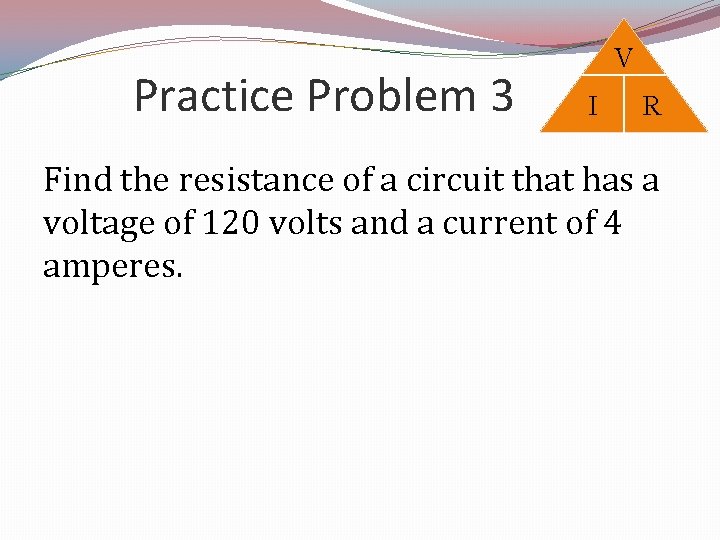
Practice Problem 3 V I R Find the resistance of a circuit that has a voltage of 120 volts and a current of 4 amperes.
- Slides: 32