
intro to design Design Principles Part II intro

- Slides: 54
intro to design Design Principles Part II
intro to design Design Principles Reviewed While design elements consist of the nouns (form generators) and adjectives (form attributes) of design, design principles are the adverbs of design. That is, design principles dictate HOW the form generators are arranged in a composition. Design principles allow us to create composition in unlimited configurations because you can mix and match them to suit your needs. design principles pt. 2
intro to design Design Principles Continued There are many design principles, but we will concentrate on the following for now: • Unity • Emphasis • Repetition • Hierarchy • Rhythm • Flow • Pattern • Position • Balance • Grouping • Variety design principles pt. 2
intro to design Unity design principles pt. 2
intro to design Unity Defined Unity is achieved when elements of a composition agree with each other to create a feel of wholeness. It is the opposite of variety though most compositions strive to create a balance of the two. design principles pt. 2
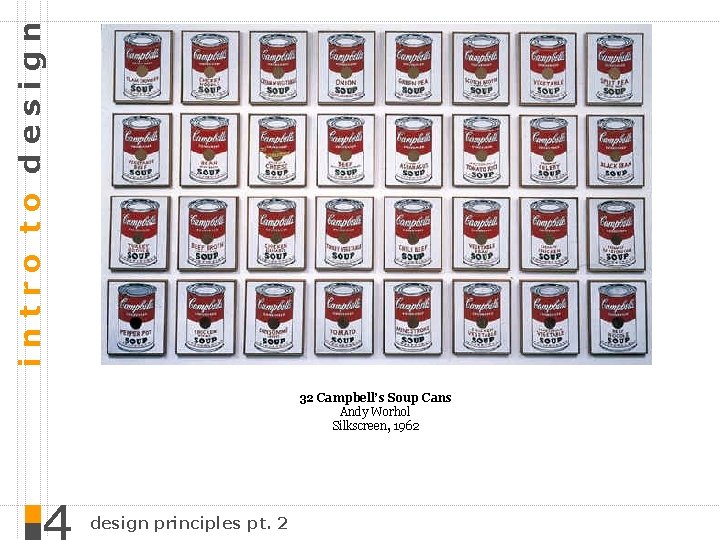
intro to design 32 Campbell’s Soup Cans Andy Worhol Silkscreen, 1962 design principles pt. 2
intro to design Creating Unity is typically accomplished in a composition by echoing elements in some manner. For example: • Using tints, shades and tones of the same hue • Using agreeable color harmonies • The repetition of similar shapes and lines • Using images that are thematically related • Repeating a texture design principles pt. 2
intro to design Creating Unity Cont. Unity is typically accomplished in a composition by echoing elements in some manner. For example: • When all elements agree with theme and tone • Shapes flow in a similar direction • Using typefaces that thematically agree • Placing elements equal distant from each other and from edges of the format • Consistent sizing of type at varying levels of importance • Grouping related information together in clusters design principles pt. 2
intro to design Variety design principles pt. 2
intro to design Variety Defined Variety is change added to a composition for the purpose of increasing visual interest. It is the opposite of unity though most compositions strive to create a balance of the two. Q: What happens if a composition has too much variety? Q: What happens if a composition has too little variety (too much unity)? design principles pt. 2
intro to design Creating Variety can be created by incorporating one or more of the following: • Using multiple hues • Incorporating tints, shades and tones of the same hue • Using multiple typefaces • Incorporating depth (foreground, midground, background) • Using dissimilar shapes and lines • Variations in flow of reads design principles pt. 2
intro to design Creating Variety Cont. Variety can be created by incorporating one or more of the following: • Positioning using the Law of Unequal Spacing • Orienting elements at varying angles (nonarchitectonically) • Adding variations to structured repetition • Using the principle of contrast • Gradations in size design principles pt. 2
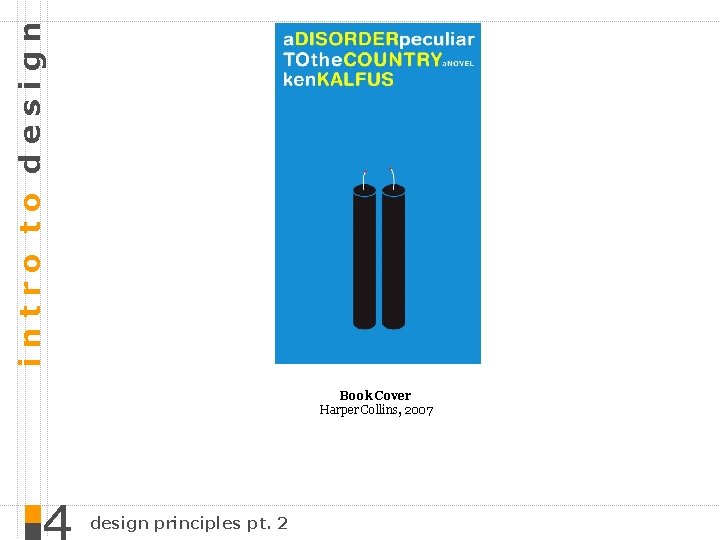
intro to design Book Cover Harper Collins, 2007 design principles pt. 2
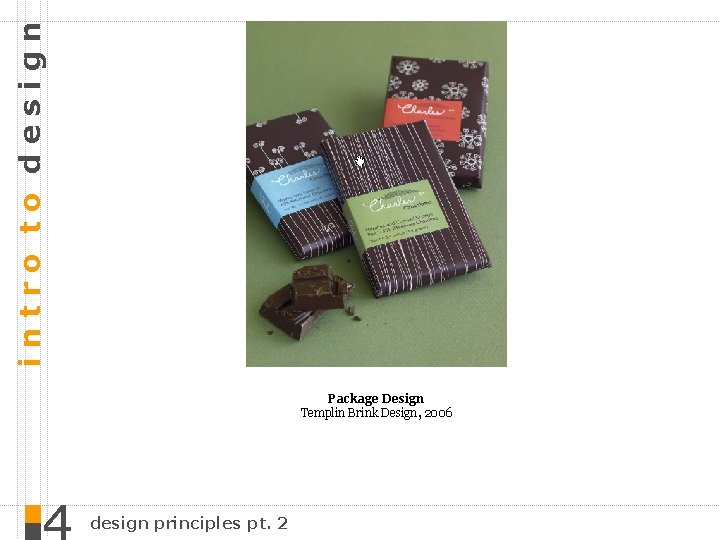
intro to design Package Design Templin Brink Design, 2006 design principles pt. 2
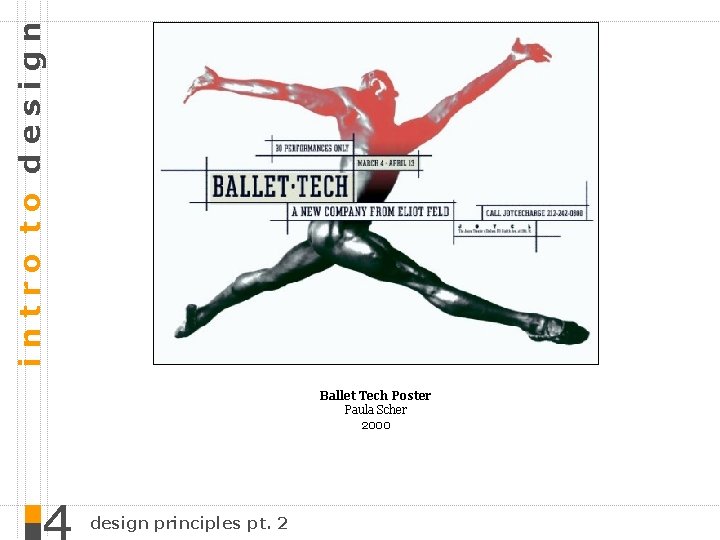
intro to design Ballet Tech Poster Paula Scher 2000 design principles pt. 2
intro to design Grouping design principles pt. 2
intro to design Grouping Defined When elements are perceived as a group they are perceived as belonging together. Grouping simplifies the visual field making it easier for the audience to interpret and navigate the composition. design principles pt. 2
intro to design Creating Groups In order to understand how to create groups it is necessary to understand how we as humans perceive them. There are four ways that we as humans perceptually associate things as being grouped together: • Grouping by proximity • Grouping by similarity • Grouping by common direction • Grouping by closure design principles pt. 2
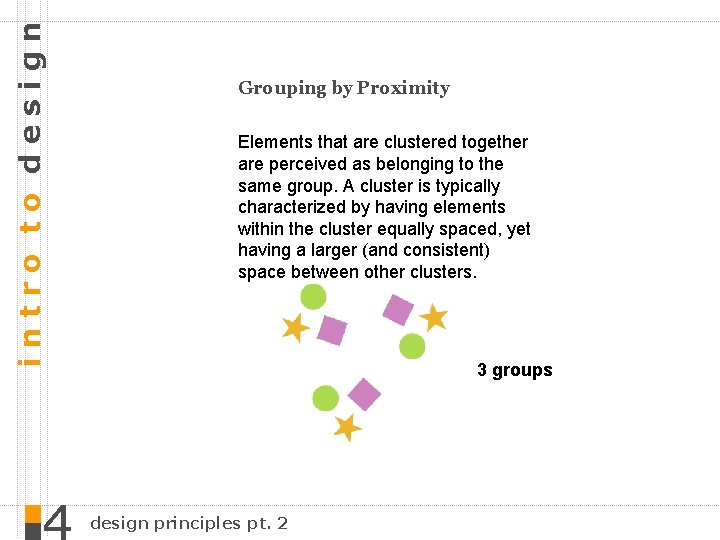
intro to design Grouping by Proximity Elements that are clustered together are perceived as belonging to the same group. A cluster is typically characterized by having elements within the cluster equally spaced, yet having a larger (and consistent) space between other clusters. 3 groups design principles pt. 2
intro to design principles pt. 2
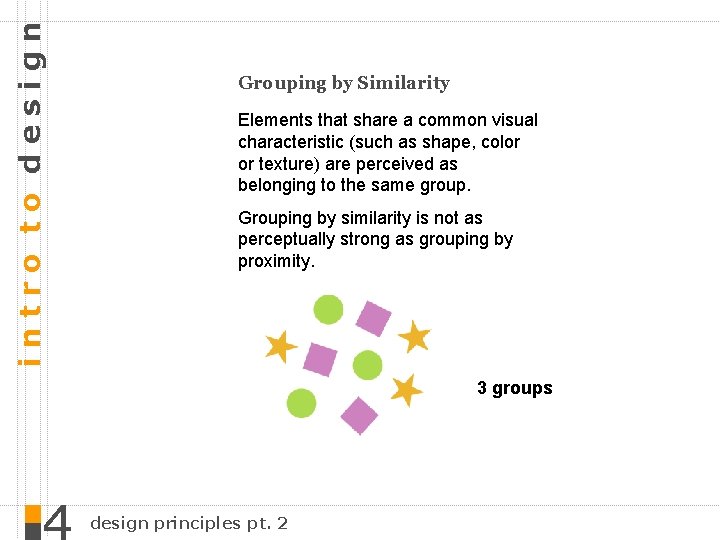
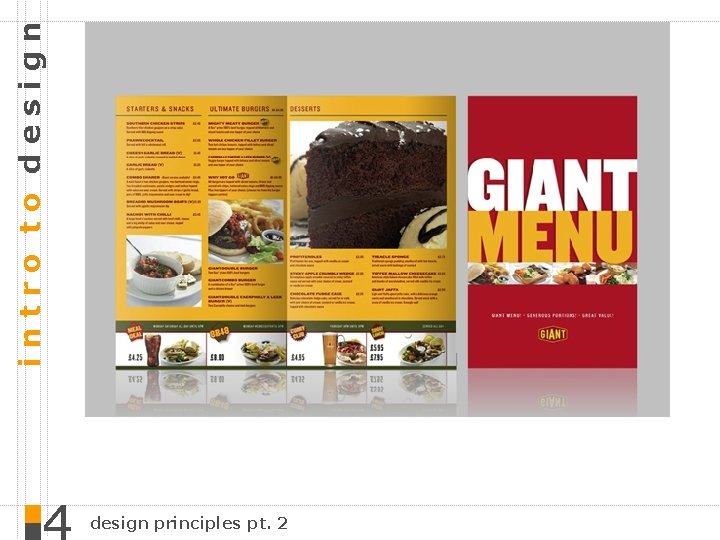
intro to design Grouping by Similarity Elements that share a common visual characteristic (such as shape, color or texture) are perceived as belonging to the same group. Grouping by similarity is not as perceptually strong as grouping by proximity. 3 groups design principles pt. 2
intro to design principles pt. 2
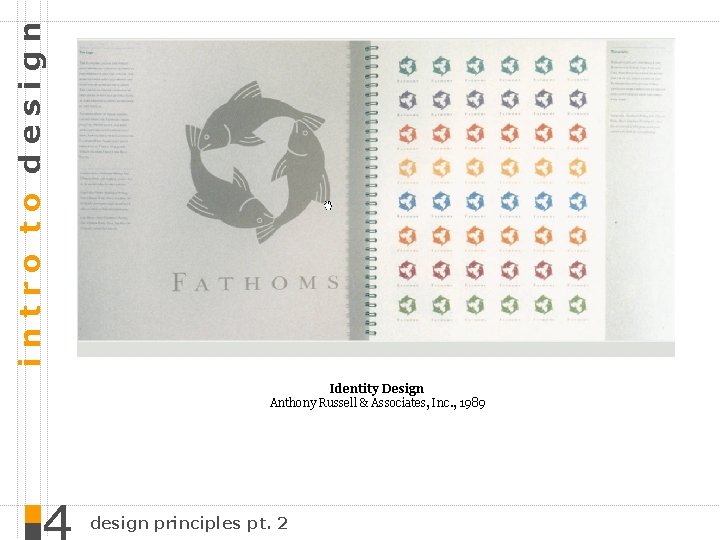
intro to design Identity Design Anthony Russell & Associates, Inc. , 1989 design principles pt. 2
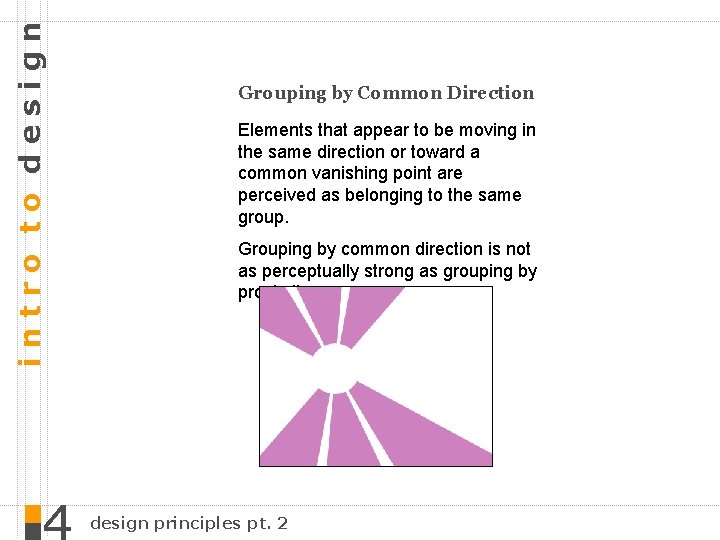
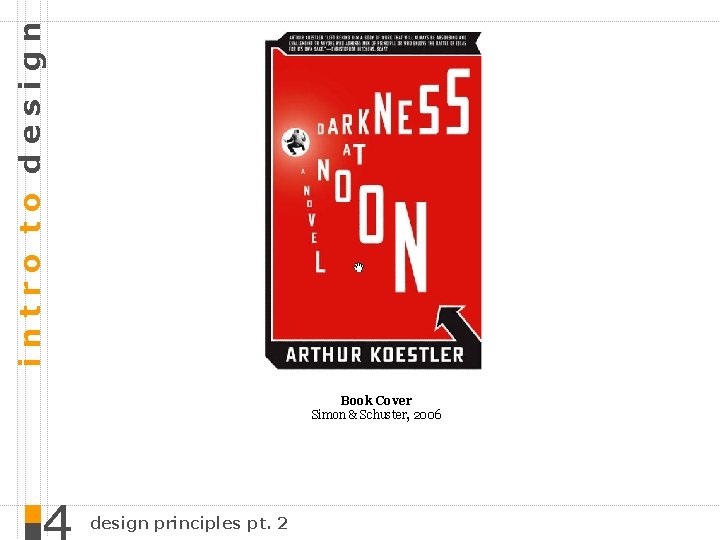
intro to design Grouping by Common Direction Elements that appear to be moving in the same direction or toward a common vanishing point are perceived as belonging to the same group. Grouping by common direction is not as perceptually strong as grouping by proximity. design principles pt. 2
intro to design Book Cover Simon & Schuster, 2006 design principles pt. 2
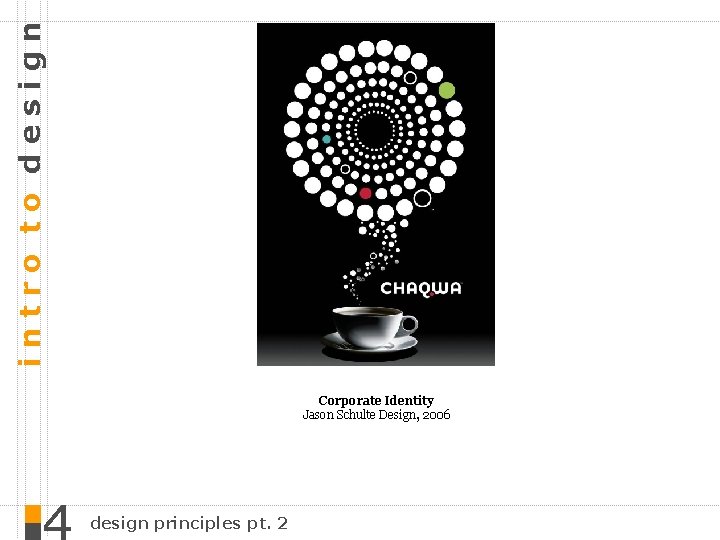
intro to design Corporate Identity Jason Schulte Design, 2006 design principles pt. 2
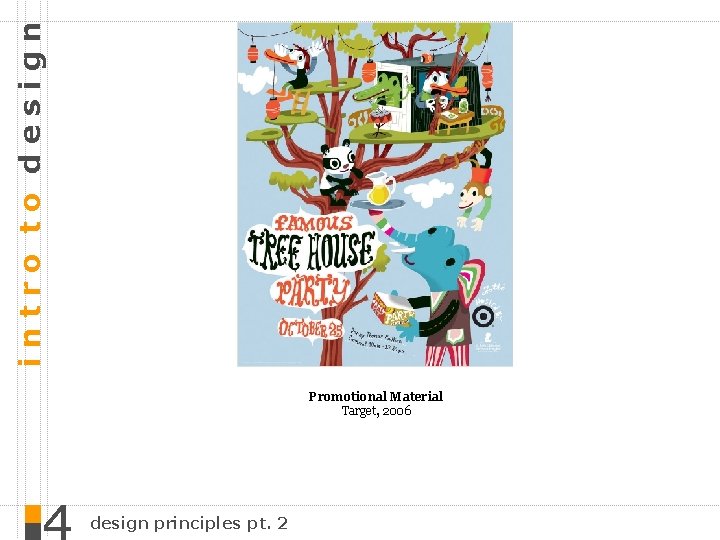
intro to design Grouping by Closure Our perceptual system will fill in missing information in order to associate disjointed parts as a group. design principles pt. 2
intro to design Promotional Material Target, 2006 design principles pt. 2
intro to design Repetition design principles pt. 2
intro to design Repetition Defined Repetition is a recurrence of a design element within a composition. Repetition is a unifying principle aimed to increase visual interest but can also contribute to flow by leading the eye. design principles pt. 2
intro to design What can be repeated? Any design element can be repeated in order to unify the composition: shape, hue, type, texture, image, etc. design principles pt. 2
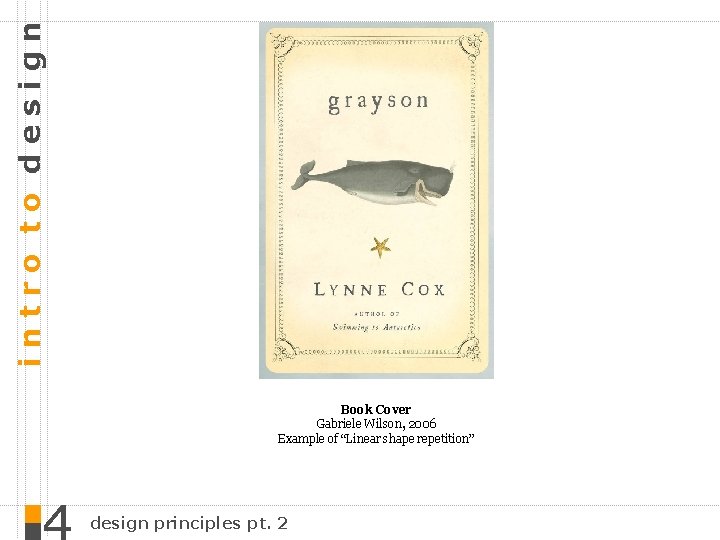
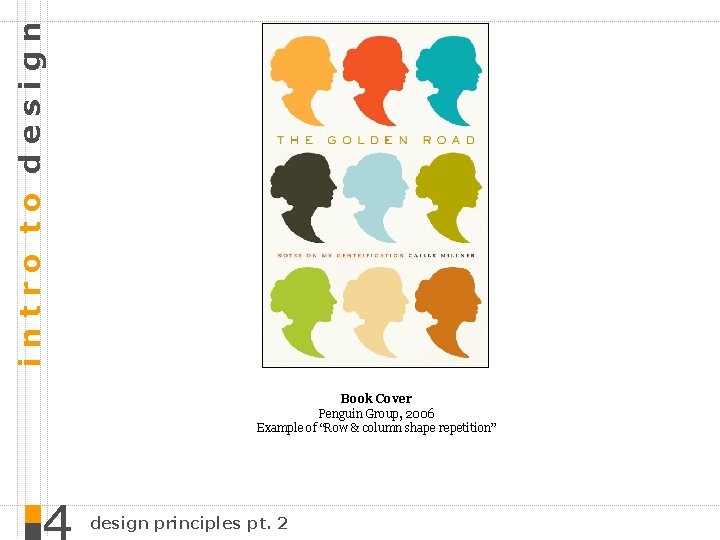
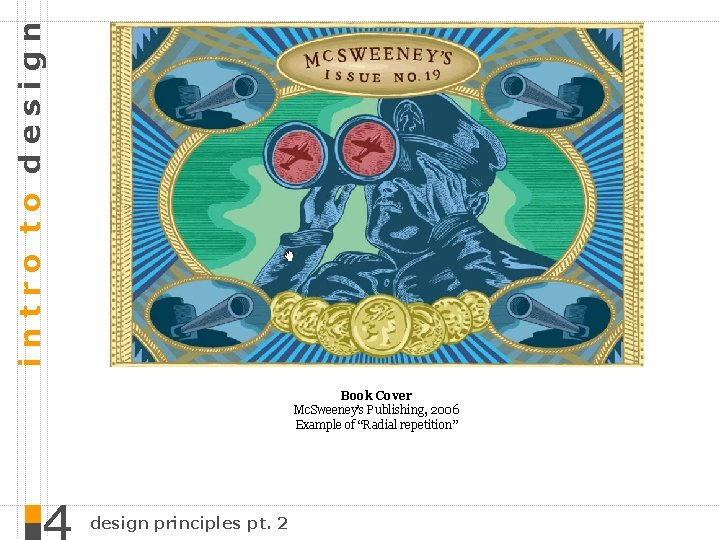
intro to design Shape Repetition There are several ways that shape repetition can be created. These include: • Linear • Radial • Rows and Columns • Random design principles pt. 2
intro to design Book Cover Gabriele Wilson, 2006 Example of “Linear shape repetition” design principles pt. 2
intro to design Book Cover Penguin Group, 2006 Example of “Row & column shape repetition” design principles pt. 2
intro to design Book Cover Mc. Sweeney’s Publishing, 2006 Example of “Radial repetition” design principles pt. 2
intro to design Christmas Card Dennard Creative Inc. , 1985 Example of “Random shape repetition” design principles pt. 2
intro to design Rhythm design principles pt. 2
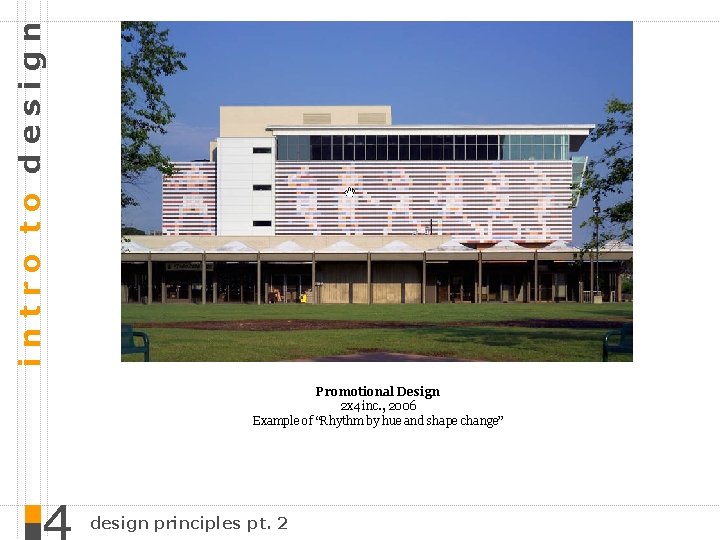
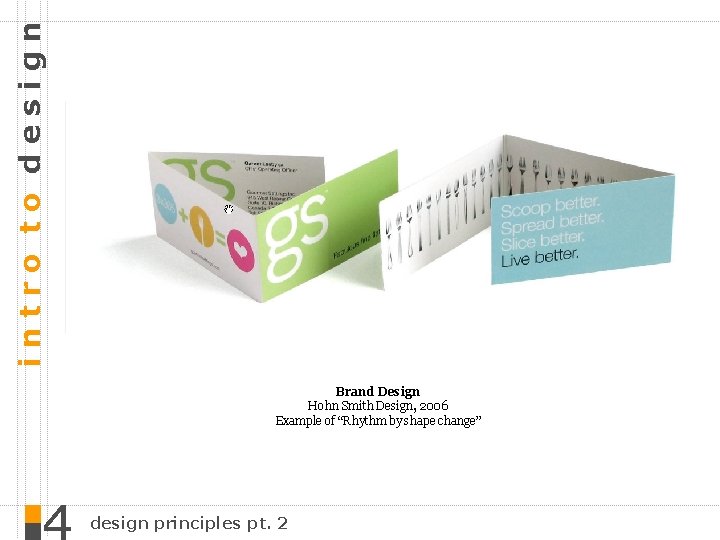
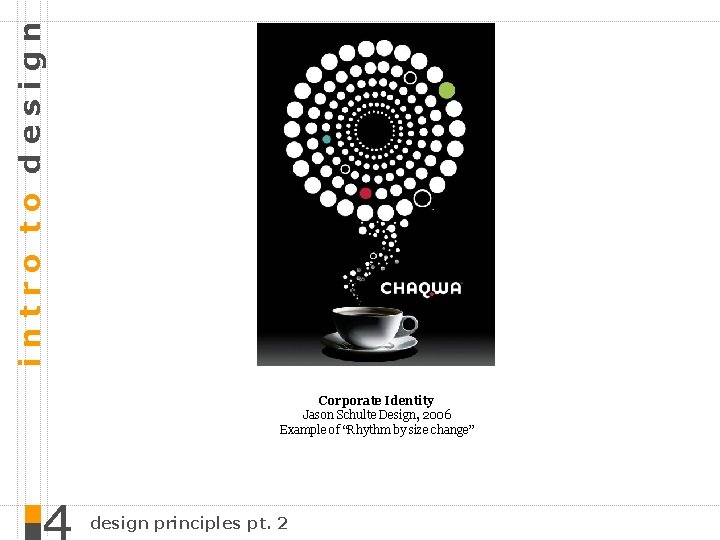
intro to design Rhythm Defined Rhythm is a more interesting form of repetition that arises from introducing a predictable and often reoccurring change or gradation to the elements being repeated. Rhythm in graphic design is very similar to how chords and scales are used in music. Where as repetition visual creates beats such as 3, 3, 3 or 3, 7, 6, 4, 1, 3, 2, 9, rhythm creates beats such as 3, 5, 3, 5… or 3, 4, 5, 4, 3…or 1, 2, 3, 4, 1, 2, 3, 4… etc. design principles pt. 2
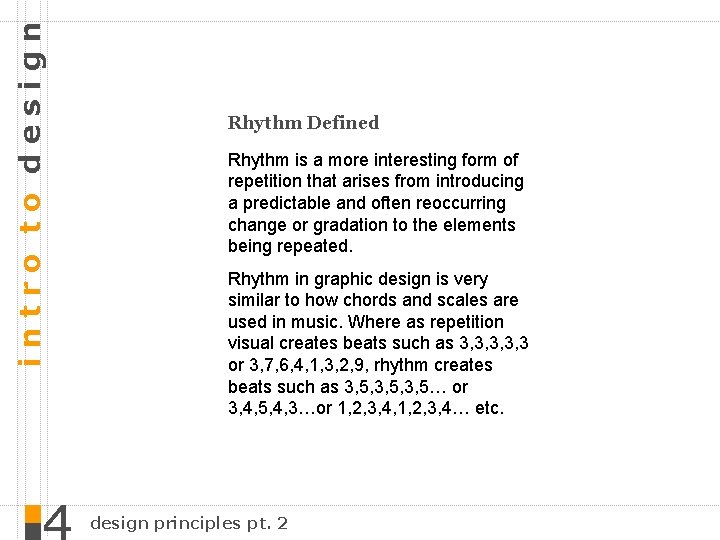
intro to design Repetition or Rhythm? design principles pt. 2
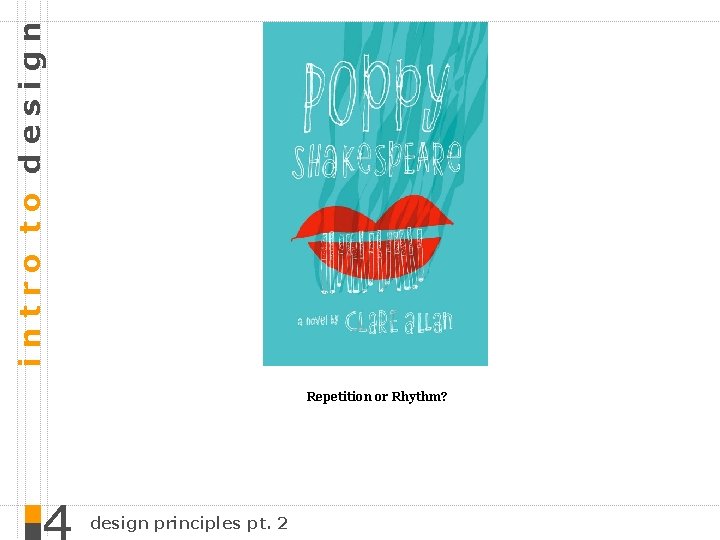
intro to design Repetition or Rhythm? design principles pt. 2
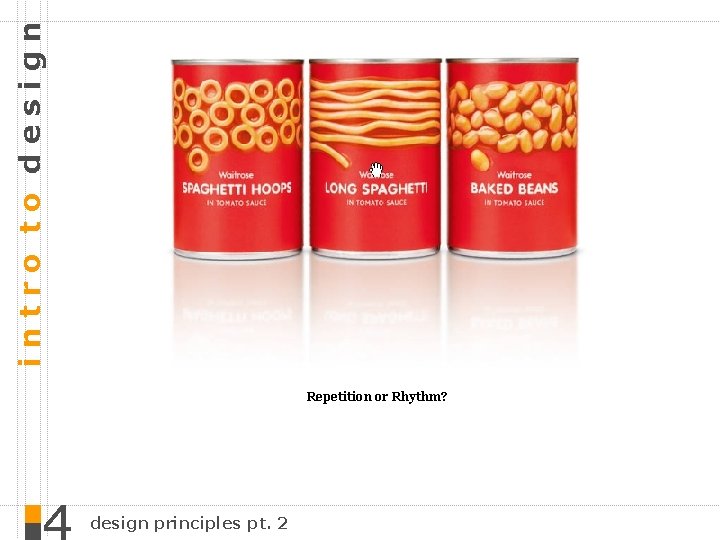
intro to design Repetition or Rhythm? design principles pt. 2
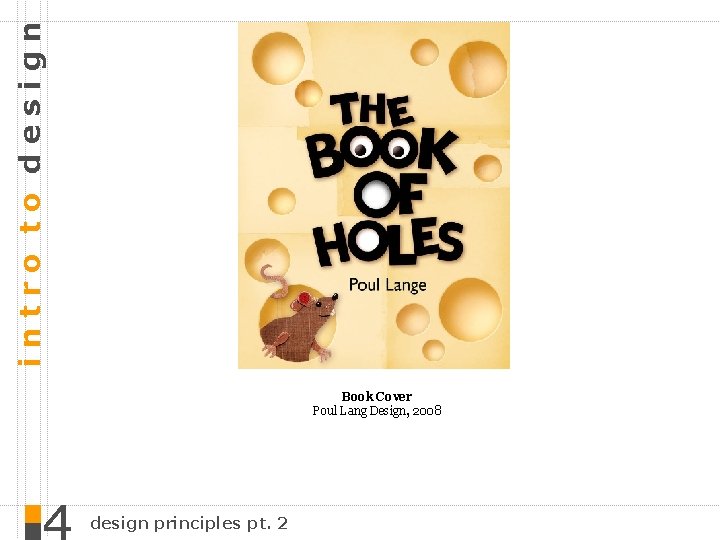
intro to design Book Cover Poul Lang Design, 2008 design principles pt. 2
intro to design Creating Rhythm is created by a predictable change or gradation in one or more of the following: • Shape • Size • Spacing between shapes • Hue • Tint, shade or tone of a hue • Value (lightness or darkness) • Shape orientation (rotation) • Shape direction (flow direction) • Shape opacity design principles pt. 2
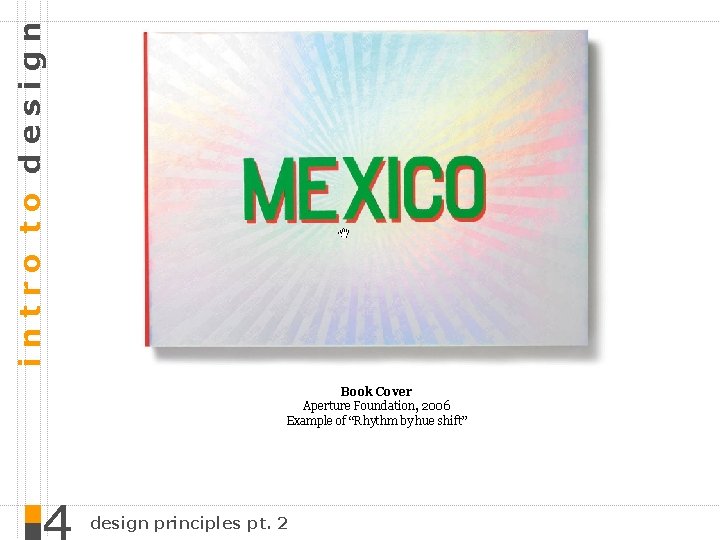
intro to design Book Cover Aperture Foundation, 2006 Example of “Rhythm by hue shift” design principles pt. 2
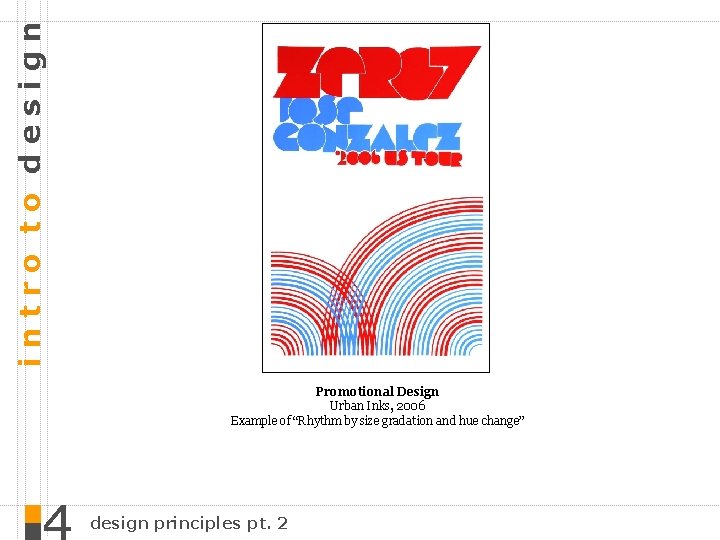
intro to design Promotional Design Urban Inks, 2006 Example of “Rhythm by size gradation and hue change” design principles pt. 2
intro to design Promotional Design 2 x 4 inc. , 2006 Example of “Rhythm by hue and shape change” design principles pt. 2
intro to design Brand Design Hohn Smith Design, 2006 Example of “Rhythm by shape change” design principles pt. 2
intro to design Corporate Identity Jason Schulte Design, 2006 Example of “Rhythm by size change” design principles pt. 2
intro to design Pattern design principles pt. 2
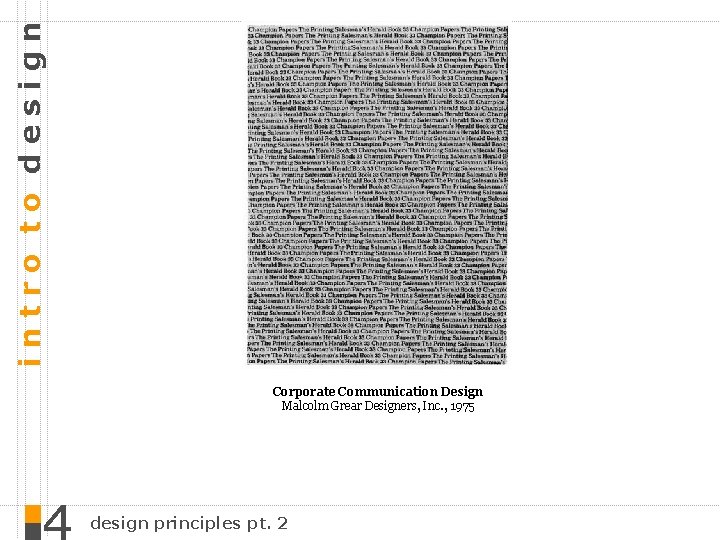
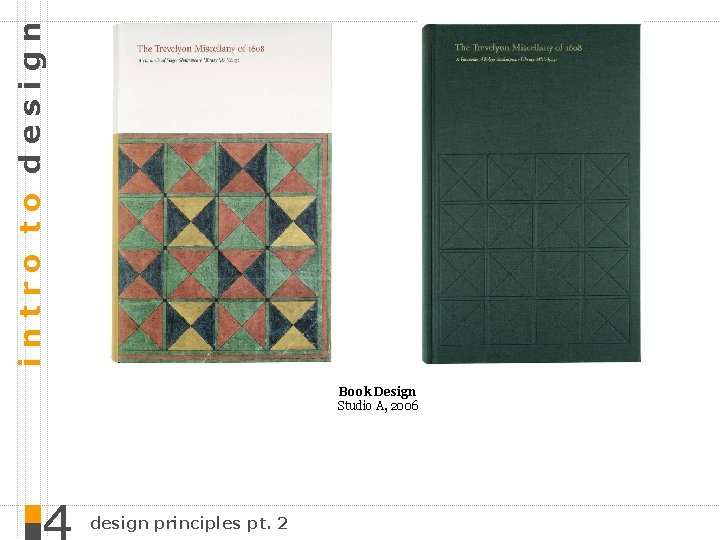
intro to design Pattern Defined Pattern is created when an entire shape or background (backdrop) is filled with a repetition or rhythm. Patterns are used to create visual interest. The three-dimensional effect of patterns creates visual texture. A repeating cluster or configuration of shapes is referred to a motif. design principles pt. 2
intro to design Where do we see patterns? Patterns are seen and used everywhere in the natural and manmade world. Some common places we see patterns include: • Textiles • Construction materials (e. g. fences, carpet, tiling, bricks) • Wallpaper • Wrapping paper • Backdrops of web pages or printed material • Animal fur • Sea shells • Stones design principles pt. 2
intro to design Corporate Communication Design Malcolm Grear Designers, Inc. , 1975 design principles pt. 2
intro to design Book Design Studio A, 2006 design principles pt. 2
intro to design The End design principles