
Intro to data analysis Measuring plankton diversity learning


- Slides: 29
Intro to data analysis: Measuring plankton diversity & learning to use R-Studio
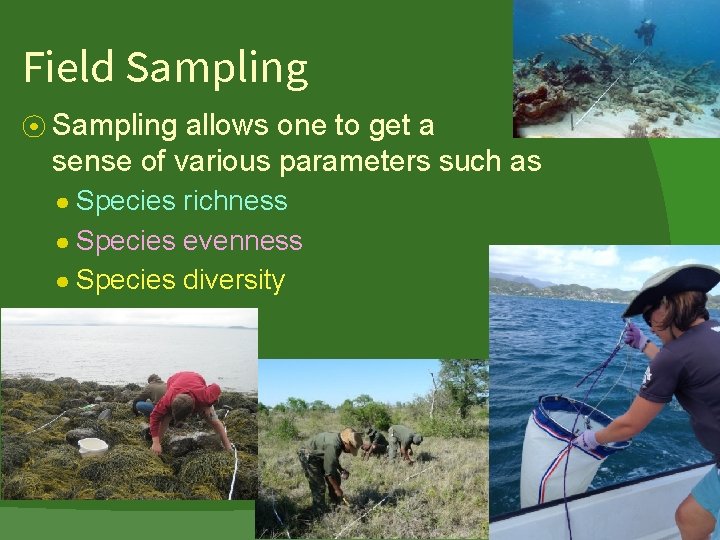
Field Sampling ⦿ Sampling allows one to get a sense of various parameters such as ● Species richness ● Species evenness ● Species diversity
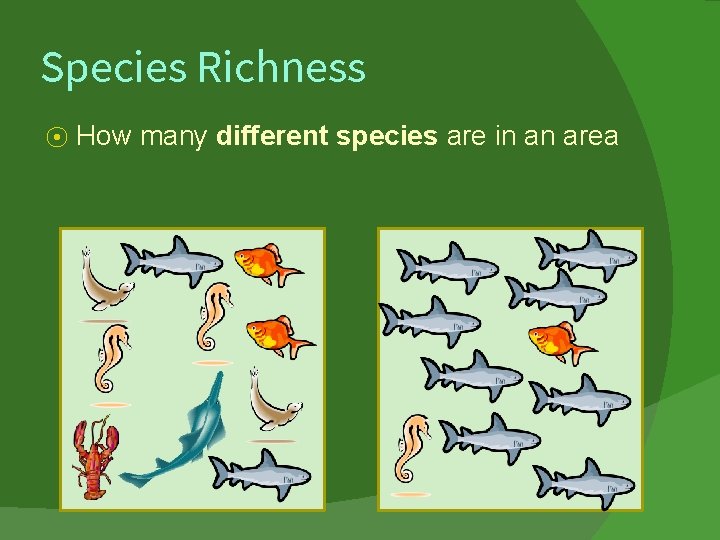
Species Richness ⦿ How many different species are in an area
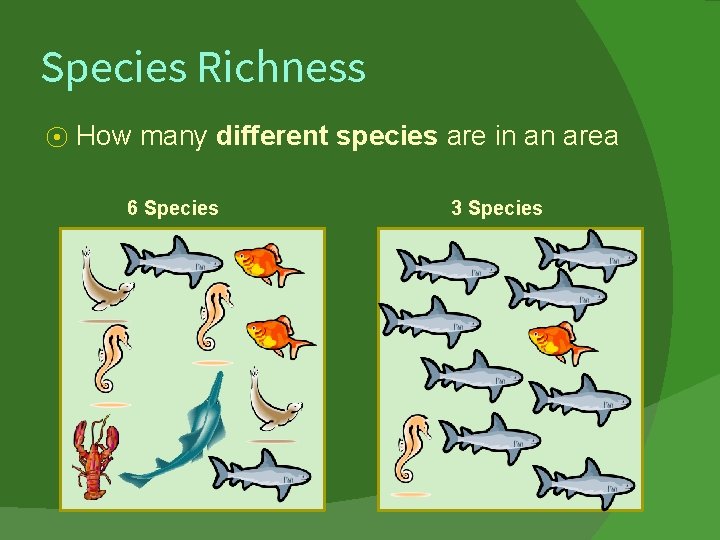
Species Richness ⦿ How many different species are in an area 6 Species 3 Species
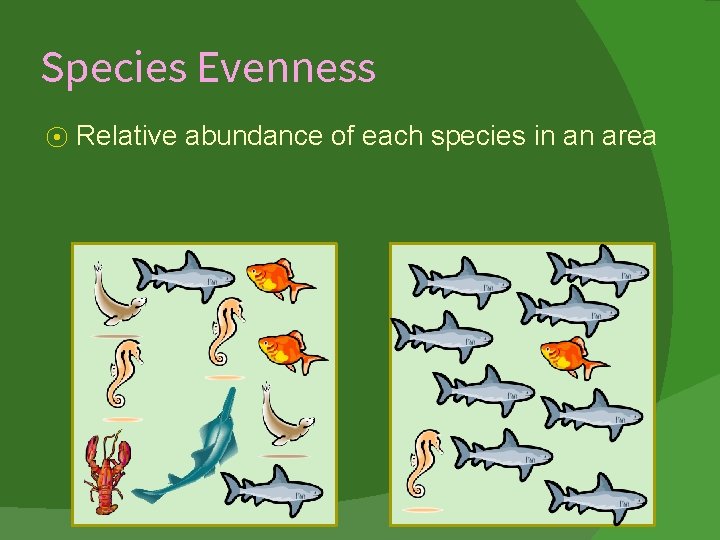
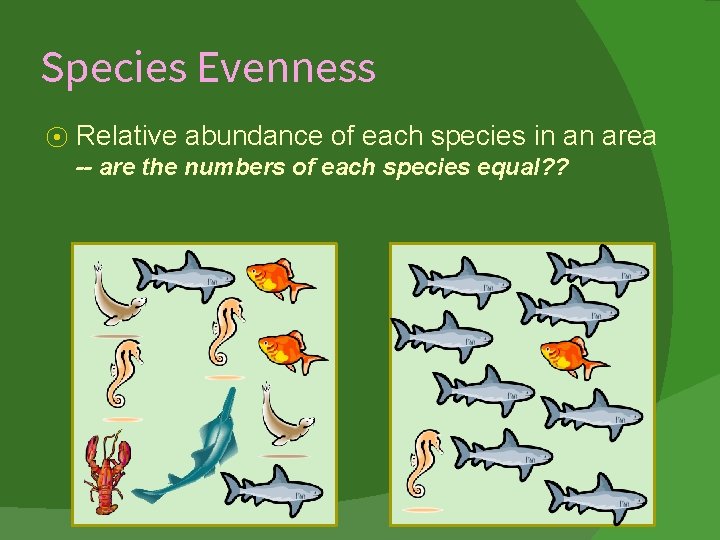
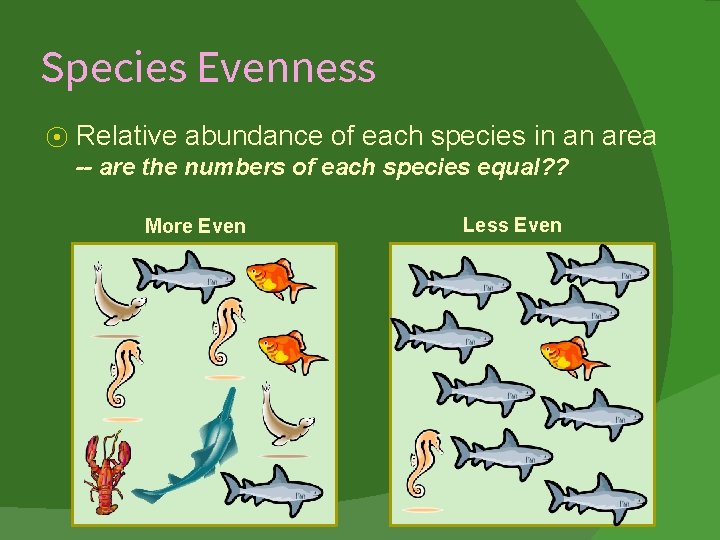
Species Evenness ⦿ Relative abundance of each species in an area
Species Evenness ⦿ Relative abundance of each species in an area -- are the numbers of each species equal? ?
Species Evenness ⦿ Relative abundance of each species in an area -- are the numbers of each species equal? ? More Even Less Even
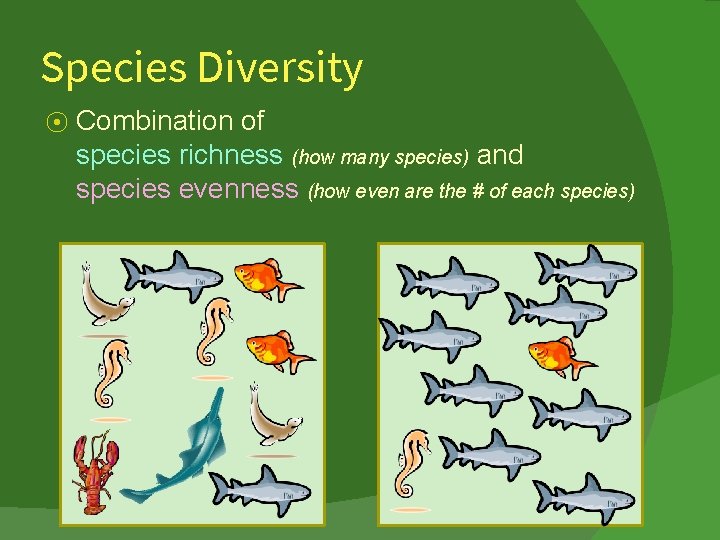
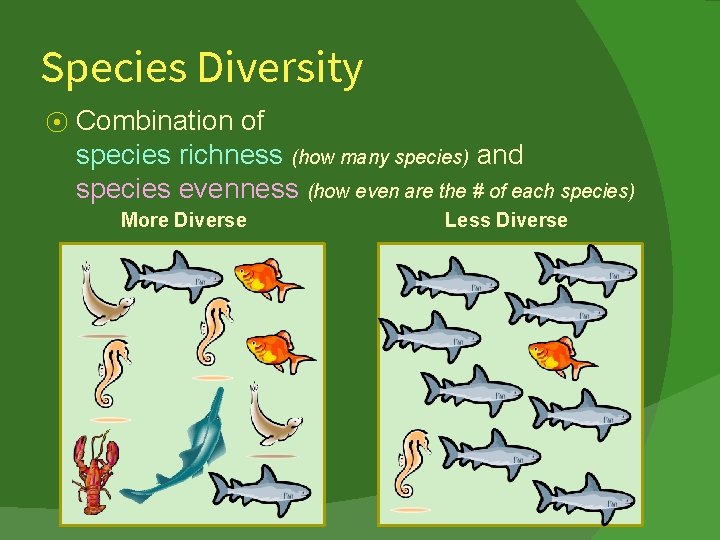
Species Diversity ⦿ Combination of species richness (how many species) and species evenness (how even are the # of each species)
Species Diversity ⦿ Combination of species richness (how many species) and species evenness (how even are the # of each species) More Diverse Less Diverse
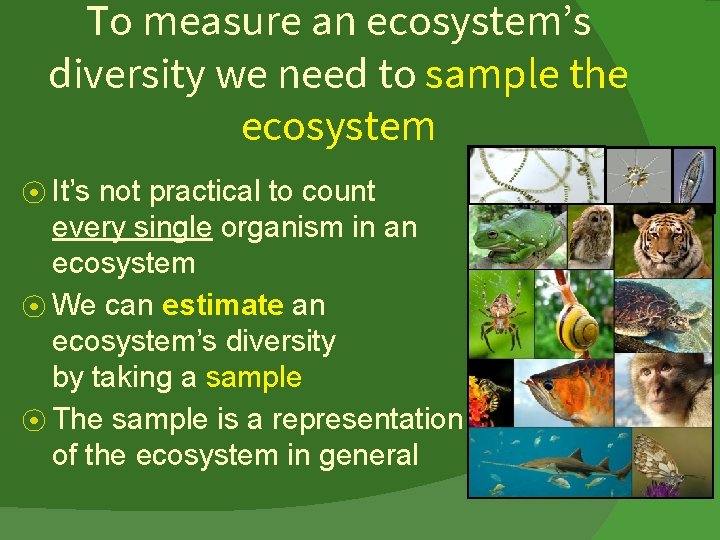
To measure an ecosystem’s diversity we need to sample the ecosystem ⦿ It’s not practical to count every single organism in an ecosystem ⦿ We can estimate an ecosystem’s diversity by taking a sample ⦿ The sample is a representation of the ecosystem in general
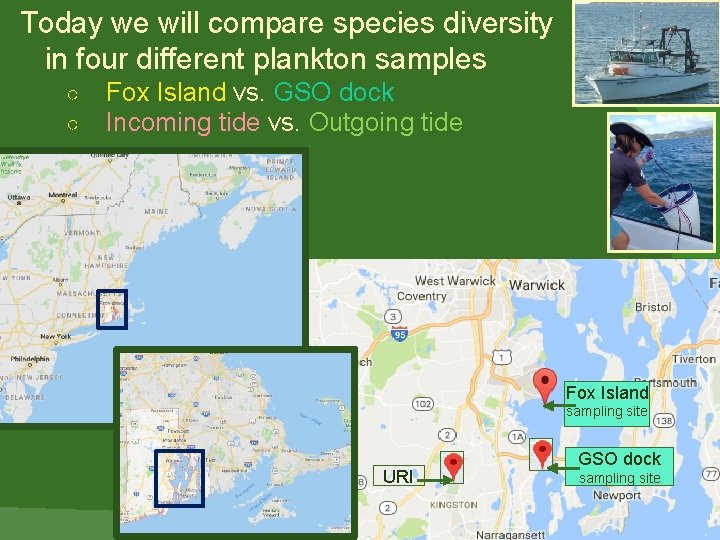
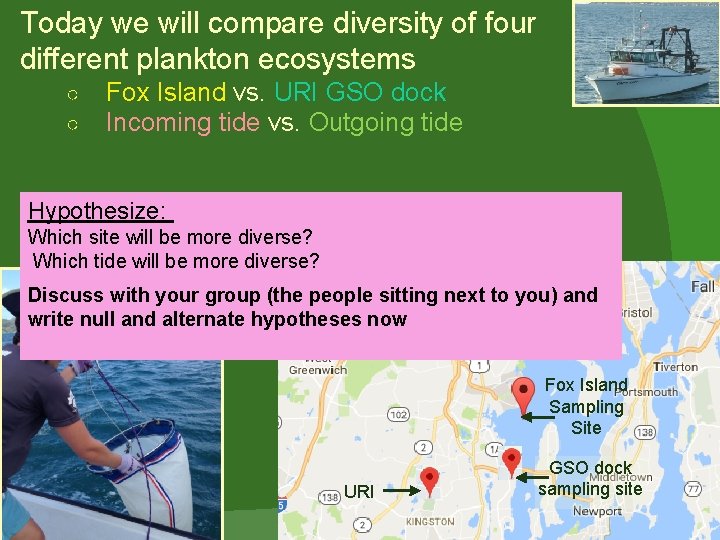
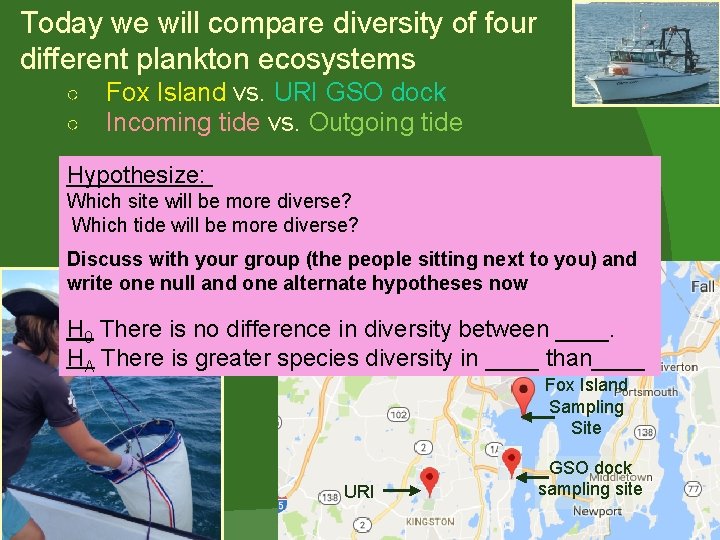
Today we will compare species diversity in four different plankton samples ○ ○ Fox Island vs. GSO dock Incoming tide vs. Outgoing tide Fox Island sampling site URI GSO dock sampling site
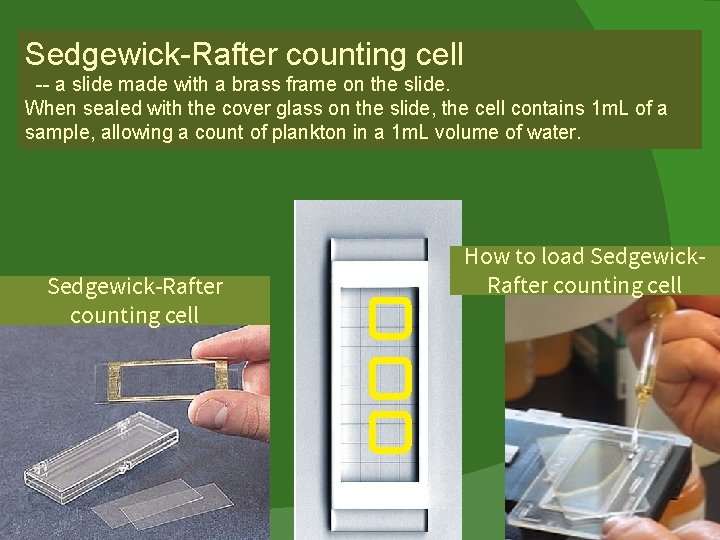
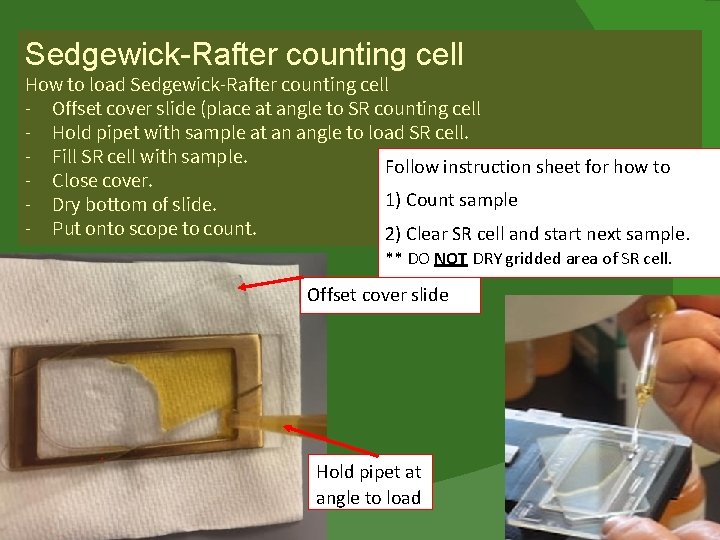
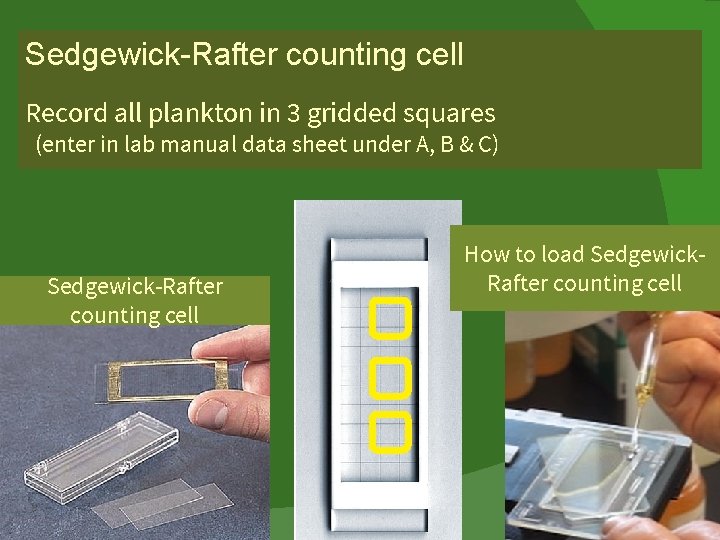
Sedgewick-Rafter counting cell -- a slide made with a brass frame on the slide. When sealed with the cover glass on the slide, the cell contains 1 m. L of a sample, allowing a count of plankton in a 1 m. L volume of water. Sedgewick-Rafter counting cell How to load Sedgewick. Rafter counting cell
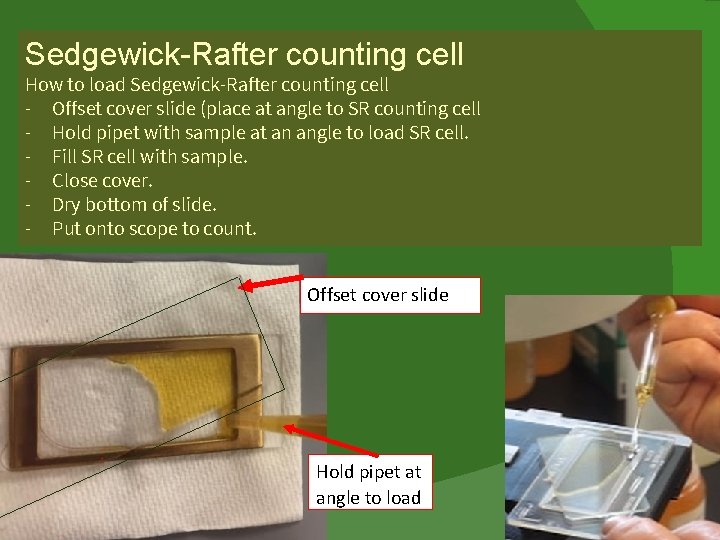
Sedgewick-Rafter counting cell How to load Sedgewick-Rafter counting cell - Offset cover slide (place at angle to SR counting cell - Hold pipet with sample at an angle to load SR cell. - Fill SR cell with sample. - Close cover. - Dry bottom of slide. - Put onto scope to count. Offset cover slide Hold pipet at angle to load
Sedgewick-Rafter counting cell How to load Sedgewick-Rafter counting cell - Offset cover slide (place at angle to SR counting cell - Hold pipet with sample at an angle to load SR cell. - Fill SR cell with sample. Follow instruction sheet for how to - Close cover. 1) Count sample - Dry bottom of slide. - Put onto scope to count. 2) Clear SR cell and start next sample. ** DO NOT DRY gridded area of SR cell. Offset cover slide Hold pipet at angle to load
Sedgewick-Rafter counting cell Record all plankton in 3 gridded squares (enter in lab manual data sheet under A, B & C) Sedgewick-Rafter counting cell How to load Sedgewick. Rafter counting cell
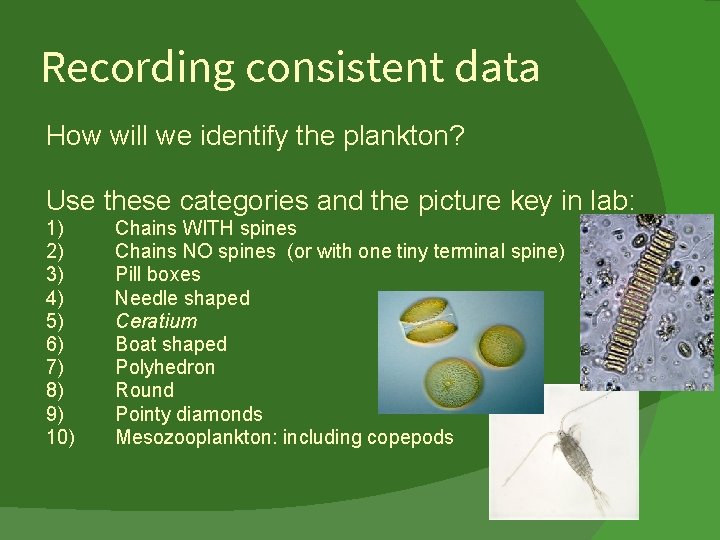
Recording consistent data How will we identify the plankton? Use these categories and the picture key in lab: 1) 2) 3) 4) 5) 6) 7) 8) 9) 10) Chains WITH spines Chains NO spines (or with one tiny terminal spine) Pill boxes Needle shaped Ceratium Boat shaped Polyhedron Round Pointy diamonds Mesozooplankton: including copepods
Today we will compare diversity of four different plankton ecosystems ○ ○ Fox Island vs. URI GSO dock Incoming tide vs. Outgoing tide Hypothesize: Which site will be more diverse? Which tide will be more diverse? Discuss with your group (the people sitting next to you) and write null and alternate hypotheses now Fox Island Sampling Site URI GSO dock sampling site
Today we will compare diversity of four different plankton ecosystems ○ ○ Fox Island vs. URI GSO dock Incoming tide vs. Outgoing tide Hypothesize: Which site will be more diverse? Which tide will be more diverse? Discuss with your group (the people sitting next to you) and write one null and one alternate hypotheses now H 0 There is no difference in diversity between ____. HA There is greater species diversity in ____ than____ Fox Island Sampling Site URI GSO dock sampling site
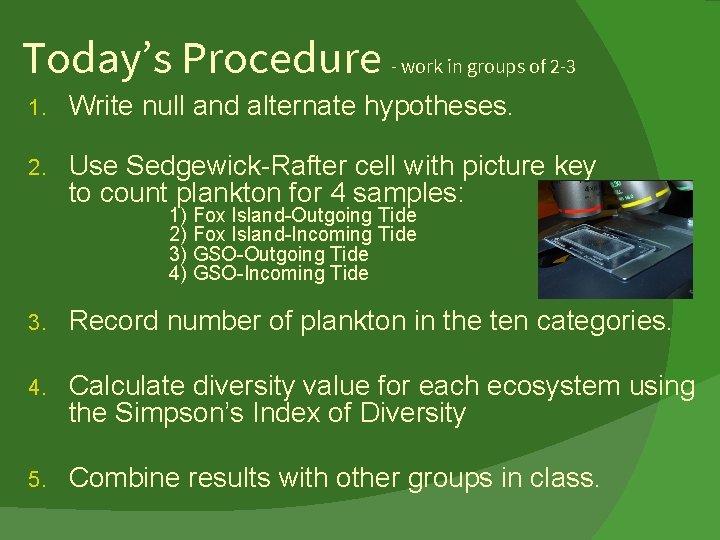
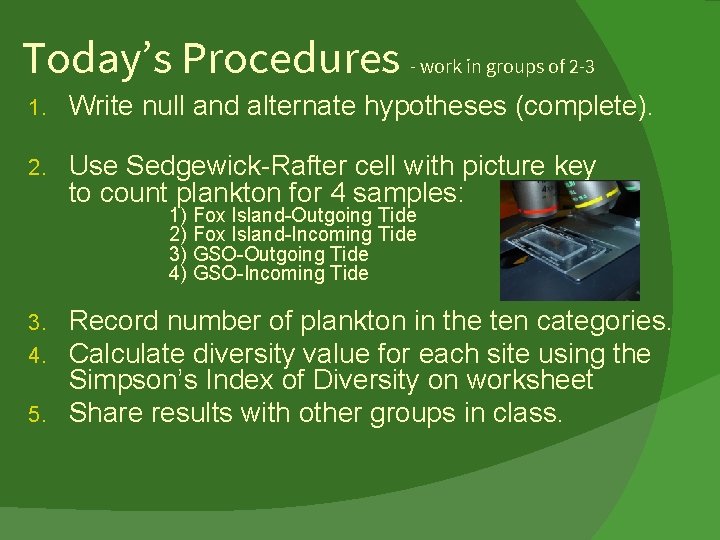
Today’s Procedure - work in groups of 2 -3 1. Write null and alternate hypotheses. 2. Use Sedgewick-Rafter cell with picture key to count plankton for 4 samples: 1) Fox Island-Outgoing Tide 2) Fox Island-Incoming Tide 3) GSO-Outgoing Tide 4) GSO-Incoming Tide 3. Record number of plankton in the ten categories. 4. Calculate diversity value for each ecosystem using the Simpson’s Index of Diversity 5. Combine results with other groups in class.
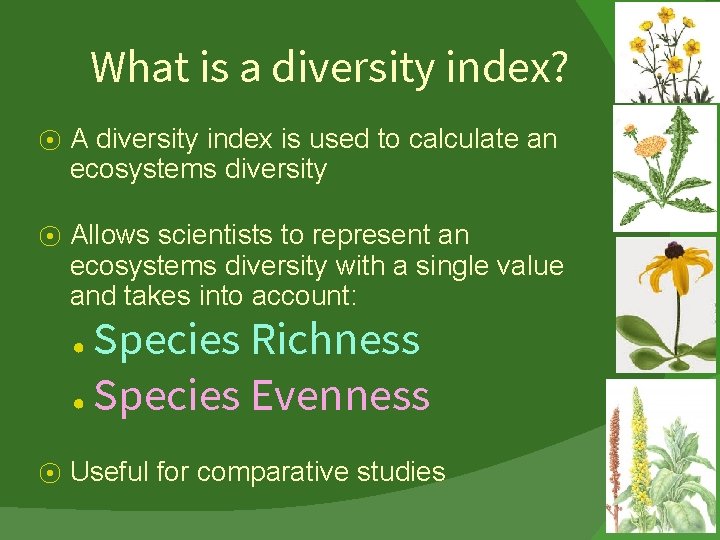
What is a diversity index? ⦿ A diversity index is used to calculate an ecosystems diversity ⦿ Allows scientists to represent an ecosystems diversity with a single value and takes into account: Species Richness ● Species Evenness ● ⦿ Useful for comparative studies
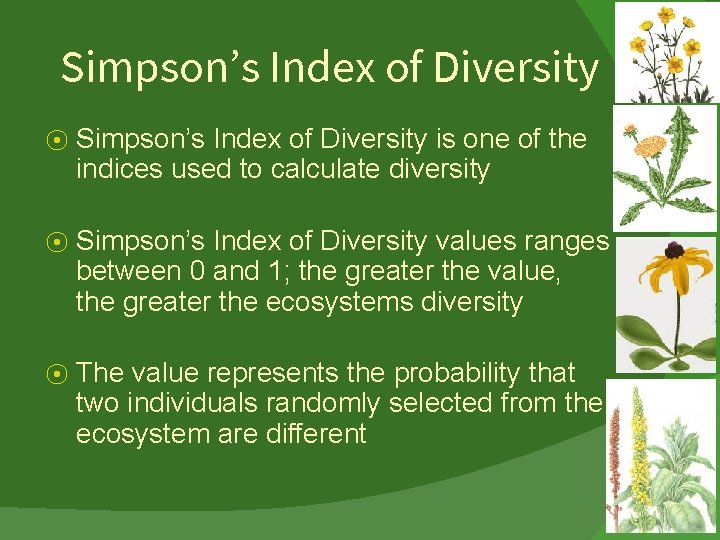
Simpson’s Index of Diversity ⦿ Simpson’s Index of Diversity is one of the indices used to calculate diversity ⦿ Simpson’s Index of Diversity values ranges between 0 and 1; the greater the value, the greater the ecosystems diversity ⦿ The value represents the probability that two individuals randomly selected from the ecosystem are different
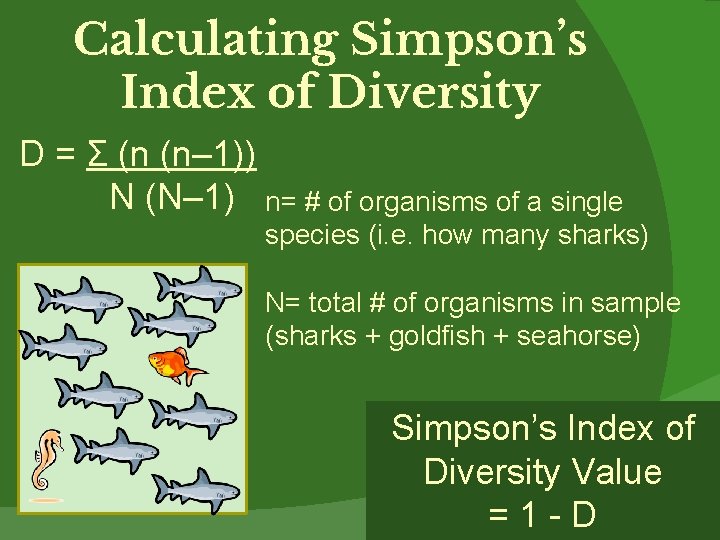
Calculating Simpson’s Index of Diversity D = Σ (n (n– 1)) N (N– 1) n= # of organisms of a single species (i. e. how many sharks) N= total # of organisms in sample (sharks + goldfish + seahorse) Simpson’s Index of Diversity Value =1 -D
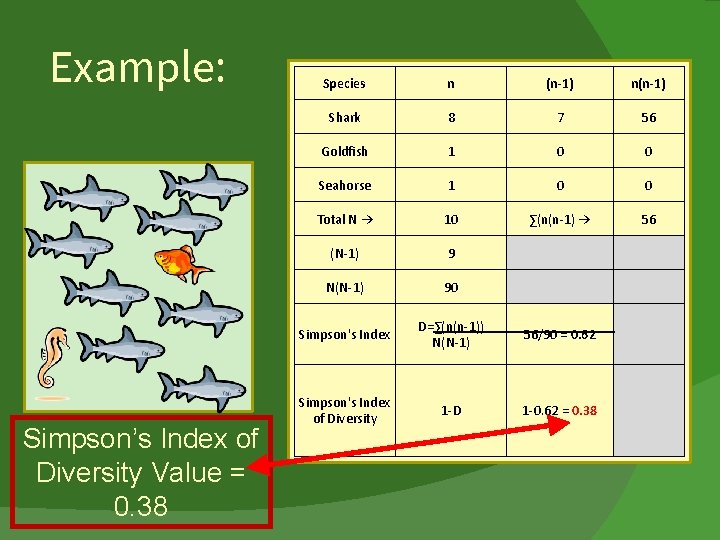
Example: Simpson’s Index of Diversity Value = 0. 38 Species n (n-1) n(n-1) Shark 8 7 56 Goldfish 1 0 0 Seahorse 1 0 0 Total N → 10 ∑(n(n-1) → 56 (N-1) 9 N(N-1) 90 Simpson's Index D=∑(n(n-1)) N(N-1) 56/90 = 0. 62 Simpson's Index of Diversity 1 -D 1 -0. 62 = 0. 38
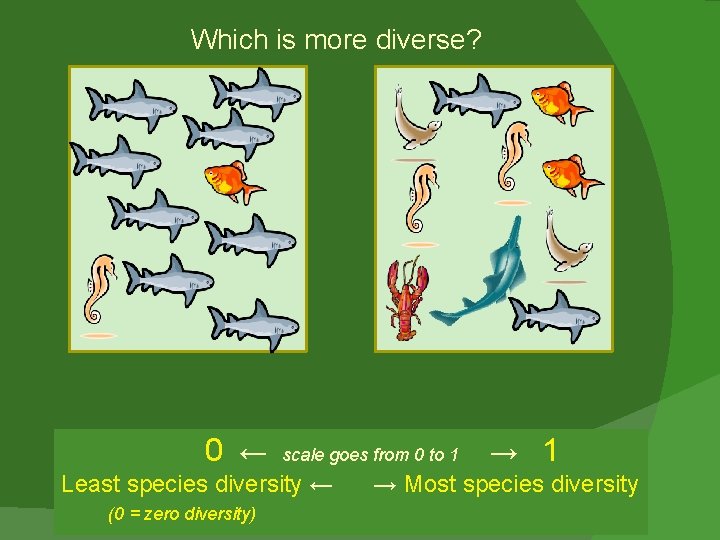
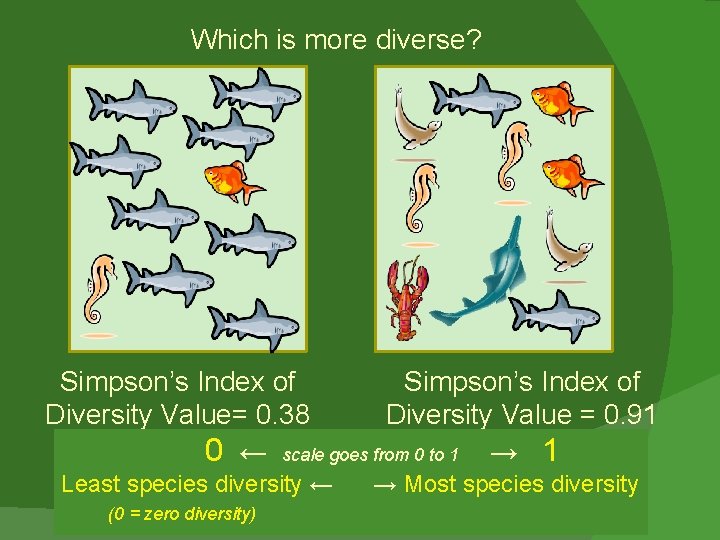
Which is more diverse?
Which is more diverse? 0 ← scale goes from 0 to 1 Least species diversity ← (0 = zero diversity) → 1 → Most species diversity
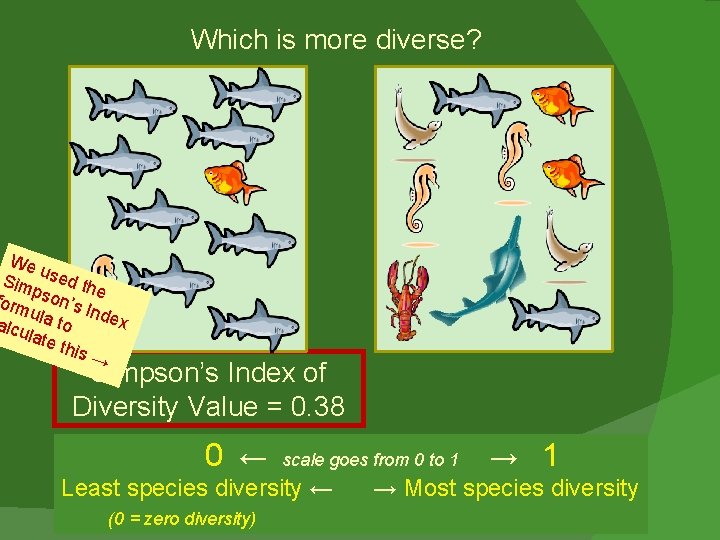
Which is more diverse? We u Sim sed th e pso n orm ’ ula s Index to alcu late this → Simpson’s Index of Diversity Value = 0. 38 0 ← scale goes from 0 to 1 Least species diversity ← (0 = zero diversity) → 1 → Most species diversity
Which is more diverse? Simpson’s Index of Diversity Value= 0. 38 Diversity Value = 0. 91 0 ← scale goes from 0 to 1 → 1 Least species diversity ← (0 = zero diversity) → Most species diversity
Today’s Procedures - work in groups of 2 -3 1. Write null and alternate hypotheses (complete). 2. Use Sedgewick-Rafter cell with picture key to count plankton for 4 samples: 1) Fox Island-Outgoing Tide 2) Fox Island-Incoming Tide 3) GSO-Outgoing Tide 4) GSO-Incoming Tide 3. 4. 5. Record number of plankton in the ten categories. Calculate diversity value for each site using the Simpson’s Index of Diversity on worksheet Share results with other groups in class.
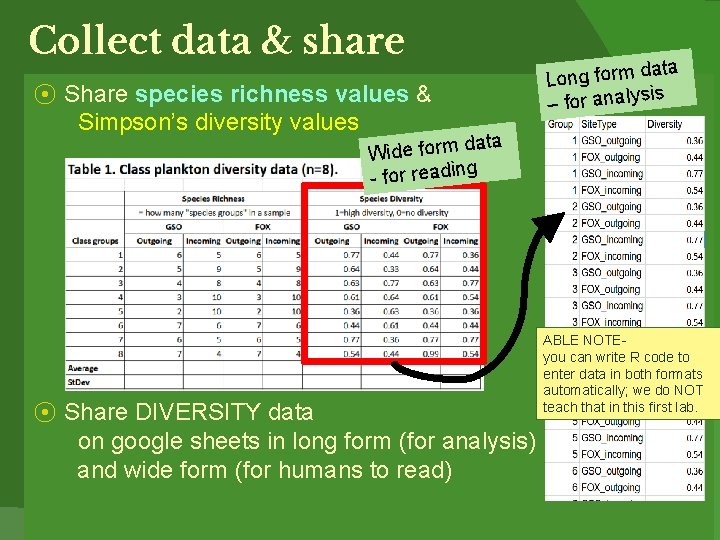
Collect data & share ⦿ Share species richness values & Simpson’s diversity values ata Long form d is – for analys data m r o f e id W g - for readin ⦿ Share DIVERSITY data on google sheets in long form (for analysis) and wide form (for humans to read) ABLE NOTEyou can write R code to enter data in both formats automatically; we do NOT teach that in this first lab.