
Intro to Culinary Math Created by Chef Fintan
Intro to Culinary Math Created by Chef Fintan Flynn Presented by Chef Emilie Metwalli
Why Learn Math
Question? ? What do you call a Chef/Manager who can’t do Math? ** Unemployed!! What do you call a Chef/Owner who can’t do Math? ** Out of Business!!
Why Learn Math?
When will I need Math? • Daily in a professional kitchen v Measuring ingredients v Managing food cost v A lot of math in a chef’s future • To interpret numbers for decision making The goal of so many chefs is v To own their own restaurant v Can’t do this by merely cooking great food
Why learn math? 1. To have proficient culinary skills 2. To convert fractions, decimals, percentages 3. To solve word problems 4. To be successful in culinary
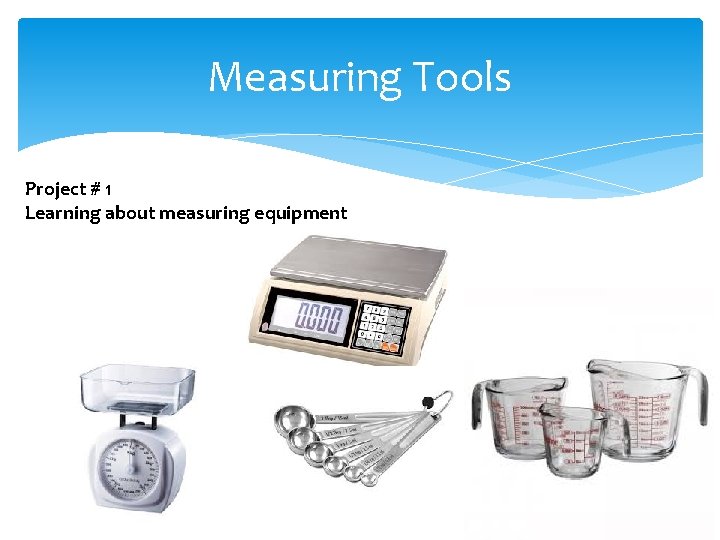
Measuring Tools Project # 1 Learning about measuring equipment
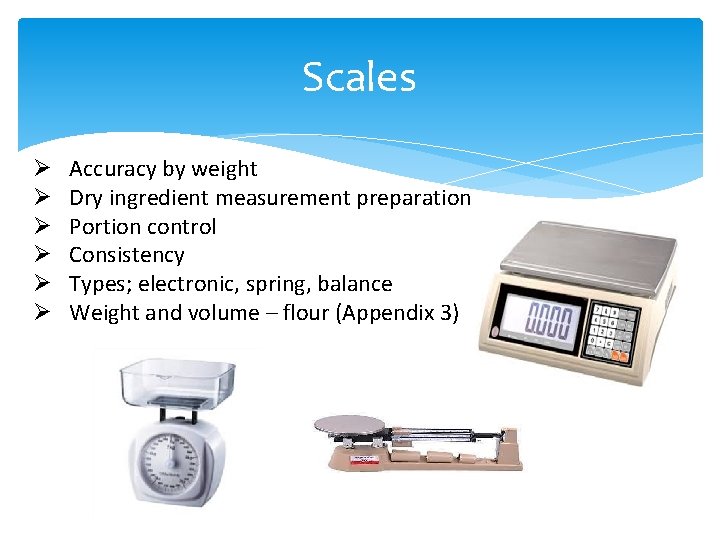
Scales Ø Ø Ø Accuracy by weight Dry ingredient measurement preparation Portion control Consistency Types; electronic, spring, balance Weight and volume – flour (Appendix 3)
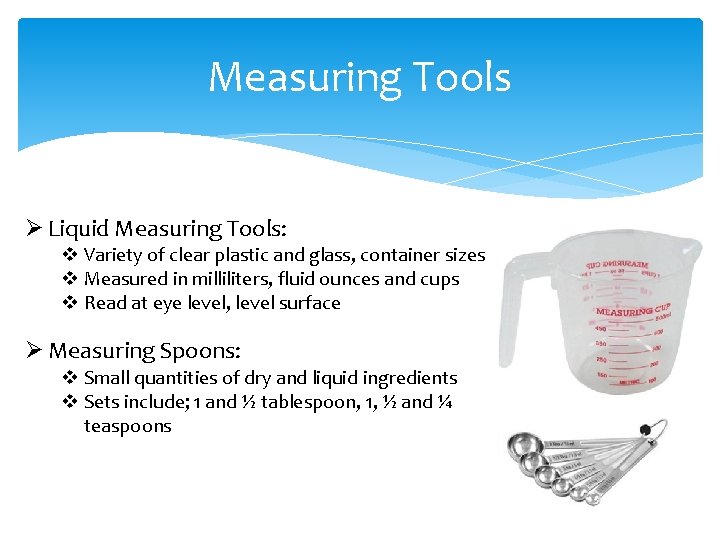
Measuring Tools Ø Liquid Measuring Tools: v Variety of clear plastic and glass, container sizes v Measured in milliliters, fluid ounces and cups v Read at eye level, level surface Ø Measuring Spoons: v Small quantities of dry and liquid ingredients v Sets include; 1 and ½ tablespoon, 1, ½ and ¼ teaspoons
Measurement Project # 2 Learning the difference Volume • Have students name some measures commonly found in the kitchen Weight • Have students name some measures commonly found in the kitchen What is the difference between them?
The Professional Kitchen Professional kitchens use 2 systems of measurement o Metric Ø Dry measures v Gram (g) Kilogram (kg) Ø Liquid Measures v Milliliter (ml), Liter (L) o Imperial (Used mainly in the US) Ø Dry Measures v Ounces (oz), Pounds (lbs. ) Ø Liquid Measures v Fluid Ounces (fl. oz), Gill (gill), Pint (pt. ), Quart (qt. )
Metric System Basic Units • The gram is the basic unit of weight. • The litre is the basic unit of volume. • The meter is the basic unit of length. • The degree Celsius is the basic unit of temperature.
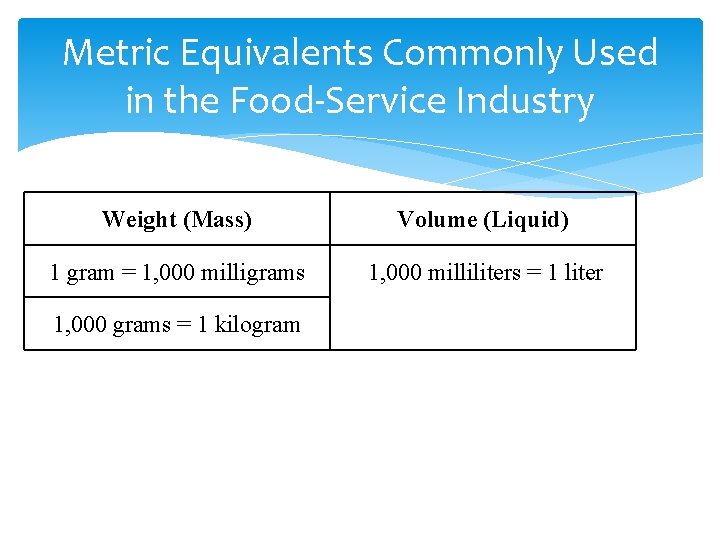
Metric Equivalents Commonly Used in the Food-Service Industry Weight (Mass) Volume (Liquid) 1 gram = 1, 000 milligrams 1, 000 milliliters = 1 liter 1, 000 grams = 1 kilogram
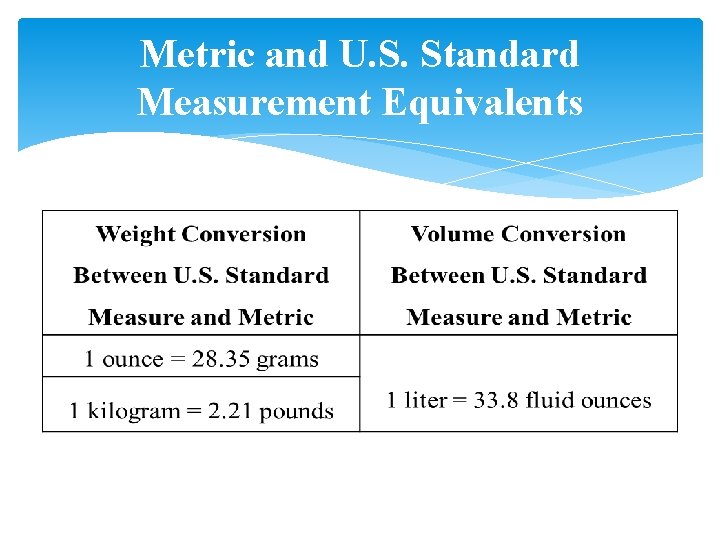
Metric and U. S. Standard Measurement Equivalents
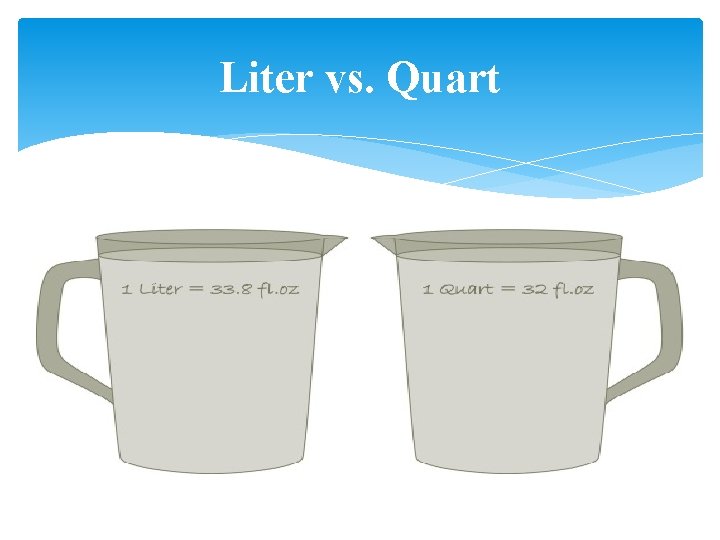
Liter vs. Quart
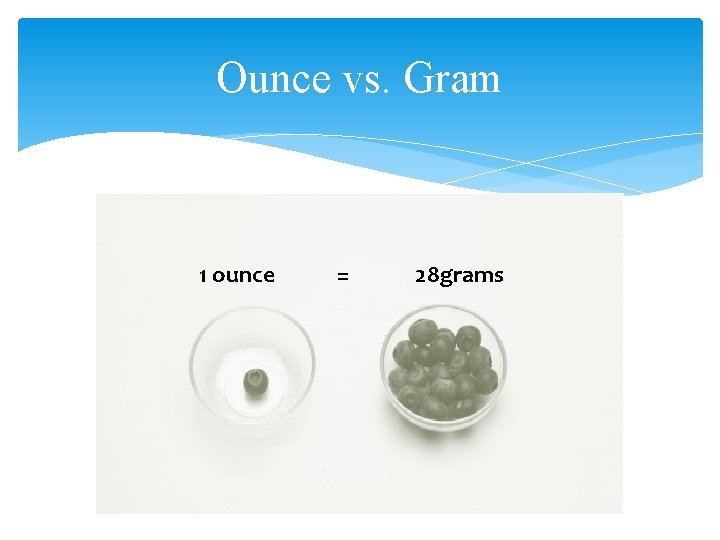
Ounce vs. Gram 1 ounce = 28 grams
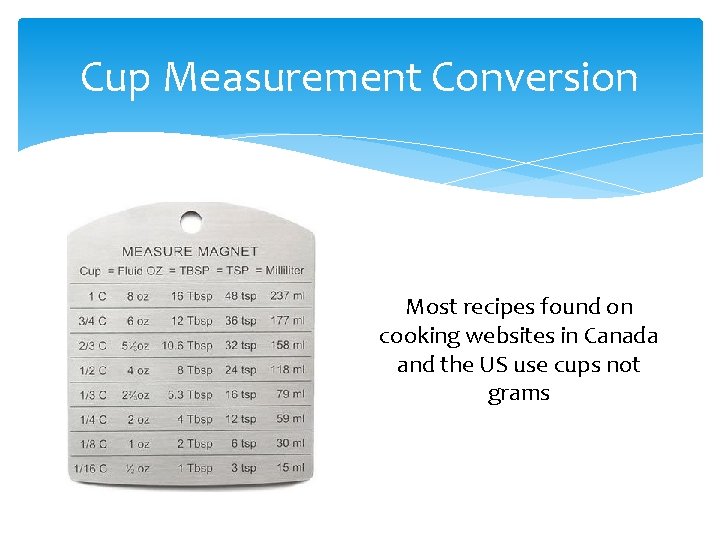
Cup Measurement Conversion Most recipes found on cooking websites in Canada and the US use cups not grams
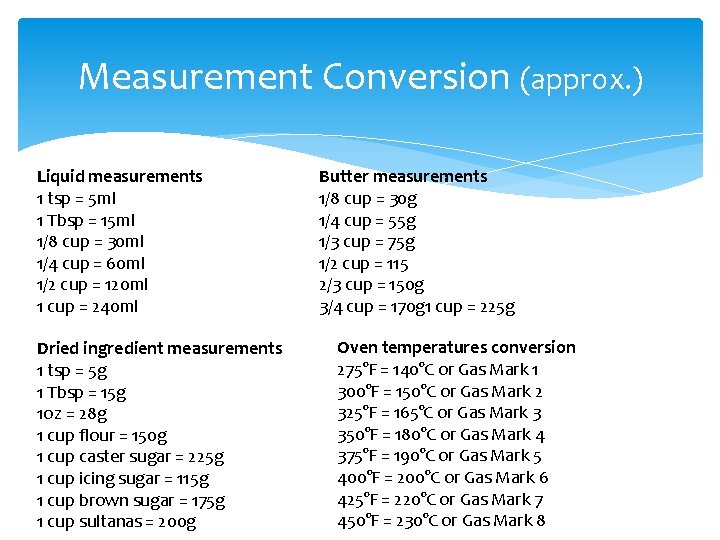
Measurement Conversion (approx. ) Liquid measurements 1 tsp = 5 ml 1 Tbsp = 15 ml 1/8 cup = 30 ml 1/4 cup = 60 ml 1/2 cup = 120 ml 1 cup = 240 ml Dried ingredient measurements 1 tsp = 5 g 1 Tbsp = 15 g 1 oz = 28 g 1 cup flour = 150 g 1 cup caster sugar = 225 g 1 cup icing sugar = 115 g 1 cup brown sugar = 175 g 1 cup sultanas = 200 g Butter measurements 1/8 cup = 30 g 1/4 cup = 55 g 1/3 cup = 75 g 1/2 cup = 115 2/3 cup = 150 g 3/4 cup = 170 g 1 cup = 225 g Oven temperatures conversion 275°F = 140°C or Gas Mark 1 300°F = 150°C or Gas Mark 2 325°F = 165°C or Gas Mark 3 350°F = 180°C or Gas Mark 4 375°F = 190°C or Gas Mark 5 400°F = 200°C or Gas Mark 6 425°F = 220°C or Gas Mark 7 450°F = 230°C or Gas Mark 8
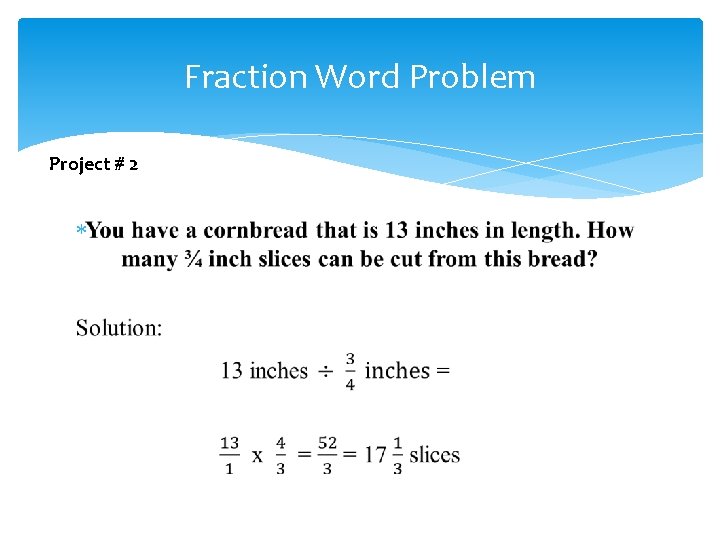
Fraction Word Problem Project # 2
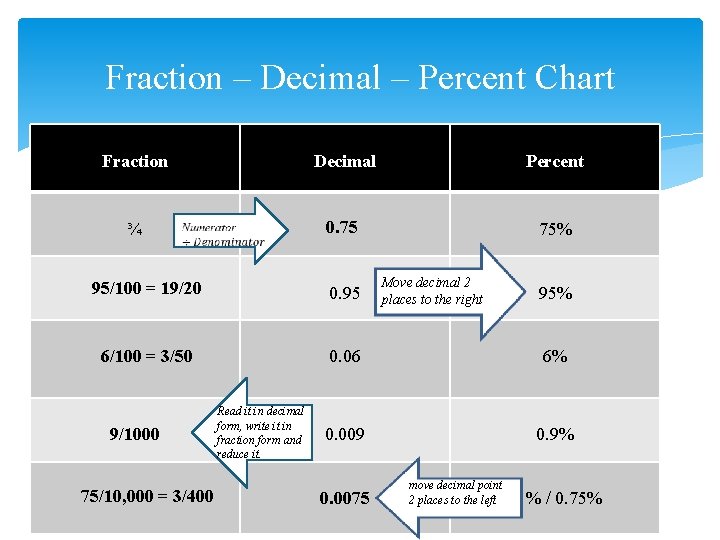
Fraction – Decimal – Percent Chart Fraction ¾ Decimal Percent 0. 75 75% Move decimal 2 places to the right 95/100 = 19/20 0. 95 6/100 = 3/50 0. 06 6% 0. 009 0. 9% 9/1000 75/10, 000 = 3/400 Read it in decimal form, write it in fraction form and reduce it. 0. 0075 move decimal point 2 places to the left 95% ¾ % / 0. 75%
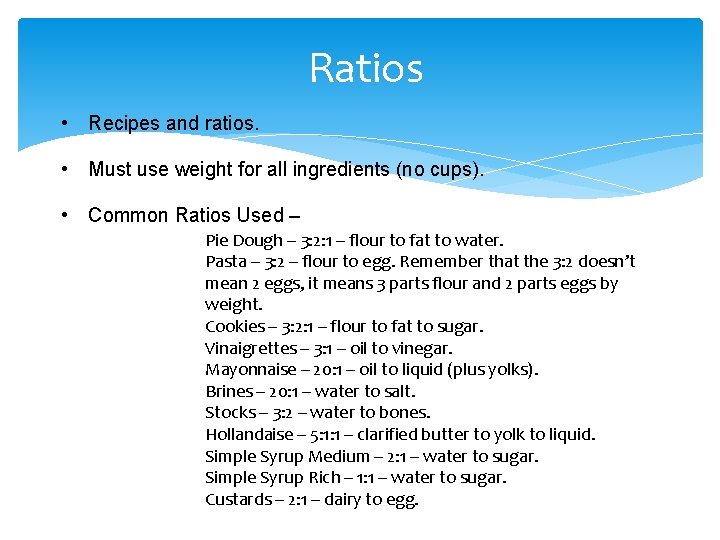
Ratios • Recipes and ratios. • Must use weight for all ingredients (no cups). • Common Ratios Used – Pie Dough – 3: 2: 1 – flour to fat to water. Pasta – 3: 2 – flour to egg. Remember that the 3: 2 doesn’t mean 2 eggs, it means 3 parts flour and 2 parts eggs by weight. Cookies – 3: 2: 1 – flour to fat to sugar. Vinaigrettes – 3: 1 – oil to vinegar. Mayonnaise – 20: 1 – oil to liquid (plus yolks). Brines – 20: 1 – water to salt. Stocks – 3: 2 – water to bones. Hollandaise – 5: 1: 1 – clarified butter to yolk to liquid. Simple Syrup Medium – 2: 1 – water to sugar. Simple Syrup Rich – 1: 1 – water to sugar. Custards – 2: 1 – dairy to egg.
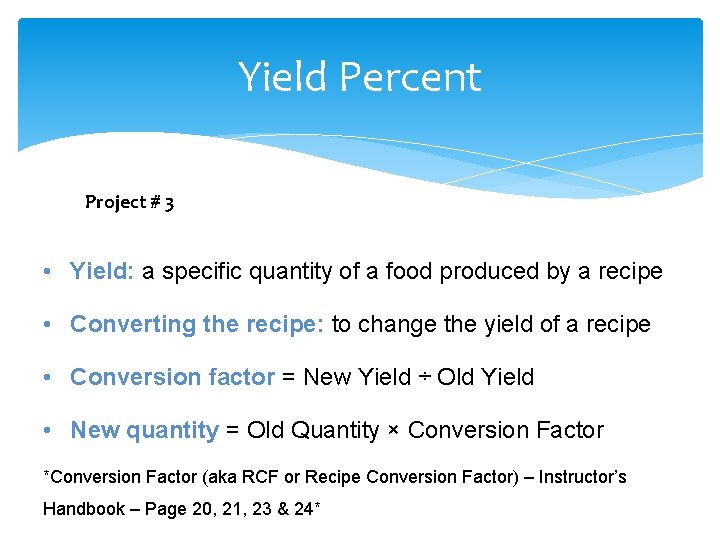
Yield Percent Project # 3 • Yield: a specific quantity of a food produced by a recipe • Converting the recipe: to change the yield of a recipe • Conversion factor = New Yield ÷ Old Yield • New quantity = Old Quantity × Conversion Factor *Conversion Factor (aka RCF or Recipe Conversion Factor) – Instructor’s Handbook – Page 20, 21, 23 & 24*
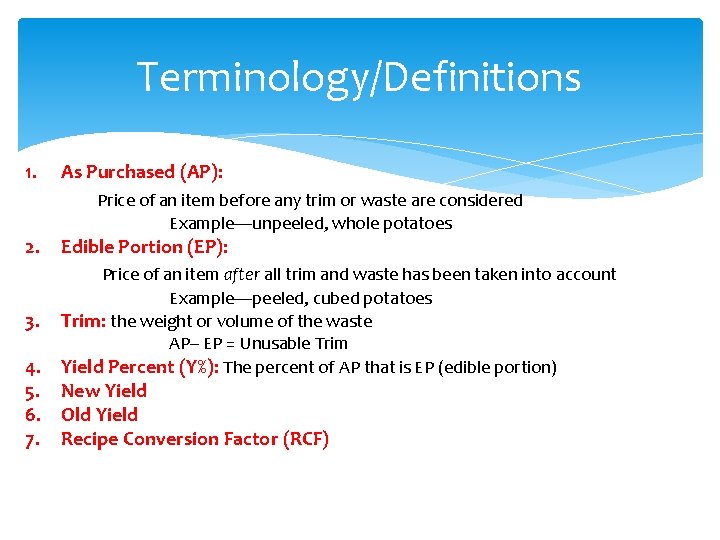
Terminology/Definitions 1. 2. 3. As Purchased (AP): Price of an item before any trim or waste are considered Example—unpeeled, whole potatoes Edible Portion (EP): Price of an item after all trim and waste has been taken into account Example—peeled, cubed potatoes Trim: the weight or volume of the waste AP– EP = Unusable Trim Yield Percent (Y%): The percent of AP that is EP (edible portion) 4. 5. New Yield 6. Old Yield 7. Recipe Conversion Factor (RCF)
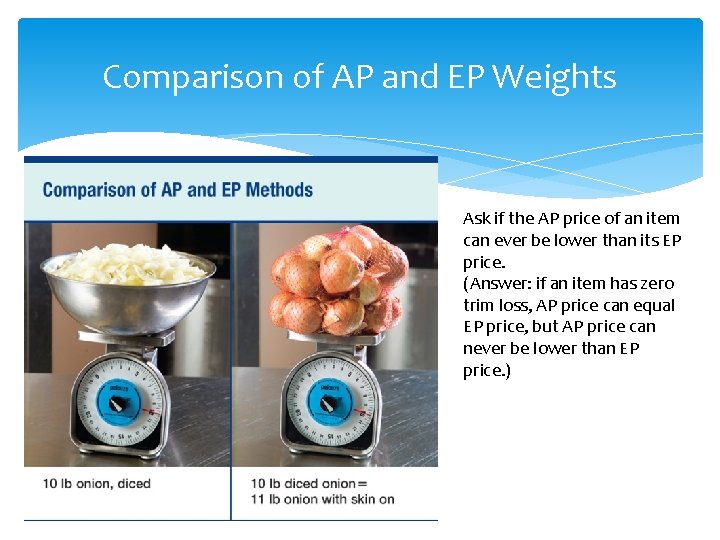
Comparison of AP and EP Weights Ask if the AP price of an item can ever be lower than its EP price. (Answer: if an item has zero trim loss, AP price can equal EP price, but AP price can never be lower than EP price. )
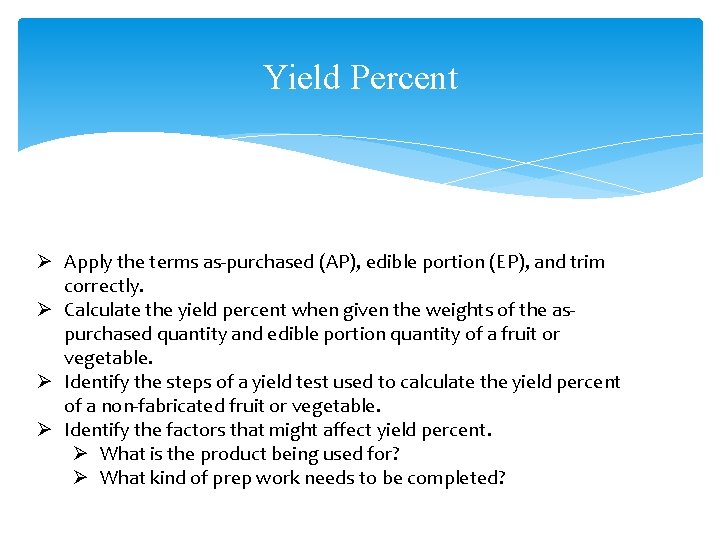
Yield Percent Ø Apply the terms as-purchased (AP), edible portion (EP), and trim correctly. Ø Calculate the yield percent when given the weights of the aspurchased quantity and edible portion quantity of a fruit or vegetable. Ø Identify the steps of a yield test used to calculate the yield percent of a non-fabricated fruit or vegetable. Ø Identify the factors that might affect yield percent. Ø What is the product being used for? Ø What kind of prep work needs to be completed?
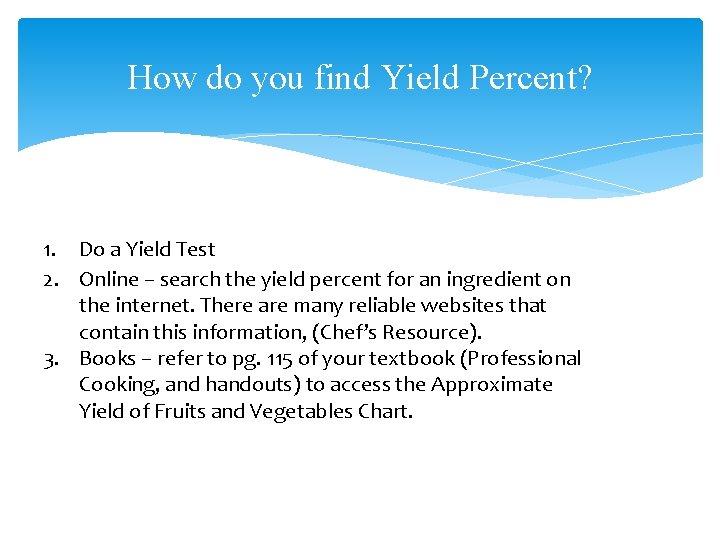
How do you find Yield Percent? 1. Do a Yield Test 2. Online – search the yield percent for an ingredient on the internet. There are many reliable websites that contain this information, (Chef’s Resource). 3. Books – refer to pg. 115 of your textbook (Professional Cooking, and handouts) to access the Approximate Yield of Fruits and Vegetables Chart.
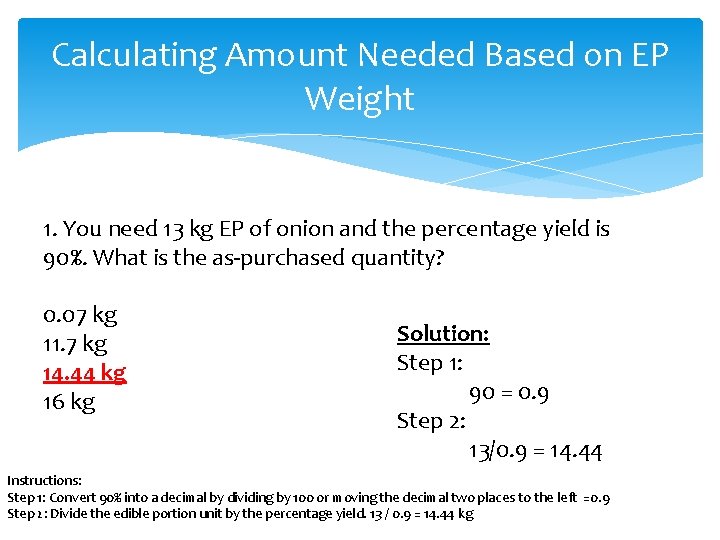
Calculating Amount Needed Based on EP Weight 1. You need 13 kg EP of onion and the percentage yield is 90%. What is the as-purchased quantity? 0. 07 kg 11. 7 kg 14. 44 kg 16 kg Solution: Step 1: 90 = 0. 9 Step 2: 13/0. 9 = 14. 44 Instructions: Step 1: Convert 90% into a decimal by dividing by 100 or moving the decimal two places to the left =0. 9 Step 2: Divide the edible portion unit by the percentage yield. 13 / 0. 9 = 14. 44 kg
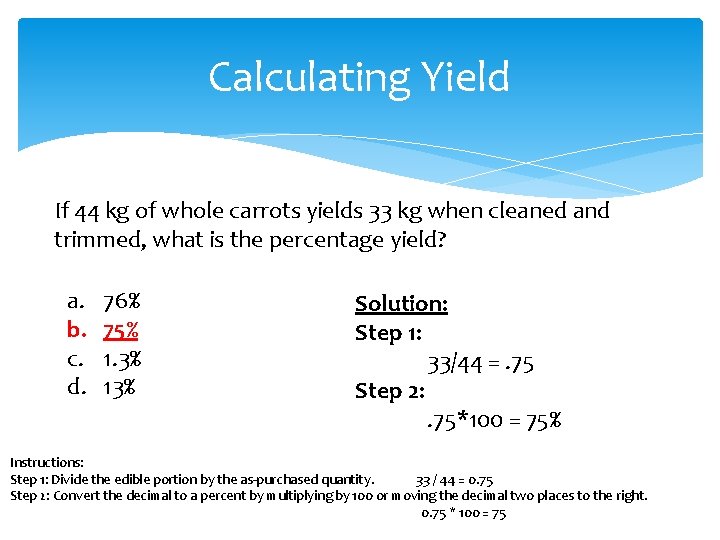
Calculating Yield If 44 kg of whole carrots yields 33 kg when cleaned and trimmed, what is the percentage yield? a. b. c. d. 76% 75% 1. 3% 13% Solution: Step 1: 33/44 =. 75 Step 2: . 75*100 = 75% Instructions: Step 1: Divide the edible portion by the as-purchased quantity. 33 / 44 = 0. 75 Step 2: Convert the decimal to a percent by multiplying by 100 or moving the decimal two places to the right. 0. 75 * 100 = 75
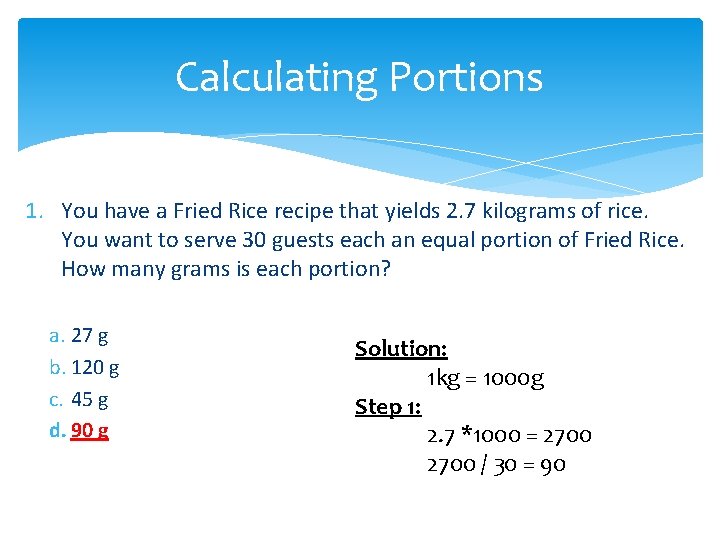
Calculating Portions 1. You have a Fried Rice recipe that yields 2. 7 kilograms of rice. You want to serve 30 guests each an equal portion of Fried Rice. How many grams is each portion? a. 27 g b. 120 g c. 45 g d. 90 g Solution: 1 kg = 1000 g Step 1: 2. 7 *1000 = 2700 / 30 = 90
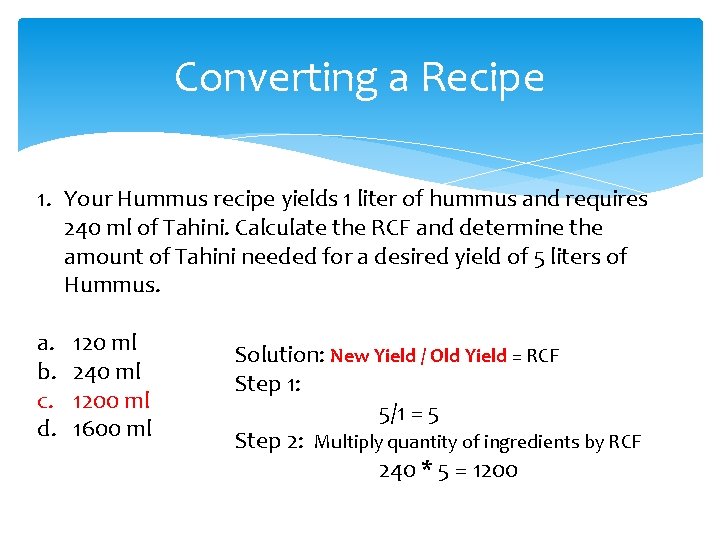
Converting a Recipe 1. Your Hummus recipe yields 1 liter of hummus and requires 240 ml of Tahini. Calculate the RCF and determine the amount of Tahini needed for a desired yield of 5 liters of Hummus. a. b. c. d. 120 ml 240 ml 1200 ml 1600 ml Solution: New Yield / Old Yield = RCF Step 1: 5/1 = 5 Step 2: Multiply quantity of ingredients by RCF 240 * 5 = 1200
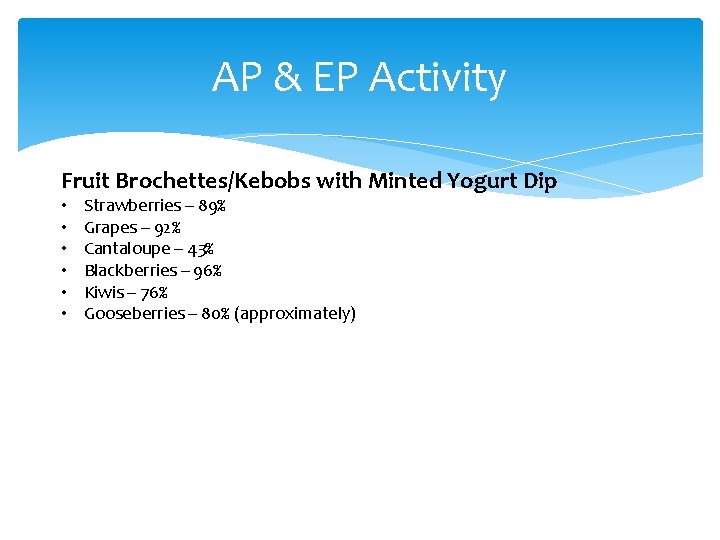
AP & EP Activity Fruit Brochettes/Kebobs with Minted Yogurt Dip • • • Strawberries – 89% Grapes – 92% Cantaloupe – 43% Blackberries – 96% Kiwis – 76% Gooseberries – 80% (approximately)
- Slides: 31