
Intro to CPTs By Alex Munoz CPC NCICS
Intro to CPTs By Alex Munoz, CPC, NCICS
CPT CODING Current Procedural Terminology Published annually by the AMA 1 st published in 1966 5 -digit codes Transforms services/procedures/ supplies/drugs into CPT/HCPCS codes
Levels of Service Codes Level I CPT—(Category 1: 99201 -99607, Category III: 0016 T-0196 t) Level II HCPCS, National Codes—(A 0021 V 5364) Level III Local Codes—phased out due to HIPAA
Why we code? Computers understand numbers Specific descriptions attached to each code It’s fun!
Why code? How many levels of service codes? How many digits?
CPT Codes Allow For. . Communication that is both effective and efficient A mechanism to report a service not described by a specific CPT or Level II code
Consider this: Renal endoscopy through nephrostomy or pyelotomy, with or without irrigation, instillation, or ureteropyelography, exclusive of radiologic service; with endopyelotomy (includes cystoscopy, ureteroscopy, dilation of ureter and ureteral pelvic junction, and insertion of endopyelotomy stent) Vs 50575
CPT Format Symbols in CPT Used to convey information Bullseye, moderate (conscious) sedation included (full list in Appendix G, CPT) Example 45391, Colonoscopy with endoscopic ultrasound examination Lightning bolt, pending FDA approval (Appendix K, CPT) Example 90650, Human Papilloma virus (HPV) vaccine, types 16, 18, bivalent, 3 dose schedule, for intramuscular use
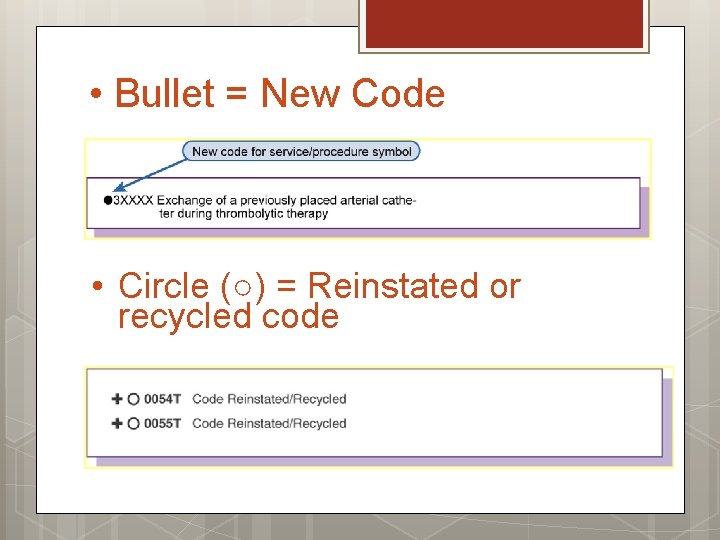
• Bullet = New Code • Circle (○) = Reinstated or recycled code
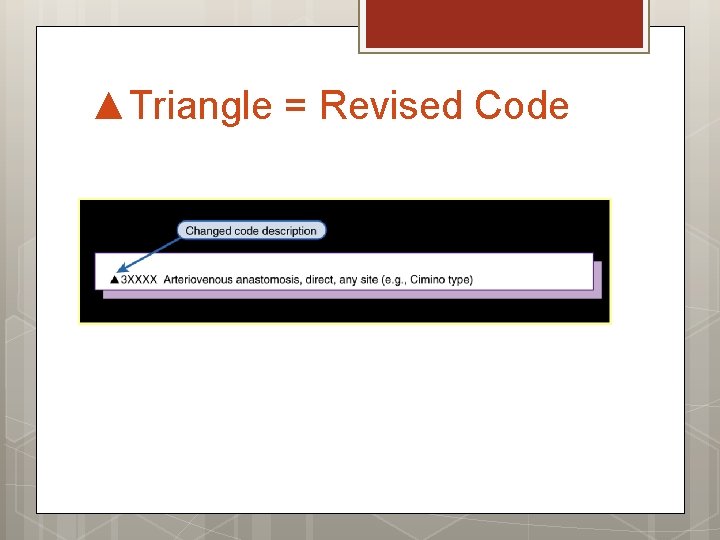
▲Triangle = Revised Code
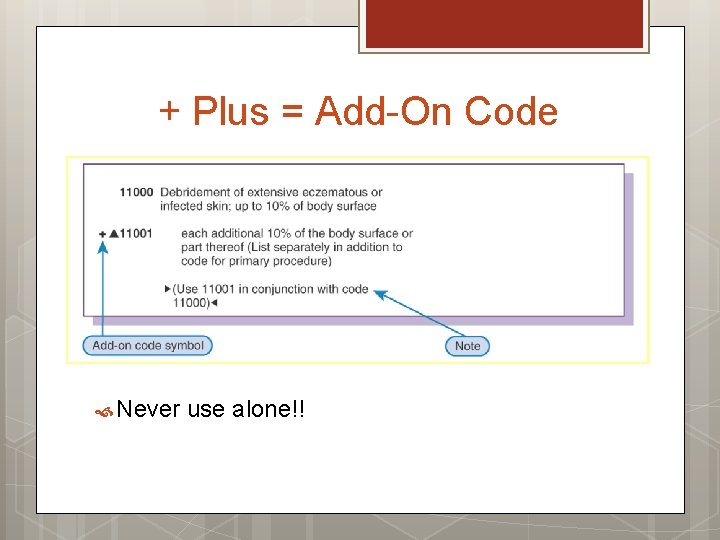
+ Plus = Add-On Code Never use alone!!
Add-On Code Can only be used with another specific code Never used alone No reduction for multiple services Full list in Appendix D of CPT
What does a bullet mean? What does a triangle mean?
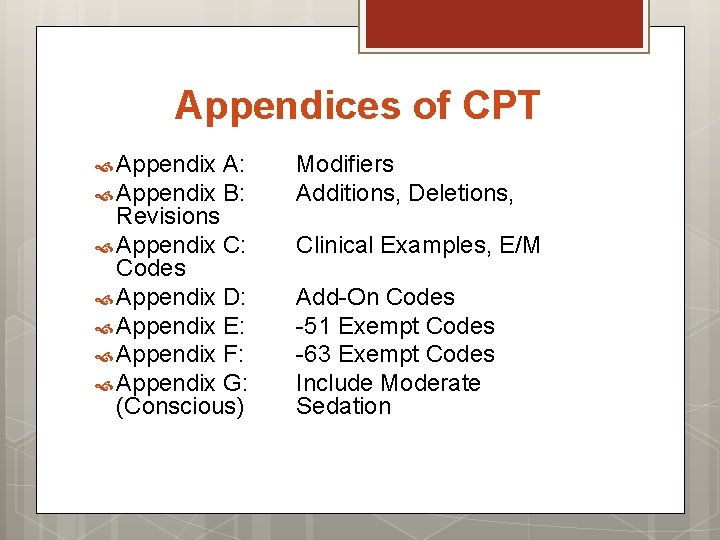
Appendices of CPT Appendix A: Appendix B: Revisions Appendix C: Codes Appendix D: Appendix E: Appendix F: Appendix G: (Conscious) Modifiers Additions, Deletions, Clinical Examples, E/M Add-On Codes -51 Exempt Codes -63 Exempt Codes Include Moderate Sedation
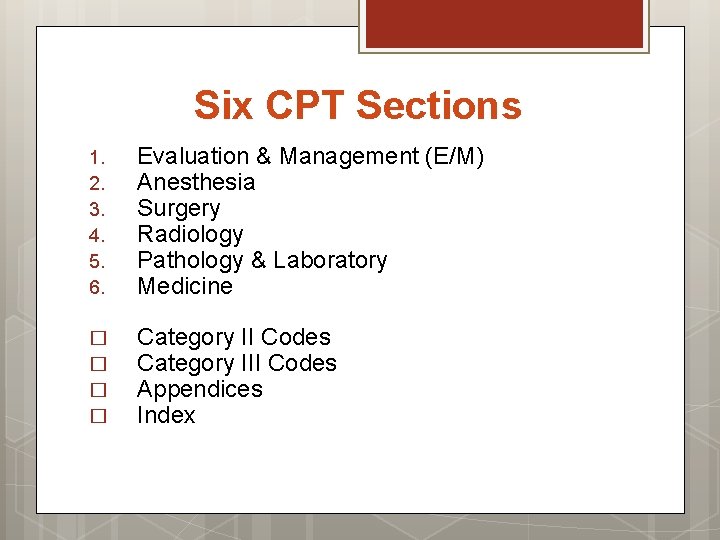
Six CPT Sections 1. 2. 3. 4. 5. 6. Evaluation & Management (E/M) Anesthesia Surgery Radiology Pathology & Laboratory Medicine � � Category II Codes Category III Codes Appendices Index
What are the six sections of the CPT book?
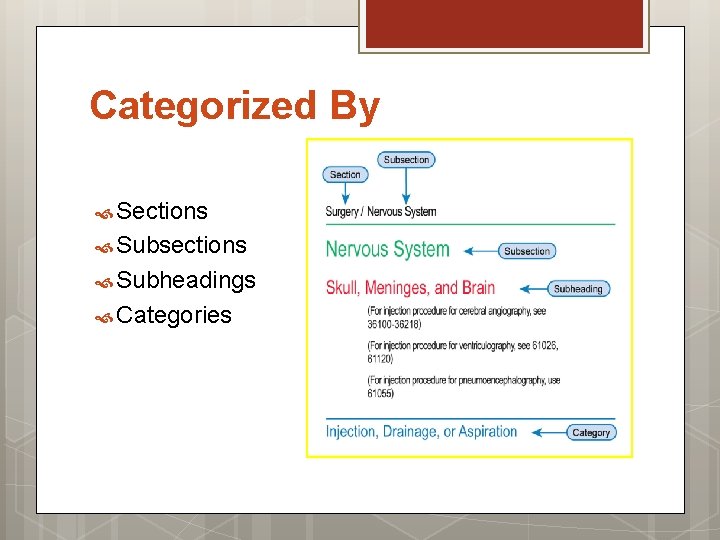
Categorized By Sections Subsections Subheadings Categories
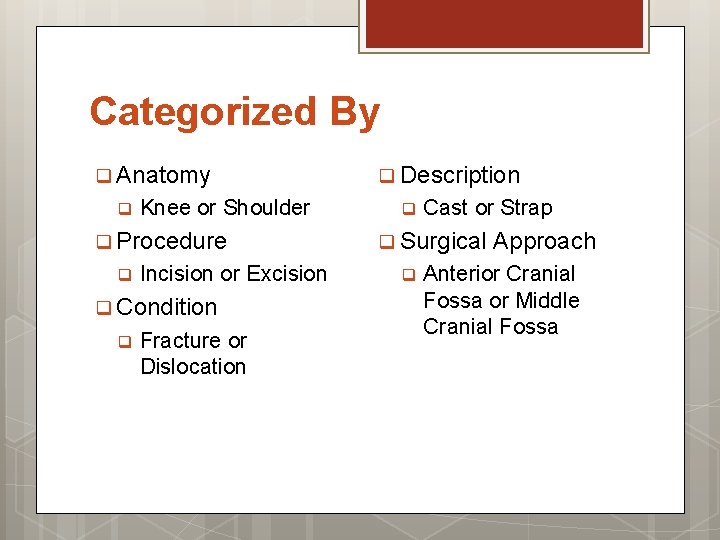
Categorized By q Anatomy q Knee or Shoulder q Procedure q Incision or Excision q Condition q Fracture or Dislocation q Description q Cast or Strap q Surgical q Approach Anterior Cranial Fossa or Middle Cranial Fossa
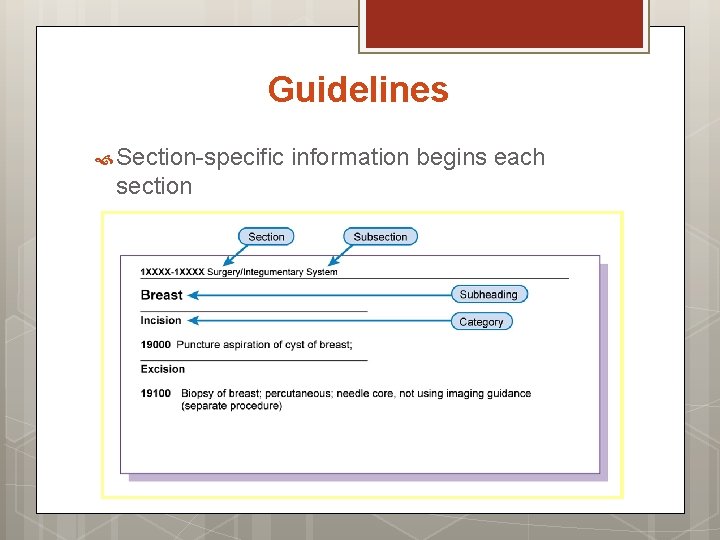
Guidelines Section-specific section information begins each
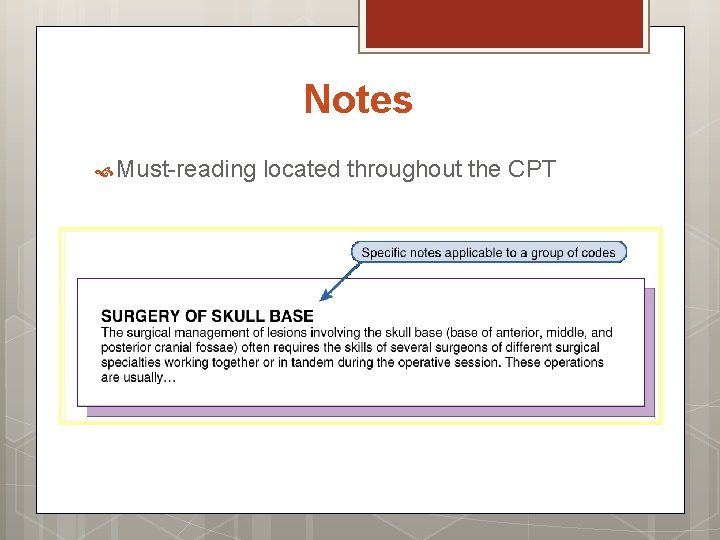
Notes Must-reading located throughout the CPT
Two Types of Codes Stand-alone: Full description Indented: Dependent on preceding standalone Verbiage before the semicolon applies to all indented codes that follow
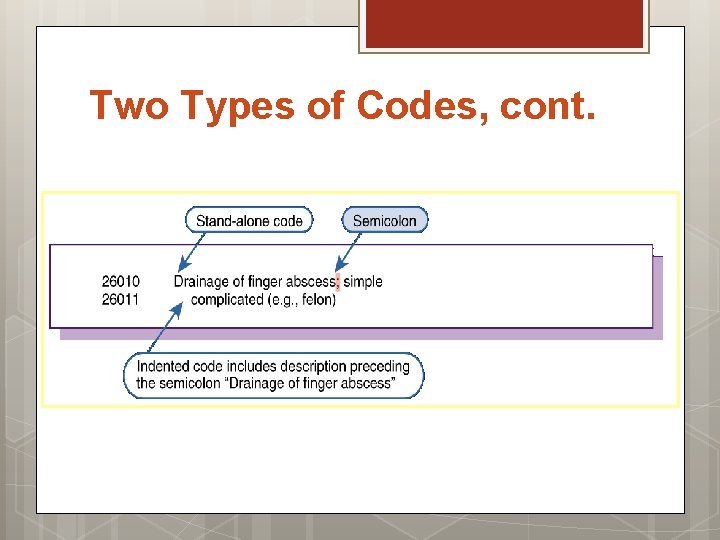
Two Types of Codes, cont.
What is a “stand alone code”? What is an “indented code”?
Semicolon Indicates full description in preceding code You must return to the stand-alone for full description
Unlisted Services Codes ending in “ 99” = “no specific Category I or III code” Used if no more specific code Special report must accompany submission
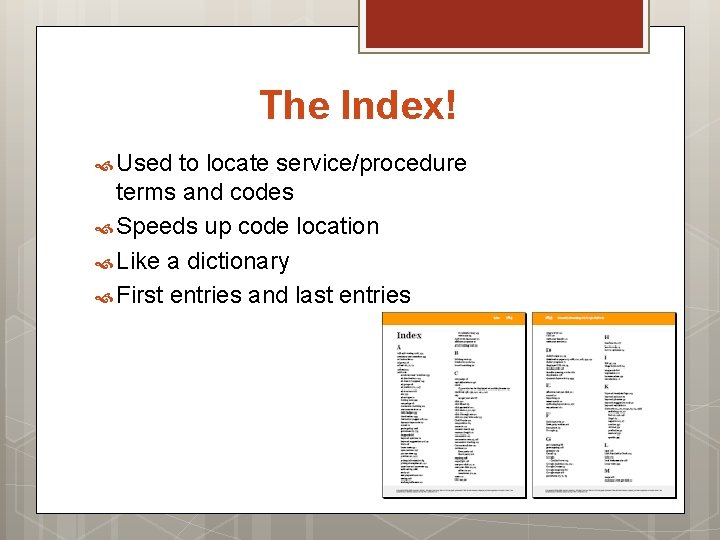
The Index! Used to locate service/procedure terms and codes Speeds up code location Like a dictionary First entries and last entries

Can we code from the (alphabetical) Index?
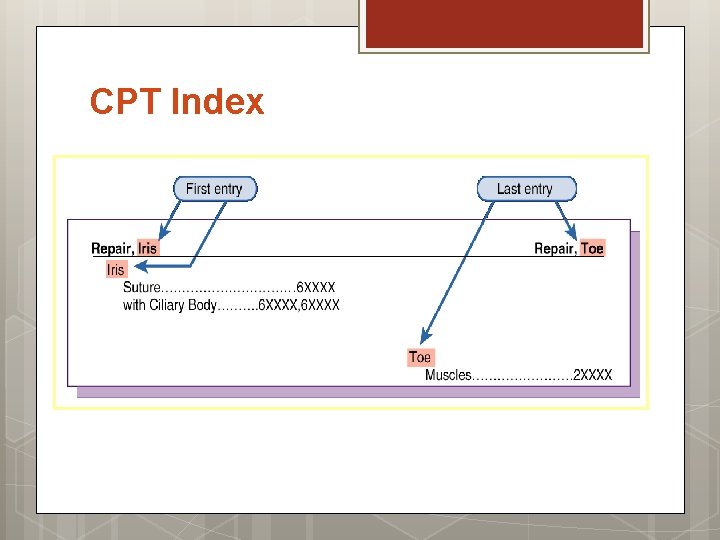
CPT Index
Presentation of Codes in Index Single code: 38115 Multiple codes: 26645, 26650 - Note comma Range of codes: 22305 -22325 - Note hyphen
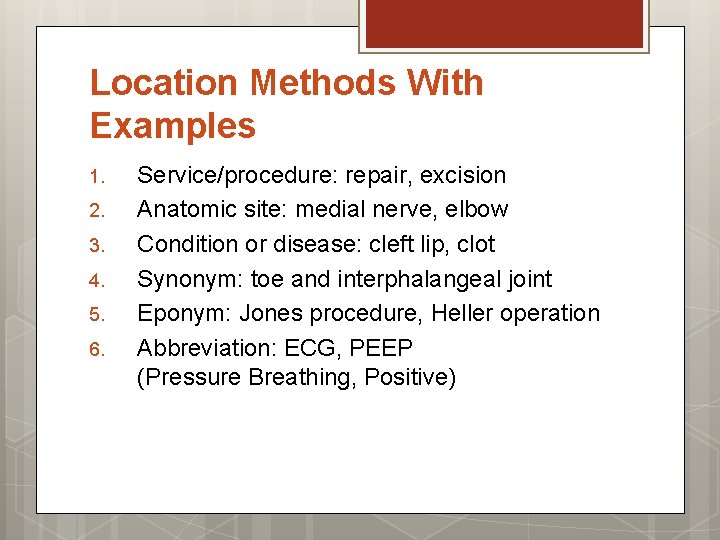
Location Methods With Examples 1. 2. 3. 4. 5. 6. Service/procedure: repair, excision Anatomic site: medial nerve, elbow Condition or disease: cleft lip, clot Synonym: toe and interphalangeal joint Eponym: Jones procedure, Heller operation Abbreviation: ECG, PEEP (Pressure Breathing, Positive)
Always… Reference index Locate code in main portion of CPT Read the entire description and any notes
“See” in Index Cross-reference “Look Index: terms here for code” Stem, Brain: See Brainstem
References: Buck, C. (2010). Step by step. Elsevier
- Slides: 33