
INTRO TO CONJUGATION How to make your verb
INTRO TO CONJUGATION “How to make your verb match your subject”
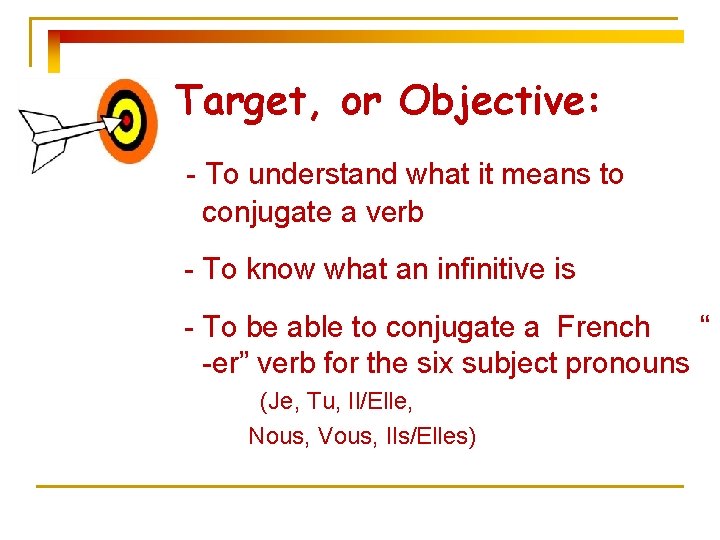
Target, or Objective: - To understand what it means to conjugate a verb - To know what an infinitive is - To be able to conjugate a French “ -er” verb for the six subject pronouns (Je, Tu, Il/Elle, Nous, Vous, Ils/Elles)

You will be successful if you can: - Describe what it means to conjugate a verb and - Conjugate a regular –er verb
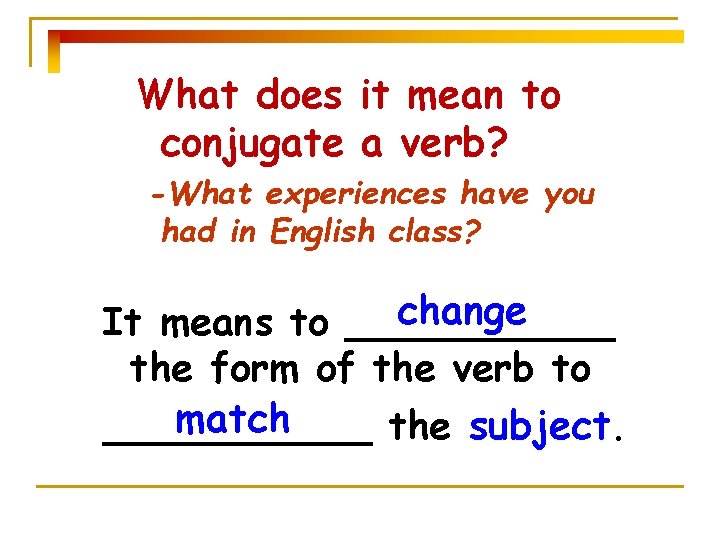
What does it mean to conjugate a verb? -What experiences have you had in English class? change It means to ______ the form of the verb to match ______ the subject.
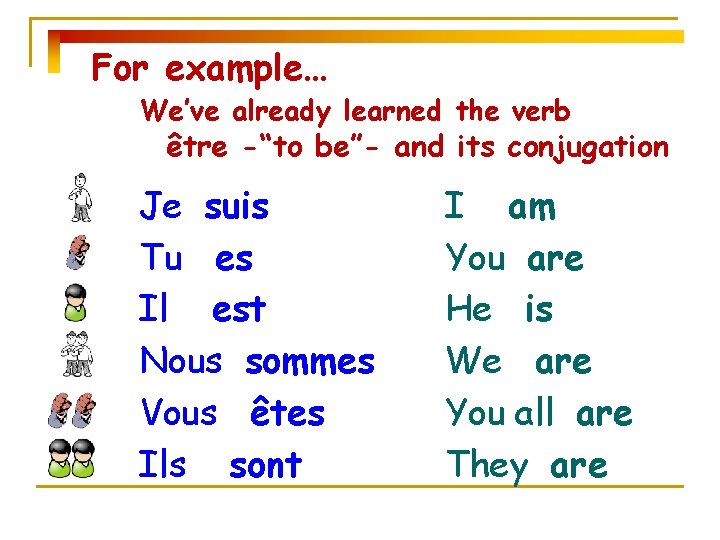
For example… We’ve already learned the verb être -“to be”- and its conjugation Je suis Tu es Il est Nous sommes Vous êtes Ils sont I am You are He is We are You all are They are
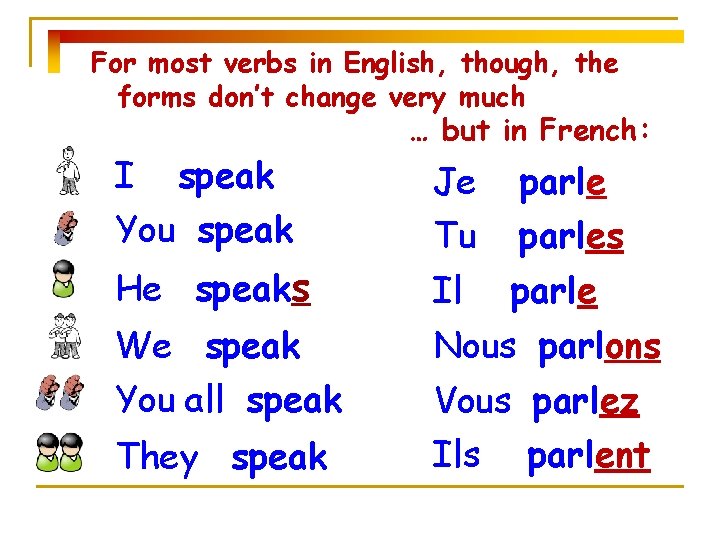
For most verbs in English, though, the forms don’t change very much I speak You speak He speaks … but in French: Je parle Tu parles Il parle We speak Nous parlons You all speak Vous parlez They speak Ils parlent
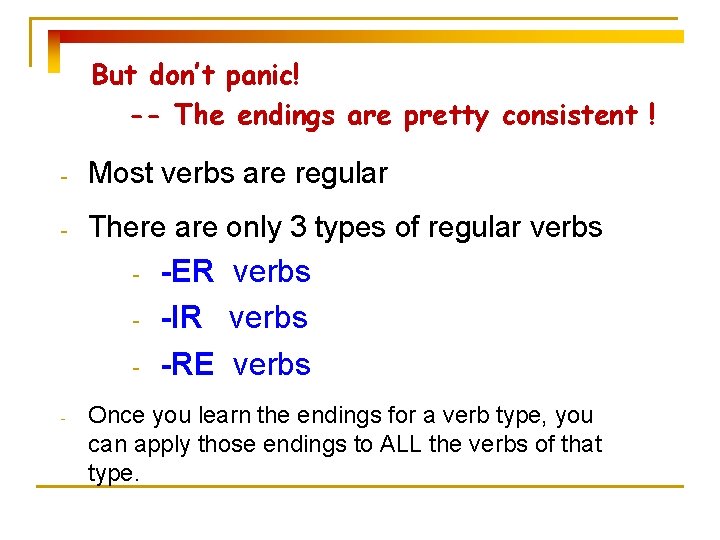
But don’t panic! -- The endings are pretty consistent ! - Most verbs are regular - There are only 3 types of regular verbs - - -ER verbs -IR verbs -RE verbs Once you learn the endings for a verb type, you can apply those endings to ALL the verbs of that type.
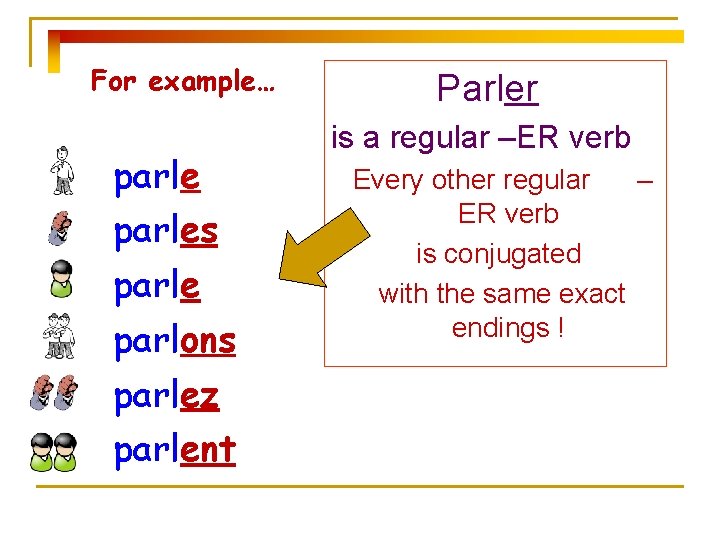
For example… parles parle parlons parlez parlent Parler is a regular –ER verb Every other regular – ER verb is conjugated with the same exact endings !
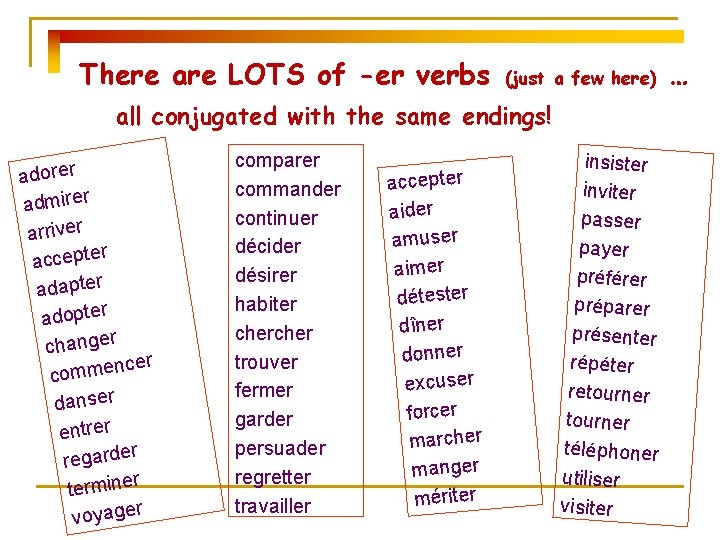
There are LOTS of -er verbs (just a few here) all conjugated with the same endings! adorer admirer arriver r accepte adapter adopter r change cer n e m m co danser entrer r regarde r termine r voyage comparer commander continuer décider désirer habiter cher trouver fermer garder persuader regretter travailler accepter aider amuser aimer détester dîner donner excuser forcer marcher manger mériter insister inviter passer payer préférer préparer présenter répéter retourner téléphoner utiliser visiter …
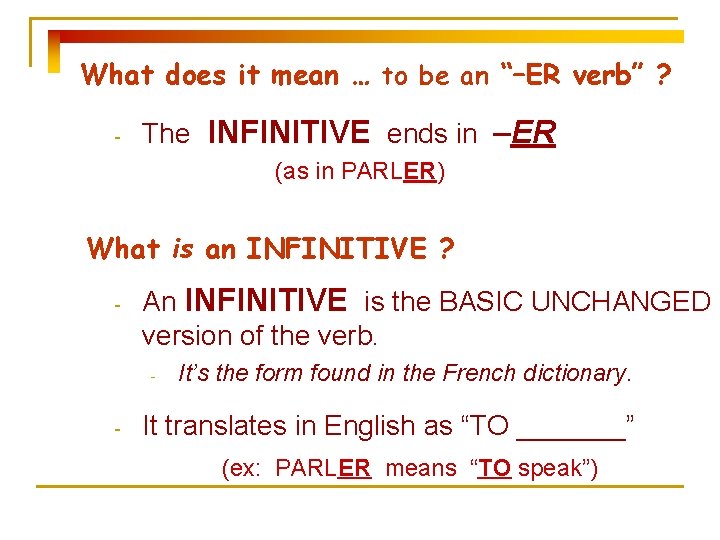
What does it mean … to be an “–ER verb” ? - The INFINITIVE ends in –ER (as in PARLER) What is an INFINITIVE ? - An INFINITIVE is the BASIC UNCHANGED version of the verb. - - It’s the form found in the French dictionary. It translates in English as “TO _______” (ex: PARLER means “TO speak”)
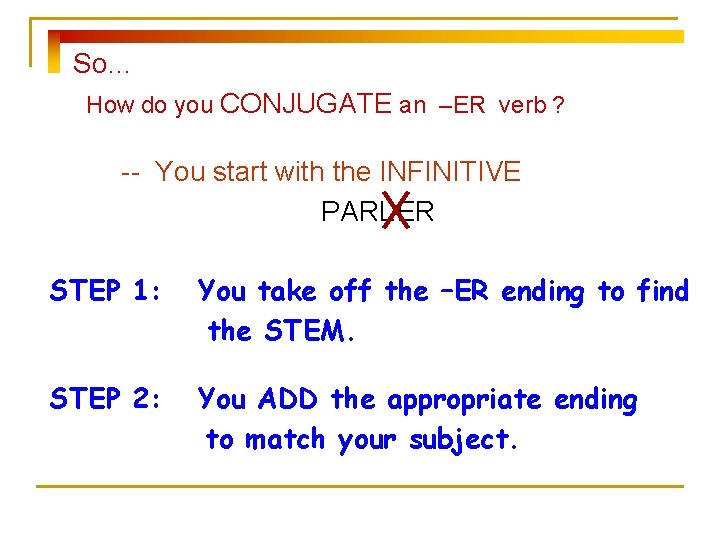
So… How do you CONJUGATE an –ER verb ? -- You start with the INFINITIVE PARL ER STEP 1: You take off the –ER ending to find the STEM. STEP 2: You ADD the appropriate ending to match your subject.
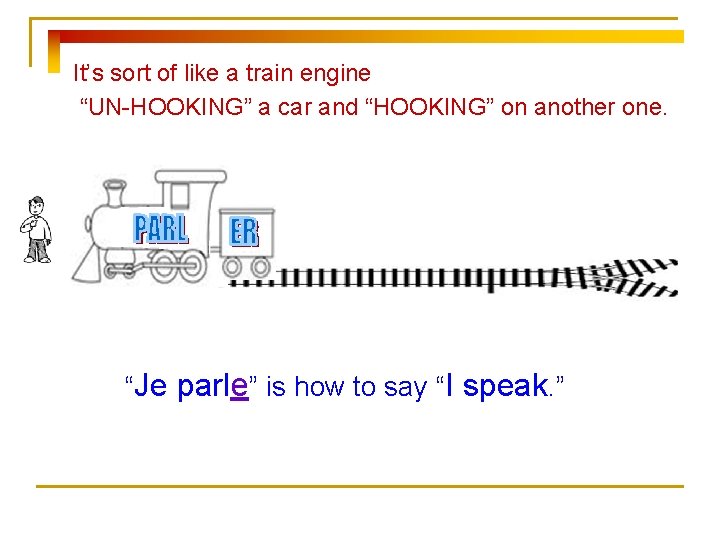
It’s sort of like a train engine “UN-HOOKING” a car and “HOOKING” on another one. “Je parle” is how to say “I speak. ”
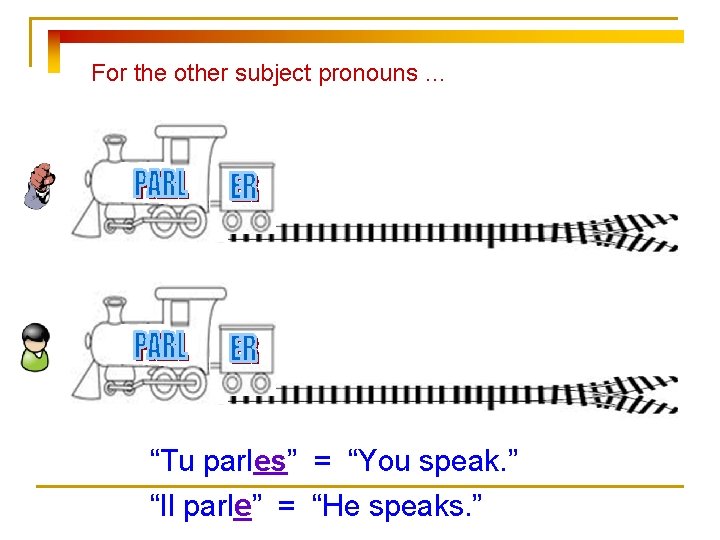
For the other subject pronouns … “Tu parles” = “You speak. ” “Il parle” = “He speaks. ”
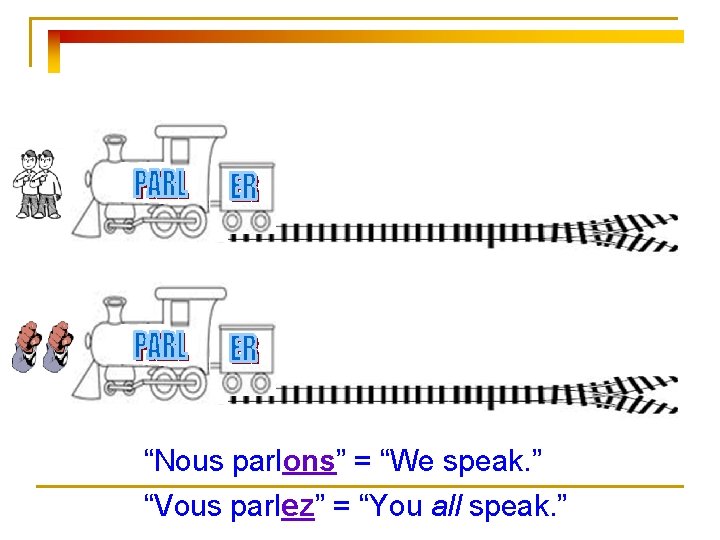
“Nous parlons” = “We speak. ” “Vous parlez” = “You all speak. ”
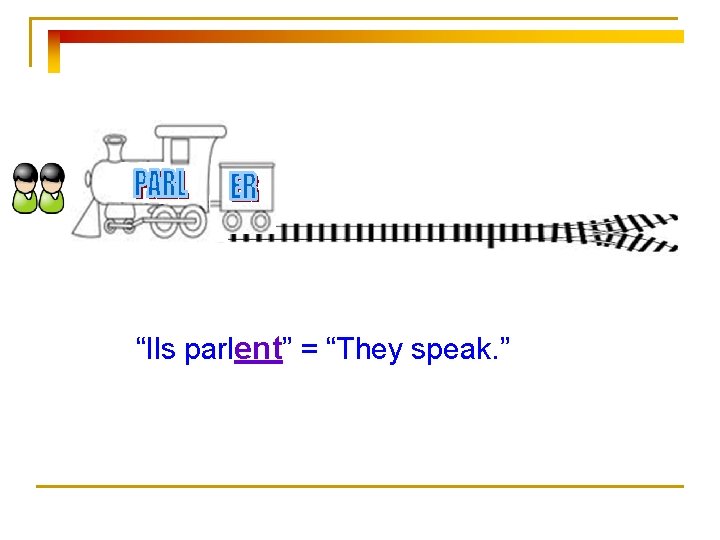
“Ils parlent” = “They speak. ”
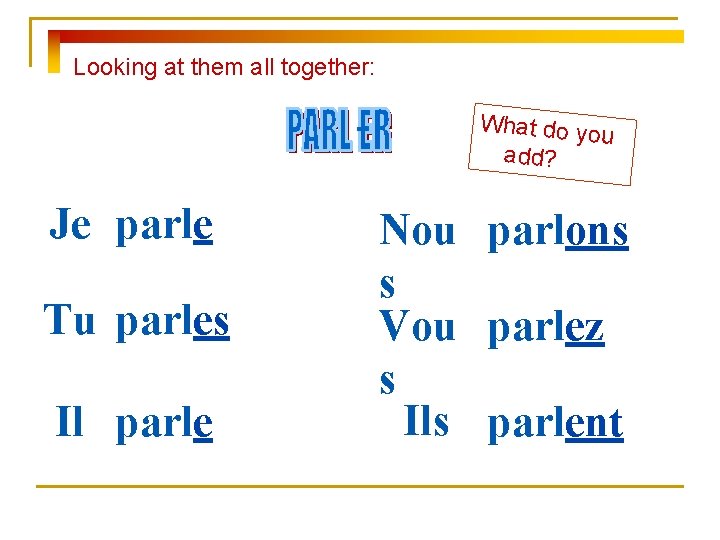
Looking at them all together: - Je parle Tu parles Il parle What do yo u add? Nou parlons s Vou parlez s Ils parlent
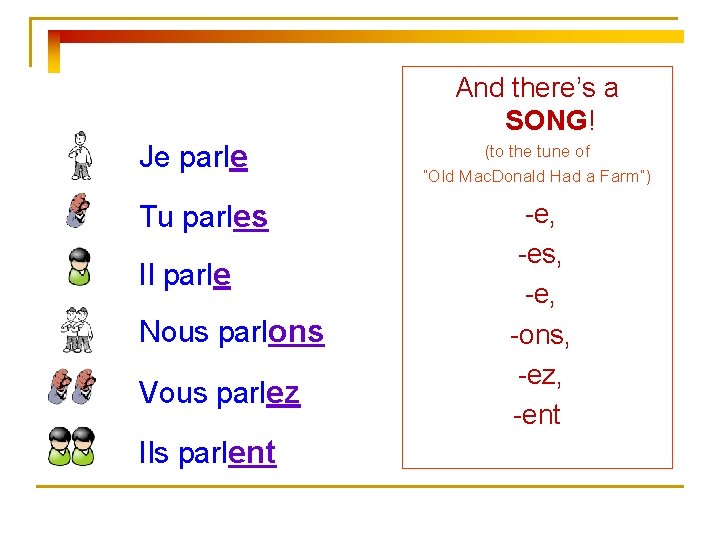
And there’s a SONG! Je parle Tu parles Il parle Nous parlons Vous parlez Ils parlent (to the tune of “Old Mac. Donald Had a Farm”) -e, -es, -e, -ons, -ez, -ent
Did we reach our target? - Do we understand what it means to conjugate a verb? - Do we know what an infinitive is? - Do we understand how to conjugate PARLER and other –er verbs for the six subject pronouns? (…once we memorize the endings? ) (Je, Tu, Il/Elle, Nous, Vous, Ils/Elles)
- Slides: 18