
Intro to Communication Week II Mass media etc

- Slides: 23
Intro to Communication Week II: Mass media, etc.
Examining: The Prison Industrial Complex • Agree or disagree? • Crime rates are going up. • The “War On Drugs” is necessary to stop violence and should be a priority. • Black people are more dangerous than Caucasians and Asians. • The main purpose of imprisonment is to keep communities safe and to rehabilitate people. • Running prisons costs the government a lot of money.
Examining: The Prison Industrial Complex • Agree or disagree? • Crime rates are going up. • The “War On Drugs” is necessary to stop violence and should be a priority. • Black people are more dangerous than Caucasians and Asians. • The main purpose of imprisonment is to keep communities safe and to rehabilitate people. • Running prisons costs the government a lot of money. • In general, these are the messages given by the media. Can you think of examples?
Examining: The Prison Industrial Complex Messages from media: • 1) Crime rates are going up • 2) “War on drugs” is to stop violence • 3) Blacks are suspicious
Examining: The Prison Industrial Complex PRISON INDUSTRIAL COMPLEX Reality: A study conducted by the Bureau of Justice in 2005 showed a record 33 -year continuous rise in the number of inmates in the United States despite falling crime rates.
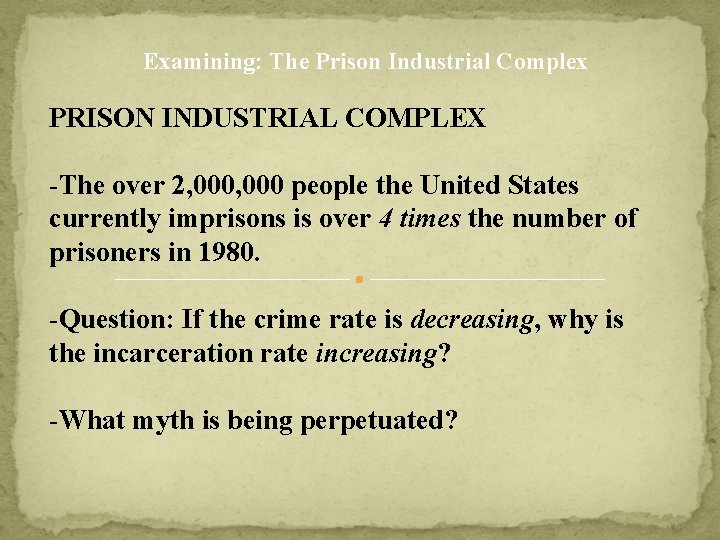
Examining: The Prison Industrial Complex PRISON INDUSTRIAL COMPLEX -The over 2, 000 people the United States currently imprisons is over 4 times the number of prisoners in 1980. -Question: If the crime rate is decreasing, why is the incarceration rate increasing? -What myth is being perpetuated?
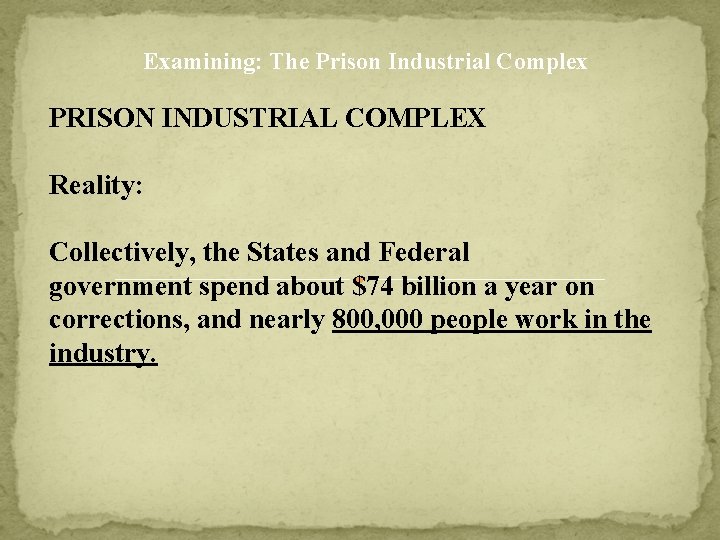
Examining: The Prison Industrial Complex PRISON INDUSTRIAL COMPLEX Reality: Collectively, the States and Federal government spend about $74 billion a year on corrections, and nearly 800, 000 people work in the industry.
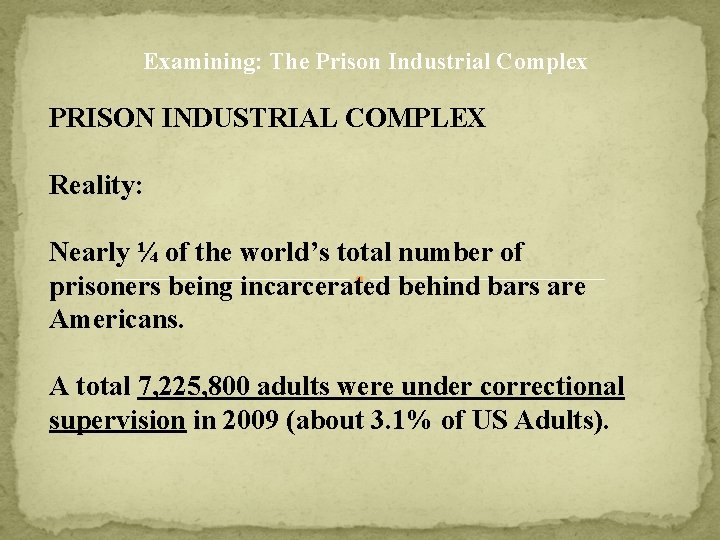
Examining: The Prison Industrial Complex PRISON INDUSTRIAL COMPLEX Reality: Nearly ¼ of the world’s total number of prisoners being incarcerated behind bars are Americans. A total 7, 225, 800 adults were under correctional supervision in 2009 (about 3. 1% of US Adults).
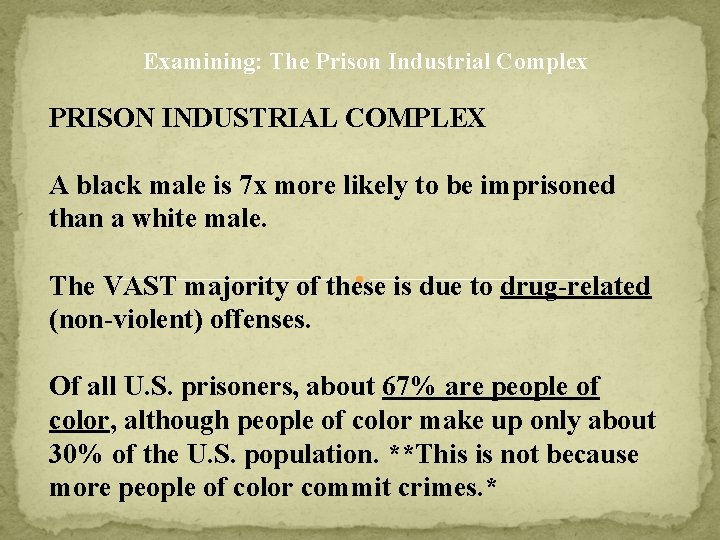
Examining: The Prison Industrial Complex PRISON INDUSTRIAL COMPLEX A black male is 7 x more likely to be imprisoned than a white male. The VAST majority of these is due to drug-related (non-violent) offenses. Of all U. S. prisoners, about 67% are people of color, although people of color make up only about 30% of the U. S. population. **This is not because more people of color commit crimes. *
Examining: The Prison Industrial Complex PRISON INDUSTRIAL COMPLEX The major myth associated with the Prison Industrial Complex is that the rise in incarceration rates reflects a commensurate rise in crime. The fact is that crime rates have fallen. In reality, the rise in incarceration rates reflects the fact that prison = big business, huge profits, and free labor from inmates.
Three theories on mass media
Mass Media Mass media as having two important sociological characteristics: 1)With MM, very few people can communicate to a great number 2)The audience has no effective way of answering back
Theory 1: Limited-Effects Theory • Constructed in the 1940’s • According to the limited-effects theory, people generally choose what to watch or read based on what they already believe • Therefore, media exerts a negligible influence on the beliefs of average people.
Theory 1: Limited-Effects Theory • Constructed in the 1940’s • According to the limited-effects theory, people generally choose what to watch or read based on what they already believe • Therefore, media exerts a negligible influence on the beliefs of average people. • What do you think about this theory? Do you agree? Why or why not?
Theory 1: Limited-Effects Theory • One objection of this theory is that it ignores the media's role in framing and limiting the discussion and debate of issues. • How media frames the debate and what questions members of the media ask change the outcome of the discussion and the possible conclusions people may draw.
Theory 2: Class-Dominant Theory • The class-dominant theory argues that the media reflects and projects the view of a minority elite, which controls it.
Theory 2: Class-Dominant Theory • The class-dominant theory argues that the media reflects and projects the view of a minority elite, which controls it. • Those who own and control the corporations that produce media comprise this elite.
Theory 2: Class-Dominant Theory • The class-dominant theory argues that the media reflects and projects the view of a minority elite, which controls it. • Those who own and control the corporations that produce media comprise this elite. • Advertising dollars fund media, and therefore control media.
Theory 2: Class-Dominant Theory • The class-dominant theory argues that the media reflects and projects the view of a minority elite, which controls it. • Those who own and control the corporations that produce media comprise this elite. • Advertising dollars fund media, and therefore control media. • Question: Who, specifically, controls the media? For example, who controls the news? • Mass corporations and their owners? • Or journalists?
Theory 3: Culturalist Theory • The culturalist theory combines the other two theories and claims that people interact with media to create their own meanings out of the images and messages they receive.
Theory 3: Culturalist Theory • The culturalist theory combines the other two theories and claims that people interact with media to create their own meanings out of the images and messages they receive. • This theory sees audiences as playing an active rather than passive role in relation to mass media.
Theory 3: Culturalist Theory • The culturalist theory combines the other two theories and claims that people interact with media to create their own meanings out of the images and messages they receive. • This theory sees audiences as playing an active rather than passive role in relation to mass media. • In other words, people draw their own conclusions based on their culture, background, experiences, etc. – but this does not mean they control the media.
Examining: Thank You For Smoking • Discuss the following clips from “Thank You For Smoking” https: //www. youtube. com/watch? v=Fkbdb. Rj. MX 2 Y • https: //www. youtube. com/watch? v=xua. HRN 7 Uh. Ro