
Intro to Biomechanics NUCCA PROTOCOLS AND PERSPECTIVES A
Intro to Biomechanics NUCCA PROTOCOLS AND PERSPECTIVES A TEXTBOOK OR THE NATIONAL UPPER CERVICAL CHIROPRACTIC ASSOCIATION ED: MICHAEL D. THOMAS
GOAL Stabilized state for a subluxation-free spinal column… “Is one in which the skull, spinal vertebrae, and pelvis are aligned and restored to their normal positions on the vertical axis of the body” “And in which all acting influences are canceled by other influences resulting in balance”

ORTHOGONALITY Head is 90° to the plane of atlas The plane of atlas is 90° to the neck
Laterality “A rotational, abnormal movement of C 1 about the condyles of occiput and about the sagittal axis of motion. Rotation is angular motion about an axis of motion. ”

Laterality Created by: Side Slip: Atlas misalign around the condylar circle by riding up the occipital condyles 2. Head Tilt: Occipital condyles ride down the superior articular surface of atlas 3. OR could be combination! 1.

Condylar and Axial Circles
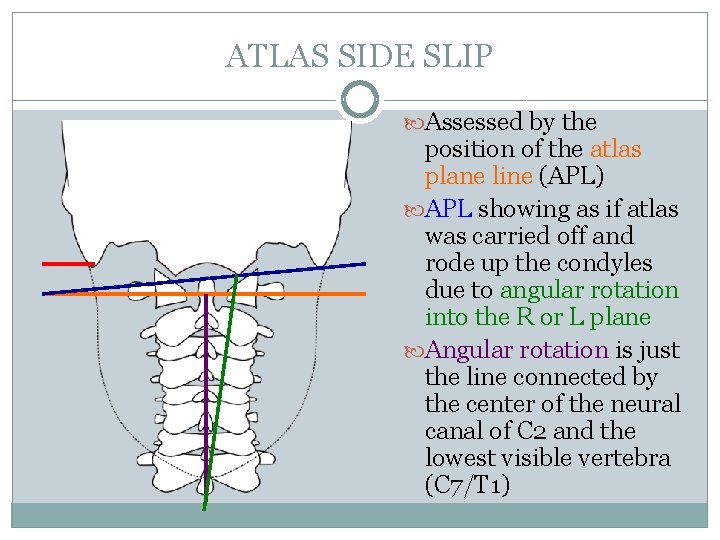
ATLAS SIDE SLIP Assessed by the position of the atlas plane line (APL) APL showing as if atlas was carried off and rode up the condyles due to angular rotation into the R or L plane Angular rotation is just the line connected by the center of the neural canal of C 2 and the lowest visible vertebra (C 7/T 1)
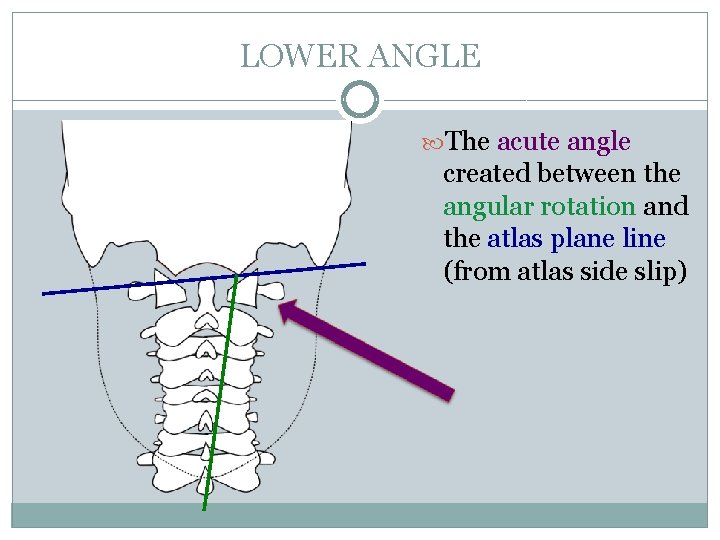
LOWER ANGLE The acute angle created between the angular rotation and the atlas plane line (from atlas side slip)

HEAD TILT Assessed by the central skull line’s relationship to the normal vertical axis. Head tilt created when occipital condyles ride down on the superior articulating surface of C 1
Misalignment Creates Resistance: Any force that tends to oppose (or slow down) motion Created by: Head Determined by size of condylar circle Degree of head tilt Neck Determined by size of axial circle Degree of lower angle created by angular rotation
Misalignment Creates Resistance The larger (or flatter) the circle = LESS or MORE resistance? Normally axial circle > condylar circle Greater degree of angle of head tilt or lower angle = LESS OR MORE resistance? Varies between the types which contributes more resistance
Leverage Resistance can be overcome by leverage Raise the height vector to Increase leverage into the NECK If axial circle > condylar circle If lower angle > head tilt Lower the height vector to Increase leverage into the HEAD If axial circle < condylar circle If head tilt > lower angle
Leverage Special Cases C 2 Spinous Rotation If into the side of laterality it will INCREASE resistance Need to INCREASE height vector (as well as rotation vector , proportionally)
NUCCA Misalignment Patterns Distribution of 4 Basic Types Type 1 Type 2 Type 3 Type 4 52% 23% 7% 18%
- Slides: 14