
Intro to Beowulf Background Info Beowulf is to
Intro to “Beowulf”
Background Info § Beowulf is to England what Homer’s Iliad and Odyssey are to ancient Greece § It is important because it is the first great work of the English national literatureshows the beginnings of English civilization
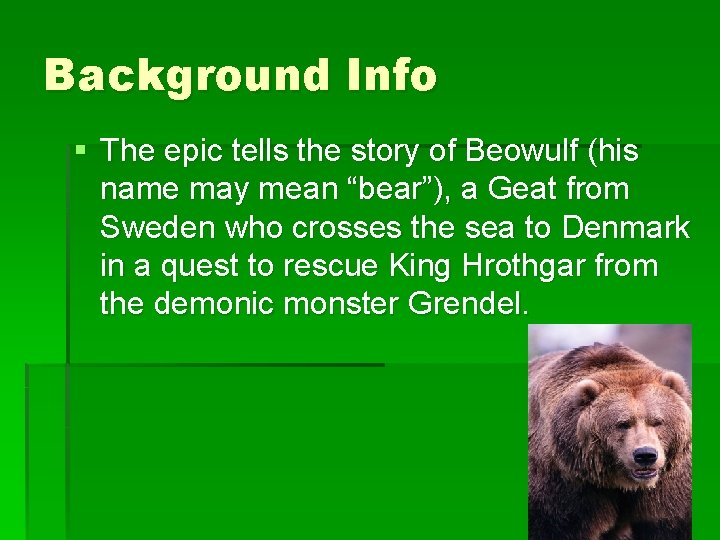
Background Info § The epic tells the story of Beowulf (his name may mean “bear”), a Geat from Sweden who crosses the sea to Denmark in a quest to rescue King Hrothgar from the demonic monster Grendel.
Background Info § Beowulf is oral art (a. k. a. ) oral epic-heroic story passed down from generation to generation § It was composed in Old English, probably in Northumbria in northeast England, sometime between the years 700 and 750.
Background Info § Scene-Northumbria § Many Christian references, so it could have been written by a monk

Beowulf: People, Monsters, and Places § Beowulf: a Geat, son of Edgetho and nephew of Higlac, king of the Geats. Higlac is both Beowulf’s feudal lord and his uncle. http: //img. dailymail. co. uk/i/pix/2007/07_02/beowulf 2 SCPE 2507_468 x 322. jpg
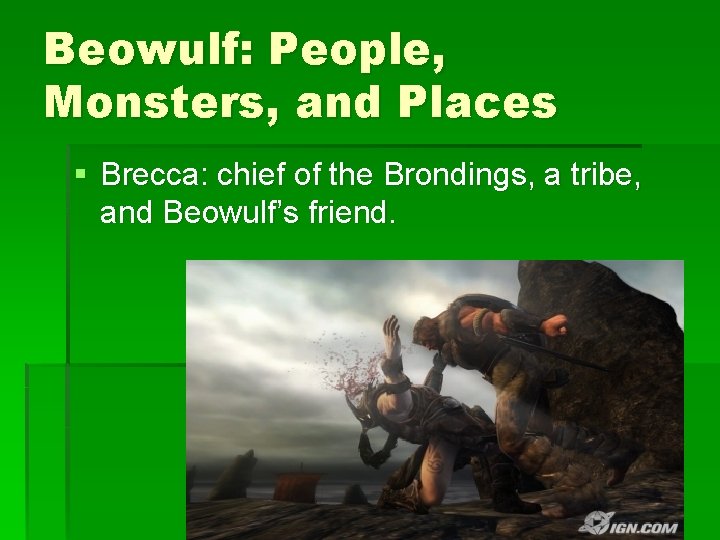
Beowulf: People, Monsters, and Places § Brecca: chief of the Brondings, a tribe, and Beowulf’s friend.
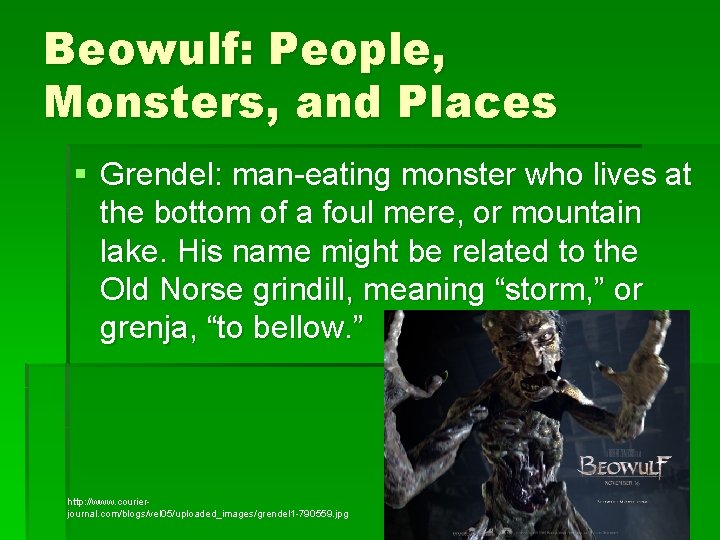
Beowulf: People, Monsters, and Places § Grendel: man-eating monster who lives at the bottom of a foul mere, or mountain lake. His name might be related to the Old Norse grindill, meaning “storm, ” or grenja, “to bellow. ” http: //www. courierjournal. com/blogs/vel 05/uploaded_images/grendel 1 -790559. jpg
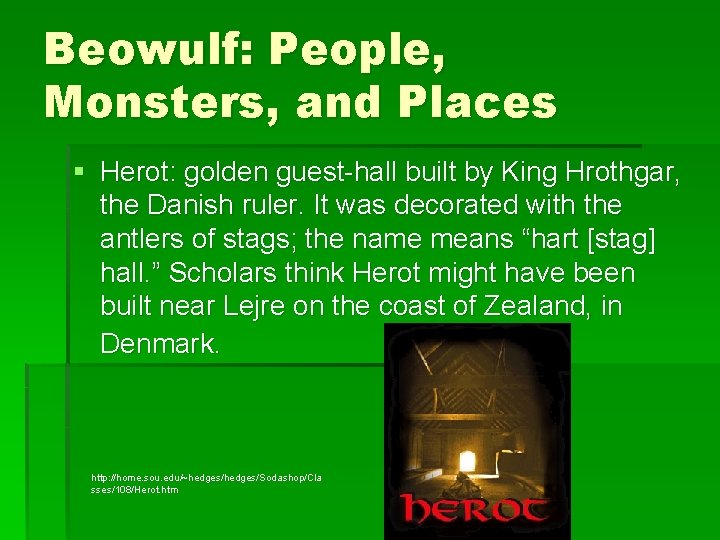
Beowulf: People, Monsters, and Places § Herot: golden guest-hall built by King Hrothgar, the Danish ruler. It was decorated with the antlers of stags; the name means “hart [stag] hall. ” Scholars think Herot might have been built near Lejre on the coast of Zealand, in Denmark. http: //home. sou. edu/~hedges/Sodashop/Cla sses/108/Herot. htm
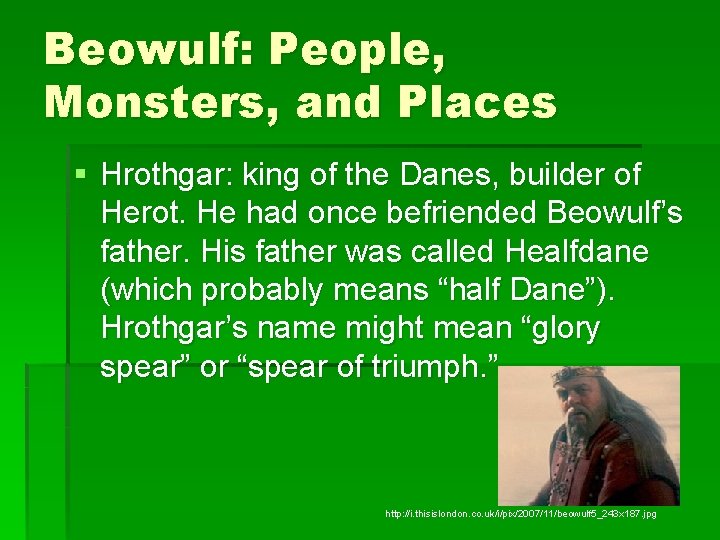
Beowulf: People, Monsters, and Places § Hrothgar: king of the Danes, builder of Herot. He had once befriended Beowulf’s father. His father was called Healfdane (which probably means “half Dane”). Hrothgar’s name might mean “glory spear” or “spear of triumph. ” http: //i. thisislondon. co. uk/i/pix/2007/11/beowulf 5_243 x 187. jpg
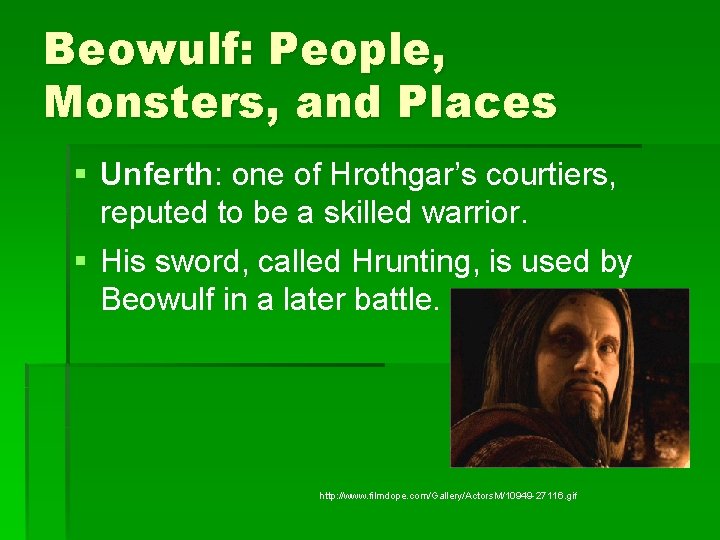
Beowulf: People, Monsters, and Places § Unferth: one of Hrothgar’s courtiers, reputed to be a skilled warrior. § His sword, called Hrunting, is used by Beowulf in a later battle. http: //www. filmdope. com/Gallery/Actors. M/10949 -27116. gif
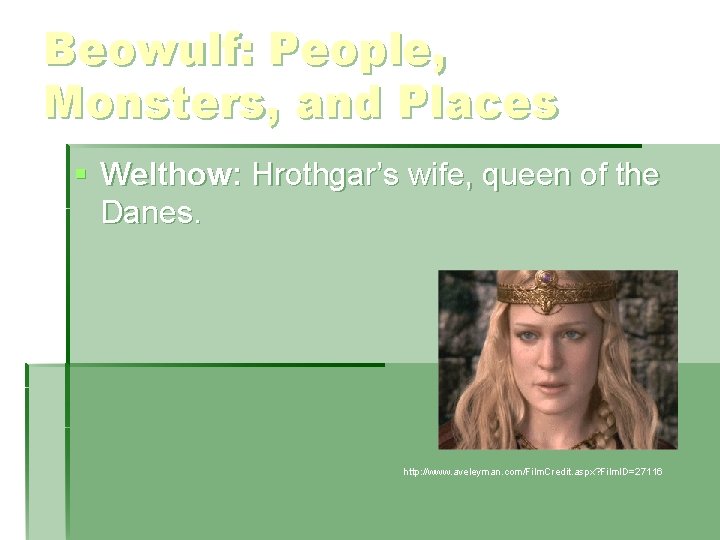
Beowulf: People, Monsters, and Places § Welthow: Hrothgar’s wife, queen of the Danes. http: //www. aveleyman. com/Film. Credit. aspx? Film. ID=27116
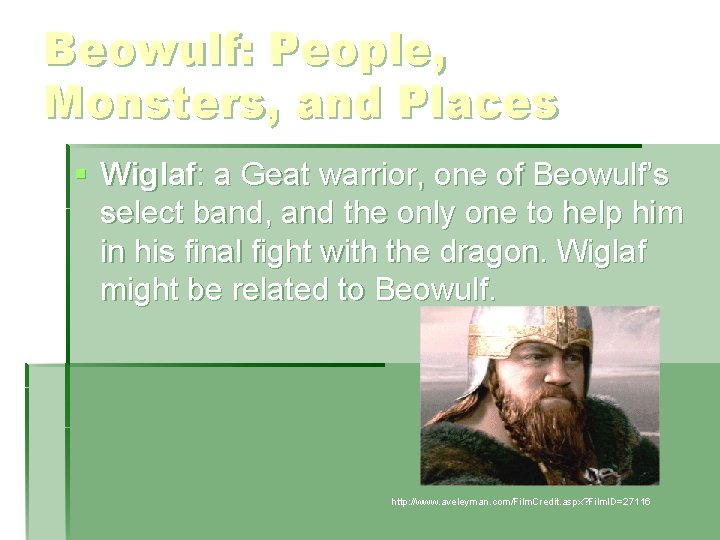
Beowulf: People, Monsters, and Places § Wiglaf: a Geat warrior, one of Beowulf’s select band, and the only one to help him in his final fight with the dragon. Wiglaf might be related to Beowulf. http: //www. aveleyman. com/Film. Credit. aspx? Film. ID=27116
The Epic Hero § Beowulf, like all epic heroes, has superior physical strength and is supremely ethical. In his quest, he must defeat monsters that embody dark, destructive powers. At the end of the quest, he is glorified by the people he has saved.
The Epic Hero § The epic hero is the central figure in a long narrative that reflects the values and heroic ideals of a particular society. § An epic is a quest story on a grand scale.
Quickwrite § Take notes on three contemporary fictional heroes from novels, films, or even comics or television. § Spiderman, Obama, Justin Morneau, Princess Diana
Quickwrite § Pick one of them, and briefly analyze him or her using these questions: • What sort of evil or oppression do they confront? • Why do they do it? What’s their motivation? • For whom do they do it? • What virtues do they represent?
Quickwrite § Now discuss some of the heroes you and your classmates chose. Do they all seem to qualify as hero-types, or do some of them fall short in one way or another?
Resources § http: //www. nexuslearning. net/books/Elem ents_of_Lit_Course 6/Anglo_Saxon_Perio d/Beowulf%20 Intro. htm
- Slides: 19