
Intro to Basic Fire Alarm Technology Silent Knight
Intro to Basic Fire Alarm Technology Silent Knight : : 7550 Meridian Circle : : Maple Grove, MN 55369 : : 800 -328 -0103
Basic Fire Let’s examine the components that make a basic Fire Alarm Control System.
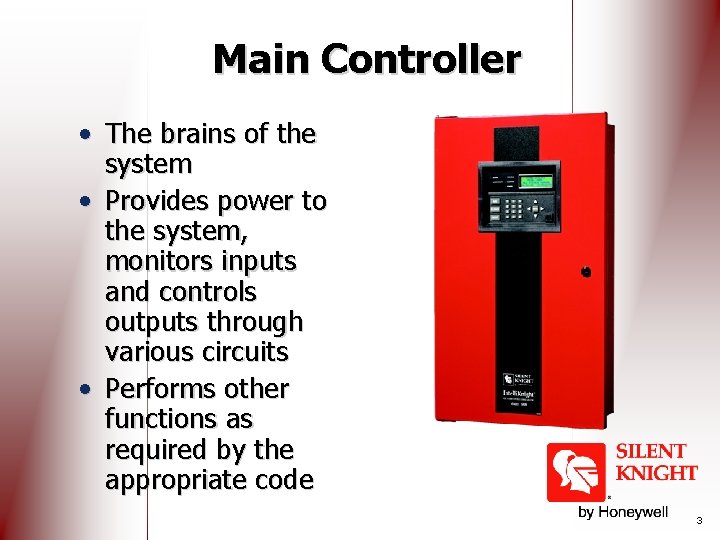
Main Controller • The brains of the system • Provides power to the system, monitors inputs and controls outputs through various circuits • Performs other functions as required by the appropriate code 3
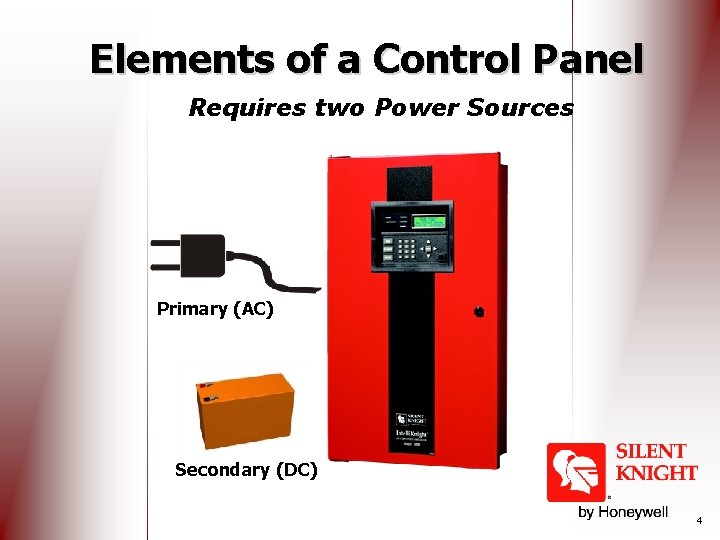
Elements of a Control Panel Requires two Power Sources Primary (AC) Secondary (DC) 4
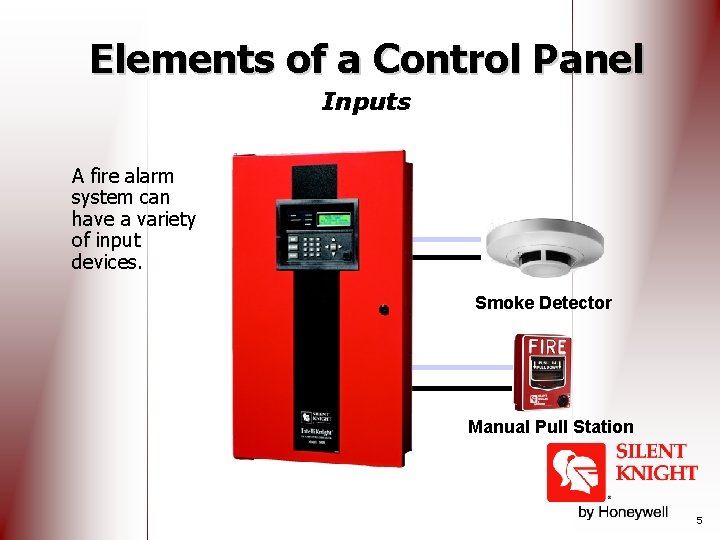
Elements of a Control Panel Inputs A fire alarm system can have a variety of input devices. Smoke Detector Manual Pull Station 5

Inputs • Initiating Device: A system component that originates transmission of a change of state condition, such as a smoke detector, manual fire alarm box, supervisory switch, etc. . . • Initiating Device Circuit (IDC): A circuit to which automatic or manual initiating devices are connected where the signal received does not identify the individual device operated 6
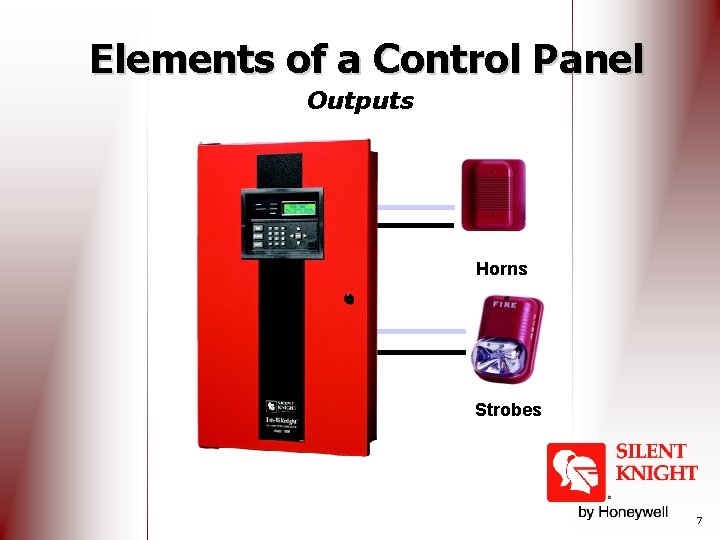
Elements of a Control Panel Outputs Horns Strobes 7
Outputs • Notification Appliance: A fire alarm system component such as a bell, horn, speaker, light, or text display that provides audible, tactile, or visible output, or any combination thereof. • Notification Appliance Circuit: A circuit or path directly connected to a notification appliance. 8
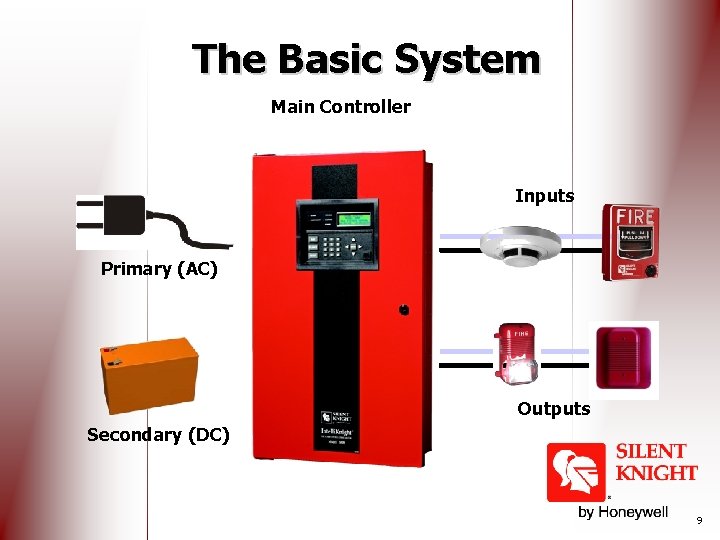
The Basic System Main Controller Inputs Primary (AC) Outputs Secondary (DC) 9

Basic Fire Alarm Technology • Signal Initiation/Initiating Devices § Need to understand stages of fire and what technology works best for each 10
The Stages of a Fire • Stage One § Incipient: Products of Combustion particles are produced (<0. 3 microns). No visible smoke or detectable heat. May occur for milliseconds or days. • Use ionization detectors 11
The Stages of a Fire • Stage Two § Smoldering: Visible smoke particles are produced (>0. 3 microns). Little visible flame or noticeable heat. • Use Photoelectric Detectors 12
The Stages of a Fire • Stage Three § Flame: Rapid combustion produces radiant energy in the visible, and invisible (IR, UV) spectrums. Heat begins to buildup at this stage • Use Spark or Flame Detectors 13
The Stages of a Fire • Stage Four § High Heat: Uncontrolled combustion is caused by the heating of nearby combustibles to their ignition point. • Use Heat Detectors § Note! Major disadvantages of using thermal energy for fire identification are • Takes a while for a fire to be recognized • The toxic gases that are produced before an alarm point is reached 14

Types of Detectors • Photoelectric § Light Scattering § Light Obscuration • Ionization • Duct • Heat (Thermal) 15
Photoelectric Smoke Detectors: Light-Scattering Type • Uses a Light-Emitting Diode (LED) that sends a beam of light into a dark chamber- a photo diode sits on the other side of a partition within the chamber • Smoke particles entering the chamber deflect some of the light rays into the photo cell. The photo cell generates a current when exposed to light, and if the current reaches a certain level, the detector alarms. 16
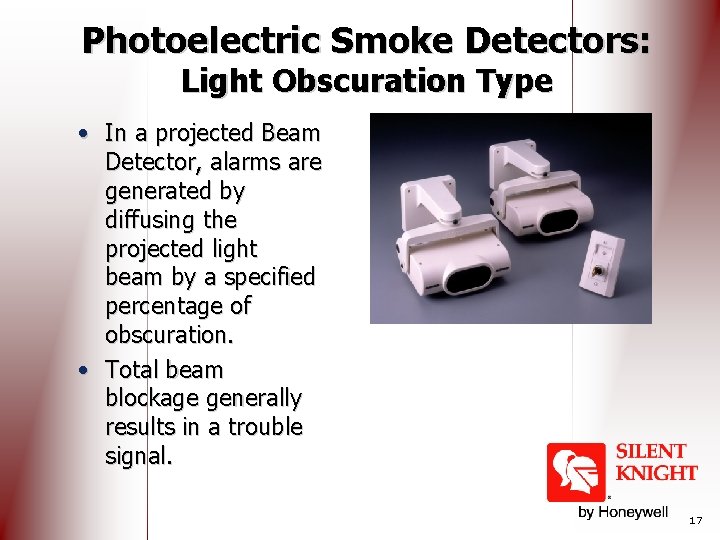
Photoelectric Smoke Detectors: Light Obscuration Type • In a projected Beam Detector, alarms are generated by diffusing the projected light beam by a specified percentage of obscuration. • Total beam blockage generally results in a trouble signal. 17
Ionization Smoke Detectors • Contain a small amount of radioactive material encapsulated in a metal chamber. Ionizing radiation develops a low, but steady electrical current. Smoke particles entering the chamber disrupt the current and trigger the detector's alarm. • Ion detectors react more quickly to fast flaming fires that give off little smoke. 18
Heat Detectors • Fixed Detectors: § Alarm when the sensing element reaches a certain set point. § Two common models have 135 and 200 -degrees F range. § Fixed element is generally a non-restorable type, and when activated, must be replaced. • Rate-of-Rise Detectors: § Respond when the rate of temperature increase is greater than an allowable limit (15 degrees in 60 secs. ) (placement in a stable environment) (e. g. . ovens, heating vents, etc. ). § The Rate-of-Rise element is restorable when conditions return to normal. • Rate Compensation will respond regardless of the rate of temperature rise. 19
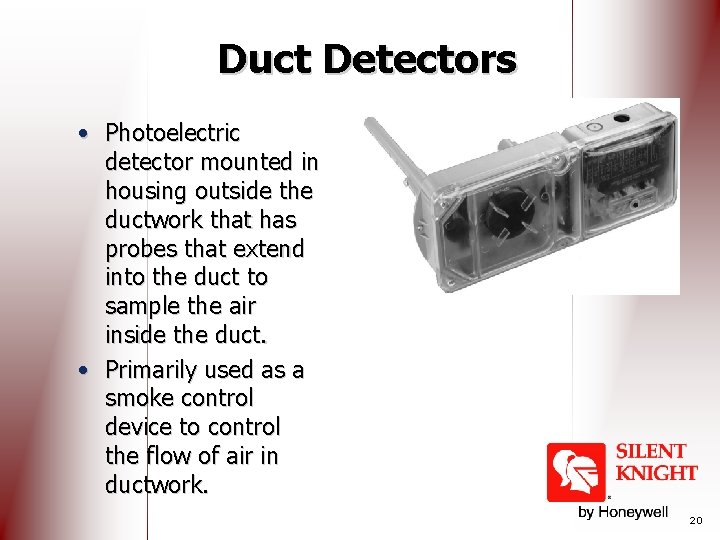
Duct Detectors • Photoelectric detector mounted in housing outside the ductwork that has probes that extend into the duct to sample the air inside the duct. • Primarily used as a smoke control device to control the flow of air in ductwork. 20
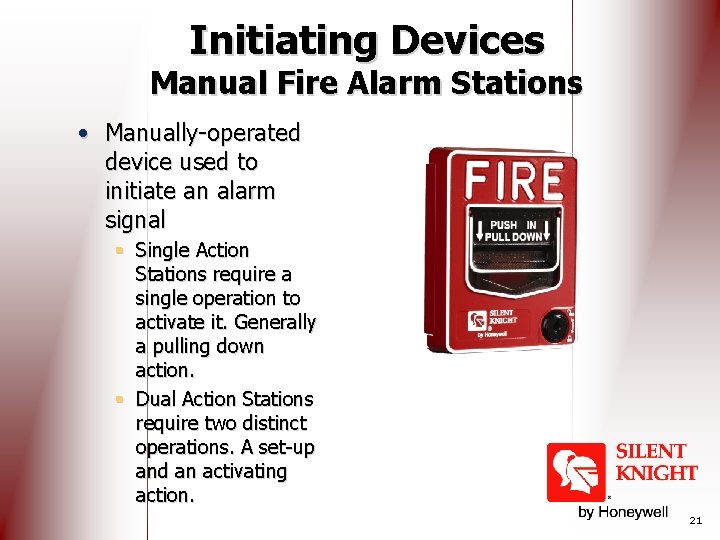
Initiating Devices Manual Fire Alarm Stations • Manually-operated device used to initiate an alarm signal § Single Action Stations require a single operation to activate it. Generally a pulling down action. § Dual Action Stations require two distinct operations. A set-up and an activating action. 21
Notification Appliances Types • Audible - Horns, Bells, Sounders, Sirens, Chimes, Speakers • Visual - Strobes • Physical - Bed shakers • Olfactory - Smell 22
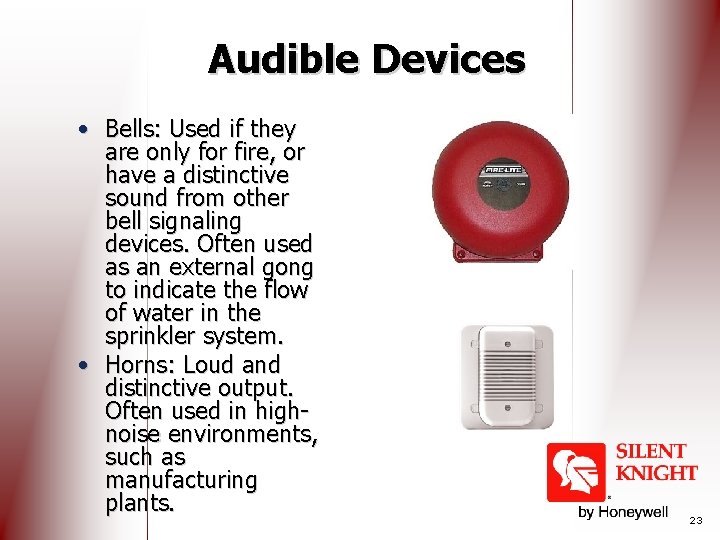
Audible Devices • Bells: Used if they are only for fire, or have a distinctive sound from other bell signaling devices. Often used as an external gong to indicate the flow of water in the sprinkler system. • Horns: Loud and distinctive output. Often used in highnoise environments, such as manufacturing plants. 23
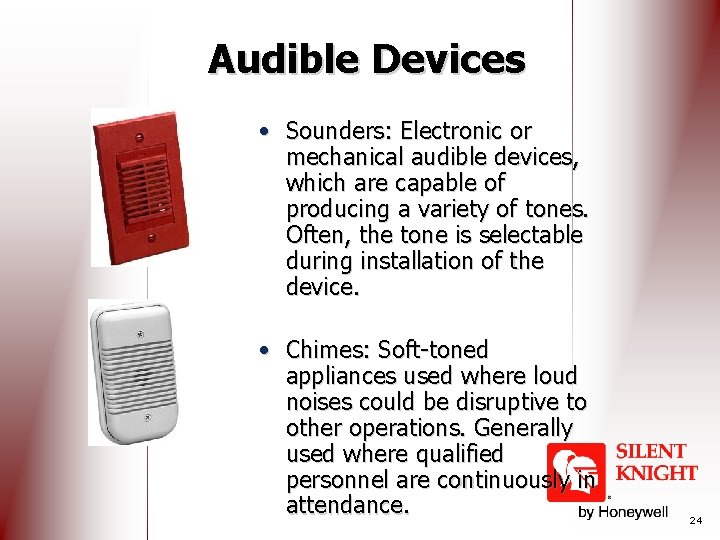
Audible Devices • Sounders: Electronic or mechanical audible devices, which are capable of producing a variety of tones. Often, the tone is selectable during installation of the device. • Chimes: Soft-toned appliances used where loud noises could be disruptive to other operations. Generally used where qualified personnel are continuously in attendance. 24
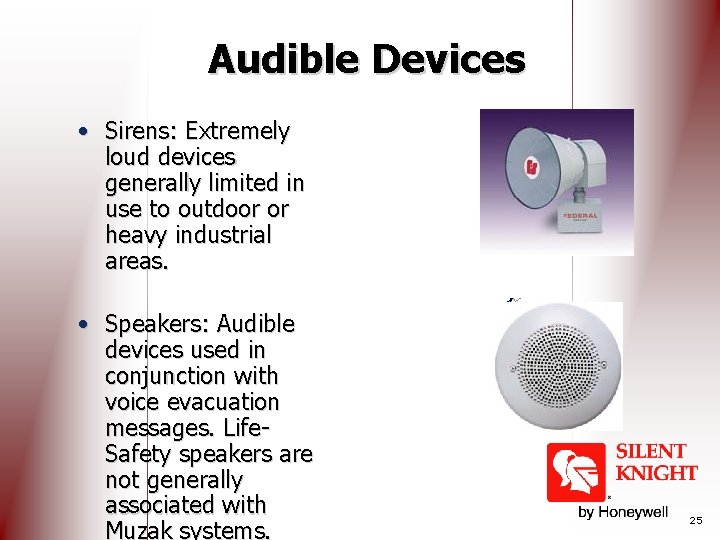
Audible Devices • Sirens: Extremely loud devices generally limited in use to outdoor or heavy industrial areas. • Speakers: Audible devices used in conjunction with voice evacuation messages. Life. Safety speakers are not generally associated with Muzak systems. 25
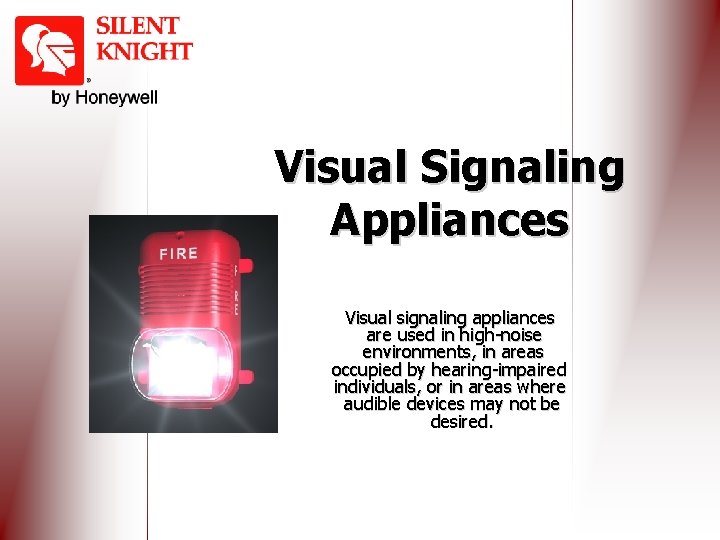
Visual Signaling Appliances Visual signaling appliances are used in high-noise environments, in areas occupied by hearing-impaired individuals, or in areas where audible devices may not be desired.
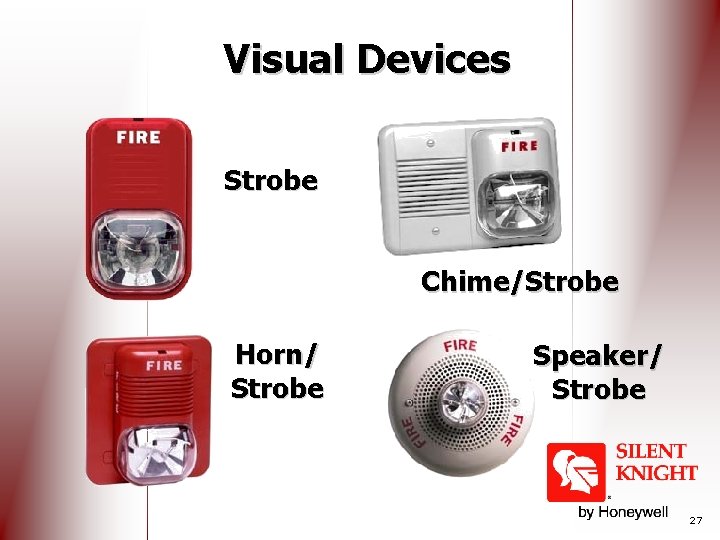
Visual Devices Strobe Chime/Strobe Horn/ Strobe Speaker/ Strobe 27
The Fire Alarm Systems
Types of Fire Alarm Control Panels • Conventional (hard wired) § Fixed § Programmable • Addressable (multiplexed) • Intelligent (analog data transfer) 29
Conventional “Hard Wired” System • Simplest type of control unit. • Generally, a single circuit board contains power supply, control, initiating and notification circuitry. • Some models use auxiliary circuit boards to perform special functions. • Input/output devices connect to dedicated circuits. • Designated outputs occur when initiating signals are received. • Limited special functions and capabilities. 30
Conventional “Programmable” System • Basic “Designed System” • Components selected by the designer to meet the direct needs of the customer. • Initiating circuits are programmable for fire, waterflow, supervisory service, etc. • Output circuits are programmable for code selection and silenceability. • On some systems, input-to-output CIRCUIT (not device) mapping. 31
Addressable System • Each device (detector, pull station…) has a unique number assigned to it called the address for reporting alarms and troubles. • Employs a Signaling Line Circuit (SLC) Loop along which all addressable input and output devices are connected to the fire alarm control panel. • Addressable devices transmit an electronic message back to the Control Unit representing their state (Normal, Alarm, Trouble) when polled by the Control Unit. 32
Analog System • Always an Addressable System. • Processes detailed, analog data from detectors about smoke levels. • Can provide sensitivity data for each detector. • Employs Drift Compensation (self calibration) in its detectors. 33
Terminology • • • FACP - Fire Alarm Control Panel. FACU - Fire Alarm Control Unit. FCC - Federal Communications Commission UL - Underwriters Laboratories NFPA - National Fire Protection Agency. AHJ, LAHJ - Authority Having Jurisdiction, Local AHJ ADAAG - Americans with Disabilities Act Accessibility Guidelines. Po. C - Products of Combustion LED - Light Emitting Diode IDC - Initiating Device Circuit NAC - Notification Appliance Circuit ELR, EOL - End of Line Resistor 34
Terminology • • • NEC - National Electrical Code (NFPA 70) NEMA - National Electrical Manufacturing Association EIA - Electronics Industry Association Cd - Candela d. B, d. BA - Decibels FWR - Full Wave Rectified ANSI - American National Standards Institute PIV - Post Indicator Valve OS&Y - Outside Stem and Yoke Valves SFPE - Society for Fire Protection Engineers Shall - Indicates a mandatory requirement Should - Indicates a recommendation or advisement 35
References • • NFPA 70 - National Electrical Code NFPA 72 - National Fire Alarm Code NFPA 101 - Life Safety Code National Electrical Code Handbook, NFPA • Life Safety Code Handbook, NFPA • Fire Protection Handbook, NFPA • Fire Alarm Signaling Systems, NFPA 36
Basic Fire Alarm Technology Please visit www. farenhyt. com for fire alarm system solutions for your facility Silent Knight : : 7550 Meridian Circle : : Maple Grove, MN 55369 : : 800 -328 -0103
- Slides: 37