
Intro to Annotated Bibliography using Wavelength the Purdue
Intro to Annotated Bibliography (using Wavelength, the Purdue OWL, and They Say/I Say) Dr. Loper
Annotated Bibliography • Read the sample annotated bibliographies in Wavelength • Based on this sample, make a list of the key features of an annotated bibliography. Each person should take notes. Consider the following: – What each entry contains – Tone/language used – How sources are used – Conclusion – Where you think this writer is going next
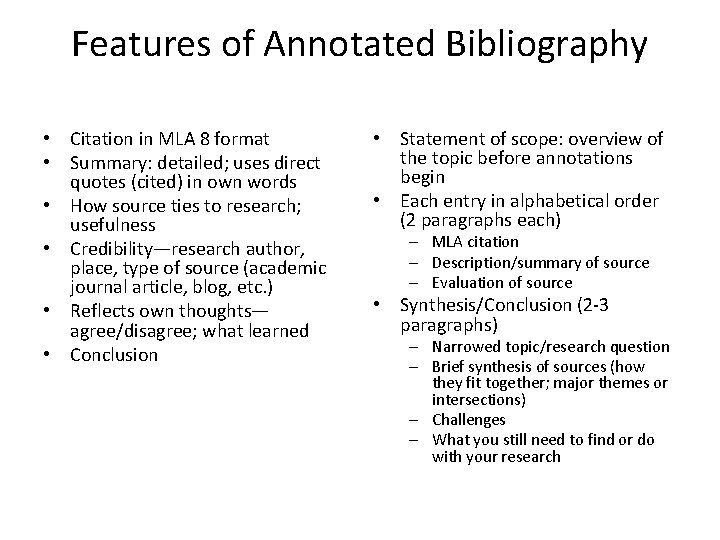
Features of Annotated Bibliography • Citation in MLA 8 format • Summary: detailed; uses direct quotes (cited) in own words • How source ties to research; usefulness • Credibility—research author, place, type of source (academic journal article, blog, etc. ) • Reflects own thoughts— agree/disagree; what learned • Conclusion • Statement of scope: overview of the topic before annotations begin • Each entry in alphabetical order (2 paragraphs each) – MLA citation – Description/summary of source – Evaluation of source • Synthesis/Conclusion (2 -3 paragraphs) – Narrowed topic/research question – Brief synthesis of sources (how they fit together; major themes or intersections) – Challenges – What you still need to find or do with your research
Evaluating Sources • How do you know if a source is reliable and relevant for your topic? • How can you find a variety of viewpoints for your essay? • How can knowing the rhetorical situation of a piece help you assess it? • What type of sources should be off limits?
Using sources • Overview of They Say / I Say and what we’re moving toward in this paper. • Read through the templates and highlight or mark ones that you’d like to try. • Using the source you brought for today, write a one-paragraph summary with at least one quotation. Use the templates for integrating the quote into the surrounding sentences. • Then, write a one-paragraph response/evaluation of the source. See the samples in Wavelength.
Writing • Write what you know about your topic so far. It can be: – Freewrite (paragraph or so) – List – Cluster/map with bubbles/circles or tree with branches – Answer questions Who? What? When? Where? Why? How?
Evaluating Sources • Get into small groups (3 -4 people). • Go to the website dhmo. org and determine whether it’s credible. Make a list with two columns: 1. What are some things that make it appear credible? 2. What are some things that make you question its credibility?

Work on your Annotations • Last class, you wrote a one-paragraph response/evaluation of the source. If you need to revise it, go ahead and do so. • Then, add an MLA-style citation using the guidelines from the Purdue OWL.
Essay 1 Reflection • View my comments and answer the following: 1. What did you do well? What are your strengths? 2. What do you need to improve on? 3. How can you improve on these things in the annotated bibliography? Be specific about what you will do. 4. What other goals do you have moving forward in this class? How will you accomplish them?
Group Work: Sample Annotated Bibliographies • Look at the sample annotated bibliographies in Wavelength. – List at least three things they have in common. Be specific. – List at least three areas where they differ. • Then, look at Ashley’s Annotated Bib. How does hers overlap with or differ from the other two? • Write a paragraph in which you compare/contrast the three annotated bibliographies.
Peer Review • Answer the following for each draft, which should have 5 -6 source entries: – What is the author’s research question? – Is there an opening statement of scope/topic overview? – Are all citations correct? Refer to the MLA section shown in the Purdue OWL. If not, offer suggestions for fixing citations. – Does each entry start with a summary? Does each summary have at least one quotation? Are quotations integrated into sentences, with in-text citations for page numbers? Suggest revisions. – Does each entry have a second paragraph of analysis/response/how student will use the source? Suggest revisions for these paragraphs. • When you finish, work on revising your draft and adding synthesis section at the end.

- Slides: 12