
Intro to Acids Bases Properties of Acids Bases
Intro to Acids & Bases
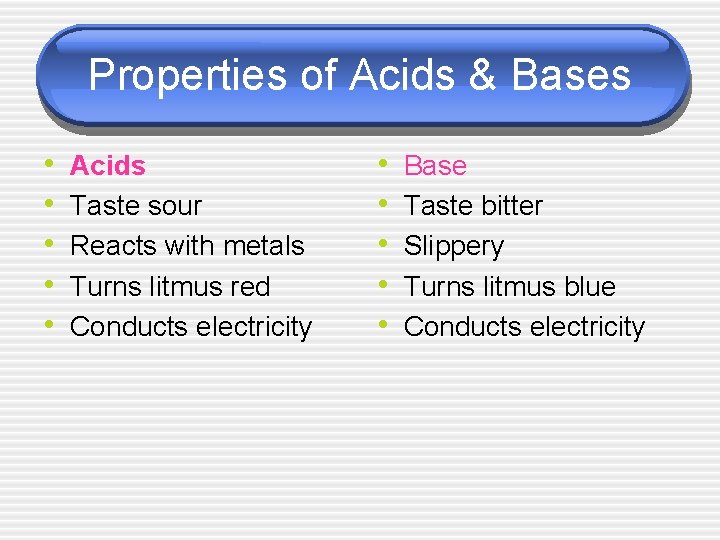
Properties of Acids & Bases • • • Acids Taste sour Reacts with metals Turns litmus red Conducts electricity • • • Base Taste bitter Slippery Turns litmus blue Conducts electricity
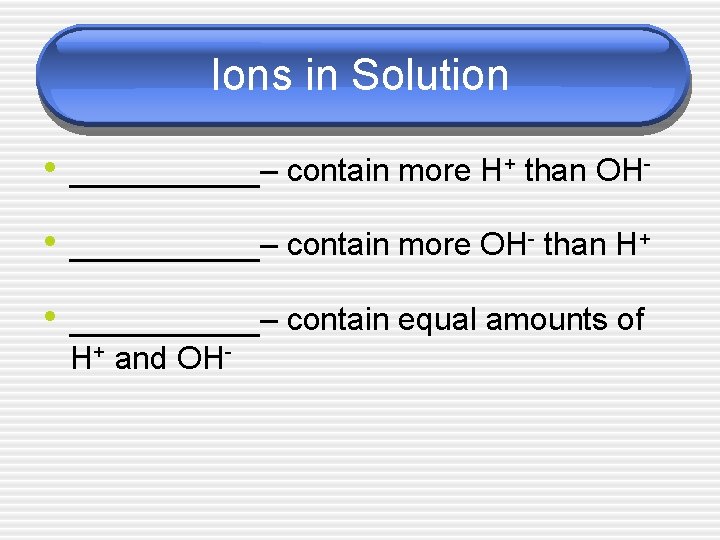
Ions in Solution • _____– contain more H+ than OH • _____– contain more OH- than H+ • _____– contain equal amounts of H+ and OH-
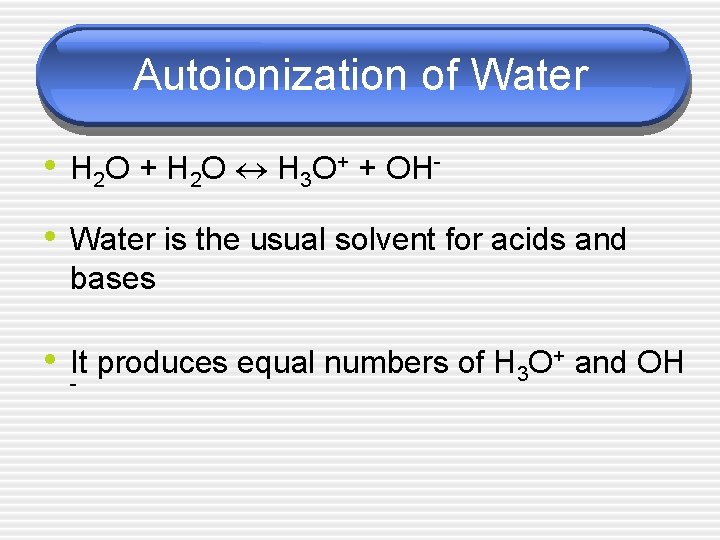
Autoionization of Water • H 2 O + H 2 O H 3 O+ + OH • Water is the usual solvent for acids and bases • It- produces equal numbers of H 3 O+ and OH
Arrhenius Model of Acids & Bases • _____ - a substance that contains H and ionized to produce H+ when dissolved in water. • _____ -a substance that contains OH and ionizes to produce OH- when dissolved in water
Arrhenius Model of Acids & Bases • HCl • Na. OH
Arrhenius Model of Acids & Bases • Although the Arrhenius model is useful in describing many acids and bases, it does not describe them all • For example NH 3 contains no OH- ions, but it is a base
Bronsted-Lowry Model • _____ - proton donor • _____ - proton acceptor
Bronsted-Lowry Model • _____– the species produced when a base accepts the H+ ion from the acid • _____– the species produced when the acid gives up its H+
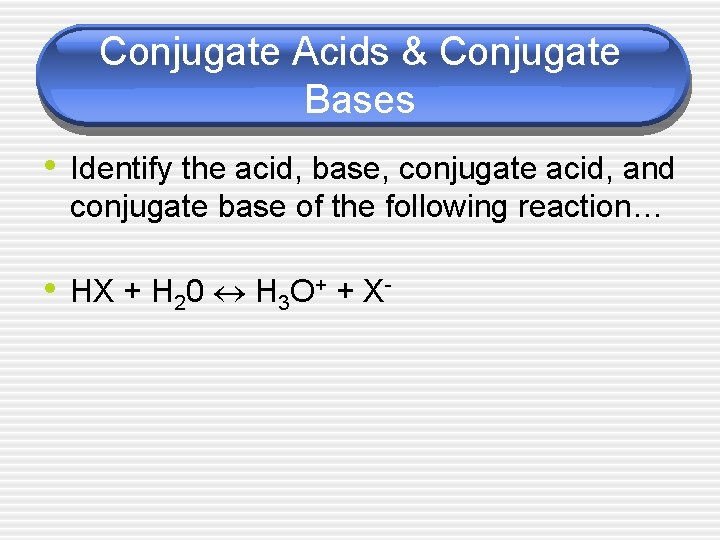
Conjugate Acids & Conjugate Bases • Identify the acid, base, conjugate acid, and conjugate base of the following reaction… • HX + H 20 H 3 O+ + X-
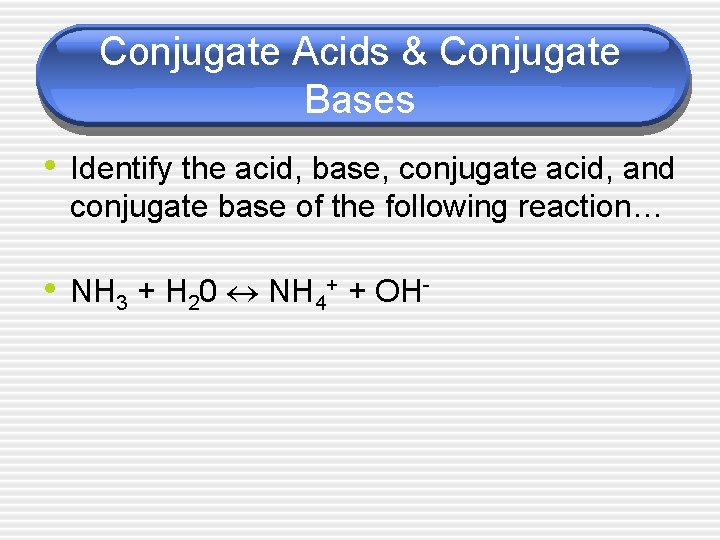
Conjugate Acids & Conjugate Bases • Identify the acid, base, conjugate acid, and conjugate base of the following reaction… • NH 3 + H 20 NH 4+ + OH-
Conjugate Acids & Conjugate Bases • _____– substance that can act as either an acid or a base
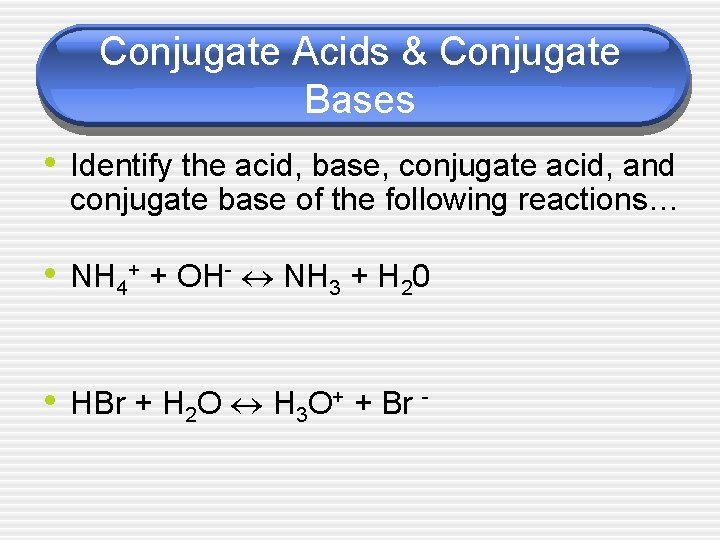
Conjugate Acids & Conjugate Bases • Identify the acid, base, conjugate acid, and conjugate base of the following reactions… • NH 4+ + OH- NH 3 + H 20 • HBr + H 2 O H 3 O+ + Br -
![The p. H Scale • [H+] is often expressed in very small numbers. •](http://slidetodoc.com/presentation_image/59856a8f5dd9ce0dc673ec2835796203/image-14.jpg "The p. H Scale • [H+] is often expressed in very small numbers. •")
The p. H Scale • [H+] is often expressed in very small numbers. • _____ is a mathematical scale in • which the concentration of hydronium ions in a solution is expressed as a number from 0 to 14. p. H = -log[H+] or p. H = -log[H 3 O+]
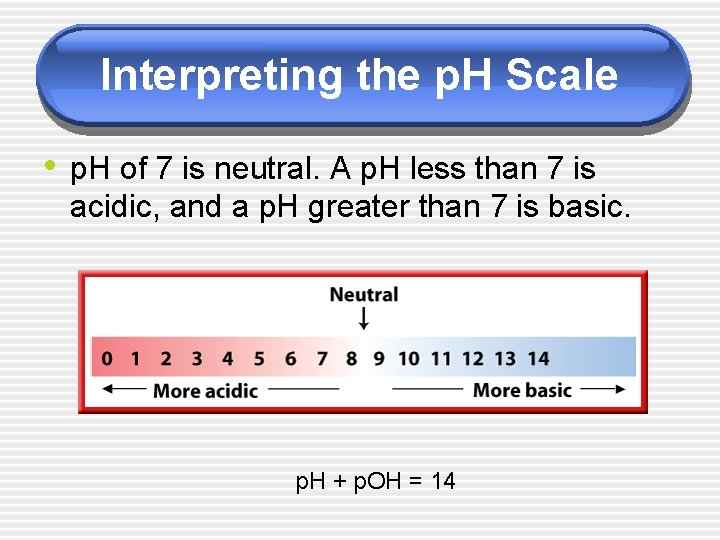
Interpreting the p. H Scale • p. H of 7 is neutral. A p. H less than 7 is acidic, and a p. H greater than 7 is basic. p. H + p. OH = 14
Acid Strength • The ______ of an acid or a base tells you the degree of ionization • Strong acids & bases break down into ______ ions • Weak acids & bases break down into just a few ions
Neutralization Reactions • ______– acid + base a salt + water • Neutralization reactions are just a special type of double replacement reactions
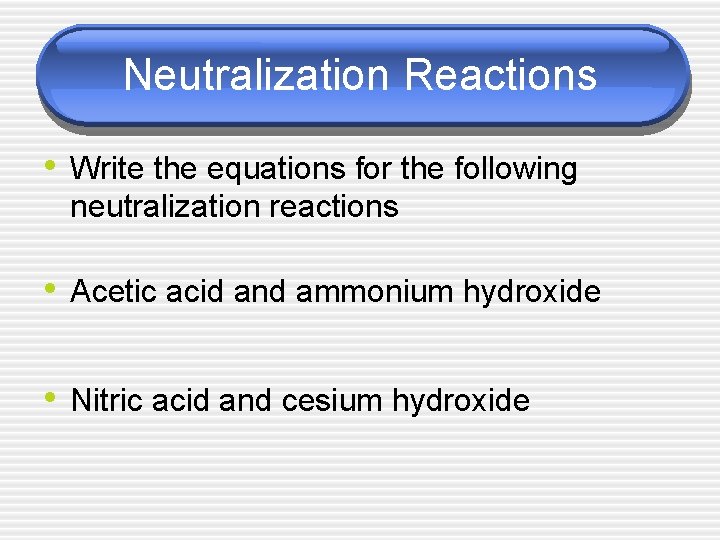
Neutralization Reactions • Write the equations for the following neutralization reactions • Acetic acid and ammonium hydroxide • Nitric acid and cesium hydroxide
- Slides: 18