
Intro do you know Tom Chi Tom Chi

- Slides: 8
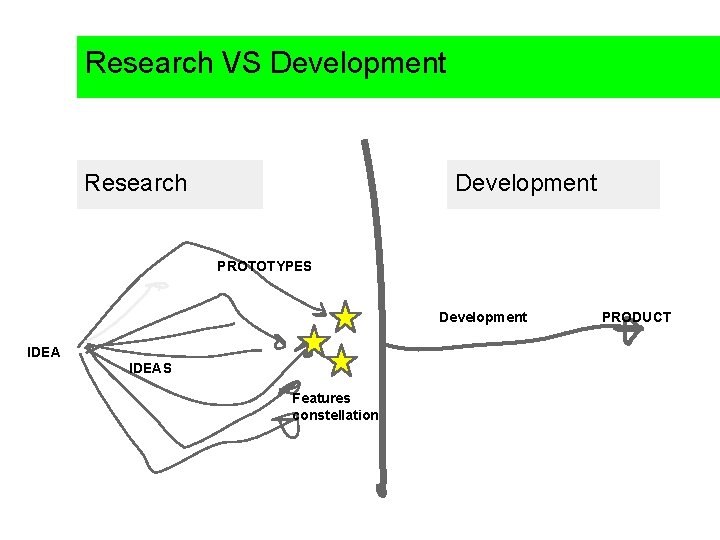
Intro: do you know Tom Chi? • Tom Chi from Google X talks about rapid prototyping and tells the story of how Google's Project Glass was prototyped within hours. http: //vimeo. com/55741515#at=0 >> you need to see this video to understand the rest! Mentor on Unreasonable at Sea: http: //vimeo. com/60131973 • • Next slide is from Tom Chi’s presentation, rebuilt by Cesar Harada, and adapted by Etienne Gernez for the Ocean of Plastic project https: //sites. google. com/site/prototypetomchibook/
Research VS Development Research Development PROTOTYPES Development IDEAS Features constellation PRODUCT
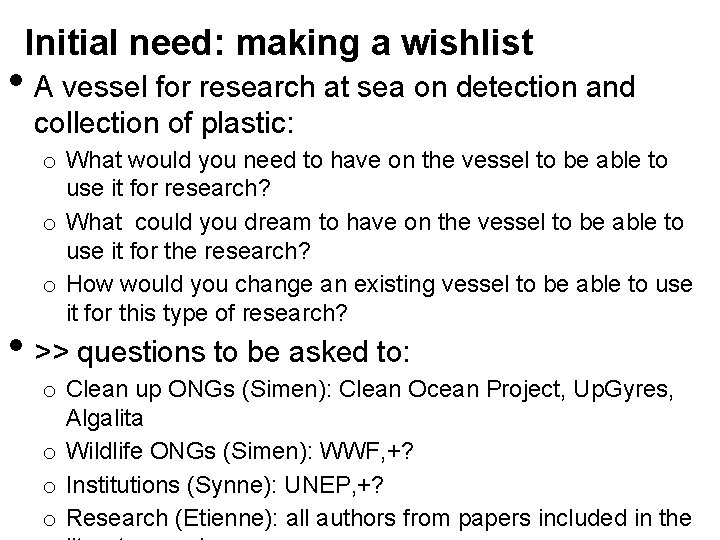
Initial need: making a wishlist • A vessel for research at sea on detection and collection of plastic: o What would you need to have on the vessel to be able to use it for research? o What could you dream to have on the vessel to be able to use it for the research? o How would you change an existing vessel to be able to use it for this type of research? • >> questions to be asked to: o Clean up ONGs (Simen): Clean Ocean Project, Up. Gyres, Algalita o Wildlife ONGs (Simen): WWF, +? o Institutions (Synne): UNEP, +? o Research (Etienne): all authors from papers included in the
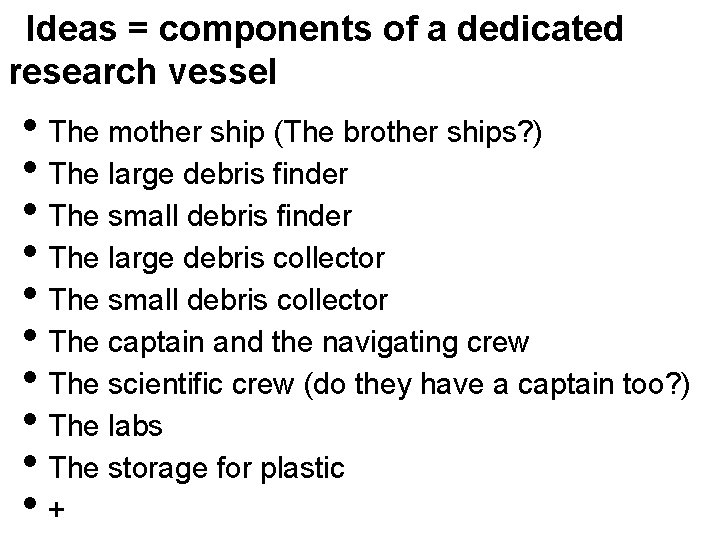
Ideas = components of a dedicated research vessel • The mother ship (The brother ships? ) • The large debris finder • The small debris finder • The large debris collector • The small debris collector • The captain and the navigating crew • The scientific crew (do they have a captain too? ) • The labs • The storage for plastic • +
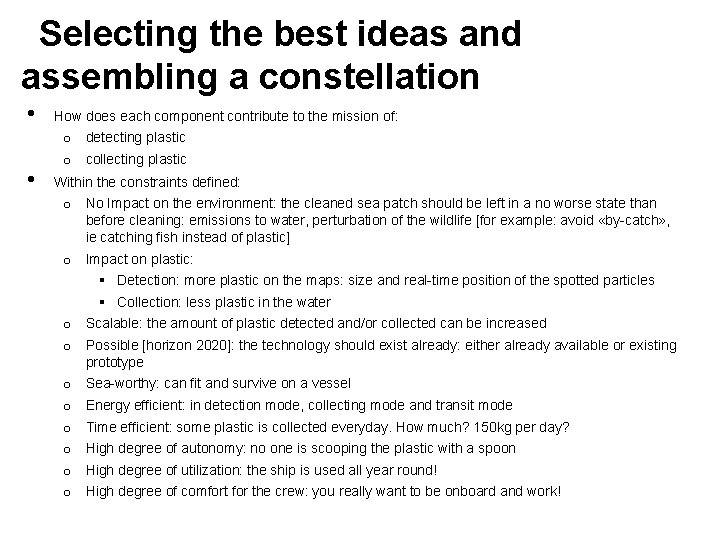
Selecting the best ideas and assembling a constellation • • How does each component contribute to the mission of: o detecting plastic o collecting plastic Within the constraints defined: o No Impact on the environment: the cleaned sea patch should be left in a no worse state than before cleaning: emissions to water, perturbation of the wildlife [for example: avoid «by-catch» , ie catching fish instead of plastic] o Impact on plastic: § Detection: more plastic on the maps: size and real-time position of the spotted particles § Collection: less plastic in the water o Scalable: the amount of plastic detected and/or collected can be increased o Possible [horizon 2020]: the technology should exist already: either already available or existing prototype o Sea-worthy: can fit and survive on a vessel o Energy efficient: in detection mode, collecting mode and transit mode o Time efficient: some plastic is collected everyday. How much? 150 kg per day? o High degree of autonomy: no one is scooping the plastic with a spoon o High degree of utilization: the ship is used all year round! o High degree of comfort for the crew: you really want to be onboard and work!
Improving and optimizing the solution: make the different element fit on a vessel • How do they all talk • • • together? How do you take them in & out the ship? What do they need to work? What comes in & out?
Next steps: • Assemble the wishlist [Simen, Synne, • Etienne] Get physical models to play! [Etienne] o o o A ship A satellite A sailing drone An underwater drone A flying drone A few humans • Put the different concepts looked at so far on the Research map and see if they get a star, and for what reason