
INTRINSICALLY UNSTRUCTURED PROTEINS By Sarah Madden Katie Jameson
INTRINSICALLY UNSTRUCTURED PROTEINS By: Sarah Madden & Katie Jameson
TABLE OF CONTENTS • • Overview Structure Function Role
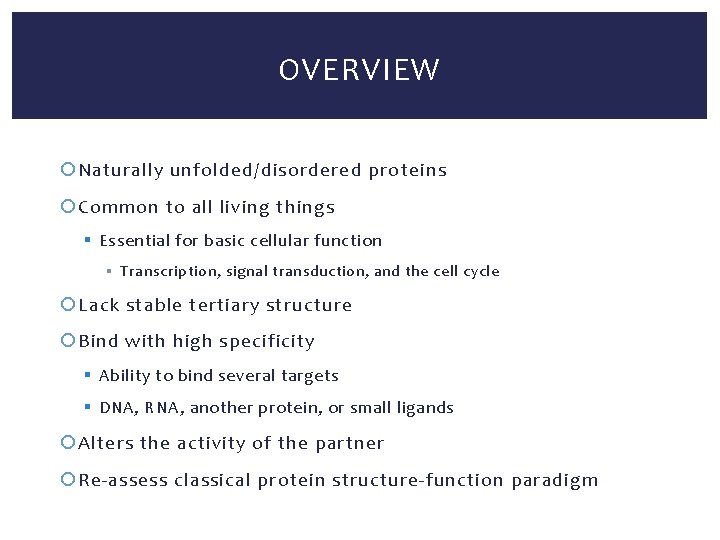
OVERVIEW Naturally unfolded/disordered proteins Common to all living things § Essential for basic cellular function § Transcription, signal transduction, and the cell cycle Lack stable tertiary structure Bind with high specificity § Ability to bind several targets § DNA, RNA, another protein, or small ligands Alters the activity of the partner Re-assess classical protein structure-function paradigm
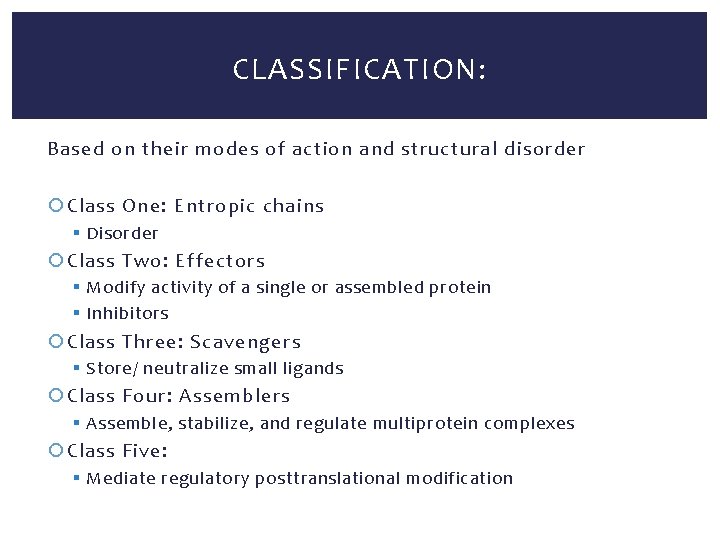
CLASSIFICATION: Based on their modes of action and structural disorder Class One: Entropic chains § Disorder Class Two: Effectors § Modify activity of a single or assembled protein § Inhibitors Class Three: Scavengers § Store/ neutralize small ligands Class Four: Assemblers § Assemble, stabilize, and regulate multiprotein complexes Class Five: § Mediate regulatory posttranslational modification
STRUCTURE Gene sequences coding for long chains of Amino Acids Physiological Conditions § Lack folded structure § Highly flexible § Random coil-like conformations Not fully disordered § Order at primary level § Amino acid composition and sequence § Secondary/tertiary that correlates with function Unstructured proteins/regions § No enzymatic activity Intrinsic structure released when bound to target molecule
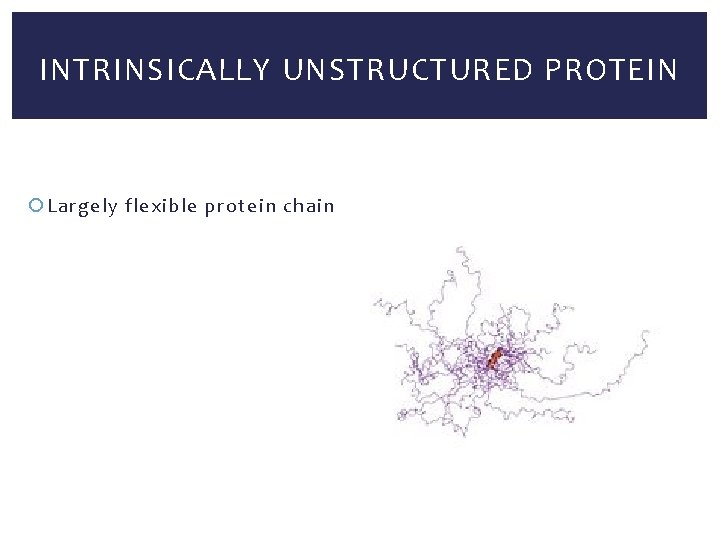
INTRINSICALLY UNSTRUCTURED PROTEIN Largely flexible protein chain
OVERVIEW General Functions: § Linkers § Coupled folding and binding • Functional Benefits: § Adopt different structures § Open Structure § Increase speed of interaction § Flexibility • Roles •
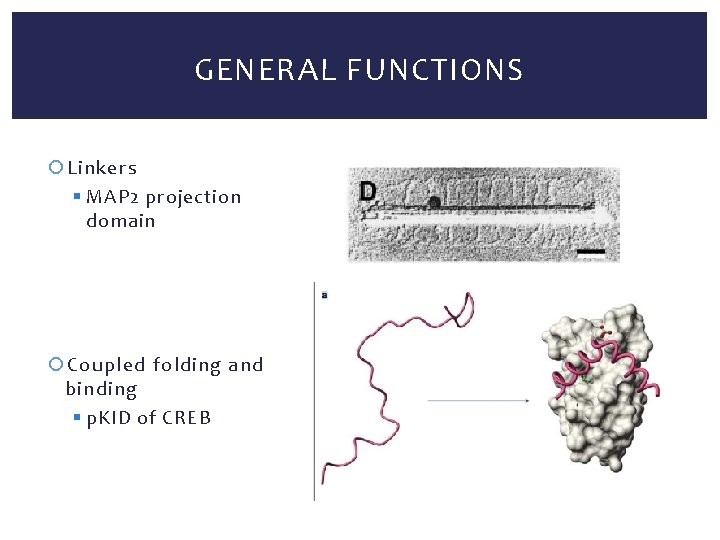
GENERAL FUNCTIONS Linkers § MAP 2 projection domain Coupled folding and binding § p. KID of CREB
FUNCTIONAL BENEFITS 1. Flexibility 2. Adopt different structures 3. Open Structure 4. Disorder-order transition 5. Increase speed of interaction
1. FLEXIBILITY Essential in the assembly of large complexes Large complexes can’t be assembled from rigid components Domain rearrangement and binding-induced folding aid in flexibility Allows for spacing between protein domains
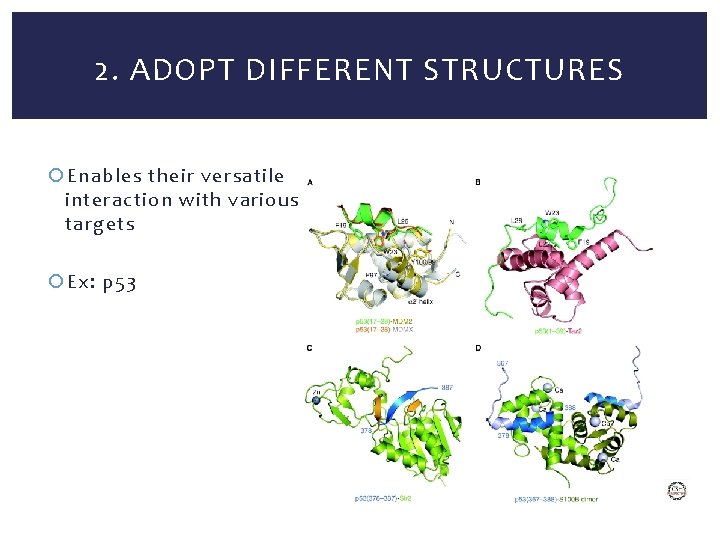
2. ADOPT DIFFERENT STRUCTURES Enables their versatile interaction with various targets Ex: p 53
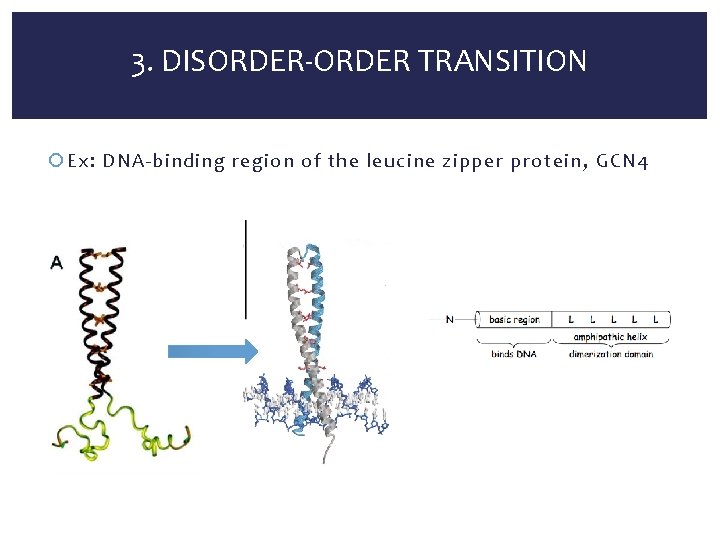
3. DISORDER-ORDER TRANSITION Ex: DNA-binding region of the leucine zipper protein, GCN 4
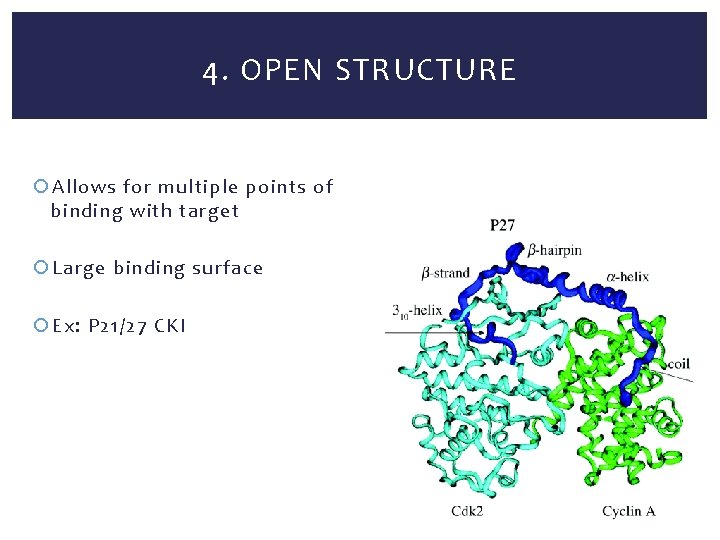
4. OPEN STRUCTURE Allows for multiple points of binding with target Large binding surface Ex: P 21/27 CKI
5. INCREASE SPEED OF INTERACTION Due to extended conformation Association rates can be enhanced by increasing the lifetime of the encounter complex by initial non-specific interaction Ex: Casein
ROLES IN CELL PROCESSES Regulation of transcription and translation Cellular signal transduction Protein phosphorylation Storage of small molecules Regulation of self assembly of large multi-protein complexes
REFERENCES Tompa, Peter. "Intrinsically Unstructured Proteins. " TRENDS in Biochemical Sciences 27. 10 (2002): 527 -33. TRENDS in Biochemical Sciences. Elsevier Science Ltd. , 5 Sept. 2002. Web. 20 Nov. 2011. <http: //tibs. trends. com>. http: //en. wikipedia. org/wiki/Intrinsically_unstructured_protein s Wright, Peter E. , and Jane H. Dyson. "Intrinsically Unstructured Proteins: Re-Assessing the Protein Structure-Function Paradigm. " Journal of Molecular Biology 293 (1999): 321 -31. Idea Library. 1999. Web. 20 Nov. 2011. <http: //www. idealibrary. com>.
- Slides: 16