
INTRINSIC MAGNETORESISTANCE IN ORGANIC LIGHTEMITTING DIODES AN INVESTIGATION
- Slides: 1
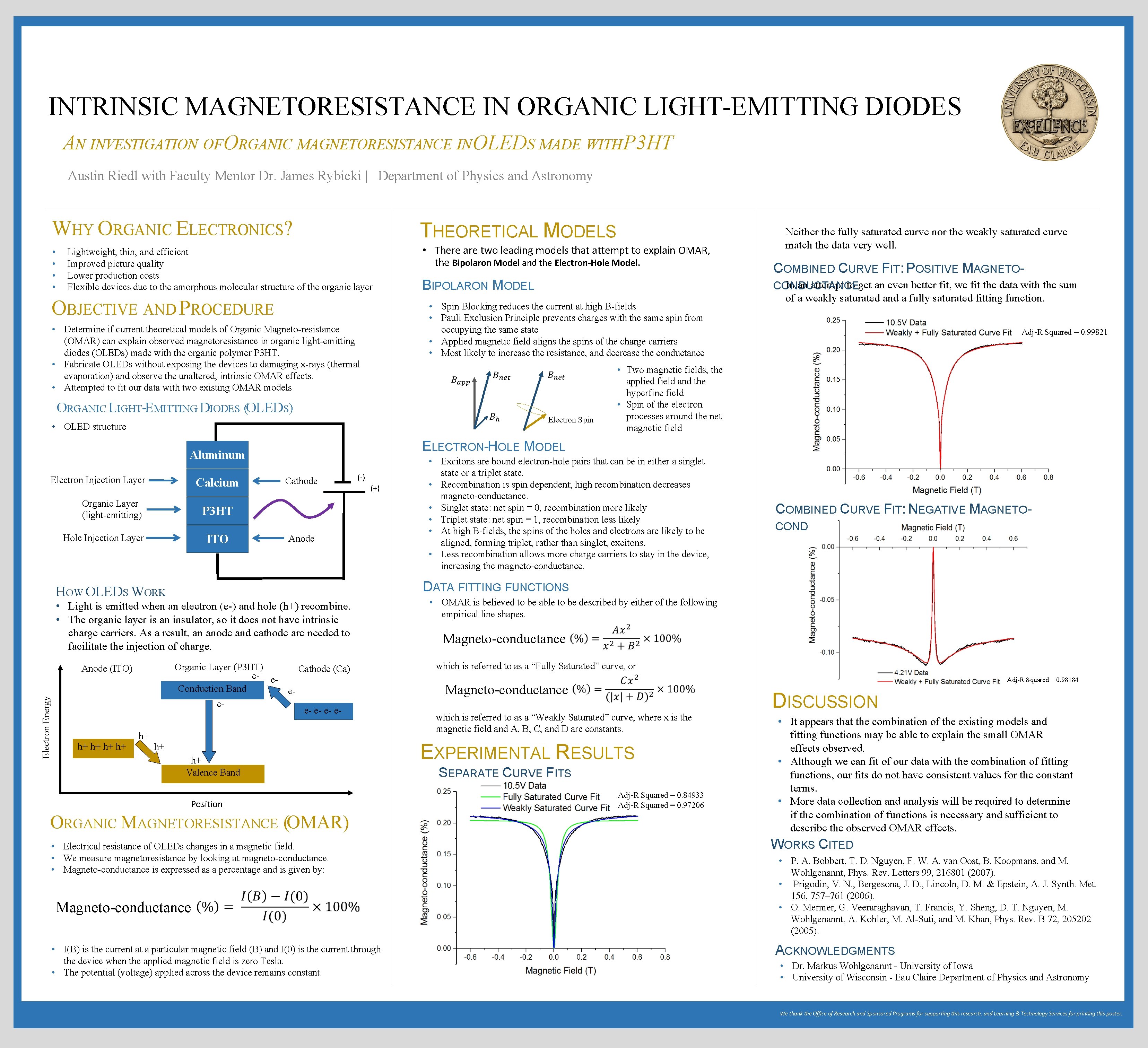
INTRINSIC MAGNETORESISTANCE IN ORGANIC LIGHT-EMITTING DIODES AN INVESTIGATION OF ORGANIC MAGNETORESISTANCE IN OLEDS MADE WITH P 3 HT Austin Riedl with Faculty Mentor Dr. James Rybicki | Department of Physics and Astronomy WHY ORGANIC ELECTRONICS? THEORETICAL MODELS • • • There are two leading models that attempt to explain OMAR, the Bipolaron Model and the Electron-Hole Model. Lightweight, thin, and efficient Improved picture quality Lower production costs Flexible devices due to the amorphous molecular structure of the organic layer OBJECTIVE AND PROCEDURE • Spin Blocking reduces the current at high B-fields • Pauli Exclusion Principle prevents charges with the same spin from occupying the same state • Applied magnetic field aligns the spins of the charge carriers • Most likely to increase the resistance, and decrease the conductance • Determine if current theoretical models of Organic Magneto-resistance (OMAR) can explain observed magnetoresistance in organic light-emitting diodes (OLEDs) made with the organic polymer P 3 HT. • Fabricate OLEDs without exposing the devices to damaging x-rays (thermal evaporation) and observe the unaltered, intrinsic OMAR effects. • Attempted to fit our data with two existing OMAR models ORGANIC LIGHT-EMITTING DIODES (OLEDS) Organic Layer (light-emitting) Cathode (-) (+) P 3 HT ITO Hole Injection Layer Anode • Light is emitted when an electron (e-) and hole (h+) recombine. • The organic layer is an insulator, so it does not have intrinsic charge carriers. As a result, an anode and cathode are needed to facilitate the injection of charge. Organic Layer (P 3 HT) e- e. Conduction Band Electron Energy e- h+ h+ Electron Spin In an attempt to get an even better fit, we fit the data with the sum CONDUCTANCE of a weakly saturated and a fully saturated fitting function. Adj-R Squared = 0. 99821 • Two magnetic fields, the applied field and the hyperfine field • Spin of the electron processes around the net magnetic field • Excitons are bound electron-hole pairs that can be in either a singlet state or a triplet state. • Recombination is spin dependent; high recombination decreases magneto-conductance. • Singlet state: net spin = 0, recombination more likely • Triplet state: net spin = 1, recombination less likely • At high B-fields, the spins of the holes and electrons are likely to be aligned, forming triplet, rather than singlet, excitons. • Less recombination allows more charge carriers to stay in the device, increasing the magneto-conductance. COMBINED CURVE FIT: NEGATIVE MAGNETOCONDUCTANCE DATA FITTING FUNCTIONS HOW OLEDS WORK Anode (ITO) COMBINED CURVE FIT: POSITIVE MAGNETO- ELECTRON-HOLE MODEL Aluminum Calcium • OLED structure Electron Injection Layer BIPOLARON MODEL Neither the fully saturated curve nor the weakly saturated curve match the data very well. Cathode (Ca) Magneto-conductance which is referred to as a “Fully Saturated” curve, or Magneto-conductance ee- e- h+ h+ h+ Valence Band Position ORGANIC MAGNETORESISTANCE (OMAR) • Electrical resistance of OLEDs changes in a magnetic field. • We measure magnetoresistance by looking at magneto-conductance. • Magneto-conductance is expressed as a percentage and is given by: Magneto-conductance • OMAR is believed to be able to be described by either of the following empirical line shapes. • I(B) is the current at a particular magnetic field (B) and I(0) is the current through the device when the applied magnetic field is zero Tesla. • The potential (voltage) applied across the device remains constant. Adj-R Squared = 0. 98184 which is referred to as a “Weakly Saturated” curve, where x is the magnetic field and A, B, C, and D are constants. EXPERIMENTAL RESULTS SEPARATE CURVE FITS Adj-R Squared = 0. 84933 Adj-R Squared = 0. 97206 DISCUSSION • It appears that the combination of the existing models and fitting functions may be able to explain the small OMAR effects observed. • Although we can fit of our data with the combination of fitting functions, our fits do not have consistent values for the constant terms. • More data collection and analysis will be required to determine if the combination of functions is necessary and sufficient to describe the observed OMAR effects. WORKS CITED • P. A. Bobbert, T. D. Nguyen, F. W. A. van Oost, B. Koopmans, and M. Wohlgenannt, Phys. Rev. Letters 99, 216801 (2007). • Prigodin, V. N. , Bergesona, J. D. , Lincoln, D. M. & Epstein, A. J. Synth. Met. 156, 757– 761 (2006). • O. Mermer, G. Veeraraghavan, T. Francis, Y. Sheng, D. T. Nguyen, M. Wohlgenannt, A. Kohler, M. Al-Suti, and M. Khan, Phys. Rev. B 72, 205202 (2005). ACKNOWLEDGMENTS • Dr. Markus Wohlgenannt - University of Iowa • University of Wisconsin - Eau Claire Department of Physics and Astronomy We thank the Office of Research and Sponsored Programs for supporting this research, and Learning & Technology Services for printing this poster.