
Intregrated planning top down and bottom up March
Intregrated planning: top down and bottom up March 2016 Presented by Adjunct Professor John Stanley Institute of Transport and Logistics Studies (ITLS) The University of Sydney Page 1
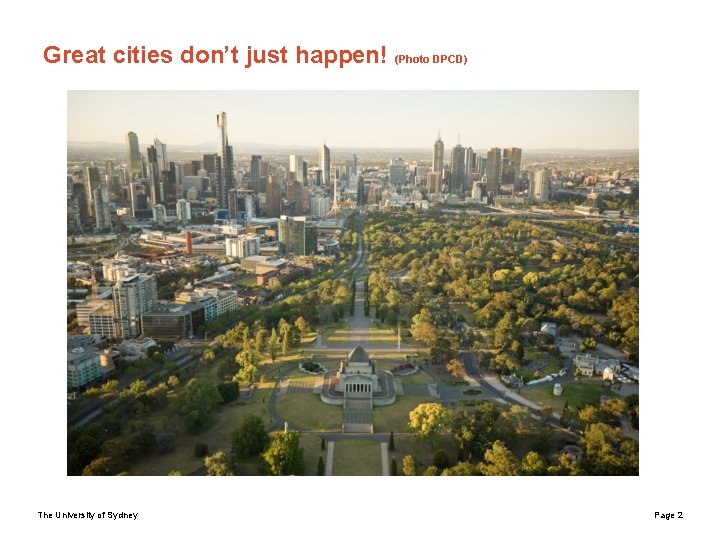
Great cities don’t just happen! (Photo DPCD) The University of Sydney Page 2
Our cities: getting better as they get bigger? – Cities reap agglomeration benefits from size (i. e. 1+1>2) – But have low productivity growth, increasing inequality and confront rising externalities, particularly in transport (e. g. congestion, air pollution), with increasingly unaffordable housing – How can our cities (and regions) get better as they get bigger? The University of Sydney Page 3
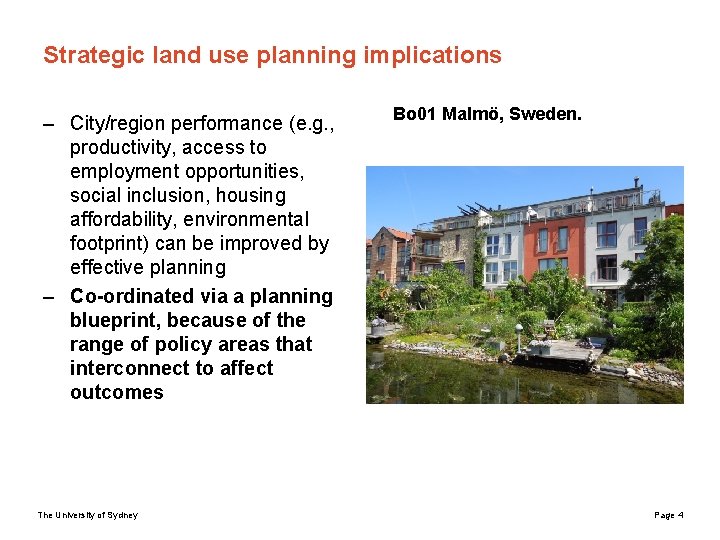
Strategic land use planning implications – City/region performance (e. g. , productivity, access to employment opportunities, social inclusion, housing affordability, environmental footprint) can be improved by effective planning – Co-ordinated via a planning blueprint, because of the range of policy areas that interconnect to affect outcomes The University of Sydney Bo 01 Malmö, Sweden. Page 4
Start with a vision of the kind of city/region you want – Major transport projects exert a massive influence over city development patterns – Start with them and you might get something you did not really need! – Start with a vision of the kind of city you want and associated goals – Then use transport infrastructure and services to help you get there – Needs an integrated, long term focus – Something that we do poorly in Australia – Our long term is about 4 -5 years (in a good week)! – But there are some encouraging signs The University of Sydney Page 5
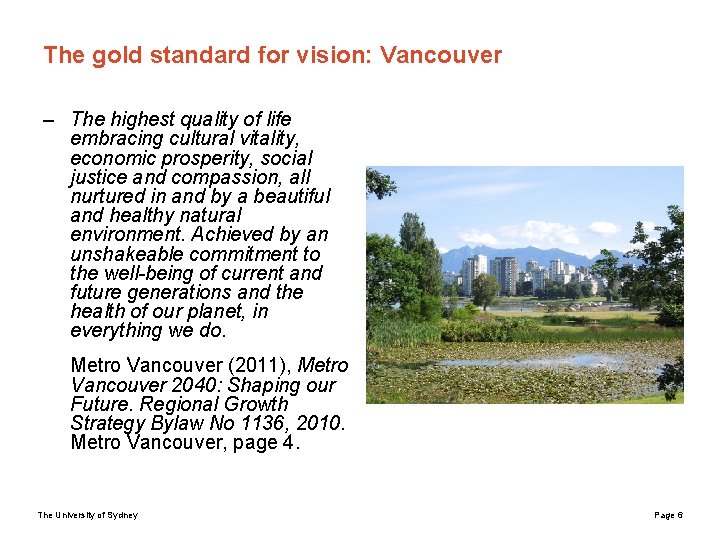
The gold standard for vision: Vancouver – The highest quality of life embracing cultural vitality, economic prosperity, social justice and compassion, all nurtured in and by a beautiful and healthy natural environment. Achieved by an unshakeable commitment to the well-being of current and future generations and the health of our planet, in everything we do. Metro Vancouver (2011), Metro Vancouver 2040: Shaping our Future. Regional Growth Strategy Bylaw No 1136, 2010. Metro Vancouver, page 4. The University of Sydney Page 6
A ‘better’ (more sustainable) city is one that… (my value judgement) 1. 2. 3. 4. 5. 6. 7. Increases its economic productivity Reduces its environmental footprint (esp. lower GHG emissions, cleaner air and increased greening) Ø I favour some ‘hard targets’ here Increases social inclusion and reduces inequality Ø More hard targets Improves health and safety outcomes Promotes intergenerational equity – this goal is likely to be achieved if the preceding goals are met Engages its communities widely Pursues integrated land use transport plans. AIM FOR DISTINCTIVENESS : WE NEED TO DO THIS BETTER The University of Sydney Page 7
Key land use development directions for goal achievement – Promote core and close surrounds – Promote a small number of inner/middle urban knowledge-based high tech hubs – Connect hubs to the core with good transit (transit corridors) – Connect people to the hubs with good transit, inc. people living in growth areas – Increase densities (mixed use) in key transit corridors (e. g. , Vancouver, London) – Promote good circulation within hubs/corridors (walkability) – Promote 20 minute city idea (neighbourhood level focus) – Add a place focus throughout (key role of streets) – Use transport and other levers to support achievement of The University of Sydney Page 8
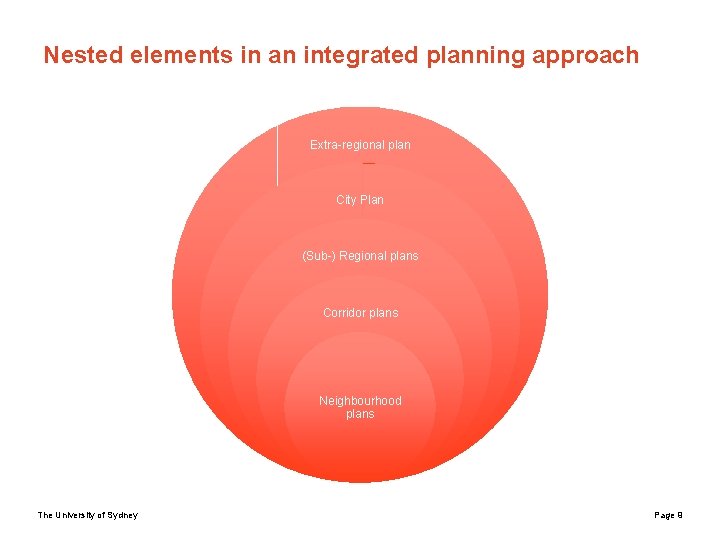
Nested elements in an integrated planning approach Extra-regional plan City Plan (Sub-) Regional plans Corridor plans Neighbourhood plans The University of Sydney Page 9
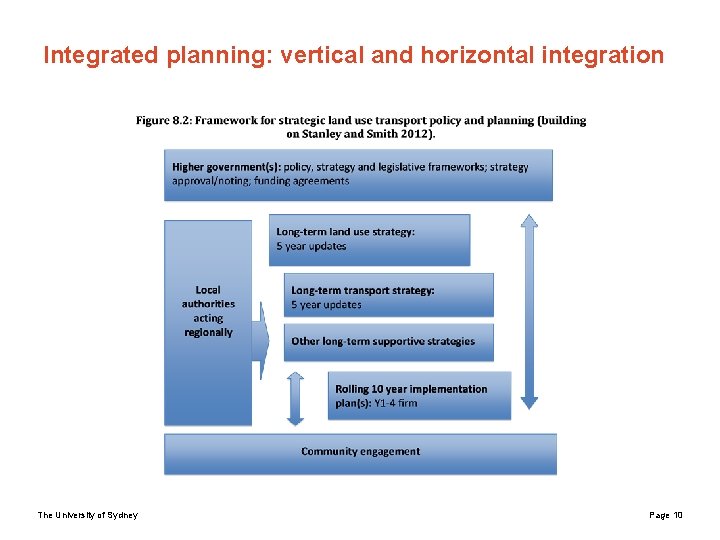
Integrated planning: vertical and horizontal integration The University of Sydney Page 10
The ‘to-do’ list – The importance of trusting partnerships – What does the federal government want from our cities? – Needs to be clearly articulated – Who speaks for the city? – London model works very well – The Greater Sydney Commission promises a state-regional local government partnership that seems likely to improve bi-partisan buy -in – How can neighbourhood voices become part of the normal governance arrangements? – Devolve a lot more authority and funding to the local level – Use the 20 Minute City model as a foundation • Needs minimum densities of 22 -25 dwellings/ha • Potential population of 300, 000 within 5 km radius (several neighbourhoods) • Let’s agree some areas (20 MCs) and service decisions for devolution (e. g. , locally integrated PT, CT + school bus services on fringe and in regional areas) The University of Sydney Page 11
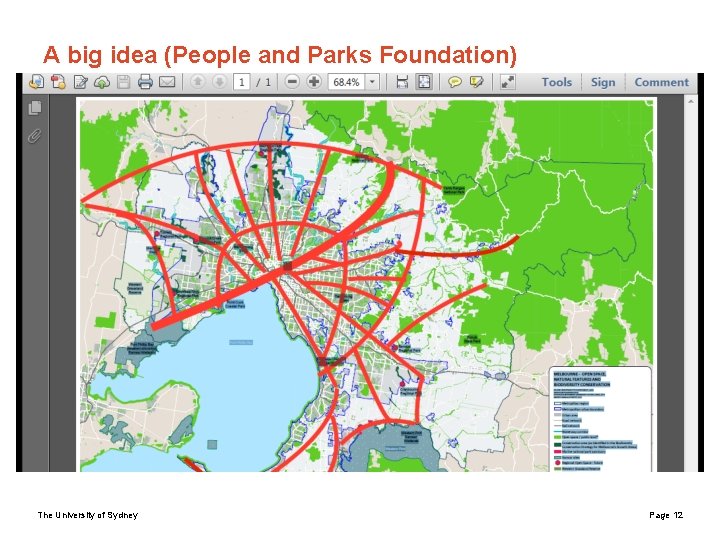
A big idea (People and Parks Foundation) The University of Sydney Page 12
- Slides: 12