
INTRAVENOUS FLUIDS ORAL REHYDRATION SOLUTION Dr Ruwan Parakramawansha
- Slides: 30
INTRAVENOUS FLUIDS & ORAL REHYDRATION SOLUTION Dr Ruwan Parakramawansha MBBS, MD, MRCP(UK), MRCPE, DMT(UK) (2013/01/30)
LEARNING OUTCOMES. . By the end of this lecture you will be able to, – List different types of IV fluids – Identify different methods of classifying i. v. fluids – Understand differences in fluids in relation to their distribution in different fluid compartments of the body – Describe indications for IV therapy – Outline complications of IV therapy – List constituents of ORS
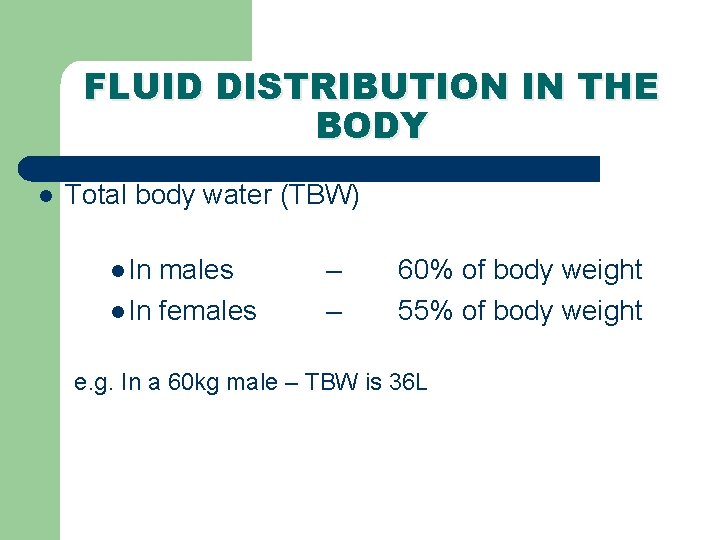
FLUID DISTRIBUTION IN THE BODY l Total body water (TBW) l In males l In females – – 60% of body weight 55% of body weight e. g. In a 60 kg male – TBW is 36 L
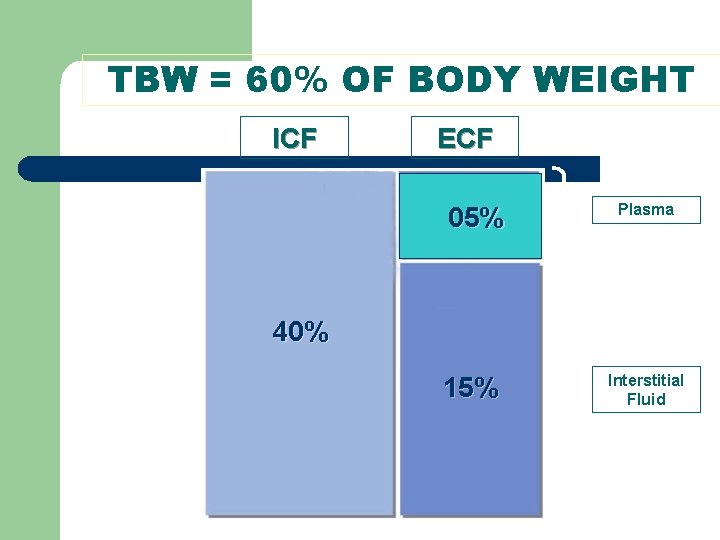
TBW = 60% OF BODY WEIGHT ICF ECF 05% Plasma 40% 15% Interstitial Fluid
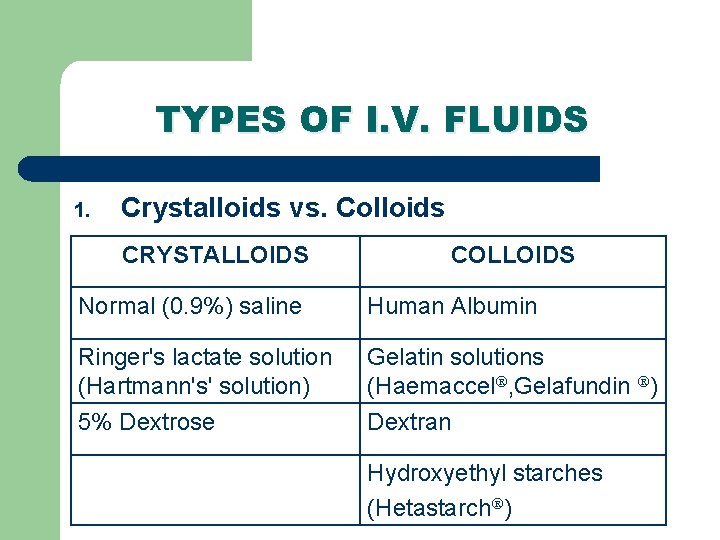
TYPES OF I. V. FLUIDS 1. Crystalloids vs. Colloids CRYSTALLOIDS COLLOIDS Normal (0. 9%) saline Human Albumin Ringer's lactate solution (Hartmann's' solution) Gelatin solutions (Haemaccel , Gelafundin ) 5% Dextrose Dextran Hydroxyethyl starches (Hetastarch )
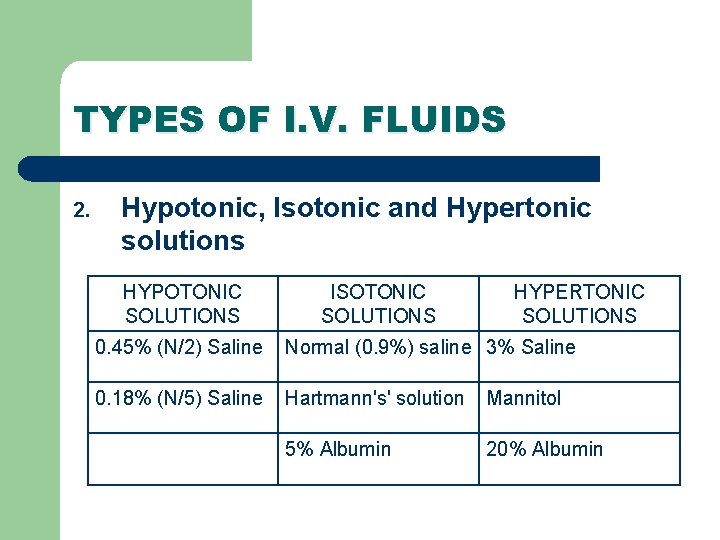
TYPES OF I. V. FLUIDS 2. Hypotonic, Isotonic and Hypertonic solutions HYPOTONIC SOLUTIONS ISOTONIC SOLUTIONS HYPERTONIC SOLUTIONS 0. 45% (N/2) Saline Normal (0. 9%) saline 3% Saline 0. 18% (N/5) Saline Hartmann's' solution Mannitol 5% Albumin 20% Albumin
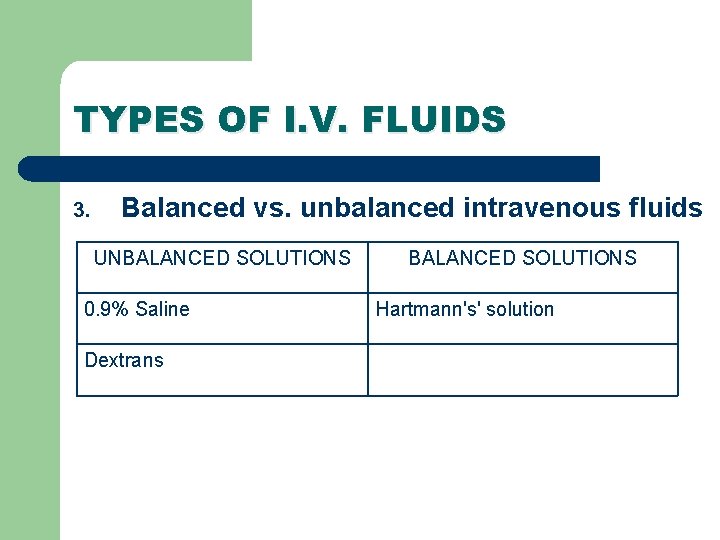
TYPES OF I. V. FLUIDS 3. Balanced vs. unbalanced intravenous fluids UNBALANCED SOLUTIONS 0. 9% Saline Dextrans BALANCED SOLUTIONS Hartmann's' solution
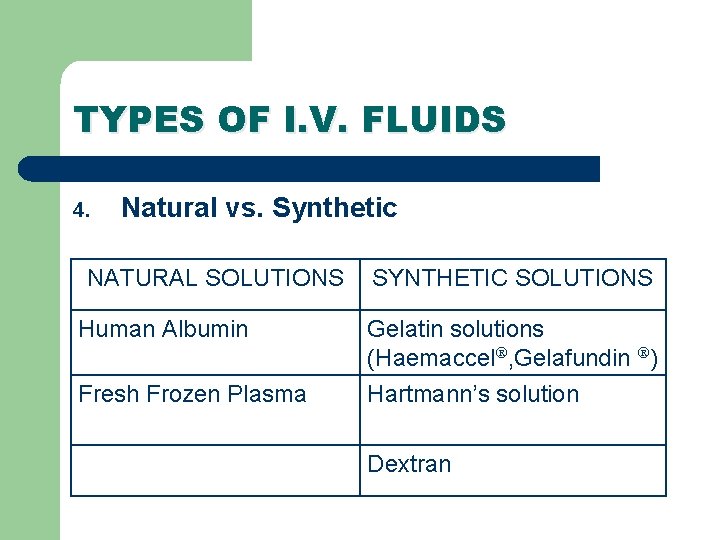
TYPES OF I. V. FLUIDS 4. Natural vs. Synthetic NATURAL SOLUTIONS SYNTHETIC SOLUTIONS Human Albumin Gelatin solutions (Haemaccel , Gelafundin ) Fresh Frozen Plasma Hartmann’s solution Dextran
CRYSTALLOIDS l Consist of inorganic ions and small organic molecules dissolved in water l Either glucose or sodium chloride (saline) based. l May be isotonic, hypotonic or hypertonic l Both water and the electrolytes in the crystalloid solution can freely cross the semi permeable membranes of the vessel walls into the interstitial space
Normal Saline (0. 9% Na. Cl) l Contains sodium and chloride ions in water and it is isotonic with extracellular fluid l Cell membrane is impermeable to Na+ and Cl- ions owing to the presence of the energy dependant Na+ /K+ - ATPase l Intravenous infusion of an isotonic solution of sodium chloride will expand only the extracellular compartment
Normal Saline (0. 9% Na. Cl) l Na+ is the main solute in ECF saline is well suited to replace ECF fluid losses e. g. dehydration due to nausea/vomiting l Na+ and Cl- freely moves across vascular membrane into the interstitium.
Normal Saline (0. 9% Na. Cl) l Remain in the intravascular space for only a short period before diffusing across the capillary wall into the interstitial space. l 1 liter infusion of normal (0. 9%) saline will result in ~ 250 ml expansion of the circulating volume. l Achieve equilibrium in 2 -3 hours.
Normal Saline (0. 9% Na. Cl) Indications: 1. 2. 3. Replacement of fluids in hypovolaemic or dehydrated patients ( Needs 3 blood loss) A small amount of saline as a special adjunct can be used to keep the veins open for medication administration As the initial plasma expander in blood loss while blood is typed and matched
Normal Saline (0. 9% Na. Cl) Adverse Effects 1. Fluid overload (peripheral and pulmonary oedema) 2. With high volume administration, 3. • Dilutional reduction of normal plasma components such as calcium and potassium • Dilutional coagulopathy • Hyperchloraemic acidosis Diuresis.
5% Dextrose – Initially behave as an isotonic solution. – Glucose is soon metabolized, leaving behind water making the solution hypotonic. – Water freely moves between intravascular, interstitial and intracellular fluid compartments till the osmolalities become the same.
5% Dextrose Indications: 1. To maintain water balance ( In pure water deficit and for patients on sodium restriction) 2. To supply calories ( ~ 200 kcal/l) l An adult require ~2500 kcal/day l Hence, glucose alone can’t meet the need. l Would need >10 liters of 5% glucose to supply all calories !!
5% Dextrose Adverse effects: 1. Causes red cell clumping (cannot be given with blood). 2. May cause water intoxication 3. Can cause hyponatraemia
Ringer’s Lactate l l A balanced isotonic electrolyte solution. Similar to 0. 9% saline in all aspects except, – Contains sodium, chloride, potassium, calcium and lactate in water. ( “physiological”) – Prevents dilutional reduction of normal plasma components such as calcium and potassium – Avoids hyperchloraemic acidosis ( Lactate converted to bicarbonate in liver. ) – Preferred to normal saline when large quantities of volume infused rapidly
COLLOIDS – – Colloids contain large molecules such as proteins that do not readily pass through the capillary membrane Remain in the intravascular space for extended periods – These large molecules also increase the osmotic pressure in the intravascular space Cause fluid to move from the interstitial and intracellular space to the intravascular space – Often referred to as volume expanders
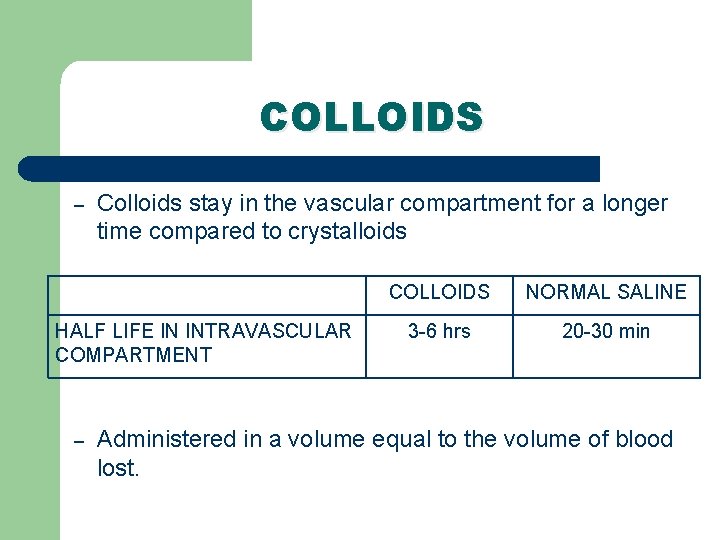
COLLOIDS – Colloids stay in the vascular compartment for a longer time compared to crystalloids HALF LIFE IN INTRAVASCULAR COMPARTMENT – COLLOIDS NORMAL SALINE 3 -6 hrs 20 -30 min Administered in a volume equal to the volume of blood lost.
INDICATIONS 1. When rapid expansion of plasma volume is desirable e. g. in haemorrhage prior to blood transfusion 2. For fluid resuscitation in the presence of hypoalbuminaemia 3. In large protein losses e. g. in burns
Gelatins l Prepared by hydrolysis of bovine collagen. a). Gelafusine - succinylated gelatin in isotonic saline b). Haemaccel - urea-linked gelatin and polygeline in an isotonic solution of sodium chloride with potassium and calcium. l Theoretical risk of transmitting bovine spongiform encephalopathy. (new-variant Creutzfeldt-Jakob disease) l Volume expanding effect lasts 2 -3 hrs.
Dextrans l High molecular weight D-glucose polymers prepared from the juice of sugar beets. l Preparations of different molecular weights e. g. Dextran 40 (MW 40, 000) Dextran 70 (MW 70, 000) l Volume expanding effect lasts 5 -6 hrs.
Dextrans l Causes haemostatic derangements – – – l l Factor VIII activity is reduced plasminogen activation and fibrinolysis is increased platelet function impaired Interfere with blood cross matching Alter laboratory tests e. g. Plasma glucose, plasma proteins
Hydroxyethyl starches l Synthesized from amylopectin(a D-glucose polymer with a branching structure) derived from maize or sorghum. l The larger molecular size leads to prolonged intravascular retention compared to other colloids. e. g. Hetastarch, Pentastarch
Human Albumin l Two preparations 5% albumin (isotonic) and 25% albumin (Hypertonic) l 20% albumin expands the plasma volume up to five times the volume infused. l Heat treated - no risk of transmitting viral infections. l Reduce ionized calcium level.
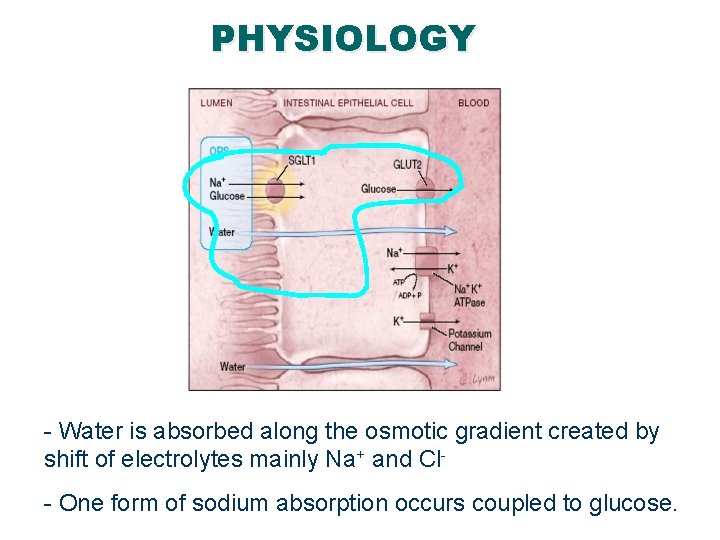
PHYSIOLOGY - Water is absorbed along the osmotic gradient created by shift of electrolytes mainly Na+ and Cl- 27 - One form of sodium absorption occurs coupled to glucose.
In Diarrhoea……. . l Imbalance between absorption and secretion of fluid and electrolytes. l Prompt fluid replacement can prevent dehydration and mortality( esp. in children) l Na+ - K+ ATPase l Na+ - Glucose co-transport unaffected
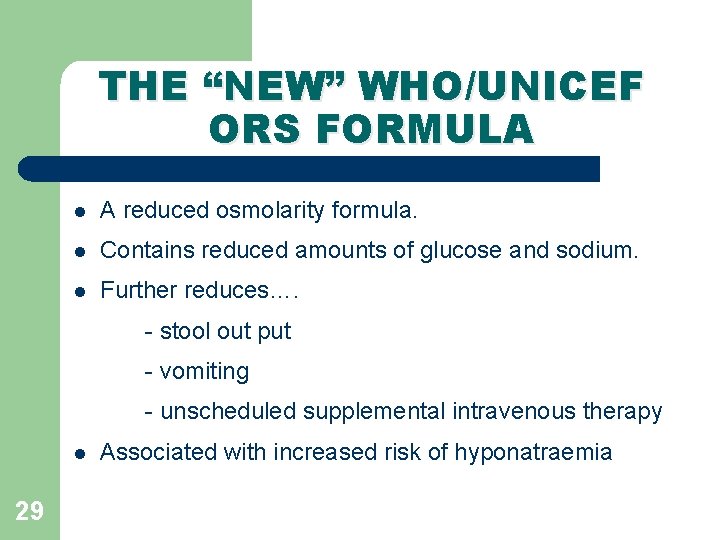
THE “NEW” WHO/UNICEF ORS FORMULA l A reduced osmolarity formula. l Contains reduced amounts of glucose and sodium. l Further reduces…. - stool out put - vomiting - unscheduled supplemental intravenous therapy l 29 Associated with increased risk of hyponatraemia
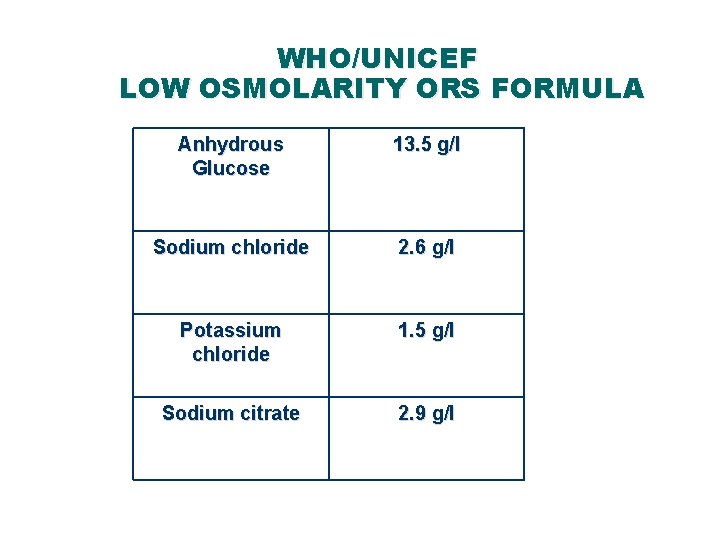
WHO/UNICEF LOW OSMOLARITY ORS FORMULA 30 Anhydrous Glucose 13. 5 g/l Sodium chloride 2. 6 g/l Potassium chloride 1. 5 g/l Sodium citrate 2. 9 g/l