
INTRAVENOUS CATHETERIZATION PART 2 Mike Muir AEMCA ACP

- Slides: 41
INTRAVENOUS CATHETERIZATION PART 2 Mike Muir AEMCA, ACP, BHSc Kevin Mc. Nab AEMCA, ACP Version 2014 OBHG Education Subcommittee
INTRAVENOUS CATHETERIZATION AUTHORS REVIEWERS Mike Muir AEMCA, ACP, BHSc Lori Smith AEMCA, ACP, RN Waterloo-Wellington-Dufferin Base Hospital Paramedic Program Manager Grey-Bruce-Huron Paramedic Base Hospital Grey Bruce Health Services, Owen Sound Rob Theriault EMCA, RCT(Adv. ), CCP(F) Peel Region Base Hospital Kevin Mc. Nab AEMCA, ACP Quality Assurance Manager Huron County EMS Updated December 2006 Angela Schotsman AEMCA, ACP S 2014 Version OBHG Education Subcommittee
MENU START AT THE BEGINNING PREPARING IV EQUIPMENT SALINE LOCK IDENTIFYING VEINS BLOOD TUBING SELECTING AN IV SITE BURETROL IV PROCEDURE PEDIATRIC VASCULAR ACCESS COMPLICATIONS OF IV THERAPY WHEN NOT TO START AN IV FACTORS AFFECTING IV FLOW SHARP SMART 2014 Version OBHG Education Subcommittee
STARTING AN I. V USE ASEPTIC TECHNIQUE NO EXCEPTIONS 2014 Version OBHG Education Subcommittee
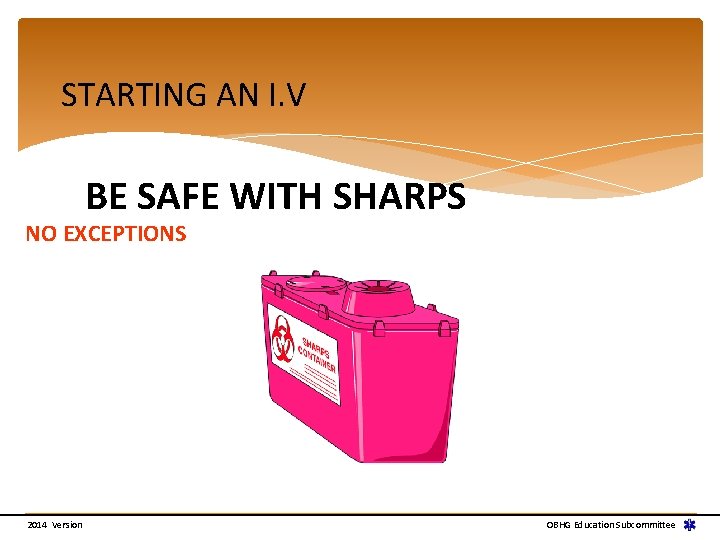
STARTING AN I. V BE SAFE WITH SHARPS NO EXCEPTIONS 2014 Version OBHG Education Subcommittee
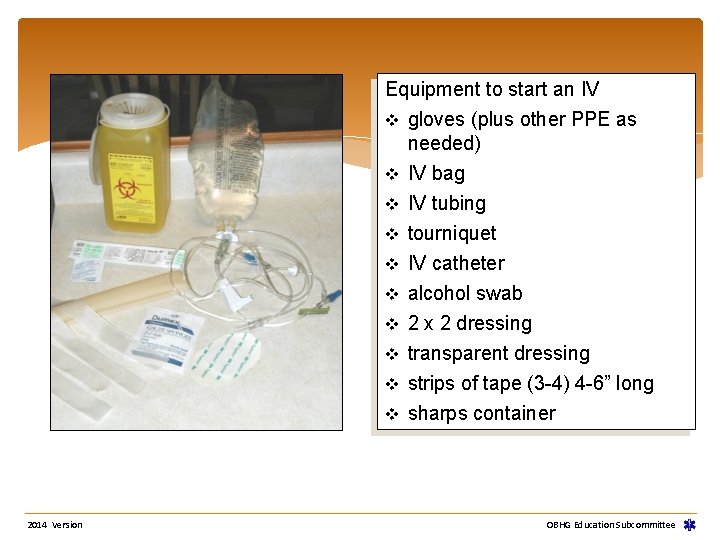
Equipment to start an IV v gloves (plus other PPE as needed) v IV bag v IV tubing v tourniquet v IV catheter v alcohol swab v 2 x 2 dressing v transparent dressing v strips of tape (3 -4) 4 -6” long v sharps container 2014 Version OBHG Education Subcommittee
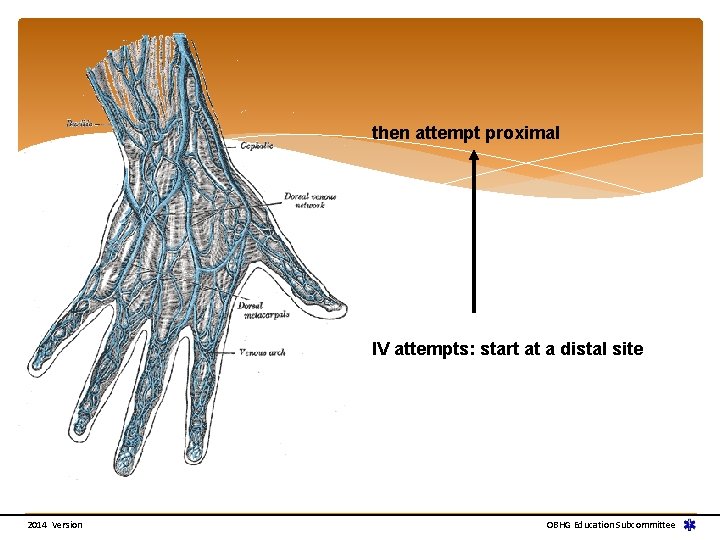
then attempt proximal IV attempts: start at a distal site 2014 Version OBHG Education Subcommittee
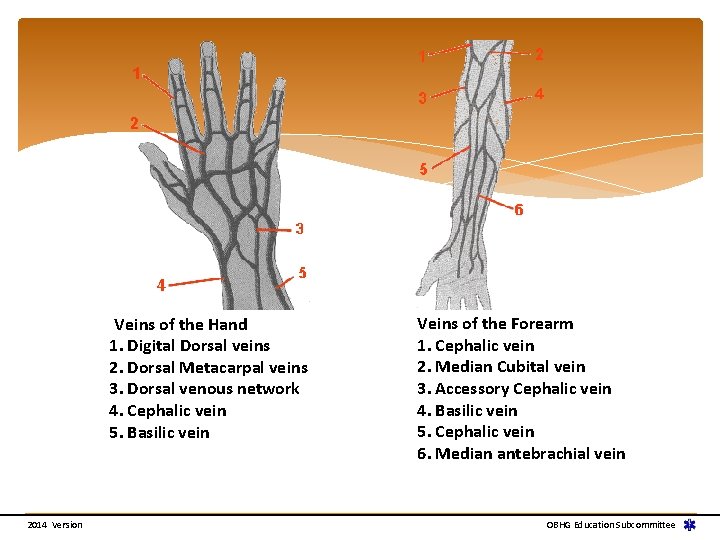
Veins of the Hand 1. Digital Dorsal veins 2. Dorsal Metacarpal veins 3. Dorsal venous network 4. Cephalic vein 5. Basilic vein 2014 Version Veins of the Forearm 1. Cephalic vein 2. Median Cubital vein 3. Accessory Cephalic vein 4. Basilic vein 5. Cephalic vein 6. Median antebrachial vein OBHG Education Subcommittee
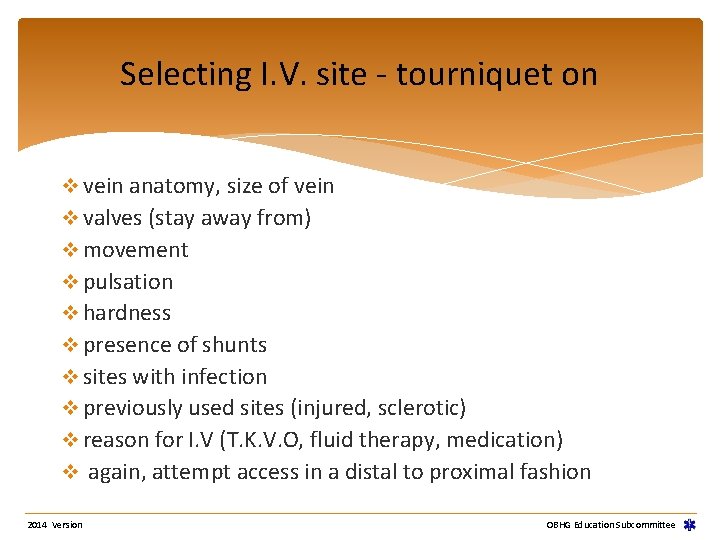
Selecting I. V. site - tourniquet on v vein anatomy, size of vein v valves (stay away from) v movement v pulsation v hardness v presence of shunts v sites with infection v previously used sites (injured, sclerotic) v reason for I. V (T. K. V. O, fluid therapy, medication) v again, attempt access in a distal to proximal fashion 2014 Version OBHG Education Subcommittee
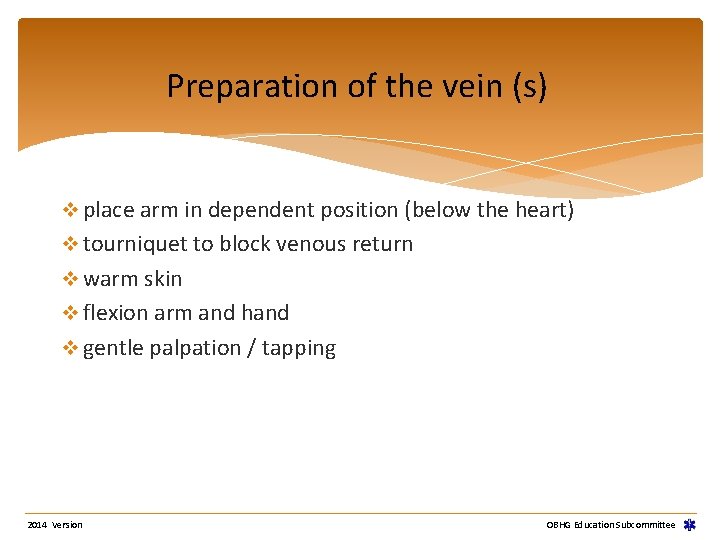
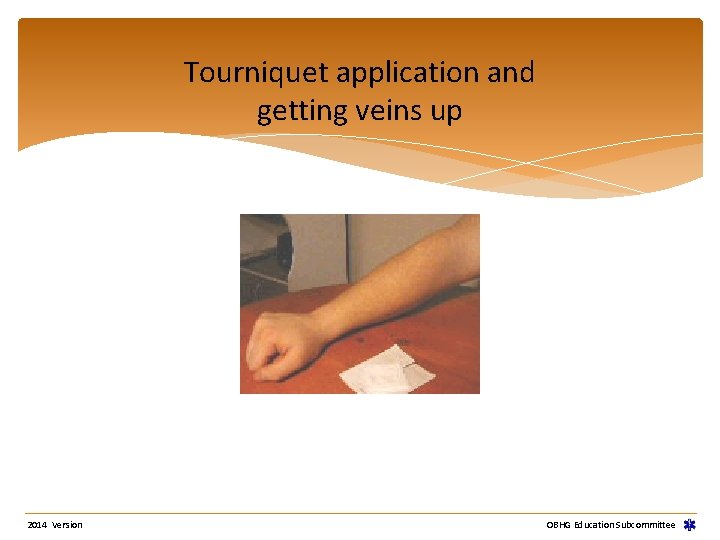
Preparation of the vein (s) v place arm in dependent position (below the heart) v tourniquet to block venous return v warm skin v flexion arm and hand v gentle palpation / tapping 2014 Version OBHG Education Subcommittee
Tourniquet application and getting veins up 2014 Version OBHG Education Subcommittee
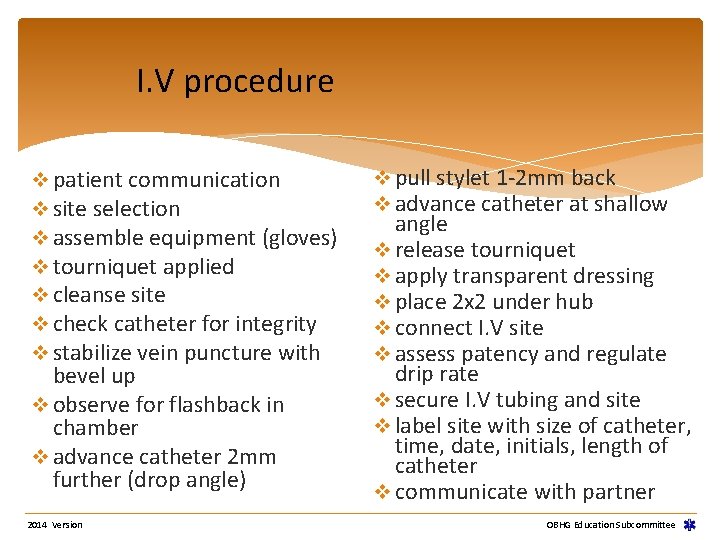
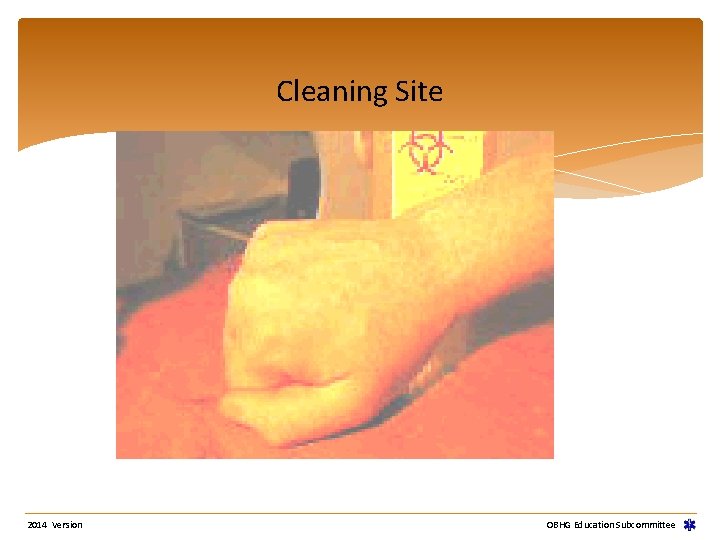
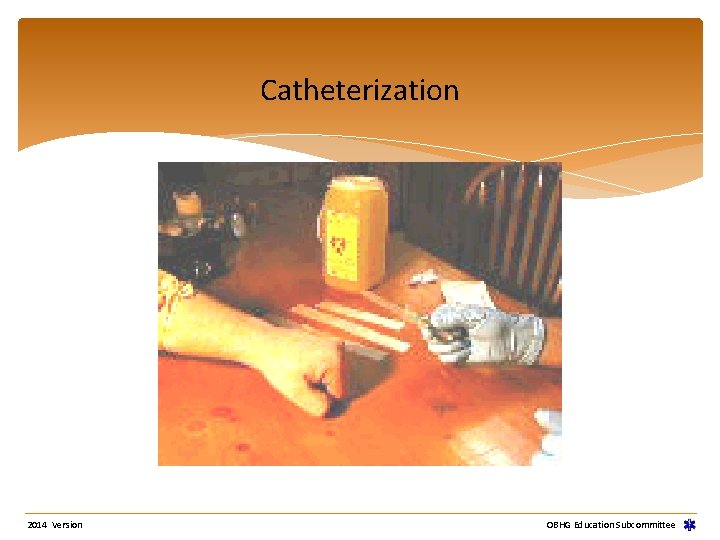
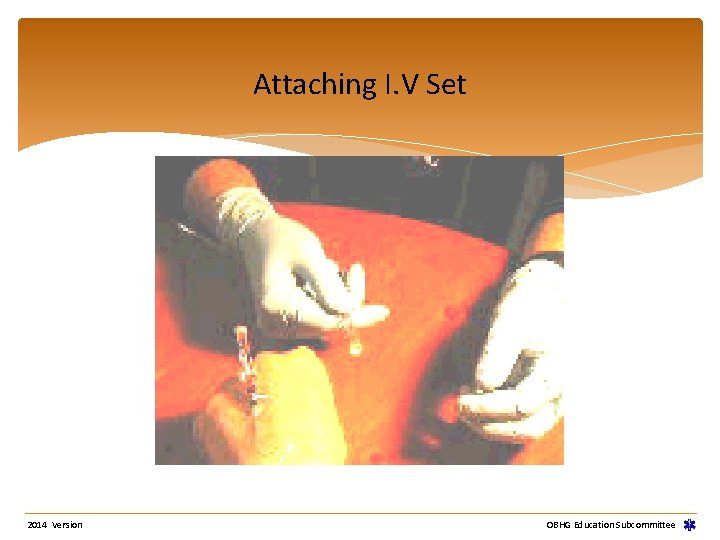
I. V procedure v patient communication v site selection v assemble equipment (gloves) v tourniquet applied v cleanse site v check catheter for integrity v stabilize vein puncture with bevel up v observe for flashback in chamber v advance catheter 2 mm further (drop angle) 2014 Version v pull stylet 1 -2 mm back v advance catheter at shallow angle v release tourniquet v apply transparent dressing v place 2 x 2 under hub v connect I. V site v assess patency and regulate drip rate v secure I. V tubing and site v label site with size of catheter, time, date, initials, length of catheter v communicate with partner OBHG Education Subcommittee
Cleaning Site 2014 Version OBHG Education Subcommittee
Catheterization 2014 Version OBHG Education Subcommittee
Attaching I. V Set 2014 Version OBHG Education Subcommittee
Complications of IV Therapy: Local/Systemic Potential complications v infiltration, extravasation - local v infection - local or systemic v fluid overload - systemic v catheter/air embolism - systemic v “speed shock” (cold fluid into core) - systemic v phlebitis (chemical, mechanical) - local v vasospasm - local 2014 Version OBHG Education Subcommittee
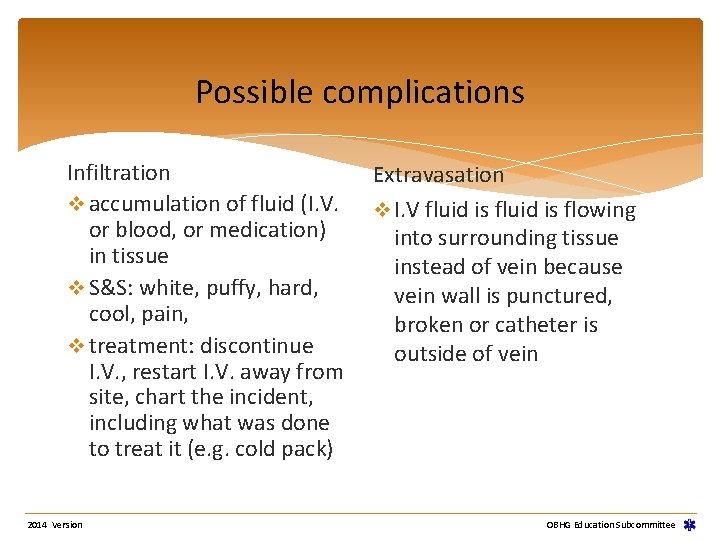
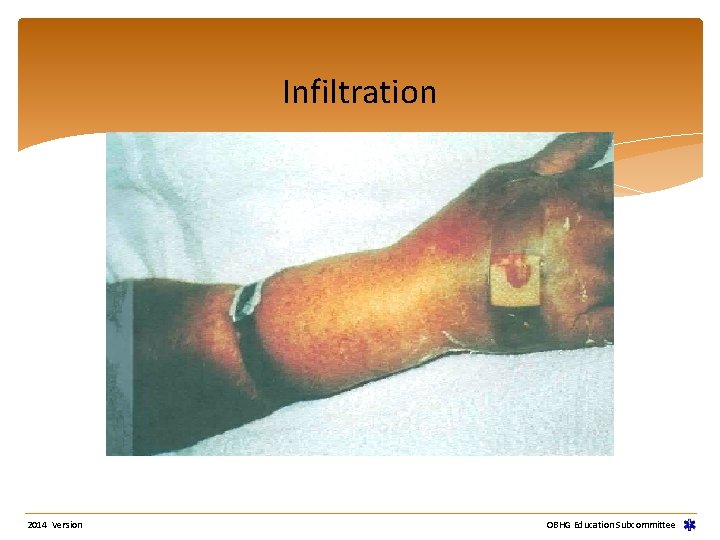
Possible complications Infiltration v accumulation of fluid (I. V. or blood, or medication) in tissue v S&S: white, puffy, hard, cool, pain, v treatment: discontinue I. V. , restart I. V. away from site, chart the incident, including what was done to treat it (e. g. cold pack) 2014 Version Extravasation v I. V fluid is flowing into surrounding tissue instead of vein because vein wall is punctured, broken or catheter is outside of vein OBHG Education Subcommittee
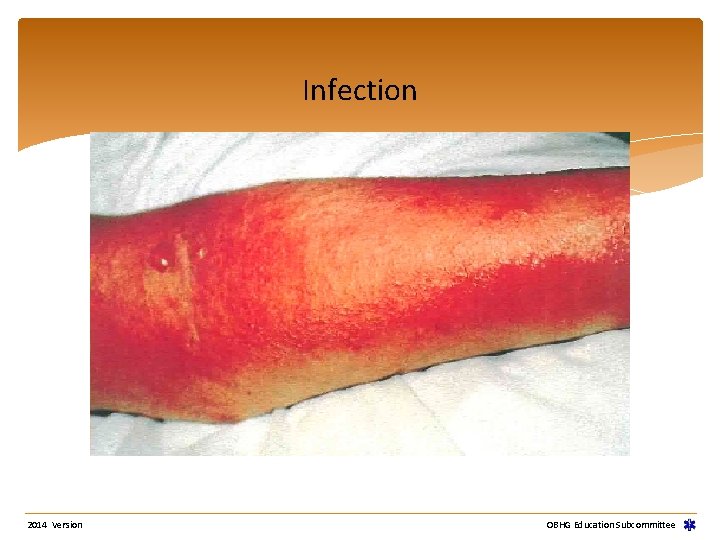
Infection at insertion site v cause: contaminated site or equipment v S&S: swelling and tenderness at site IV access is never so urgent that aseptic technique can be bypassed Systemic infection (Sepsis) due to invasion of bacteria, virus, or fungus into bloodstream v onset 1 -2 days post I. V, fever, chills, shaking, malaise, tachycardia, hypotension v cause: use of contaminated equipment or solutions, contamination at site of venipuncture 2014 Version OBHG Education Subcommittee
Infection 2014 Version OBHG Education Subcommittee
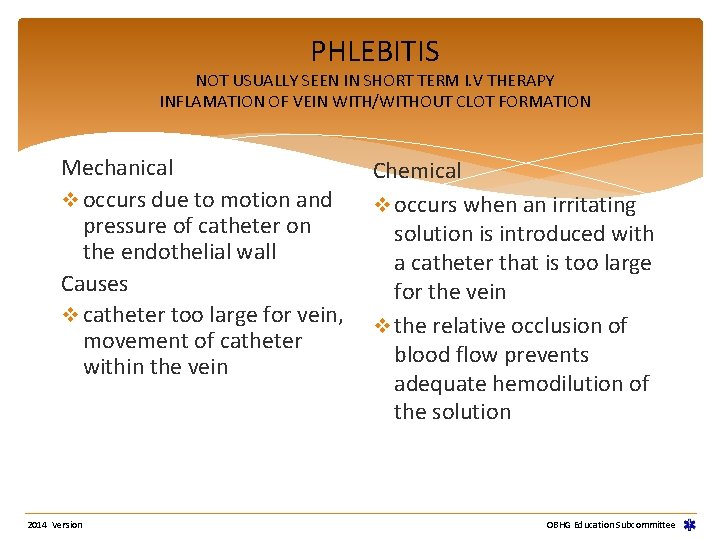
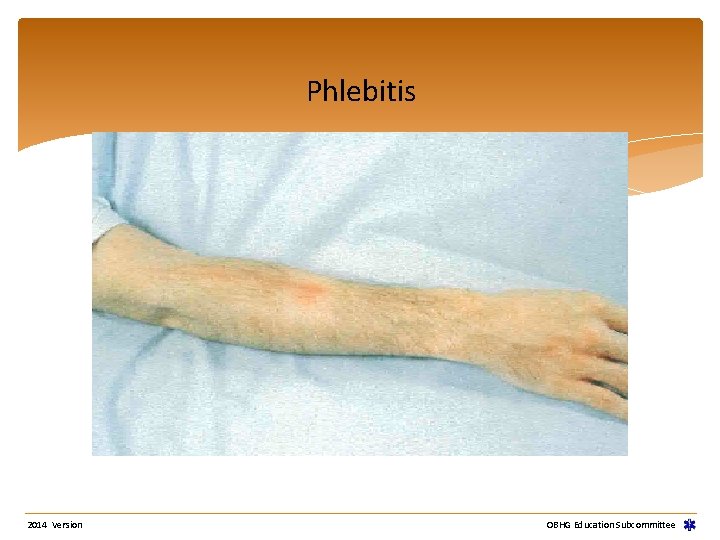
PHLEBITIS NOT USUALLY SEEN IN SHORT TERM I. V THERAPY INFLAMATION OF VEIN WITH/WITHOUT CLOT FORMATION Mechanical v occurs due to motion and pressure of catheter on the endothelial wall Causes v catheter too large for vein, movement of catheter within the vein 2014 Version Chemical v occurs when an irritating solution is introduced with a catheter that is too large for the vein v the relative occlusion of blood flow prevents adequate hemodilution of the solution OBHG Education Subcommittee
Phlebitis 2014 Version OBHG Education Subcommittee
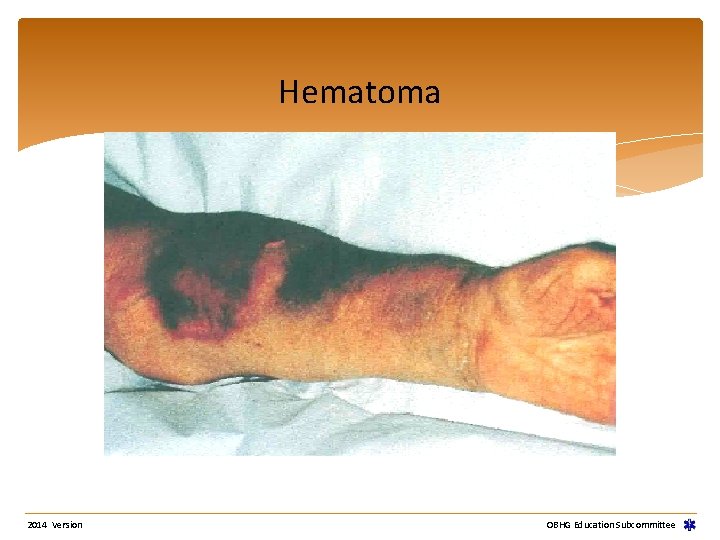
Hematoma 2014 Version OBHG Education Subcommittee
Infiltration 2014 Version OBHG Education Subcommittee
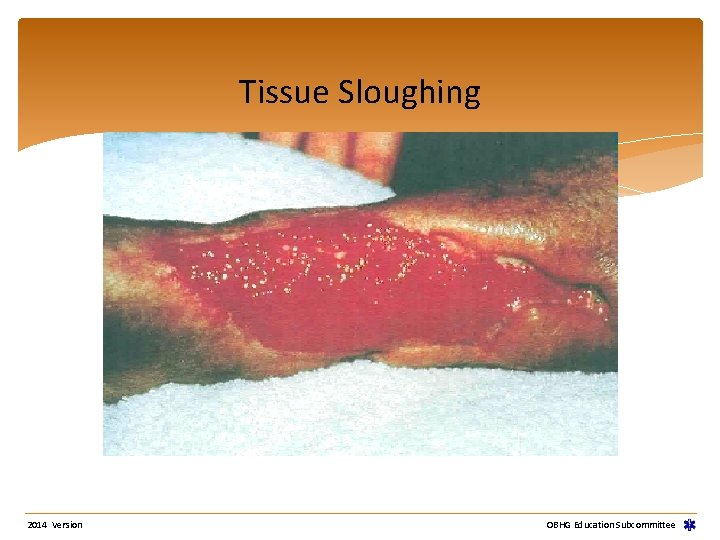
Tissue Sloughing 2014 Version OBHG Education Subcommittee
Fluid Overload v causes: excess fluid administration, renal failure, cardiac failure v S&S: headache, hypertension, coughing, dyspnea, pulmonary edema, restlessness, JVD v treatment: slow I. V to TKVO, oxygen, elevate head v document and notify receiving hospital 2014 Version OBHG Education Subcommittee
Air Embolism v air inadvertently enters the vasculature and heads through the right side of the heart to the pulmonary circuit and blocks a pulmonary vessel v 10 ml air can seriously harm or kill a patient Signs & Symptoms v clear chest (or wheezing), coughing, sudden onset of SOB, chest pain, dizziness v tests – ABGs, lung scan, pulmonary angiogram Treatment v administer O 2, put pt. in sitting position, IVC filter v Or - place pt. on left side with head down trapping air in right atrium v report to hospital staff stat and document incident 2014 Version OBHG Education Subcommittee
CATHETER EMBOLISM Catheter Embolism v piece of catheter breaks off entering blood stream v will travel to right side of heart and most likely will become lodged in pulmonary capillary bed causing signs and symptoms of a pulmonary embolism 2014 Version vtests: CXR vrisk of PE, CVA, MI DON’T RE-THREAD THE NEEDLE THROUGH THE CATHETER WHEN YOU MISS ON INITIAL ATTEMPT(S) OBHG Education Subcommittee
Factors that affect flow v catheter against valve v catheter too large for vein v vasospasm v kinked tube v I. V bag too low- i. e. height of bag v elevated arm v thrombosis v flexion v tourniquet inadvertently left on v amount of fluid in bag low v line taped too tight - circulation restricted 2014 Version OBHG Education Subcommittee
Saline Lock v allows for venous access without I. V fluid set attached v used for patients that need extricated v if only medications needed: good alternative (e. g. seizure patient) v prevents fluid overload Limitations v can be time consuming v catheter can become occluded 2014 Version OBHG Education Subcommittee
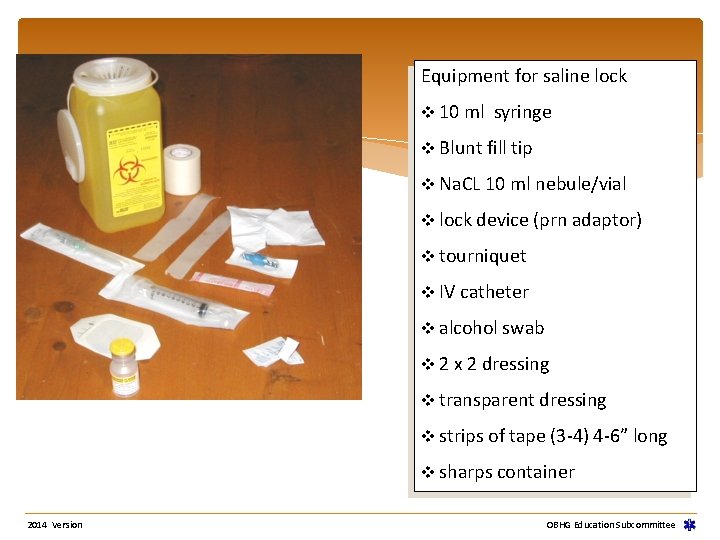
Equipment for saline lock v 10 ml syringe v Blunt fill tip v Na. CL 10 ml nebule/vial v lock device (prn adaptor) v tourniquet v IV catheter v alcohol swab v 2 x 2 dressing v transparent dressing v strips of tape (3 -4) 4 -6” long v sharps container 2014 Version OBHG Education Subcommittee
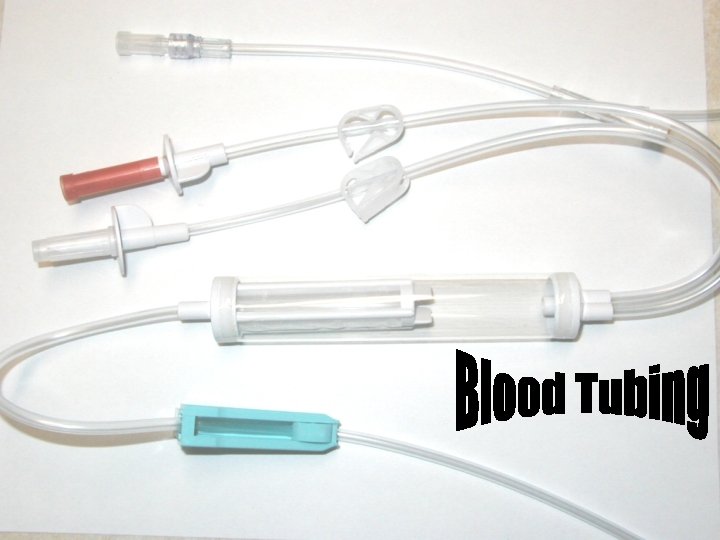
Blood Tubing v if anticipated that patient will need blood administration, it is recommended that one line be started using blood tubing v will not be primary I. V line due to time v needed for preparation v 2 nd I. V. access alternative 2014 Version OBHG Education Subcommittee
2014 Version OBHG Education Subcommittee
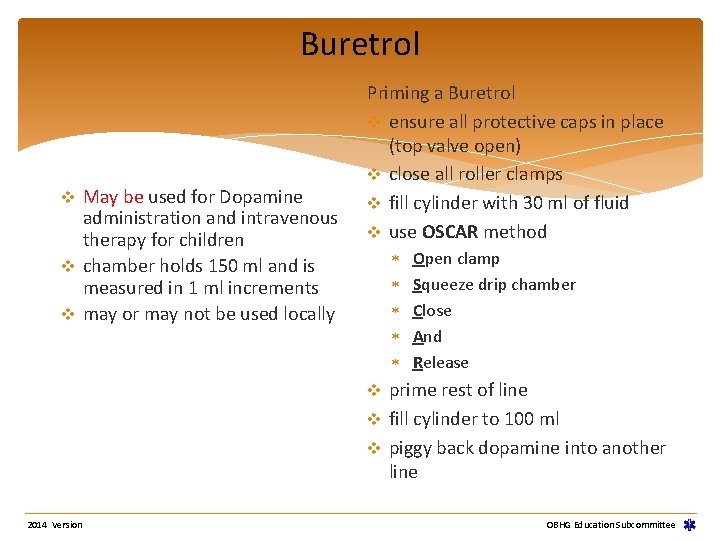
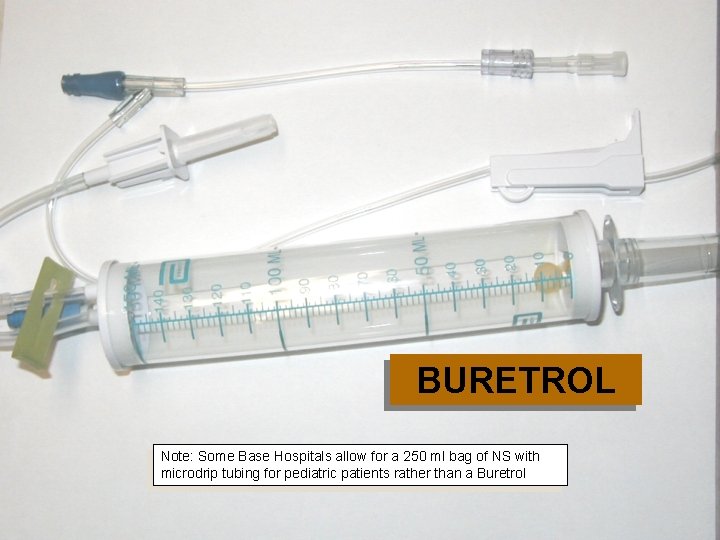
Buretrol v May be used for Dopamine administration and intravenous therapy for children v chamber holds 150 ml and is measured in 1 ml increments v may or may not be used locally Priming a Buretrol v ensure all protective caps in place (top valve open) v close all roller clamps v fill cylinder with 30 ml of fluid v use OSCAR method Open clamp Squeeze drip chamber Close And Release v prime rest of line v fill cylinder to 100 ml v piggy back dopamine into another line 2014 Version OBHG Education Subcommittee
BURETROL Note: Some Base Hospitals allow for a 250 ml bag of NS with microdrip tubing for pediatric patients rather than a Buretrol 2014 Version OBHG Education Subcommittee
Pediatrics Vascular Access v preferred site is the largest most accessible vein (arm, leg, hand, foot, scalp) v access is difficult as veins collapse during shock and arrest v may be necessary to attempt a blind insertion based upon prediction of anatomic location of vein v 2 person job v immobilize site with board and cling v beware of fluid overload v use Buretrol or 250 ml bag with microdrip tubing v if volume replacement needed use macro set Note: Some Base Hospitals allow for a 250 ml bag of NS with microdrip tubing for pediatric patients rather than a Buretrol 2014 Version OBHG Education Subcommittee
When not to start an I. V. v when transport is a higher priority v when you “think” the hospital may want one v AV fistula – avoid same arm!! v Arterio-venous shunt in a hemodialysis patient v Starting an IV on the same arm will jeopardize hemodialysis treatment v Mastectomy – avoid same arm v Lymph nodes in the arm on the same side may have been removed as part of the cancer treatment – if IV fluid goes interstitial, it won’t reabsorb well 2014 Version OBHG Education Subcommittee
Fistulas and Shunts vhemodialysis access in arm for patients with chronic renal failure vlimited life span, limited number of sites, preserve each site as long as possible vfistula identifiable by palpating for a “thrill” over site once again… DO NOT TAKE BLOOD PRESSURE OR PERFORM VENIPUNCTURE ON ARM WITH FISTULA 2014 Version OBHG Education Subcommittee
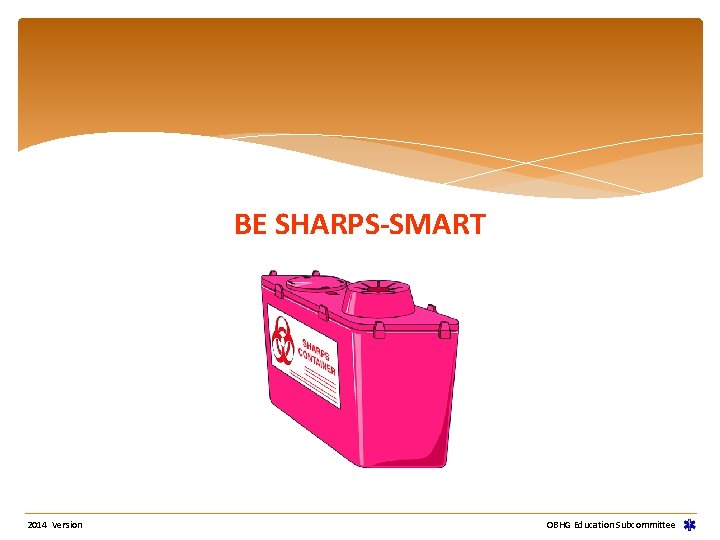
BE SHARPS-SMART 2014 Version OBHG Education Subcommittee
Sharps and needlestick injuries What to do if you have an injury v. NOTIFY SUPERVISOR IMMEDIATELY v. COMPLETE INCIDENT REPORT AND DOCUMENTATION v. COMPLETE ACR DOCUMENTATION (if appropriate) v. SEEK MEDICAL ATTENTION 2014 Version OBHG Education Subcommittee
NEEDLESTICK POLICY Ask for local policy ALS Patient Care Standards 2014 Version OBHG Education Subcommittee
Well Done! OBHG Education Subcommittee Self-directed Education Program 2014 Version OBHG Education Subcommittee