
Intraoperative EPIC Documentation Teaching Standard Megan Hellrung BSN

Intraoperative EPIC Documentation Teaching Standard Megan Hellrung, BSN, RN & Kristi Schuessler, BSN, RN, CNOR
Objectives � Review current EPIC Op-Time documentation practices amongst AIP OR Nurses � Identify both collective and inconsistent documentations practices � Clarify EPIC Op-Time documentation criteria � Regulate documentation practices through development of standards to guide consistent practice and continuity of care

Background � AIP OR EPIC Charting Guidelines Survey was distributed to assess OR Nurses documentation practices in two groups - Service Specialists/Current Staff Nurse - Recent/Current Orientee Nurse � The surveys response rates: (off orientation >1 year) (hire date within 1 year) - 41/115 Service Specialists/Current Staff Nurses = 36% - 19/30 Recent/Current Orientee Nurses = 63%
Background, continued � Literature review to assess recent evidencebased practices related to electronic healthcare documentation - Association of Operating Room Nurses (AORN) Recommended Practices for Perioperative Health Care Information Management - http: //www. aornstandards. org/content/1/SEC 28. body � Literature review of UCH Policies/Procedures and Guidelines applicable to Op-Time documentation - Surgical Counts - Specimen Collection
Background, continued � Organize group of expert-opinion stakeholders to review and analyze each section of the Op. Time Chart - Inpatient OR Nurse Manager, Inpatient OR Associate Nurse Manager, Inpatient OR Clinical Nurse Educator, Senior Risk Manager, OR EPIC Superuser, Perioperative Patient Safety Specialist, Perioperative Clinical Scholar � Collaborate with additional EPIC personnel and UCH healthcare professionals to obtain secondary support for specialty documentation - Service Specialists, Nursing Practice Guideline Committee, Information Technology Trainer, Systems Analyst RN � Creation of Teaching Standard: Intraoperative EPIC Documentation tool
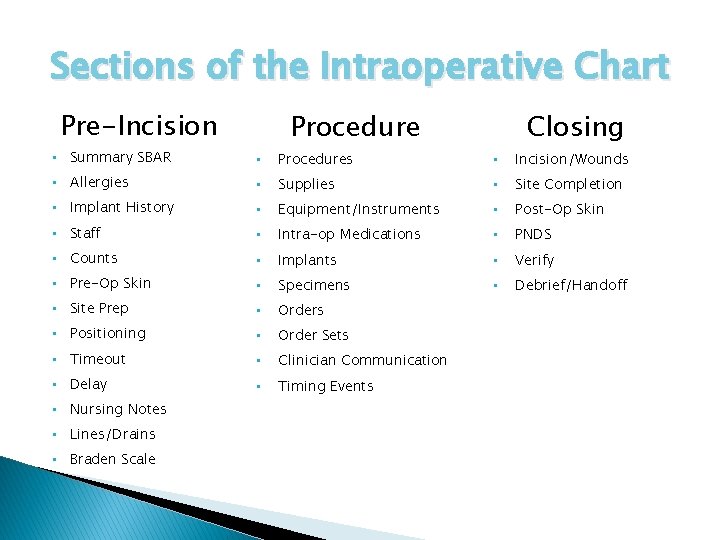
Sections of the Intraoperative Chart Pre-Incision Closing Procedure • Summary SBAR • Procedures • Incision/Wounds • Allergies • Supplies • Site Completion • Implant History • Equipment/Instruments • Post-Op Skin • Staff • Intra-op Medications • PNDS • Counts • Implants • Verify • Pre-Op Skin • Specimens • Debrief/Handoff • Site Prep • Orders • Positioning • Order Sets • Timeout • Clinician Communication • Delay • Timing Events • Nursing Notes • Lines/Drains • Braden Scale
Intraoperative Timing Events � “Cut Time” populated only upon incision (or start of intervention if no incision) � “Sweep” populated upon completion of the MWE (Methodical Wound Exam) � “Close Time” when drapes are removed from patient � “Ready for OR Discharge” – when patient is stable and ready for transfer (even if on PACU hold) ◦ Should always be populated
Allergies, Implant History � Allergies must be marked as reviewed prior to procedure start time � If patient’s prior implants populate here and are being explanted, document explant date and time
Staff � Accurate be kept “Time In” and “Time Out” records must ◦ If staff member leaves for a break, populate “Time Out”. When they return, populate “Time In” � Temporary relief person documented as “Circulator Relief/Scrub Relief” � Permanent relief person documented as “Circulator/Scrub” � Company reps are documented as “Vendor” � Students, observers, etc are documented as “Visitor” � Document support staff (Radiology, Neuromonitoring, etc)
Counts � Remember to document the time and surgeon completing the MWE � If count is incorrect – specify only portion that was incorrect (i. e. sponges incorrect, sharps/instruments correct) � “Counted By” – Scrub � “Verified By” - Circulator � Second “Closing” count specified as “Instrument Check Fluoro/Xray” for Anterior Lumbar Interbody Fusion (ALIF), XLIF (lateral) ◦ Document surgeon’s name as “verified by” and “counted by” � Wound Packing of countable items
Pre-Op Skin, Site Prep � An overall skin assessment is to be completed in the Pre-Op area o Can be completed with patient verbally or via visual assessment � Site prep should include surgical site, laterality and hair removal (if applicable) and prep solution o If multiple surgical site(s) planned for a procedure(s), each prep site must be entered individually o If an inclusive body surface area prep is required, a single selection of site option or selection of multiple sites for one inclusive procedure document as a single entry o If multiple preps are utilized on same surgical site, each prep solution must be selected
Positioning � Primary positioning of the patient required for a surgical procedure(s) must be documented o o � All surgical team members involved in positioning the patient must be documented. - Anesthesia staff must be included related to their responsibility and control of the patient’s airway. The time final positioning of the patient occurs must be documented - Important to determine the length of time a patient has been in position, supports assessment for injury and care to maintain the patient’s skin integrity Any additional positioning that occur throughout a single procedure requires a supplementary positioning entry
Timeout � Must be completed prior to the start of any procedure o “OR-Pre Incision” is appropriate for all OR surgical procedures or completed as a bedside procedures o Procedure timeout questions must be addressed and confirmed prior to timeout verification (i. e. hard-stop questions) o Briefing questions should all be addressed and documented as “Yes” when members of the surgical team discuss if the patient requires the listed care interventions
Delay complication that prevents a first case from starting at the scheduled time or causes turnover time to be greater than thirty minutes must be documented �A o “No Delay”= patient arrives in the OR on time/room turnover is completed and surgical team ready within thirty minutes o “ No Delay” = A scheduled case starts later than originally planned but turnover from the previous case was completed in thirty minutes o “No Delay” = If a Request for Time (RFT) follows a completed scheduled case � OR RN is responsible to ensure the delay type and delay reason reflects the anesthesia record’s delay type and delay reason o The delay length is the amount of time documented in minutes before the patient was brought back to OR and/or the number of minutes over thirty minutes allotted for turnover.
Nursing Notes � Must document: ◦ Preop Interview/Patient education (AORN Guidelines for Perioperative Practice) ◦ Communication with patient’s family ◦ Wound packing (if applicable) �Placement date and time �Name of person placing the packing �Location �Quantity of items being placed �Date and time of removal, if applicable
Lines, Drains, Airways � Lines and airways placed by the anesthesia provider are documented by the anesthesia provider � Airways placed by the surgeon (i. e. trach) are documented by the OR nurse � Drains placed by the surgeon are documented by the OR nurse � If patient arrives to OR with drains in place, OR nurse should document an assessment (but not if placed in the OR) � Assign a number to drain to distinguish it from other drains � Document removal of drains � Document assessment of urine upon placement of Foley
Braden Scale, Procedures � Braden Scale documented by pre-op RN � If not completed by pre-op RN, OR RN must document ◦ Document thinking of patient pre-operatively, not anesthetized � Procedures ◦ Document Description, Laterality, Type of Anesthesia, Wound Class for each panel (if applicable) ◦ Verify wound class with surgeon ◦ Laterality documented as “N/A” if midline or no laterality – not “Bilateral”
Supplies � If documenting a one-time supply, at a minimum must document: �Supply name �Quantity used or wasted �Name of the manufacturer �Manufacturer number (i. e. reference number or model number) � Document a reason when a supply is wasted � If patient has Latex allergy – ensure these items are either removed or at “ 0”
Equipment/Instruments � Equipment that is applied directly to the patient and has the risk to cause a thermal injury must be documented o Device name, serial number and/or hospital code and the initial settings the device will be applied to the patient
Intra-Op Medications � Medication administration in the OR may occur through direct administration or from the sterile field o o o If a medication is administered to in multiple doses (i. e. local injection prior to incision or local injection prior to dressing application), each individual administration must be documented as a separate entry (time stamped). It is appropriate to select “Other” when medication is administered indirectly to the patient (i. e. bladder irrigation). It is appropriate to document procedure “Cut Time” as the administration time for PRN medications that are present on the sterile field and are required for the procedure start (i. e. irrigation)
Implants � The action of an implant either on the sterile field or that has reached the patient must be documented. • If an implant is being removed from a patient for lawsuit/legal reasons, it must be documented as “Explanted” in either the Implant History screen if applicable, or within the Implant screen. - A Pathology Requisition may also be completed for explanted items for lawsuit/legal reasons, per surgeon preference (Please refer to XX. Specimens, A, #5, b. ). � When an implant is a tissue, organ or tissue derivatives, the Track. Core barcode may be scanned, if applicable to populate the implant and required implant fields. �If an implant does not have a Track. Core barcode or will not scan, the OR RN must enter the tissue implant manually into the chart. The OR RN must manually enter the ITM number below the barcode as the Track. Core ID.
Specimens When a specimen is obtained but surgeon requests that the specimen not be sent for pathology examination, document a Nursing Note acknowledging the surgeon’s request � The specimen ID should be identified as a numerical value to support the organization of specimen collection (i. e. Permanent, Frozen or Fresh specified as 1, 2, 3 etc. ) � Specimens that are removed from a patient for lawsuit/legal reasons must be documented as a requisition per legal obligations. � o If a specimen/evidence is to be given to the responsible law enforcement officer, a Nursing Note must be documented acknowledging the transfer of the specimen/evidence
Orders � Any Laboratory order or Central Supply order requested or completed within the OR must be signed o The order mode appropriate for intraoperative Orders include: “Verbal, with read back verification” or “Telephone, with read back verification”. � Central Supply orders should utilize the comment section to identify which OR is requesting the item(s), a reference to who will pick up the item(s) and the OR phone number as a contact
Order Sets, Clinician Communication � Document orders in “Orders” section, not Order Sets � Clinician Communication ◦ Transfer phone call with critical results to anesthesia provider (no documentation necessary) ◦ If RN does take the information and communicate it to anesthesia provider/surgeon, must document ◦ Recommend communication with pathologist (i. e. frozen section) documented here �Only if RN relays information to surgeon ◦ Do not document information called about another patient in your patient’s chart
Timing Events � Robot Console Start / Robot Console Stop � Vein In / Vein Out for CABG procedures ◦ Time of incision on leg, then time vein removed from leg � No other timing events documented here at this time
Incisions/Wounds � Pre-existing ◦ No if new incision ◦ Yes if the patient has a pre-existing incision that has a “Final Assessment” date and time documented (document a new incision and mark “Yes” for preexisting) ◦ If incision is pre-existing and does not have a “Final Assessment” date and time documented, do not create a new incision entry, and document an assessment of the existing incision � Scope Sites ◦ Only populate for creation of multiple scope sites (i. e. laparoscopic procedures) �Do not populate if multiple incisions (but not scope sites) �If multiple incisions on same body part, new incision entries must be created for each incision
Incisions/Wounds Continued � Existing burn – Dressing Assessment (often “removed”), type of graft used, type of dressing applied � Non-wound packing �Placement date and time �Name of person placing the packing �Location (must be specified as ear, eye, mouth, nose, or vagina) �Quantity of items being placed �Date and time of removal (if removed while in the OR) � Wound Packing does not exist in EPIC. Document as non-wound packing with a location comment, and also make a Nursing Note � Telfa “wicks” should be considered packing, as they have been retained
Site Completion � Document site completion for each surgical site � Do not document wound packing under site completion
Post-Op Skin, PNDS ◦ Add any variance from Pre-Op Skin assessment ◦ Assess any additional interventions directly applied to the skin including tourniquet (if applicable), grounding, positioning, warming, and operative sites. � OR RN must review pre-populated “Outcome Group” phrases to ensure that nursing contributions applied are documented o If a pre-populated diagnosis in the “Outcome Group” does not apply, it is appropriate to deselect the phrase o If a pre-populated intervention(s) descending “Outcome Group” phrases does not apply it is appropriate to deselect the intervention(s)
Verify � Verification is to be completed after the patient has been safely transferred to the next phase of care and handoff report has been completed o o Legal electronic signature authenticating the information in the chart is accurate, reflecting the factual events of the procedure and care provided within the OR. The OR RN must return to the OR to complete a final review of the chart.
Debrief/Handoff � Completion of the Debrief/Handoff should be done at the end of the case after the patient has been safely transferred to the next phase of care and handoff report has been completed � The OR RN should utilize the Debrief/Handoff tool during staff changes such as breaks/lunches or permanent shift relief or during handoff report in phase of care change as a means to provide standardized report
Additional Information � OR Pre-Op Checklist o OR RN to complete when the OR RN will act as the primary nurse for the patient throughout the Intraoperative care setting � Transferring a Patient ◦ Receiving unit must document patient transfer � Editing the Chart ◦ If chart is “read-only”, must create an addendum to the chart to make necessary edits � Procedure not Performed ◦ Document “Procedure not Performed” under “More Actions” in the EPIC sidebar �Include whether canceled “In Preop”, “Before Induction”, or “After Induction” ◦ Chart does not need to be verified if before “Cut Time”
Additional Information, continued � Transplant Charting ◦ Transplant times under “Txp Surgical Forms” ◦ Document pre-incision verification of donor and recipient blood types between the OR RN and the surgeon by selecting “ABO Pre-Organ Arrival Verification” in the “Timeout” section ◦ Document verification of organ and donor/recipient blood types between the OR RN and the surgeon at the time the organ has entered the room by selecting “ABO Organ Verification” in the “Timeout” section ◦ If the patient is an organ donor only and is not receiving a transplanted organ, then a single verification must be documented in the “Timeout” section under “ABO Organ Recovery Verification”.

Conclusion � Survey results, literature review and expert stakeholders/healthcare professionals act as the foundation backing and building this tool � Several updates for standardization to support OR RN organization, efficiency and continuity of care through EPIC documentation � Readily accessible tool for review and reference can be resourced via AIP OR Weebly education site: o http: //uchor. weebly. com/documentationteaching-tool. html
References � � � Beyea, S. C. (1999). Standardized language-making nursing practice count. AORN Journal, 70(5): 831 -832, 834, 837 -838. (LOE VII) Braden, B. & Bergstrom, N. (1988). Braden scale for predicting pressure sore risk. In Prevention Plus: Home of the Braden Scale. Retrieved March 18, 2015, from http: //www. bradenscale. com/images/bradenscale. pdf (LOE VIII) Garner, JS. (1985) CDC guideline for prevention of surgical wound infections [Electronic version]. Infect Control, 7(3): 193 -200. (LOE VII) Giarrizzo-Wilson, S. , Anderson, C. A. , Hughes, A. B. , & Klein, C. A. (March 9, 2012). Guideline for healthcare information management. In Guidelines for Perioperative Practice. Retrieved from http: //www. aornstandards. org/content/1/SEC 28. body (LOE VII) Kleinbeck, S. V. M. (1999). Development of the Perioperative Nursing Data Set. AORN Journal, 70(1): 15 -18, 21 -23, 26 -28. (LOE VII) Price, M. C. , Whitney, J. D. , & King, C. A. (2005). Development of a risk assessment tool for intraoperative pressure ulcers [Electronic version]. JWOCN, 19 -32. (LOE V)
- Slides: 35