
INTRAOCULAR LENS POWER CALCULATION IN POSTREFRACTIVE SURGERY ASIAN
- Slides: 12
INTRA-OCULAR LENS POWER CALCULATION IN POSTREFRACTIVE SURGERY ASIAN EYES USING THE HAIGIS-L FORMULA Dr Daphne Han, FRCS Dr Wei-Han Chua, FRCS Dr Peter Tseng, FRCS The authors have no financial interest in the subject matter of this presentation
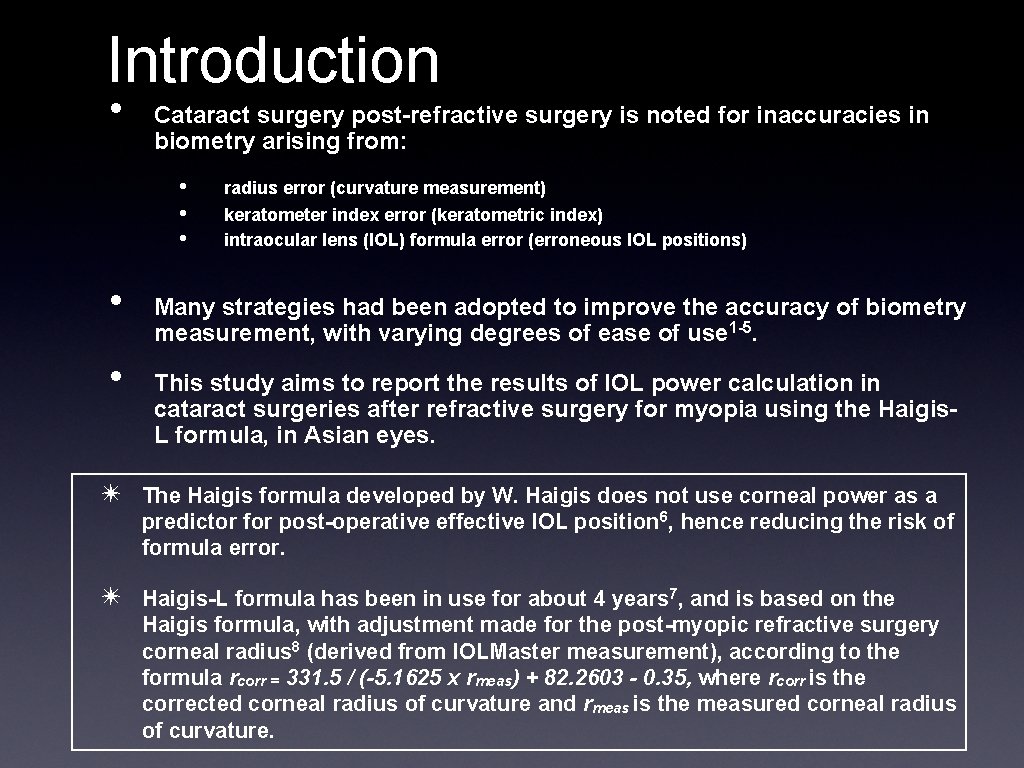
Introduction • Cataract surgery post-refractive surgery is noted for inaccuracies in biometry arising from: • • • radius error (curvature measurement) keratometer index error (keratometric index) intraocular lens (IOL) formula error (erroneous IOL positions) Many strategies had been adopted to improve the accuracy of biometry measurement, with varying degrees of ease of use 1 -5. This study aims to report the results of IOL power calculation in cataract surgeries after refractive surgery for myopia using the Haigis. L formula, in Asian eyes. ✴ The Haigis formula developed by W. Haigis does not use corneal power as a predictor for post-operative effective IOL position 6, hence reducing the risk of formula error. ✴ Haigis-L formula has been in use for about 4 years 7, and is based on the Haigis formula, with adjustment made for the post-myopic refractive surgery corneal radius 8 (derived from IOLMaster measurement), according to the formula rcorr = 331. 5 / (-5. 1625 x rmeas) + 82. 2603 - 0. 35, where rcorr is the corrected corneal radius of curvature and rmeas is the measured corneal radius of curvature.
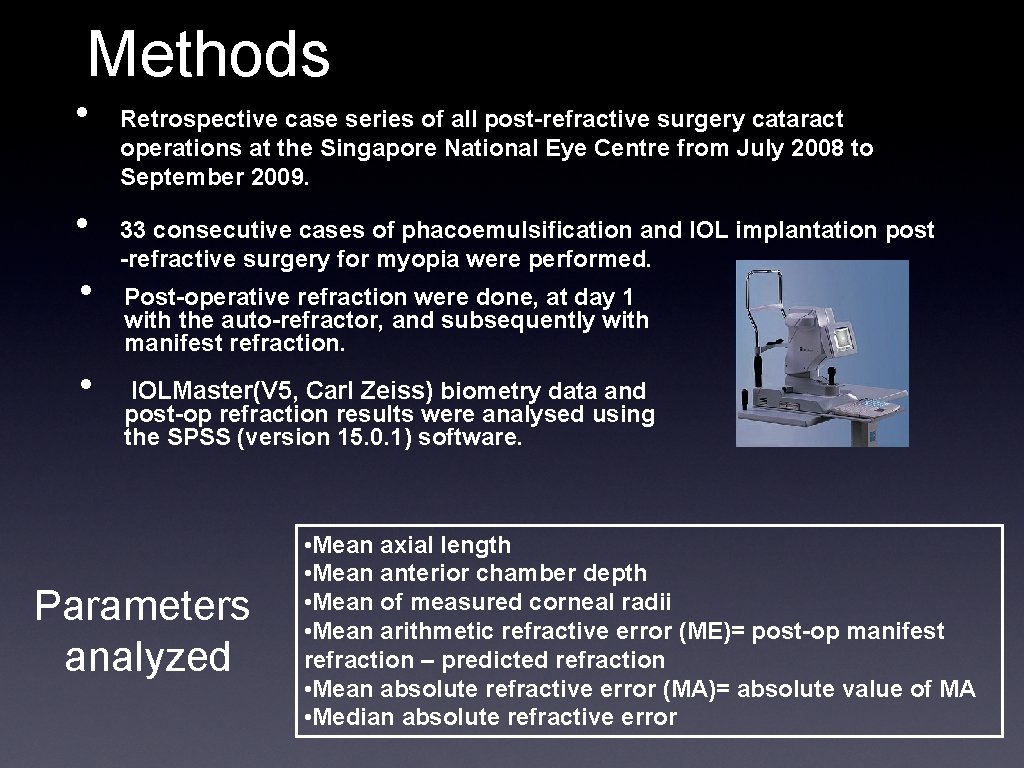
Methods • • Retrospective case series of all post-refractive surgery cataract operations at the Singapore National Eye Centre from July 2008 to September 2009. 33 consecutive cases of phacoemulsification and IOL implantation post -refractive surgery for myopia were performed. Post-operative refraction were done, at day 1 with the auto-refractor, and subsequently with manifest refraction. IOLMaster(V 5, Carl Zeiss) biometry data and post-op refraction results were analysed using the SPSS (version 15. 0. 1) software. Parameters analyzed • Mean axial length • Mean anterior chamber depth • Mean of measured corneal radii • Mean arithmetic refractive error (ME)= post-op manifest refraction – predicted refraction • Mean absolute refractive error (MA)= absolute value of MA • Median absolute refractive error
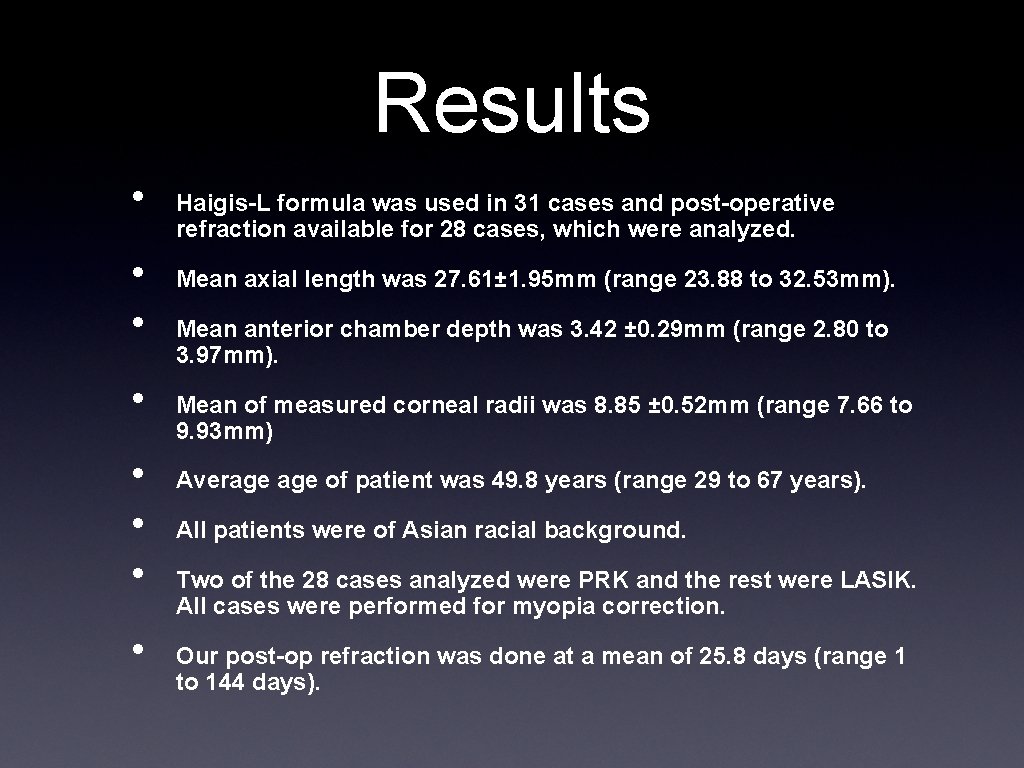
Results • • Haigis-L formula was used in 31 cases and post-operative refraction available for 28 cases, which were analyzed. Mean axial length was 27. 61± 1. 95 mm (range 23. 88 to 32. 53 mm). Mean anterior chamber depth was 3. 42 ± 0. 29 mm (range 2. 80 to 3. 97 mm). Mean of measured corneal radii was 8. 85 ± 0. 52 mm (range 7. 66 to 9. 93 mm) Average of patient was 49. 8 years (range 29 to 67 years). All patients were of Asian racial background. Two of the 28 cases analyzed were PRK and the rest were LASIK. All cases were performed for myopia correction. Our post-op refraction was done at a mean of 25. 8 days (range 1 to 144 days).
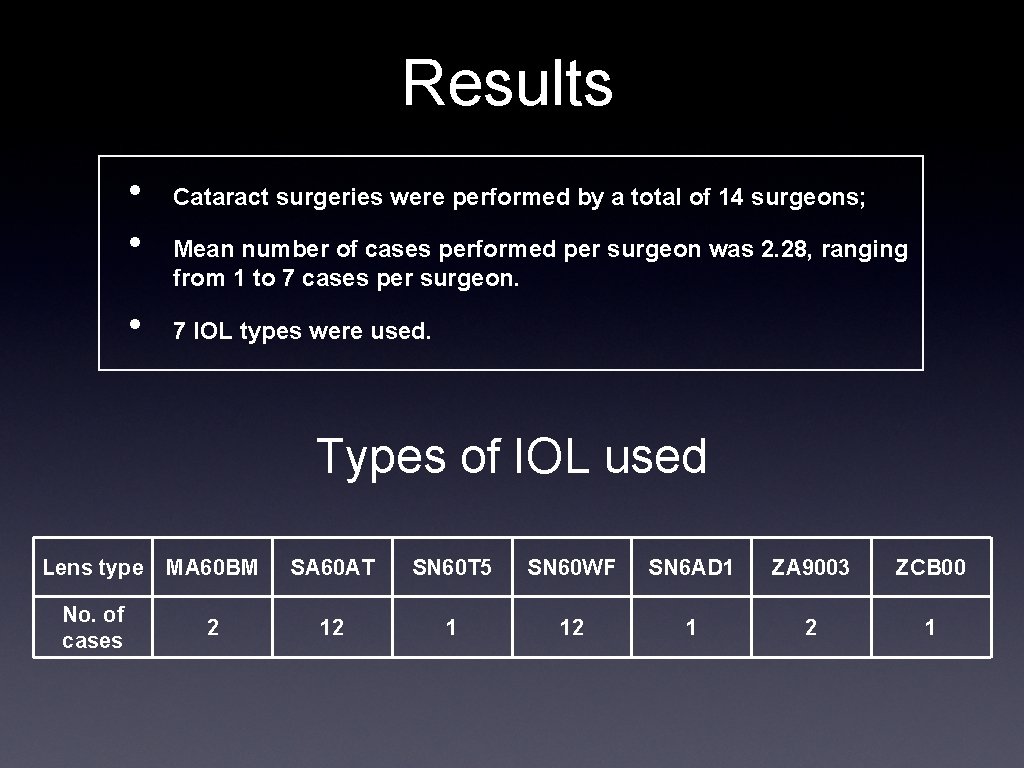
Results • • • Cataract surgeries were performed by a total of 14 surgeons; Mean number of cases performed per surgeon was 2. 28, ranging from 1 to 7 cases per surgeon. 7 IOL types were used. Types of IOL used Lens type MA 60 BM SA 60 AT SN 60 T 5 SN 60 WF SN 6 AD 1 ZA 9003 ZCB 00 No. of cases 2 12 1 2 1
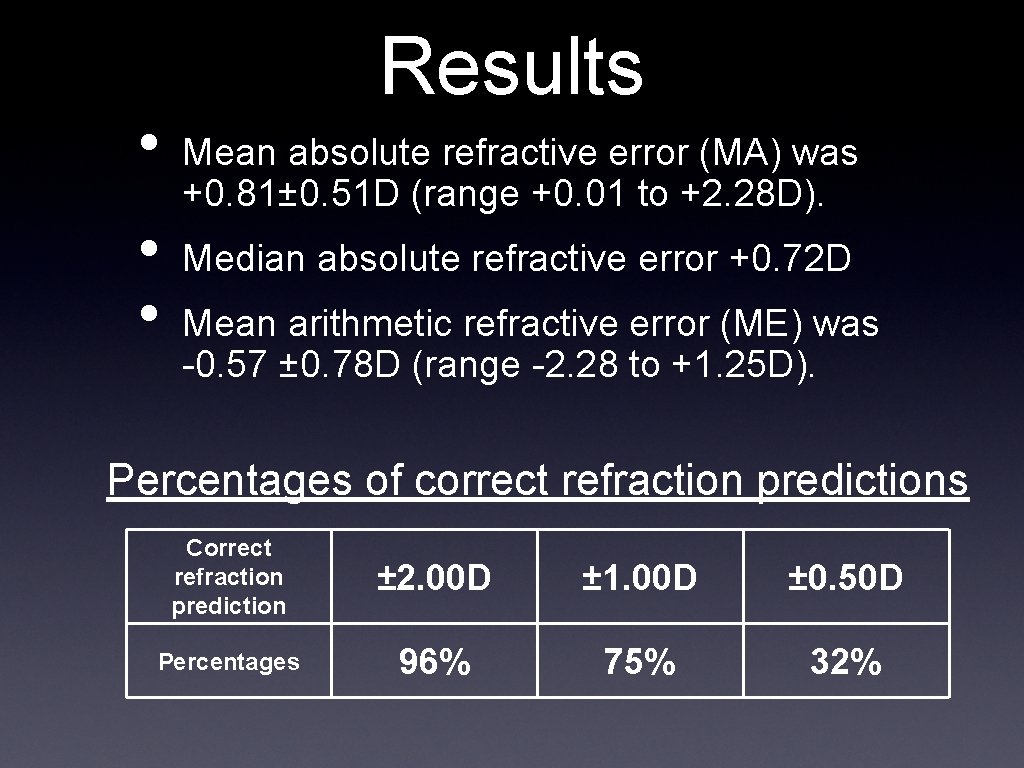
• • • Results Mean absolute refractive error (MA) was +0. 81± 0. 51 D (range +0. 01 to +2. 28 D). Median absolute refractive error +0. 72 D Mean arithmetic refractive error (ME) was -0. 57 ± 0. 78 D (range -2. 28 to +1. 25 D). Percentages of correct refraction predictions Correct refraction prediction ± 2. 00 D ± 1. 00 D ± 0. 50 D Percentages 96% 75% 32%
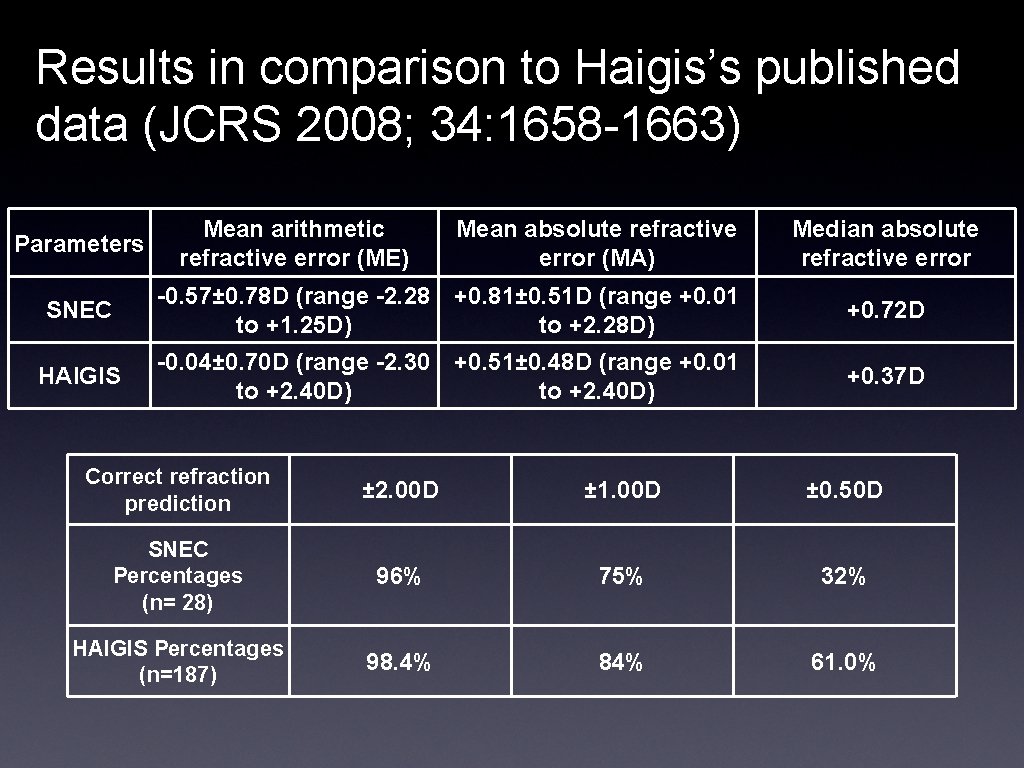
Results in comparison to Haigis’s published data (JCRS 2008; 34: 1658 -1663) Parameters Mean arithmetic refractive error (ME) Mean absolute refractive error (MA) Median absolute refractive error SNEC -0. 57± 0. 78 D (range -2. 28 +0. 81± 0. 51 D (range +0. 01 to +1. 25 D) to +2. 28 D) +0. 72 D HAIGIS -0. 04± 0. 70 D (range -2. 30 +0. 51± 0. 48 D (range +0. 01 to +2. 40 D) +0. 37 D Correct refraction prediction ± 2. 00 D ± 1. 00 D ± 0. 50 D SNEC Percentages (n= 28) 96% 75% 32% HAIGIS Percentages (n=187) 98. 4% 84% 61. 0%
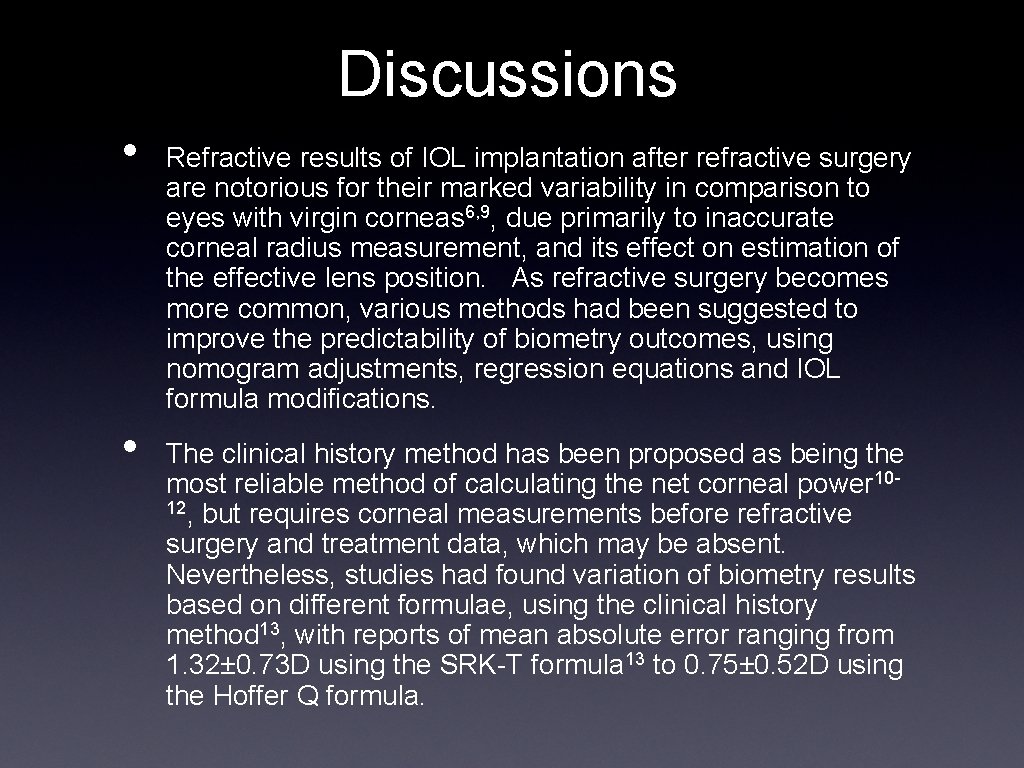
Discussions • • Refractive results of IOL implantation after refractive surgery are notorious for their marked variability in comparison to eyes with virgin corneas 6, 9, due primarily to inaccurate corneal radius measurement, and its effect on estimation of the effective lens position. As refractive surgery becomes more common, various methods had been suggested to improve the predictability of biometry outcomes, using nomogram adjustments, regression equations and IOL formula modifications. The clinical history method has been proposed as being the most reliable method of calculating the net corneal power 1012, but requires corneal measurements before refractive surgery and treatment data, which may be absent. Nevertheless, studies had found variation of biometry results based on different formulae, using the clinical history method 13, with reports of mean absolute error ranging from 1. 32± 0. 73 D using the SRK-T formula 13 to 0. 75± 0. 52 D using the Hoffer Q formula.
• • • Discussion Our study is limited by its small sample size and the variable length of follow-up. Majority of the refractive surgeries were performed elsewhere. However, all phacoemulsifications were performed at our centre, by a total of 14 surgeons, using a total of 7 lens types. We did not encounter any dense or white cataracts that the IOLMaster could not be applied upon. Although the outcome shown in our study seem less accurate in comparison to Haigis’s own report 8, this may be a result of the above limitations. The range of our outcome is nevertheless similar to Haigis’s results. The span of our ME was 3. 53 D and of the MA was 2. 27 D, compared to Haigis’s 4. 7 D and 2. 39 respectively, which show that our results have a tighter spread. Our outcome of the Haigis-L formula for IOL calculation of post-refractive surgery Asian eyes compare reasonably well with other formulae 13. The Haigis-L formula has the advantage of being extremely user-friendly since no clinical history is required. The fact that in this study a total of 14 surgeons contributed to the results also attest to its reliability and ease of use.
Summary • Haigis-L requires no pre-refractive surgery keratometry and treatment data • Excellent ease of use compared to other formulae, no extra calculations required. • Requires the IOLMaster. • Not for white or dense posterior subcapsular cataracts. • Our results in Asian eyes with a diverse number of surgeons and lens types show its applicability.
References 1. Shammas HJ, Shammas MC. No-history method of intraocular lens power calculation for cataract surgery after myopic laser in situ keratomileusis. J Cataract Refract Surg. 2007 Jan; 33(1): 31 -6. 2. Borasio E, Stevens J, Smith GT. Estimation of true corneal power after keratorefractive surgery in eyes requiring cataract surgery: BESSt formula. J Cataract Refract Surg. 2006 Dec; 32(12): 2004 -14. 3. Rosa N, Capasso L, Romano A. A new method of calculating intraocular lens power after photorefractive keratectomy. J Refract Surg. 2002 Nov-Dec; 18(6): 720 -4. 4. Aramberri J. Intraocular lens power calculation after corneal refractive surgery: double-K method. J Cataract Refract Surg. 2003 Nov; 29(11): 2063 -8. 5. Koch DD, Wang L. Calculating IOL power in eyes that have had refractive surgery. J Cataract Refract Surg. 2003 Nov; 29(11): 2039 -42. 6. Haigis W, Lege B, Miller N, Schneider B. Comparison of immersion ultrasound biometry and partial coherence interferometry for intraocular lens calculation according to Haigis. Graefes Arch Clin Exp Ophthalmol. 2000 Sep; 238(9): 765 -73. 7. Haigis W. [Preoperative intraocular lens power calculations in problem eyes]. Z Med Phys. 2007; 17(1): 45 -54. German. 8. Haigis W. Intraocular lens calculation after refractive surgery for myopia: Haigis-L formula. J Cataract Refract Surg. 2008 Oct; 34(10): 1658 -63. 9. Elder MJ. Predicting the refractive outcome after cataract surgery: the comparison of different IOLs and SRK-II v SRK-T. Br J Ophthalmol. 2002 Jun; 86(6): 620 -2 10. Savini G, Barboni P, Zanini M. Ophthalmology. 2006 Aug; 113(8): 1271 -82. Intraocular lens power calculation after myopic refractive surgery: theoretical comparison of different methods. 11. Morris AH, Whittaker KW, Morris RJ, Corbett MC. Errors in intraocular lens power calculation after photorefractive keratectomy. Eye (Lond). 1998; 12 ( Pt 2): 327 -8. 12. Kalski RS, Danjoux JP, Fraenkel GE, Lawless MA, Rogers C. J Refract Surg. Intraocular lens power calculation for cataract surgery after photorefractive keratectomy for high myopia. 1997 Jul-Aug 13(4): 362 -6. 13. Fam HB, Lim KL A comparative analysis of intraocular lens power calculation methods after myopic excimer laser surgery. J Refract Surg. 2008 Apr; 24(4): 355 -60.
Corresponding author: Daphne. Han. C. Y@snec. com. sg Thank you