
Intranasal Drug Delivery Clinical Implications for Emergency Medicine









- Slides: 50
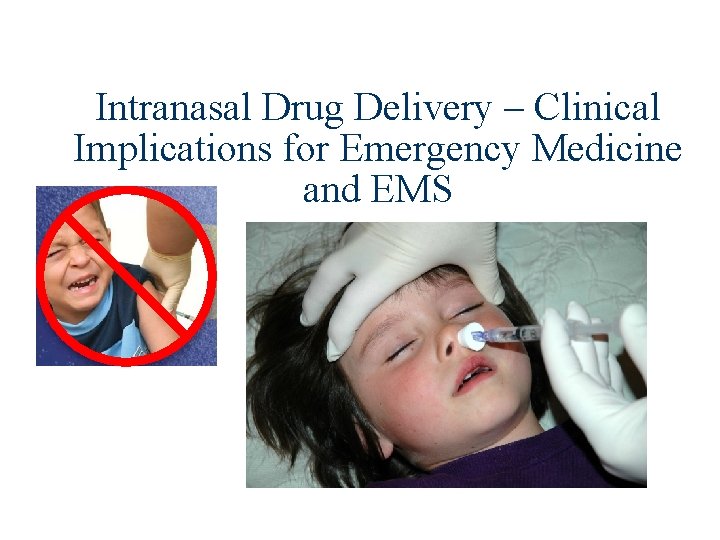
Intranasal Drug Delivery – Clinical Implications for Emergency Medicine and EMS
Lecture outline w Why use intranasal medications? w Intranasal drug delivery: General concepts w Intranasal drugs indications with clinical cases and personal insights: • Pain Control • Sedation • Seizures w Drug doses w Resources • Opiate overdose • Epistaxis • Nasopharyngeal procedures
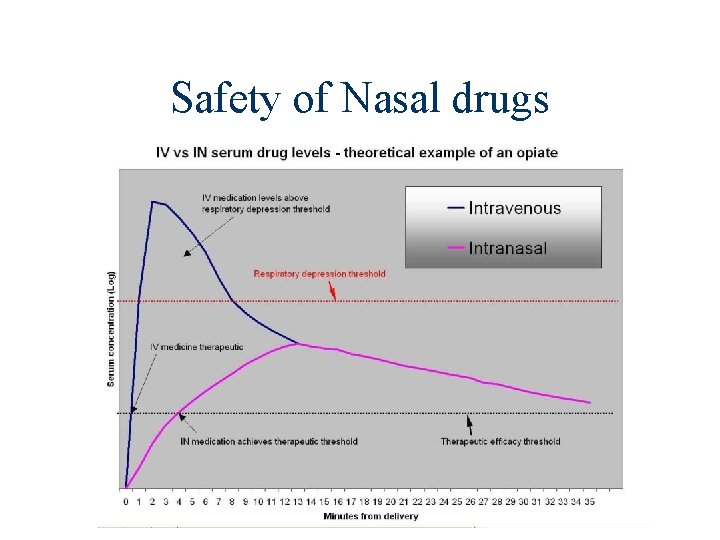
Advantages of Nasal drugs n n n Ease of use and convenience Saves time / reduces resource utilization Rapidly effective - onset within 2 -10 minutes Safe – No high peak serum levels yet rapidly therapeutic No special training is required to deliver the medication No shots are needed Painless No needle stick risk Extensive literature support Patients (& Parents & clinicians) really like this approach Faster care and discharge
Understanding IN delivery: General principles w First pass metabolism w Nose brain pathway w Bioavailability w Safety vs IV drugs
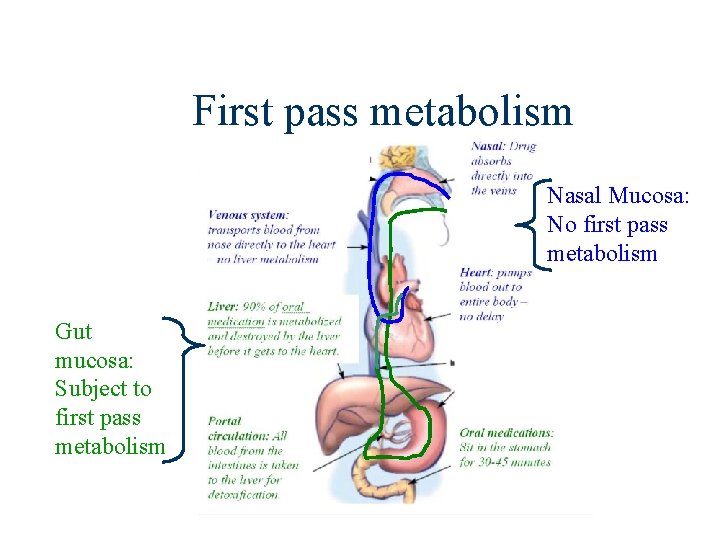
First pass metabolism Nasal Mucosa: No first pass metabolism Gut mucosa: Subject to first pass metabolism
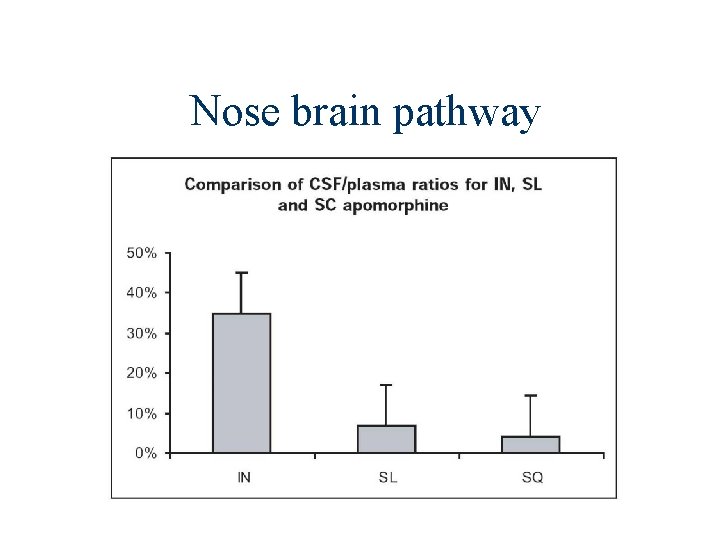
Nose brain pathway w The olfactory mucosa (smelling area in nose) is in direct contact with the brain and CSF. w Medications absorbed across the olfactory mucosa directly enter the CSF. w This area is termed the nose brain pathway and offers a rapid, direct route for drug delivery to the brain. Olfactory mucosa, nerve Brain CSF Highly vascular nasal mucosa
Nose brain pathway
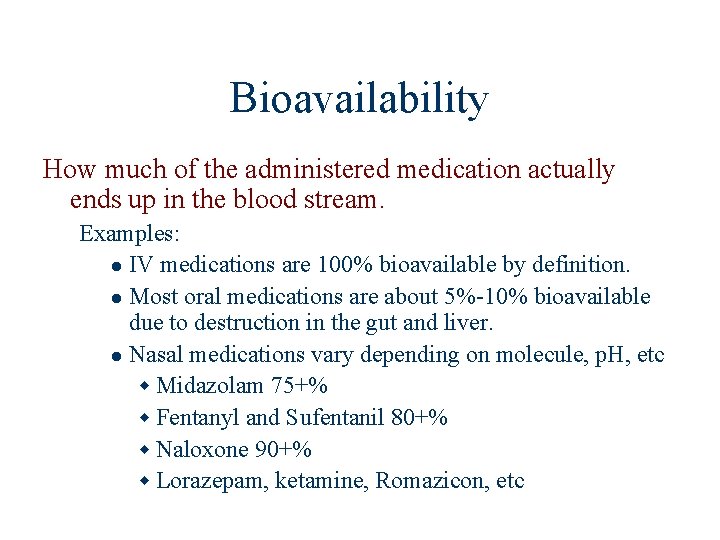
Bioavailability How much of the administered medication actually ends up in the blood stream. Examples: l IV medications are 100% bioavailable by definition. l Most oral medications are about 5%-10% bioavailable due to destruction in the gut and liver. l Nasal medications vary depending on molecule, p. H, etc w Midazolam 75+% w Fentanyl and Sufentanil 80+% w Naloxone 90+% w Lorazepam, ketamine, Romazicon, etc
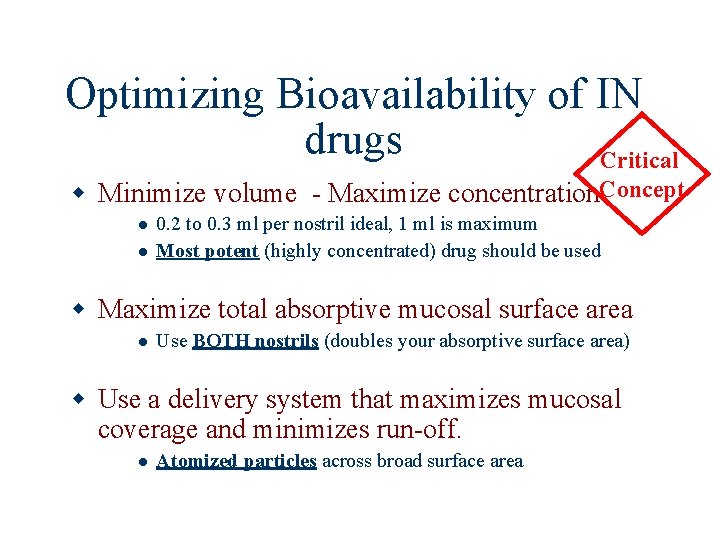
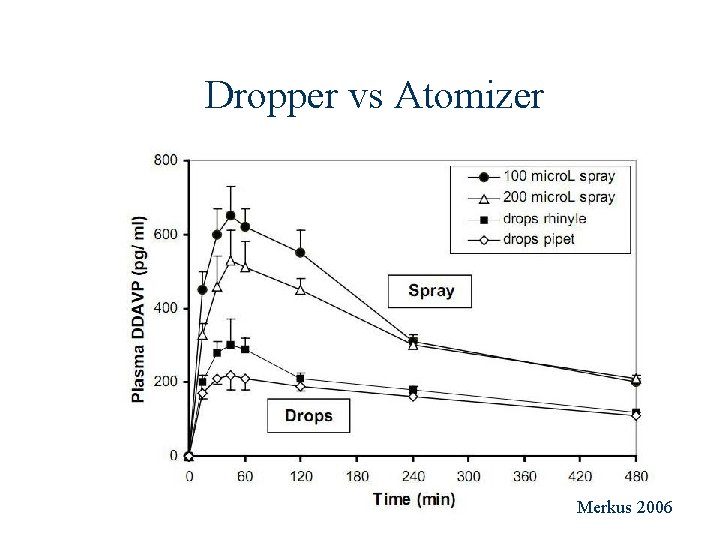
Optimizing Bioavailability of IN drugs Critical w Minimize volume - Maximize concentration. Concept l l 0. 2 to 0. 3 ml per nostril ideal, 1 ml is maximum Most potent (highly concentrated) drug should be used w Maximize total absorptive mucosal surface area l Use BOTH nostrils (doubles your absorptive surface area) w Use a delivery system that maximizes mucosal coverage and minimizes run-off. l Atomized particles across broad surface area
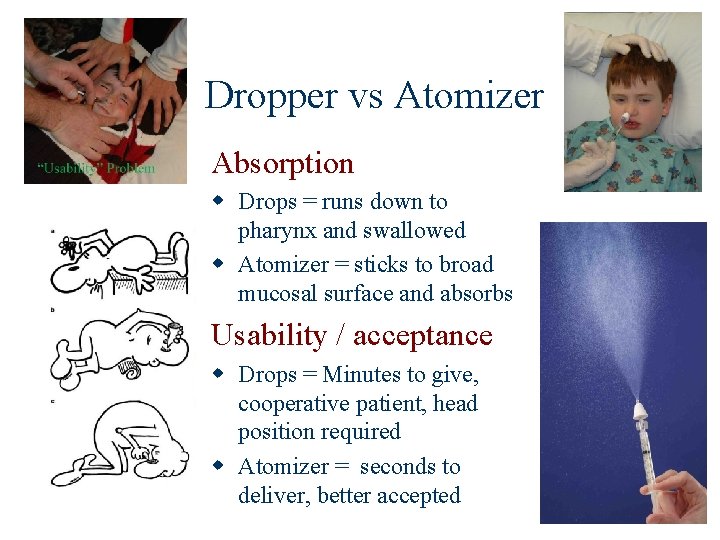
Dropper vs Atomizer Absorption w Drops = runs down to pharynx and swallowed w Atomizer = sticks to broad mucosal surface and absorbs Usability / acceptance w Drops = Minutes to give, cooperative patient, head position required w Atomizer = seconds to deliver, better accepted
Dropper vs Atomizer Merkus 2006
Safety of Nasal drugs
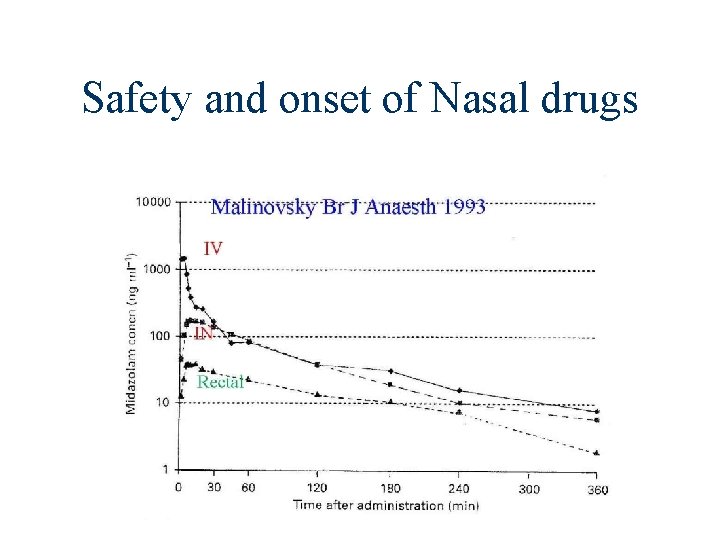
Safety and onset of Nasal drugs
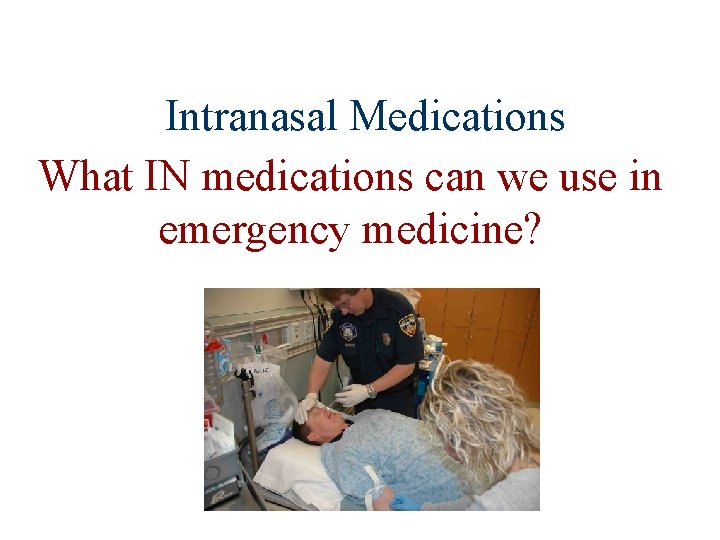
Intranasal Medications What IN medications can we use in emergency medicine?
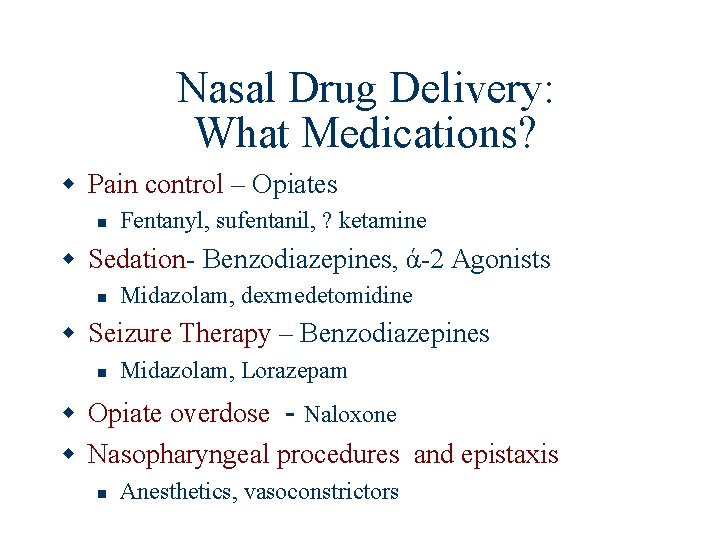
Nasal Drug Delivery: What Medications? w Pain control – Opiates n Fentanyl, sufentanil, ? ketamine w Sedation- Benzodiazepines, ά-2 Agonists n Midazolam, dexmedetomidine w Seizure Therapy – Benzodiazepines n Midazolam, Lorazepam w Opiate overdose - Naloxone w Nasopharyngeal procedures and epistaxis n Anesthetics, vasoconstrictors
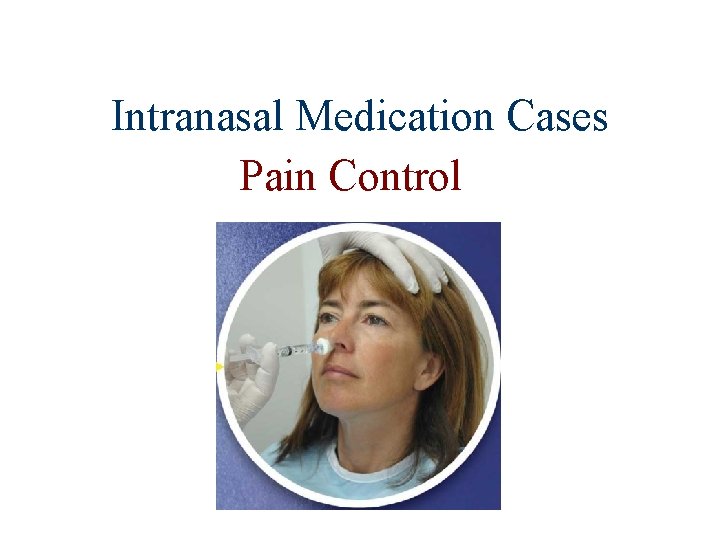
Intranasal Medication Cases Pain Control
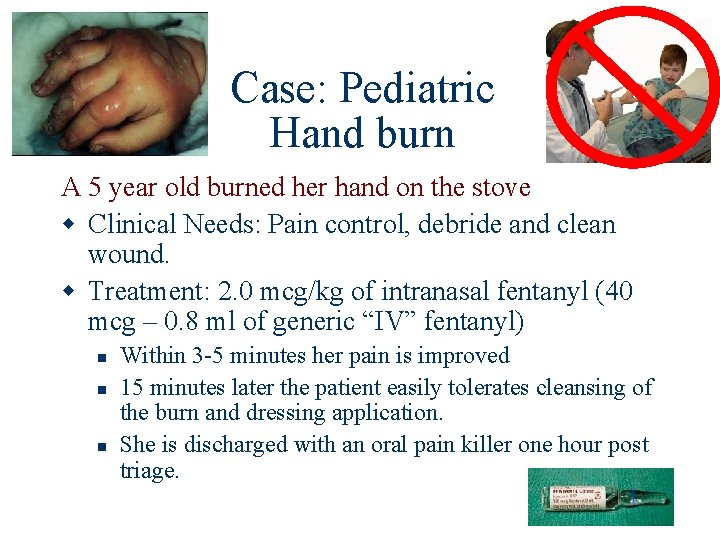
Case: Pediatric Hand burn A 5 year old burned her hand on the stove w Clinical Needs: Pain control, debride and clean wound. w Treatment: 2. 0 mcg/kg of intranasal fentanyl (40 mcg – 0. 8 ml of generic “IV” fentanyl) n n n Within 3 -5 minutes her pain is improved 15 minutes later the patient easily tolerates cleansing of the burn and dressing application. She is discharged with an oral pain killer one hour post triage.
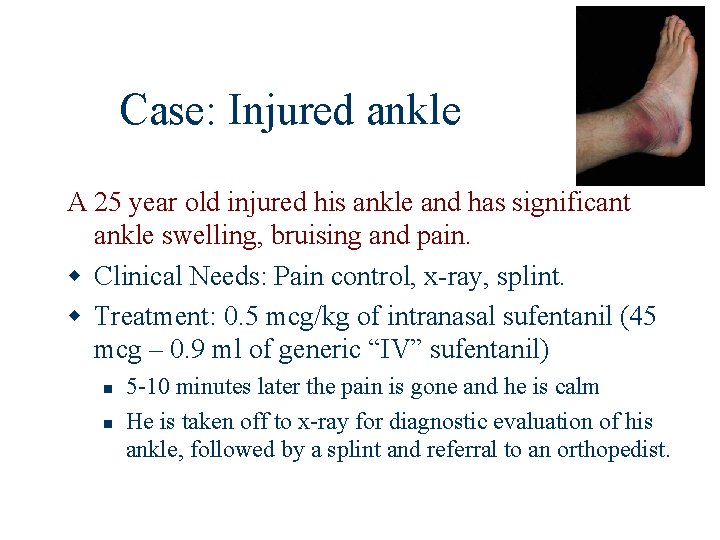
Case: Injured ankle A 25 year old injured his ankle and has significant ankle swelling, bruising and pain. w Clinical Needs: Pain control, x-ray, splint. w Treatment: 0. 5 mcg/kg of intranasal sufentanil (45 mcg – 0. 9 ml of generic “IV” sufentanil) n n 5 -10 minutes later the pain is gone and he is calm He is taken off to x-ray for diagnostic evaluation of his ankle, followed by a splint and referral to an orthopedist.
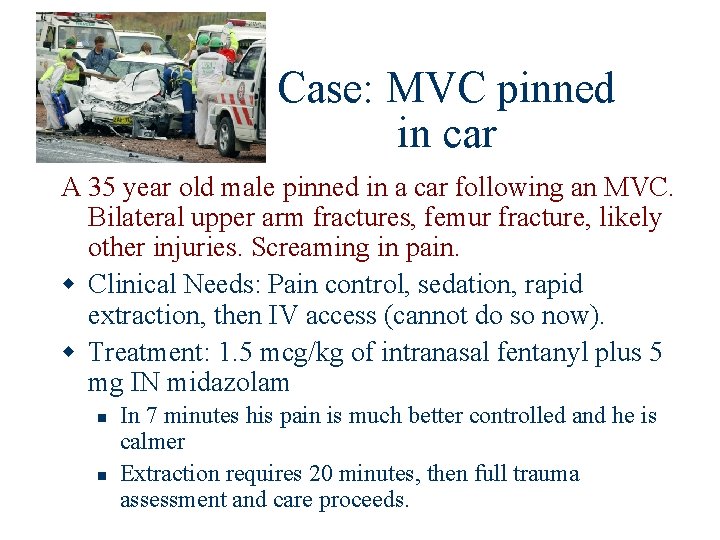
Case: MVC pinned in car A 35 year old male pinned in a car following an MVC. Bilateral upper arm fractures, femur fracture, likely other injuries. Screaming in pain. w Clinical Needs: Pain control, sedation, rapid extraction, then IV access (cannot do so now). w Treatment: 1. 5 mcg/kg of intranasal fentanyl plus 5 mg IN midazolam n n In 7 minutes his pain is much better controlled and he is calmer Extraction requires 20 minutes, then full trauma assessment and care proceeds.
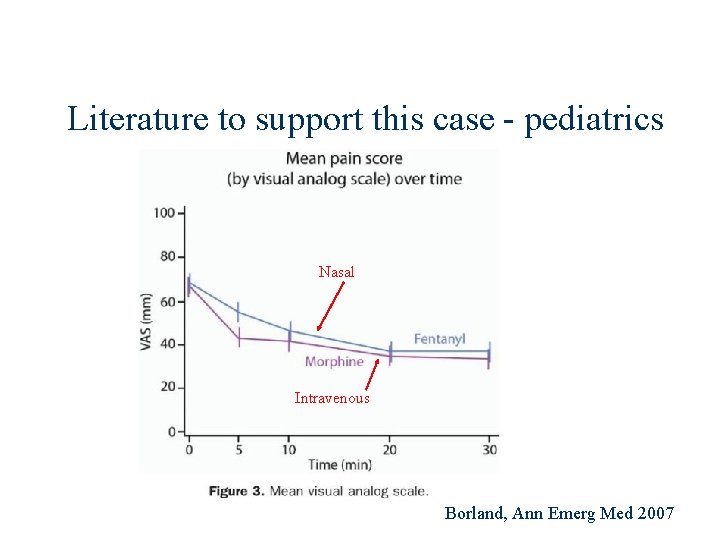
Literature to support this case - pediatrics Nasal Intravenous Borland, Ann Emerg Med 2007
Literature to support this case - adults Steenblik, Am J Emerg Med 2012
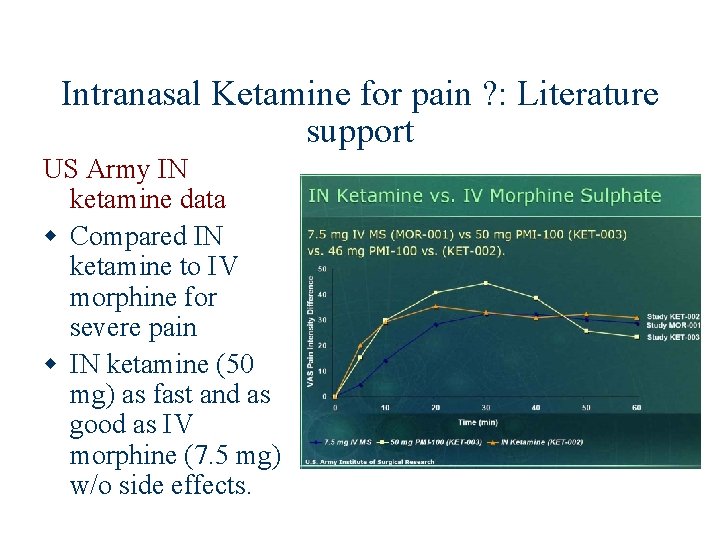
Intranasal Ketamine for pain ? : Literature support US Army IN ketamine data w Compared IN ketamine to IV morphine for severe pain w IN ketamine (50 mg) as fast and as good as IV morphine (7. 5 mg) w/o side effects.
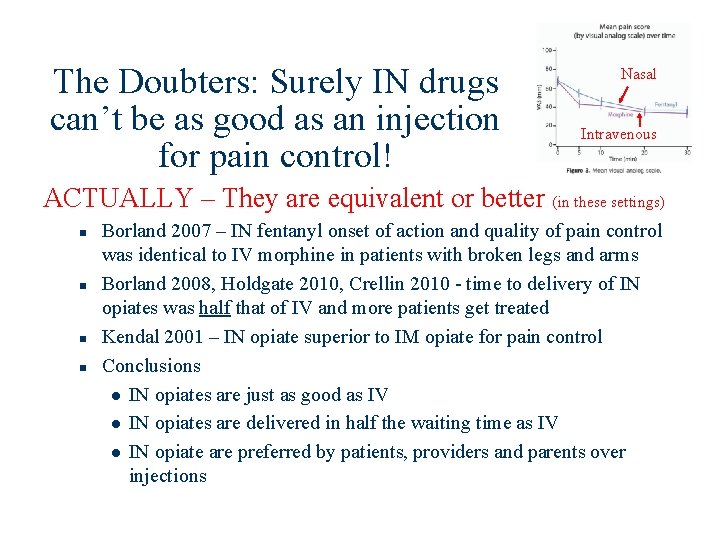
The Doubters: Surely IN drugs can’t be as good as an injection for pain control! Nasal Intravenous ACTUALLY – They are equivalent or better (in these settings) n n Borland 2007 – IN fentanyl onset of action and quality of pain control was identical to IV morphine in patients with broken legs and arms Borland 2008, Holdgate 2010, Crellin 2010 - time to delivery of IN opiates was half that of IV and more patients get treated Kendal 2001 – IN opiate superior to IM opiate for pain control Conclusions l IN opiates are just as good as IV l IN opiates are delivered in half the waiting time as IV l IN opiate are preferred by patients, providers and parents over injections
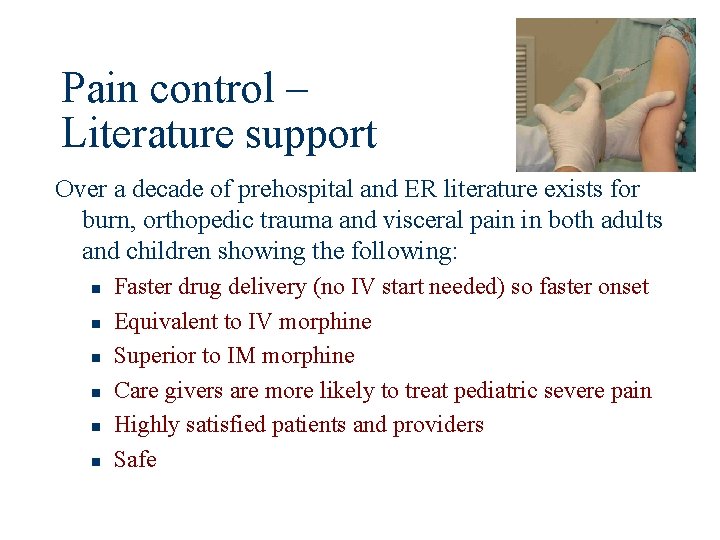
Pain control – Literature support Over a decade of prehospital and ER literature exists for burn, orthopedic trauma and visceral pain in both adults and children showing the following: n n n Faster drug delivery (no IV start needed) so faster onset Equivalent to IV morphine Superior to IM morphine Care givers are more likely to treat pediatric severe pain Highly satisfied patients and providers Safe
IN opiates for Pain control – My insights • This is the most common use of IN drugs in my practice - daily. • Generic concentrations available in U. S. work fine and are inexpensive ($1 -4/vial) • Great patient and parent satisfier: Rapid pain resolution with no need for a painful injection. • Efficacy: Very effective – and it can be titrated. • Use a pulse oximeter with sufentanil: • Sufentanil is especially potent and must be treated with respect. • Fentanyl seems fine and can safely be given with minimal risk • Give an oral pain killer as well: It kicks in as IN drug wears off
Intranasal Medication Cases Sedation
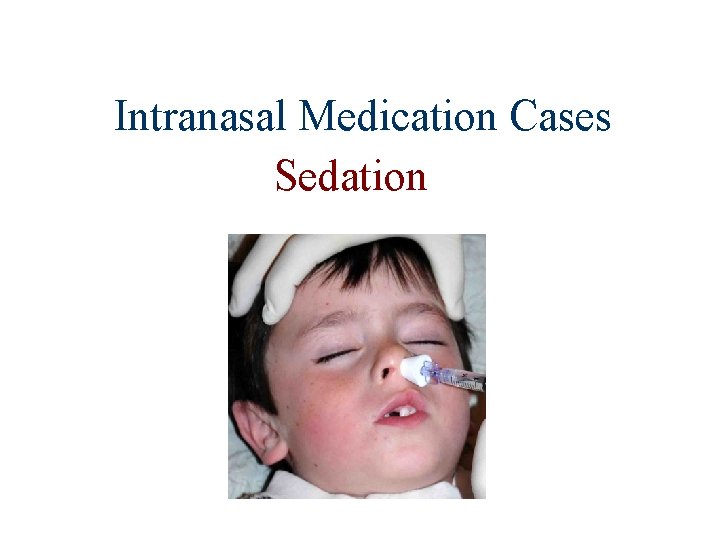
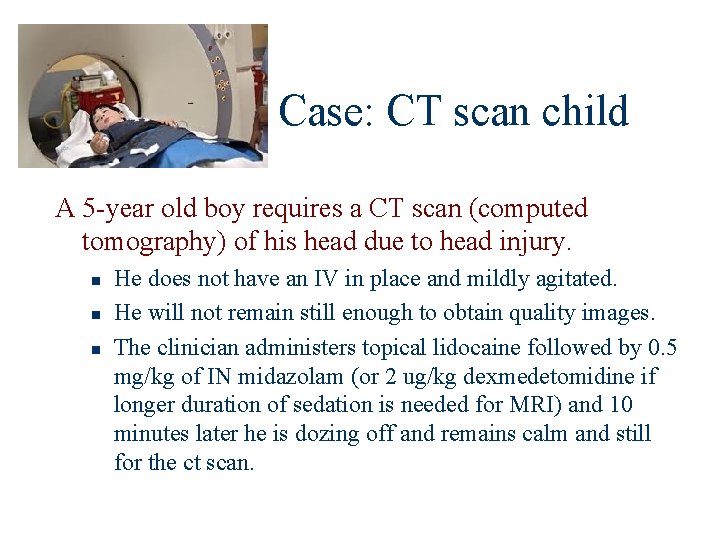
Case: CT scan child A 5 -year old boy requires a CT scan (computed tomography) of his head due to head injury. n n n He does not have an IV in place and mildly agitated. He will not remain still enough to obtain quality images. The clinician administers topical lidocaine followed by 0. 5 mg/kg of IN midazolam (or 2 ug/kg dexmedetomidine if longer duration of sedation is needed for MRI) and 10 minutes later he is dozing off and remains calm and still for the ct scan.
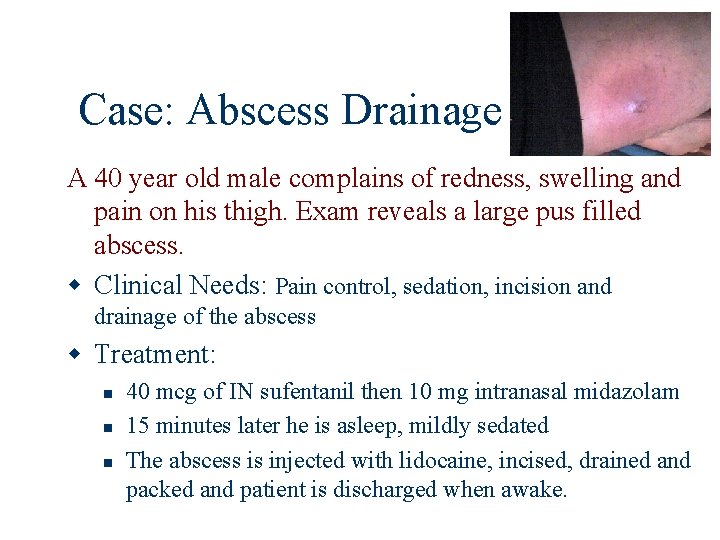
Case: Abscess Drainage A 40 year old male complains of redness, swelling and pain on his thigh. Exam reveals a large pus filled abscess. w Clinical Needs: Pain control, sedation, incision and drainage of the abscess w Treatment: n n n 40 mcg of IN sufentanil then 10 mg intranasal midazolam 15 minutes later he is asleep, mildly sedated The abscess is injected with lidocaine, incised, drained and packed and patient is discharged when awake.
Case: Excited Delirium A 27 -year old male is apprehended by police and paramedics for extremely violent, out of control behavior following use of crystal meth. n n n He is at significant risk of injuring himself and others. It is too dangerous (needle stick risk) to give him an injection of sedatives. The paramedic administers 10 mg of IN midazolam and 7 minutes later he is calm and can be transported safely to the hospital.
Literature to support this case - pediatrics Klein, Ann Emerg Med 2011
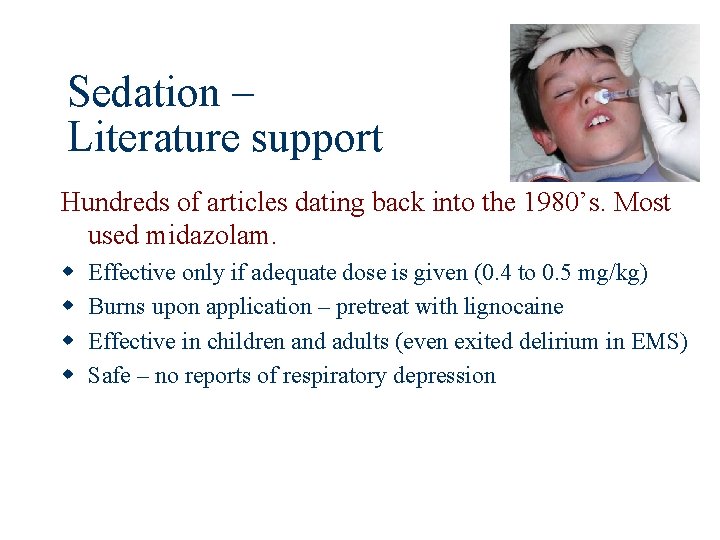
Sedation – Literature support Hundreds of articles dating back into the 1980’s. Most used midazolam. w w Effective only if adequate dose is given (0. 4 to 0. 5 mg/kg) Burns upon application – pretreat with lignocaine Effective in children and adults (even exited delirium in EMS) Safe – no reports of respiratory depression
IN Benzos for sedation – my insights w Nasal Midazolam burns on application: Pretreat with lignocaine, warn the parents, this lasts 30 -45 seconds then dissipates w Timing: Children become sedated at about 5 -10 minutes, maximal at 10 -20 and starts to wear off at 25 -30 so be ready to do prep and suture or do procedure in this time frame. w Efficacy: Sedation is not deep. OK for minor procedures, CT, ? MRI, not good enough for complex face laceration. More data needs to be obtained for lorazepam.
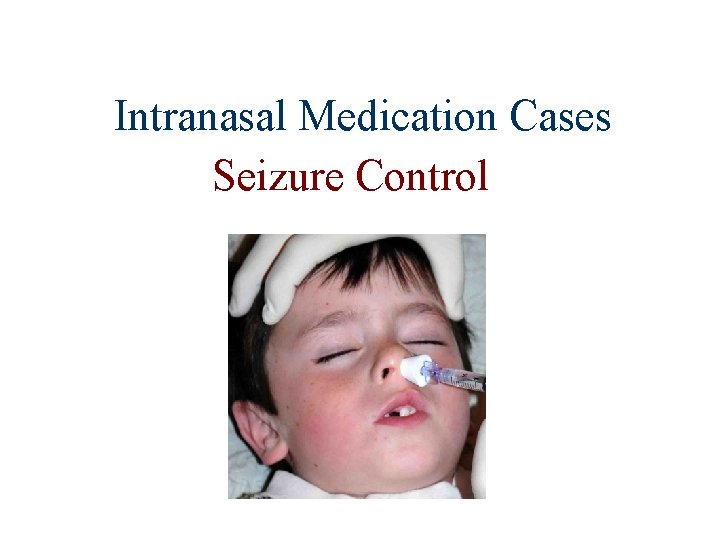
Intranasal Medication Cases Seizure Control
Case: Seizing child The ambulance is transporting a 13 y. o. girl suffering a grand mal seizure. w Despite trying, no IV can be successfully established. w Rectal diazepam is unsuccessful at controlling the seizure. w IV attempts in the clinic / hospital are also unsuccessful. w However, on patient arrival a dose of nasal midazolam (Versed, Dormicum) is given and within 3 minutes of drug delivery the child stops seizing.
Seizure Therapy Literature support Lahat 2000; Fisgin 2002; Holsti 2006; Ahmad 2006; Arya 2011; Holsti 2011; Javadzadeh 2012; Thakker 2012: w IN midazolam is superior to rectal diazepam for seizure control and is preferred by care givers w IN midazolam is superior to intramuscular injection of paraldehyde w IN midazolam/lorazepam is equivalent to intravenous delivery for stopping seizures, much faster at stopping them due to no IV start needed and it leads to less respiratory depression w IN midazolam can be delivered by family at home safely and effectively
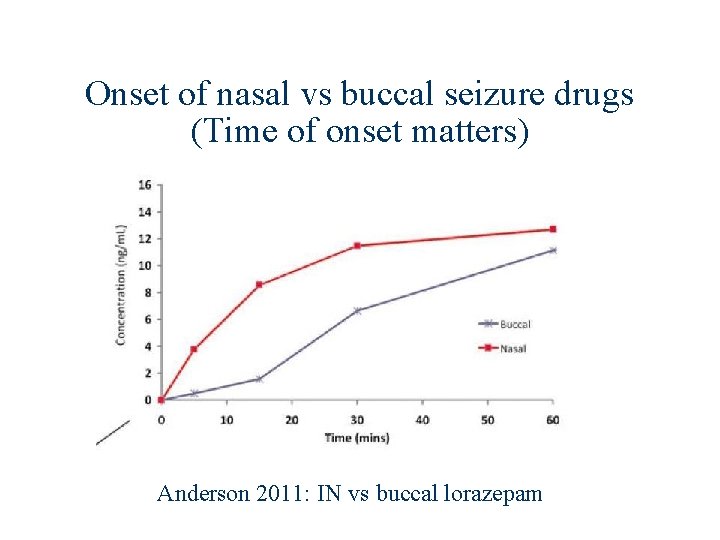
Onset of nasal vs buccal seizure drugs (Time of onset matters) Anderson 2011: IN vs buccal lorazepam
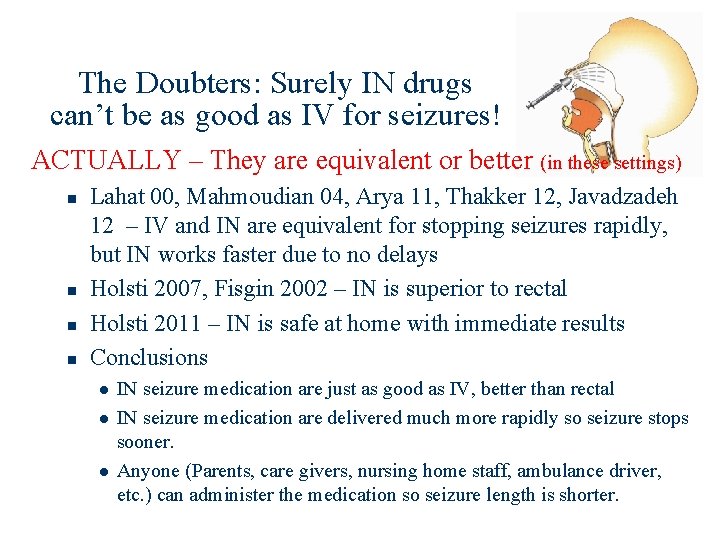
The Doubters: Surely IN drugs can’t be as good as IV for seizures! ACTUALLY – They are equivalent or better (in these settings) n n Lahat 00, Mahmoudian 04, Arya 11, Thakker 12, Javadzadeh 12 – IV and IN are equivalent for stopping seizures rapidly, but IN works faster due to no delays Holsti 2007, Fisgin 2002 – IN is superior to rectal Holsti 2011 – IN is safe at home with immediate results Conclusions l l l IN seizure medication are just as good as IV, better than rectal IN seizure medication are delivered much more rapidly so seizure stops sooner. Anyone (Parents, care givers, nursing home staff, ambulance driver, etc. ) can administer the medication so seizure length is shorter.
IN benzodiazepines for seizures – My insights Very effective, very fast: Rapid seizure resolution without IV access. n n Should be first line therapy in ALL prolonged acute seizures while IV access is being established (if at all) Effective and safe at home, in EMS setting, in hospital More effective, less expensive and preferred by providers when compared to alternative (rectal diazepam).
Intranasal Medication Cases Opiate Overdose
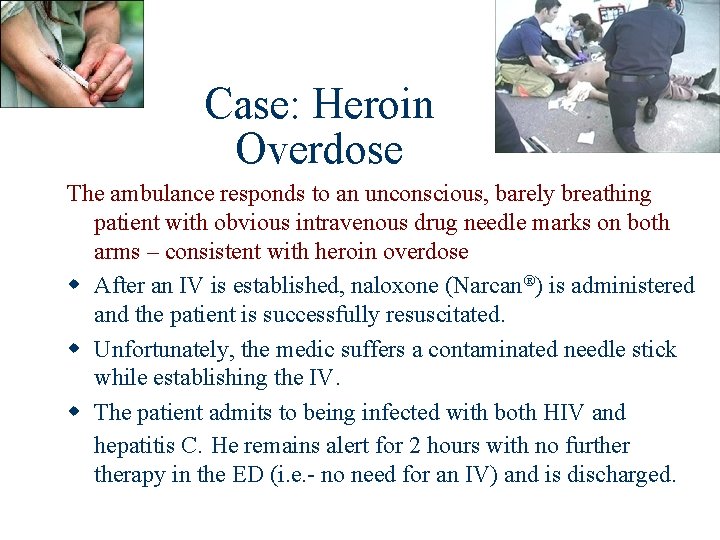
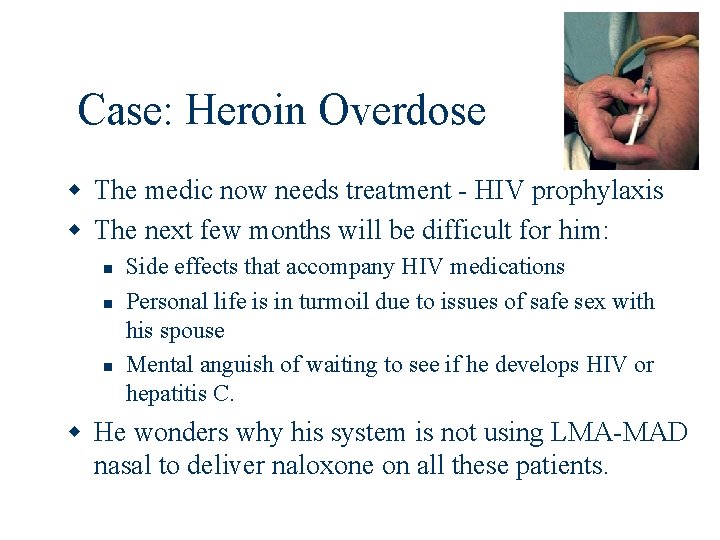
Case: Heroin Overdose The ambulance responds to an unconscious, barely breathing patient with obvious intravenous drug needle marks on both arms – consistent with heroin overdose w After an IV is established, naloxone (Narcan ) is administered and the patient is successfully resuscitated. w Unfortunately, the medic suffers a contaminated needle stick while establishing the IV. w The patient admits to being infected with both HIV and hepatitis C. He remains alert for 2 hours with no furtherapy in the ED (i. e. - no need for an IV) and is discharged.
Case: Heroin Overdose w The medic now needs treatment - HIV prophylaxis w The next few months will be difficult for him: n n n Side effects that accompany HIV medications Personal life is in turmoil due to issues of safe sex with his spouse Mental anguish of waiting to see if he develops HIV or hepatitis C. w He wonders why his system is not using LMA-MAD nasal to deliver naloxone on all these patients.
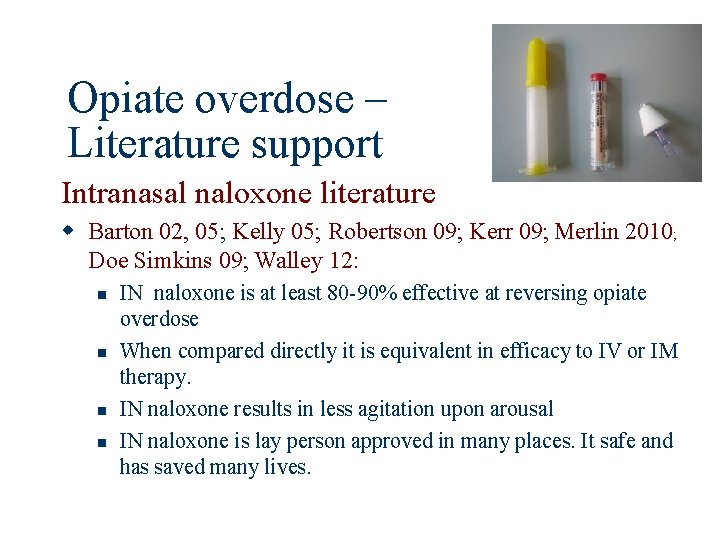
Opiate overdose – Literature support Intranasal naloxone literature w Barton 02, 05; Kelly 05; Robertson 09; Kerr 09; Merlin 2010; Doe Simkins 09; Walley 12: n n IN naloxone is at least 80 -90% effective at reversing opiate overdose When compared directly it is equivalent in efficacy to IV or IM therapy. IN naloxone results in less agitation upon arousal IN naloxone is lay person approved in many places. It safe and has saved many lives.
IN naloxone for opiate overdose – my insights Why not? Is there a downside? w w w High risk population for HIV, HCV, HBV Difficult IV to establish due to scarring of veins Elimination of needle eliminates needle stick risk They awaken more gently than with IV naloxone New epidemiology shows prescription drugs (methadone, etc) are causing many deaths that naloxone at home could reverse. w Simple enough that lay public can administer and not even call ambulance Every ambulance system, police agency and many clinics and families with high risk patients should be utilizing this approach.
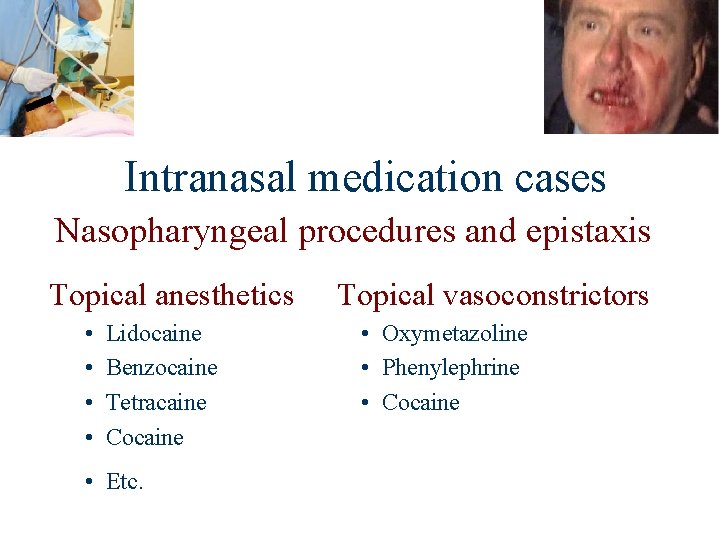
Intranasal medication cases Nasopharyngeal procedures and epistaxis Topical anesthetics • • Lidocaine Benzocaine Tetracaine Cocaine • Etc. Topical vasoconstrictors • Oxymetazoline • Phenylephrine • Cocaine
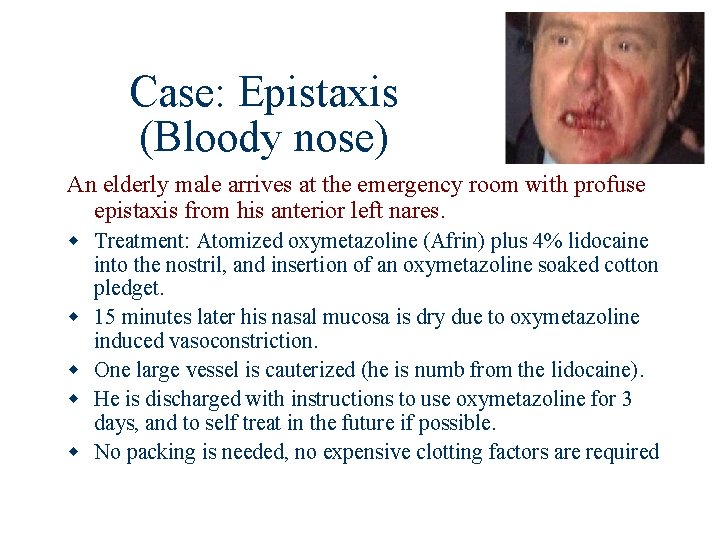
Case: Epistaxis (Bloody nose) An elderly male arrives at the emergency room with profuse epistaxis from his anterior left nares. w Treatment: Atomized oxymetazoline (Afrin) plus 4% lidocaine into the nostril, and insertion of an oxymetazoline soaked cotton pledget. w 15 minutes later his nasal mucosa is dry due to oxymetazoline induced vasoconstriction. w One large vessel is cauterized (he is numb from the lidocaine). w He is discharged with instructions to use oxymetazoline for 3 days, and to self treat in the future if possible. w No packing is needed, no expensive clotting factors are required
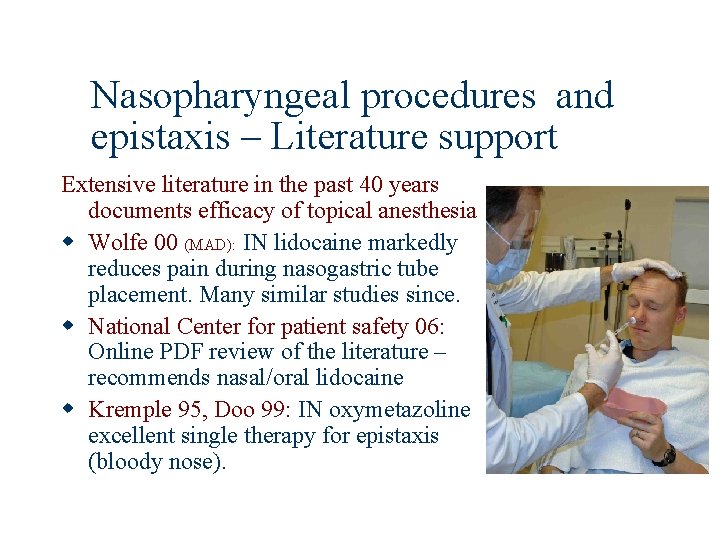
Nasopharyngeal procedures and epistaxis – Literature support Extensive literature in the past 40 years documents efficacy of topical anesthesia w Wolfe 00 (MAD): IN lidocaine markedly reduces pain during nasogastric tube placement. Many similar studies since. w National Center for patient safety 06: Online PDF review of the literature – recommends nasal/oral lidocaine w Kremple 95, Doo 99: IN oxymetazoline excellent single therapy for epistaxis (bloody nose).
IN anesthetics and vasoconstrictors – my insights Nasal instrumentation: Do it every time n Proven by multiple studies to improve procedural comfort. Epistaxis: Very effective, very simple n Inexpensive and easy
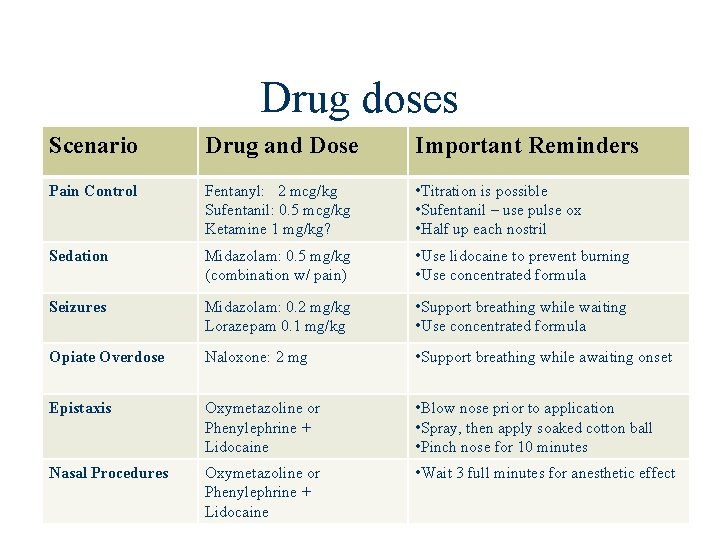
Drug doses Scenario Drug and Dose Important Reminders Pain Control Fentanyl: 2 mcg/kg Sufentanil: 0. 5 mcg/kg Ketamine 1 mg/kg? • Titration is possible • Sufentanil – use pulse ox • Half up each nostril Sedation Midazolam: 0. 5 mg/kg (combination w/ pain) • Use lidocaine to prevent burning • Use concentrated formula Seizures Midazolam: 0. 2 mg/kg Lorazepam 0. 1 mg/kg • Support breathing while waiting • Use concentrated formula Opiate Overdose Naloxone: 2 mg • Support breathing while awaiting onset Epistaxis Oxymetazoline or Phenylephrine + Lidocaine • Blow nose prior to application • Spray, then apply soaked cotton ball • Pinch nose for 10 minutes Nasal Procedures Oxymetazoline or Phenylephrine + Lidocaine • Wait 3 full minutes for anesthetic effect
Intranasal medications summary w Another tool for drug delivery to supplement standard IV, IM, PO–very useful when appropriate w Supported by extensive literature w Inexpensive w Speeds up care in many situations w Safe
Questions? n www. intranasal. net