
IntraMuscular Injection PREPARED BY Dr Altayeb Abdulazeem Idress
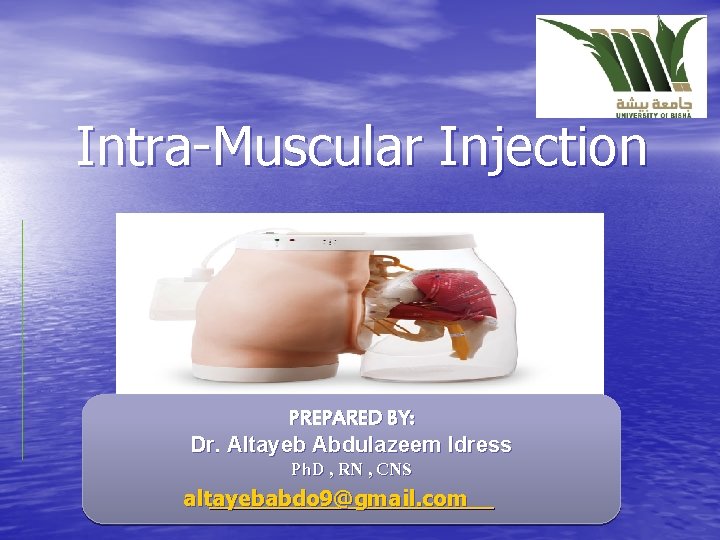
Intra-Muscular Injection PREPARED BY: Dr. Altayeb Abdulazeem Idress Ph. D , RN , CNS altayebabdo 9@gmail. com
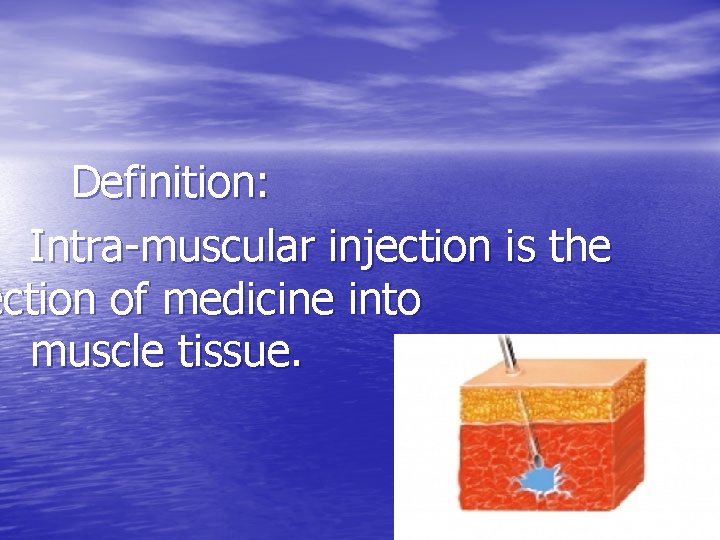
Definition: Intra-muscular injection is the ection of medicine into muscle tissue.
Intramuscular (IM) injections are used to promote rapid drug absorption and to provide an alternate route when the drug is irritating to subcutaneous tissue.

The IM route enhances the absorption rate because there are more blood vessels in the muscles than in subcutaneous tissue

The nurse should determine the maximum volume to inject on the basis of the site, the pt’s muscle development and the age.
• 3 ml for a large muscle (gluteus medius) in a well developed adult • 1 to 2 ml for less developed muscles in children, elderly, and thin clients • 0. 5 to 1. 0 ml for the deltoid muscle
When more than 3 ml is ordered, the medication can be divided into two different sites.
Common intramuscular Injection sites and muscles: Site -Dorsogluteal -Ventrogluteal -Anterolateral aspect of thigh - Upper arm Muscle Gluteus maximus Gluteus medius Vastus lateralis Deltoid
Selection of appropriate site for IM injection 1. Dorsogluteal: Place hand on iliac crest and locate the posterosuperior iliac spine. Draw an imaginary line between the trochanter and the iliac spine; the injection site is the outer quadrant.
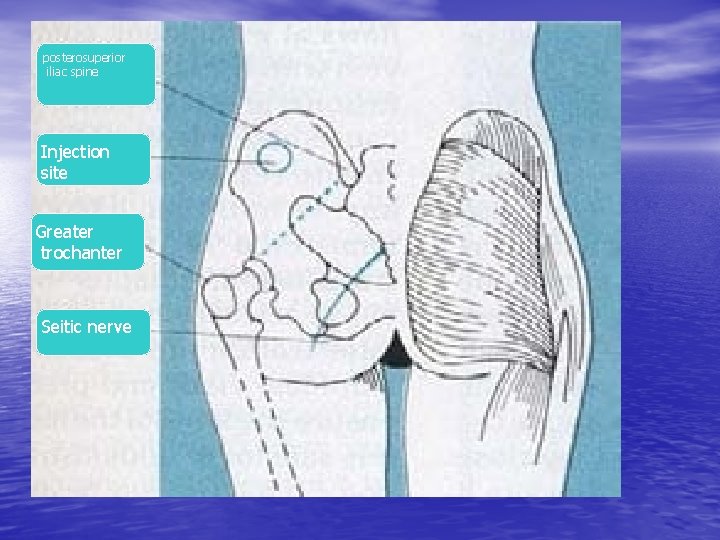
posterosuperior iliac spine Injection site Greater trochanter Seitic nerve
2. Ventrogluteal: Place palm of left hand on right greater trochanter so that index finger points toward anterosuperior iliac spine; spread first and middle fingers to form a V; injection site is the middle of the V.

3. Vastus lateralis: Identify greater trochanter; place hand at lateral femoral condyle; injection site is middle third of anterior lateral aspect.
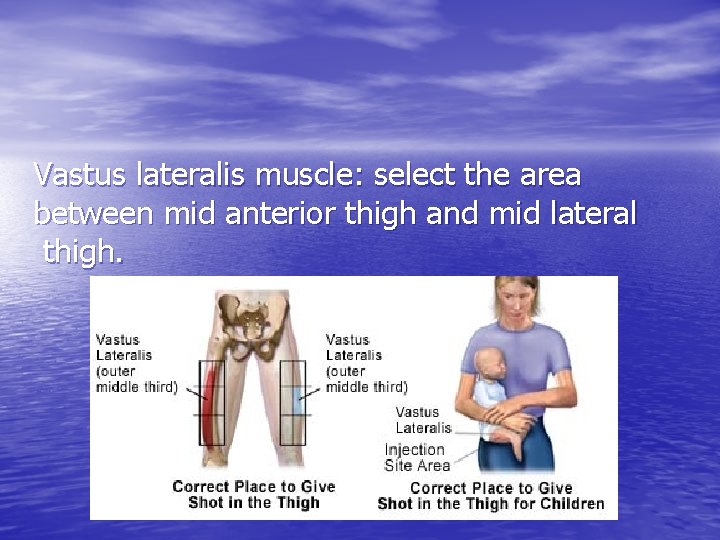
Vastus lateralis muscle: select the area between mid anterior thigh and mid lateral thigh.
4. Deltoid: Locate the lateral side of the humerus from two to three fingerwidths below the acromion process in adults or one fingerwidth below the acromion process in children.
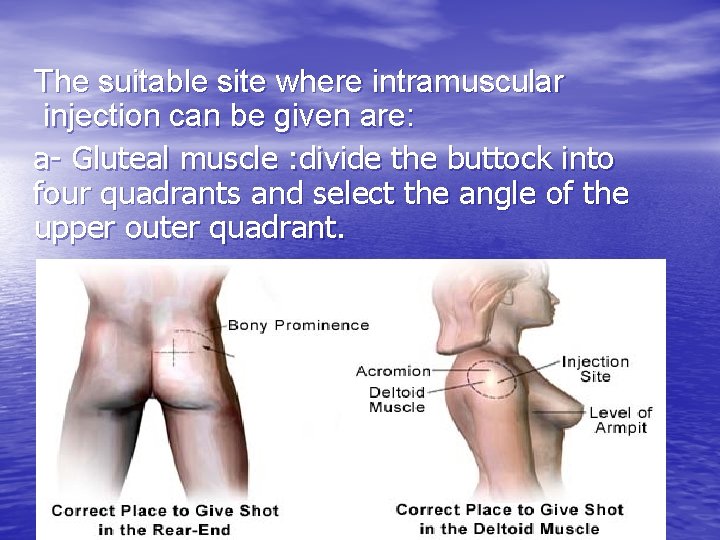
The suitable site where intramuscular injection can be given are: a- Gluteal muscle : divide the buttock into four quadrants and select the angle of the upper outer quadrant.
PROCEDURE: Equipment: • Medication administration report (MAR) • Medication as prescribed • Sterile 3 -ml syringe and long bevel, 20 to 22 gauge, 1 - to 2 -inch needle • Alcohol swab • Nonsterile gloves • Sterile 2 × 2 gauze pad

Nursing care: 1. Check with client and the chart for any known allergies. 2. Wash hands. 3. Follow the six rights. 4. Prepare the medication from an ampule or vial.

5. Check the pt’s identification armband. 6. Explain the procedure to the pt; provide for privacy. 7. Place the client in an appropriate position to expose the site.
• Deltoid: sitting position. • Ventrogluteal: • Side-lying: flex the knee, pivot the leg forward from the hip about 20° so it can rest on the bed. • Prone.
8. Don non sterile gloves. 9. Select and clean the site. • Assess the pt’s skin for redness, scarring, breaks in the skin, and palpate for lumps or nodules.
• Select site using the anatomic landmarks. • Cleanse the area with an alcohol swab, cleanse from inside outward using friction; wait 30 seconds to allow to dry.
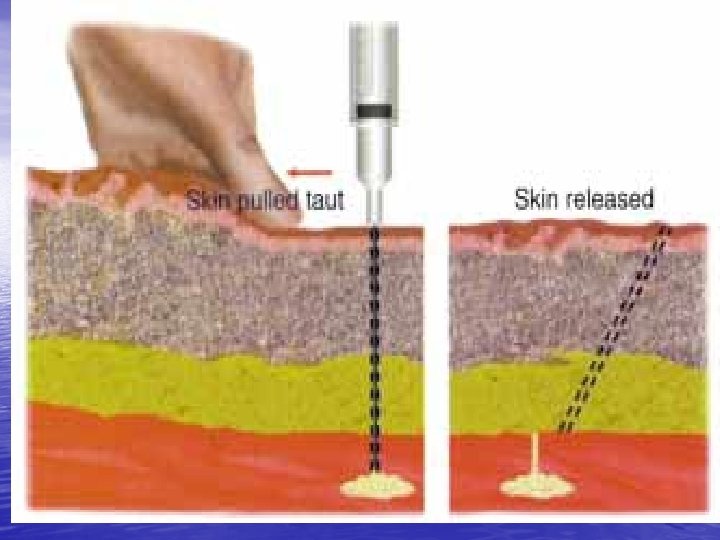
10. Prepare for the injection. • Remove the needle cap by pulling it straight off, and expel any air bubbles from the syringe. • Pull the skin down or to one side (Ztrack technique) with nondominant hand.
Z-track technique When administering a Z-track injection, the nurse should place the client in the prone position then pull the skin to one side, insert the needle at a 90° angle and administer the medication
Z-track technique a common method formerly used for IM injections, increases the risk that medication will leak into the needle track and the subcutaneous tissue; this risk is virtually eliminated using the Z track technique, making it the technique of choice.
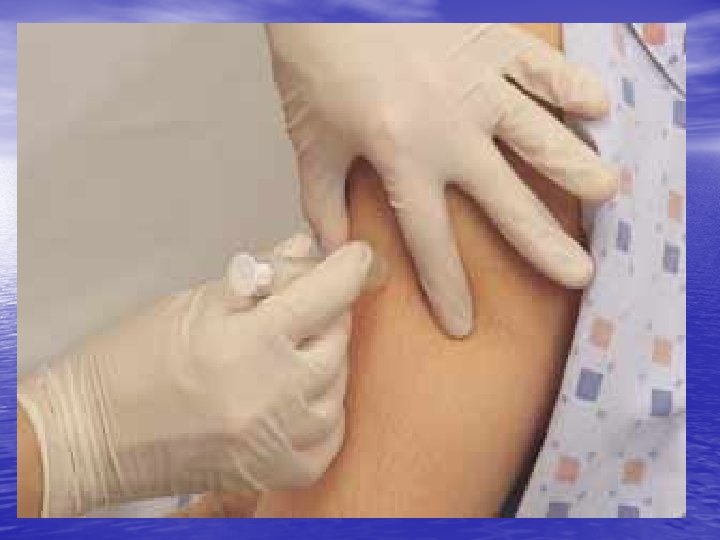
11. Administer the injection. • Deltoid: quickly insert the needle with a dart like motion at a 90° angle.
• Ventrogluteal: quickly insert the needle using a dar tlike motion and steady pressure at a 90° angle to the iliac crest in the middle of the V
• Aspirate by pulling back on the plunger, and observe for blood. • If blood appears, remove the needle and discard.
• If blood does not appear, inject the medication slowly, about 10 sec/ml. • Wait 10 seconds after the medication has been injected, then smoothly withdraw the needle at the same angle of insertion.
• Apply gentle pressure at the site with a dry, sterile 2 × 2 gauze; do not massage the injection site. Swab using gentle pressure. • Discard the needle and syringe in a sharps container; do not recap the needle.
12. Position pt for comfort; encourage pt receiving ventrogluteal injections to perform leg exercises (flexion and extension). 13. Remove gloves, wash hands.
14. Record on the MAR the dosage, route, site, and time. 15. Inspect the injection site within 2 to 4 hours and evaluate the pt’s response to the medication.
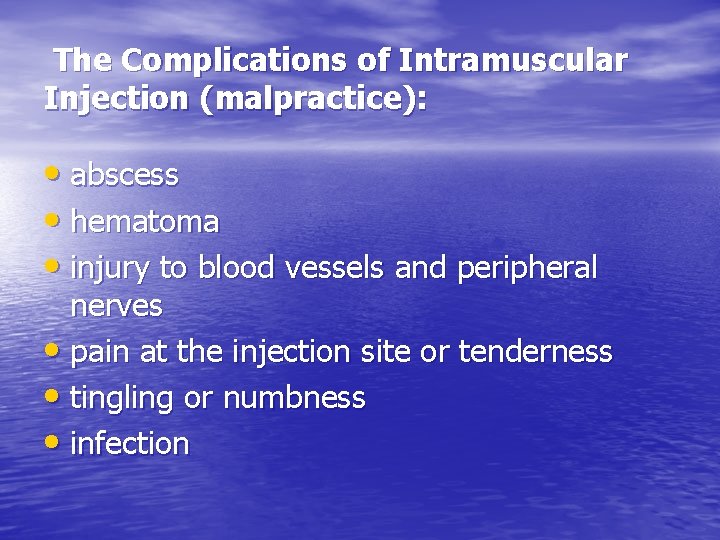
The Complications of Intramuscular Injection (malpractice): • abscess • hematoma • injury to blood vessels and peripheral nerves • pain at the injection site or tenderness • tingling or numbness • infection

The End
- Slides: 35