
Intragroup and Intergroup Conflict BH 2286 Effective Teamwork
Intragroup and Intergroup Conflict BH 2286 Effective Teamwork Lecture 5
Learning Outcomes After this lecture you will be able to… define intra-group conflict, explain how and in what ways it affects group performance, and how it can be leveraged for team effectiveness. define inter-group conflict, explain how and in what ways it affects organisational effectiveness, and how it can be leveraged for organisational effectiveness.
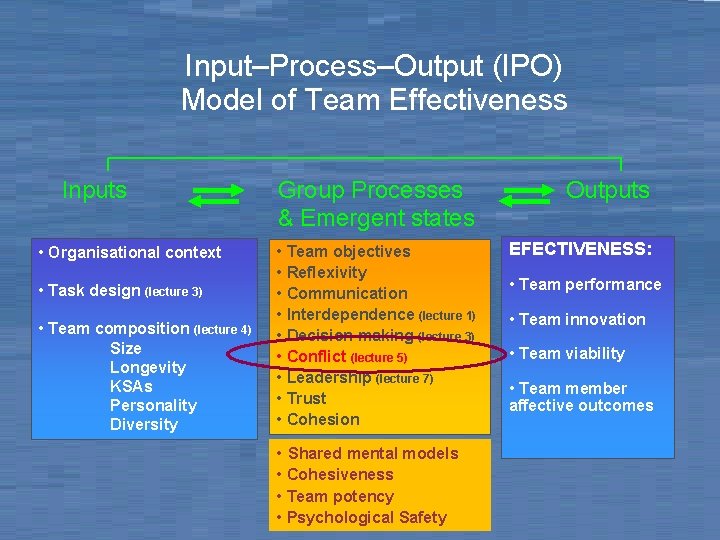
Input–Process–Output (IPO) Model of Team Effectiveness Inputs • Organisational context • Task design (lecture 3) • Team composition (lecture 4) Size Longevity KSAs Personality Diversity Group Processes & Emergent states Outputs • Team objectives • Reflexivity • Communication • Interdependence (lecture 1) • Decision making (lecture 3) • Conflict (lecture 5) • Leadership (lecture 7) • Trust • Cohesion EFECTIVENESS: • Shared mental models • Cohesiveness • Team potency • Psychological Safety • Team performance • Team innovation • Team viability • Team member affective outcomes
Lecture Structure Defining conflict Intra-group Conflict Models of Intra-group Conflict Empirical Evidence and Critique Management of Intra-group Conflict Inter-group Conflict Theories of Intra-group Conflict Management of Inter-group Conflict
Definition of Conflict is … … the struggle that arises when the goal-directed behavior of one person or group blocks the goal-directed behavior of another person or group; … … even if this state of affairs is only perceived by one of the parties involved.

Levels of conflict Intrapersonal conflict Interpersonal conflict Intragroup conflict Interorganisational conflict
Intragroup vs. Intergroup Conflict Intra-group conflict refers to conflicts within groups Inter-group conflict refers to conflicts between groups
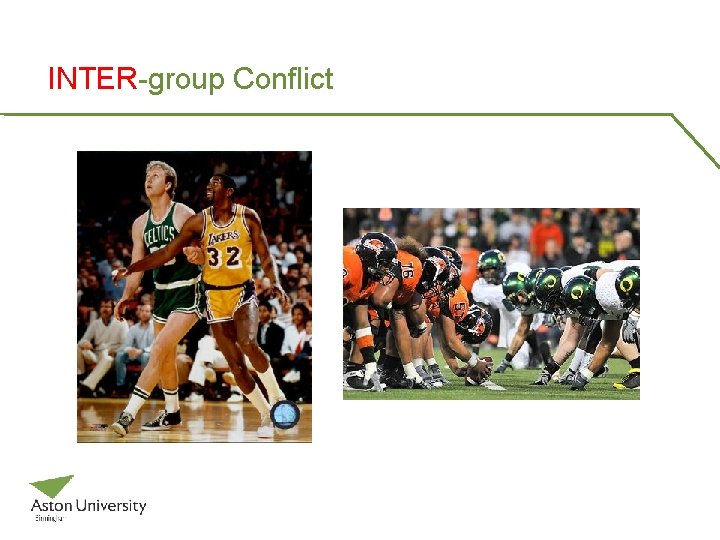
INTER-group Conflict
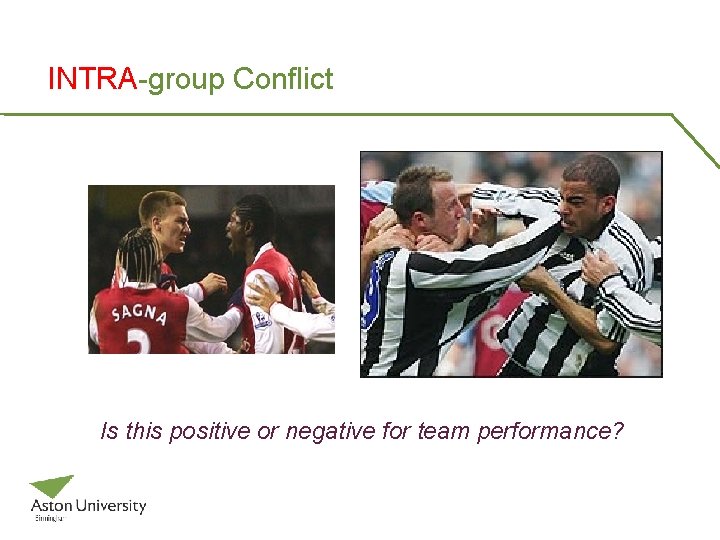
INTRA-group Conflict Is this positive or negative for team performance?
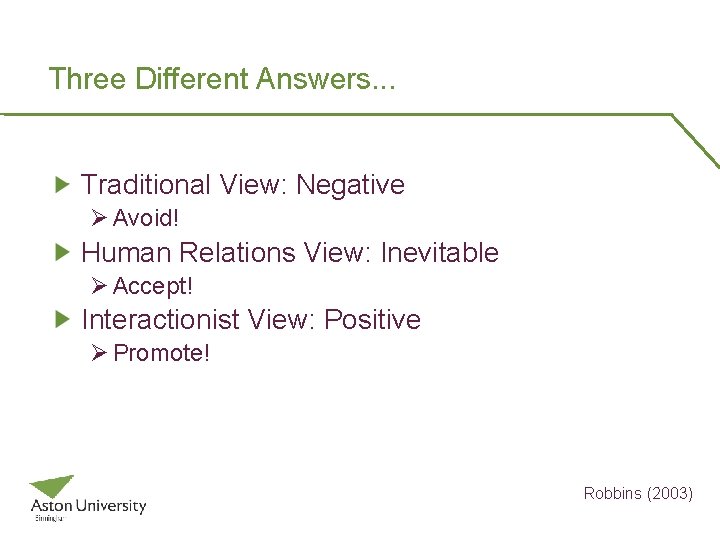
Three Different Answers. . . Traditional View: Negative Ø Avoid! Human Relations View: Inevitable Ø Accept! Interactionist View: Positive Ø Promote! Robbins (2003)
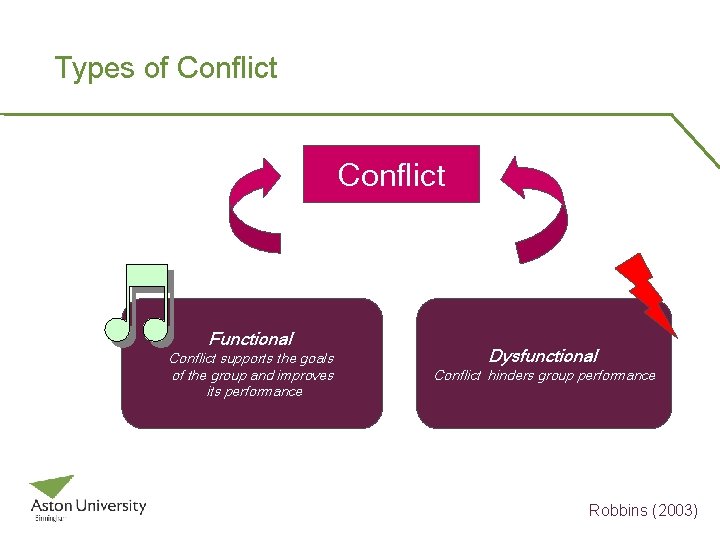
Types of Conflict Functional Conflict supports the goals of the group and improves its performance Dysfunctional Conflict hinders group performance Robbins (2003)
Dysfunctional Conflict Diverts energies Hinders group cohesion Promotes interpersonal hostilities Creates a negative environment for workers Can decrease productivity and job satisfaction and contribute to absenteeism. Robbins (2003)
Functional Conflict Facilitates change, innovation and creativity Facilitates better group decision making uncovers unshared information in hidden profiles helps to overcome groupthink breaks down group polarization Robbins (2003)
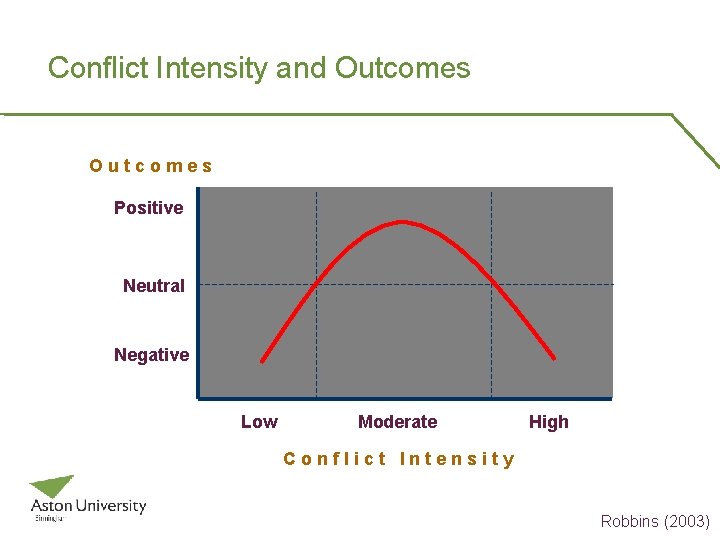
Conflict Intensity and Outcomes Positive Neutral Negative Low Moderate High Conflict Intensity Robbins (2003)
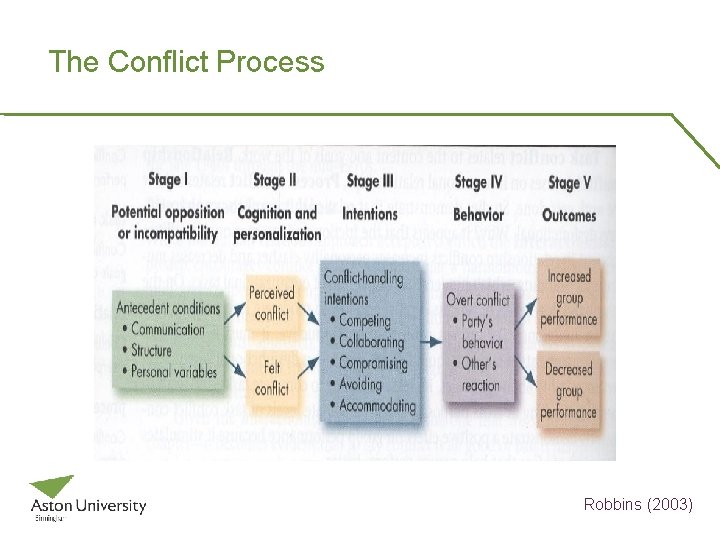
The Conflict Process Robbins (2003)
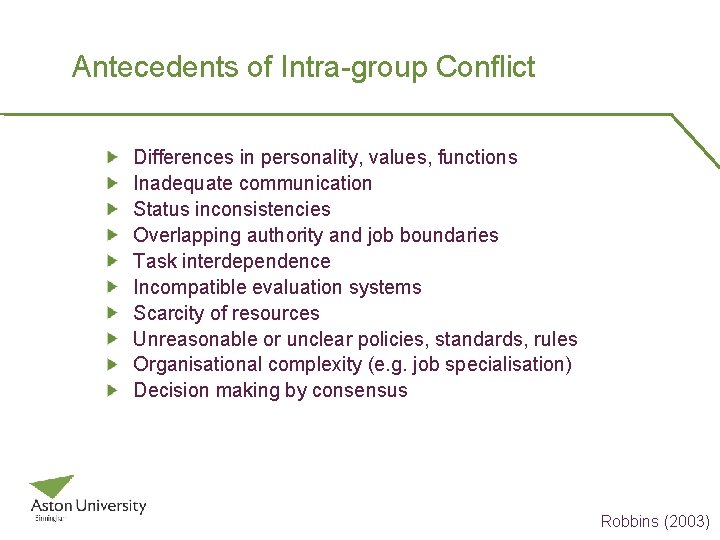
Antecedents of Intra-group Conflict Differences in personality, values, functions Inadequate communication Status inconsistencies Overlapping authority and job boundaries Task interdependence Incompatible evaluation systems Scarcity of resources Unreasonable or unclear policies, standards, rules Organisational complexity (e. g. job specialisation) Decision making by consensus Robbins (2003)
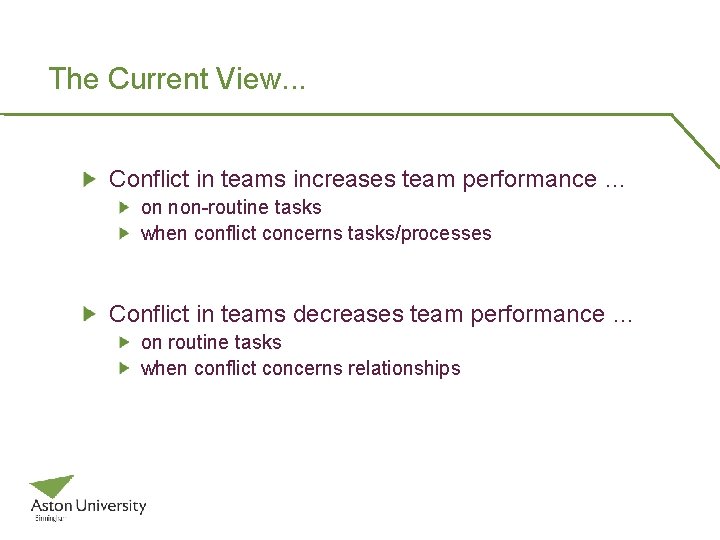
The Current View. . . Conflict in teams increases team performance … on non-routine tasks when conflict concerns tasks/processes Conflict in teams decreases team performance … on routine tasks when conflict concerns relationships
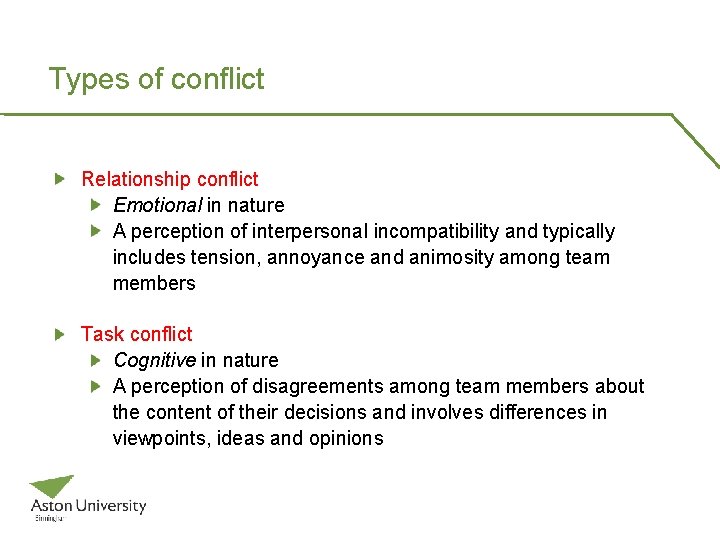
Types of conflict Relationship conflict Emotional in nature A perception of interpersonal incompatibility and typically includes tension, annoyance and animosity among team members Task conflict Cognitive in nature A perception of disagreements among team members about the content of their decisions and involves differences in viewpoints, ideas and opinions
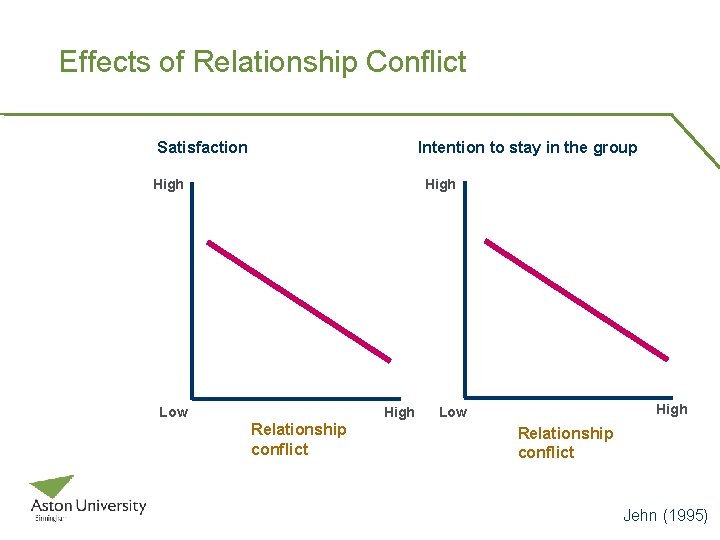
Effects of Relationship Conflict Intention to stay in the group Satisfaction High Low High Relationship conflict High Low Relationship conflict Jehn (1995)
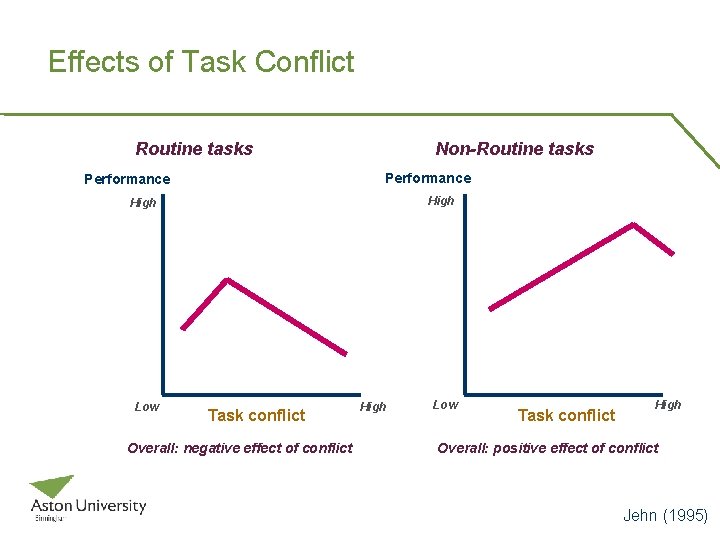
Effects of Task Conflict Routine tasks Non-Routine tasks Performance High Low Task conflict Overall: negative effect of conflict High Low Task conflict High Overall: positive effect of conflict Jehn (1995)
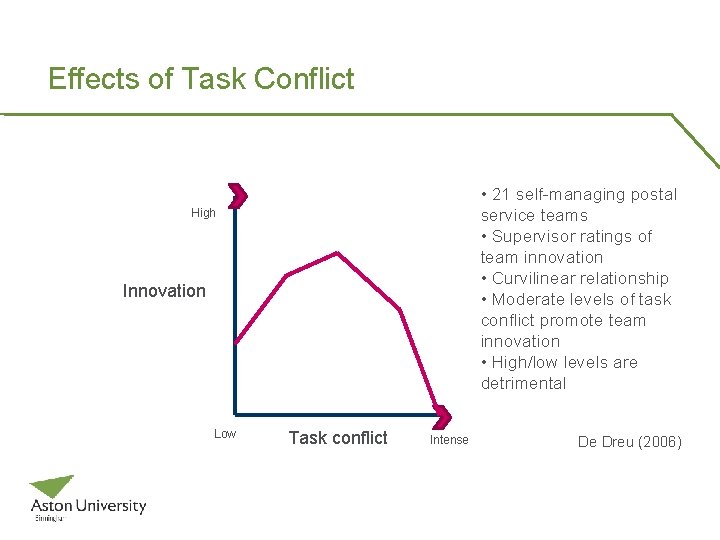
Effects of Task Conflict • 21 self-managing postal service teams • Supervisor ratings of team innovation • Curvilinear relationship • Moderate levels of task conflict promote team innovation • High/low levels are detrimental High Innovation Low Task conflict Intense De Dreu (2006)
Discourage Undesirable Conflict Dilemma: Task conflict has positive effects Relationship conflict has negative effects Implication: Enhance task conflict and reduce relationship conflict. BUT: relationship conflict and task conflict are highly related (r=. 47). Simons & Peterson (2000)
Towards a Solution Study 70 top management teams Develop trust Teams will low intra-group trust displayed much stronger positive associations between task and relationship conflict High trust leads to more accurate attributions Develop ‘loudness’ Open expression of differing positions prevents those differences from festering into relationship conflict Conclusion: Trust is key to gaining the benefits of task conflict without suffering the costs of relationship conflict Simons & Peterson (2000)
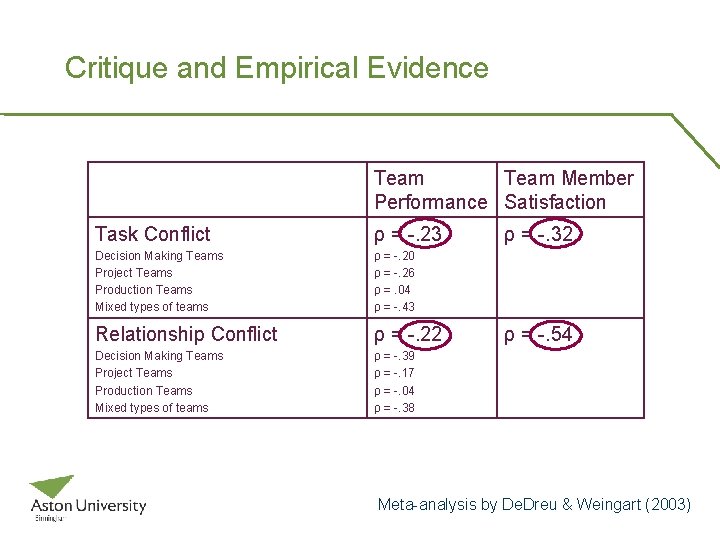
Critique and Empirical Evidence Team Member Performance Satisfaction Task Conflict ρ = -. 23 Decision Making Teams Project Teams Production Teams Mixed types of teams ρ = -. 20 ρ = -. 26 ρ =. 04 ρ = -. 43 Relationship Conflict ρ = -. 22 Decision Making Teams Project Teams Production Teams Mixed types of teams ρ = -. 39 ρ = -. 17 ρ = -. 04 ρ = -. 38 ρ = -. 32 ρ = -. 54 Meta-analysis by De. Dreu & Weingart (2003)
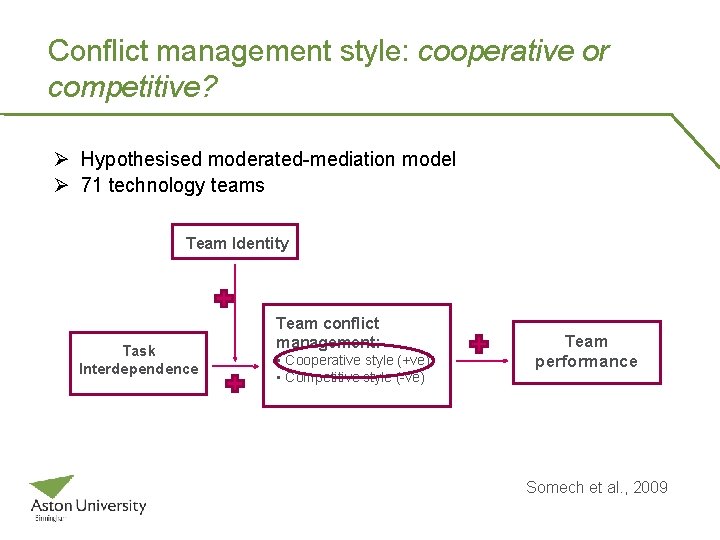
Conflict management style: cooperative or competitive? Ø Hypothesised moderated-mediation model Ø 71 technology teams Team Identity Task Interdependence Team conflict management: • Cooperative style (+ve) • Competitive style (-ve) Team performance Somech et al. , 2009
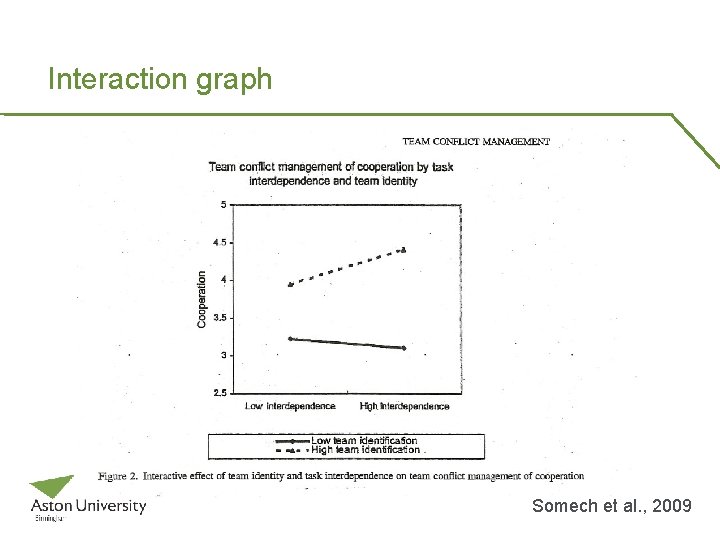
Interaction graph Somech et al. , 2009
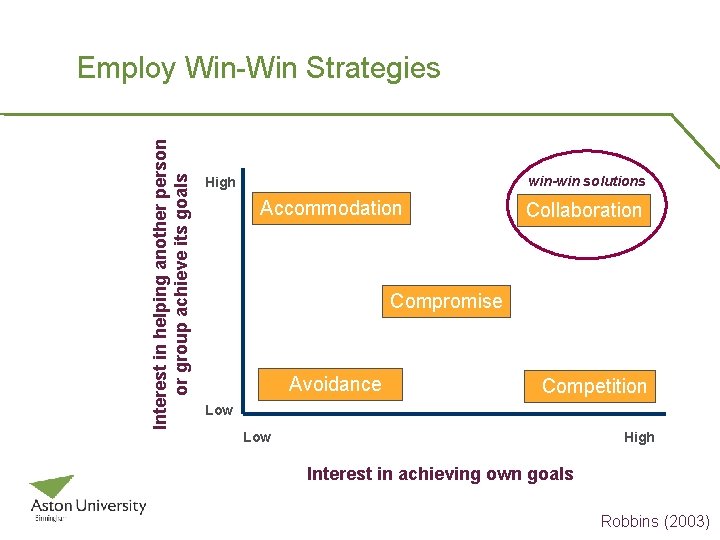
Interest in helping another person or group achieve its goals Employ Win-Win Strategies win-win solutions High Accommodation Collaboration Compromise Avoidance Competition Low High Interest in achieving own goals Robbins (2003)
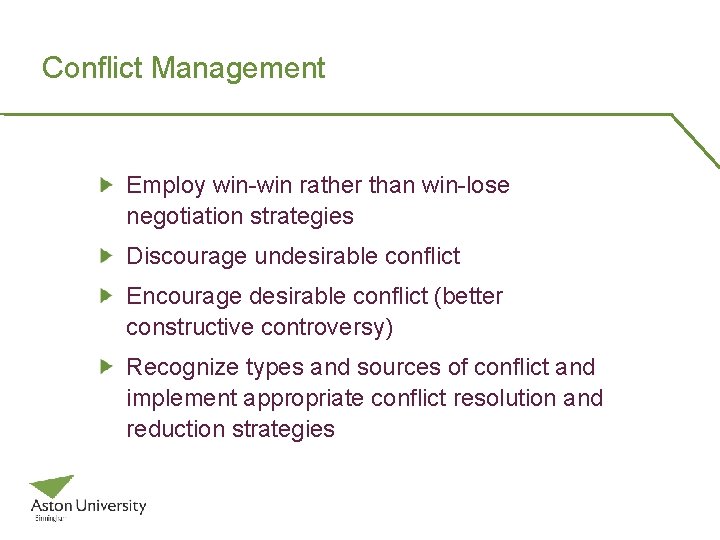
Conflict Management Employ win-win rather than win-lose negotiation strategies Discourage undesirable conflict Encourage desirable conflict (better constructive controversy) Recognize types and sources of conflict and implement appropriate conflict resolution and reduction strategies
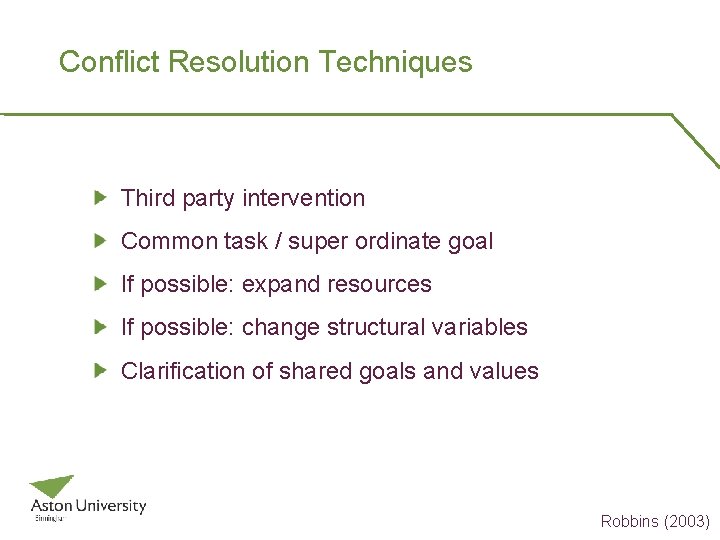
Conflict Resolution Techniques Third party intervention Common task / super ordinate goal If possible: expand resources If possible: change structural variables Clarification of shared goals and values Robbins (2003)
Effects of Inter-Group Conflict Negative Between groups: Lack of communication and cooperation, decreases organisational effectiveness Positive Between groups: Innovation, higher quality decisions, increases organisational effectiveness Fosters cohesion within groups
Two Approaches A) Realistic Goal Conflict Theory B) Social Identity Approach Van Knippenberg (2003)
A) Realistic Conflict Theory (RCT) Conflict between groups arises, because of incompatible goals (i. e. competition) This leads to increased motivation and cohesion within groups… …but leads to prejudiced attitudes, hostility, and discrimination between groups. Emphasis on the compatibility of interests Van Knippenberg (2003)
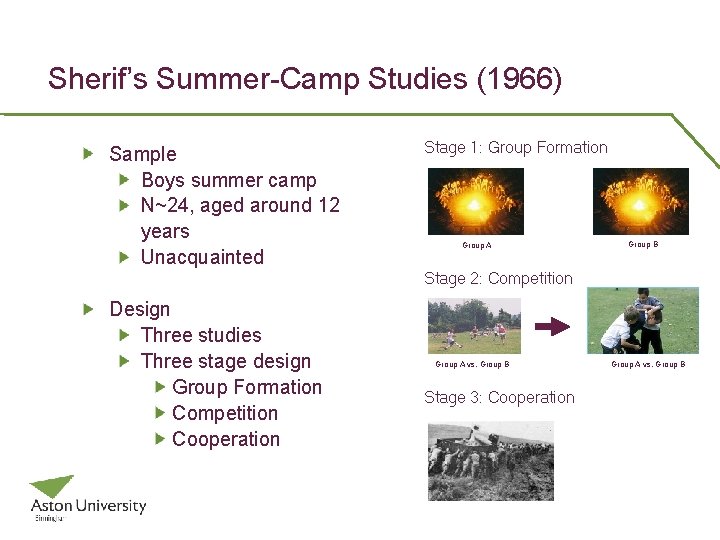
Sherif’s Summer-Camp Studies (1966) Sample Boys summer camp N~24, aged around 12 years Unacquainted Stage 1: Group Formation Group A Group B Stage 2: Competition Design Three studies Three stage design Group Formation Competition Cooperation Group A vs. Group B Stage 3: Cooperation Group A vs. Group B
Managing Inter-Group Relations From a RCT perspective: Change the incentive system: intergroup rewards Articulate super ordinate goals (effective team leadership) Eliminate specific negative interactions Provide well-defined tasks Mediation/third party intervention if necessary
Critique and Empirical Evidence Competition is only to the detriment of intergroup relations when group members identify strongly with their group. Studies using the minimal group paradigm show that negative intergroup attitudes and behaviour may even emerge in the absence of conflicting interests. Van Knippenberg (2002)
B) Social Identity Approach Individuals perceive others as well as themselves in terms of their group membership. Group membership reflects on the self concept. Thus, the status of the group also reflects on the self concept. The status of the group is determined by social comparison with out-groups. When the in-group has a higher status than the out-group, this reflects positively on the group member’s self concept. Individuals want to feel good about themselves, therefore they tend to favour their in-group, and discriminate towards the out -group. Intergroup Bias Van Knippenberg (2002)
Inter-Group Bias: Conditions and Consequences Conditions for intergroup biases to occur: Identification with the group Group membership has to be salient Competitive settings accentuate, whereas cooperative attenuate group biases If boundaries are permeable, intergroup bias diminishes Consequences of intergroup bias: In-group favouritism Out-group discrimination Conflict Van Knippenberg (2002)
Empirical Evidence and Critique Meta-analytic evidence supports the explanations put forward by the Social Identity approach Yet, most, if not all of these studies have been conducted in the laboratory More research in field settings is needed to support the claims made by the Social Identity Approach Study of teams ‘in the wild’ Van Knippenberg (2002)
Managing Inter-Group Relations From a Social Identity Perspective: Breaking down group categorisations: Decategorisation Encourage frequent interaction (Contact Hypothesis) Recategorisation Creating and emphasising shared organisational goals and rewards Dual identification (organisation and group) Job rotation Common Vision Van Knippenberg (2002)
… But still stimulating Constructive Intergroup Conflict Promote member exchanges between different teams/departments Facilitate communication If the organisation is too static and passive a restructure might initiate sharing of different perspectives and foster functional conflict Empower minority dissents Van Knippenberg (2002)
Lecture summary Different types of conflict Functional/dysfunctional Task/relationship Within groups/between groups Importance of intergroup trust as a team process for managing conflict Inconclusive evidence on the effects of task conflict on outcomes Two major theories on intra-group conflict Practical guidelines on how to manage this
Reading **Knippenberg, D. (2002). Intergroup relations in organizations. In M. A. West, D. Tjosvold & ; K. G. Smith (Eds. ), International Handbook of Teamwork and Cooperative Working (pp. 381 -399). Chichester, England: Wiley. Somech, A. , Desivilya, H. S. , & Lidogoster, H. (2009). Team conflict management and team effectiveness: the effects of task interdependence and team identification. Journal of Organizational Behavior, 30, 359 -378. Jehn, K. A. (1995), ‘A Multimethod Examination of the Benefits and Detriments of Intragroup Conflict’, Administrative Science Quarterly, 40(2): 256 -282. Langfred, C. W. (2007). The downside of self-management: a longitudinal study of the effects of conflict on trust, autonomy and task interdependence in self-managing teams. Academy of Management Journal, 50(4), 885 -900.
Additional References De Dreu, C. K. W. , & Weingart, L. R. (2003). Task versus relationship conflict, team performance, and team member satisfaction: A meta-analysis. Journal of Applied Psychology, 88(4), 741 -749. Simons, T. L. , & Peterson, R. S. (2000). Task conflict and relationship conflict in top management teams: The pivotal role of intragroup Trust. Journal of Applied Psychology, 85, 102 -111. Jehn, K. A. (1995). A multimethod examination of the benefits and detriments of intragroup conflict. Administrative Science Quarterly, 40(2), 256 -282. Sherif, M. , & Sherif, C. W. (1966). Groups in harmony and tension. New York: Octagon Books.
- Slides: 43