
Intracranial Cysts and Cystic Lesions ASN Annual Meeting
- Slides: 60
Intracranial Cysts and Cystic Lesions: ASN Annual Meeting 2016 John A. Bertelson, MD Chief of Neurology, Seton Brain and Spine Institute Assistant Professor of Medicine, Dell Medical School, UT Austin Clinical Assistant Professor of Psychology, UT Austin
Relevant Disclosures n None
Thanks n Bela Ajtai, MD Ph. D
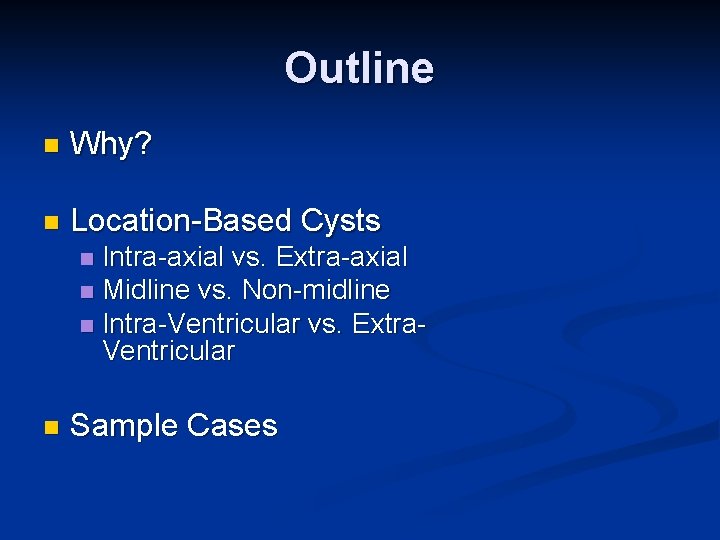
Outline n Why? n Location-Based Cysts Intra-axial vs. Extra-axial n Midline vs. Non-midline n Intra-Ventricular vs. Extra. Ventricular n n Sample Cases
Why Review Intracranial Cysts?
Why Review Intracranial Cysts? n Extremely common incidental findings n Need to exclude pathologic lesions n Generate a focused differential based on cyst location and imaging appearance
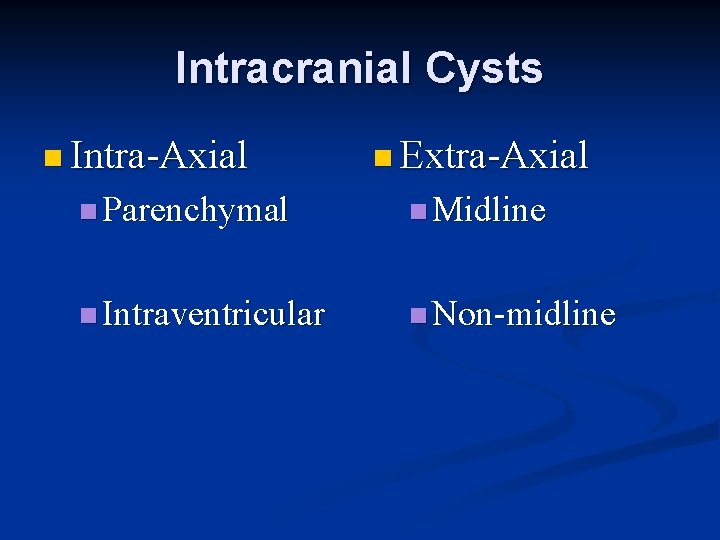
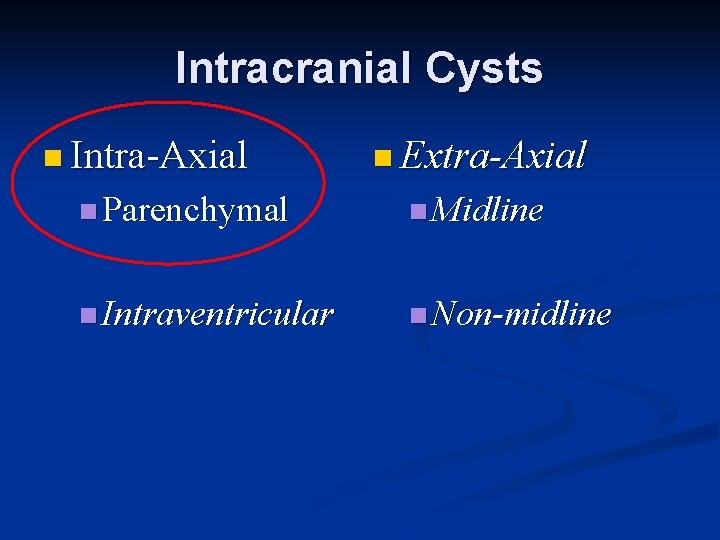
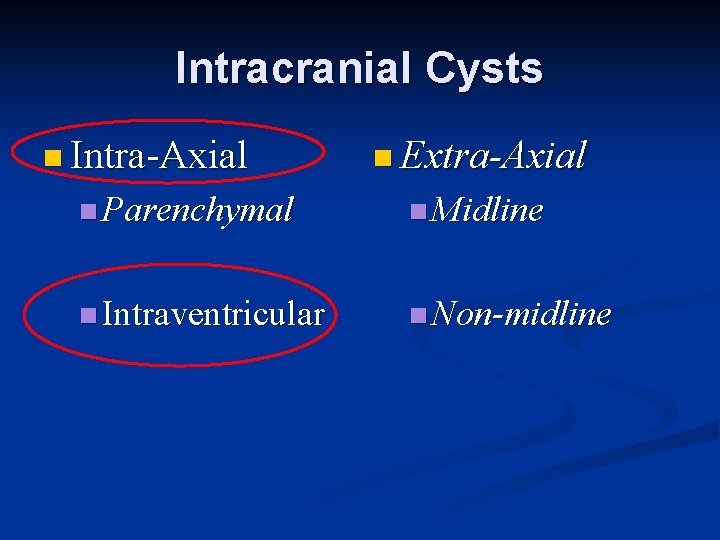
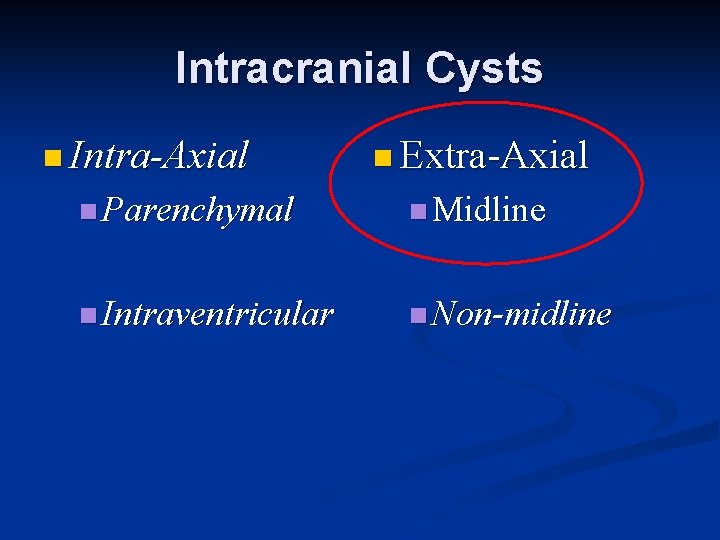
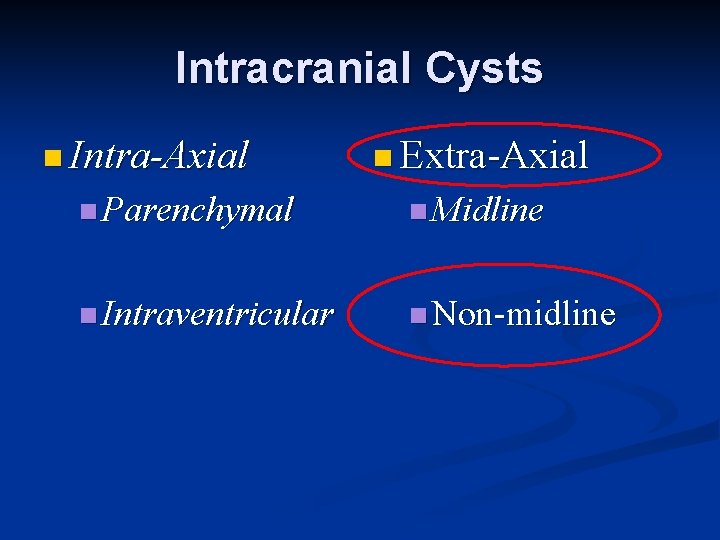
Intracranial Cysts n Intra-Axial n Extra-Axial n Parenchymal n Midline n Intraventricular n Non-midline
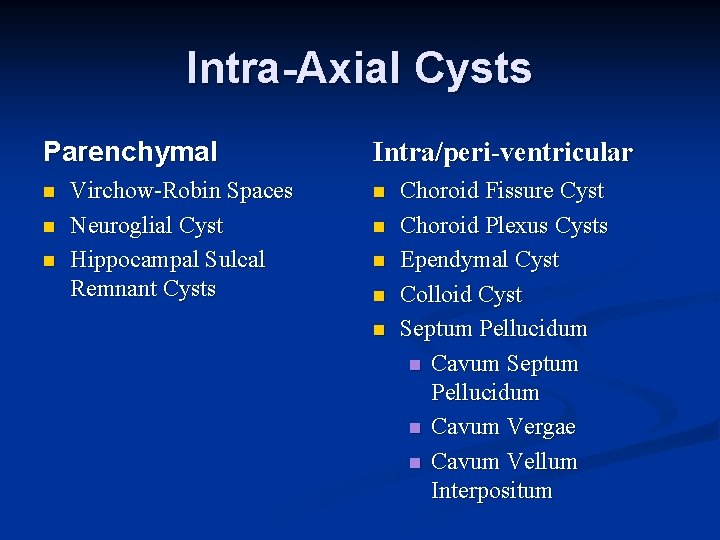
Intra-Axial Cysts Parenchymal n n n Virchow-Robin Spaces Neuroglial Cyst Hippocampal Sulcal Remnant Cysts Intra/peri-ventricular n n n Choroid Fissure Cyst Choroid Plexus Cysts Ependymal Cyst Colloid Cyst Septum Pellucidum n Cavum Vergae n Cavum Vellum Interpositum
Intracranial Cysts n Intra-Axial n Extra-Axial n Parenchymal n Midline n Intraventricular n Non-midline
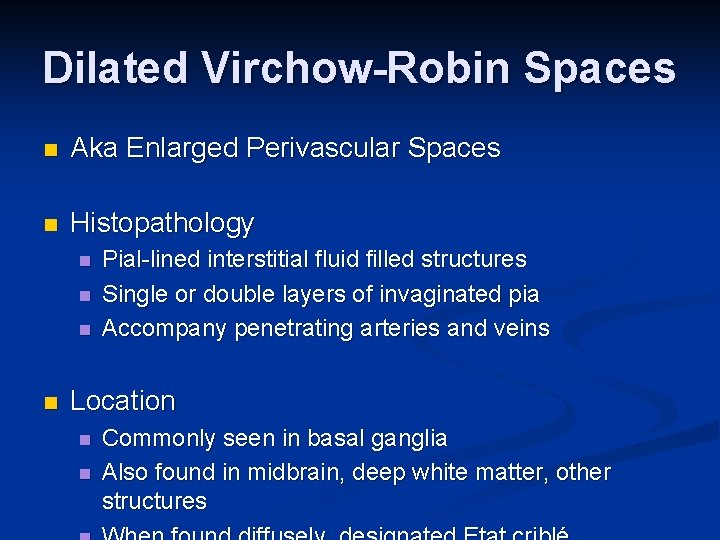
Dilated Virchow-Robin Spaces n Aka Enlarged Perivascular Spaces n Histopathology n n Pial-lined interstitial fluid filled structures Single or double layers of invaginated pia Accompany penetrating arteries and veins Location n n Commonly seen in basal ganglia Also found in midbrain, deep white matter, other structures
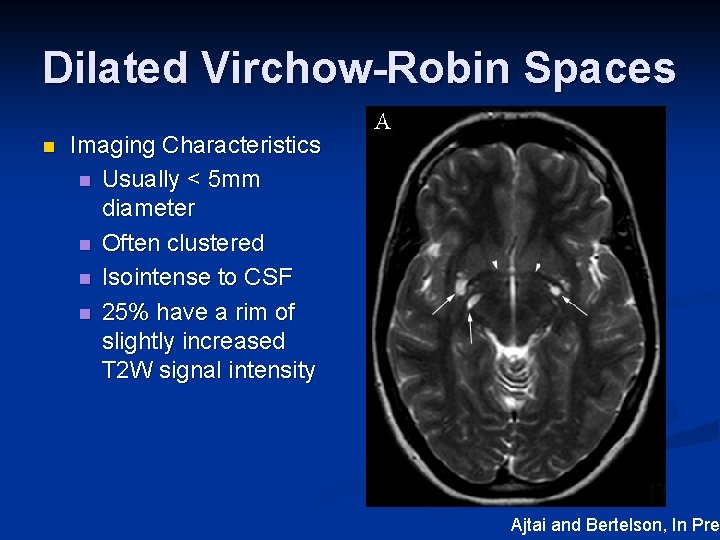
Dilated Virchow-Robin Spaces n Imaging Characteristics n Usually < 5 mm diameter n Often clustered n Isointense to CSF n 25% have a rim of slightly increased T 2 W signal intensity Ajtai and Bertelson, In Pres
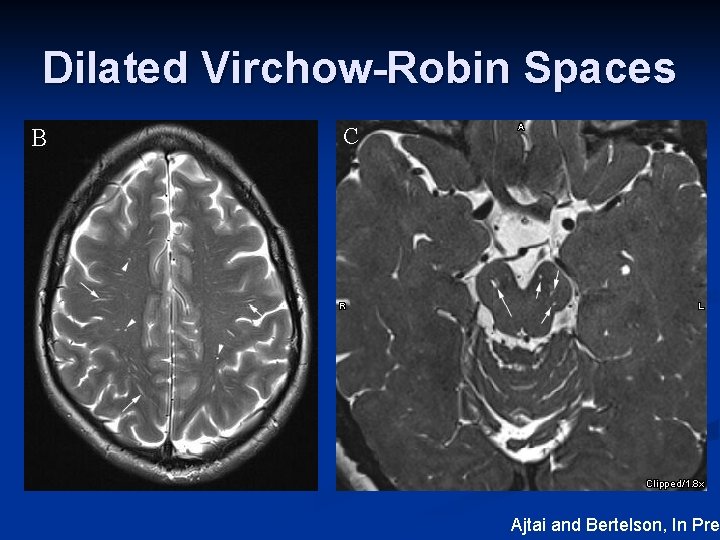
Dilated Virchow-Robin Spaces Ajtai and Bertelson, In Pres
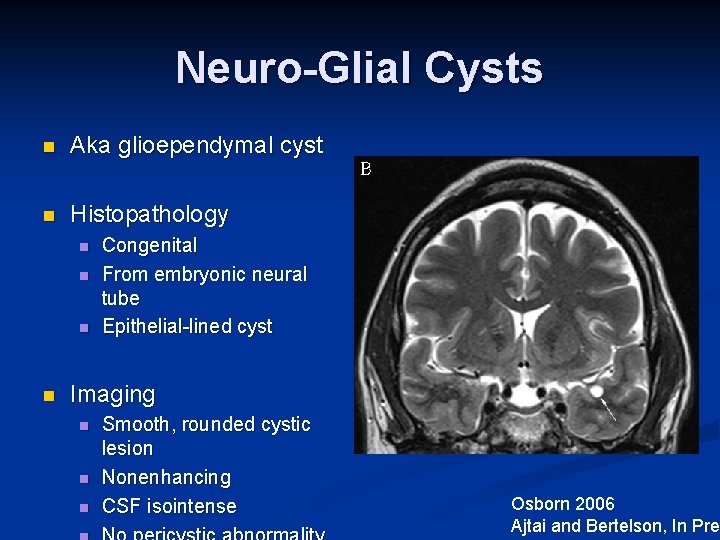
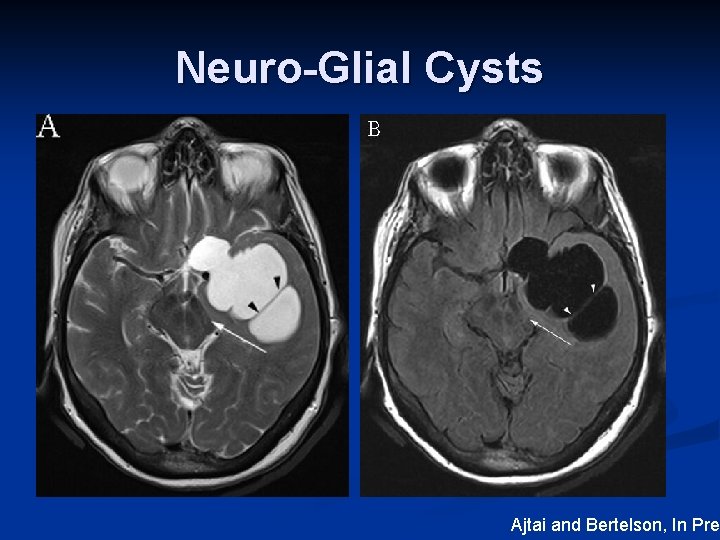
Neuro-Glial Cysts n Aka glioependymal cyst n Histopathology n n Congenital From embryonic neural tube Epithelial-lined cyst Imaging n n n Smooth, rounded cystic lesion Nonenhancing CSF isointense Osborn 2006 Ajtai and Bertelson, In Pres
Neuro-Glial Cysts Ajtai and Bertelson, In Pres
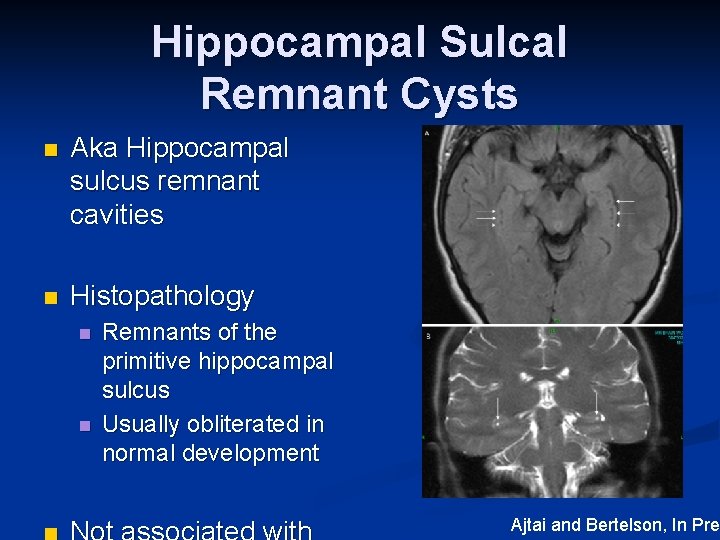
Hippocampal Sulcal Remnant Cysts n Aka Hippocampal sulcus remnant cavities n Histopathology n n Remnants of the primitive hippocampal sulcus Usually obliterated in normal development Ajtai and Bertelson, In Pres
Intracranial Cysts n Intra-Axial n Extra-Axial n Parenchymal n Midline n Intraventricular n Non-midline
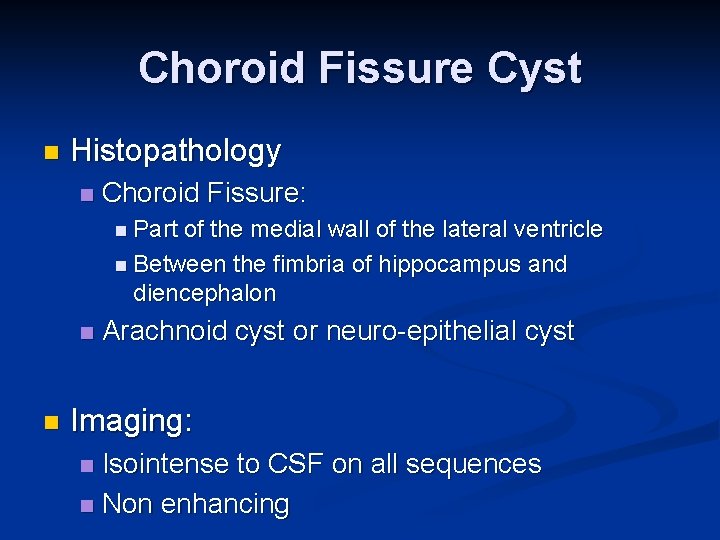
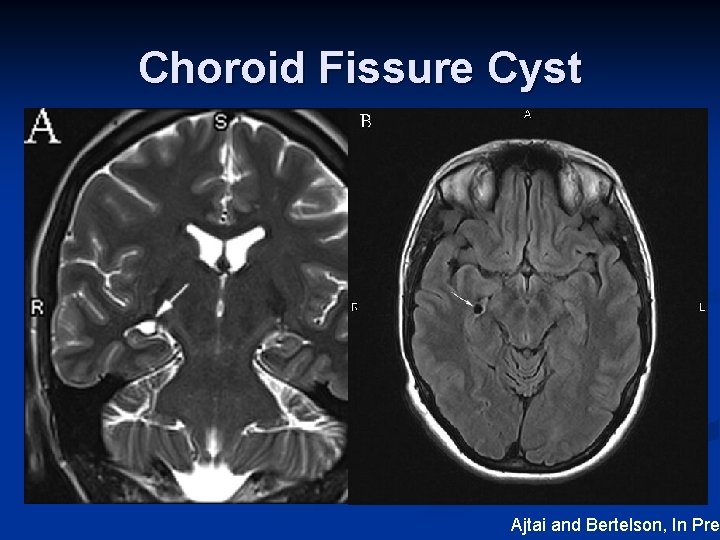
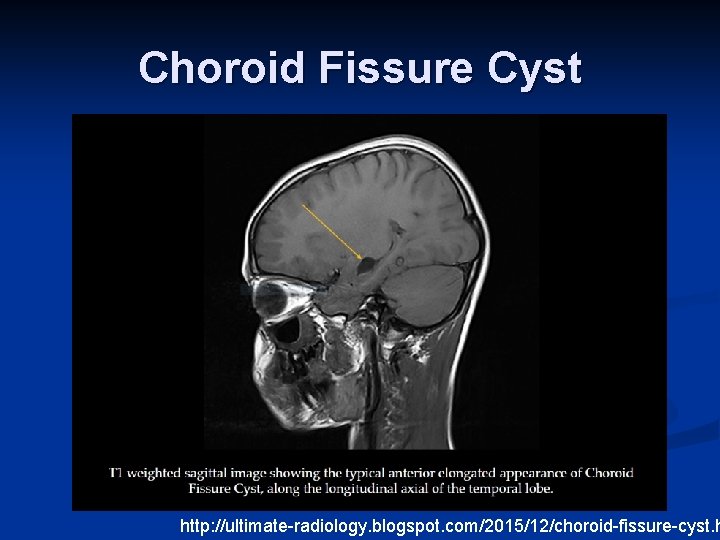
Choroid Fissure Cyst n Histopathology n Choroid Fissure: n Part of the medial wall of the lateral ventricle n Between the fimbria of hippocampus and diencephalon n n Arachnoid cyst or neuro-epithelial cyst Imaging: Isointense to CSF on all sequences n Non enhancing n
Choroid Fissure Cyst Ajtai and Bertelson, In Pres
Choroid Fissure Cyst http: //ultimate-radiology. blogspot. com/2015/12/choroid-fissure-cyst. h
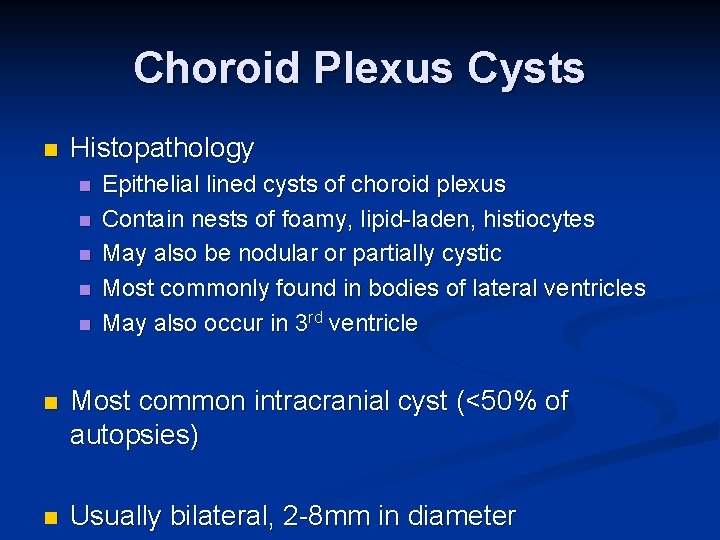
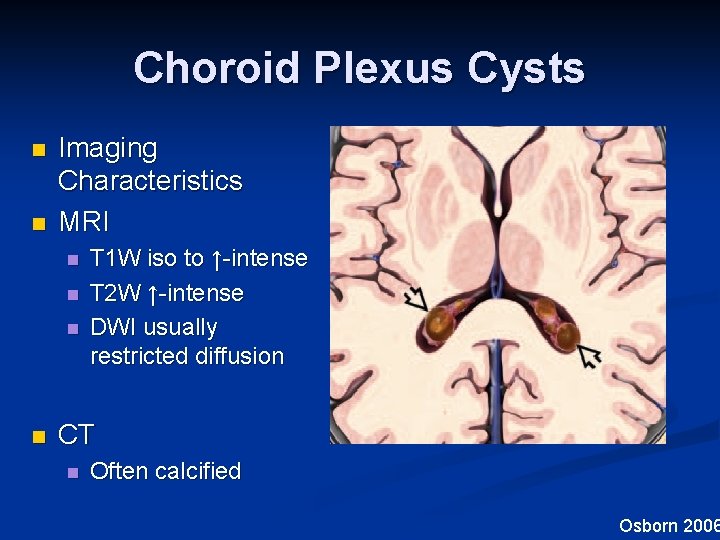
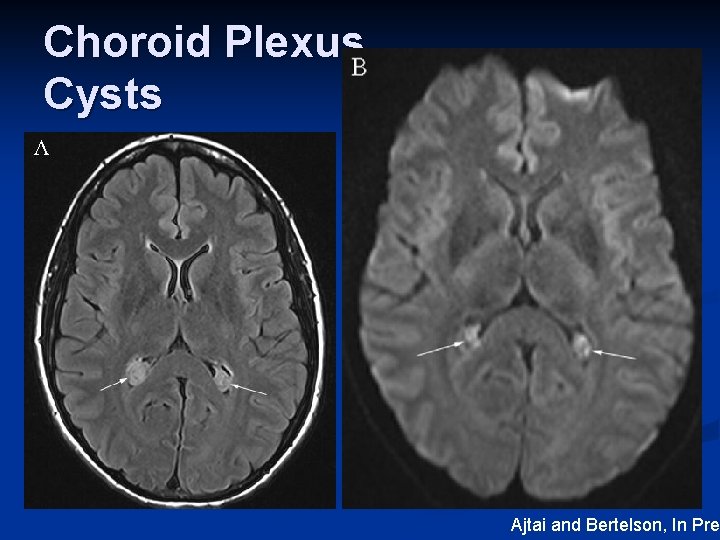
Choroid Plexus Cysts n Histopathology n n n Epithelial lined cysts of choroid plexus Contain nests of foamy, lipid-laden, histiocytes May also be nodular or partially cystic Most commonly found in bodies of lateral ventricles May also occur in 3 rd ventricle n Most common intracranial cyst (<50% of autopsies) n Usually bilateral, 2 -8 mm in diameter
Choroid Plexus Cysts n n Imaging Characteristics MRI n n T 1 W iso to ↑-intense T 2 W ↑-intense DWI usually restricted diffusion CT n Often calcified Osborn 2006
Choroid Plexus Cysts Ajtai and Bertelson, In Pres
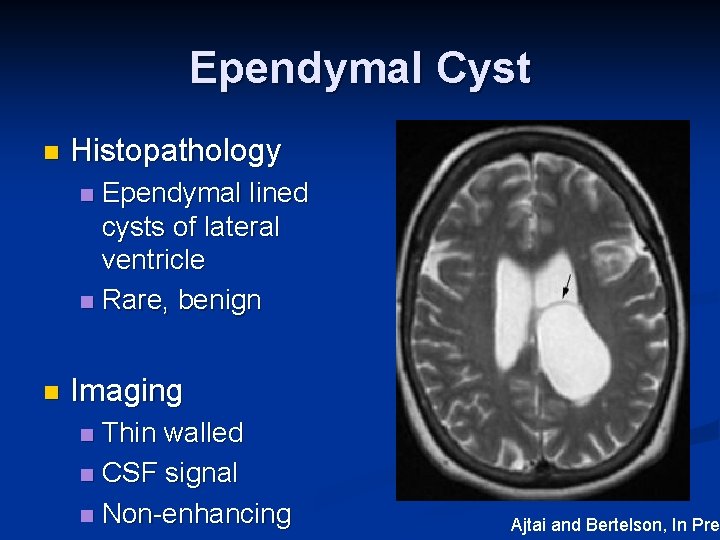
Ependymal Cyst n Histopathology Ependymal lined cysts of lateral ventricle n Rare, benign n n Imaging Thin walled n CSF signal n Non-enhancing n Ajtai and Bertelson, In Pres
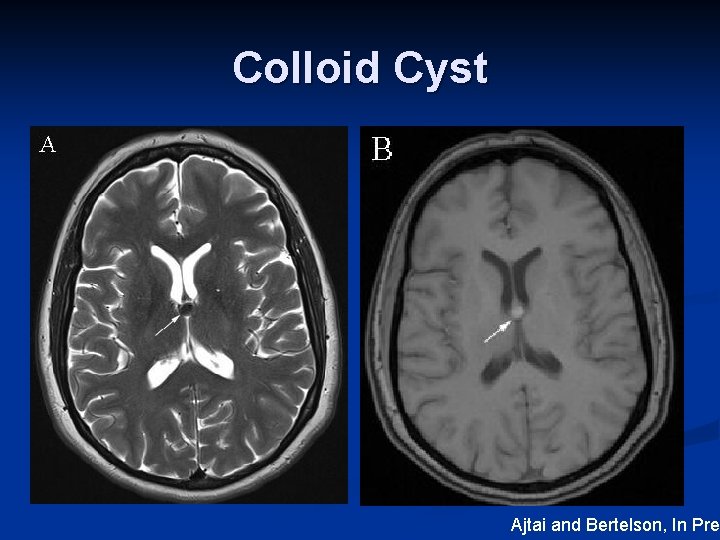
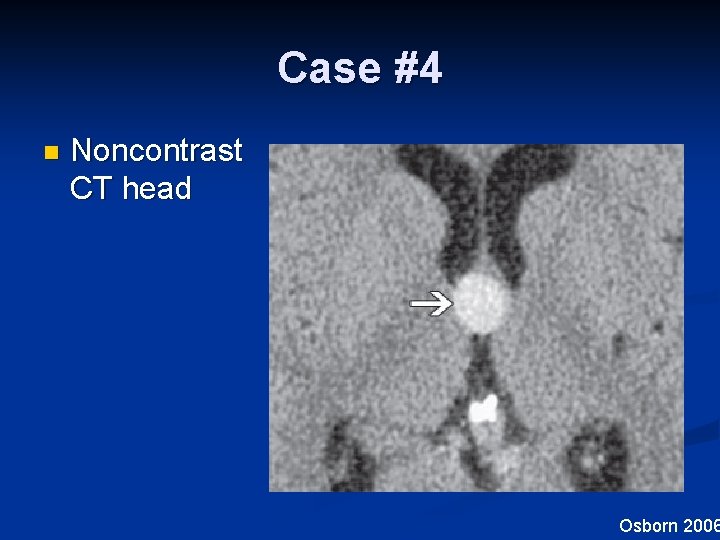
Colloid Cyst n Histopathology n n n Congenital, arising from ectopic embryonic endoderm Mucin-containing cysts Intraventricular n n 15 -20% of intraventricular masses Almost always occur at the foramen of Monro Variable size (0. 3 -4 cm, mean 1. 5 cm) Clinical relevance n May produce acute hydrocephalus Osborn 2006
Colloid Cyst Ajtai and Bertelson, In Pres
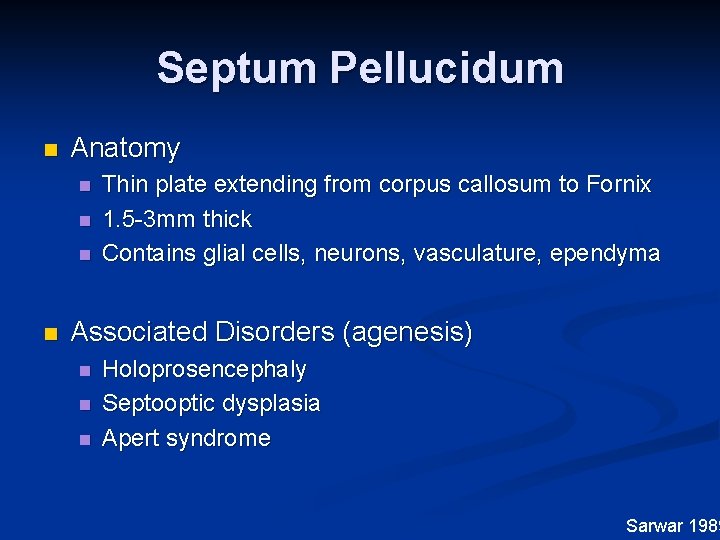
Septum Pellucidum n Anatomy n n Thin plate extending from corpus callosum to Fornix 1. 5 -3 mm thick Contains glial cells, neurons, vasculature, ependyma Associated Disorders (agenesis) n n n Holoprosencephaly Septooptic dysplasia Apert syndrome Sarwar 1989
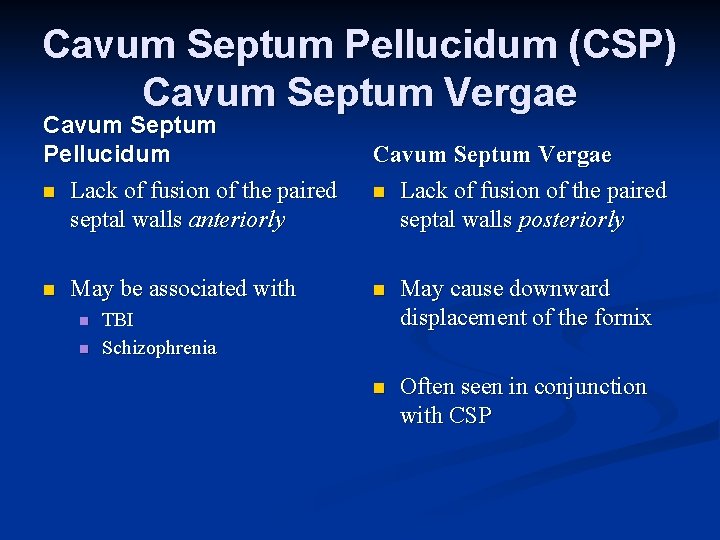
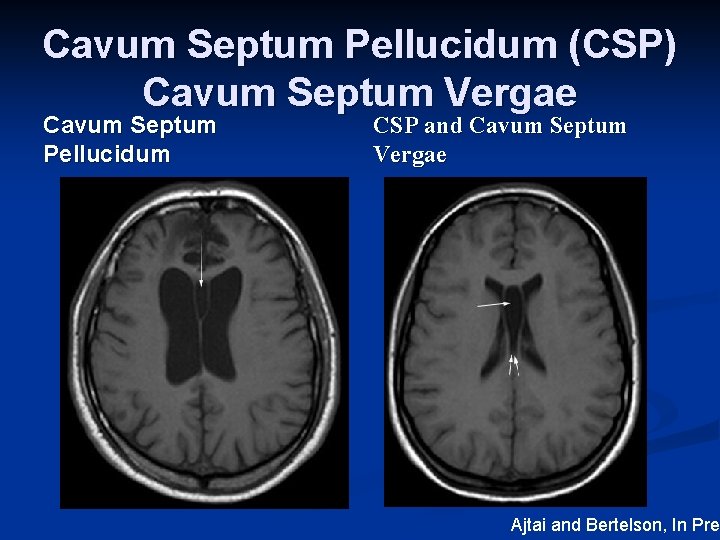
Cavum Septum Pellucidum (CSP) Cavum Septum Vergae Cavum Septum Pellucidum n Lack of fusion of the paired septal walls anteriorly n May be associated with n n Cavum Septum Vergae n Lack of fusion of the paired septal walls posteriorly n May cause downward displacement of the fornix n Often seen in conjunction with CSP TBI Schizophrenia
Cavum Septum Pellucidum (CSP) Cavum Septum Vergae Cavum Septum Pellucidum CSP and Cavum Septum Vergae Ajtai and Bertelson, In Pres
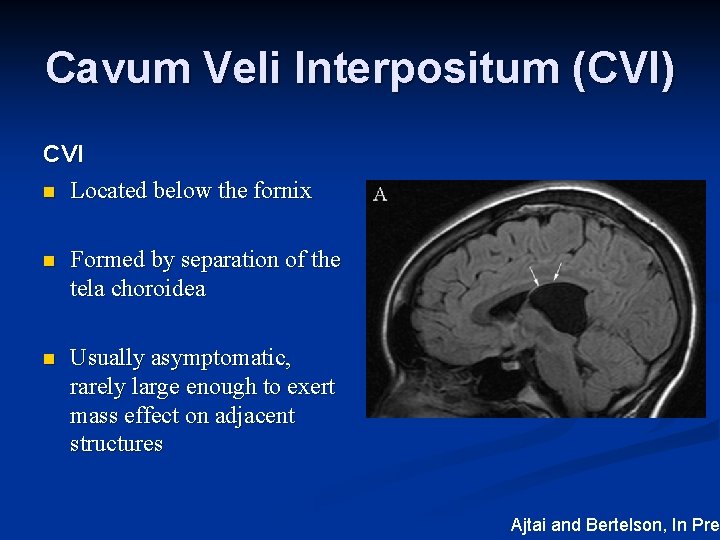
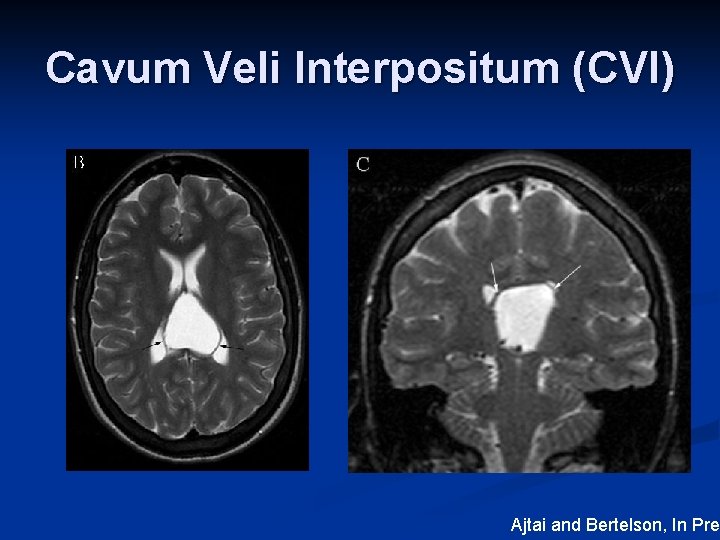
Cavum Veli Interpositum (CVI) CVI n Located below the fornix n Formed by separation of the tela choroidea n Usually asymptomatic, rarely large enough to exert mass effect on adjacent structures Ajtai and Bertelson, In Pres
Cavum Veli Interpositum (CVI) Ajtai and Bertelson, In Pres
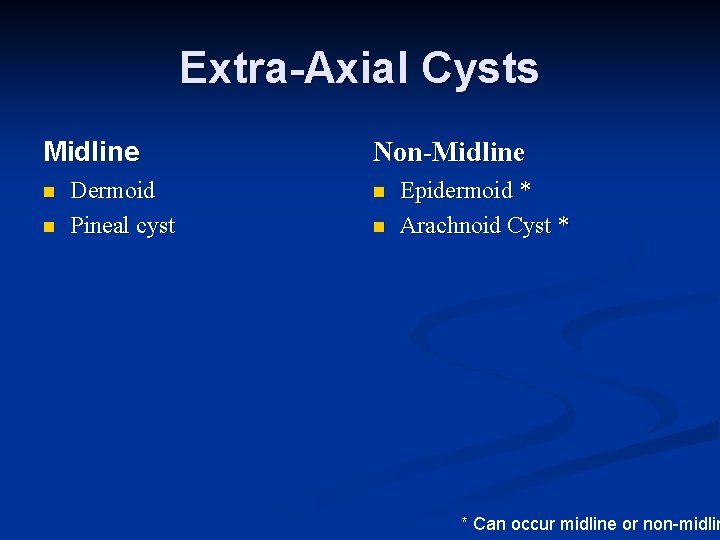
Extra-Axial Cysts Midline n n Dermoid Pineal cyst Non-Midline n n Epidermoid * Arachnoid Cyst * * Can occur midline or non-midlin
Intracranial Cysts n Intra-Axial n Extra-Axial n Parenchymal n Midline n Intraventricular n Non-midline
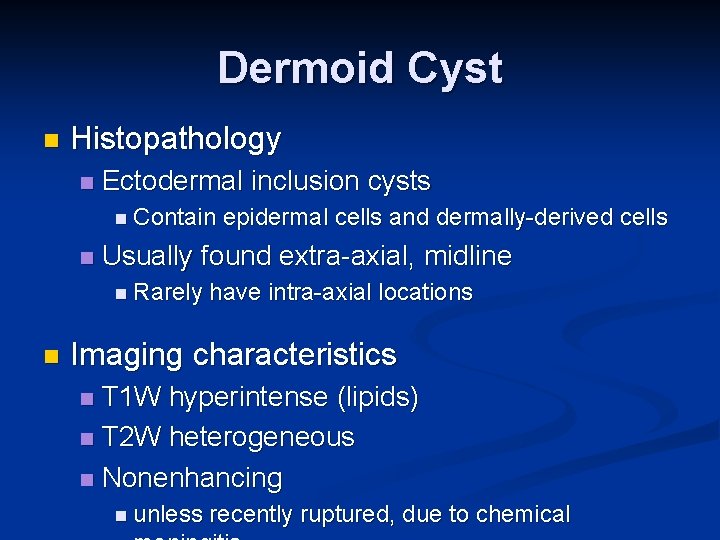
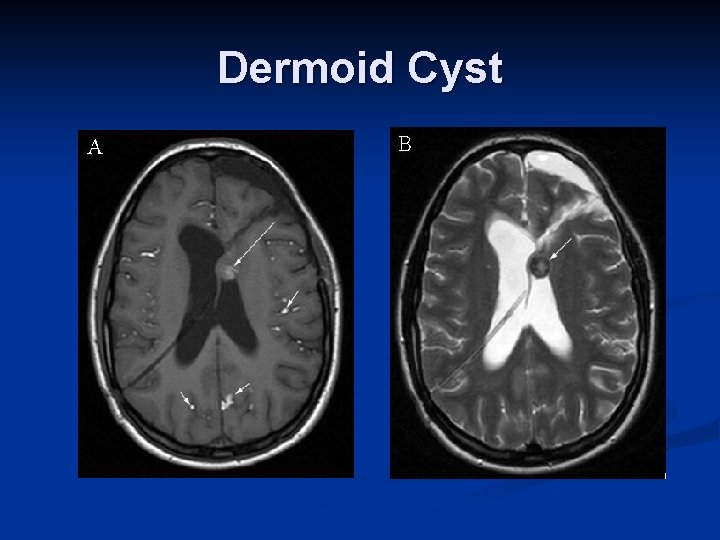
Dermoid Cyst n Histopathology n Ectodermal inclusion cysts n Contain n Usually found extra-axial, midline n Rarely n epidermal cells and dermally-derived cells have intra-axial locations Imaging characteristics T 1 W hyperintense (lipids) n T 2 W heterogeneous n Nonenhancing n n unless recently ruptured, due to chemical
Dermoid Cyst
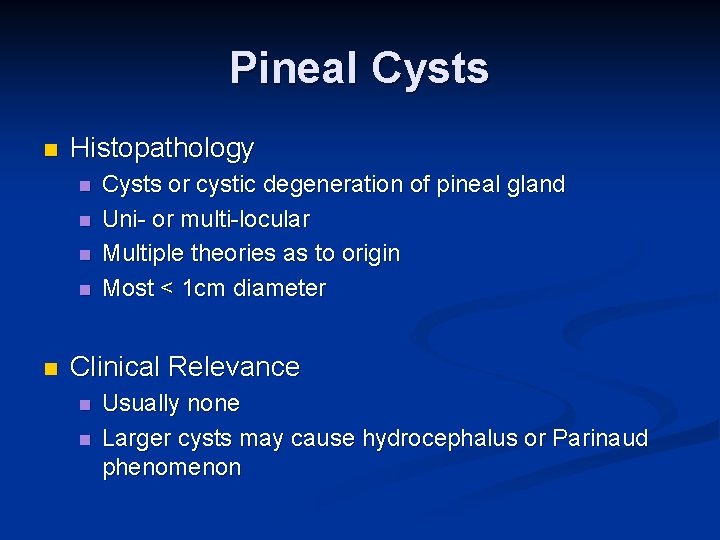
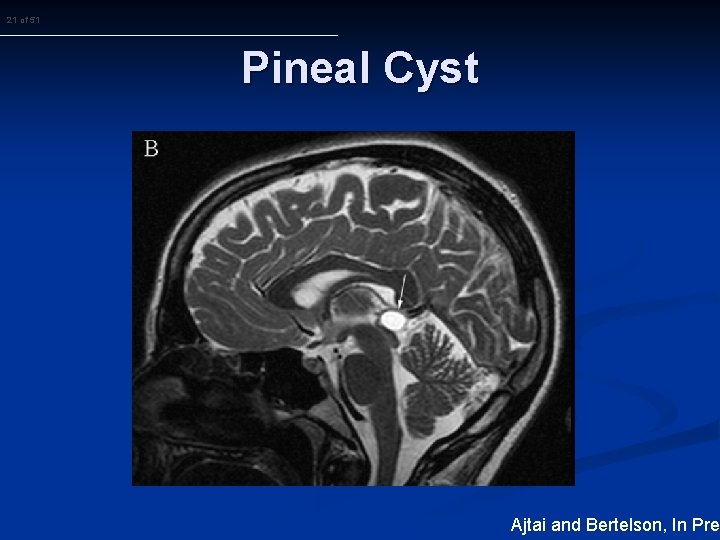
Pineal Cysts n Histopathology n n n Cysts or cystic degeneration of pineal gland Uni- or multi-locular Multiple theories as to origin Most < 1 cm diameter Clinical Relevance n n Usually none Larger cysts may cause hydrocephalus or Parinaud phenomenon
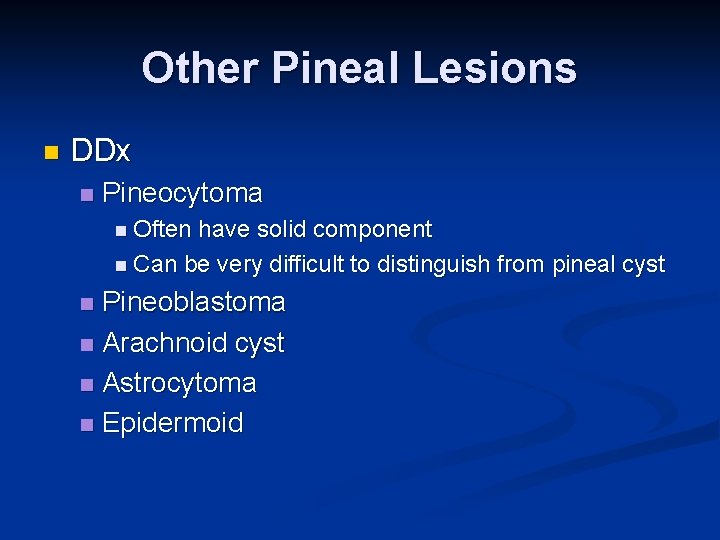
Other Pineal Lesions n DDx n Pineocytoma n Often have solid component n Can be very difficult to distinguish from pineal cyst Pineoblastoma n Arachnoid cyst n Astrocytoma n Epidermoid n
21 of 51 Pineal Cyst Ajtai and Bertelson, In Pres
Intracranial Cysts n Intra-Axial n Extra-Axial n Parenchymal n Midline n Intraventricular n Non-midline
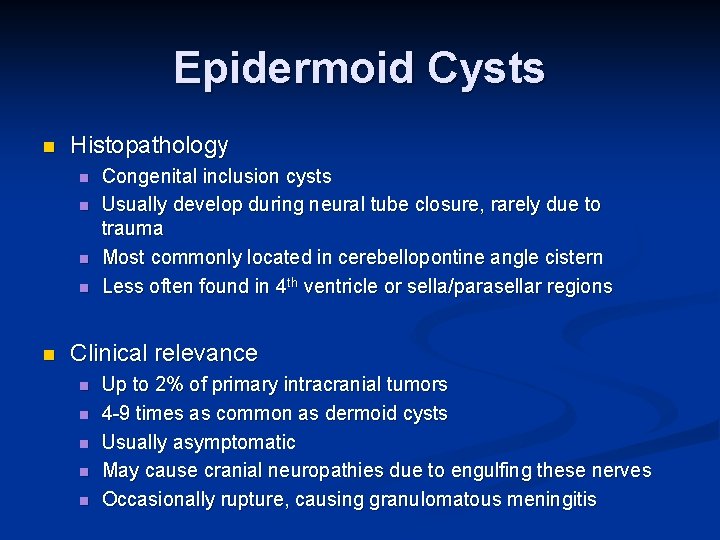
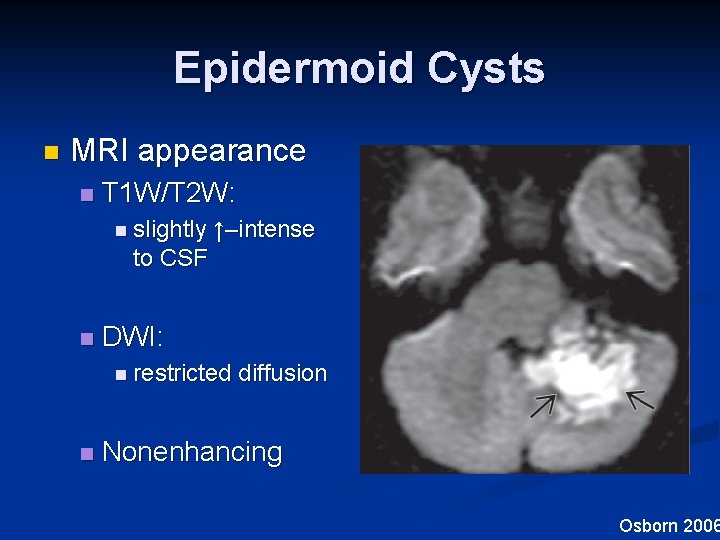
Epidermoid Cysts n Histopathology n n n Congenital inclusion cysts Usually develop during neural tube closure, rarely due to trauma Most commonly located in cerebellopontine angle cistern Less often found in 4 th ventricle or sella/parasellar regions Clinical relevance n n n Up to 2% of primary intracranial tumors 4 -9 times as common as dermoid cysts Usually asymptomatic May cause cranial neuropathies due to engulfing these nerves Occasionally rupture, causing granulomatous meningitis
Epidermoid Cysts n MRI appearance n T 1 W/T 2 W: n slightly ↑–intense to CSF n DWI: n restricted n diffusion Nonenhancing Osborn 2006
Arachnoid Cysts n Histopathology Intra-arachnoid n Benign, congenital lesions filled with CSF n Usually supratentorial, n n 50 -60% n within the middle cranial fossa Clinical relevance Generally asymptomatic n Displaces (does not engulf) cranial nerves n n Rarely result in cranial neuropathies Osborn 2006
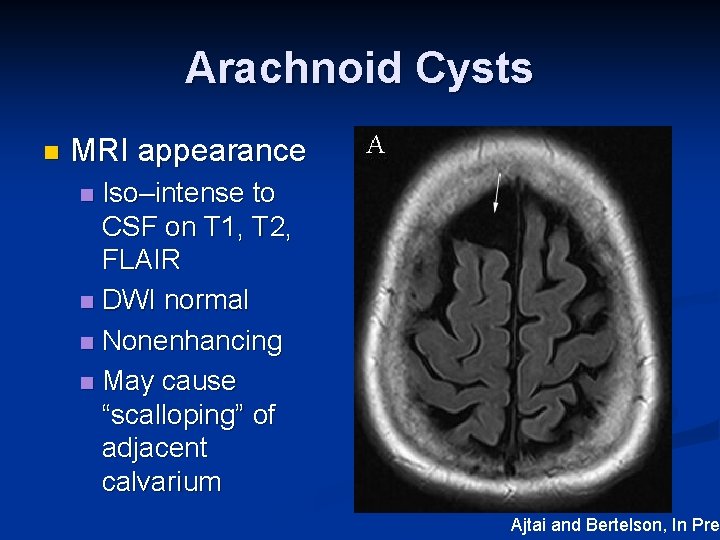
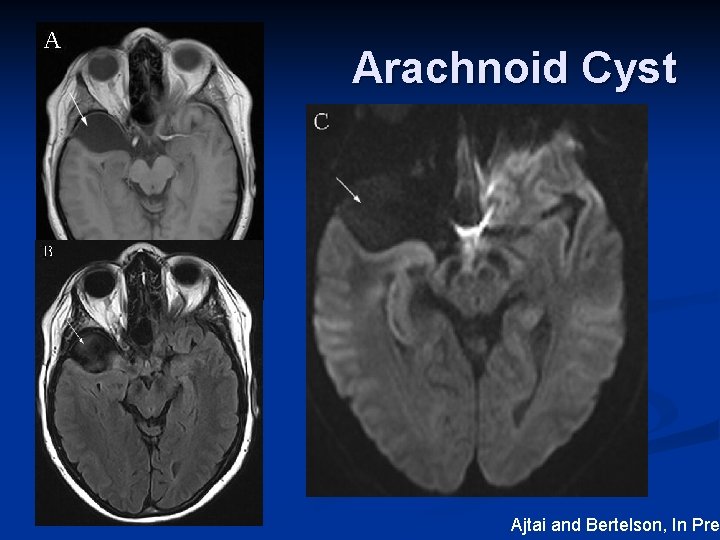
Arachnoid Cysts n MRI appearance Iso–intense to CSF on T 1, T 2, FLAIR n DWI normal n Nonenhancing n May cause “scalloping” of adjacent calvarium n Ajtai and Bertelson, In Pres
Arachnoid Cyst Ajtai and Bertelson, In Pres
Pathologic Processes with Cystic Components n Neoplasm Glioblastoma Multiforme n Metastasis n Hemangioblastoma n n Infection Abscess n Neurocysticercosis n n Other n Porencephalic Cysts
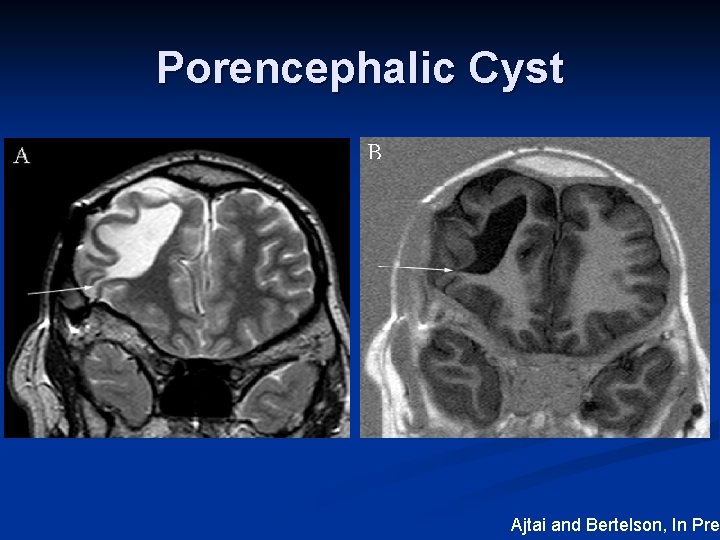
Porencephalic Cyst Acquired cavities of CSF n Traumatic, vascular, or infectious insult n Variable size n Usually lined by gliotic white matter n
Porencephalic Cyst Ajtai and Bertelson, In Pres
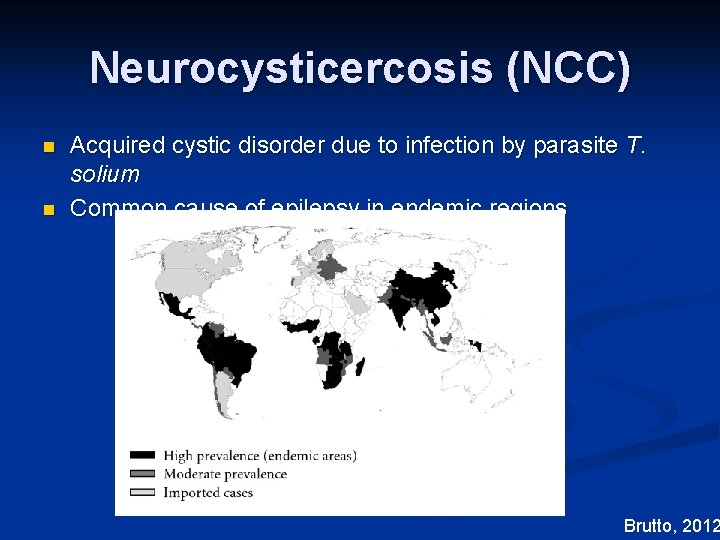
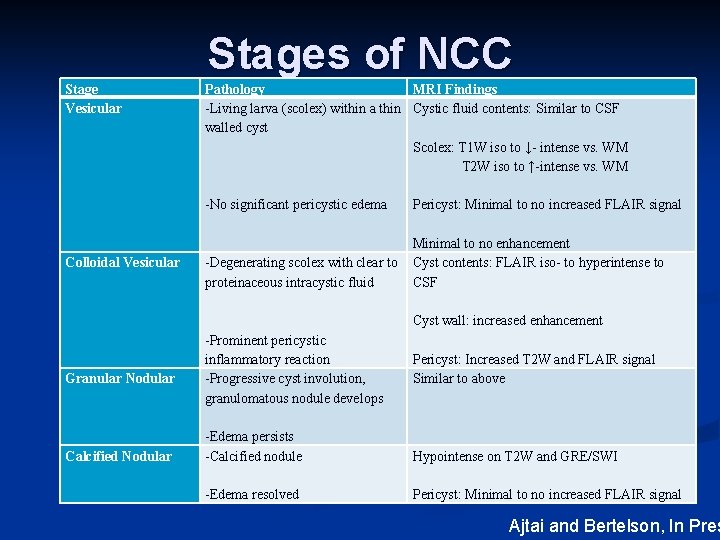
Neurocysticercosis (NCC) n n Acquired cystic disorder due to infection by parasite T. solium Common cause of epilepsy in endemic regions Brutto, 2012
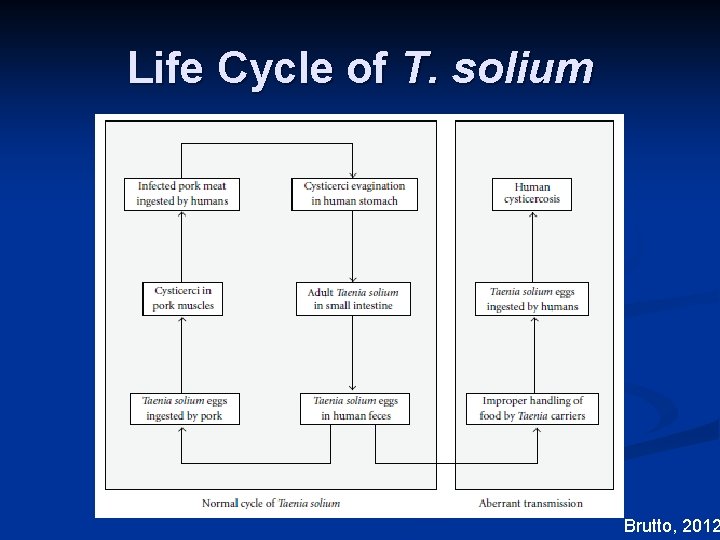
Life Cycle of T. solium Brutto, 2012
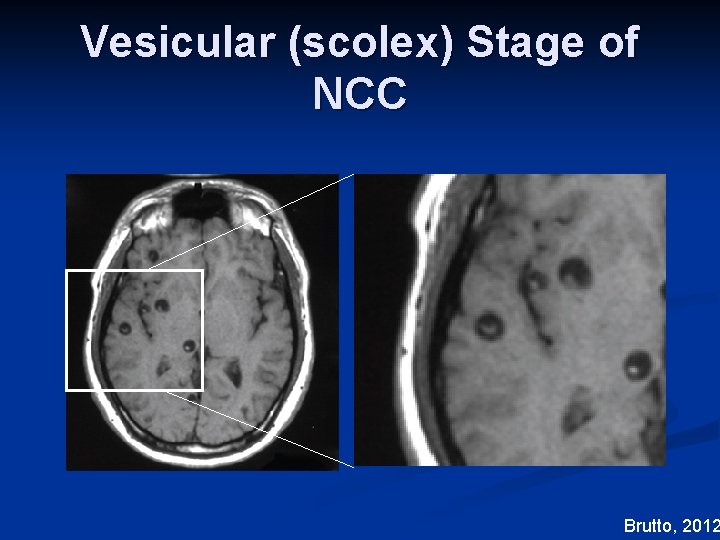
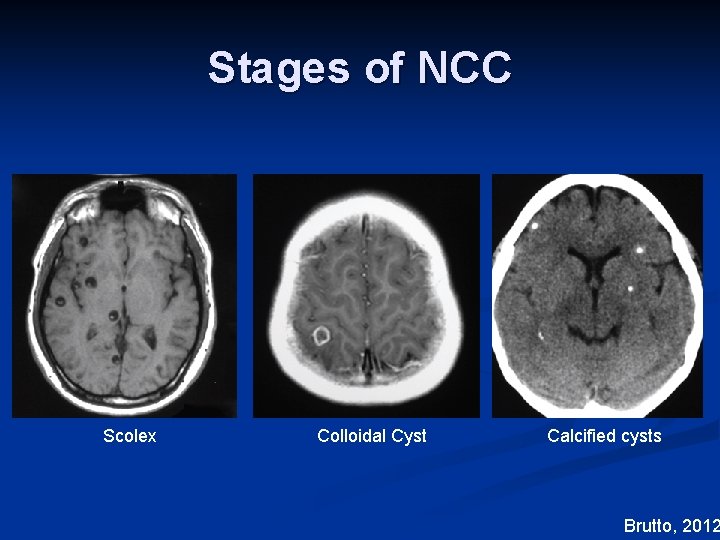
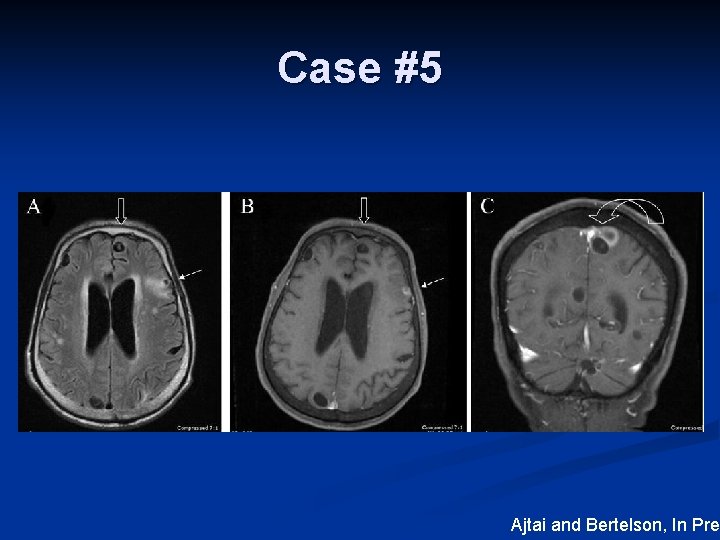
Stages of NCC Stage Vesicular Colloidal Vesicular Granular Nodular Calcified Nodular Pathology -Living larva (scolex) within a thin walled cyst -No significant pericystic edema MRI Findings Cystic fluid contents: Similar to CSF Scolex: T 1 W iso to ↓- intense vs. WM T 2 W iso to ↑-intense vs. WM Pericyst: Minimal to no increased FLAIR signal Minimal to no enhancement -Degenerating scolex with clear to Cyst contents: FLAIR iso- to hyperintense to proteinaceous intracystic fluid CSF Cyst wall: increased enhancement -Prominent pericystic inflammatory reaction Pericyst: Increased T 2 W and FLAIR signal -Progressive cyst involution, Similar to above granulomatous nodule develops -Edema persists -Calcified nodule Hypointense on T 2 W and GRE/SWI -Edema resolved Pericyst: Minimal to no increased FLAIR signal Ajtai and Bertelson, In Pres
Vesicular (scolex) Stage of NCC Brutto, 2012
Stages of NCC Scolex Colloidal Cyst Calcified cysts Brutto, 2012
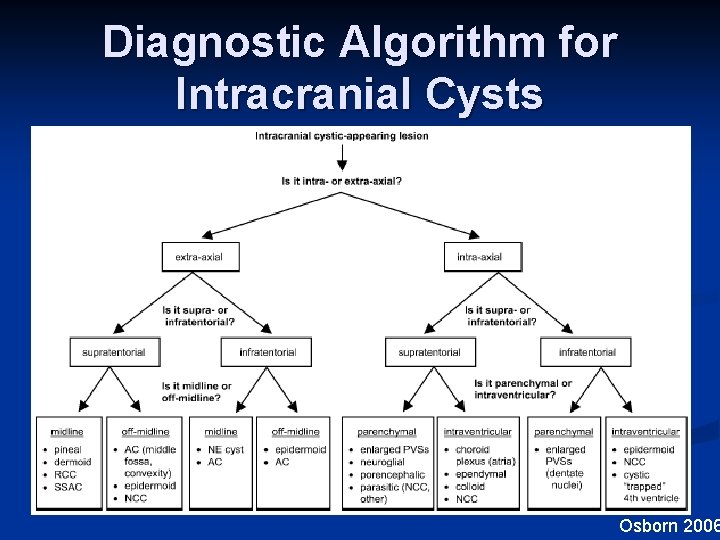
Diagnostic Algorithm for Intracranial Cysts Osborn 2006
Intracranial Cysts n Generally benign and incidental findings n Most cysts have comparable signal characteristics n n Fluid isointense to CSF Lack of enhancement Lack of pericystic signal abnormality Location helps devise a focused differential n n n Intraaxial vs. Extra-axial Midline vs. Non-midline Intra-ventricular vs. Parenchymal
Unknown Cases
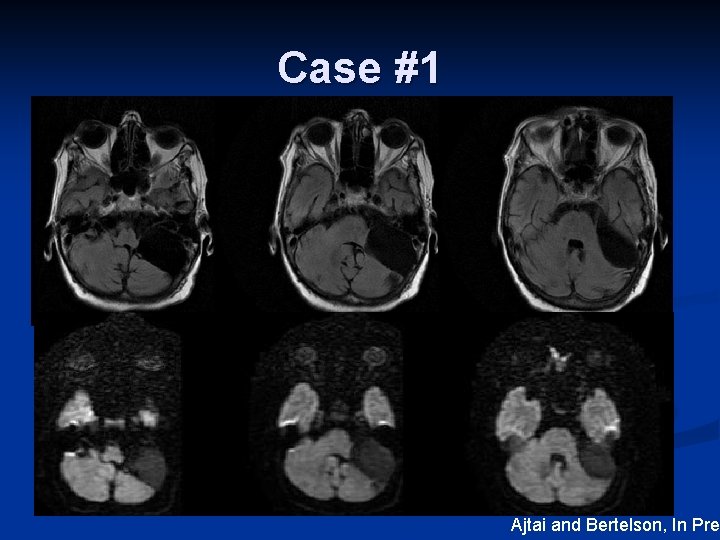
Case #1 Ajtai and Bertelson, In Pres
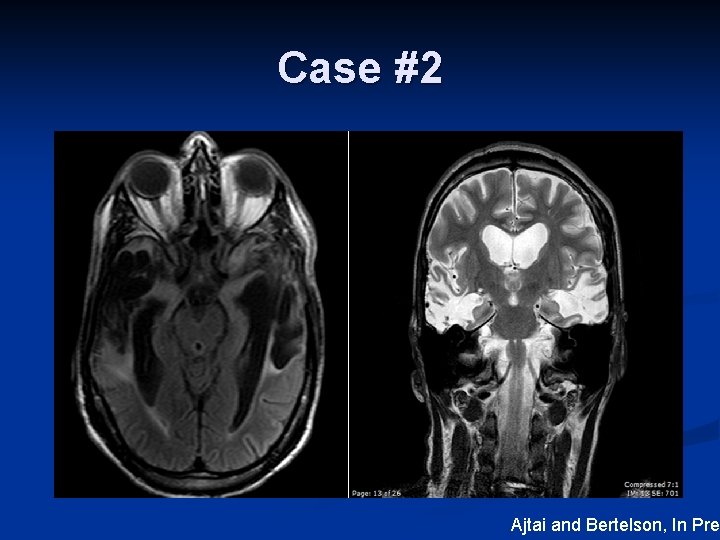
Case #2 Ajtai and Bertelson, In Pres
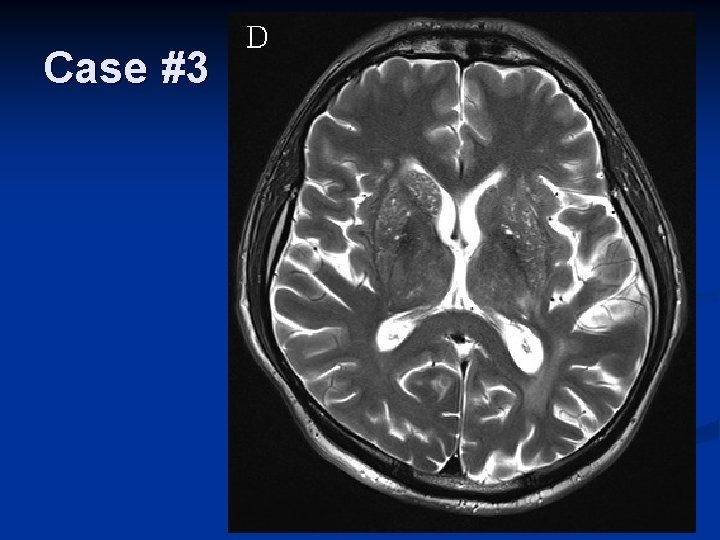
Case #3
Case #4 n Noncontrast CT head Osborn 2006
Case #5 Ajtai and Bertelson, In Pres
References n n Osborne AG and Preece MT. Intracranial Cysts: Radiologic-Pathologic Correlation and Imaging Approach. Radiology 239(3) 650 -64, 2006. Ajtai B and Bertelson J. Intracranial Cysts. Continuum, in press. Sarwar M. The Septum Pellucidum: Normal and Abnormal. AJNR 10: 989 -1005, 1989. Del Brutto OH. Neurocysticercosis: A Review. The Scientific World Journal , 2012.