
IntraChunk Dependency Annotation Expanding Hindi InterChunk Annotated Treebank
Intra-Chunk Dependency Annotation : Expanding Hindi Inter-Chunk Annotated Treebank Prudhvi Kosaraju, Bharat Ram Ambati, Samar Husain Dipti Misra Sharma, Rajeev Sangal Language Technologies Research Centre IIIT Hyderabad
Treebank • Linguistic resources in which each sentence has – Parse tree – morphological, syntactic and lexical information marked explicitly • Some treebanks – Penn Treebank (Marcus et al. , 1993) for English – Prague Dependency Treebank (Hajicova, 1998) for Czech. • For Indian Languages – Lack of such treebank been a major bottleneck for advance research and development of NLP tools and applications
Treebank creation • Annotated manually or semi-automatically • Manual creation – Annotators has to follow prescribed guidelines – Costly process in terms of both money & time • Semi-automatic creation – Running of tools or parsers – Manual correction of Errors Note: An accurate annotating parser/tool saves cost and time for both the annotation as well as the validation task
Hindi Treebank • Multi-layered and multi-representational treebank having – Dependency relations – Verb arguments (Prop. Bank, Palmer et al. , 2005) – Phase structure • Dependency treebank has information at – morpho-syntactic (morphological , part-of-speech (POS) and chunk) level – syntactico-semnatic (dependency) level
Hindi Dependency Treebank • Manual annotation has been done at – Part_of_speech level – Chunk level – Morph level – Inter-chunk dependency level
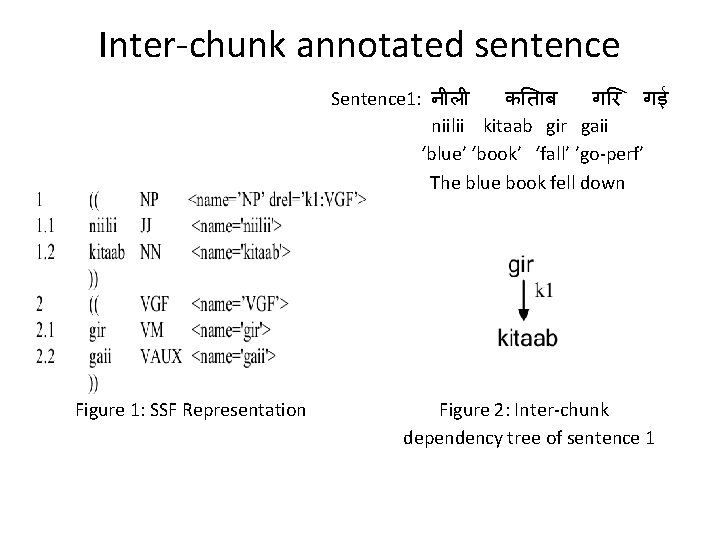
Inter-chunk annotated sentence Figure 1: SSF Representation Sentence 1: न ल क त ब ग र गई niilii kitaab gir gaii ‘blue’ ‘book’ ‘fall’ ’go-perf’ The blue book fell down Figure 2: Inter-chunk dependency tree of sentence 1
Intra-chunk dependencies • Intra-chunk dependencies left unannotated since – Identification of intra-chunk dependencies are quite deterministic – Can be automatically annotated with high degree of accuracy • Marking intra-chunk dependencies on interchunk dependency annotated trees results expansion of the later • Automatic conversion to phase structure depends upon the expanded version of the treebank • Hence, a High quality intra-chunk dependency annotator/parser is required
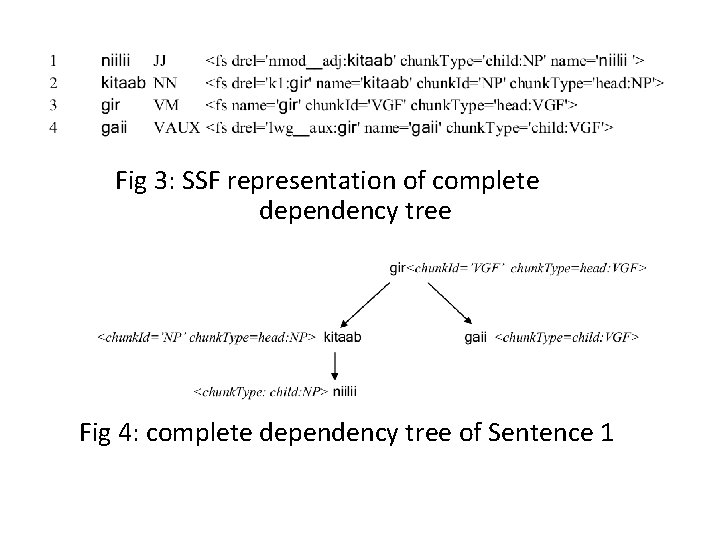
Fig 3: SSF representation of complete dependency tree Fig 4: complete dependency tree of Sentence 1
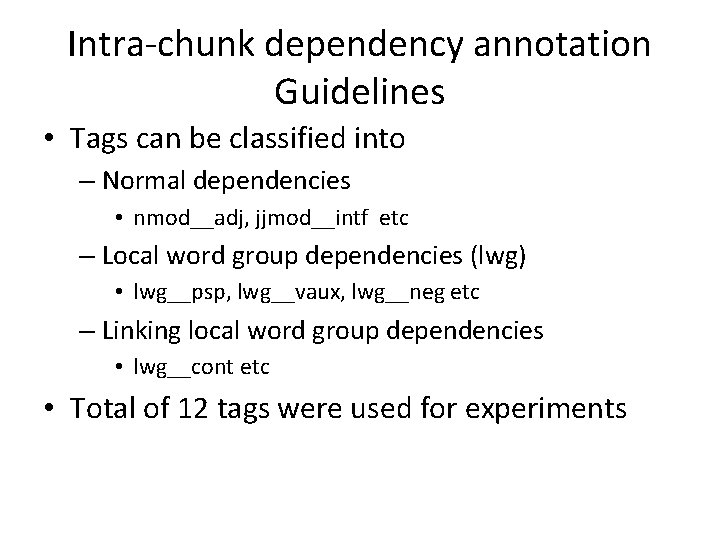
Intra-chunk dependency annotation Guidelines • Tags can be classified into – Normal dependencies • nmod__adj, jjmod__intf etc – Local word group dependencies (lwg) • lwg__psp, lwg__vaux, lwg__neg etc – Linking local word group dependencies • lwg__cont etc • Total of 12 tags were used for experiments
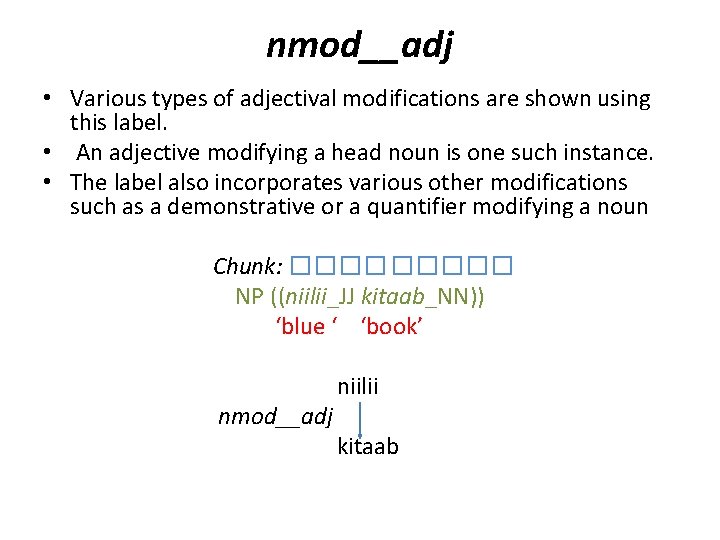
nmod__adj • Various types of adjectival modifications are shown using this label. • An adjective modifying a head noun is one such instance. • The label also incorporates various other modifications such as a demonstrative or a quantifier modifying a noun Chunk: ����� NP ((niilii_JJ kitaab_NN)) ‘blue ‘ ‘book’ niilii nmod__adj kitaab
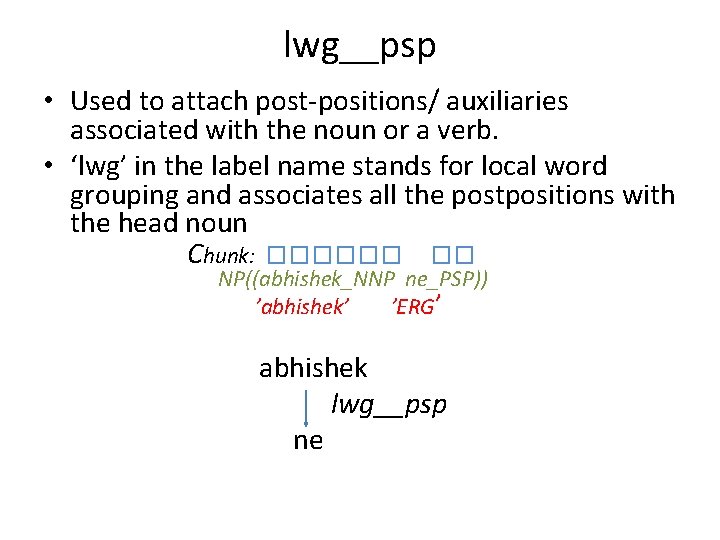
lwg__psp • Used to attach post-positions/ auxiliaries associated with the noun or a verb. • ‘lwg’ in the label name stands for local word grouping and associates all the postpositions with the head noun Chunk: ������ �� NP((abhishek_NNP ne_PSP)) ’abhishek’ ’ERG’ abhishek lwg__psp ne
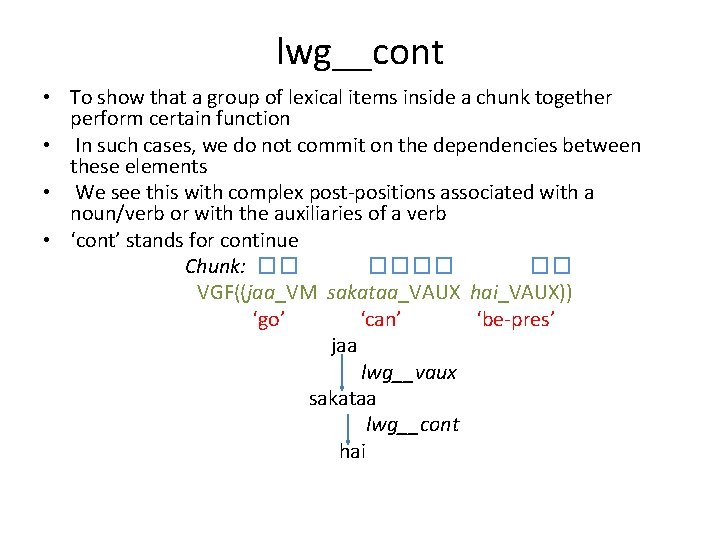
lwg__cont • To show that a group of lexical items inside a chunk together perform certain function • In such cases, we do not commit on the dependencies between these elements • We see this with complex post-positions associated with a noun/verb or with the auxiliaries of a verb • ‘cont’ stands for continue Chunk: �� VGF((jaa_VM sakataa_VAUX hai_VAUX)) ‘go’ ‘can’ ‘be-pres’ jaa lwg__vaux sakataa lwg__cont hai
Intra-chunk dependnecy annotator/parser • Built a robust intra-chunk dependency parser for Hindi – Rule based Approach – Statistical Approach – Hybrid Approach (using heuristic based postprocessing component on top of statistical approach) • The rule based tool can easily adaptable to other languages as well
Rule based intra-chunk dependency annotator • Identifies modifier-modified (parent-child) relationship inside a chunk • Rules provided in a fixed rule template • Heads in each chunk determined by head computation module • All information present in the SSF can be captured through the rule template
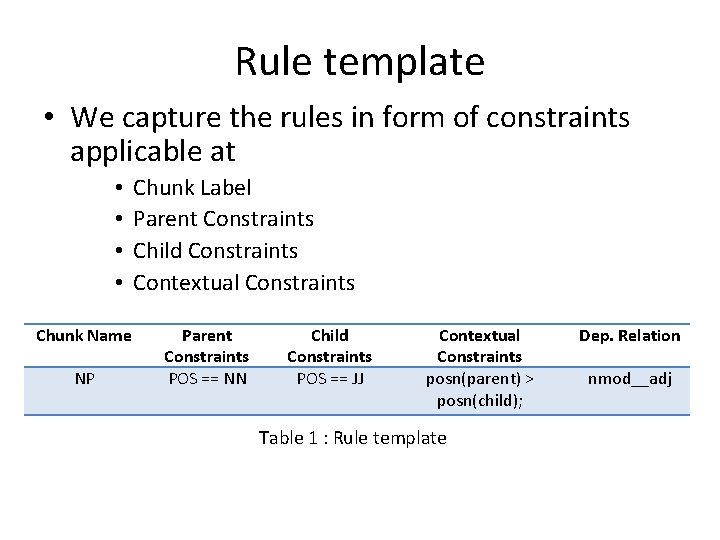
Rule template • We capture the rules in form of constraints applicable at • • Chunk Name NP Chunk Label Parent Constraints Child Constraints Contextual Constraints Parent Constraints POS == NN Child Constraints POS == JJ Contextual Constraints posn(parent) > posn(child); Table 1 : Rule template Dep. Relation nmod__adj
Statistical approach : Sub-tree parsing using Malt parser • Malt parser(Nivre et al. , 2007) , transition based dependency parser is best suited for identifying short range dependencies (Nivre, 2003) • Each chunk is separated and called sub-tree • Data is divided into training (192 sentences), development(64) and testing(64) • We followed the strategies used in kosaraju et. al, 2010 – Feature pool – Pruning features using forward selector
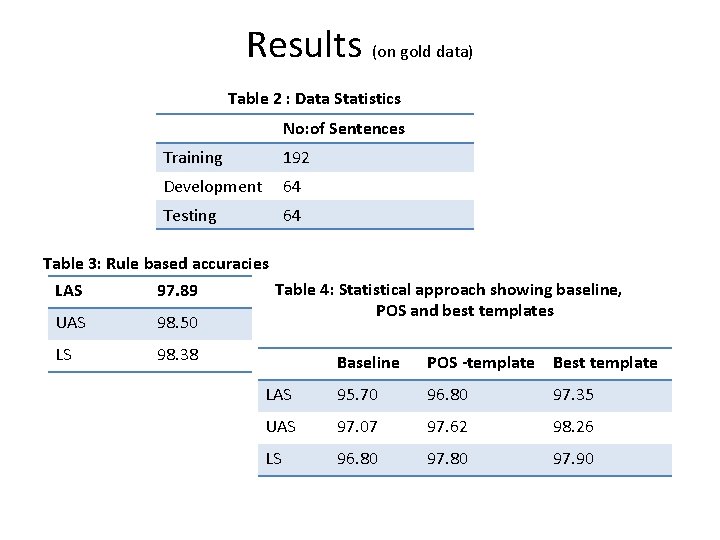
Results (on gold data) Table 2 : Data Statistics No: of Sentences Training 192 Development 64 Testing 64 Table 3: Rule based accuracies LAS 97. 89 UAS 98. 50 LS 98. 38 Table 4: Statistical approach showing baseline, POS and best templates Baseline POS -template Best template LAS 95. 70 96. 80 97. 35 UAS 97. 07 97. 62 98. 26 LS 96. 80 97. 90
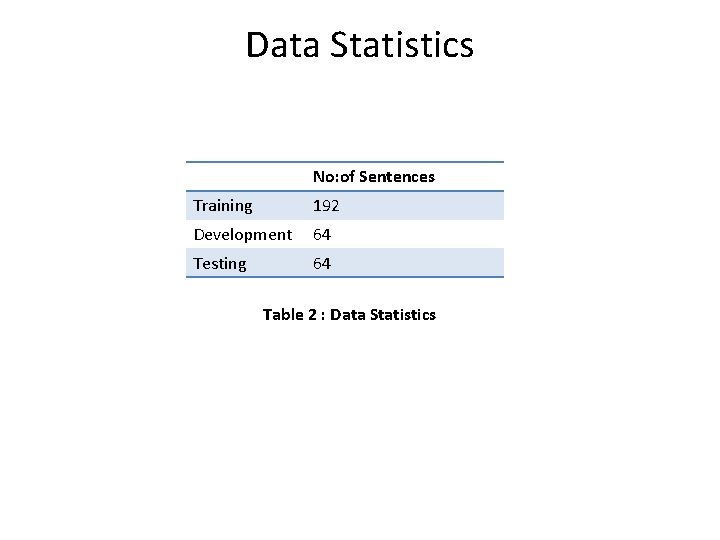
Data Statistics No: of Sentences Training 192 Development 64 Testing 64 Table 2 : Data Statistics
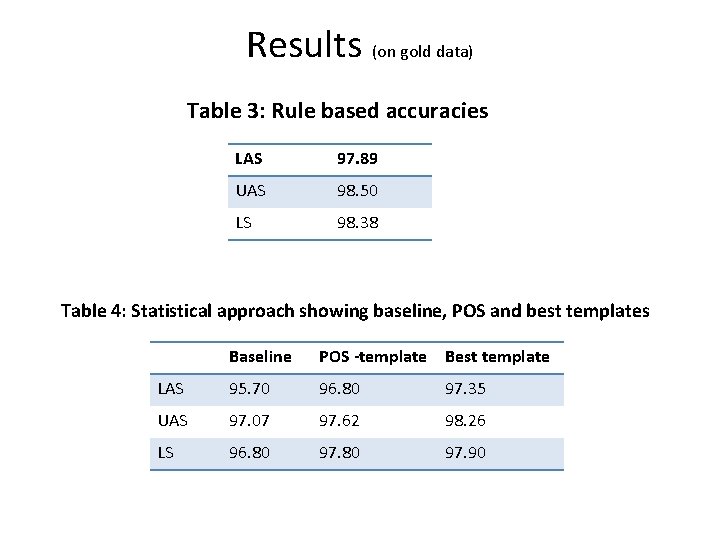
Results (on gold data) Table 3: Rule based accuracies LAS 97. 89 UAS 98. 50 LS 98. 38 Table 4: Statistical approach showing baseline, POS and best templates Baseline POS -template Best template LAS 95. 70 96. 80 97. 35 UAS 97. 07 97. 62 98. 26 LS 96. 80 97. 90
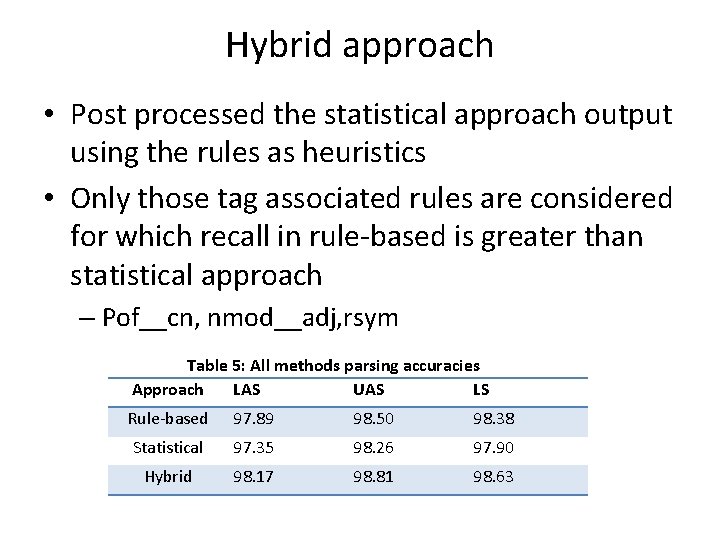
Hybrid approach • Post processed the statistical approach output using the rules as heuristics • Only those tag associated rules are considered for which recall in rule-based is greater than statistical approach – Pof__cn, nmod__adj, rsym Table 5: All methods parsing accuracies Approach LAS UAS LS Rule-based 97. 89 98. 50 98. 38 Statistical 97. 35 98. 26 97. 90 Hybrid 98. 17 98. 81 98. 63
Special Cases ‘Chunks are self contained units. Intra-chunk dependencies are chunk internal and do not span outside a chunk. ’ • The above is the basis for neat division of interchunk and intra-chunk parsing • However, there are two cases this constraint does not hold. – In these two cases a chunk internal element that is not the head of the chunk has a relation with a lexical item outside its chunk • Hence, these relations are to be handled seperately
Special cases • rsym__EOS (End of Sentence marker): – Occurs in the last chunk, Attached to head of the sentence • lwg__psp : – According to guidelines, psp attaches to head of the chunk with lwg__psp – However, if the right most child of a CCP (conjunction chunk) is a nominal (NP or VGNN), one needs to attach the PSP of this nominal child to the head of the CCP during expansion – If there are multiple PSP, then first PSP gets a lwg__psp and second lwg__cont
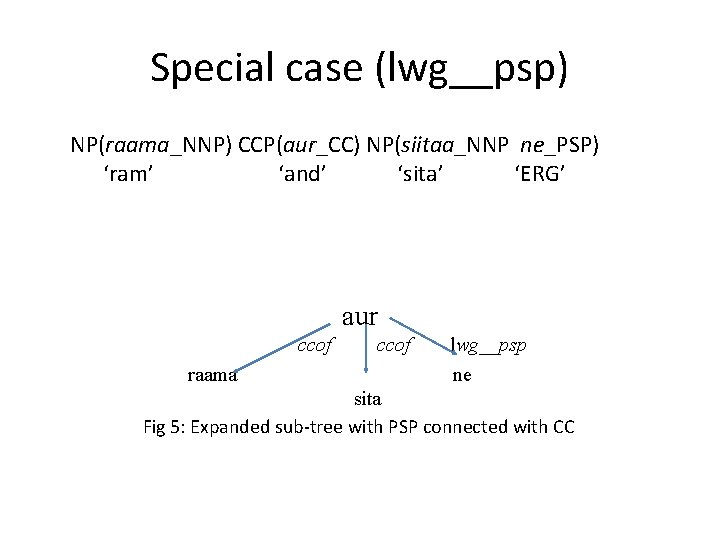
Special case (lwg__psp) NP(raama_NNP) CCP(aur_CC) NP(siitaa_NNP ne_PSP) ‘ram’ ‘and’ ‘sita’ ‘ERG’ aur ccof raama ccof lwg__psp ne sita Fig 5: Expanded sub-tree with PSP connected with CC
Conclusion • Described annotation guidelines for marking intra-chunk dependency relations • Approaches: 1. Rule based 2. Statistical 3. Hybrid (using 1&2) • By error analysis the outputs, only certain tags are not being marked correctly. • This is good news because then one can make very targeted manual corrections after the automatic tool is run

THANK YOU
- Slides: 25