
Intracardiac Shunts Andre C Lapeyre MD Charanjit S




- Slides: 36
Intracardiac Shunts Andre C. Lapeyre, MD Charanjit S. Rihal, MD © Mayo Clinic – Mayo Foundation © 2016 MFMER | slide-
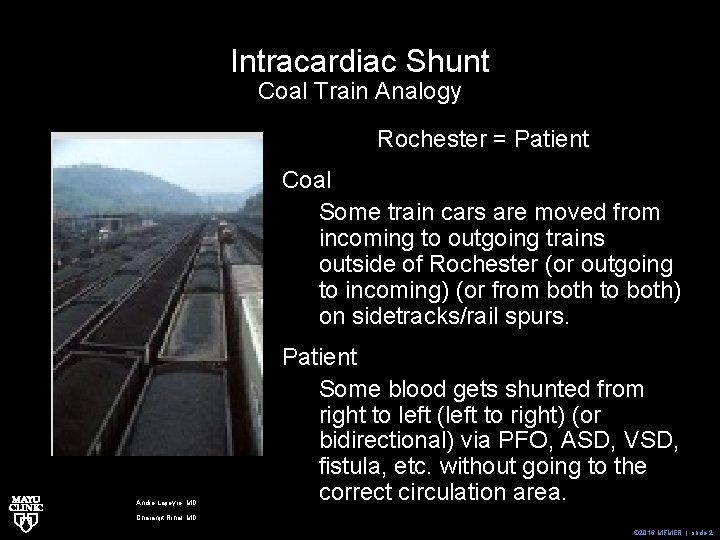
Intracardiac Shunt Coal Train Analogy Rochester = Patient Coal Some train cars are moved from incoming to outgoing trains outside of Rochester (or outgoing to incoming) (or from both to both) on sidetracks/rail spurs. Andre Lapeyre, MD Patient Some blood gets shunted from right to left (left to right) (or bidirectional) via PFO, ASD, VSD, fistula, etc. without going to the correct circulation area. Charanjit Rihal, MD © 2016 MFMER | slide-2
Intracardiac Shunt • Oxygen saturation method • Requires “full” oxygen saturation data which includes: • High SVC • IVC below the diaphragm • Right atrium • Right ventricle • Pulmonary artery • Pulmonary vein • Left atrium • Ideally left ventricle • Systemic arterial • May miss systemic shunts • Not very good for intrapulmonary shunts • Double sampling dye curve method • More accurate • Difficult to do and now of primarily historical interest Andre Lapeyre, MD Charanjit Rihal, MD © 2016 MFMER | slide-3
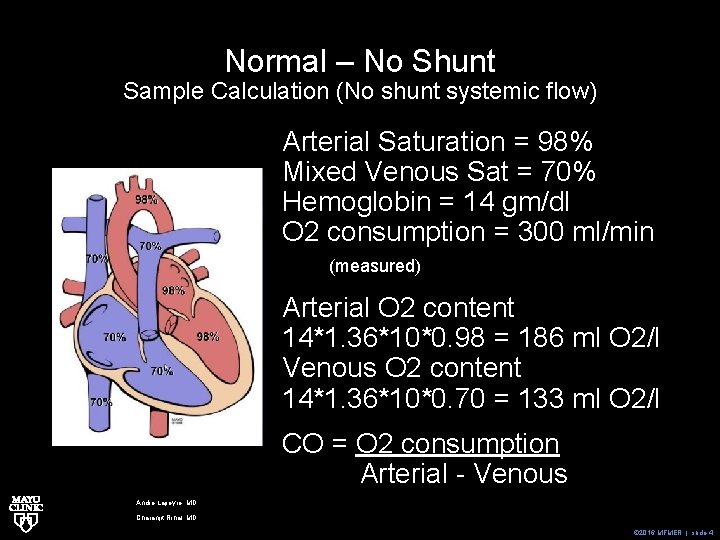
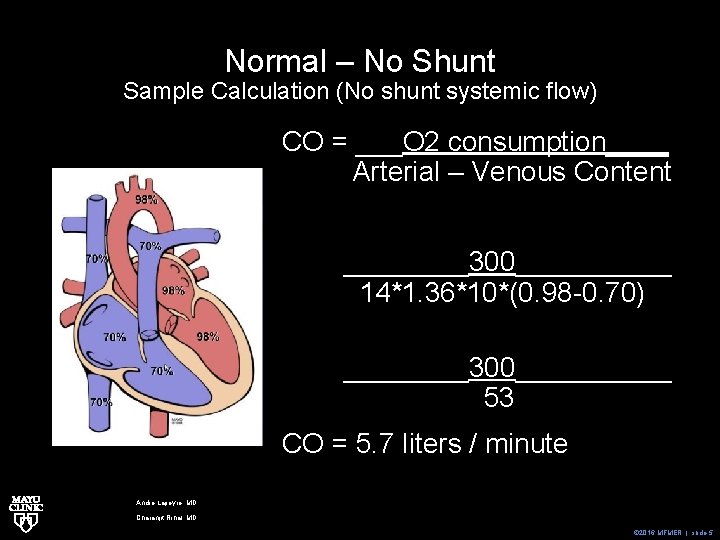
Normal – No Shunt Sample Calculation (No shunt systemic flow) Arterial Saturation = 98% Mixed Venous Sat = 70% Hemoglobin = 14 gm/dl O 2 consumption = 300 ml/min (measured) Arterial O 2 content 14*1. 36*10*0. 98 = 186 ml O 2/l Venous O 2 content 14*1. 36*10*0. 70 = 133 ml O 2/l CO = O 2 consumption Arterial - Venous Andre Lapeyre, MD Charanjit Rihal, MD © 2016 MFMER | slide-4
Normal – No Shunt Sample Calculation (No shunt systemic flow) CO = ___O 2 consumption____ Arterial – Venous Content ____300_____ 14*1. 36*10*(0. 98 -0. 70) ____300_____ 53 CO = 5. 7 liters / minute Andre Lapeyre, MD Charanjit Rihal, MD © 2016 MFMER | slide-5
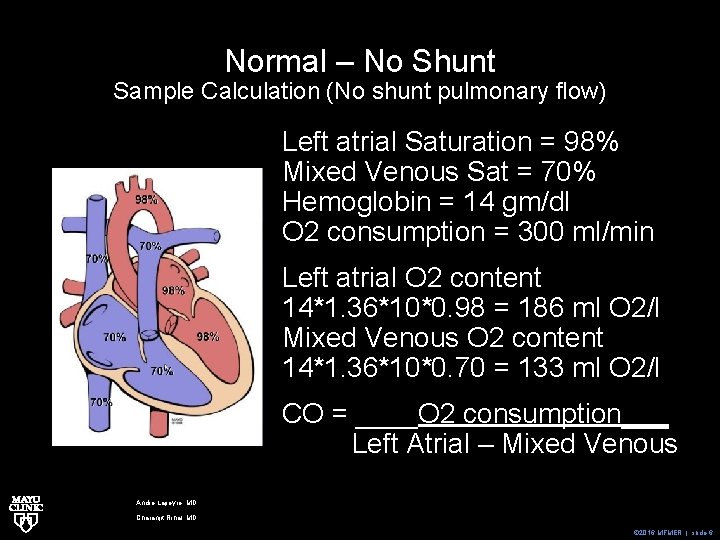
Normal – No Shunt Sample Calculation (No shunt pulmonary flow) Left atrial Saturation = 98% Mixed Venous Sat = 70% Hemoglobin = 14 gm/dl O 2 consumption = 300 ml/min Left atrial O 2 content 14*1. 36*10*0. 98 = 186 ml O 2/l Mixed Venous O 2 content 14*1. 36*10*0. 70 = 133 ml O 2/l CO = ____O 2 consumption___ Left Atrial – Mixed Venous Andre Lapeyre, MD Charanjit Rihal, MD © 2016 MFMER | slide-6
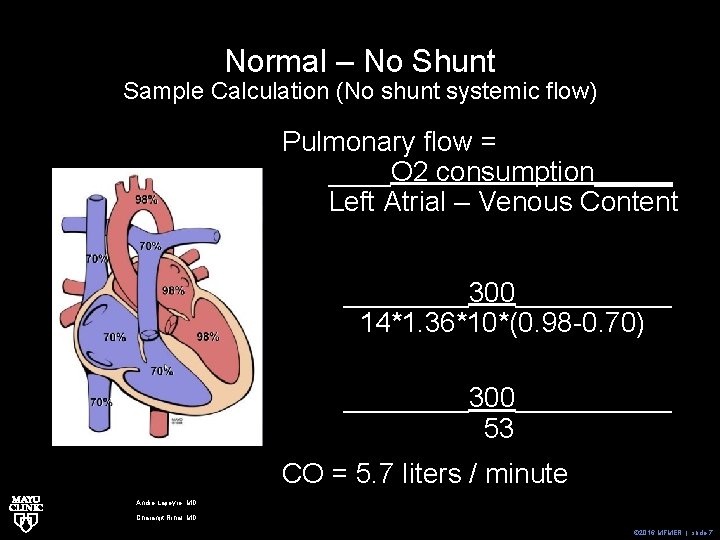
Normal – No Shunt Sample Calculation (No shunt systemic flow) Pulmonary flow = ____O 2 consumption_____ Left Atrial – Venous Content ____300_____ 14*1. 36*10*(0. 98 -0. 70) ____300_____ 53 CO = 5. 7 liters / minute Andre Lapeyre, MD Charanjit Rihal, MD © 2016 MFMER | slide-7
Flows – Normal – No Shunt Sample Calculation As expected in a no shunt situation: CO = systemic blood flow (SBF) CO = pulmonary blood flow (PBF) SBF = PBF So: CO = SBF = PBF = 5. 7 liters / minute Qp = PBF Qs = SBF Andre Lapeyre, MD Qp/Qs = 1. 0 Charanjit Rihal, MD © 2016 MFMER | slide-8
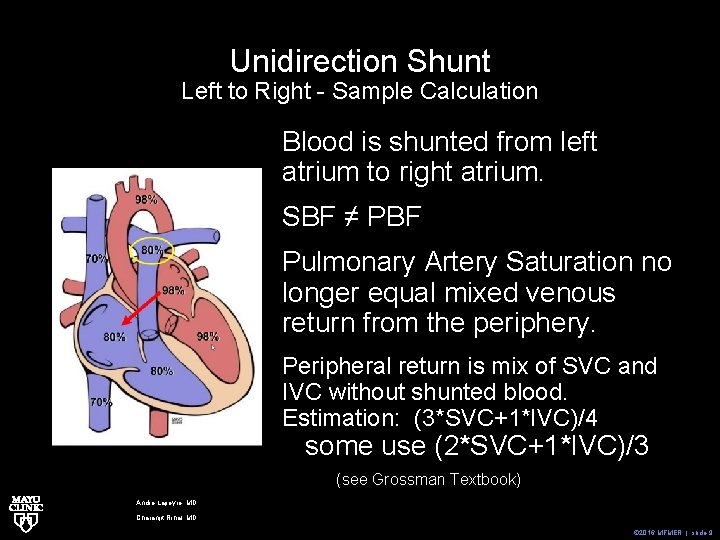
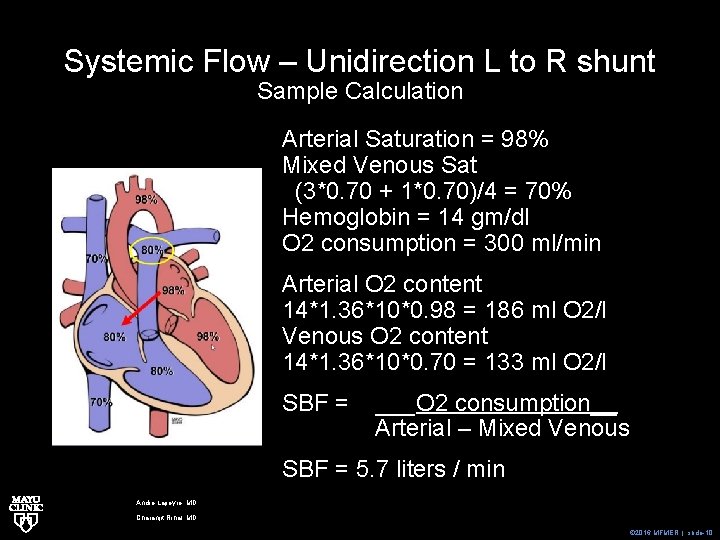
Unidirection Shunt Left to Right - Sample Calculation Blood is shunted from left atrium to right atrium. SBF ≠ PBF Pulmonary Artery Saturation no longer equal mixed venous return from the periphery. Peripheral return is mix of SVC and IVC without shunted blood. Estimation: (3*SVC+1*IVC)/4 some use (2*SVC+1*IVC)/3 (see Grossman Textbook) Andre Lapeyre, MD Charanjit Rihal, MD © 2016 MFMER | slide-9
Systemic Flow – Unidirection L to R shunt Sample Calculation Arterial Saturation = 98% Mixed Venous Sat (3*0. 70 + 1*0. 70)/4 = 70% Hemoglobin = 14 gm/dl O 2 consumption = 300 ml/min Arterial O 2 content 14*1. 36*10*0. 98 = 186 ml O 2/l Venous O 2 content 14*1. 36*10*0. 70 = 133 ml O 2/l SBF = ___O 2 consumption__ Arterial – Mixed Venous SBF = 5. 7 liters / min Andre Lapeyre, MD Charanjit Rihal, MD © 2016 MFMER | slide-10
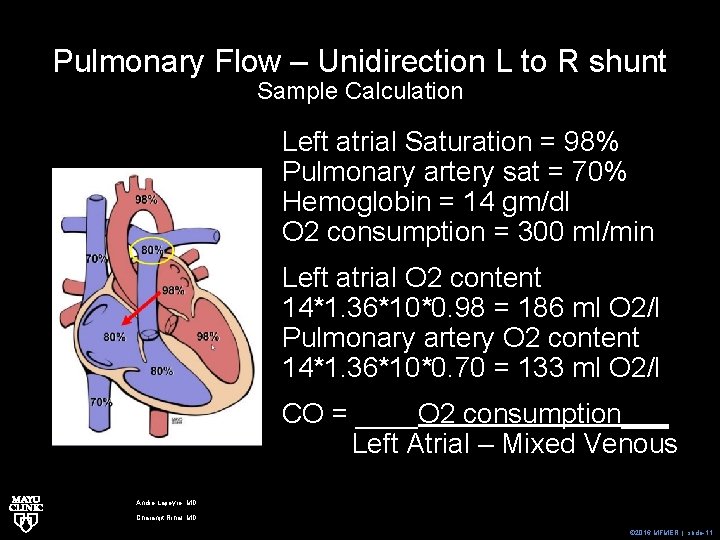
Pulmonary Flow – Unidirection L to R shunt Sample Calculation Left atrial Saturation = 98% Pulmonary artery sat = 70% Hemoglobin = 14 gm/dl O 2 consumption = 300 ml/min Left atrial O 2 content 14*1. 36*10*0. 98 = 186 ml O 2/l Pulmonary artery O 2 content 14*1. 36*10*0. 70 = 133 ml O 2/l CO = ____O 2 consumption___ Left Atrial – Mixed Venous Andre Lapeyre, MD Charanjit Rihal, MD © 2016 MFMER | slide-11
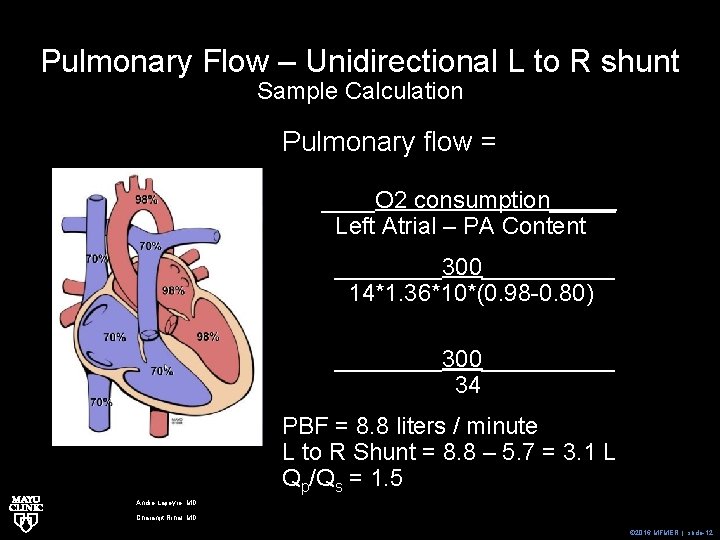
Pulmonary Flow – Unidirectional L to R shunt Sample Calculation Pulmonary flow = ____O 2 consumption_____ Left Atrial – PA Content ____300_____ 14*1. 36*10*(0. 98 -0. 80) ____300_____ 34 PBF = 8. 8 liters / minute L to R Shunt = 8. 8 – 5. 7 = 3. 1 L Qp/Qs = 1. 5 Andre Lapeyre, MD Charanjit Rihal, MD © 2016 MFMER | slide-12
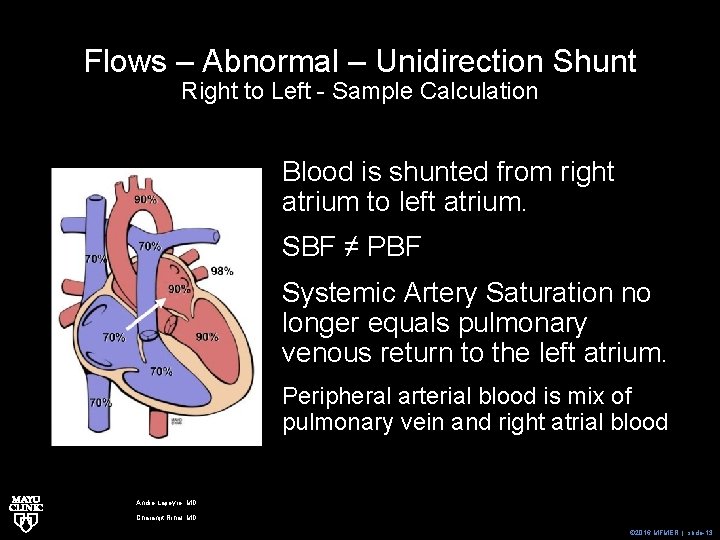
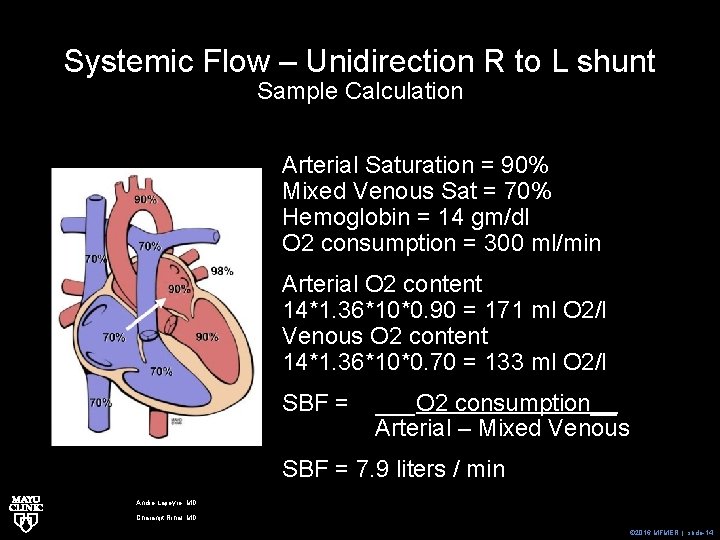
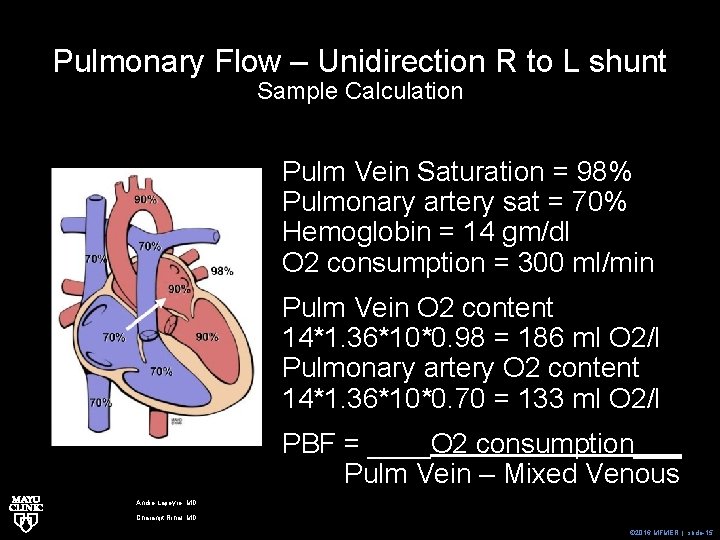
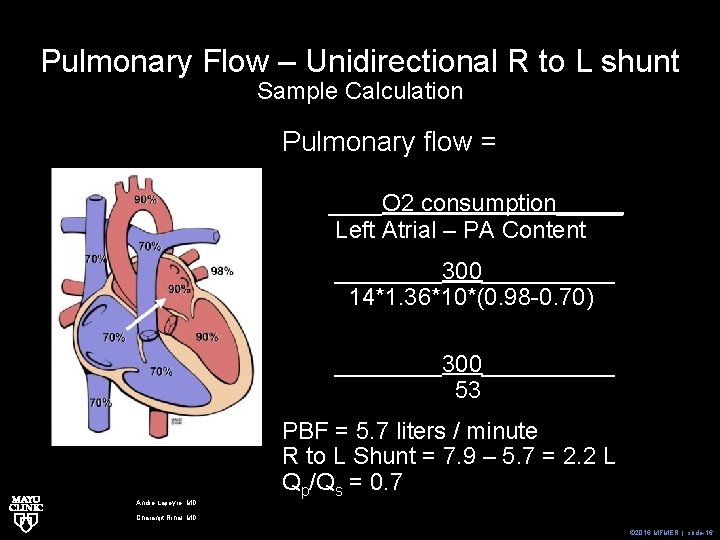
Flows – Abnormal – Unidirection Shunt Right to Left - Sample Calculation Blood is shunted from right atrium to left atrium. SBF ≠ PBF Systemic Artery Saturation no longer equals pulmonary venous return to the left atrium. Peripheral arterial blood is mix of pulmonary vein and right atrial blood Andre Lapeyre, MD Charanjit Rihal, MD © 2016 MFMER | slide-13
Systemic Flow – Unidirection R to L shunt Sample Calculation Arterial Saturation = 90% Mixed Venous Sat = 70% Hemoglobin = 14 gm/dl O 2 consumption = 300 ml/min Arterial O 2 content 14*1. 36*10*0. 90 = 171 ml O 2/l Venous O 2 content 14*1. 36*10*0. 70 = 133 ml O 2/l SBF = ___O 2 consumption__ Arterial – Mixed Venous SBF = 7. 9 liters / min Andre Lapeyre, MD Charanjit Rihal, MD © 2016 MFMER | slide-14
Pulmonary Flow – Unidirection R to L shunt Sample Calculation Pulm Vein Saturation = 98% Pulmonary artery sat = 70% Hemoglobin = 14 gm/dl O 2 consumption = 300 ml/min Pulm Vein O 2 content 14*1. 36*10*0. 98 = 186 ml O 2/l Pulmonary artery O 2 content 14*1. 36*10*0. 70 = 133 ml O 2/l PBF = ____O 2 consumption___ Pulm Vein – Mixed Venous Andre Lapeyre, MD Charanjit Rihal, MD © 2016 MFMER | slide-15
Pulmonary Flow – Unidirectional R to L shunt Sample Calculation Pulmonary flow = ____O 2 consumption_____ Left Atrial – PA Content ____300_____ 14*1. 36*10*(0. 98 -0. 70) ____300_____ 53 Andre Lapeyre, MD PBF = 5. 7 liters / minute R to L Shunt = 7. 9 – 5. 7 = 2. 2 L Qp/Qs = 0. 7 Charanjit Rihal, MD © 2016 MFMER | slide-16
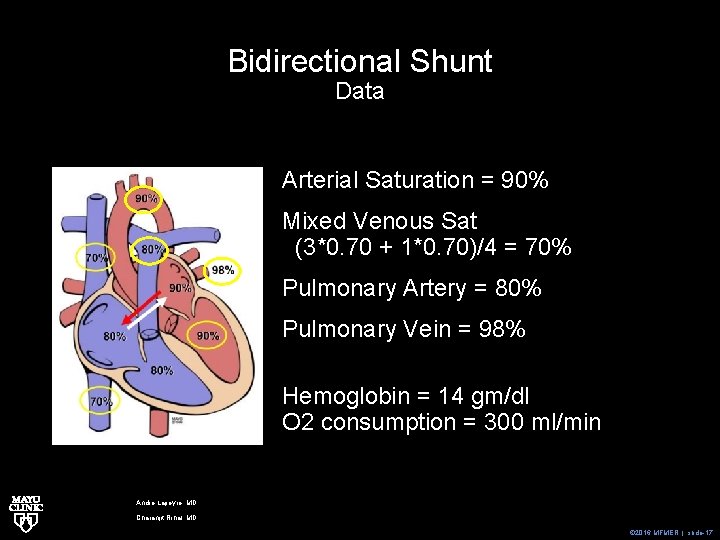
Bidirectional Shunt Data Arterial Saturation = 90% Mixed Venous Sat (3*0. 70 + 1*0. 70)/4 = 70% Pulmonary Artery = 80% Pulmonary Vein = 98% Hemoglobin = 14 gm/dl O 2 consumption = 300 ml/min Andre Lapeyre, MD Charanjit Rihal, MD © 2016 MFMER | slide-17
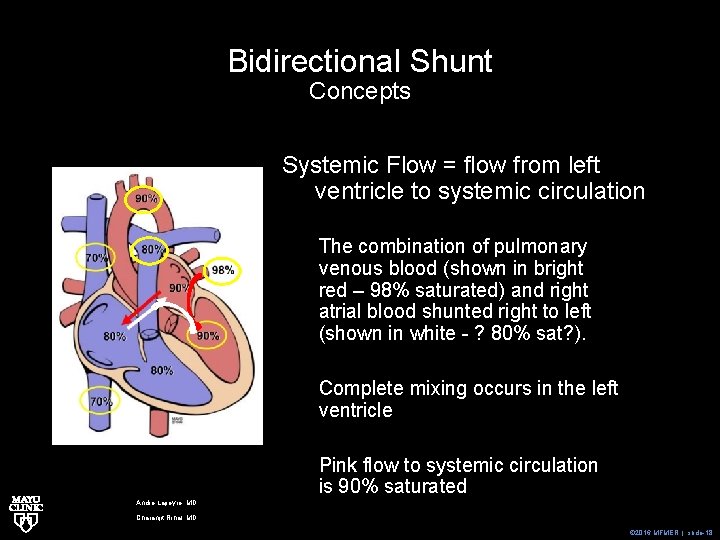
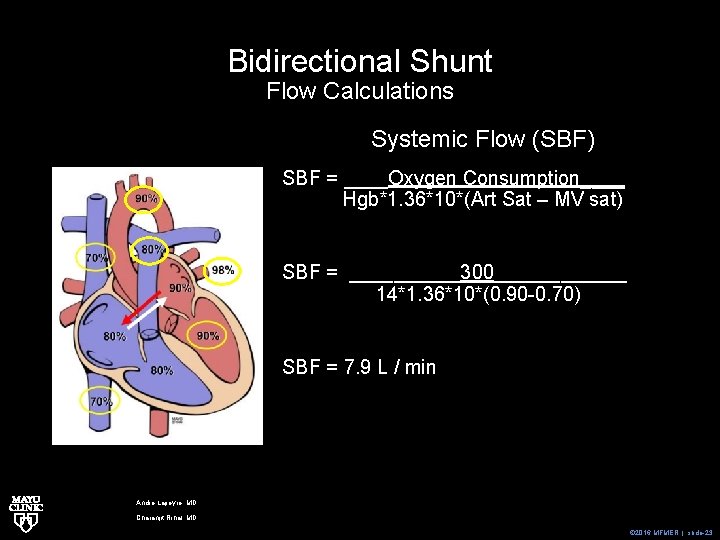
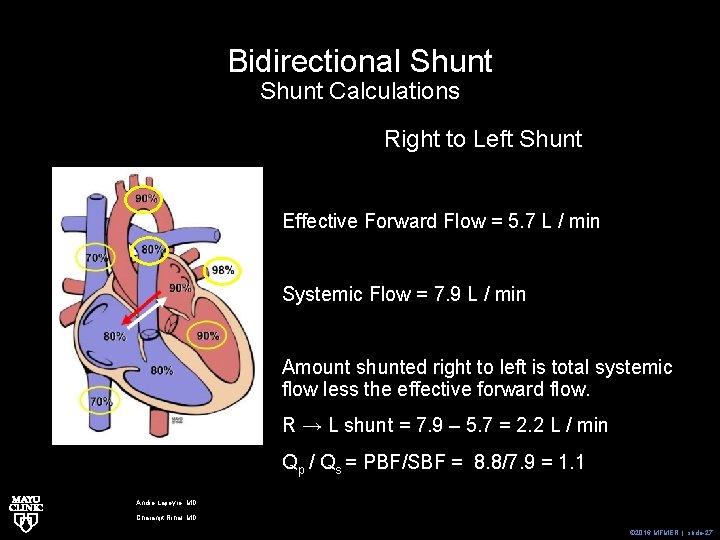
Bidirectional Shunt Concepts Systemic Flow = flow from left ventricle to systemic circulation The combination of pulmonary venous blood (shown in bright red – 98% saturated) and right atrial blood shunted right to left (shown in white - ? 80% sat? ). Complete mixing occurs in the left ventricle Pink flow to systemic circulation is 90% saturated Andre Lapeyre, MD Charanjit Rihal, MD © 2016 MFMER | slide-18
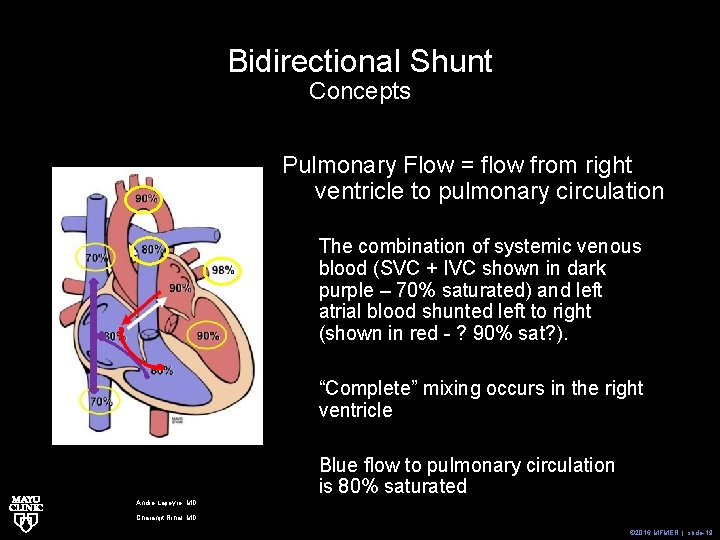
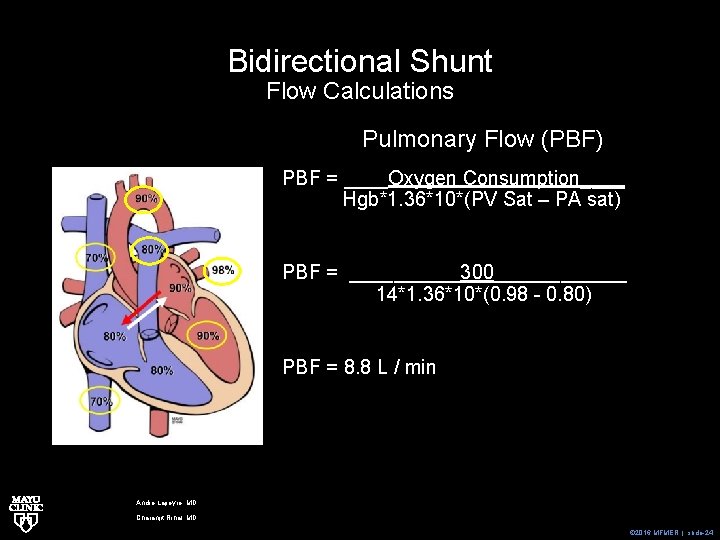
Bidirectional Shunt Concepts Pulmonary Flow = flow from right ventricle to pulmonary circulation The combination of systemic venous blood (SVC + IVC shown in dark purple – 70% saturated) and left atrial blood shunted left to right (shown in red - ? 90% sat? ). “Complete” mixing occurs in the right ventricle Blue flow to pulmonary circulation is 80% saturated Andre Lapeyre, MD Charanjit Rihal, MD © 2016 MFMER | slide-19
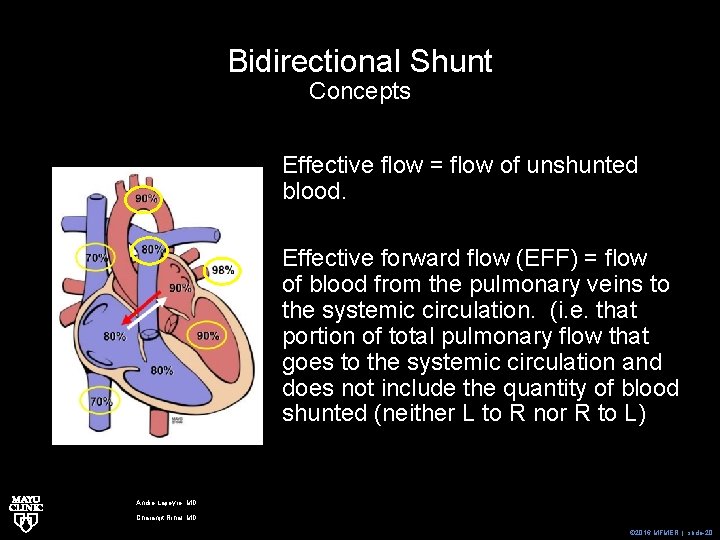
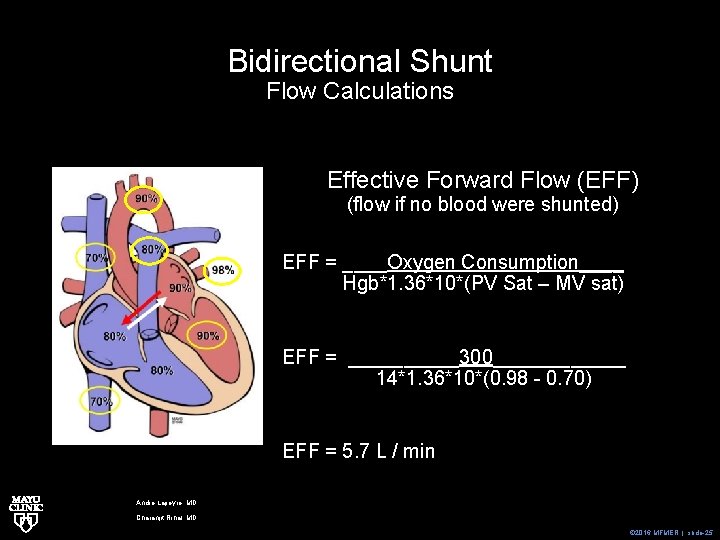
Bidirectional Shunt Concepts Effective flow = flow of unshunted blood. Effective forward flow (EFF) = flow of blood from the pulmonary veins to the systemic circulation. (i. e. that portion of total pulmonary flow that goes to the systemic circulation and does not include the quantity of blood shunted (neither L to R nor R to L) Andre Lapeyre, MD Charanjit Rihal, MD © 2016 MFMER | slide-20
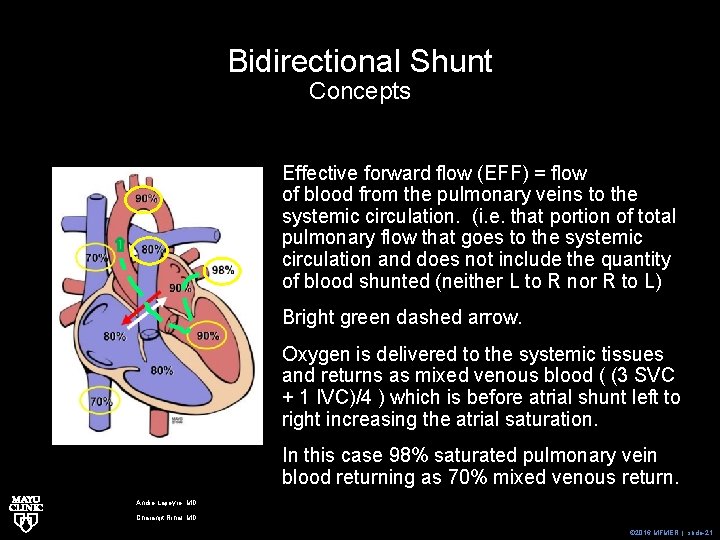
Bidirectional Shunt Concepts Effective forward flow (EFF) = flow of blood from the pulmonary veins to the systemic circulation. (i. e. that portion of total pulmonary flow that goes to the systemic circulation and does not include the quantity of blood shunted (neither L to R nor R to L) Bright green dashed arrow. Oxygen is delivered to the systemic tissues and returns as mixed venous blood ( (3 SVC + 1 IVC)/4 ) which is before atrial shunt left to right increasing the atrial saturation. In this case 98% saturated pulmonary vein blood returning as 70% mixed venous return. Andre Lapeyre, MD Charanjit Rihal, MD © 2016 MFMER | slide-21
Bidirectional Shunt Data Arterial Saturation = 90% Mixed Venous Sat (3*0. 70 + 1*0. 70)/4 = 70% Pulmonary Artery = 80% Pulmonary Vein = 98% Hemoglobin = 14 gm/dl O 2 consumption = 300 ml/min Andre Lapeyre, MD Charanjit Rihal, MD © 2016 MFMER | slide-22
Bidirectional Shunt Flow Calculations Systemic Flow (SBF) SBF = ____Oxygen Consumption____ Hgb*1. 36*10*(Art Sat – MV sat) SBF = _____300______ 14*1. 36*10*(0. 90 -0. 70) SBF = 7. 9 L / min Andre Lapeyre, MD Charanjit Rihal, MD © 2016 MFMER | slide-23
Bidirectional Shunt Flow Calculations Pulmonary Flow (PBF) PBF = ____Oxygen Consumption____ Hgb*1. 36*10*(PV Sat – PA sat) PBF = _____300______ 14*1. 36*10*(0. 98 - 0. 80) PBF = 8. 8 L / min Andre Lapeyre, MD Charanjit Rihal, MD © 2016 MFMER | slide-24
Bidirectional Shunt Flow Calculations Effective Forward Flow (EFF) (flow if no blood were shunted) EFF = ____Oxygen Consumption____ Hgb*1. 36*10*(PV Sat – MV sat) EFF = _____300______ 14*1. 36*10*(0. 98 - 0. 70) EFF = 5. 7 L / min Andre Lapeyre, MD Charanjit Rihal, MD © 2016 MFMER | slide-25
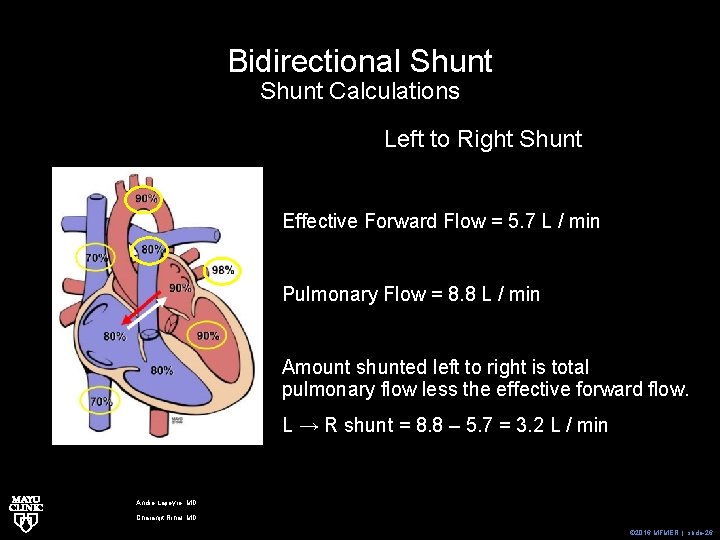
Bidirectional Shunt Calculations Left to Right Shunt Effective Forward Flow = 5. 7 L / min Pulmonary Flow = 8. 8 L / min Amount shunted left to right is total pulmonary flow less the effective forward flow. L → R shunt = 8. 8 – 5. 7 = 3. 2 L / min Andre Lapeyre, MD Charanjit Rihal, MD © 2016 MFMER | slide-26
Bidirectional Shunt Calculations Right to Left Shunt Effective Forward Flow = 5. 7 L / min Systemic Flow = 7. 9 L / min Amount shunted right to left is total systemic flow less the effective forward flow. R → L shunt = 7. 9 – 5. 7 = 2. 2 L / min Qp / Qs = PBF/SBF = 8. 8/7. 9 = 1. 1 Andre Lapeyre, MD Charanjit Rihal, MD © 2016 MFMER | slide-27
Intracardiac Shunts Common sources of error • Using assumed oxygen consumption • formulas for calculating assumed VO 2 have many “gross” assumptions = error • Inaccurate measured VO 2 • • Poor fit of mask or mouthpiece Irregular breathing pattern Shallow, tachypnic breathing Instrument calibration error • Inaccurate hemoglobin – diluted sample • Inaccurate oxygen saturation measurement • Oximeter calibration error • Prolonged time from sample draw to measurement • Diluted sample • Patient on 100% oxygen – need to add dissolved oxygen content to calculations Andre Lapeyre, MD Charanjit Rihal, MD © 2016 MFMER | slide-28
Flow and Shunt Practice Calculate all flows and shunts Three practice data sets follow this slide. Please do all your calculations of pulmonary flow, systemic flow, effective flow, right to left shunt, left to right shunt and Qp / Qs for each data set without looking at the answer slides which are included at the very end. Round all to single decimal point. Andre Lapeyre, MD Charanjit Rihal, MD © 2016 MFMER | slide-29
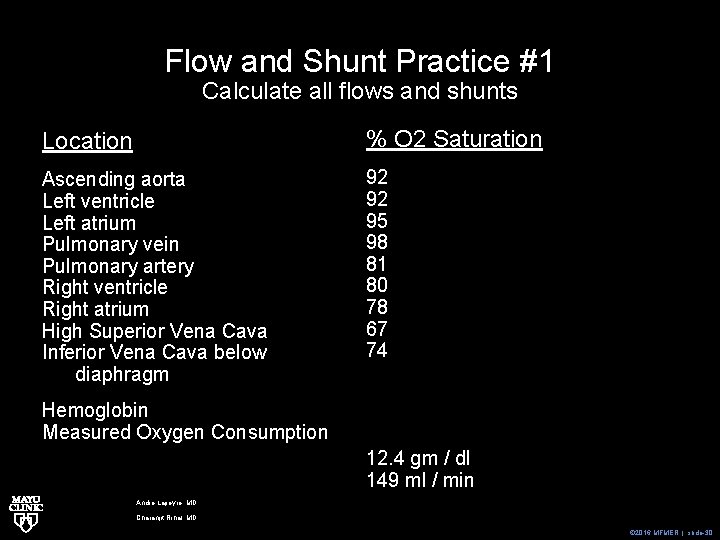
Flow and Shunt Practice #1 Calculate all flows and shunts Location % O 2 Saturation Ascending aorta Left ventricle Left atrium Pulmonary vein Pulmonary artery Right ventricle Right atrium High Superior Vena Cava Inferior Vena Cava below diaphragm 92 92 95 98 81 80 78 67 74 Hemoglobin Measured Oxygen Consumption 12. 4 gm / dl 149 ml / min Andre Lapeyre, MD Charanjit Rihal, MD © 2016 MFMER | slide-30
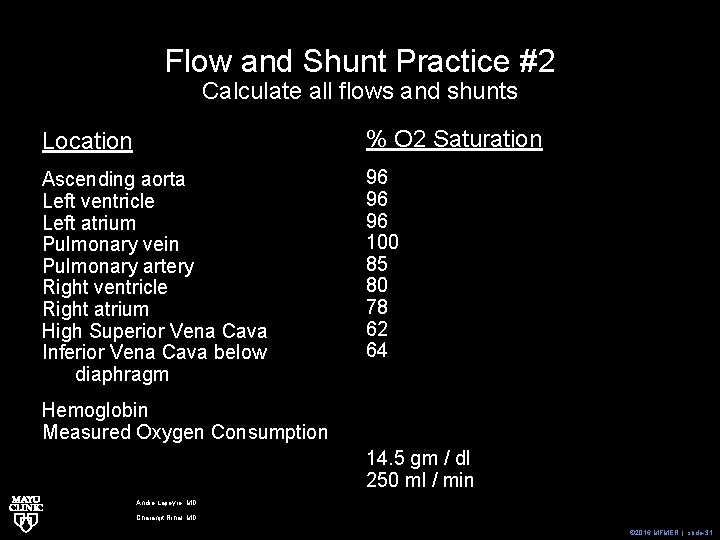
Flow and Shunt Practice #2 Calculate all flows and shunts Location % O 2 Saturation Ascending aorta Left ventricle Left atrium Pulmonary vein Pulmonary artery Right ventricle Right atrium High Superior Vena Cava Inferior Vena Cava below diaphragm 96 96 96 100 85 80 78 62 64 Hemoglobin Measured Oxygen Consumption 14. 5 gm / dl 250 ml / min Andre Lapeyre, MD Charanjit Rihal, MD © 2016 MFMER | slide-31
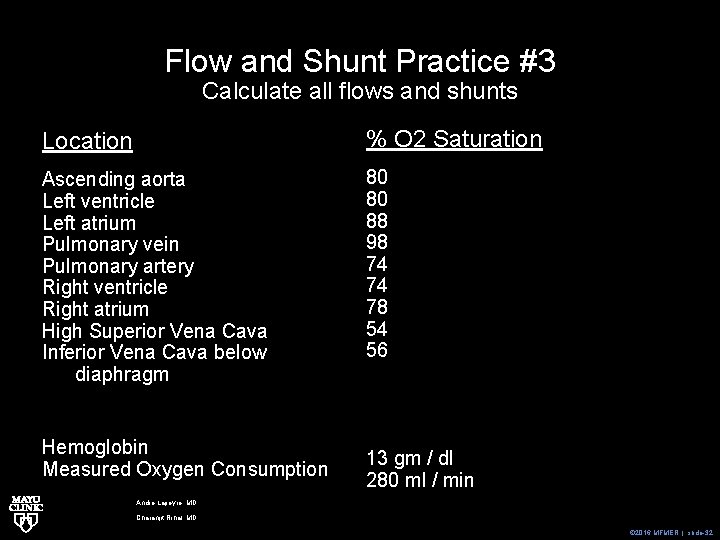
Flow and Shunt Practice #3 Calculate all flows and shunts Location % O 2 Saturation Ascending aorta Left ventricle Left atrium Pulmonary vein Pulmonary artery Right ventricle Right atrium High Superior Vena Cava Inferior Vena Cava below diaphragm 80 80 88 98 74 74 78 54 56 Hemoglobin Measured Oxygen Consumption 13 gm / dl 280 ml / min Andre Lapeyre, MD Charanjit Rihal, MD © 2016 MFMER | slide-32
Answer slides follow this slide please do all your own calculations before proceeding to the answers. Andre Lapeyre, MD Charanjit Rihal, MD © 2016 MFMER | slide-33
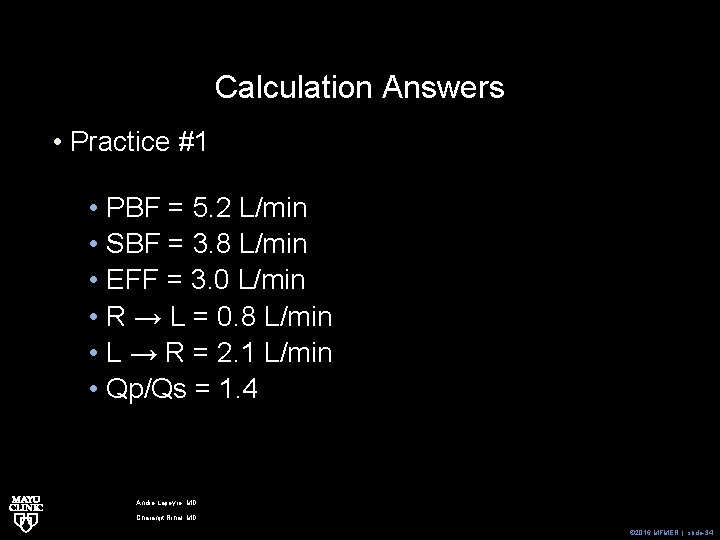
Calculation Answers • Practice #1 • PBF = 5. 2 L/min • SBF = 3. 8 L/min • EFF = 3. 0 L/min • R → L = 0. 8 L/min • L → R = 2. 1 L/min • Qp/Qs = 1. 4 Andre Lapeyre, MD Charanjit Rihal, MD © 2016 MFMER | slide-34
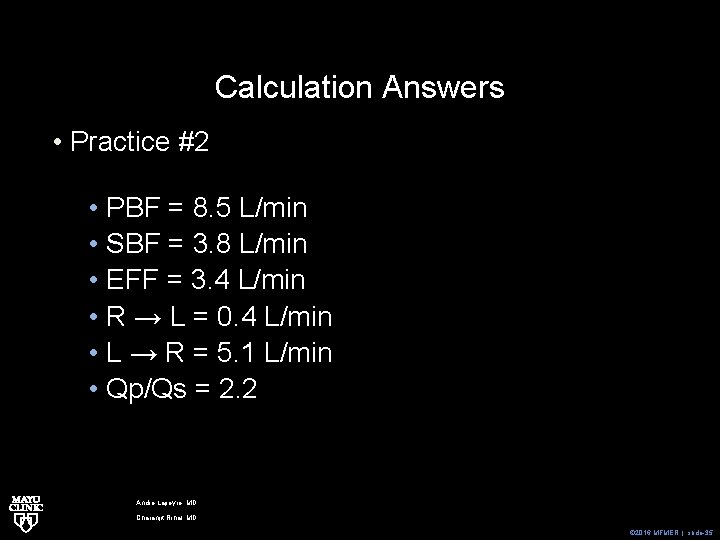
Calculation Answers • Practice #2 • PBF = 8. 5 L/min • SBF = 3. 8 L/min • EFF = 3. 4 L/min • R → L = 0. 4 L/min • L → R = 5. 1 L/min • Qp/Qs = 2. 2 Andre Lapeyre, MD Charanjit Rihal, MD © 2016 MFMER | slide-35
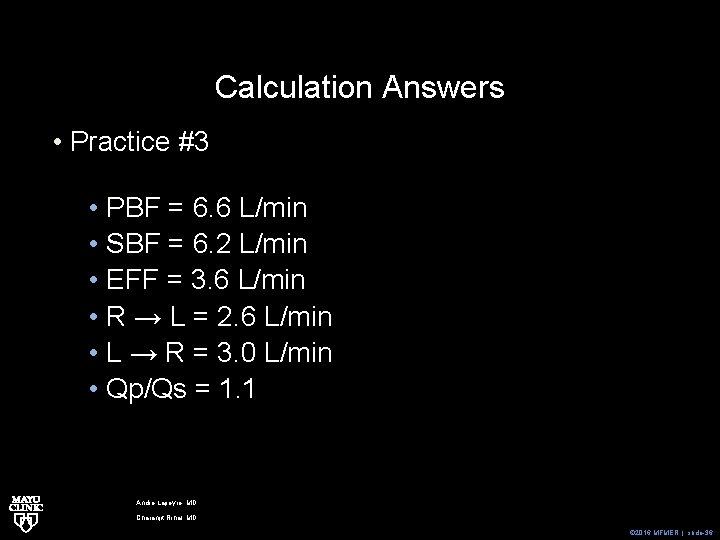
Calculation Answers • Practice #3 • PBF = 6. 6 L/min • SBF = 6. 2 L/min • EFF = 3. 6 L/min • R → L = 2. 6 L/min • L → R = 3. 0 L/min • Qp/Qs = 1. 1 Andre Lapeyre, MD Charanjit Rihal, MD © 2016 MFMER | slide-36