
Intracanal medicaments Lec 10 Function of Intracanal medicaments

- Slides: 19
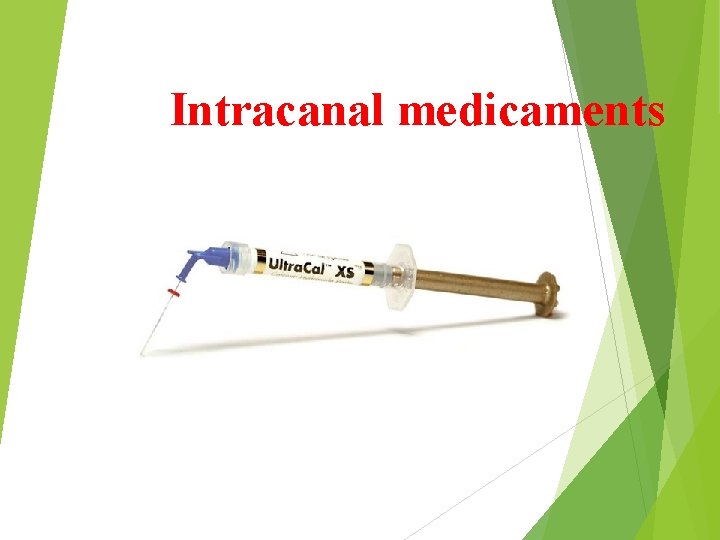
Intracanal medicaments Lec : 10
Function of Intracanal medicaments q. They disinfect the root canal system. q. To reduce the number of microorganism and prevent the growth of ny new microorganism. q. Rendering contents of canal inert. q. Prevention or control of post treatment plan. q. Control of persistent periapical abscess in weeping canal.
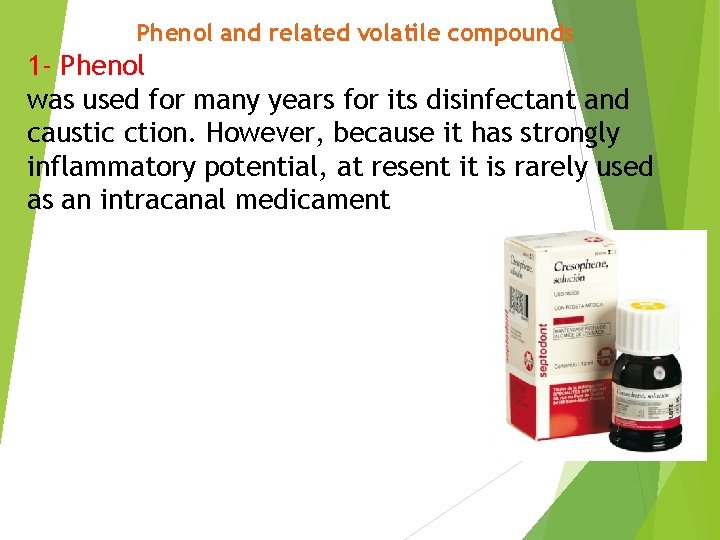
Phenol and related volatile compounds 1 - Phenol was used for many years for its disinfectant and caustic ction. However, because it has strongly inflammatory potential, at resent it is rarely used as an intracanal medicament
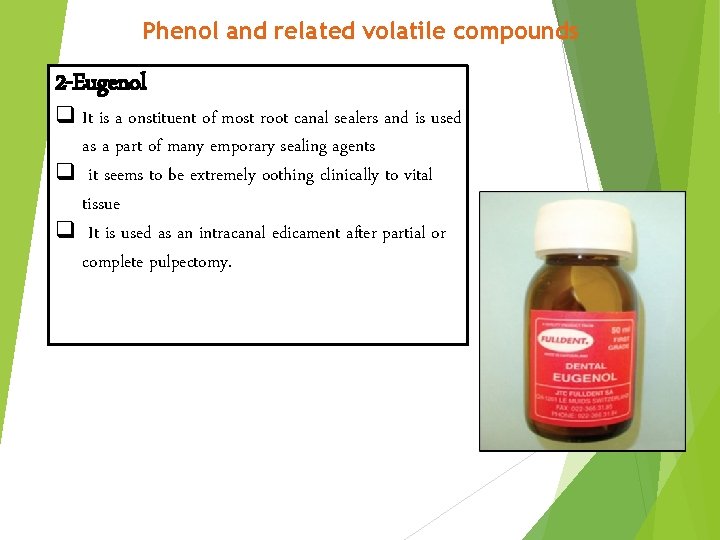
Phenol and related volatile compounds 2 -Eugenol q It is a onstituent of most root canal sealers and is used as a part of many emporary sealing agents q it seems to be extremely oothing clinically to vital tissue q It is used as an intracanal edicament after partial or complete pulpectomy.
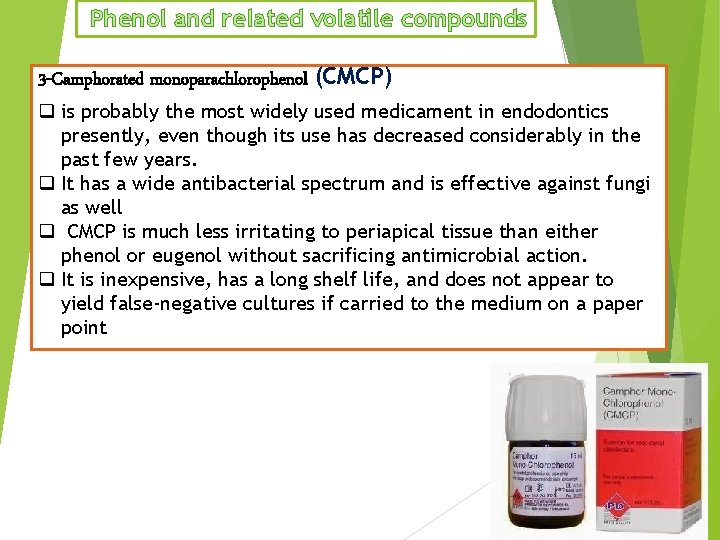
Phenol and related volatile compounds 3 -Camphorated monoparachlorophenol (CMCP) q is probably the most widely used medicament in endodontics presently, even though its use has decreased considerably in the past few years. q It has a wide antibacterial spectrum and is effective against fungi as well q CMCP is much less irritating to periapical tissue than either phenol or eugenol without sacrificing antimicrobial action. q It is inexpensive, has a long shelf life, and does not appear to yield false-negative cultures if carried to the medium on a paper point
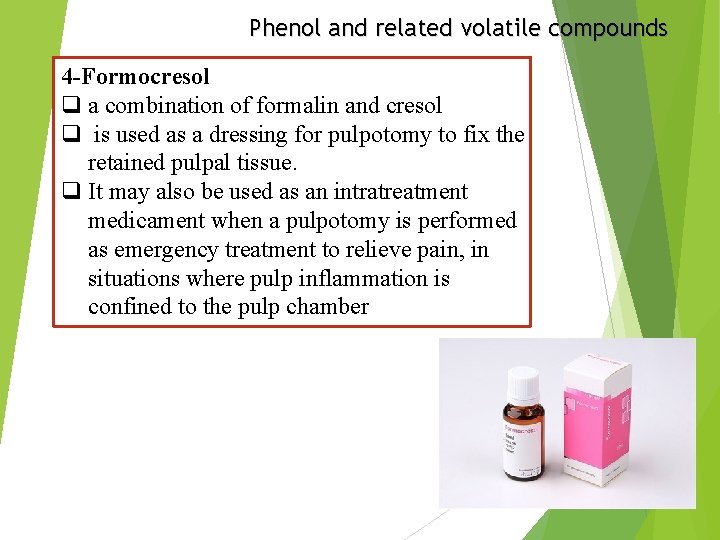
Phenol and related volatile compounds 4 -Formocresol q a combination of formalin and cresol q is used as a dressing for pulpotomy to fix the retained pulpal tissue. q It may also be used as an intratreatment medicament when a pulpotomy is performed as emergency treatment to relieve pain, in situations where pulp inflammation is confined to the pulp chamber
Intracanal medicaments PBSC Penicillin: Effective against gram-positive microorganisms. Bacitracin: Effective against penicillin-resistant microorganisms. Streptomycin: Effective against the gram-negative microorganisms. Caprylate: As the sodium salt, effective against fungi. Nystatin replaces sodium caprylate as the antifungal agent in a similar medicament, PBSN. Both are available in a paste form that may be injected into root canals or impregnated on paper points
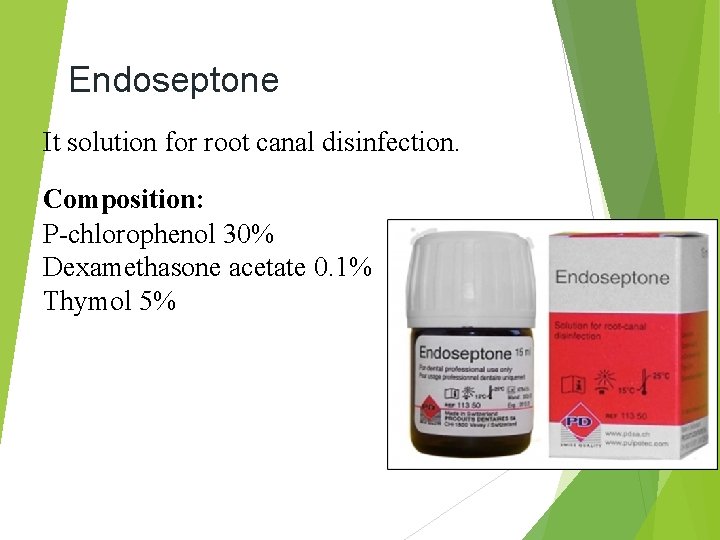
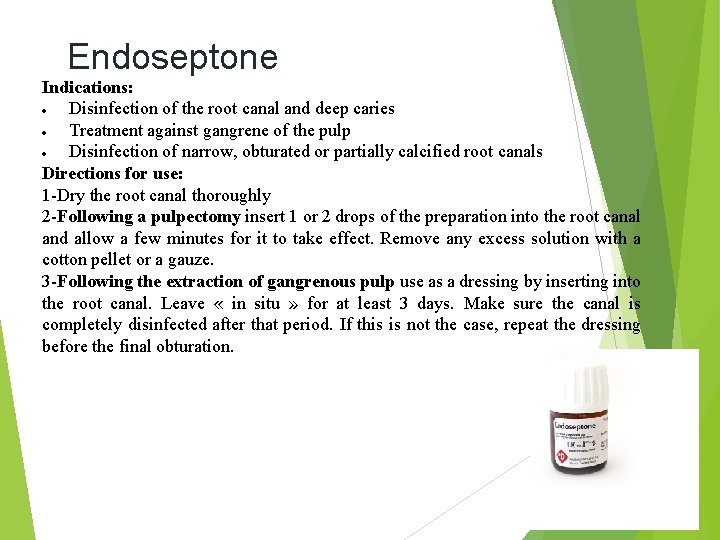
Endoseptone It solution for root canal disinfection. Composition: P-chlorophenol 30% Dexamethasone acetate 0. 1% Thymol 5% PHENOL AND RELATED VOLATILE COMPOUNDS
Endoseptone Indications: Disinfection of the root canal and deep caries Treatment against gangrene of the pulp Disinfection of narrow, obturated or partially calcified root canals Directions for use: 1 -Dry the root canal thoroughly 2 -Following a pulpectomy insert 1 or 2 drops of the preparation into the root canal and allow a few minutes for it to take effect. Remove any excess solution with a cotton pellet or a gauze. 3 -Following the extraction of gangrenous pulp use as a dressing by inserting into the root canal. Leave « in situ » for at least 3 days. Make sure the canal is completely disinfected after that period. If this is not the case, repeat the dressing before the final obturation.
Intracanal medicaments Sulfonamides q Sulfanilamide and sulfathiazole are used as medicaments by mixing with sterile distilled water or by placing a moistened paper point into a fluffed jar containing the powder. q Yellowish tooth discoloration has been reported after use. The medication is suggested for use when closing teeth that had been left open after an acute periapical abscess.
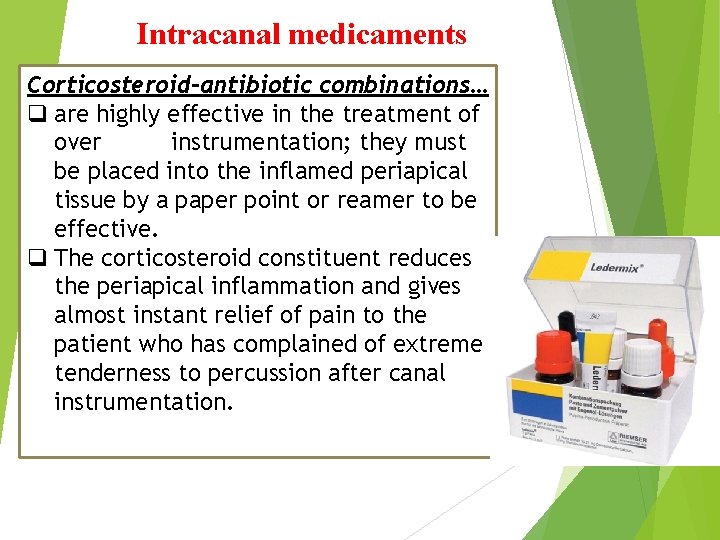
Intracanal medicaments Corticosteroid-antibiotic combinations… q are highly effective in the treatment of over instrumentation; they must be placed into the inflamed periapical tissue by a paper point or reamer to be effective. q The corticosteroid constituent reduces the periapical inflammation and gives almost instant relief of pain to the patient who has complained of extreme tenderness to percussion after canal instrumentation.
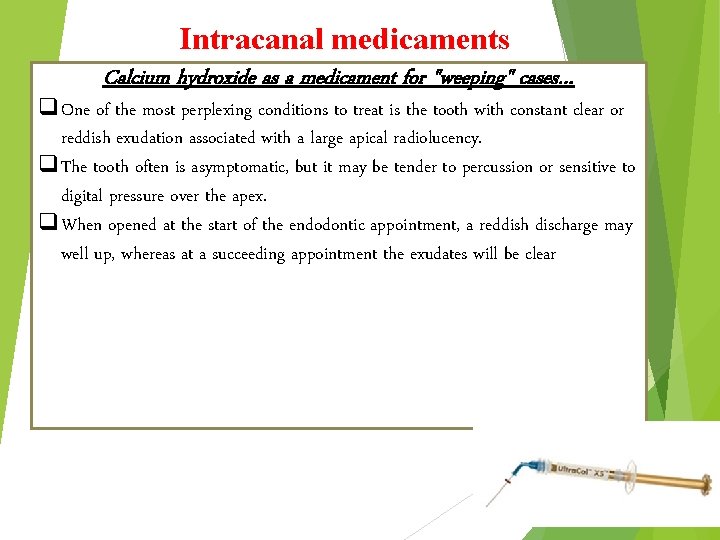
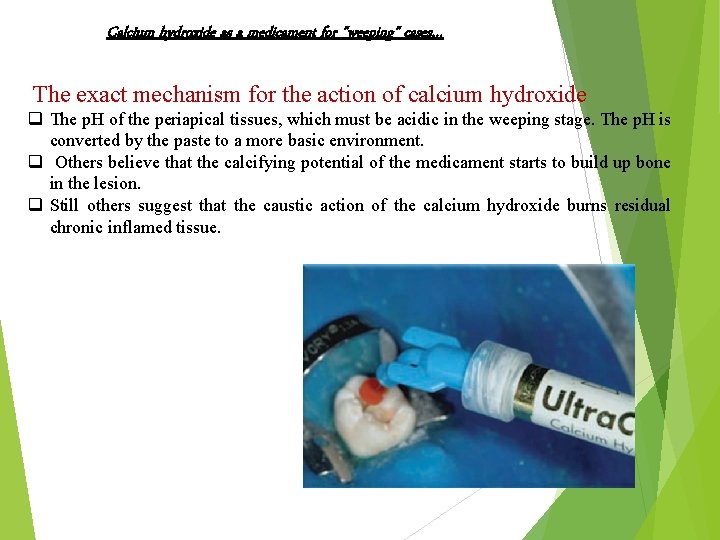
Intracanal medicaments Calcium hydroxide as a medicament for "weeping" cases… q. One of the most perplexing conditions to treat is the tooth with constant clear or reddish exudation associated with a large apical radiolucency. q. The tooth often is asymptomatic, but it may be tender to percussion or sensitive to digital pressure over the apex. q. When opened at the start of the endodontic appointment, a reddish discharge may well up, whereas at a succeeding appointment the exudates will be clear
Calcium hydroxide as a medicament for "weeping" cases… The exact mechanism for the action of calcium hydroxide q The p. H of the periapical tissues, which must be acidic in the weeping stage. The p. H is converted by the paste to a more basic environment. q Others believe that the calcifying potential of the medicament starts to build up bone in the lesion. q Still others suggest that the caustic action of the calcium hydroxide burns residual chronic inflamed tissue.
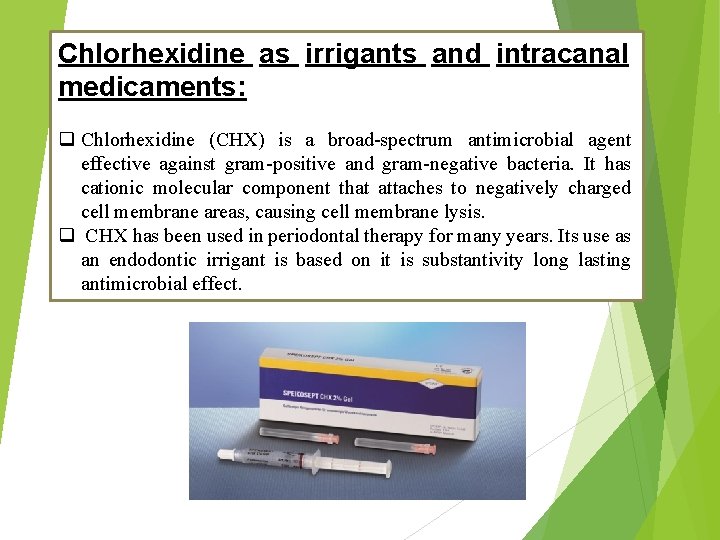
Chlorhexidine as irrigants and intracanal medicaments: q Chlorhexidine (CHX) is a broad-spectrum antimicrobial agent effective against gram-positive and gram-negative bacteria. It has cationic molecular component that attaches to negatively charged cell membrane areas, causing cell membrane lysis. q CHX has been used in periodontal therapy for many years. Its use as an endodontic irrigant is based on it is substantivity long lasting antimicrobial effect.
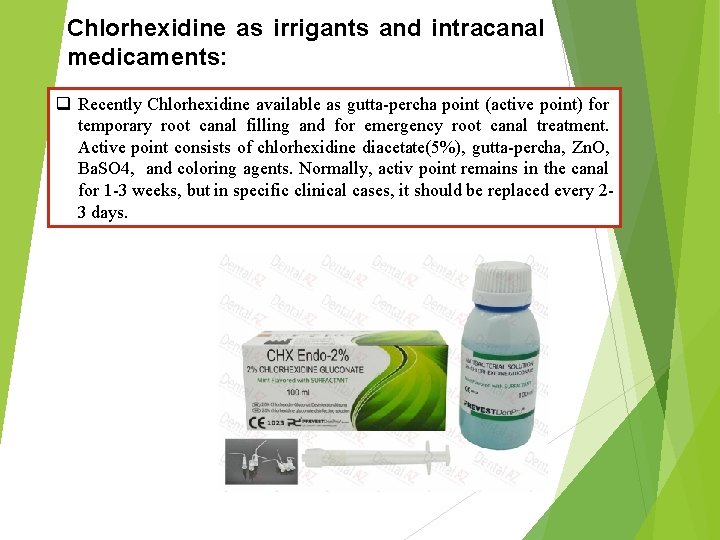
Chlorhexidine as irrigants and intracanal medicaments: q Recently Chlorhexidine available as gutta-percha point (active point) for temporary root canal filling and for emergency root canal treatment. Active point consists of chlorhexidine diacetate(5%), gutta-percha, Zn. O, Ba. SO 4, and coloring agents. Normally, activ point remains in the canal for 1 -3 weeks, but in specific clinical cases, it should be replaced every 23 days.
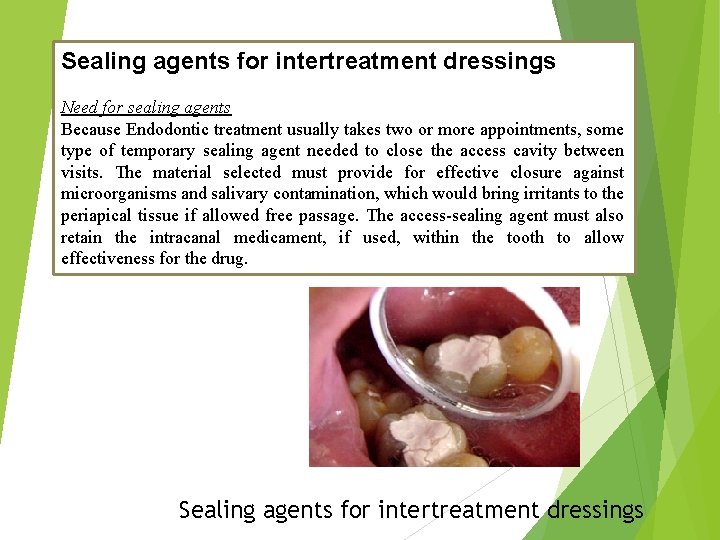
Sealing agents for intertreatment dressings Need for sealing agents Because Endodontic treatment usually takes two or more appointments, some type of temporary sealing agent needed to close the access cavity between visits. The material selected must provide for effective closure against microorganisms and salivary contamination, which would bring irritants to the periapical tissue if allowed free passage. The access-sealing agent must also retain the intracanal medicament, if used, within the tooth to allow effectiveness for the drug. Sealing agents for intertreatment dressings
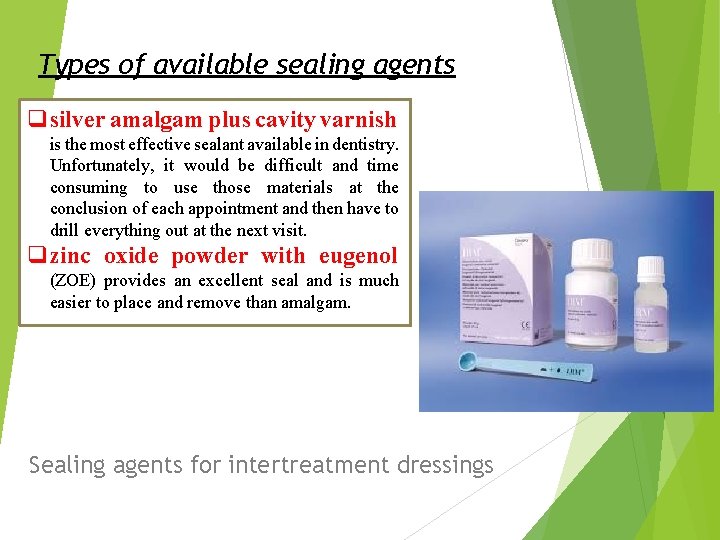
Types of available sealing agents qsilver amalgam plus cavity varnish is the most effective sealant available in dentistry. Unfortunately, it would be difficult and time consuming to use those materials at the conclusion of each appointment and then have to drill everything out at the next visit. qzinc oxide powder with eugenol (ZOE) provides an excellent seal and is much easier to place and remove than amalgam. Sealing agents for intertreatment dressings
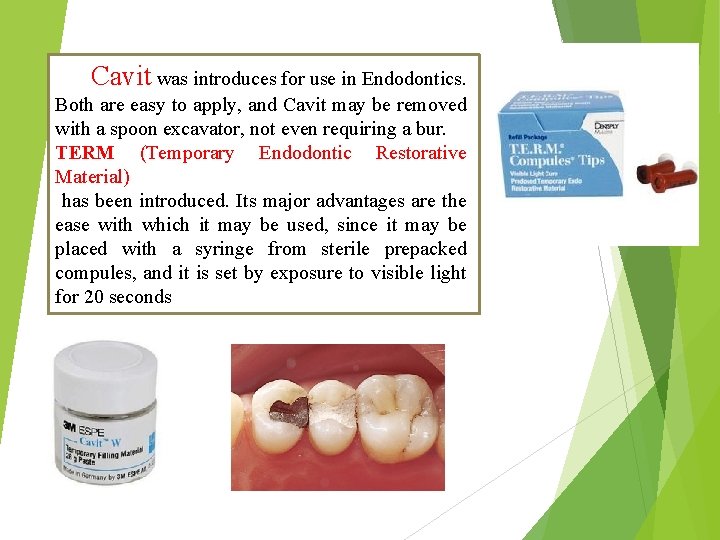
Cavit was introduces for use in Endodontics. Both are easy to apply, and Cavit may be removed with a spoon excavator, not even requiring a bur. TERM (Temporary Endodontic Restorative Material) has been introduced. Its major advantages are the ease with which it may be used, since it may be placed with a syringe from sterile prepacked compules, and it is set by exposure to visible light for 20 seconds